Best AI Visibility Optimization Tool for 2026: 5 Compared
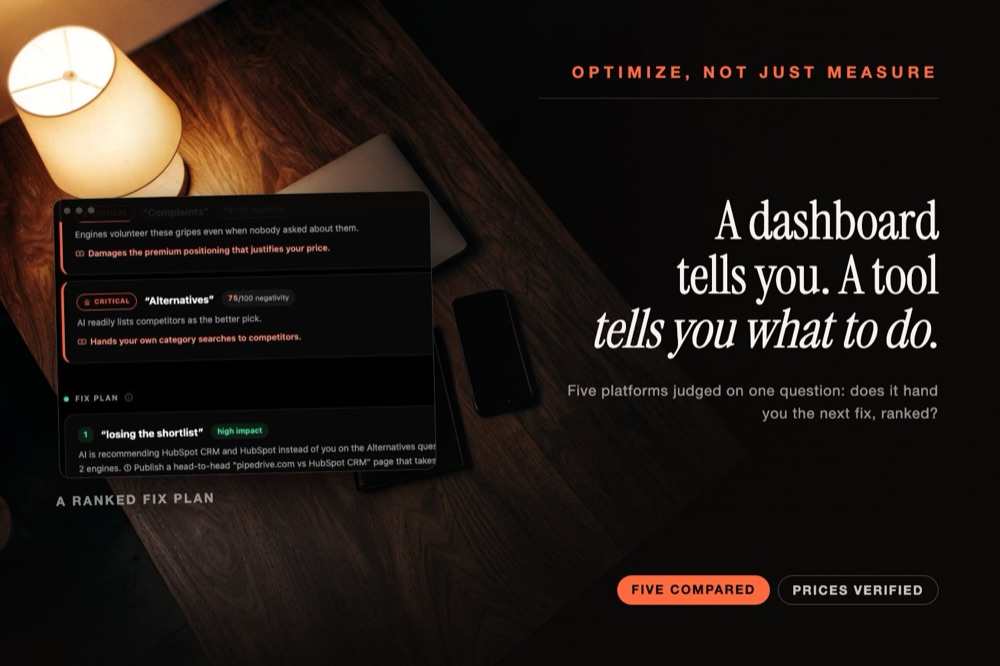
Short version: an AI visibility optimization tool turns "ChatGPT never mentions us" into an ordered list of changes — this page to rewrite, that roundup to get listed in, this schema block to fix, that review thread to answer. A monitoring dashboard stops at the diagnosis and hands you a chart.
Most products sold as AI search optimization tools are measurement with an optimization label stapled on. This piece reviews five that genuinely reach into the second half of the job, prices each one against what its own site says today (5 August 2026), then maps the rest of the market by the job it actually does.
How Does an AI Visibility Optimization Tool Differ From a Monitoring Dashboard?
Monitoring answers one question: are we in the answer? Optimization answers a harder one: what do we change so that we are, and did the change work?
Three checks separate them. When an engine says something wrong about you, does the product name the exact URL that answer leaned on? Does it rank the resulting work by expected impact instead of dumping a generic checklist? Can you re-run the identical prompt set after shipping a fix and read the delta per engine?
An AI visibility optimization tool clears all three. A tracker clears none — which is still a legitimate purchase, and we published a roundup of LLM visibility tools organized by company size for exactly that job. Treat this post as the layer sitting on top of it.
Why the distinction matters comes down to where citations originate. Peec AI's study of roughly 200,000 AI responses across eight engines, published 30 July 2026, found that holding rank #1 inside a cited listicle lifted brand visibility by 16.5 percentage points in B2B SaaS and 13.4 points in emerging martech. No dashboard pulls that lever for you. It is an editorial and outreach job, and a tool earns its price by handing it over as a ranked task rather than a chart.
Which AI Visibility Optimization Tools Are Worth Paying For in 2026?
1. Kairosy — the scan that ends in a Fix Plan
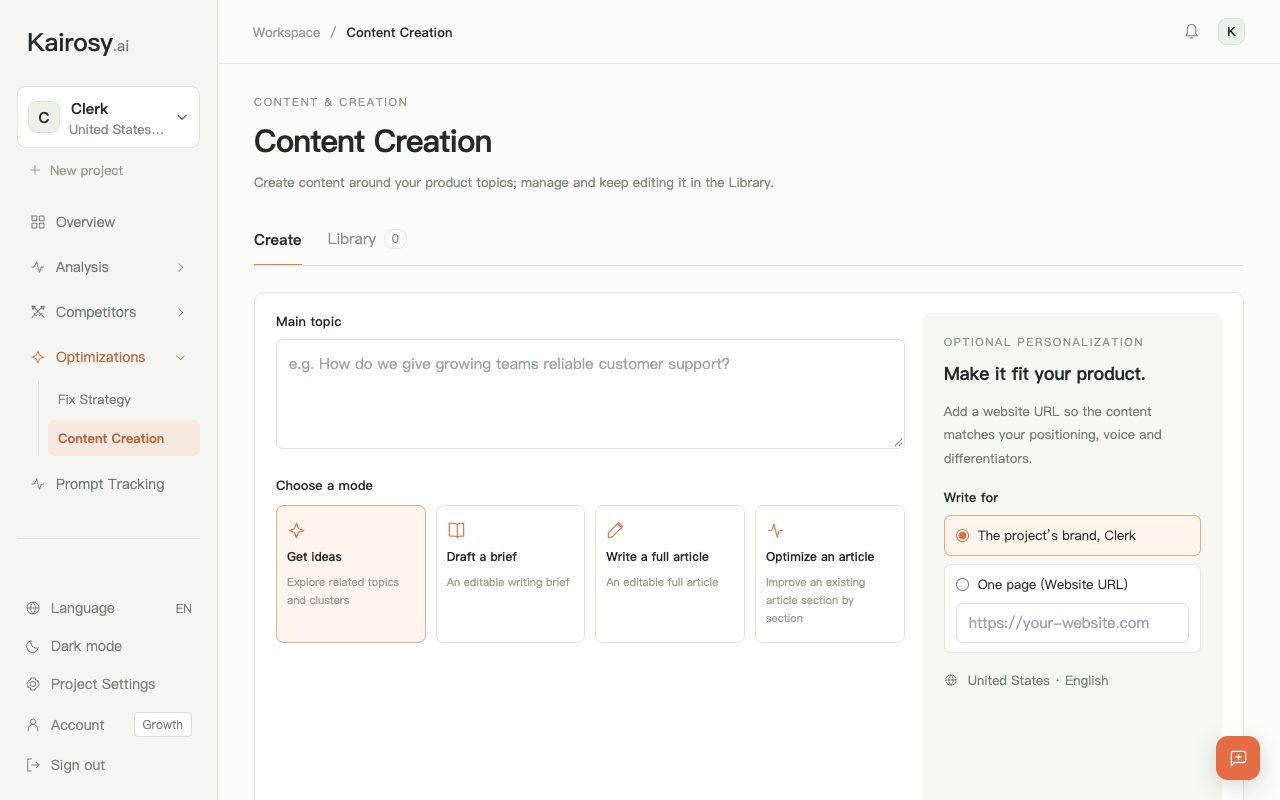
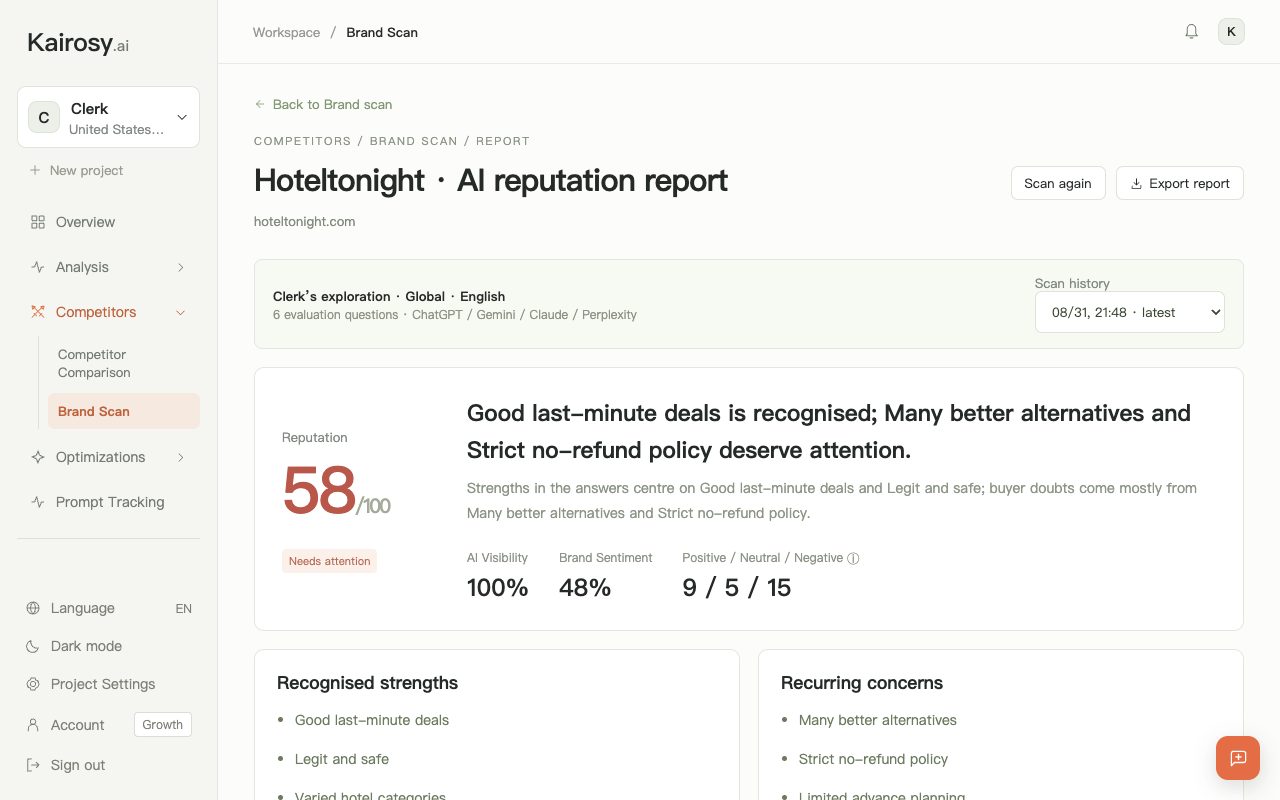
Kairosy puts a set of real buyer questions to ChatGPT, Gemini, Claude and Perplexity, classifies every answer as positive, neutral, negative, competitor-preferred or absent, records the URLs each engine cited, and closes with a prioritized Fix Plan. That last step is why it sits in an optimization roundup rather than a tracking one.
A worked example from the public library: Kairosy's scan of Anyword (24 buyer questions, 1 August 2026) returned 50/100 and a "Vulnerable" verdict — 83% visibility but only 40% favorability, with Claude scoring the brand 44 and ChatGPT 58. High presence, poor framing, and the per-engine split tells you which model to work on first.
Pricing: a new account gets a free 7-day trial. Paid plans are $29 Basic, $99 Pro and $399 Growth per month, adding weekly rescans per brand and market with email alerts, daily prompt tracking, and market-specific scans across 25 countries. See AI reputation management and AI brand monitoring for how the measure and fix halves connect.
Be clear about the limits. Kairosy is not a rank tracker, carries no keyword or backlink database, and is not a content editor. As an AI visibility optimization tool it tells you which source to fix and in what order; your writers still write.
2. Profound — the enterprise AI visibility platform
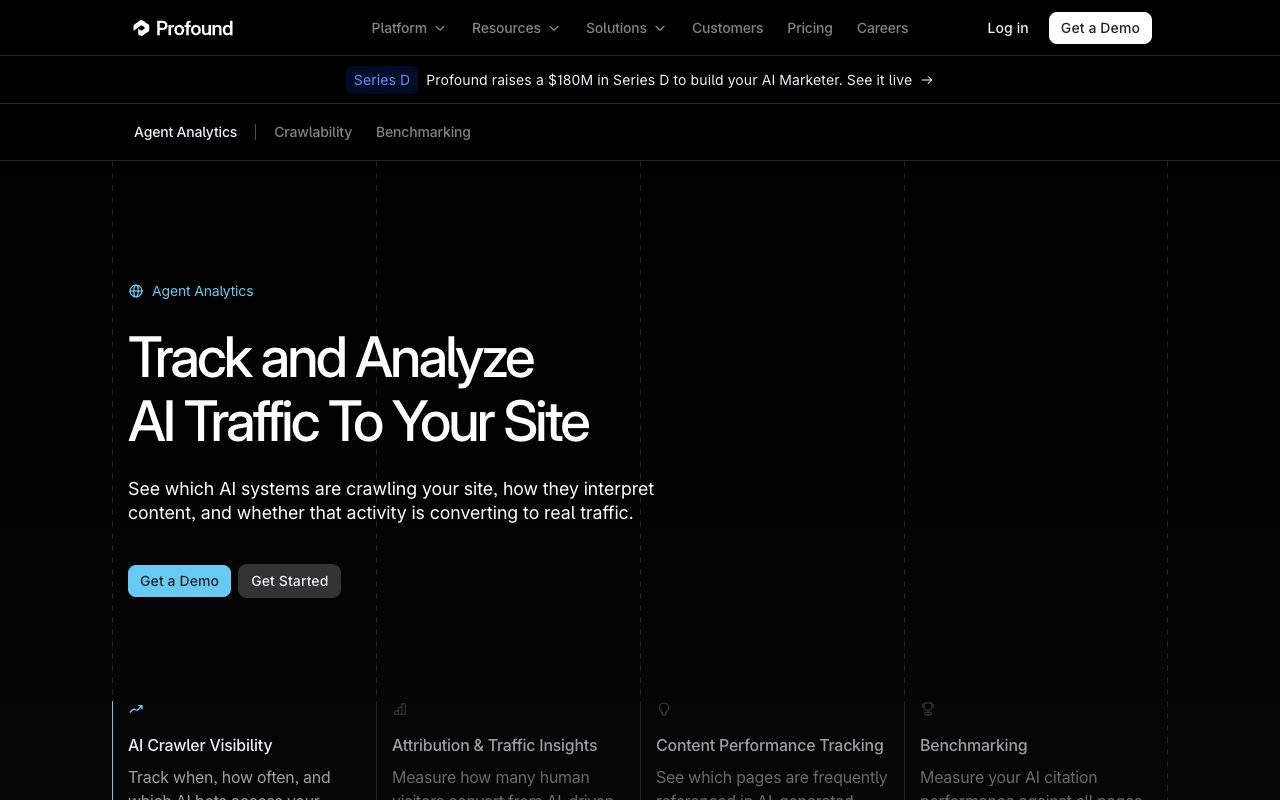
Profound is the heaviest product here. Its pricing page (checked September 24, 2026) no longer lists self-serve tiers for brands: a free Trial runs 50 prompts daily for 7 days on ChatGPT, Gemini and Google AI Overviews, and everything beyond it is a custom Enterprise contract covering up to 9 engines with SSO/SAML. Agencies get a separate Agency Growth plan at $99/month plus $399/month per client workspace, and Vendr's anonymized buyer data (a third-party source) puts the median contract at $34,500 a year. Coverage spans Perplexity, ChatGPT, Claude, Gemini, Grok, Microsoft Copilot, DeepSeek and Google AI Overviews.
Its optimization surface is Prompt Volumes and Agent Analytics: which conversations exist at what scale, and how AI agents crawl your site. Genuinely actionable, but it assumes a team with capacity to act. Check the live Profound pricing page before budgeting — its plan structure has already changed during 2026.
3. Otterly.ai — cheapest entry that ships briefs
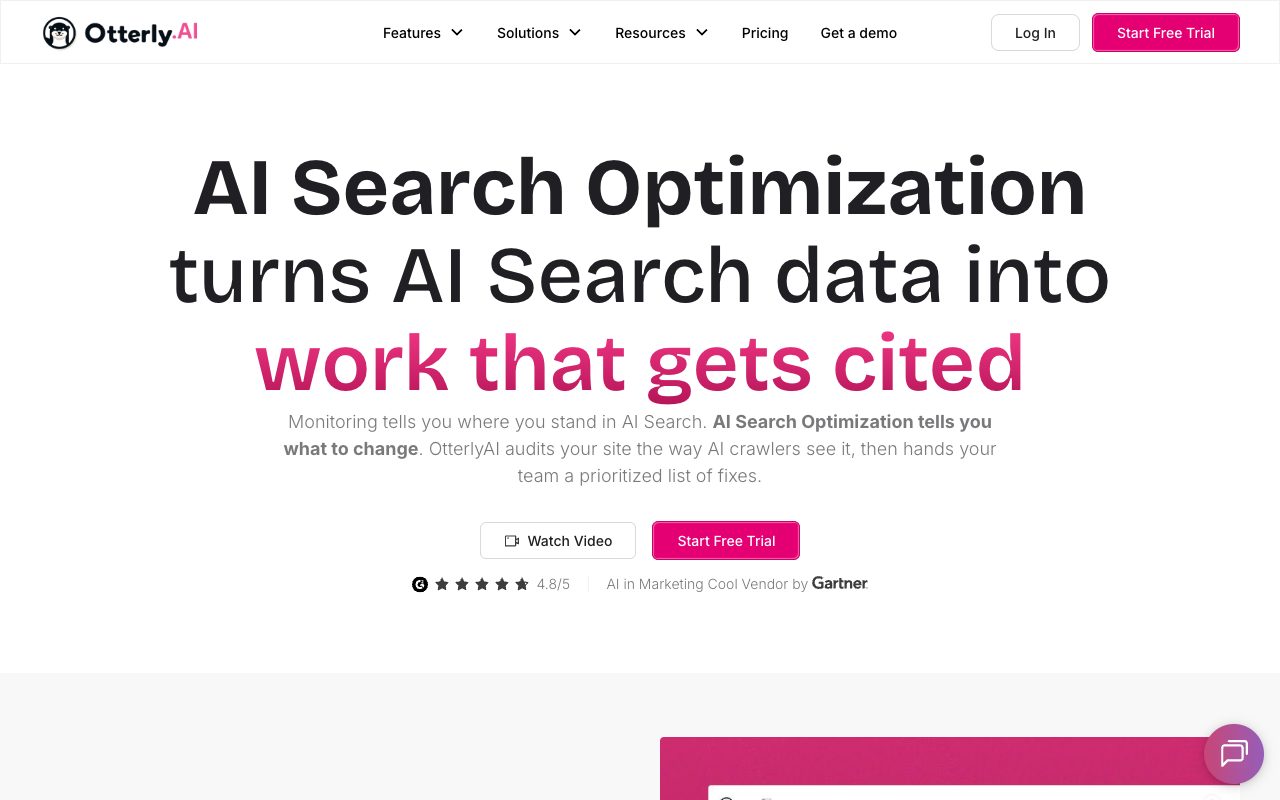
Otterly.ai publishes real numbers, which is rare in this category. Lite is $29/month for 15 search prompts, Standard $189 for 100, Premium $489 for 400, with an Enterprise tier and 15% off annual billing. Base engines are ChatGPT, Google AI Overviews, Perplexity and Microsoft Copilot; Claude, Gemini and Google AI Mode are add-ons. GEO URL audits run 1,000 / 5,000 / 10,000 per month by tier, and every plan tracks daily.
What makes it an AI visibility analysis tool rather than a pure monitor: content audits with a predictive citation score before you publish, plus content briefs and on-page recommendations. Details are on the Otterly.ai pricing page. It advertises a free trial without publishing the length.
4. Semrush AI Visibility Toolkit — if your team already lives in Semrush
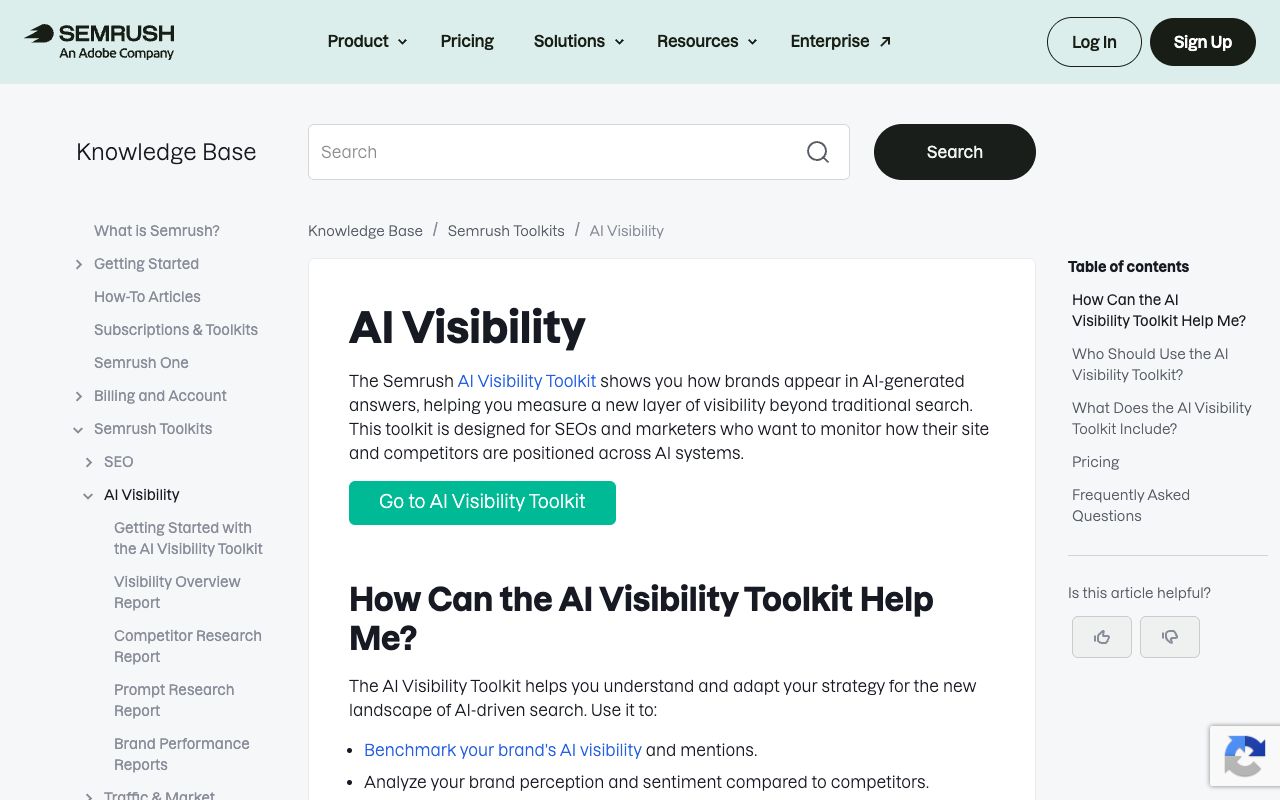
Semrush sells this as a $99/month add-on per domain. The base subscription includes 25 tracked prompts, 300 daily queries in AI Analysis reports, 1,000 daily queries in Prompt Research, 10 CSV exports a day, and AI Search checks for up to 100 pages, per the Semrush knowledge base article. Semrush One bundles raise prompt tracking to 100 on Pro+ and 200 on Advanced.
Six reports ship inside it: Visibility Overview with an AI Visibility Score, Competitor Research, Prompt Research, Brand Performance (share of voice, sentiment, narratives), Prompt Tracking and an AI Search Site Audit. That last one is the real optimization module — it checks whether AI crawlers can reach and parse your pages, which is where plenty of invisibility actually starts.
5. Surfer — tracking wired straight into a writing tool
Surfer works the content end. Its AI Tracker covers ChatGPT, Gemini, Google AI Overviews, Google AI Mode and Perplexity — visibility score, competitor benchmarks, sentiment, topic gaps and source attribution — then routes the gaps into Content Editor to write the missing article.
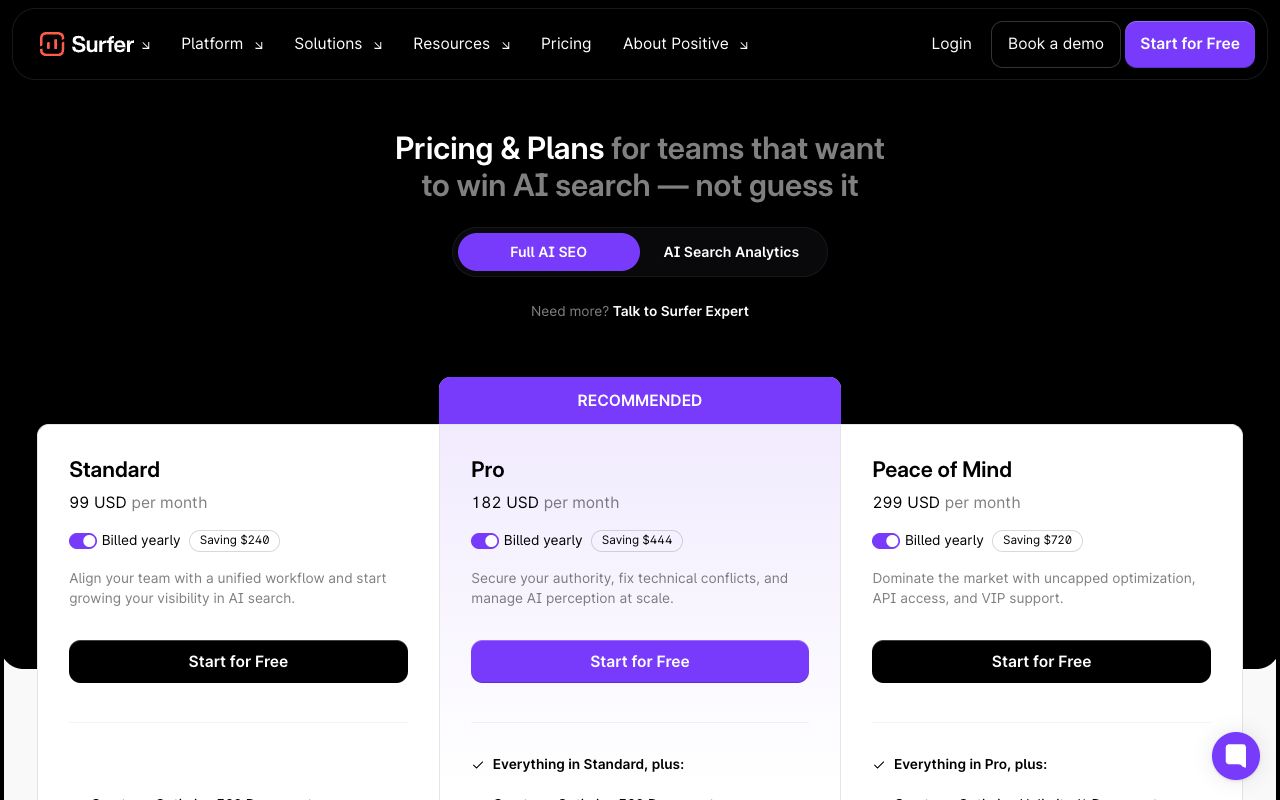
Billed yearly, plans are Discovery $49, Standard $99, Pro $182 and Peace of Mind $299 per month, with document limits of 120 / 360 / 360 / unlimited; AI Search Analytics is also sold standalone at $158/month for 100 prompts, per the Surfer pricing page. Buy it when your bottleneck is producing pages, not diagnosing why AI skips you.
AI Visibility Optimization Tools Compared: Pricing and What Each One Changes
A useful AI brand visibility optimization tool should be judged on its output, not its chart count. Read the last column first: it is the only one that separates an AI visibility optimization tool from a reporting layer. Prices below were taken from each vendor's own site on 5 August 2026 and are the entry tier.
| Tool | Entry price | Engines at entry tier | Optimization output |
|---|---|---|---|
| Kairosy | Free 7-day trial; $29 Basic | ChatGPT, Gemini, Claude, Perplexity | Prioritized Fix Plan plus cited source URLs per answer |
| Profound | Free 7-day trial; Enterprise custom | 3 on the Trial; up to 9 on Enterprise | Prompt Volumes and Agent Analytics |
| Otterly.ai | $29/mo Lite, 15 prompts | ChatGPT, AI Overviews, Perplexity, Copilot | Content briefs plus predictive citation score |
| Semrush AI Visibility Toolkit | $99/mo per domain add-on | Multiple, incl. Google AI Mode and ChatGPT | AI Search Site Audit and Prompt Research |
| Surfer | $49/mo Discovery (billed yearly) | ChatGPT, Gemini, AI Overviews, AI Mode, Perplexity | Content Editor briefs from tracked gaps |
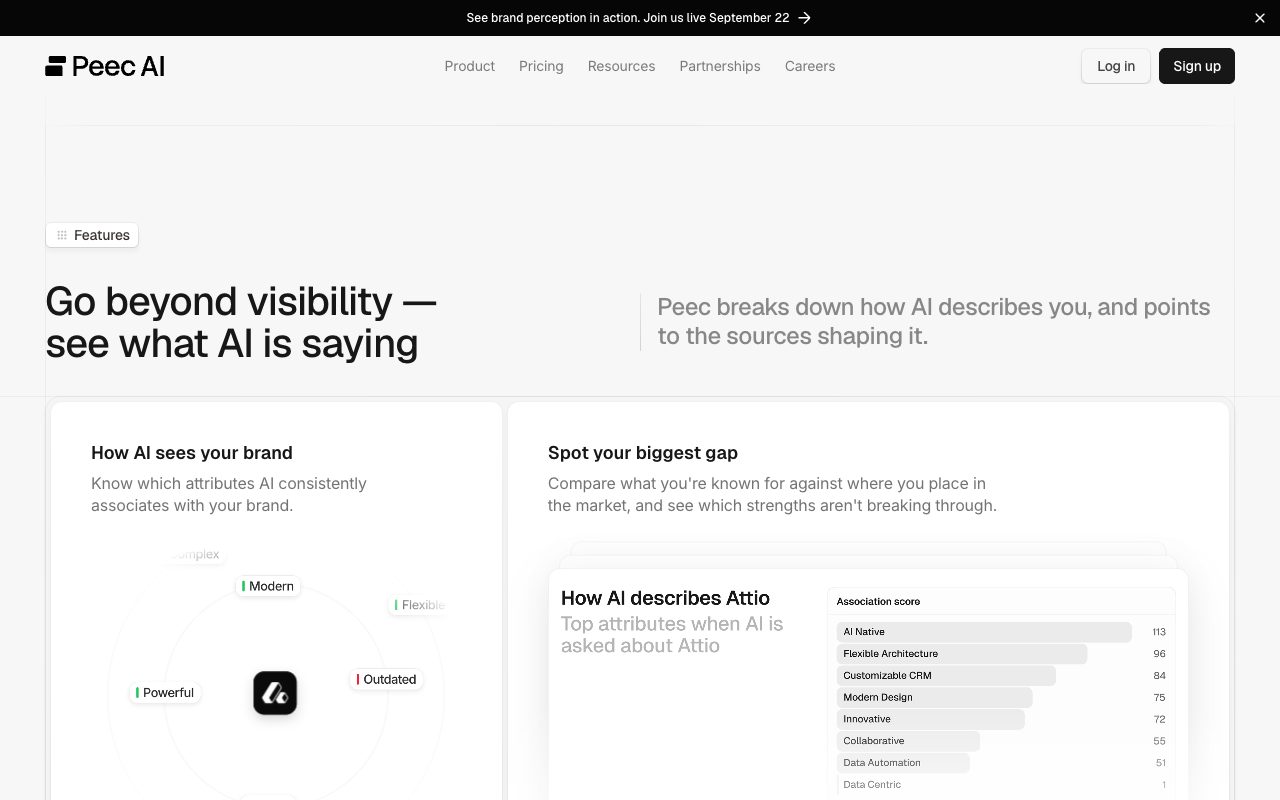
| Peec AI | Free trial; four tiers | Choice of 3 models per plan | Suggested prompt opportunities and source lists |
One honesty note on that last row: Peec AI's pricing page lists Starter, Pro, Advanced and Enterprise, with 1, 2 and 5 projects on the three self-serve tiers, three chosen models per plan, up to three countries per project and daily tracking throughout. The price figures render client-side and did not load for us, so read them off the live Peec AI pricing page rather than trusting a secondhand number.
What Other AI Search Optimization Tools Exist?
Outside the five above, AI search optimization tools cluster into three jobs. Most teams end up owning one from each.
AI reputation optimization tools
The job here is changing what a model says by changing the sources it reads. Kairosy's Fix Plan is one instance; classic listening suites now overlap too. Brand24 lists Individual at $249/month, Team $349, Pro $499, Business $699 and Enterprise from $1,499 with a 14-day trial, and ships AI Sentiment Analysis, an AI Brand Assistant and an AI Visibility module — see the Brand24 pricing page. When a specific answer is actively hostile, our walkthrough on how to fix negative AI mentions covers the source-by-source playbook.
AI sentiment optimization tools
These answer "how are we described", not "are we mentioned". Semrush's Brand Performance reports, Surfer's sentiment view, Peec AI's competitor sentiment tracking and Kairosy's per-answer classification all live here. The metric to watch is the gap between visibility and favorability — Anyword's 83% versus 40% above is a textbook sentiment problem, not a presence problem, and the fix is different in kind.
AI content and technical optimization tools
Frase sits on the content side: Starter $39/month billed yearly ($49 monthly), Professional $103 ($129), Scale $239 ($299), plus Enterprise, with 10 / 40 / 100 articles and 50 / 250 / 1,000 audit pages per tier and a 7-day free trial on its pricing page. On the technical side you can start free: our schema markup checker, llms.txt generator and AI crawler checker cover the three things that silently block citation.
Two reality checks before you spend here. SE Ranking's 300,000-domain study, published 7 November 2025, found only 10.13% of domains carry an llms.txt file and no correlation between having one and being cited — generate it, but do not book it as a win. And Google's own AI features documentation states plainly that "there are no additional requirements to appear in AI Overviews or AI Mode" and "you don't need to create new machine readable files, AI text files, or markup". Structured data still has to match your visible content, which is what a schema checker is for.
How Do You Turn an AI Visibility Report Into a Real Optimization?
Buying an AI visibility optimization tool does nothing on its own. The loop that works looks like this.
- Choose 20 to 30 buyer questions you would genuinely want to win. Two hundred prompts produce noise, not priorities.
- Baseline every engine at once and store the cited URL behind each answer.
- Sort the bad answers by source type — your own page, a review site, a category roundup, a forum thread.
- Fix the source rather than the symptom. A roundup you rank low in is an outreach job. A weak product page is a rewrite plus schema. A hostile review thread needs a public reply.
- Re-run the identical prompt set two to four weeks later and read the per-engine delta. Same questions, same markets, or the comparison is meaningless.
Cadence matters less than consistency. Weekly rescans are plenty for brand-level questions; daily tracking earns its keep only at the individual prompt level, where a single source change can flip an answer inside a week.
FAQs About AI Search Optimization Tools
What are AI search optimization tools?
They are products that measure how generative engines describe your brand and then help you change it. The measurement half tracks mentions, position, sentiment and citations across ChatGPT, Gemini, Claude, Perplexity and Google AI surfaces. The optimization half turns those findings into content briefs, technical fixes or outreach targets.
Of the AI visibility optimization tools which is the best for a small team?
For a team under ten people, start where the entry price is real and the output is a task list: Kairosy's free monthly report or $29 Basic tier, or Otterly.ai's $29 Lite plan. Both give you something to act on in an afternoon. Profound and Semrush make more sense once someone owns AI visibility as a named job.
What does an AI visibility optimization tool cost in 2026?
Entry tiers cluster at $29 to $99 per month, mid-tier at roughly $99 to $250, and enterprise coverage at $399 and up before custom quotes. Verified examples on 5 August 2026: Otterly.ai $29, Kairosy $29, Surfer $49 billed yearly, Semrush's toolkit $99 per domain. Profound, listed at $99 then, has since withdrawn its self-serve brand tiers and now sells brands only custom Enterprise contracts.
Can an AI visibility analysis tool prove it changed anything?
Only if it re-runs the same prompts under the same conditions and shows you before and after per engine. Ask any vendor how it handles prompt drift and market differences. Without a frozen prompt set, month-over-month "improvements" are mostly model randomness.
Do I need an AI visibility platform if I already pay for Semrush or Ahrefs?
Not necessarily. If you already hold a Semrush seat, its $99 add-on is the cheapest route to an AI visibility platform inside a workflow your team knows. Add a dedicated tool when you need engines Semrush does not cover, per-answer sentiment on named competitors, or a fix list ranked by impact rather than a report to interpret yourself.
See what AI says about your brand
Run a free scan across ChatGPT, Gemini, Claude & Perplexity in about 30 seconds.
Run my free scan