Content Refresh Strategy Guide for 2026: 7 Steps With a Change Log

A content refresh is a substantive change to an existing page, made because the page stopped matching its readers, its search demand or the facts. This content refresh strategy guide walks through the whole loop in seven steps: choose the right action, find candidates, rank them by sign-up value, review each page, ship with a change log, assign owners and windows, and then compare before and after.
One boundary sits under every step. Editing the "last updated" line without changing what the page says is not a refresh. Google's own helpful content guidance lists it as a warning sign, asking site owners: "Are you changing the date of pages to make them seem fresh when the content has not substantially changed?" Treat that question as the entry test for everything below.
Should You Update, Rewrite, Merge or Retire a Page?
The first rule in any content refresh strategy guide is to pick the action before you open the editor. Defaulting to "update" leaves overlapping pages competing and dead pages alive.
- Update when the page still answers the right question and the structure holds, but facts, prices, screenshots or examples have aged.
- Rewrite when the URL is worth keeping but the search intent behind it has moved, for example a "what is" explainer now attracting comparison queries.
- Merge when two or more of your pages split the same intent and neither one is complete. Keep the stronger URL and 301 the rest into it.
- Retire when the topic no longer relates to your product, the page earns nothing, and no stronger page could absorb it. Redirect if a close match exists, otherwise let it return 404 or 410.
Before you merge or retire, check what links still point at the old URL. The Ahrefs link rot study (updated February 2024) found that at least 66.5% of links to sites over the previous nine years were dead, and careless deletions are part of how that happens. Run every planned redirect through the free redirect checker so you land on one hop, not a chain.
The decision table below is a template. The signals and thresholds are example values for you to tune, not measured benchmarks.
| Signal on the page (example values) | Update | Rewrite | Merge | Retire |
|---|---|---|---|---|
| Clicks down, average position steady, facts dated | Yes | |||
| Impressions up for queries the page never answers | Yes | |||
| Two URLs showing for the same query set | Yes | |||
| AI answers cite a competitor's version of your topic | Yes | If intent shifted | ||
| Zero key events in 12 months and off-product topic | If a close page exists | Yes | ||
| Product feature described was discontinued | If the topic still matters | Otherwise |
How Do You Find Refresh Candidates in GSC, GA4 and AI Answer Records?
Use three views, because each misses something: Search Console shows how Google sees the page, GA4 shows what visitors do, and AI answer records show whether assistants still mention or cite you.
Google Search Console: the decay and drift view
The Performance report gives clicks, impressions, CTR and average position, filterable by page and query. Pull the same metrics for two equal windows and sort pages by the largest click loss. Two patterns matter: clicks dropping while position holds (a SERP feature or AI answer is absorbing the click) and new queries showing impressions with no matching section on the page (intent drift, a rewrite candidate).
GA4: the business view
In GA4, open Reports, then Engagement, then Landing page. Google's help article lists its default columns as sessions, active users, new users, average engagement time per session, key events and total revenue. Mark your sign-up event as a key event first, or the report cannot tell you which pages actually produce sign-ups.
AI answer records: the citation view
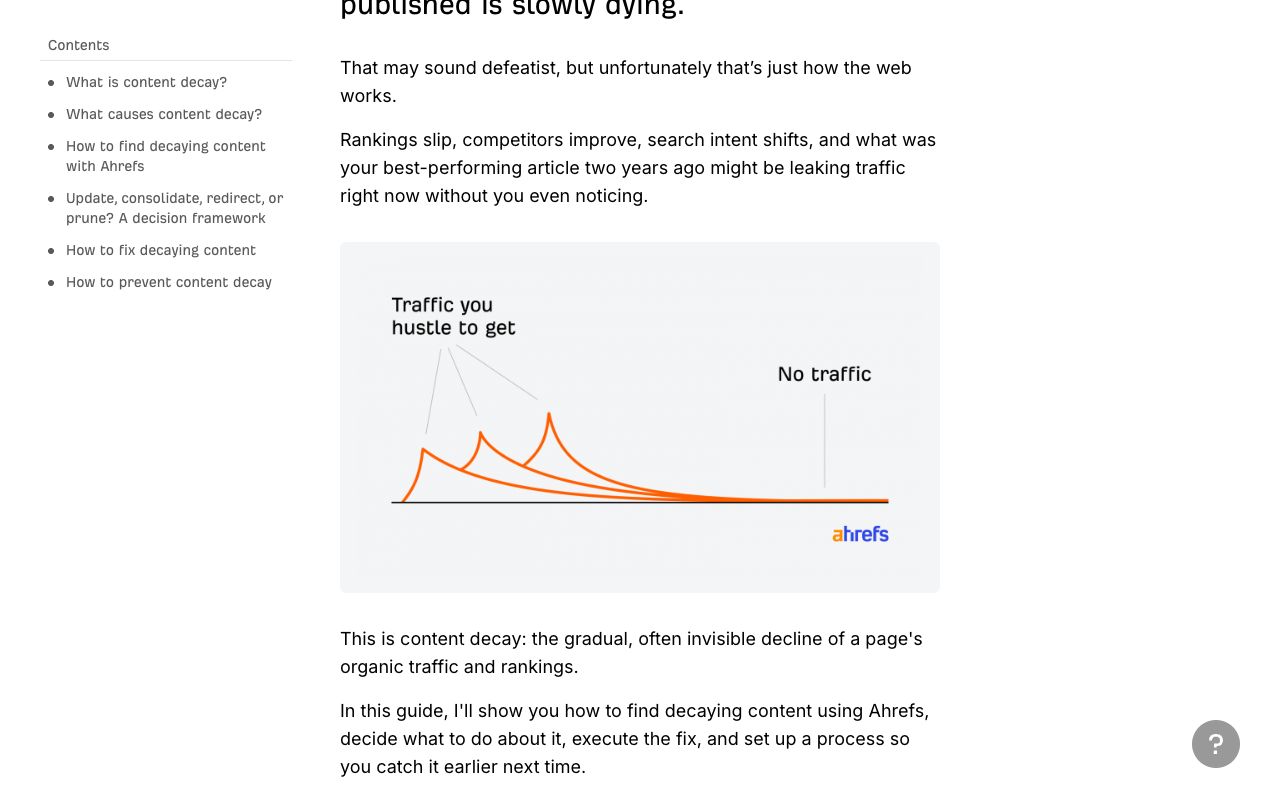
This is the input most teams lack. A page can hold its Google ranking and still drop out of the answers ChatGPT, Gemini, Claude or Perplexity give. Ahrefs' content decay explainer (Louise Linehan, March 13, 2026) cites Ahrefs research finding that URLs cited by AI assistants are 25.7% "fresher" than organic search results. That is the core of content refresh AI work: the answers themselves become a candidate list.
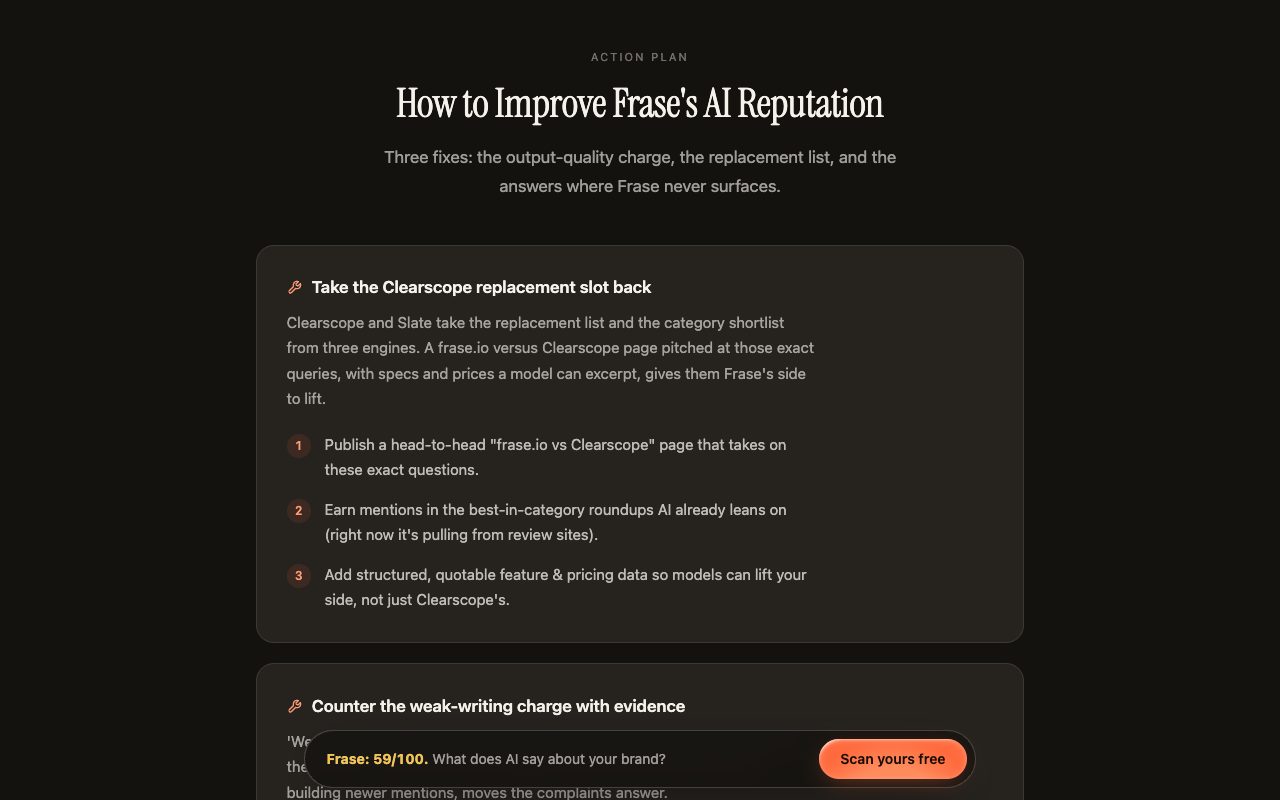
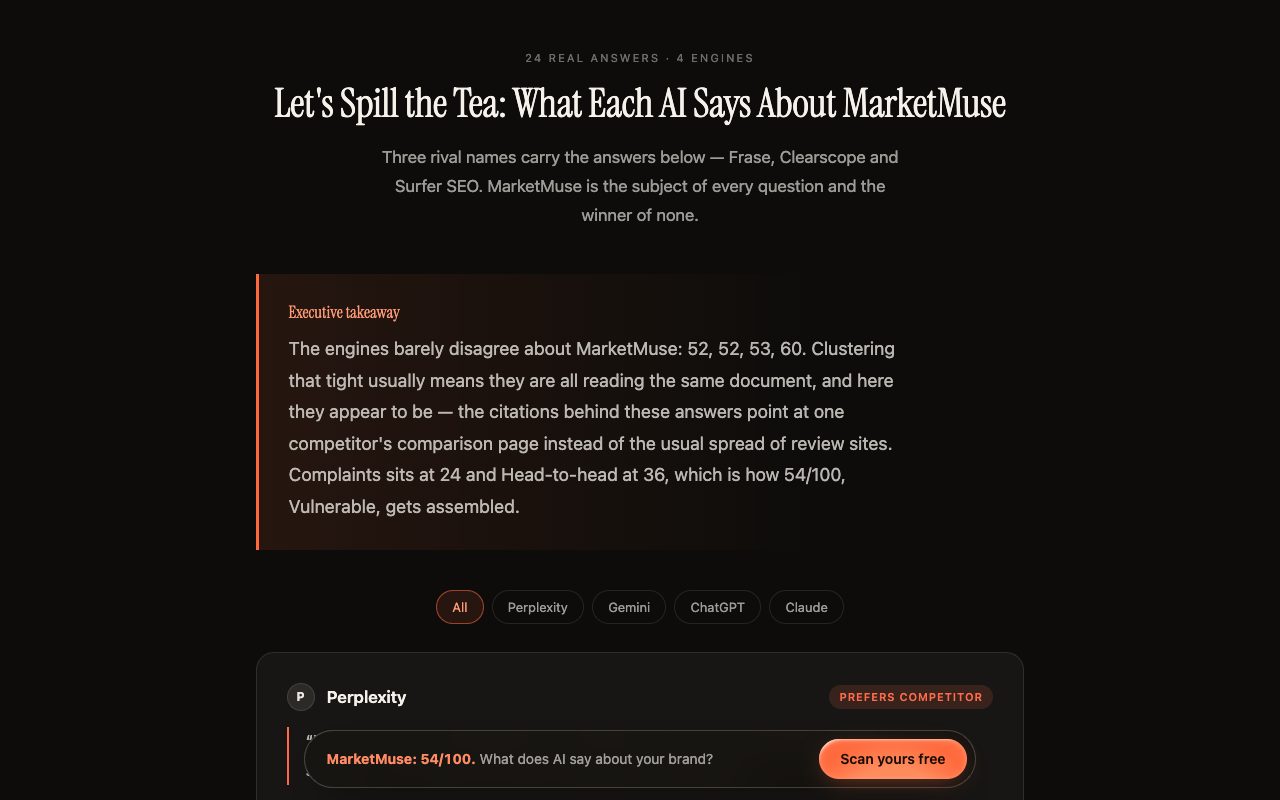
A concrete example: Kairosy's public scan of Frase (scanned August 5, 2026) scored the brand 59/100, At risk. The complaints topic scored 24 and the alternatives topic 26, and the fix list asks for a head-to-head "frase.io vs Clearscope" page with quotable feature and pricing data. If Frase already had such a page, that finding would put it at the top of the refresh queue, regardless of what GSC said.
Kairosy's AI brand monitoring keeps these records for your own tracked questions. Prompt Tracking re-runs them daily and marks each answer as mentioned, not mentioned or competitor recommended, and Source Analysis lists the domains and URLs the answers cite. It does not report Google rankings or prompt search volume, so it complements GSC rather than replacing it.
Which Refresh Candidates Go First? Scoring Sign-Up Contribution, Relevance, Decay and Effort
A long candidate list is a backlog, not a plan. Score each candidate on four factors from 1 to 5 and sort by the total, with sign-up contribution weighted double. Pages that convert are where a refresh pays back first.
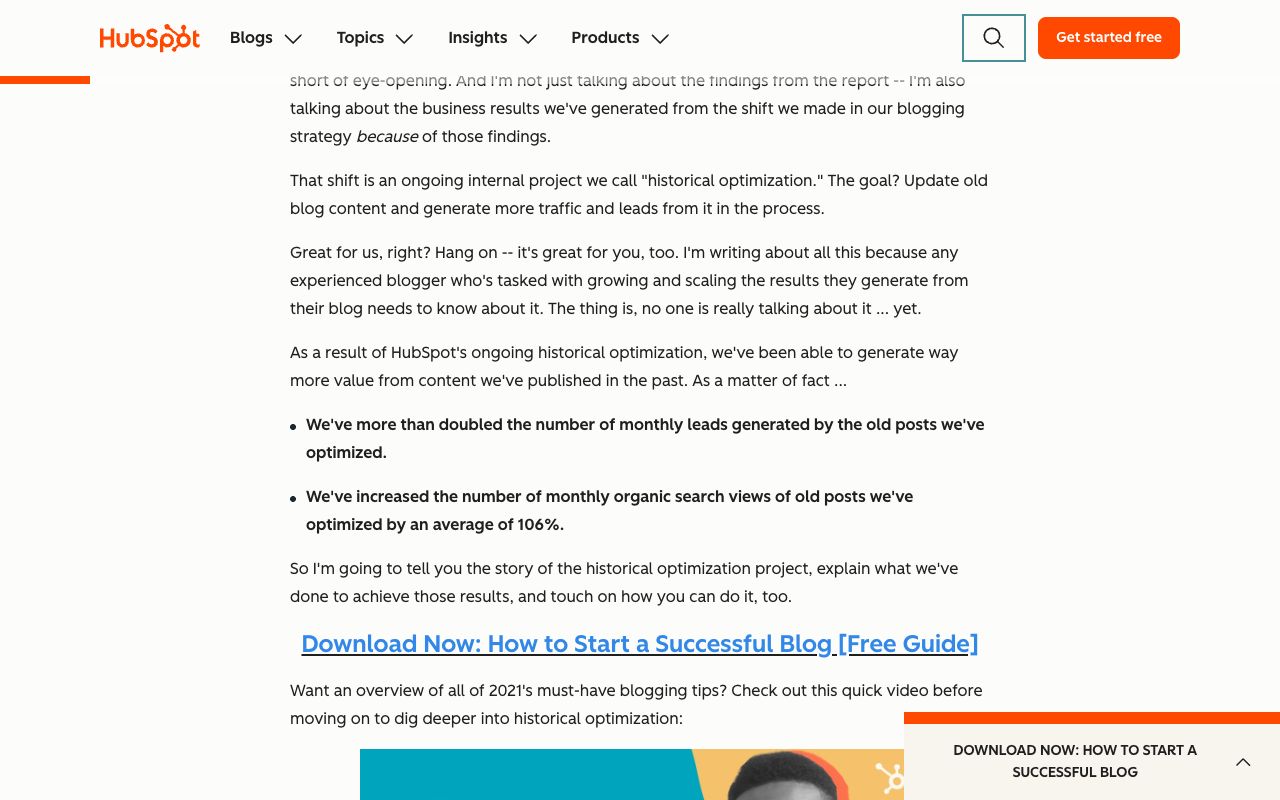
The weighting follows evidence about where value sits. HubSpot's historical optimization write-up (updated June 13, 2025) reports that 76% of its monthly blog views and 92% of its monthly blog leads came from posts published before that month. It is one company's data, but your old pages likely carry more pipeline than this month's new ones too.
| Page (example values) | Sign-up contribution ×2 | Product relevance | Decay | Change cost (5 = cheap) | Score |
|---|---|---|---|---|---|
| /compare/northwind-vs-contoso | 5 ×2 = 10 | 5 | 4 | 3 | 22 |
| /guides/onboarding-checklist | 4 ×2 = 8 | 4 | 2 | 5 | 19 |
| /blog/industry-trends-2024 | 1 ×2 = 2 | 2 | 5 | 2 | 11 |
Define each factor once and write it down. Sign-up contribution comes from GA4 key events on the landing page. Relevance asks whether the topic still maps to something you sell. Decay blends lost clicks with lost AI mentions. Change cost estimates the hours needed, including design and legal review.
Your content refresh velocity, meaning how many scored candidates you push through review and publication per month, is set by the cost column.
What Should a Per-Page Refresh Review Check: Facts, Intent, Missing Questions, Sources, UX?
One review sheet per page keeps the edit scoped and fills the change log's "why" column. Here are the best practices for auditing existing content for refresh, as five passes.
- Facts. Re-verify every price, limit, statistic, screenshot and product claim against its primary source today. Mark anything you cannot verify and remove or reword it.
- Intent. Compare the page's opening to the top queries in GSC. If the queries ask "which" and the page answers "what", the first screen needs rebuilding.
- Missing questions. List questions buyers ask in GSC queries, sales calls and AI answers that the page skips. Each gets a section or an FAQ entry.
- Sources. Replace dead and redirected outbound links, and add named, dated sources for every data claim. Check whether the domains AI answers cite on this topic are ones you can earn a mention on.
- Experience. Check headings, tables, load time, mobile layout and calls to action. A refreshed page that buries the sign-up path wastes its new traffic.
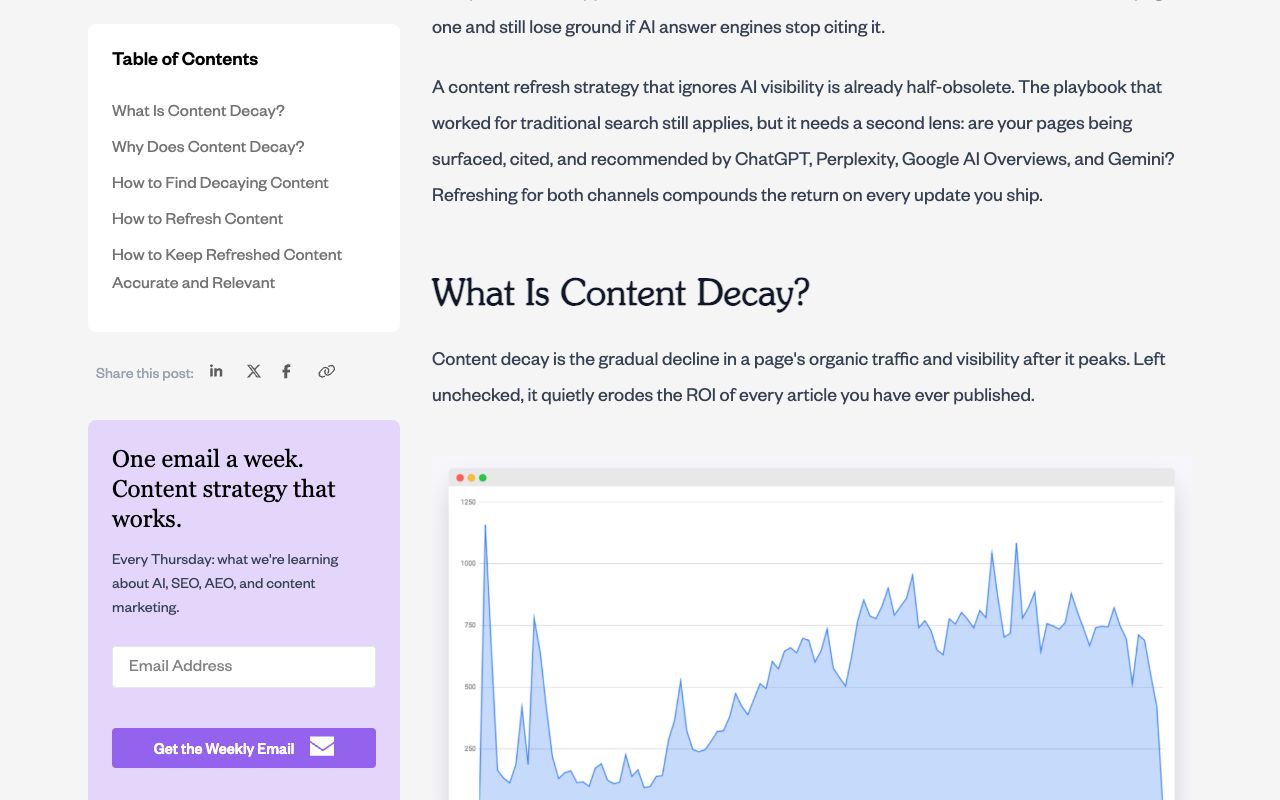
Animalz' content refresh guide (Jimmy Daly, last updated May 1, 2026) cites a 2018 AdEspresso analysis showing an average traffic loss of 1.21% per week on decaying content.
For page-level fixes such as crawler access, headings and schema, follow the sibling guide on how to optimize content for AI search. This content refresh strategy guide stays at the program level: which pages, in what order, and how you prove the work paid off.
How Do You Ship the Refresh and Keep a Change Log?
Execute from the review sheet, not from memory. Draft the new sections, get facts signed off, publish, then request recrawling. Only after the content has substantially changed should the visible "updated" date move.
When a section needs new copy rather than edits, draft it where the evidence lives. Drafts you generate in Kairosy's Content Creation are kept in its content library, so the change log can point at the exact draft that went live.
For brand-new pages that a merge leaves behind, the principles in write content for AI search apply. After publishing, confirm the URL is indexable with the free index checker. Bing, Naver, Seznam.cz, Yandex and Yep accept change notifications through IndexNow if your CMS supports it.
The one-page change log below is a sample with fictional entries. Keep one row per published change, not per draft.
| Date | URL | Action | What changed | Why (from review) | Owner | Check on |
|---|---|---|---|---|---|---|
| 2026-11-03 | /compare/northwind-vs-contoso | Update | New pricing table, two FAQs on migration | Prices dated, AI answers cite rival's comparison | Maya (content) | 2026-12-15 |
| 2026-11-05 | /guides/onboarding-checklist | Rewrite | Intro and H2s rebuilt around "which tool" queries | Intent drift in GSC queries | Leo (SEO) | 2026-12-17 |
| 2026-11-06 | /blog/setup-tips-2023 | Merge | 301 into onboarding checklist, best section moved | Two URLs on one query set | Leo (SEO) | 2026-12-04 |
Who Owns Each Page, and How Do You Set Cadence and Observation Windows?
Every page in the program needs one named owner who answers for its accuracy. Otherwise comparison pages, the hardest to edit, age fastest.
There is no universal "refresh every N days" rule worth adopting. Cadence should come from the page itself: how fast its facts change (pricing and comparison pages change with every competitor release), how quickly its decay signals appear, and how long you need to read results. Ahrefs' decay article tracks the query "how to start a blog" through 13 ranking changes in one year, which is exactly why one calendar for every page breaks down.
Set an observation window per change before you publish. Leave enough time for recrawling and for at least several weeks of comparable traffic. During that window, don't touch the page again, or you cannot attribute the result. Teams running website refresh strategies across hundreds of URLs usually stagger publication so each batch has its own clean window.
Kairosy fits into this as a weekly check, not a pager. Tracked prompts run daily, each tracking slot gets a deep rescan every Monday, and the weekly email flags score drops, a competitor being preferred, an engine flipping and new negative keywords. There are no real-time alerts, so plan reviews around that rhythm.
How Do You Compare Search, AI Citation and Sign-Up Results Before and After?
Before and after numbers on one page are noisy, because seasonality and algorithm updates move them too. Plan a small experiment with a control group before anything ships.
Here is an experiment design ready to run. It has not been executed yet, and every value is an example.
| Element | Plan (example values) |
|---|---|
| Hypothesis | Refreshing high-scoring comparison pages raises sign-ups from those pages |
| Treatment group | 10 pages from the top of the scored list, refreshed in one week |
| Control group | 10 similar pages with matching scores, left unchanged |
| Windows | Equal-length pre and post windows, post window starting after recrawl is confirmed |
| Search metrics | GSC clicks, impressions and average position per page |
| AI metrics | Mentioned rate and cited URLs for the same tracked questions |
| Business metric | GA4 key events (sign-ups) by landing page |
| Decision rule | Keep the refresh pattern if treatment beats control on sign-ups and does not lose on clicks |
Read the three layers together. Search shows whether Google responded. AI answer records show whether assistants now mention you or cite the refreshed URL. GA4 shows whether either change reached the business. Your tracked questions in Kairosy's Prompt Tracking keep a seven-run history per engine, so a shift in mentions has its own before and after inside the same view.
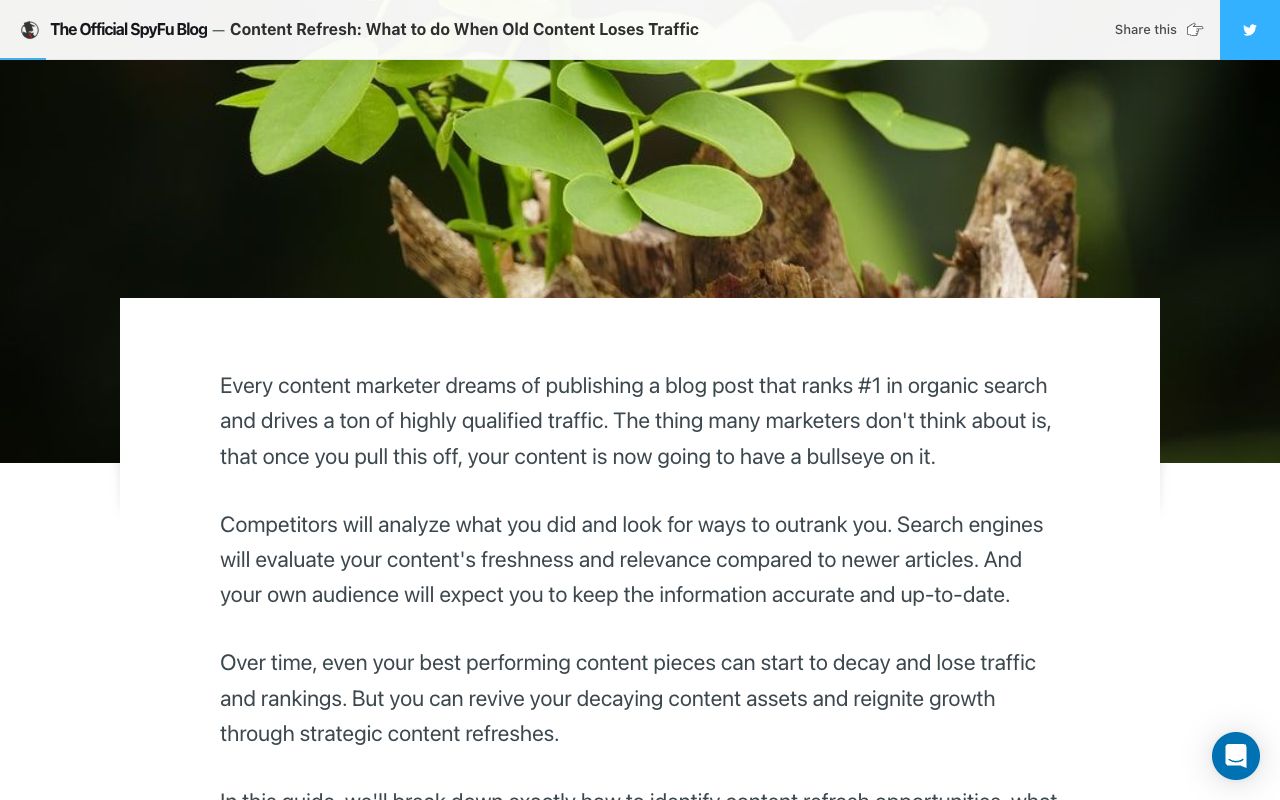
SpyFu's content refresh walkthrough (Sidra Condron, April 19, 2024) shares a case where cumulative traffic across 21 refreshed posts rose 52% after one month. Treat case studies like that as reasons to test, not as targets to promise.
Content Refresh Strategy Guide FAQs
Does changing the publish date count as a content refresh?
No. Only move the date after the page has substantially changed. Google's helpful content guidance names date changes without real edits as a warning sign, and readers notice when "updated this month" sits on top of last year's prices.
How often should you refresh content?
Base it on each page's rate of factual change, its decay signals and its observation window. A pricing comparison may need attention after every competitor change, while an evergreen definition may stay accurate for a long time. A single fixed interval for every page is not a best practice.
What is content refresh velocity?
It is the number of scored refresh candidates your team takes from review to publication in a set period. Track it next to outcomes, because a high pace of shallow updates is worse than a slower pace of real ones.
Can AI write the refresh for you?
AI can draft new sections, propose FAQs and flag stale claims. A person still has to verify every fact against its source, because a refreshed page with a wrong number is worse than the original.
How do you measure whether a refresh worked in AI search?
Track a fixed set of buyer questions before and after, and record whether each engine mentions you and which URLs it cites. Compare against an untouched control group so seasonal shifts don't get credited to the refresh.
When should you delete a page instead of refreshing it?
Retire it when the topic no longer relates to your product, it produces no key events, and no stronger page can absorb its useful parts. Redirect to a close match if one exists, and check incoming links first.
Run this content refresh strategy guide as a loop: score, review, ship, log, wait, compare, then score again.
See what AI says about your brand
Run a free scan across ChatGPT, Gemini, Claude & Perplexity in about 30 seconds.
Run my free scan