LLM Source Preference Analysis Tools: 6 Compared + URL Matrix (2026)
LLM source preference analysis tools tell you which URLs an AI engine keeps choosing for which questions, and which near-identical pages it keeps passing over. That pattern, a page picked again and again for the same intent across runs and engines, is what we mean by AI URL preference insights; a single citation count is only the raw material.
Below: six tools that expose URL-level data, a five-step method, a question × engine × URL selection matrix and cited-vs-uncited comparison cards. One boundary runs through all of it: no tool reads a model's internal preferences, so everything here is inferred from what engines visibly return. Prices were checked on vendor pages on October 22, 2026.
What Are LLM Source Preferences, and What Can a Tool Actually Observe?
"LLM source preferences" is shorthand for a repeatable selection pattern: given the question "best content optimization tool for a small agency," Perplexity cites the same two comparison pages in five runs out of seven, while Gemini leans on a vendor feature page. The pattern is measurable; the reason behind it is not visible.
A tool can observe four things: which URLs an answer cites, where they sit (first source, inline, footnote), how often they recur for a fixed question, and which engine returned them in which market and on which date.
Some platforms add a fifth signal: pages the engine retrieved during search but did not cite. That gap matters. In data summarized by Lily Ray on August 17, 2026, Suganthan Mohanadasan found that only 3.1% of 3,554 retrieved pages made it into the final ChatGPT answers he examined. Being fetched and being chosen are separate events, and preference analysis lives in the space between them.
No tool can show the weighting inside the model, such as why a ranker scored one passage higher. The honest output is a pattern plus a testable hypothesis.
Which LLM Source Preference Analysis Tools Show URL-Level Data?
We judged each tool on six dimensions taken straight from the analysis you will run: URL granularity (page, not just domain), cross-model coverage, topic grouping, history, content-type labels and competitor context.
| Tool | Finest source unit | Engines (as listed) | Retrieved-but-uncited | Entry price (Oct 22, 2026) |
|---|---|---|---|---|
| Kairosy | URL, tied to the full answer | Pick 4 of ChatGPT, Gemini, Claude, Perplexity, DeepSeek, Doubao | No | $29/mo, 7-day trial without a card |
| Peec AI | URL, with URL-type label | Multiple (see plan) | Yes ("Retrieved") | See pricing page |
| Profound | Cited websites and pages | 8 listed on feature page | Not stated | Free 7-day trial, then custom |
| Ahrefs Brand Radar | Cited pages and domains | 7 AI platforms | Not stated | From $199/mo |
| Semrush AI Visibility Toolkit | Cited domains (Sources view) | ChatGPT, Google AI, Gemini, Perplexity | Not stated | $99/mo per domain, billed annually |
| Otterly.AI | Link citations per prompt | 4 included, 3 as add-ons | Not stated | $29/mo (Lite) |
Kairosy: URL Sources Read Next to the Answer That Cited Them
Kairosy asks real buyer questions about your brand on any 4 of its 6 engines, keeps every answer in full with its cited sources, and classifies the sentiment of each one. The Source Analysis page lists the domains and URLs those answers cite and splits them into brand-building sources versus third-party ones.
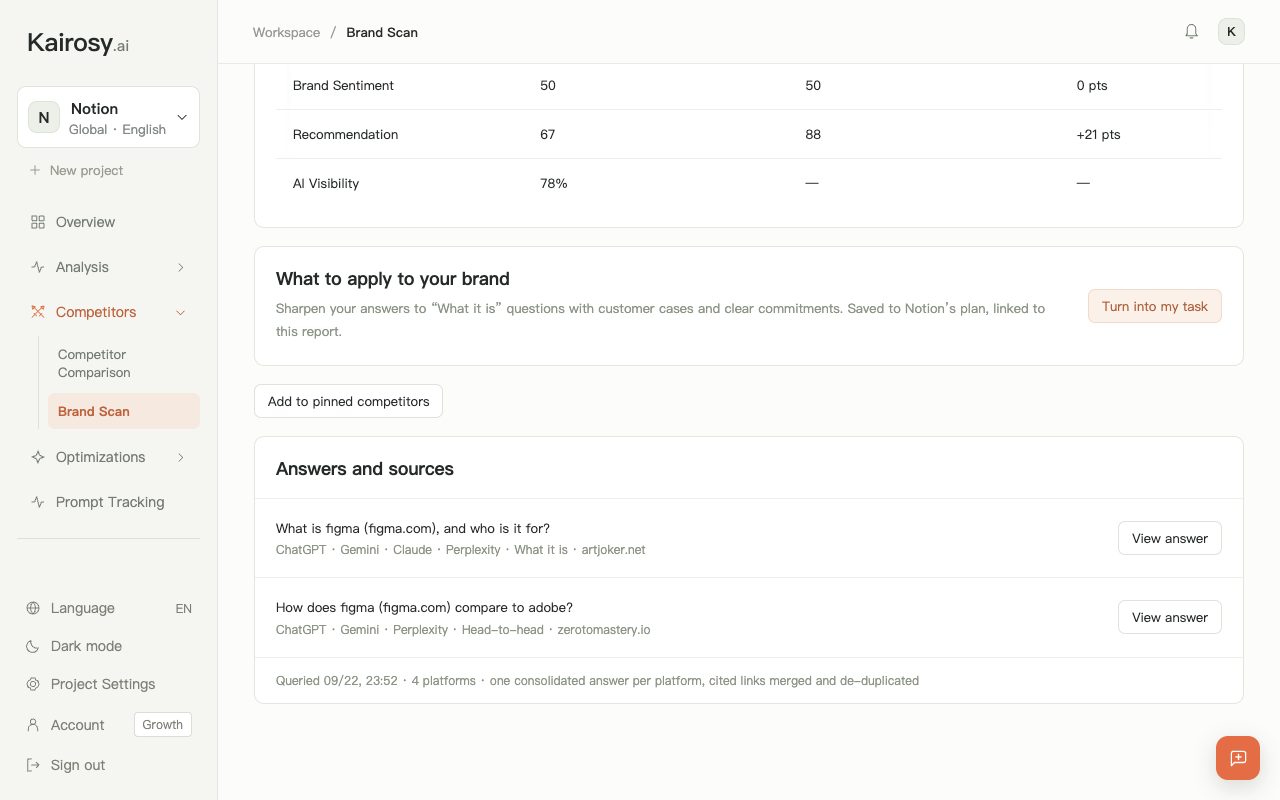
For preference work, the useful part is history: tracked prompts re-run daily, and each per-engine card keeps a 7-run history marked mentioned, not mentioned, or competitor recommended. Limits: Kairosy does not log pages an engine retrieved but did not cite, and it offers no prompt-volume data. Basic costs $29 a month for one brand in one market with 15 tracked prompts a day; Pro is $99 and Growth $399.
Peec AI: The Clearest Retrieved-vs-Cited Split
Peec AI's URL documentation defines "Retrieved" as the "percentage of chats in which the URL appeared as a source" and keeps it apart from "Total citations," the count of inline citations. Each URL also gets a content-type classification, and a Prompts table shows "which prompts triggered this URL as a source, regardless of whether it was cited or not." High retrieval with low citation flags a page the engine reads but declines to quote. Plans run Starter, Pro, Advanced and Enterprise; the figures render inside the pricing page, so check them there.
Profound: Citation Authority Across Eight Engines
Profound's Answer Engine Insights page promises to "find out which websites drive AIs answers about you" and to track their authority, across ChatGPT, Perplexity, Claude, Gemini, Google AI Overviews, Copilot, Grok and DeepSeek. The pricing page lists a free trial with 50 prompts tracked daily for seven days on three engines; Enterprise is custom and covers up to nine engines.
Ahrefs Brand Radar: Cited Pages at Database Scale
Brand Radar helps you "identify top cited pages and domains" across AI Overviews and AI Mode, ChatGPT, Perplexity, Gemini, Copilot, Grok and Claude. Its strength is breadth: the Ahrefs pricing page described a pool of "493 million+ organic prompts" on October 22, 2026. The trade-off is history granularity; the Ahrefs help article (updated September 3, 2026) says AI chatbot data refreshes "once a month." Standalone pricing starts at $199 a month, with custom prompt packs at $50, $100 and $250.
Semrush AI Visibility Toolkit: Domain Gaps Against Competitors
Semrush works one level up. Its Competitor Research report shows "all the domains cited by AI" when a tracked brand is mentioned, and a Missing filter isolates domains cited for competitors but not for you. That is strong for outreach planning and weaker for page-level questions, because a domain win does not tell you which article earned it. The toolkit is $99 a month per domain billed annually, with 25 custom prompts tracked daily on ChatGPT, Google AI, Gemini and Perplexity.
Otterly.AI: Link Citations for Smaller Prompt Sets
Otterly.AI lists Link Citations Analysis and Citation Source Tracking on Standard and above, per its pricing page. Lite is $29 a month for 15 prompts; Standard is $189 for 100 and Premium $489 for 400. ChatGPT, Google AI Overviews, Perplexity and Copilot are included; Claude, Gemini and Google AI Mode are paid add-ons, which matters if cross-model comparison is your main goal.
How Do You Analyze Which URL an LLM Prefers? A Five-Step Method
This works with any of the LLM source preference analysis tools above, or a spreadsheet. For capture mechanics engine by engine, see our guide to tracking AI search engine sources.
1. Build a Candidate URL Set and a Frozen Question Set
Pick one topic, say "content optimization software." List every page that could plausibly answer it: your feature page, your pricing page, two competitor comparison pages, a G2 category page, a Reddit thread, a trade-press review. Then write 8–12 questions and freeze their wording.
2. Compare Citation Frequency, First Appearance and Cross-Model Differences
For each URL, record three numbers per engine over at least five runs: how many runs cited it, how often it was the first source, and on how many engines it appeared. First position matters because the opening source usually frames the answer. A URL cited by every engine is probably winning on content; one cited by a single engine is probably winning on that engine's retrieval index.
3. Profile the Winners: Page Type, Evidence, Freshness, Topical Match
Now open the pages. Label each one by type (listicle, comparison, product page, docs, forum), note the concrete evidence it carries (prices, test results, dates, named sources), its last visible update, and how closely its headings mirror the question.
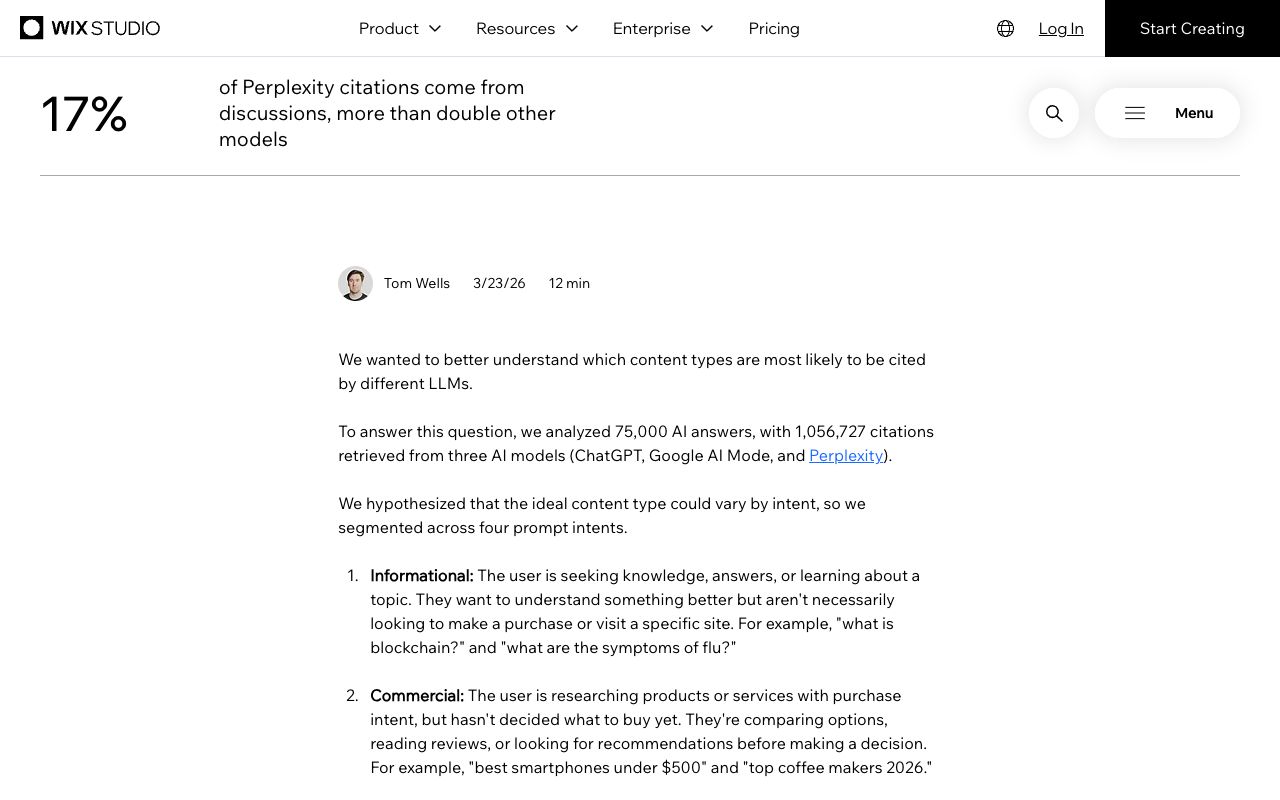
The Wix Studio AI Search Lab study by Tom Wells, published March 23, 2026, analyzed 75,000 answers and 1,056,727 citations from ChatGPT, Google AI Mode and Perplexity. Listicles took 21.9% of citations, articles 16.7% and product pages 13.7%; for commercial-intent questions listicles rose to 40.86%. Perplexity drew 17.35% of its citations from discussions, more than double the 7.52% average.
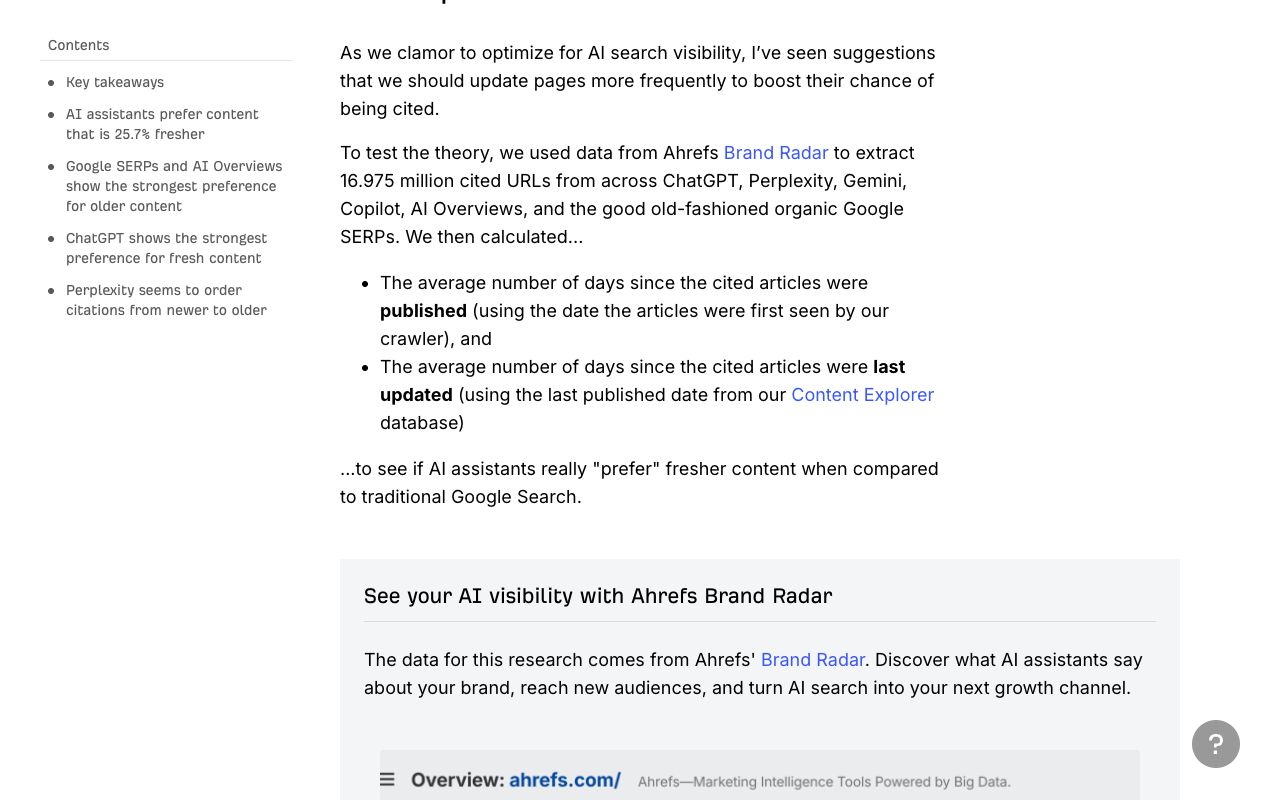
Freshness shows a similar lean. Ahrefs' study by Ryan Law (July 28, 2025) of 16.975 million cited URLs found AI assistants cited content about 25.7% fresher than organic search results, measured in days since publication.
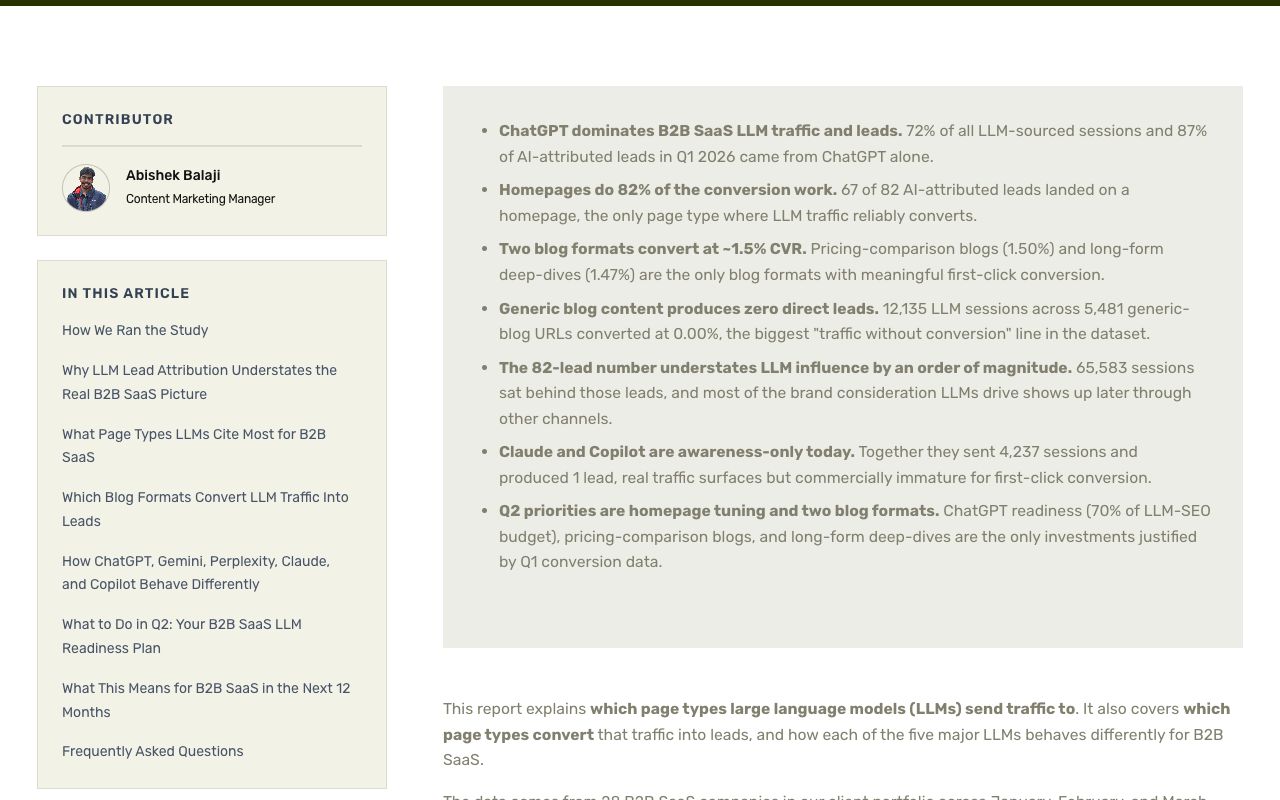
TripleDart's Q1 2026 analysis of 28 B2B SaaS companies measured something else, LLM-referred traffic rather than citations: homepages drew 31.9% of 65,583 sessions and 81.7% of AI-attributed leads. Each study counts something different, so treat them as priors to test.
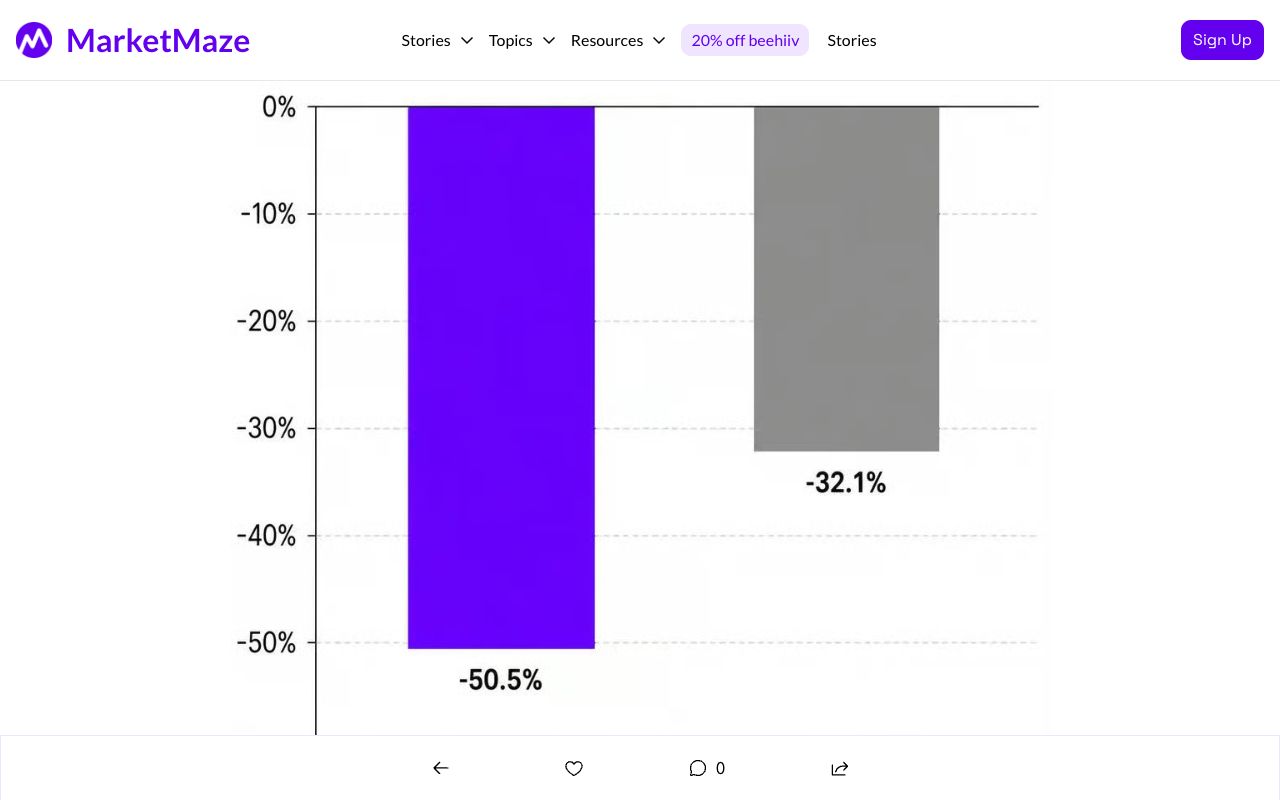
Priors also move. Peec AI's paired-week panel of 180 million sources across 1 million prompts, as reported by MarketMaze on September 7, 2026, saw ChatGPT's listicle citation share fall from 15.77% to 7.80% around the GPT-5.6 rollout, and comparison pages from 9.08% to 6.17%. MarketMaze warns this does not prove an intentional crackdown.
4. Control for Retrievability Before You Call Anything a Preference
An uncited page may simply be unreachable. Before comparing content, confirm the losing page is indexed, returns a 200, and is not blocked for AI crawlers. Run it through the free AI crawl checker and the index checker. If a tool reports retrieval data, use it: a page that is never retrieved has a discovery problem, while a page retrieved often but rarely cited has a content or framing problem.
5. Turn Observations Into Page Updates and External-Source Hypotheses
Write each conclusion as a hypothesis with a re-test date: "If we add a dated pricing table to /pricing, Perplexity will cite it for the cost question within two weekly runs." If every engine leans on one review roundup that omits you, the hypothesis is external: get into that source. Our post on AI source monitoring covers assigning those external sources to an owner.
What Does a Question × Engine × URL Selection Matrix Look Like?
The matrix below uses example values for a fictional brand, Northwind Docs, a content optimization tool. Each cell shows how many of seven daily runs cited that URL, with an asterisk where it was the first source.
| Question (frozen) | URL | ChatGPT | Perplexity | Gemini | Claude |
|---|---|---|---|---|---|
| Best content optimization tool for agencies | contoso.com/best-content-tools | 6/7* | 7/7* | 2/7 | 0/7 |
| Best content optimization tool for agencies | northwinddocs.com/agencies | 0/7 | 1/7 | 3/7 | 0/7 |
| Northwind Docs pricing vs Fabrikam | northwinddocs.com/pricing | 1/7 | 2/7 | 5/7* | 0/7 |
| Northwind Docs pricing vs Fabrikam | reddit.com/r/SEO thread (2025) | 4/7 | 6/7* | 1/7 | 0/7 |
| Is Northwind Docs worth it? | g2.com category page | 5/7* | 4/7 | 4/7 | 0/7 |
The Contoso listicle wins the commercial question on two engines and opens the answer: a strong observable preference. The Reddit thread beats the Northwind pricing page on Perplexity, which fits the Wix finding about discussions (worth watching with Perplexity brand monitoring), but that fit is a hypothesis, not a cause. Claude's zero column is not a preference at all until you check whether its answers cite any sources for these questions.
Why Does AI Cite One Page Over Another? Cited vs Uncited Comparison Cards
People asking why AI cites one page over another want one cause. A comparison card keeps what you saw apart from what you suspect. Two cards, again with example values:
Card A: Pricing Question, Perplexity
- Cited: Reddit thread, 6 of 7 runs, first source in 4.
- Not cited: northwinddocs.com/pricing, 2 of 7 runs, never first.
- Observable: the thread quotes a monthly price and names Fabrikam as the cheaper option.
- Observable: the pricing page shows "Contact sales" for the agency tier and has no visible update date.
- Unverified cause: the engine favors pages that state a number for a cost question.
- Test: publish the agency price with a date, re-run the frozen question for two weeks.
Card B: Agency Question, ChatGPT
- Cited: contoso.com/best-content-tools, 6 of 7 runs.
- Not cited: northwinddocs.com/agencies, 0 of 7 runs.
- Observable: the Contoso page is a ranked list with a comparison table and an update date from last month.
- Unverified cause: list format matches commercial intent, or the page ranks for the search the engine ran.
- Test: pitch inclusion in the Contoso list and, separately, add a comparison table to the agency page, then run it through the AI-Ready Page Audit.
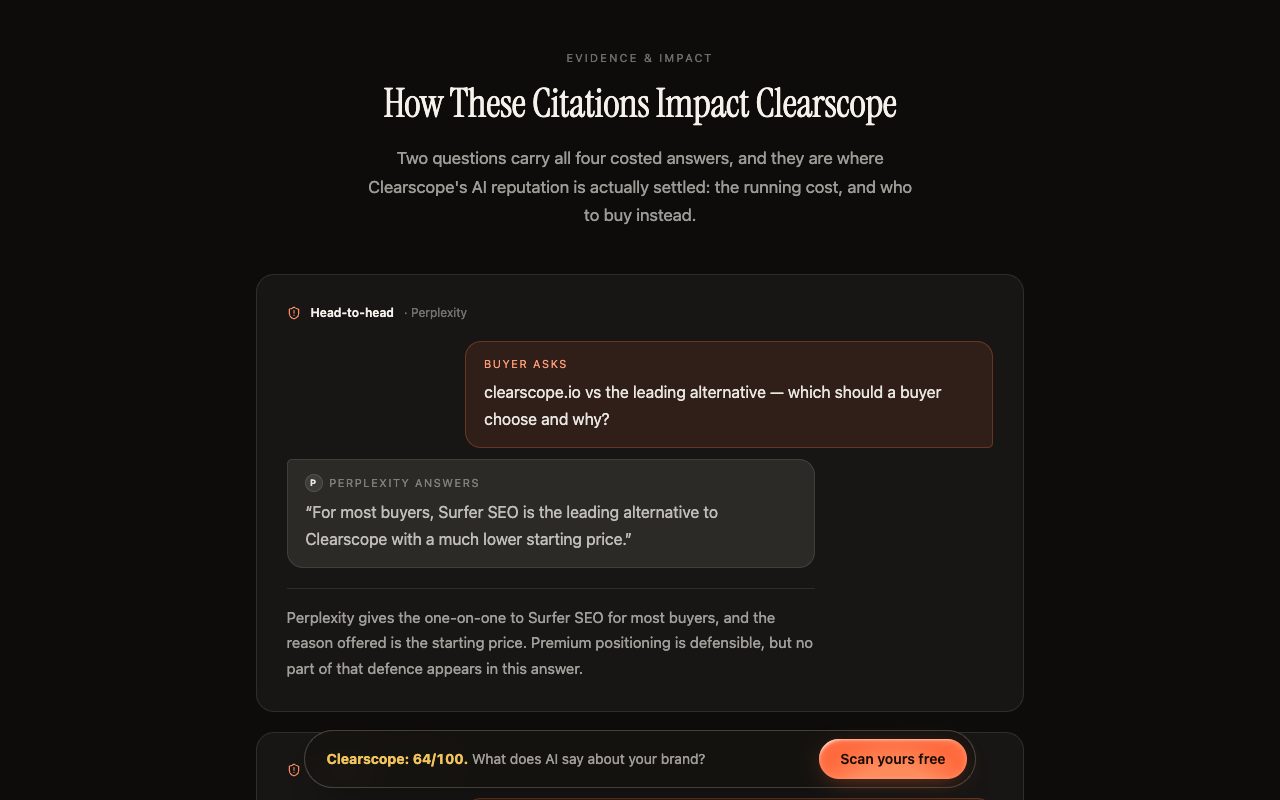
Kairosy's public scan of Clearscope (August 5, 2026) shows the observable half with real data. On the head-to-head question, Perplexity named Surfer SEO as the leading alternative and tied its reasoning to a lower starting price; ChatGPT handed the all-in-one positioning to Frase.io. The scan records what each engine said and cited, not why its retriever ranked those pages.
LLM Source Preference Analysis Tools FAQs
Which AI optimization tools provide URL preference insights for LLMs?
Among the tools above, Peec AI and Kairosy report at the URL level next to the prompts that produced them, and Peec adds retrieved-versus-cited data. Ahrefs Brand Radar and Profound show cited pages and websites at broader scale. Semrush's Sources view works at the domain level.
Can LLM source preference analysis tools see why a model chose a page?
No. They see outputs: cited URLs, their order, their frequency and the engine. The reason a model selected a page is an inference you test by changing one variable and re-running fixed questions.
How many runs do I need before calling a URL "preferred"?
There is no industry standard. A practical floor is five to seven runs of the same frozen question on the same engine, with the URL cited in most of them. One appearance tells you a page is eligible; repeated first-position citations tell you it is favored for that intent.
Is citation count enough to understand LLM source preferences?
No. A raw count hides which question produced the citation, whether the page opened the answer, and whether a rival page was available and ignored. Preference work needs the question, engine, position and competing pages in one view.
Why does one engine cite a page that another ignores?
Engines run different searches over different indexes and change behavior across model versions, as the GPT-5.6 listicle shift showed. A page cited on one engine only often points to a retrieval or indexing difference; a page cited everywhere usually points to content that answers the question directly.
See what AI says about your brand
Run a free scan across ChatGPT, Gemini, Claude & Perplexity in about 30 seconds.
Run my free scan