LLM Tools for Improving Product Discoverability (2026 Guide)
A brand mention in ChatGPT is not a product recommendation. The useful LLM tools for improving product discoverability work at the SKU level: they show which of your products an assistant actually names for a shopping question, which page it read to get there, and which attribute was missing when it picked a rival instead.
The gap between "mentioned" and "recommended" is wide. In Kairosy's public scan of Spocket (24 buyer questions, scanned 2026-08-05), the brand turned up in 83% of answers but only 8% of answers recommended it, while 21% steered the buyer to a rival such as Modalyst or AutoDS. The name was known. The offer was not winning.
Products lose that way for boring reasons: a title that does not say what the item is, a price that differs between the feed and the page, a sizing chart that lives in a PDF, a return policy no assistant can quote. This guide sorts the tools by the job they do, then walks through a manual check and a tool-assisted re-test loop. If you want the brand-level version of this work, read how to improve visibility in AI search first; everything below stays at product level.
Which LLM Tools for Improving Product Discoverability Fit Each Job?
Short version: you need one tool that measures, one channel that supplies clean product data, and a way to publish the pages assistants quote. Most stores already own part of the second group without knowing it.
| Job | Tool | What it covers | Access (checked 2026-10-22) |
|---|---|---|---|
| Monitoring | Kairosy | Fixed question sets re-run daily, per-engine answers, cited sources, competitor recommended | 7-day trial, from $29/mo |
| Monitoring | Profound Shopping | SKU tracking inside ChatGPT Shopping responses, merchant layer | Enterprise plan only |
| Monitoring | Writesonic AI Shopping Tracker | Product-level visibility, shopping rank, purchase-link share | 7-day free trial, price not listed on feature page |
| Product data | OpenAI product feed spec | Feed fields ChatGPT search and checkout read | Free spec, onboarding required |
| Product data | Google Merchant Center | Product data specification incl. highlights and details | Free account |
| Product data | Feedonomics Agentic Catalog Exports | One optimized catalog sent to several AI shopping surfaces | No public price found, ask for a quote |
| Content and distribution | Shopify agentic storefronts | Catalog syndication to ChatGPT, Copilot, Google AI Mode, Gemini | On by default for eligible stores |
Two things are deliberately missing. On-site semantic search (the search bar inside your own store) helps visitors who already arrived; it does nothing for a shopper asking Gemini which running shoe to buy. Generic product directories and launch listings are not LLM discoverability tools either; at best they become one more page an engine might cite.
What Are the Best LLM Tools for Improving Product Discoverability in 2026?
These seven split into three groups. You will rarely need all of them, and the measurement tools are only worth paying for once your feed is clean.
Kairosy: question-level monitoring with sources
Kairosy is a brand-reputation and visibility scanner. You load the shopping questions you care about into Prompt Tracking and they re-run daily on 4 engines you choose from ChatGPT, Gemini, Claude, Perplexity, DeepSeek and Doubao. Each run keeps a per-engine answer card marked mentioned, not mentioned, or competitor recommended, plus a 7-run history and the cited URLs.
For product work, the useful parts are the answer text and Source Analysis: you see whether "best waterproof trail shoe under $150" names your model, and which review site or retailer page fed the answer. The Brand Scan page runs a one-off scan of any brand, which is how you size up a rival product line before you track it.
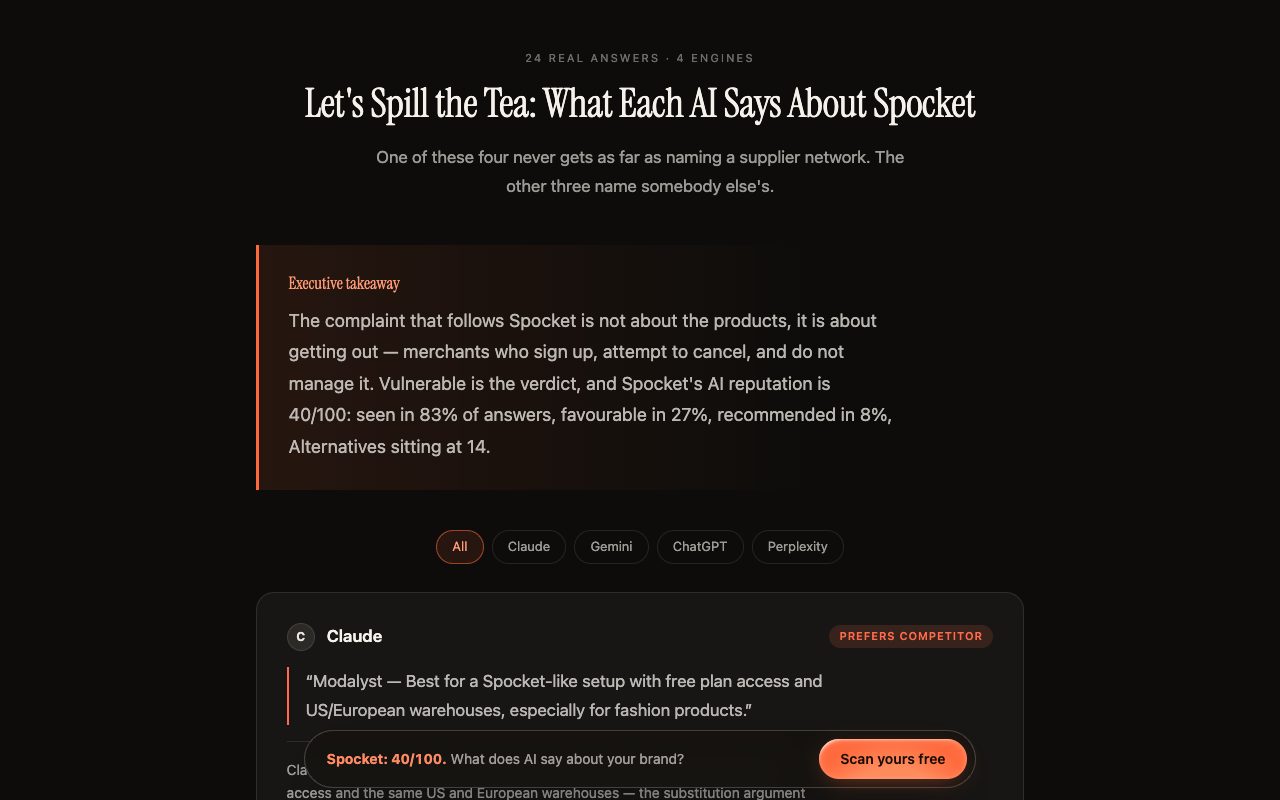
Be clear about the limits. Kairosy reads answers and citations; it does not capture shopping-card layouts, tile prices or checkout links, it has no prompt-volume data, and it sends a weekly email rather than real-time alerts. Plans start at $29/month (Basic, 15 tracked prompts a day) after a 7-day trial; Pro is $99 with 60 prompts a day. Details on the AI brand monitoring page.
Profound Shopping: SKU tracking inside ChatGPT Shopping
Profound's Shopping feature runs your tracked prompts through ChatGPT, notes which ones trigger shopping mode, and captures the product tiles, prices, merchant links and attributes. Its Product Analysis view tracks individual SKUs and shows which prompts surface them, and the merchant layer shows which retailers own the checkout options.
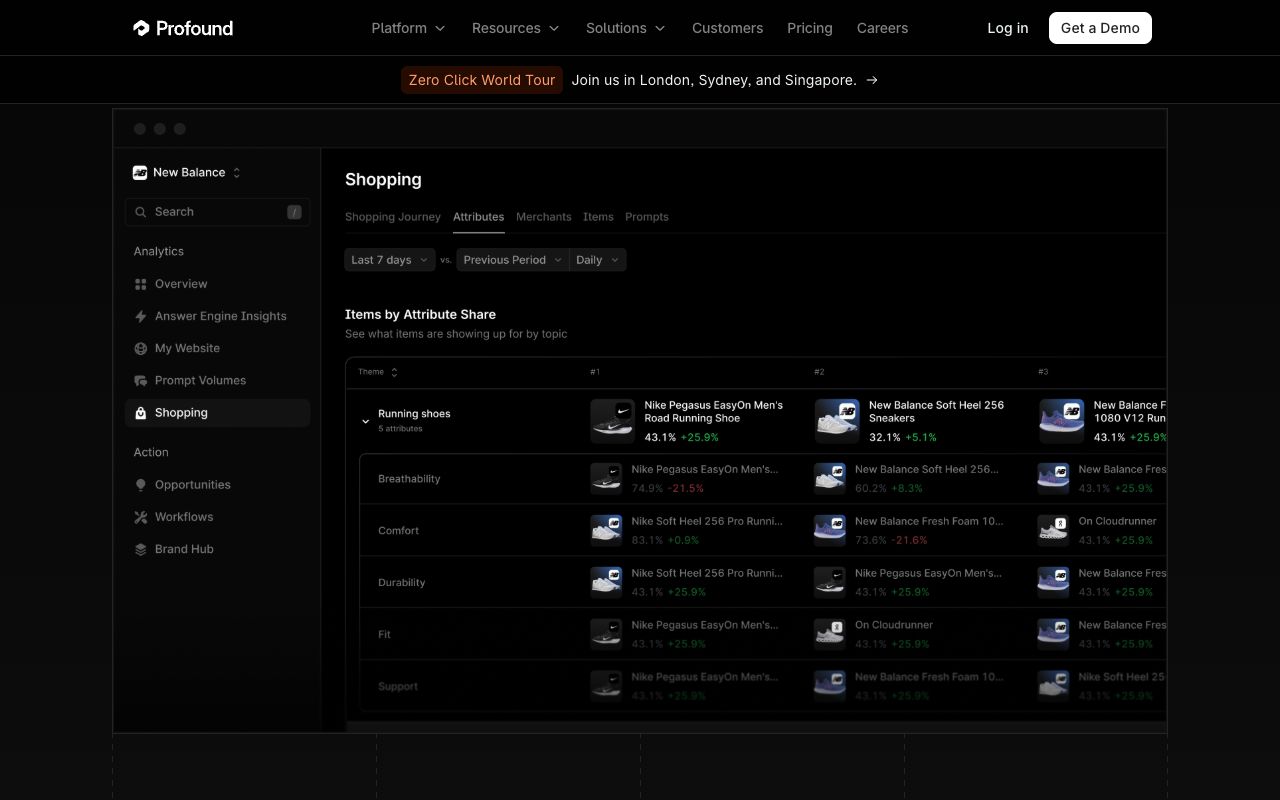
It is the deepest view of ChatGPT Shopping itself. The catch is access: Profound's documentation lists Shopping as available on the Enterprise plan only, and the coverage described centers on ChatGPT.
Writesonic AI Shopping Tracker: rank and purchase-link share
Writesonic's AI Shopping Tracker reports four product metrics: shopping visibility, direct purchase link share (how often the card sends buyers to your site rather than a reseller), shopping share of voice and average shopping rank. It also logs "detected aliases", the naming variants assistants use for your product.
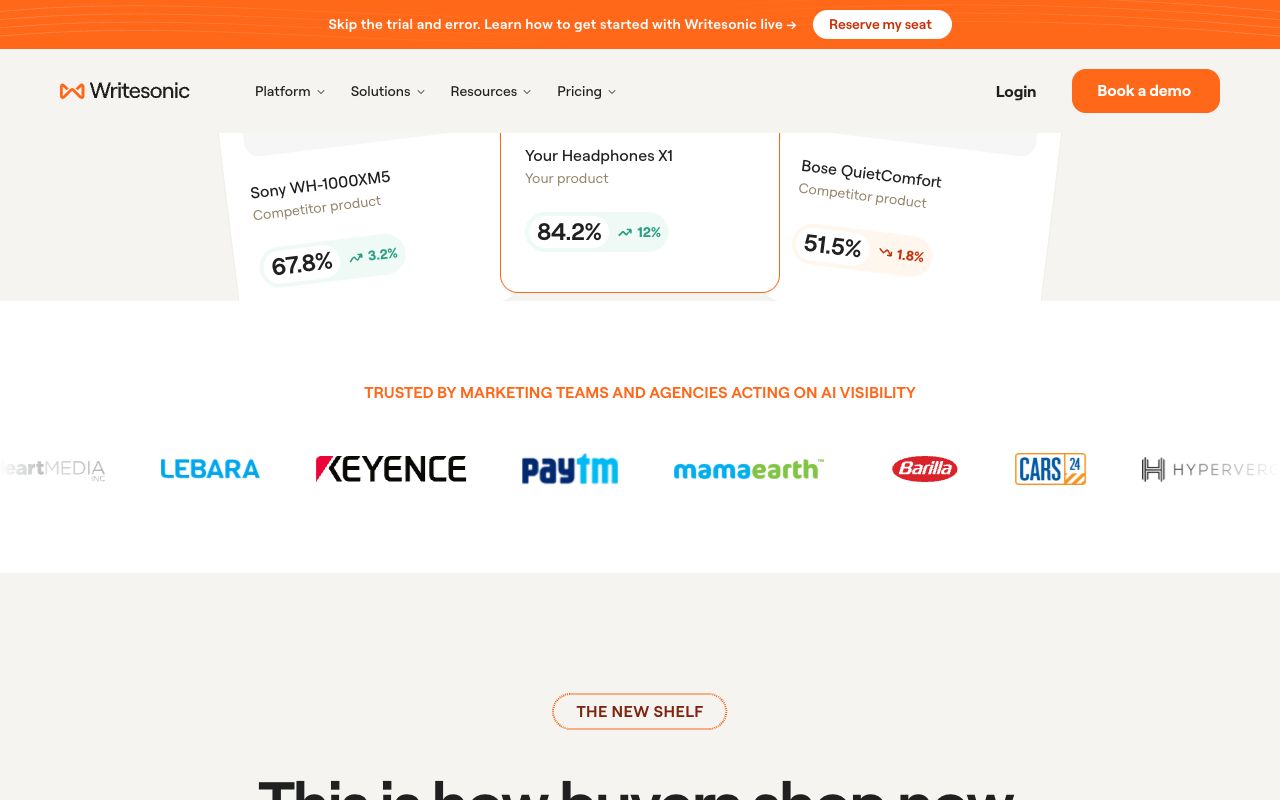
The alias list is underrated. If ChatGPT calls your "Ridge 2 GTX" the "Ridge waterproof", your tracking and your page copy should both handle that name. The feature page offers a 7-day free trial but lists no price, so confirm cost on a demo call.
OpenAI product feed spec: the fields ChatGPT reads
The OpenAI product feed specification is not a SaaS tool, but it is the closest thing to a rulebook for ChatGPT product discovery. Required fields include item_id, title, description, url, brand, seller_name, image_url, availability and price; gtin and mpn are optional.
Two details matter for discoverability. Search eligibility is on by default while checkout is off unless configured separately, and the spec asks for a real brand and seller name rather than placeholders. A feed that says "Store 1" as seller is a feed that cannot be matched to your entity.
Google Merchant Center: highlights and details for Google surfaces
Google's product data specification covers the same core fields plus two that answer engines love to quote: product_highlight and product_detail (technical specs). Shopify's own help center notes that products reach Google AI Mode and Gemini through the Google & YouTube channel or Merchant Center, so this feed is the input for Google's AI shopping answers.
Feedonomics Agentic Catalog Exports: one feed, many surfaces
Feedonomics, part of Commerce, launched Agentic Catalog Exports on May 1, 2026, according to eCommerce News. It sends an optimized catalog to ChatGPT, Google Gemini, Microsoft Copilot, Perplexity, Amazon, PayPal and Stripe, so you maintain one data layer instead of one integration per assistant. Feedonomics does not list a price in the launch coverage, so ask for a quote. It suits large or multi-channel catalogs; a 40-SKU shop is better served by its platform's native feed.
Shopify agentic storefronts: distribution you may already have
According to the Shopify Help Center, agentic storefronts let shoppers discover and buy your products in ChatGPT, Google AI Mode, Gemini, Microsoft Copilot and Meta, through Shopify Catalog (Google surfaces go through Merchant Center). It is active by default for eligible stores, and you choose channels under Sales channels > Agentic.
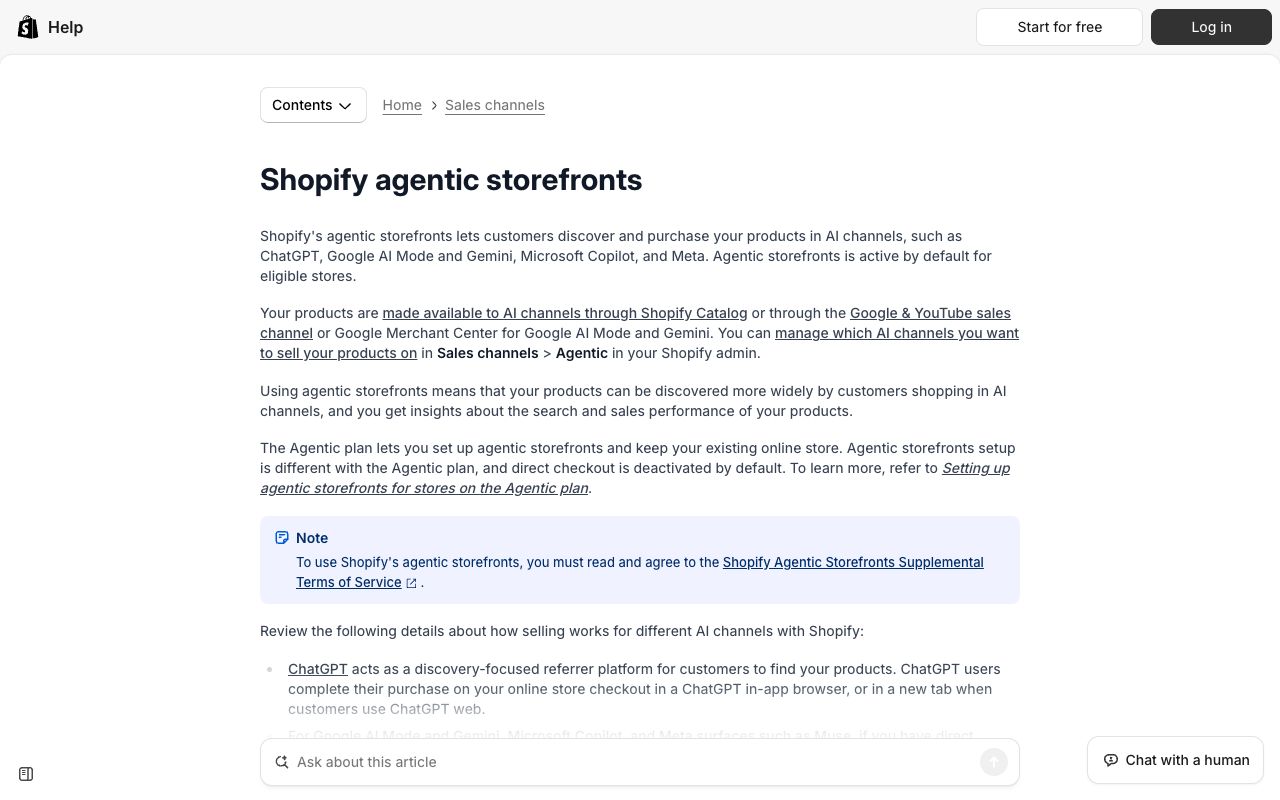
Distribution is not the same as being picked. Your catalog being readable by ChatGPT only puts the product in the pool; the title, attributes and third-party pages decide whether it gets named.
How Do You Audit Product Discoverability by Hand Before Buying Tools?
Do this once for your top five SKUs before you pay for anything. It takes an afternoon and finds most of the problems the paid tools will later report.
Step 1: check the product facts for consistency
- Name: the same product name on the page title, H1, feed title and Amazon or retailer listings.
- Attributes: material, size range, weight, compatibility and use case written as text, not only in images.
- Price: identical in the feed, on the page and in your structured data.
- Stock:
availabilityupdated when the item sells out, so an assistant does not recommend a dead link. - Policies: shipping, returns and warranty stated on the product page in plain sentences.
- Entity: brand and seller name match across feed, schema and your About page.
Run each page through the free schema markup checker to confirm your Product markup carries price, availability and GTIN. Mismatches here are the most common reason an engine quotes an old price.
Step 2: compare against the products that win
Ask ChatGPT, Gemini and Perplexity the shopping question in three phrasings: a category question ("best carry-on backpack for photographers"), a constraint question ("under $200, fits a 16-inch laptop") and a comparison ("X vs Y"). Note which SKUs get named and open their pages. Usually the winner states an attribute you only imply: capacity in liters, a laptop-sleeve size, a warranty length.
Step 3: fix product pages, comparison pages and scenario Q&A
Add the missing attribute to the page copy and the feed. Write an honest comparison page against the rival that keeps getting picked, with a spec table an assistant can quote. Then add short scenario answers on the product page: "Will it fit under an airline seat?", "Is it waterproof in heavy rain?". These read like the questions shoppers type into assistants, because they are.
How Do You Run a Tool-Assisted Shopping Question Test?
The manual audit is a snapshot. Answers shift from run to run, so the tool-assisted loop exists to repeat the same questions and count.
- Build a fixed shopping question set. Ten to fifteen questions per product line: category, constraint, comparison and "alternatives to [rival]". Freeze the wording so week four is comparable with week one.
- Track discovery and recommendation separately. Discovery rate is the share of answers that name your product; recommendation rate is the share that pick it. In Kairosy this is the mentioned versus competitor-recommended split on each answer card.
- Read the report, not just the number. Look at the cited pages for the answers you lost. If a 2023 review roundup is the source, a page edit will not move it; outreach or a newer comparison might.
- Improve with a person in the loop. Tools draft the fix list; a human checks it against the real product. Never let a generator invent specs.
- Re-test after the change is indexed. Give it one to two weeks, then compare the same questions.
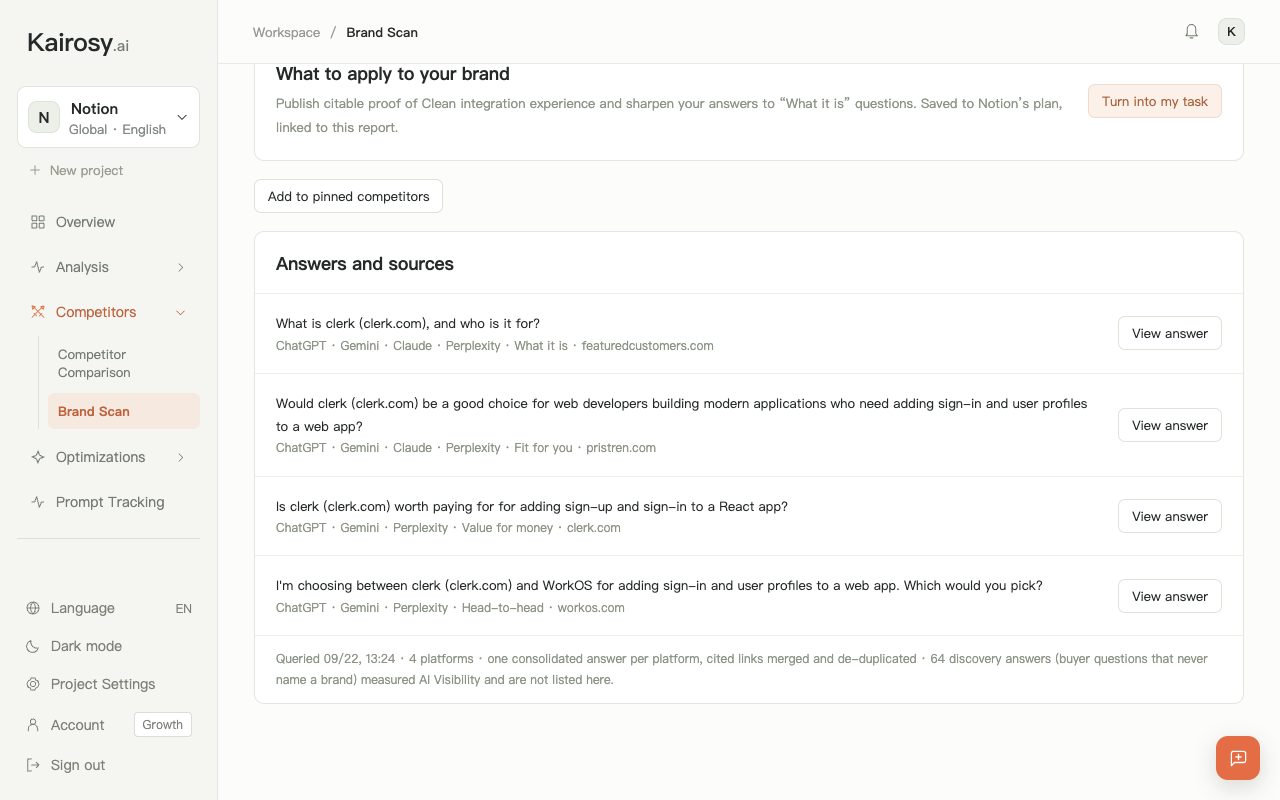
Rival product lines are worth a one-off scan before you add them to tracking. The view below is a Brand Scan of Resend in the US market; the same screen works for any competitor whose products keep displacing yours.
What Does a Product Discovery Path Map Look Like?
This is the deliverable to build for each hero SKU. It traces one buying scenario from question to re-test. The values below are example data for a fictional brand, Northwind, not measured results; replace them with your own runs.
| Stage | Example value (fictional) |
|---|---|
| Shopping question | "Best carry-on backpack for a photographer, under $200" |
| SKU recommended | A rival 30L camera pack; Northwind Trail 28 mentioned only as "also available" |
| Page cited | A third-party roundup listing the rival's laptop sleeve size |
| Missing attribute | Northwind page never states the laptop sleeve fits 16 inches or the carry-on dimensions |
| Change made | Added dimensions, sleeve size and airline-fit answer to page, feed product_detail and schema |
| Re-test | Same question re-run daily for two weeks; recommendation rate compared with the baseline |
One map per SKU forces the right discipline: every fix is tied to a question you can re-ask and a source you can see. That is what separates real ai brand visibility optimization tools from dashboards that only report a score.
LLM Tools for Improving Product Discoverability FAQs
Do I need a product feed if my pages are already well written?
Yes, if you sell physical goods. ChatGPT and Google both read structured product data from feeds; good pages help the answer text, while the feed drives eligibility for shopping results. They should say the same thing.
How is product discoverability different from trying to improve brand visibility in AI answer engines?
Brand visibility asks whether the assistant knows you. Product discoverability asks whether it picks a specific SKU for a specific need. You can improve brand presence in AI search results and still lose every "best X under $Y" question.
Which tools to increase brand’s visibility in LLM answers also work at SKU level?
Profound Shopping and Writesonic's AI Shopping Tracker track individual products in shopping responses. Kairosy works at the question level: put a product name in the question set and it reports mention, recommendation and sources per engine.
Does site search or a product directory count as LLM discoverability?
No. Your store's own semantic search serves visitors already on the site, and directories are just pages. Neither changes which products an external assistant recommends, though a directory may occasionally be cited.
How often should I re-test shopping questions?
Daily tracking gives you a stable average; act on trends across a week or two, not a single run. Re-test any edited SKU after its page and feed have been recrawled.
Can these LLM tools for improving product discoverability guarantee a recommendation?
No tool can. Assistants weigh third-party reviews, price and stock you do not fully control. What these tools give you is a measurable loop: find the missing attribute, fix it, and check whether the answer changed. For a page-level readiness check before you start, the AI-Ready Page Audit is the paid option.
See what AI says about your brand
Run a free scan across ChatGPT, Gemini, Claude & Perplexity in about 30 seconds.
Run my free scan