9 Best B2B SEO Tools in 2026 (Prices Verified)
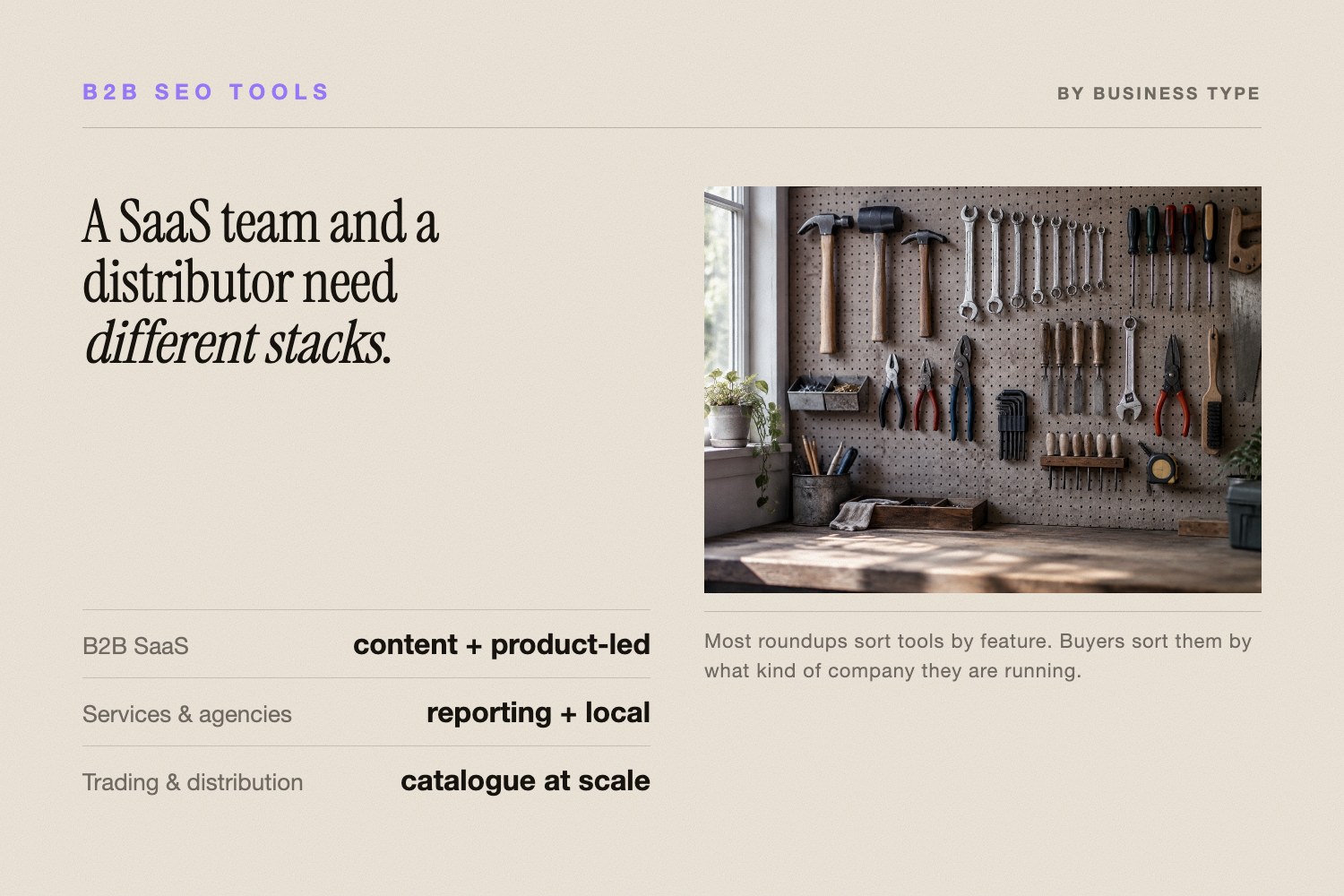
Most software roundups sort by feature — keyword research over here, backlinks over there. That ordering falls apart in B2B, because a 12-person managed IT firm and a 4,000-SKU industrial distributor share almost no requirements. So this list sorts nine B2B SEO tools by who is buying them: B2B SaaS, B2B services and agencies, and B2B trading, distribution and manufacturing.
Every price below was read off the vendor's own pricing page on August 5, 2026. Where a vendor publishes nothing, the entry says demo-and-quote instead of repeating a number from a review site.
What Makes B2B SEO Tools Different From B2C Tools?
Three structural differences change which software earns its seat.
First, the money hides in tiny search volumes. A phrase like "sso provisioning for scim" might get 90 searches a month and still route a $60k contract. Consumer-grade volume filters bury exactly the queries you want, so a B2B stack has to be usable at the long-tail end rather than the head.
Second, nobody buys alone. A procurement lead, an engineer and a CFO each research separately, and the pages that serve them look nothing alike — a security whitepaper, a spec sheet, a pricing comparison. Your tooling has to track a cluster of intents, not a keyword.
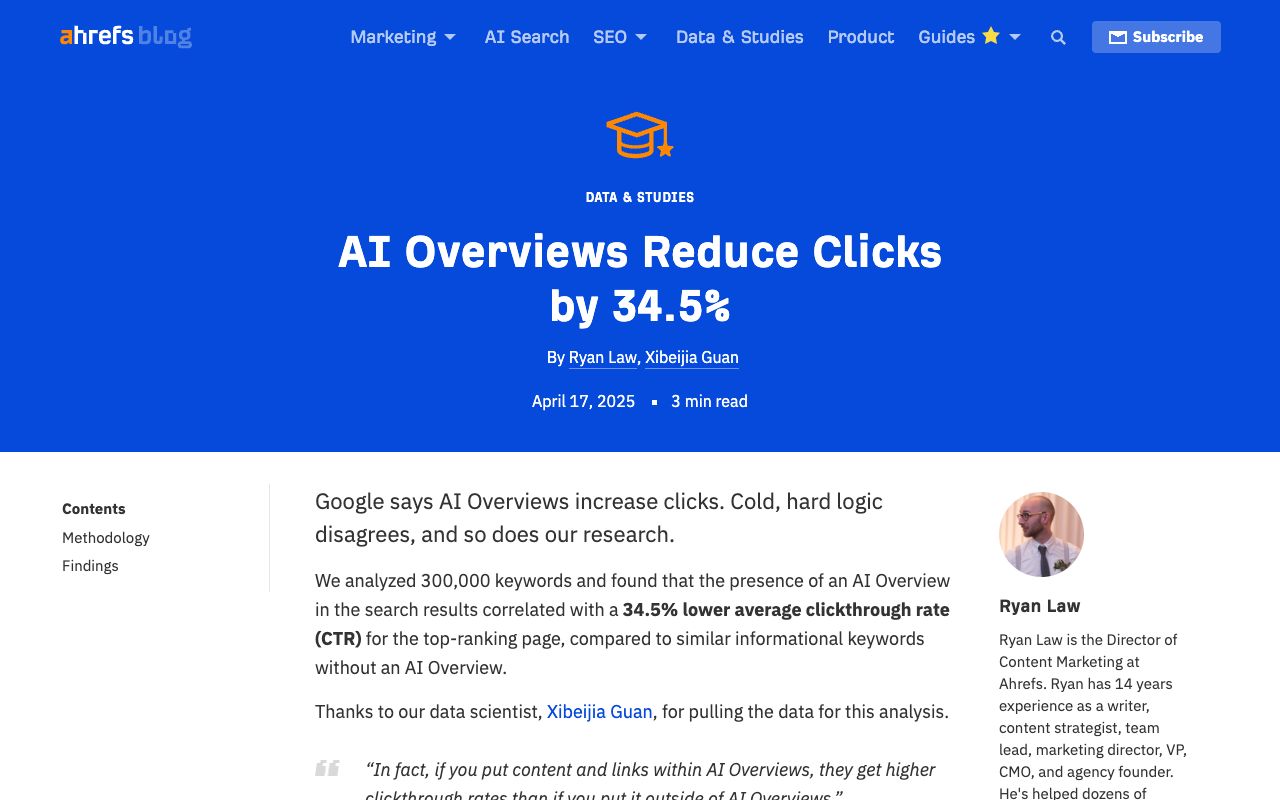
Third, discovery has partially moved off the results page. Ahrefs' April 2025 study of 300,000 keywords found that the presence of an AI Overview correlated with a 34.5% lower average clickthrough rate. In practice, a buyer now asks an assistant "who are the top vendors for X" and gets a three-name shortlist before any of those vendors know it happened. That is a new measurement surface, and none of the classic crawlers cover it.
So a working B2B stack answers four separate questions: what do buyers search, can our site be crawled and parsed, is our content good enough to be quoted, and do AI assistants name us when a shortlist gets built. Different company types weight those four very differently — which is why the sections below split by business model instead of by tool category.
Which B2B SEO Tools Fit a B2B SaaS Company Best?
SaaS is the segment where AI-assistant shortlisting bites hardest. Category pages, "best X software" listicles and review-site profiles are exactly the material assistants were trained on and continue to cite, so a SaaS brand's reputation in those answers is downstream of content it does not own.
1. Kairosy — for tracking whether assistants put you on the shortlist
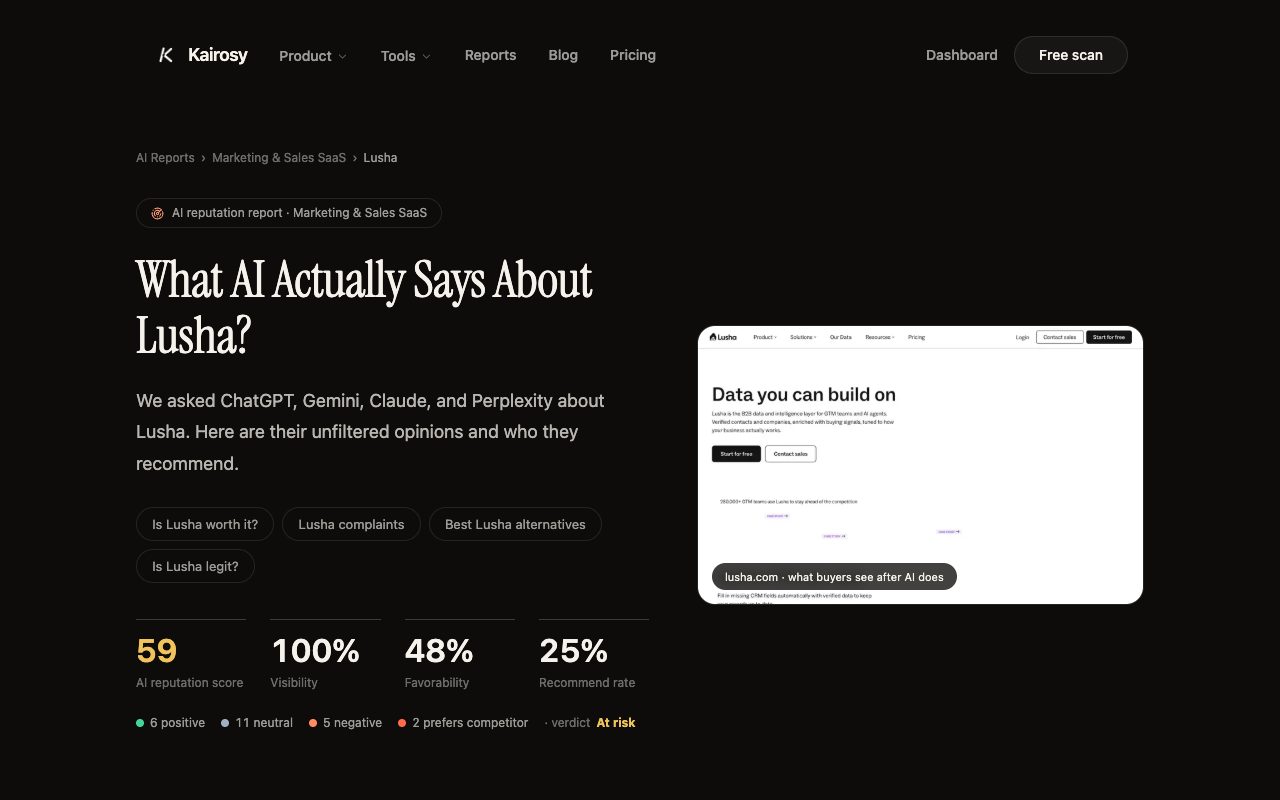
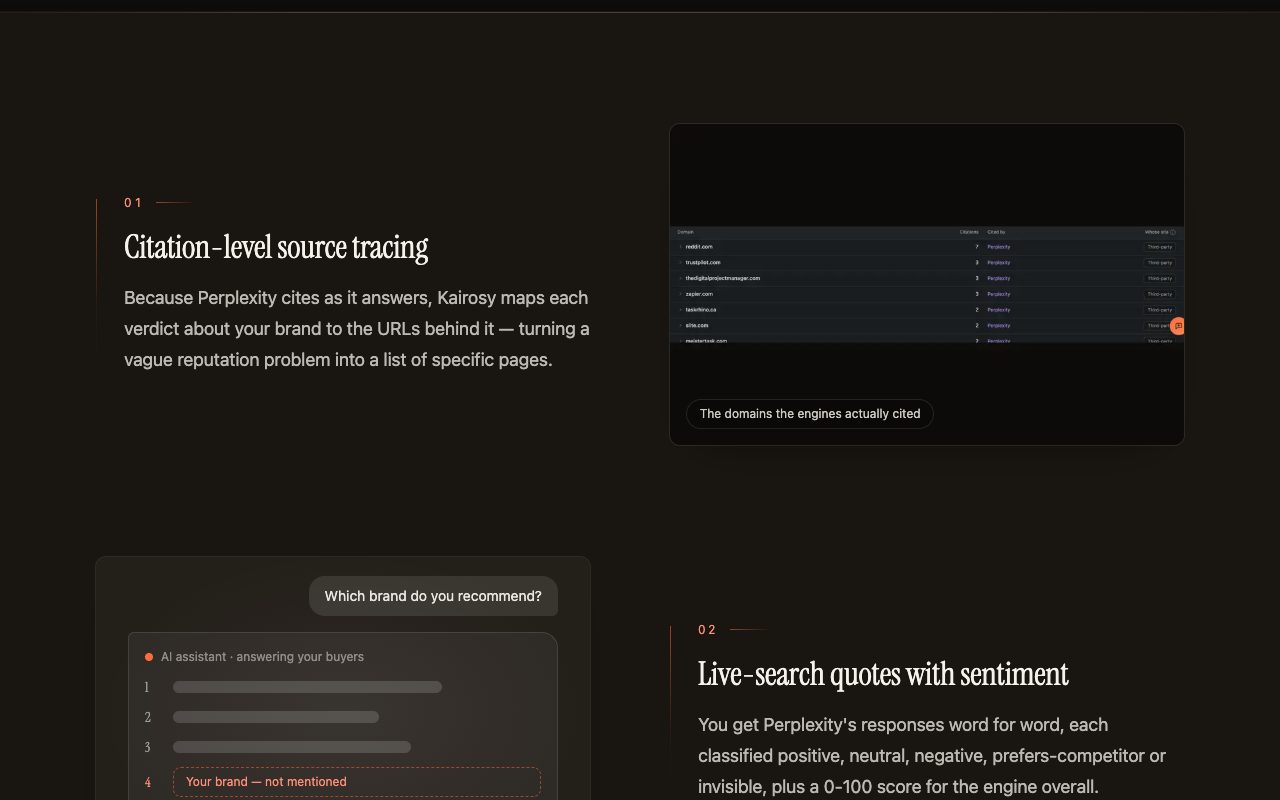
Kairosy sits in a different lane from everything else here. It does not track Google rankings or crawl backlinks. It runs the questions a prospect would actually type into an assistant, then records what ChatGPT, Gemini, Claude and Perplexity each answer — the score, the sentiment, which rival gets named instead of you, and which URLs the engines cited to justify it.
For B2B SaaS that matters because the competitive set in AI answers is often not the competitive set in your deck. Kairosy's scan of Pipedrive (24 buyer questions, August 1, 2026) returned 71/100 with 92% visibility but only a 63% recommend rate, and HubSpot was the top-named alternative in the answer set. Engine scores ranged from 81/100 on Perplexity down to 58/100 on Gemini, which is the kind of spread you never see in a rank tracker. The Kustomer scan is starker: 100% visibility but 58/100 overall, with Zendesk taking a 29% share of voice against Kustomer's own 26%. Being seen and being recommended are not the same metric.
Pricing: every new account gets 7 days of the full product, no card. Basic is $29/month (15 tracked prompts re-run daily, 8 AI content pieces), Pro is $99/month (28 prompts refreshed daily, 40 content pieces, competitor gap analysis), Growth is $399/month (70 prompts daily, 150 content pieces, white-label reports and API). Paid plans add country-specific scans across 25 markets, which matters if you sell the same product into the US and DACH with different competitors in each.
Honest limitation: it will not do keyword research or link building. Pair it with one of the two below. There is also a free AI-readiness audit if you want to check crawlability and structure before paying for anything.
2. Ahrefs — for building a category from a standing start
Most B2B SaaS companies are trying to rank for terms their category invented, which means the work is equal parts keyword discovery and link acquisition. Ahrefs is still the strongest single index for that combination, and its Site Explorer is the fastest way to reverse-engineer which comparison pages are sending competitors their trial signups.
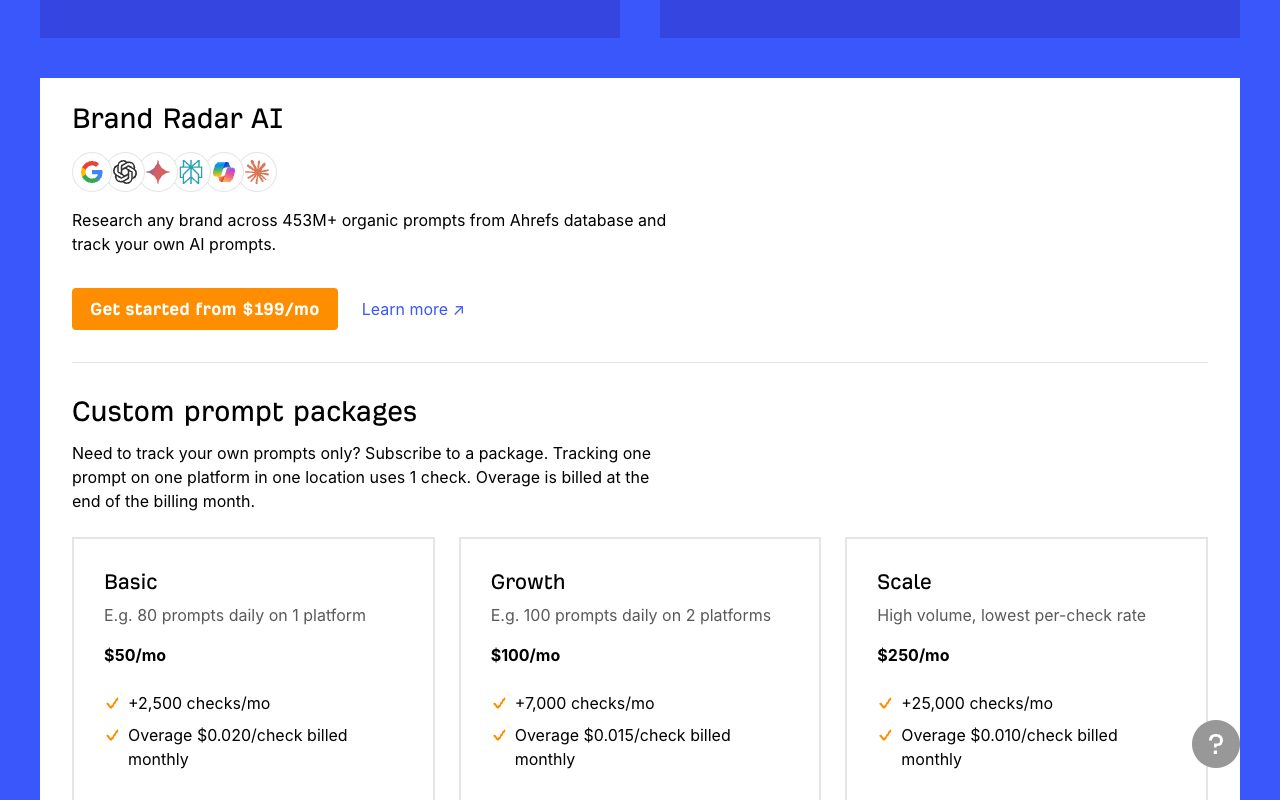
Pricing on ahrefs.com/pricing today: Starter $29/month, Lite $129/month (5 projects, 750 tracked keywords, 5 tracked AI prompts), Standard $249/month, Advanced $449/month, Enterprise $1,499/month on annual commitment. Brand Radar AI, its assistant-visibility module, is a separate line starting at $199/month, with custom prompt packages layered on top from $50 to $250/month. A free tier stays available for domains you have verified.
The catch for small SaaS teams: five tracked AI prompts on the $129 tier is a sample, not a monitor. If AI visibility is a real priority, the $199/month Brand Radar add-on roughly doubles your bill. We compared the wider field in our Ahrefs alternatives breakdown.
3. Clearscope — for briefs when your writers aren't subject-matter experts
SaaS content fails in a specific way: a freelancer writes a competent 1,800-word piece about a technical workflow they have never performed, and it reads like it. Clearscope's grading works well as a floor — it forces coverage of the entities and subtopics that already-ranking pages treat as mandatory, which catches the worst gaps before a draft reaches an SME reviewer.
Pricing on clearscope.io/pricing: Essentials $129/month (50 pages, 50 tracked prompts, 20 topic explorations), Business $399/month (300 pages, 300 tracked prompts, dedicated account manager), Enterprise quote-only. Users and projects are unlimited on every tier, which is unusual and genuinely useful for a content team with rotating contractors.
Before you optimize anything, run a draft through our free reading level checker. Technical B2B copy that scores at postgraduate reading level tends to get skipped by both skim-readers and extractive summarizers.
What Are the Best SEO Tools for B2B Services Firms and Agencies?
A services business — an agency, consultancy, law firm, MSP, staffing group — has the opposite problem to SaaS. The site is small, the money is local or vertical, and the deliverable is often a report you hand to someone else. So the priorities are multi-client management, defensible reporting, and enough breadth that you are not paying four vendors.
4. Semrush — for breadth when one seat has to cover everything
Semrush wins on surface area rather than any single depth. One login covers keyword research, position tracking, technical site audit, backlink work, local listings and paid-search intel, which is the right shape when a two-person marketing team also owns advertising.
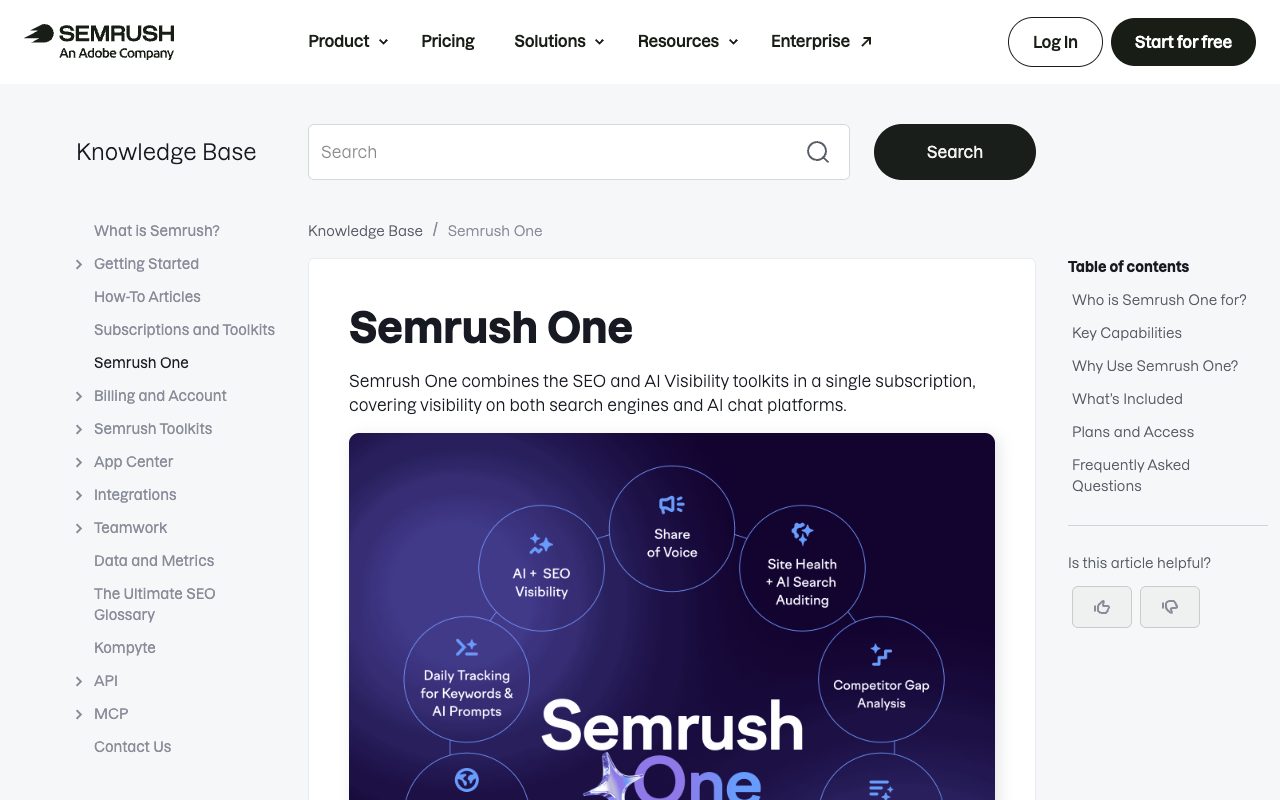
Pricing on semrush.com/pricing, month-to-month: SEO $139, Starter $199, Pro+ $299, Advanced $549. Annual billing cuts roughly 17% (SEO drops to $117.33/month). Website limits run 5 on the lower tiers to 40 on Advanced, with 500 to 5,000 keywords tracked daily. Read the plan names carefully — the $139 SEO plan is classic search only, and assistant tracking starts at Starter, which bundles 50 prompts tracked daily on a single domain. Pro+ raises that to 100 prompts and Advanced to 200. Extra users start at $45/month, which adds up fast in an agency.
Where it hurts: seat costs. A five-person agency on Pro+ pays $299 plus four seats, and the practical answer is usually sharing one login until that breaks.
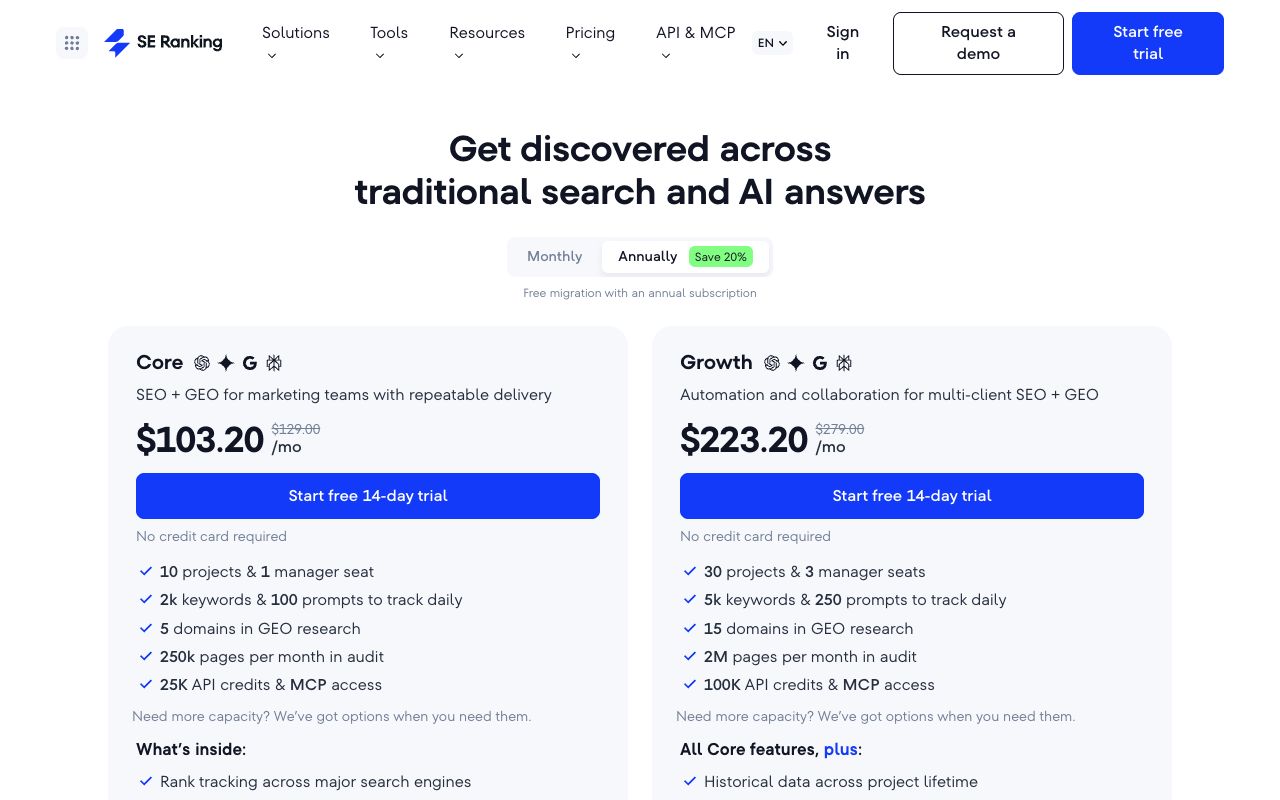
5. SE Ranking — for agencies that live inside client reporting
If your deliverable is a monthly PDF with someone else's logo on it, SE Ranking is the most economical serious option among the seo tools for B2B agencies. It covers the same core jobs as Semrush at a lower entry point and treats white-label reporting as a first-class feature rather than an enterprise upsell.
Pricing on seranking.com: Core $129/month (10 projects, 2,000 daily-tracked keywords, 1 seat), Growth $279/month (30 projects, 5,000 keywords, 3 seats), Enterprise custom. Two add-ons matter for agencies — the Agency Pack at +$69/month, which carries white-label reporting and 30 client seats but requires annual billing, and the AI Search Toolkit at +$89/month for 200 prompts on Growth across AI Overviews, AI Mode, ChatGPT and Perplexity. A 14-day trial runs on every plan without a card.
Read the annual-billing condition carefully. The headline monthly price does not include the agency features most agencies are shopping for.
6. Surfer — for shops producing volume against a deadline
Agencies with a content-production line care about throughput per writer more than about model sophistication. Surfer's editor is fast to learn, the outline builder cuts brief-writing time, and juniors ship acceptable drafts sooner.
Published tiers on surferseo.com/pricing are billed yearly: Discovery $49/month (120 documents), Standard $99/month (360 documents, 25 AI prompts refreshed weekly and ChatGPT only), Pro $182/month (50 prompts refreshed daily across ChatGPT, Perplexity, Google and Gemini, 5 brand workspaces), Peace of Mind $299/month (unlimited documents under fair use, 100 prompts), Enterprise custom. There is also a standalone AI Search Analytics plan at $158/month for teams who want the tracking without the editor. Monthly-billing rates are not shown on the page, so budget against the annual figures.
Caveat worth saying out loud: a high optimization score is a correlation with pages that already rank, not a promise. It is a quality floor for volume work, not a strategy.
Which B2B SEO Tools Suit Manufacturers, Distributors, and Traders?
This segment has the opposite profile again: enormous sites, thin per-page content, product data locked in a PIM or an ERP, PDFs everywhere, and buyers searching by part number, spec, alloy grade or HS code. Content optimization is barely the issue. Crawl budget, index coverage and structured data are.
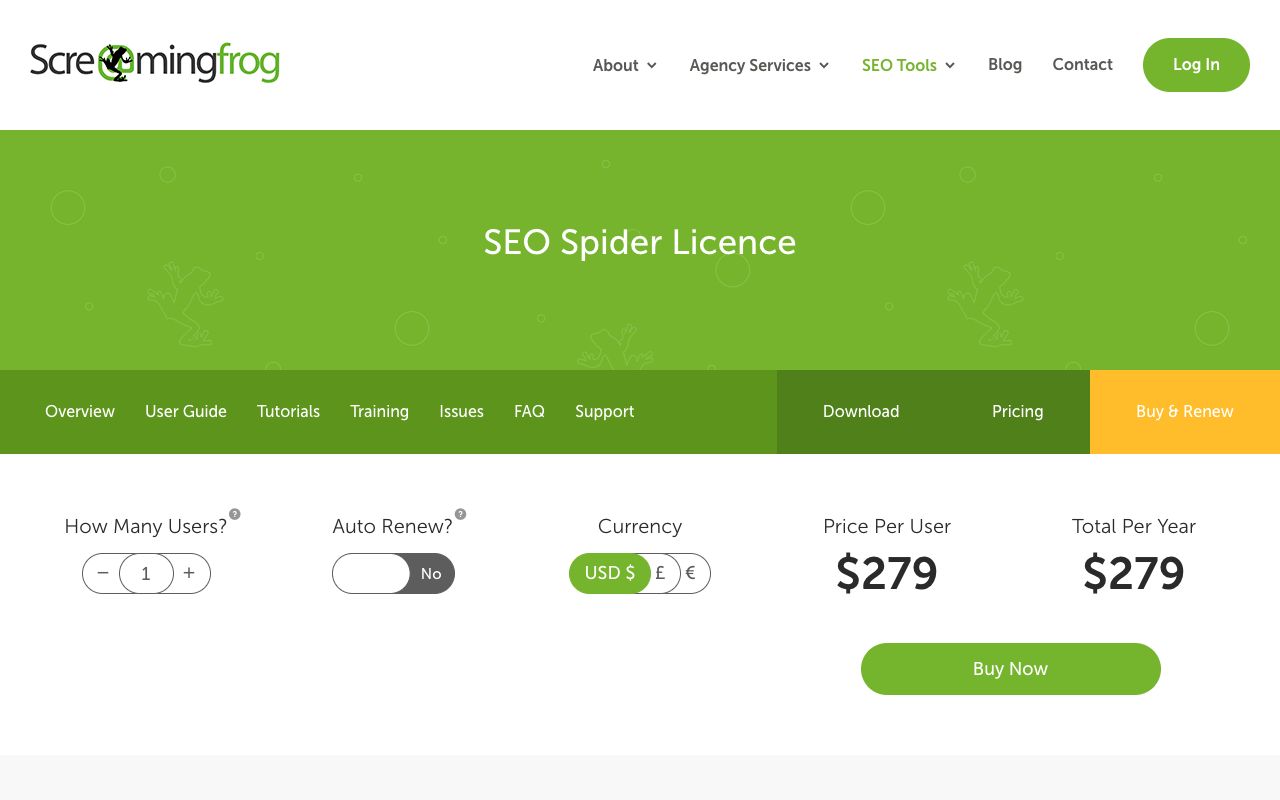
7. Screaming Frog SEO Spider — for catalogs that break cloud crawlers
A 300,000-URL catalog with faceted navigation is where most hosted auditors quietly sample and give up. Screaming Frog runs on your machine, so you control memory and storage, and it will pull custom fields out of product templates with XPath or regex — part numbers, stock states, spec-table rows — which turns "is our data on the page at all" into an answerable question.
Pricing on screamingfrog.co.uk: $279 per licence per year, with bulk discounts. The free version crawls 500 URLs per run and otherwise includes the feature set. Chromium-based JavaScript rendering, XML sitemap generation, redirect auditing and structured-data validation are all in the box. Log file analysis ships as a separate download.
Then pair the crawl output with two free checks: our index checker to confirm the product URLs you care about are actually indexed, and the schema markup checker against Google's Product structured data requirements. Distributors lose more visibility to malformed product markup than to any content problem.
8. Google Search Console — the free baseline nobody should skip
Search Console is free, and for a catalog site it is the only honest source on index coverage — how many of your product URLs Google accepted, which it discarded as duplicates, and which it crawled but chose not to index. Its query data is also the cleanest read on part-number and spec-string searches, because those phrases are too sparse to show up in any third-party keyword database.
Its limits are real: 16 months of history, sampled query rows, and nothing at all about competitors. Treat it as ground truth for your own site and buy the rest.
9. Similarweb — for demand and market sizing before you commit budget
Distribution and manufacturing SEO decisions are usually territory decisions: which region, which category, which competitor's traffic is actually worth chasing. Similarweb is the standard estimate for that, covering traffic sources, geographic split and audience overlap across a market rather than a single site.
Pricing is demo-and-quote. Similarweb publishes no plan prices for its business and enterprise packages and routes you to sales for a custom package. The browser extension and a set of free tools, including a website traffic checker and keyword generator, are available at no cost. If your need is specifically account-level buying signal rather than traffic estimates, Bombora's Company Surge is the usual B2B intent alternative, also demo-and-quote with no published rate card.
B2B SEO Tools Pricing Compared (Verified August 5, 2026)
Entry price means the cheapest tier that does real work, not a trial. Every figure came from the vendor's own page on the date above.
| Tool | Best fit | Entry price | Free option |
|---|---|---|---|
| Kairosy | All three segments (AI answer visibility) | $29/mo Basic | 7-day full trial, no card |
| Ahrefs | B2B SaaS | $29/mo Starter, $129/mo Lite | Webmaster Tools, free forever |
| Clearscope | B2B SaaS content teams | $129/mo Essentials | None published |
| Semrush | Services firms wanting one login | $139/mo SEO, $199/mo with AI search | Limited free account |
| SE Ranking | Agencies with client reporting | $129/mo Core | 14-day trial |
| Surfer | High-volume content production | $49/mo Discovery, billed yearly | None published |
| Screaming Frog | Large catalogs and technical audits | $279 per licence per year | 500 URLs per crawl |
| Google Search Console | Every B2B site | Free | Free |
| Similarweb | Market and territory research | Demo-and-quote | Extension and free tools |
Add-ons distort this comparison if you ignore them. Ahrefs charges from $199/month for Brand Radar AI on top of the plan price, and SE Ranking bills the Agency Pack (+$69/month) and the AI Search Toolkit (+$89/month) as separate lines. Semrush folds assistant tracking into the plan itself, but only from the $199 Starter tier upward — the $139 entry plan does not include it. Read that as a market signal: every major suite now prices AI-answer tracking as premium, which tells you what they think it is worth.
How Do You Choose the Best SEO Platform for B2B in 2026?
There is no single best SEO platform for B2B, but there are three defensible stacks by budget.
Under $100/month. Google Search Console plus Ahrefs Webmaster Tools plus free Screaming Frog covers crawl health and your own performance data. Add Kairosy Basic at $29/month so you know whether assistants name you at all. You will lack competitor keyword data — accept that and go deeper on customer interviews instead.
$150–$400/month. Pick one suite, not two. Services firms take SE Ranking Core at $129; SaaS takes Ahrefs Lite at $129. Add Kairosy Pro at $99 for daily prompt tracking, and keep the free Screaming Frog for spot audits. This is where most sub-50-person B2B companies should land.
$600/month and up. Semrush Pro+ or Advanced as the system of record, Clearscope Business for editorial standards, a paid Screaming Frog licence, and Kairosy Growth if you need white-label output or API access. Add Similarweb only when a real territory decision depends on it.
Whichever tier you pick, split the budget across two jobs, not one. Classic B2B SEO tools tell you where you rank. They cannot tell you that an assistant just handed a prospect three competitor names — that requires continuous AI brand monitoring, and it is the measurement gap most 2026 stacks still have. Our roundup of LLM visibility tools covers that category on its own.
B2B SEO Tools FAQs
What are the best B2B SEO tools for a small team?
For a team under ten people, Google Search Console plus one paid suite is enough. SE Ranking Core at $129/month or Ahrefs Lite at $129/month both cover research, tracking and audit. Add an AI visibility tracker separately, since assistant answers are now part of how B2B shortlists get formed.
Are free B2B SEO tools good enough to start?
For your own site, largely yes. Search Console, Ahrefs Webmaster Tools, the 500-URL free Screaming Frog and Kairosy's 7-day free trial will surface most problems. What free tiers never give you is competitor data — no free tool shows which pages are winning your rivals their pipeline.
What is the best SEO platform for B2B SaaS specifically?
Ahrefs, for the combination of keyword depth and link data you need to build a category. But its AI-prompt allowance is small at the entry tiers, so most SaaS teams run a dedicated AI-visibility tool next to it rather than paying $199/month extra for Brand Radar.
Do B2B SEO tools track ChatGPT and other assistants yet?
Partly. Semrush bundles it from the $199/month Starter plan up, SE Ranking sells it as an $89/month add-on, Surfer includes 25 weekly prompts on its $99 tier, and Ahrefs sells Brand Radar from $199/month. Coverage depth varies a lot, and most suites report mention counts rather than sentiment, competitor substitution or the citations sitting behind an answer.
How many SEO tools for B2B does one company actually need?
Three, usually. One suite for keywords and rankings, one crawler for technical health, and one AI-visibility tracker. Buying a fourth overlapping suite is the most common waste in B2B SEO budgets — teams end up paying twice for the same keyword index.
How often should you re-check your AI visibility?
Monthly at minimum, weekly if you are in an active competitive category. Assistant answers shift when the sources behind them change, so a single scan is a snapshot. Weekly rescans with alerting catch a competitor displacing you before it shows up in pipeline.
See what AI says about your brand
Run a free scan across ChatGPT, Gemini, Claude & Perplexity in about 30 seconds.
Run my free scan