Best Ways to Monitor Brand Mentions in AI Search (2026)
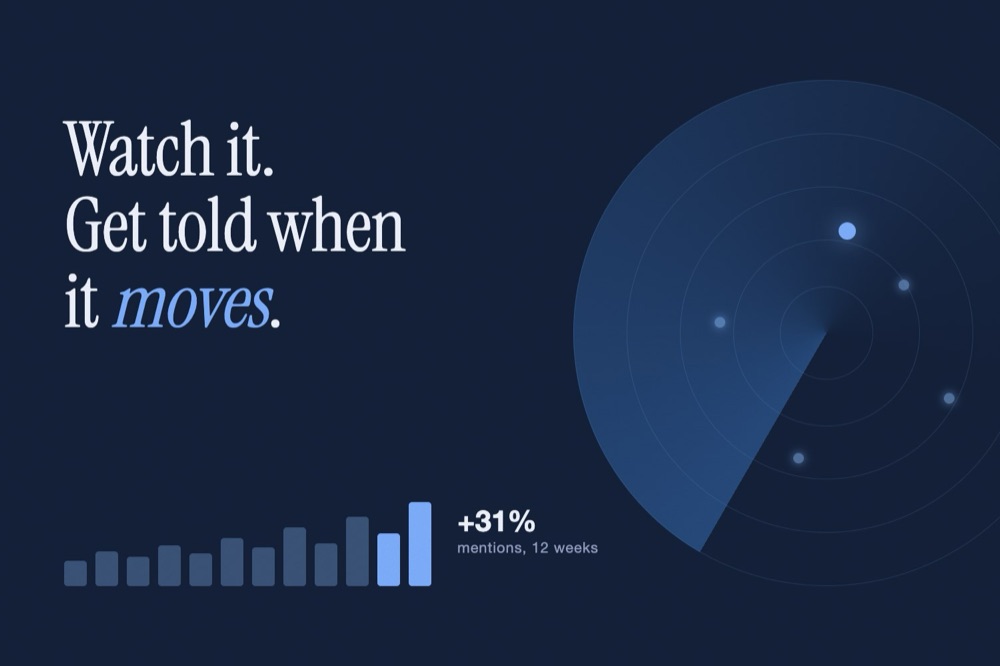
A buyer asks Perplexity which tool to pick. A prospect asks ChatGPT if you're legit. A journalist asks Gemini what you're known for. Those conversations are happening right now, they're shaping opinions before anyone visits your site, and by default you never see them. Monitoring is how you get eyes on that invisible channel. This guide covers why it matters, what to watch, the best ways to monitor brand mentions in AI search, and the tools that do it for you.
Why should you monitor brand mentions in AI search?
AI search has crossed from novelty to real buying channel. Adobe Analytics found retail traffic from AI sources rose 138% year over year in May 2026, and those AI-referred visitors converted at a 54% higher rate than other traffic — a reversal from a year earlier. The money is following the attention. Here's why you should monitor brand mentions in AI search results before your competitors do:
- The answer is your first impression, and you didn't write it. Whatever ChatGPT or Gemini says about you is what a buyer believes first — you don't get to approve it.
- Errors and negatives harden. A wrong price or an outdated fact gets repeated across sessions until it becomes the default answer, unless someone is watching.
- Competitors get recommended instead of you. When AI names a rival as "the best option" for your category, that's a lost deal you never even saw.
- The market is pricing this as urgent. Profound raised $96M at a $1B valuation in early 2026 purely to monitor how brands appear in AI answers — investors see the problem clearly.
What to monitor in AI search
Five signals make up a complete picture. Watch all of them, not just whether you're mentioned:
| Signal | The question it answers |
|---|---|
| Visibility | Are you named at all when buyers ask category questions? |
| Favorability / sentiment | How are you described — positive, neutral, or with caveats? |
| Sources | Which URLs does the AI cite to build its answer? |
| Competitor share | Who gets recommended instead of, or ahead of, you? |
| Change over time | Are those trending up or down since last week? |
Sources are the most actionable of the five: they're the levers you can pull. If Perplexity keeps citing a three-year-old review, that review — not your homepage — is where the fix lives. Competitor share is the one executives grasp fastest, because "we're named in 2 of 10 answers and our rival is in 8" turns an abstract AI worry into a concrete competitive gap. And change over time is what separates monitoring from a one-off audit: a single snapshot can't tell you whether you're gaining or losing ground, only a trend can.
Best ways to monitor brand mentions in AI search
Think of these as a maturity ladder, from free-but-manual to automated-and-reliable:
- Manual spot-checks. Type your buying questions into each AI yourself. Free and instant for a gut-check, but not repeatable and impossible to trend.
- Prompt-set tracking. Define a fixed set of buyer-intent prompts and re-run the same set on a schedule so results are comparable over time. This discipline underpins every serious tool.
- Automated scans with alerts. Software runs the prompt set on a cadence and flags changes, so you're notified rather than remembering to look. The catch: alerts must fire on material change only, or fatigue sets in.
- Cross-engine coverage. Watch ChatGPT, Gemini, Claude, and Perplexity together. A brand can be strong in one and invisible in another, so single-engine monitoring gives a false read.
- Act on the sources. The payoff of monitoring isn't the dashboard — it's fixing the citations. Correct your own pages and earn accurate mentions on the third-party sites AI pulls from.
That last rung is the bridge from watching to improving, and it's where an ongoing AI brand monitoring setup earns its keep. Most teams climb this ladder in order: they start with a few manual checks, realize the answers keep changing, graduate to a fixed prompt set in a spreadsheet, and eventually hand the whole thing to a tool once the manual version becomes a chore nobody keeps up. The mistake is stopping at spot-checks — a metric you measure once and never again tells you nothing about whether your last fix worked or whether a competitor just overtook you.
Best AI brand monitoring tools
Four monitoring platforms plus a listening-tool option, each with a different center of gravity:
Profound
Profound is the enterprise heavyweight, reporting use by 700+ enterprises and more than 10% of the Fortune 500. It monitors how brands surface across AI answers and agent outputs with deep analytics — the choice for large teams with budget to match.
Otterly.ai
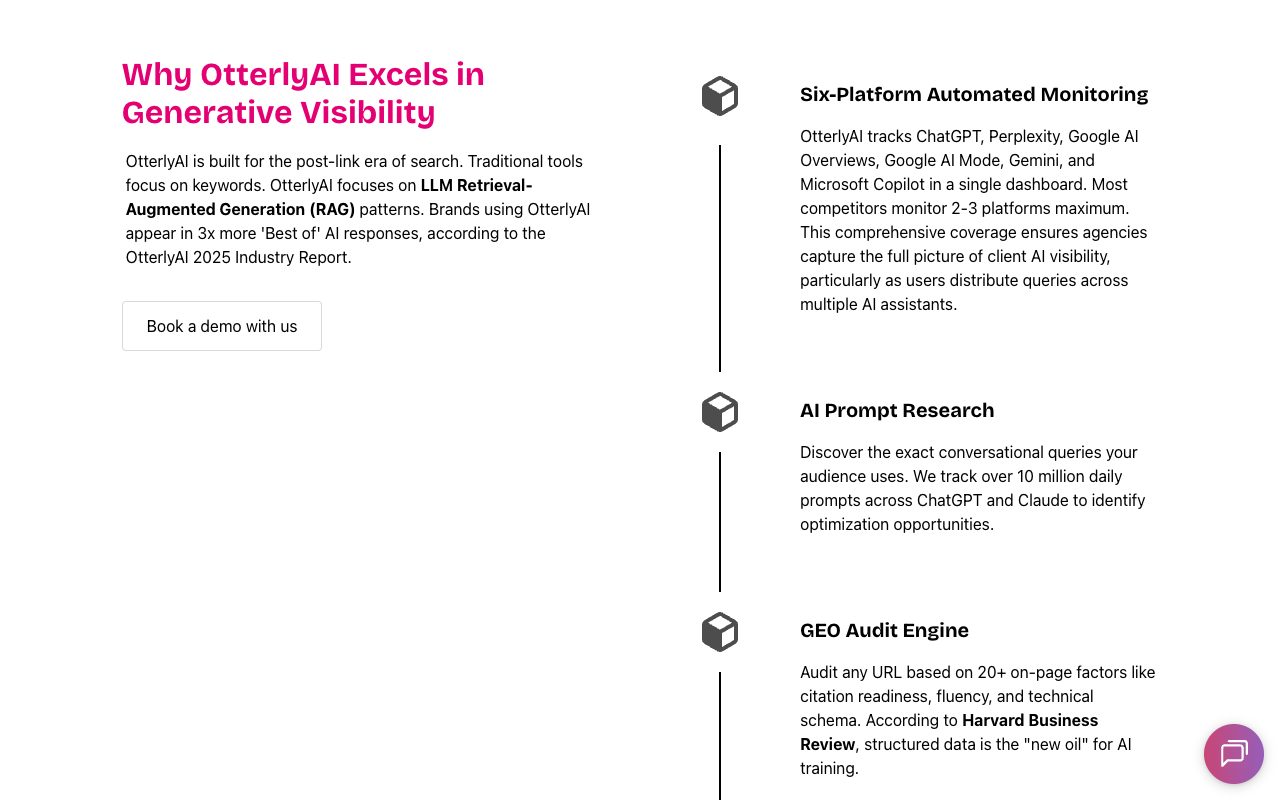
Otterly.ai monitors six engines — ChatGPT, Google AI Overviews, AI Mode, Gemini, Perplexity, and Copilot — tracking mentions, citations, position, and sentiment. Its Lite plan starts at $29/mo for 15 prompts, making it the most accessible dedicated monitor here.
Peec AI
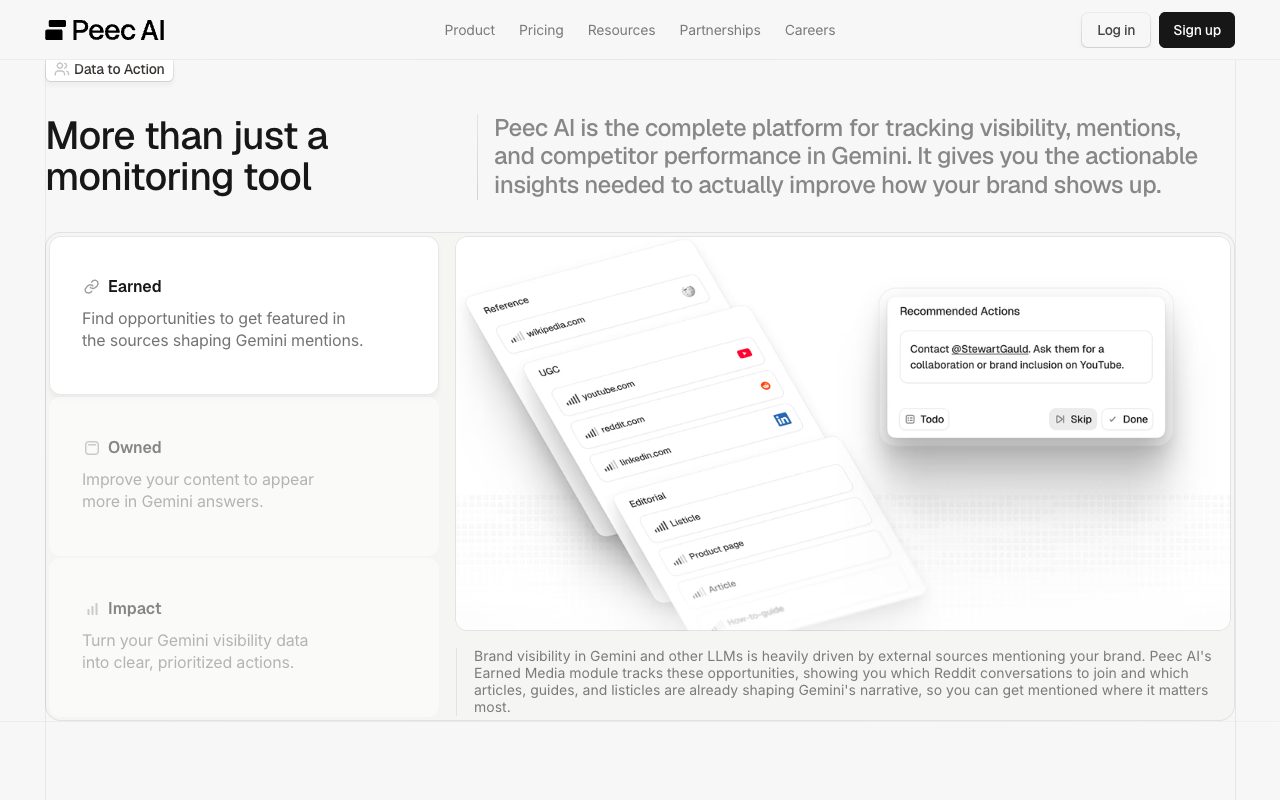
Peec AI tracks four dimensions per engine — position, sources, sentiment, and mention frequency — and adds an "Earned Media" module surfacing the Reddit threads and articles shaping your answers. Strong for teams that want to see the sources, not just the scores.
Semrush and Brand24
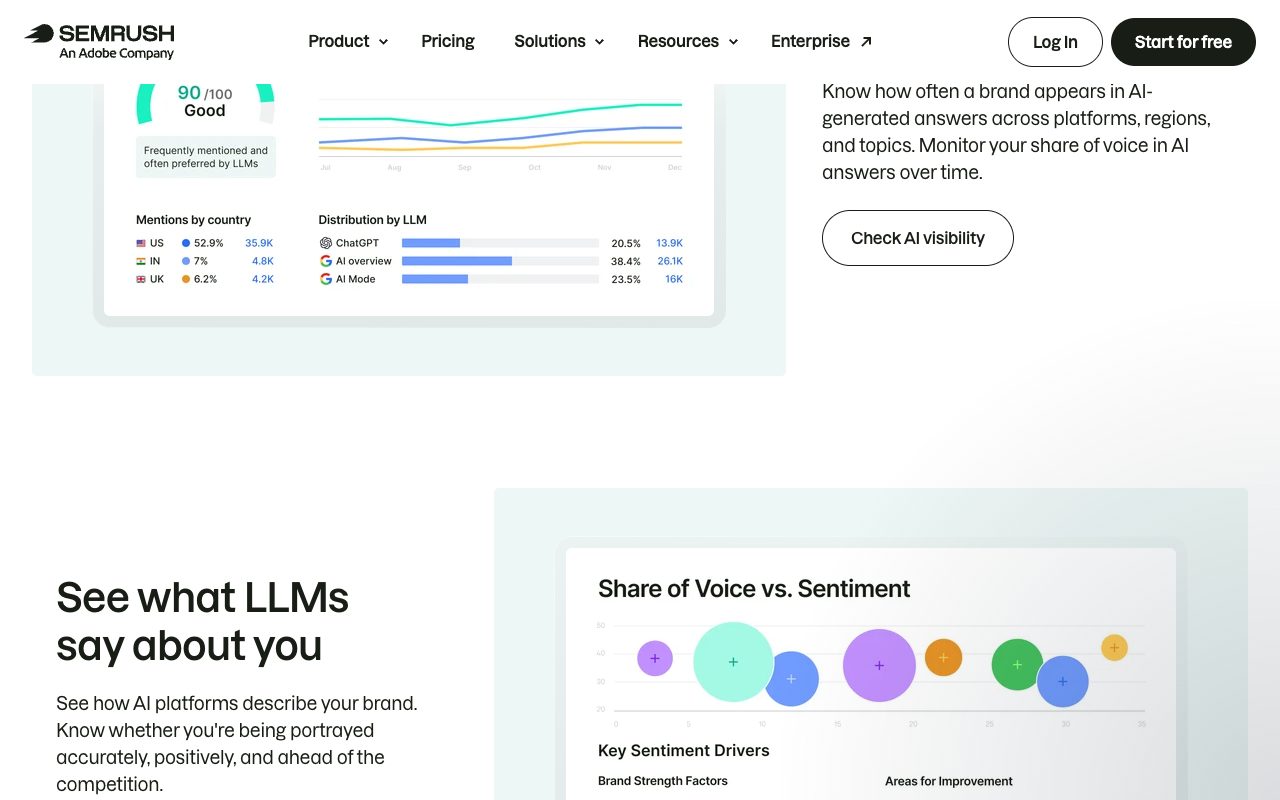
Semrush launched its AI Visibility Toolkit in late 2025, tracking mentions, position, citations, and share of voice across ChatGPT, Google AI Mode, Perplexity, and Gemini — convenient if you already run Semrush. Brand24 is the social-listening incumbent that added AI-chatbot monitoring, useful if you want AI mentions alongside traditional social listening.
How to turn monitoring into a positive AI reputation
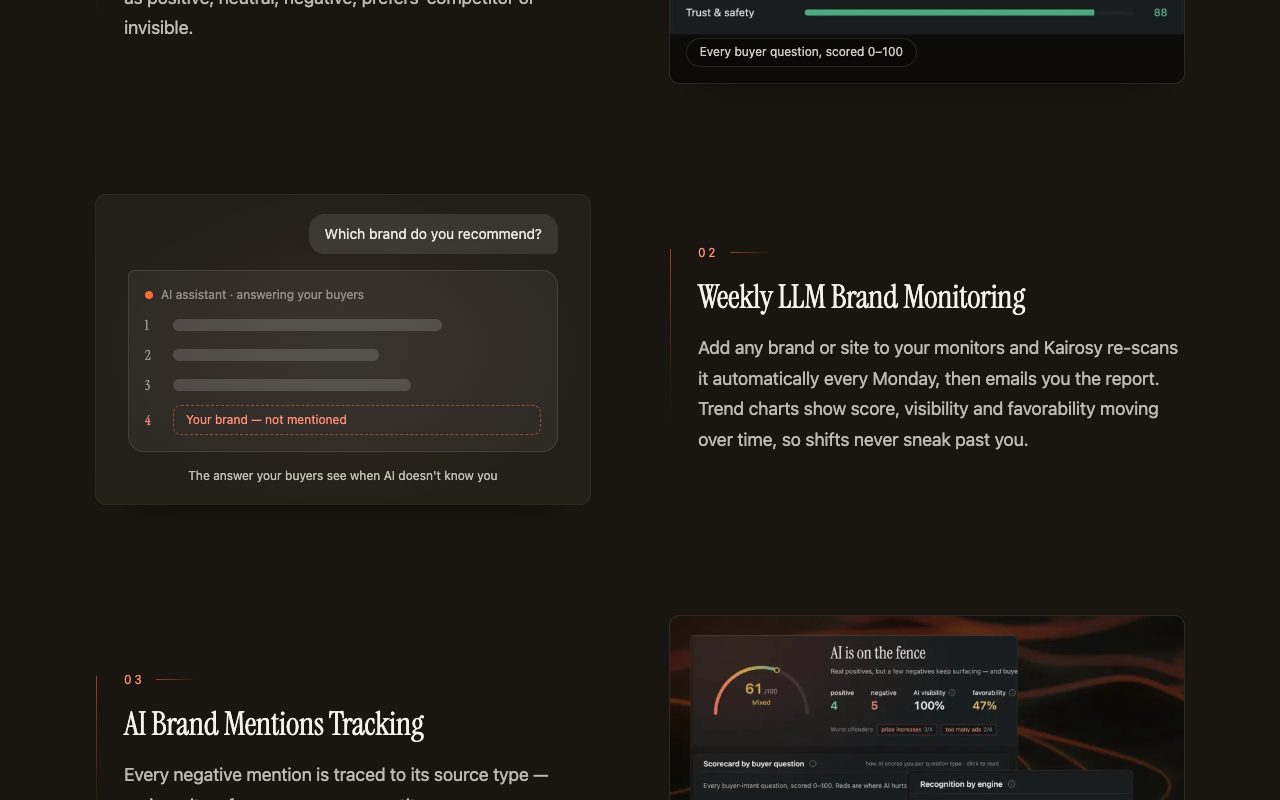
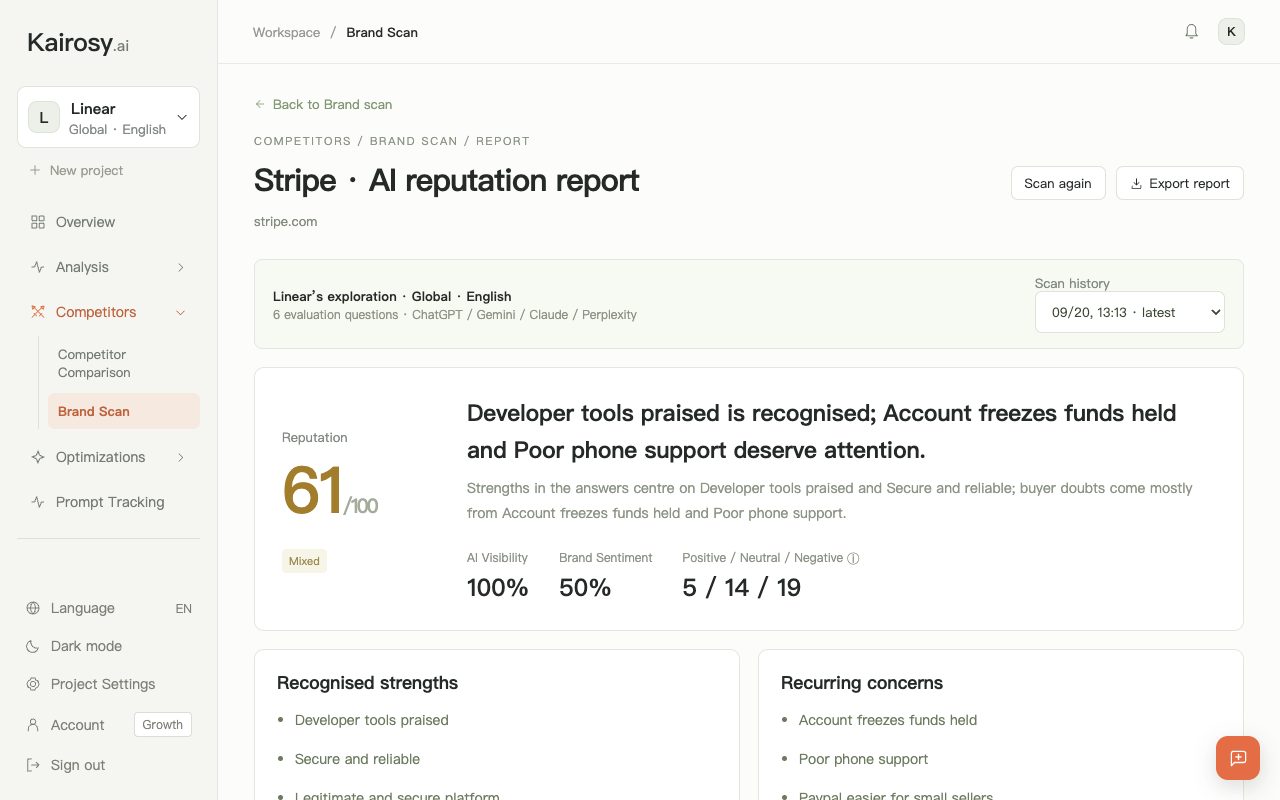
Monitoring is step one; the goal is a better answer. Kairosy is built for exactly that loop — it scans your brand across ChatGPT, Gemini, Claude, and Perplexity, re-scans every week, and emails an alert only when something new and negative appears: a fresh negative, a competitor starting to get recommended, or a score drop. That "tell me only when it actually changes" design is the anti-cry-wolf approach the methods above call for. From there it points you at the sources to fix — see a worked example in this Allbirds AI performance report. The first scan is free, and it's worth checking your AI crawler access at the same time.
AI brand monitoring FAQs
How often should I monitor my brand in AI search?
Weekly is the sensible default — it matches how fast AI answers drift with model updates while staying manageable. Fast-moving or high-stakes categories may warrant more frequent checks.
Which AI engines should I monitor?
At minimum ChatGPT, Gemini, Claude, and Perplexity, since buyers split across them. Google AI Overviews and Copilot are worth adding if your audience uses them heavily.
Can I monitor AI brand mentions for free?
Manual spot-checks cost nothing, and Kairosy's monthly scan and Semrush's free checker give automated entry points. Free options are fine to start; paid tools add history, alerts, and multi-engine coverage.
What's the difference between monitoring and improving my AI presence?
Monitoring tells you what AI says; improving means acting on it — fixing your pages and the third-party sources AI cites, then re-scanning to confirm the answer moved. Good monitoring makes the second step possible.
See what AI says about your brand
Run a free scan across ChatGPT, Gemini, Claude & Perplexity in about 30 seconds.
Run my free scan