Prompt Volume Data Explained: Vendors, Units and Limits (2026)
Prompt volume data is a vendor's estimate of how often people send a given question, or a cluster of similar questions, to an AI assistant such as ChatGPT, Gemini, Claude or Perplexity over a stated period. No AI platform publishes these totals, so every figure you will see is modeled from a panel, from clickstream, or from Google search volume, and the three methods disagree.
This guide defines the metric, describes the vendors that sell it and the free Google Trends proxy, separates prompt volume data from keyword search volume and from your own monitoring counts, and closes with a provenance checklist and a rewording demonstration. One boundary first: Kairosy does not provide prompt volume data. It measures what the engines answer, not how often people ask.
What Is Prompt Volume in AI Visibility or SEO?
In AI visibility work, prompt volume is the demand side: an estimated count of prompts on a topic, per platform, per time window. It plays the role monthly search volume plays in SEO, with one structural difference. A Google query is short and repeats verbatim thousands of times. An AI prompt is long, conversational and rarely identical twice, so vendors must cluster prompts before they can count anything.
Four attributes define any prompt volume figure, and a number missing one of them is not comparable to anything:
- Unit. Prompts per month (Profound Prompt Volumes, Semrush topic-level volume) or an impression-style estimate derived from Google volume (Ahrefs "AI adjusted volume"). Not interchangeable.
- Platform. Always per assistant. Profound's product page, read October 21, 2026, lists ChatGPT, Gemini, Claude and Perplexity, with Grok and DeepSeek described as coming later.
- Time window. Profound refreshes weekly on a series that begins in January 2025; Ahrefs refreshes assistant data monthly over a 90-day window. Different windows, different numbers.
- Geography. Panels and clickstream are country-specific. Profound names ten countries, Semrush claims 117 regional databases, and a US figure says nothing about Germany.
Semrush's clickstream study of ChatGPT search behavior (April 7, 2026; over 1 billion lines of US data, October 2024 to February 2026) shows why the unit matters: 65% to 85% of prompts could not be matched to any traditional search keyword, and search-enabled prompts averaged 8.7 words against 13.5 for the rest. Every vendor therefore counts a bucket, and the bucket is their design decision.
Which AI Search Tools With Prompt Volume Data Are Worth Checking?
Profound Prompt Volumes: panel projection
Profound's Prompt Volumes went generally available to enterprise customers on June 10, 2025. The feature page says the data comes from "double opt-in consumer panels of real answer engine users," scaled to "hundreds of millions of prompts per month from millions of active users." The launch post is candid that totals are projected: probabilistic modeling analyzes "tens of millions of real conversations, extrapolating frequency, intent, and sentiment across broader populations." Pricing is not published on the feature page.
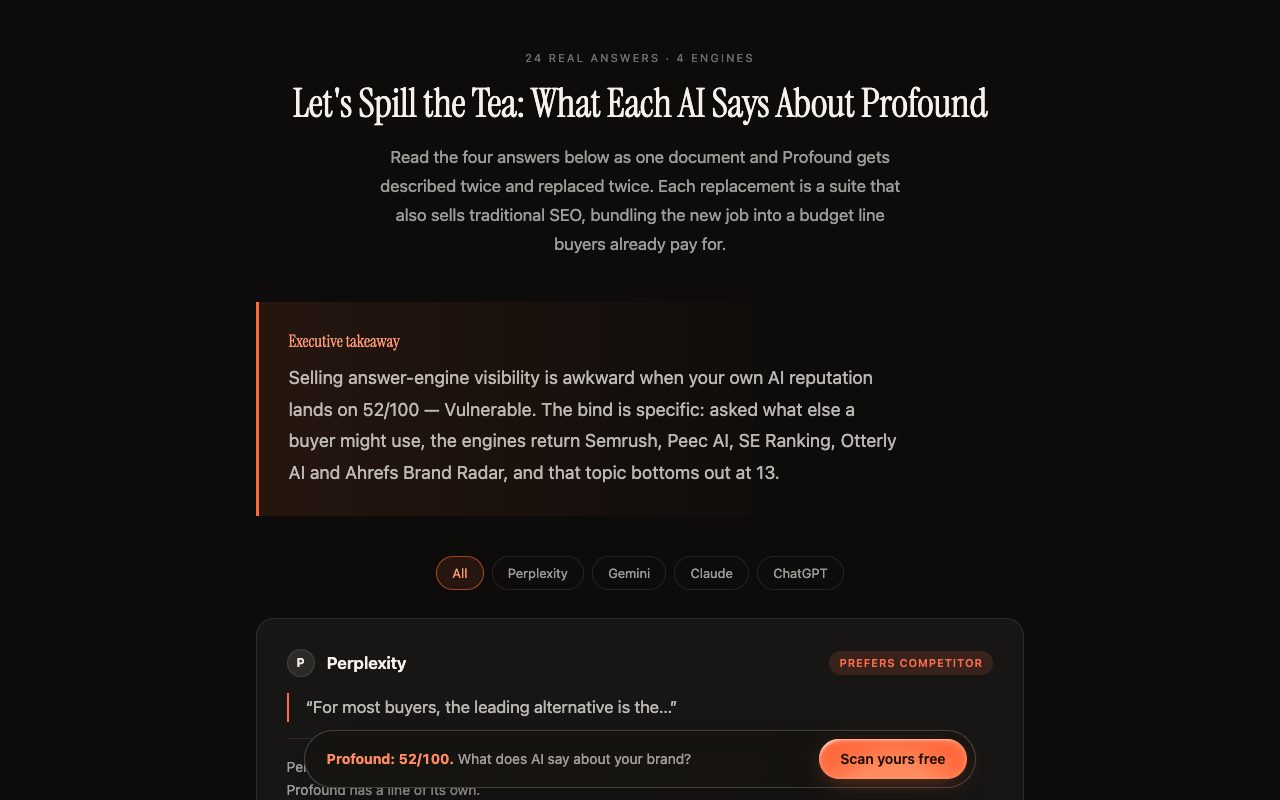
Kairosy's public scan of Profound shows the other side of the coin: how the assistants describe the vendor itself, with every cited source. Volume and reputation are two separate measurements.
Google Trends Explore: a free proxy, not prompt volume
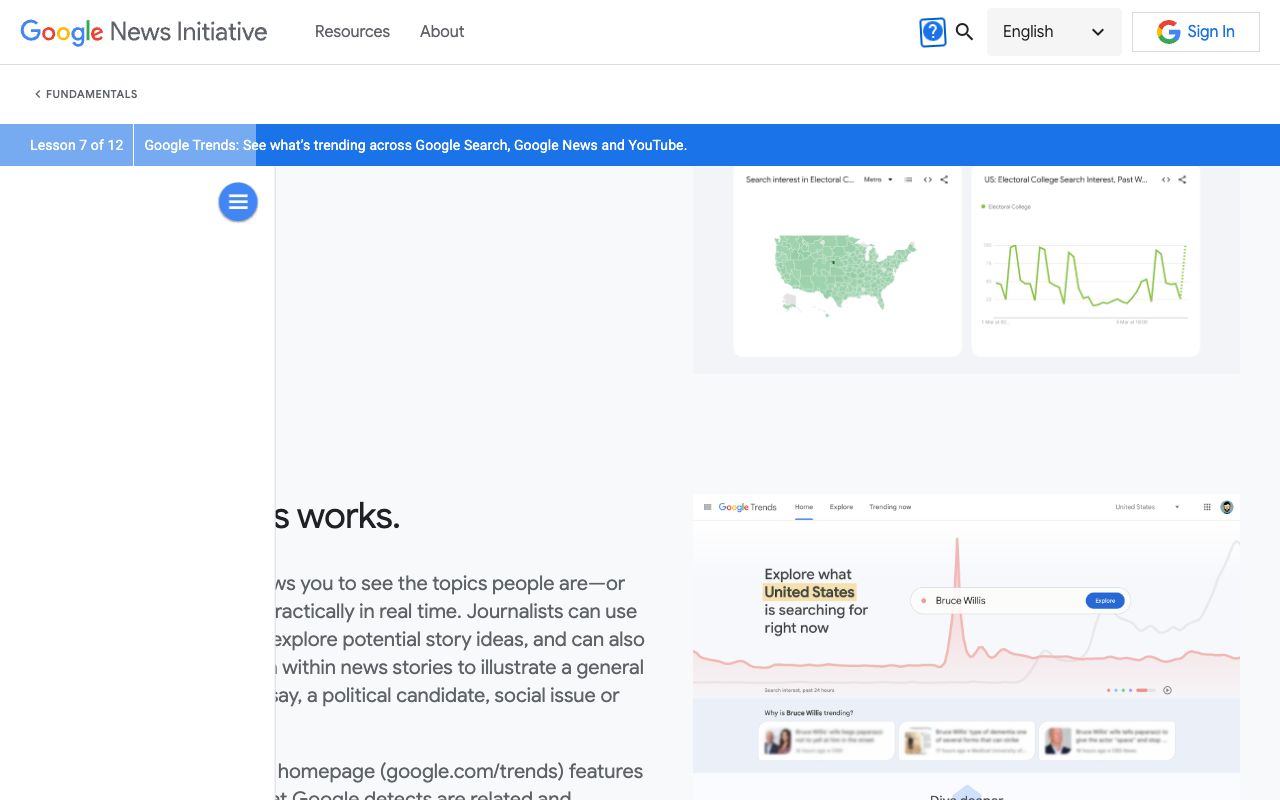
The Google Trends Explore tool is free and often suggested as a stand-in. Google's Trends data FAQ (read October 21, 2026) says "each data point is divided by the total searches of the geography and time range it represents," then scaled 0–100. It uses a sample, shows low-volume terms as "0" and, critically, excludes searches "made by AI Mode and AI Overviews." It is a relative index of Google search interest that says nothing about prompts sent to ChatGPT or Claude.
Ahrefs vs Profound prompt volume data: derived vs measured
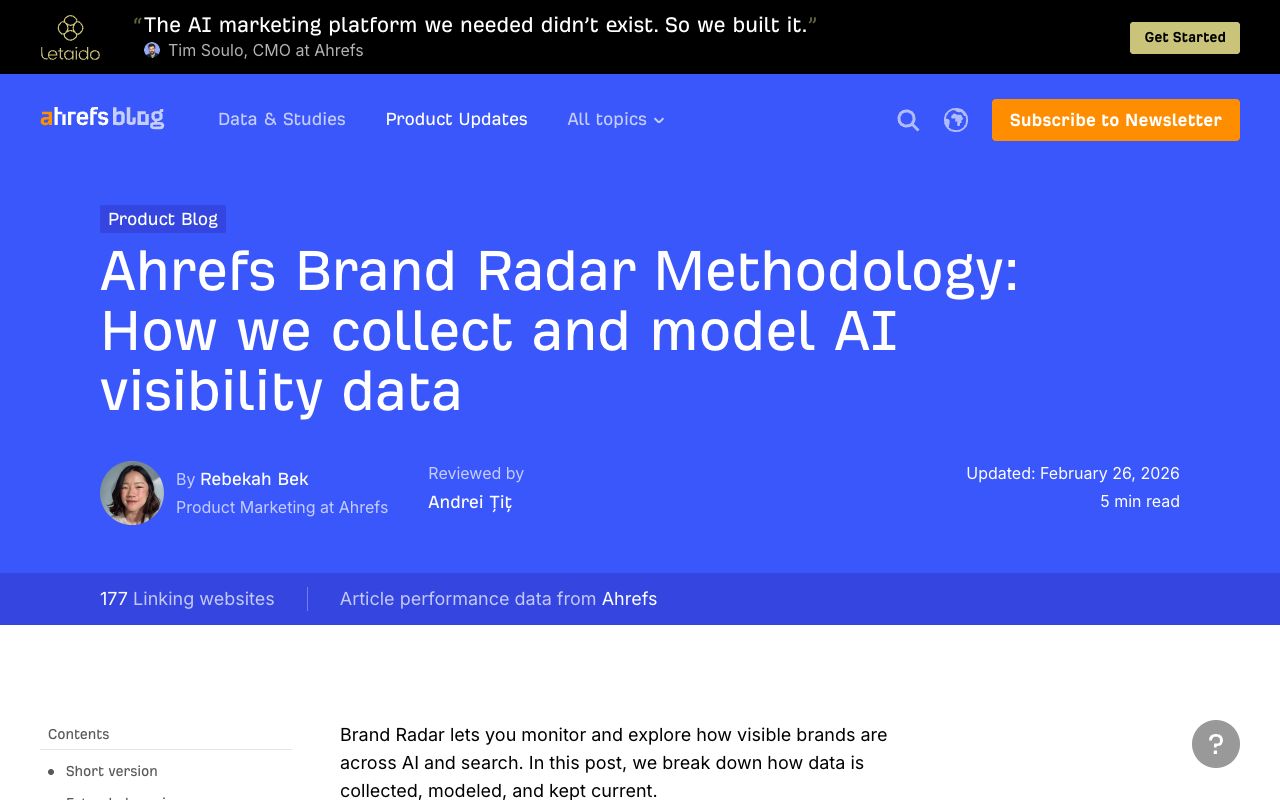
The Ahrefs vs Profound prompt volume data question is really a question about two methods. Ahrefs' Brand Radar methodology post (February 26, 2026) sources prompts from Google's People Also Ask corpus plus semantic fan-out and refreshes ChatGPT, Perplexity, Gemini and Copilot monthly on a 90-day window. Its September 29, 2026 update reports the dataset grew from roughly 14 million to 30 million prompts and that reports now use "AI adjusted volume": find the parent keyword, take its Google search volume, multiply by each platform's estimated usage ratio.
Ahrefs publishes two disclaimers worth quoting to anyone presenting its AI prompt volume as a measurement: the weighting is "a modeling choice, not a measured relationship," and "we do not claim a validated link between Google search volume and how often a query is asked inside an AI tool." Profound projects observed prompts to a population; Ahrefs adjusts Google demand by a ratio. They are estimates of different things.
Adobe Brand Visibility and Semrush: one upstream, two products
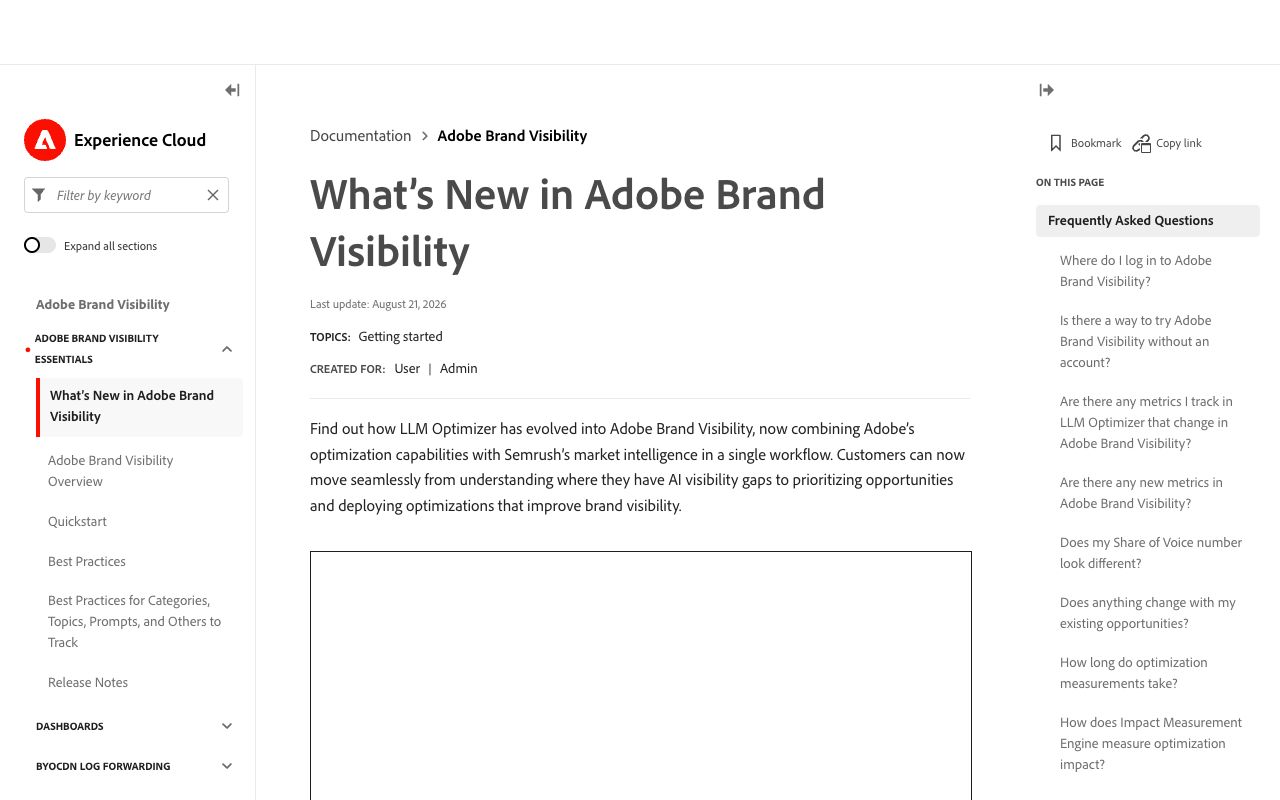
Adobe's documentation home states that "LLM Optimizer has evolved into Adobe Brand Visibility, combining Adobe's optimization capabilities with Semrush's market intelligence in a single workflow." The What's New entry dated August 21, 2026 renames the old high/medium/low Popularity indicator to Topic Volume and reweights Share of Voice by "search demand and ranking position." Brand-presence data refreshes weekly. Adobe sells prompt packages at custom pricing; the documentation pages I could read publish no list price.
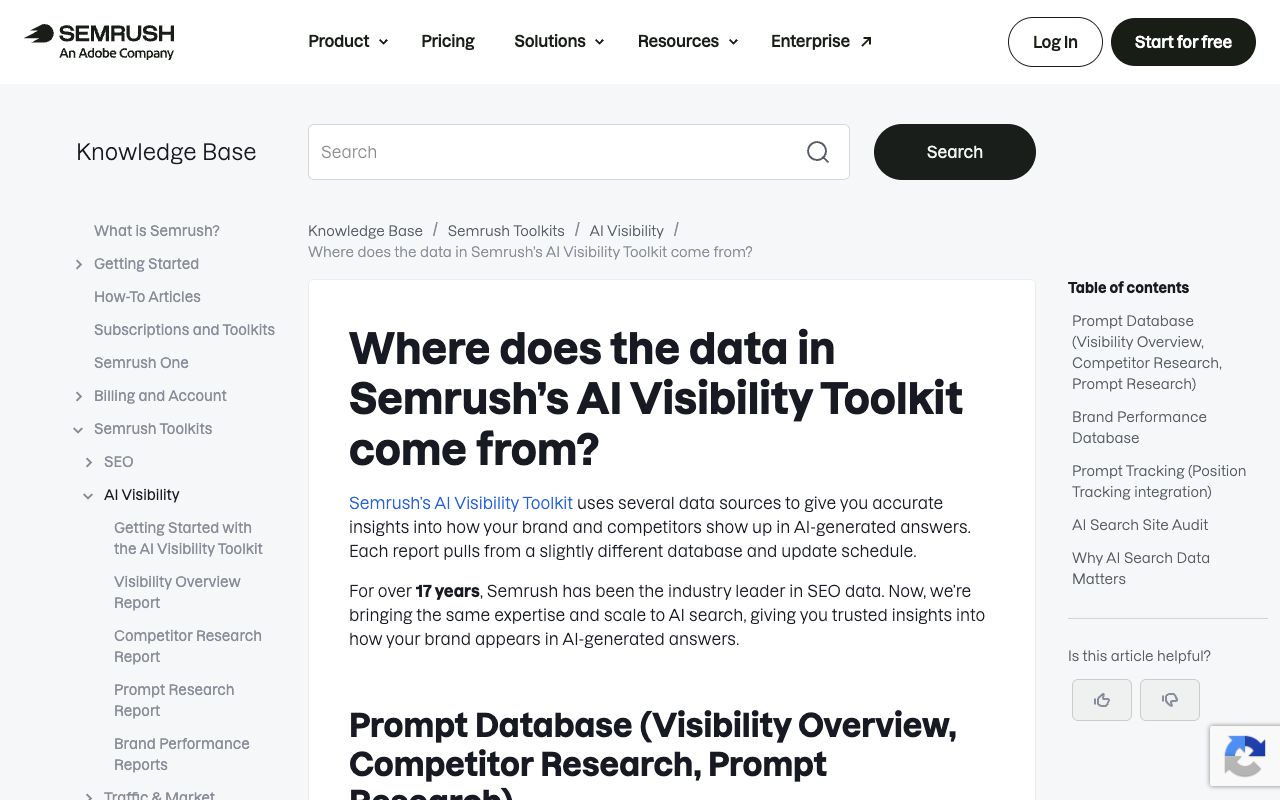
Semrush's AI Visibility Toolkit data page says the prompt database holds "over 317 million prompts" across 117 regional databases, sourced from "AI search clickstream data and Google's keyword dataset," updated daily. Because single prompts are too specific to count, Semrush reports topic-level volume by grouping prompts semantically and modeling the totals. The same page concedes that "no platform can provide exact numbers on visibility" and calls its figures "reliable directional signals."
The Adobe vs Profound prompt volume date coverage differs too: Profound's series starts January 2025, while Adobe's Topic Volume dates from the August 2026 release. Two products, one Semrush-shaped upstream for Adobe, and neither is an official platform total.
| Source (read Oct 21, 2026) | Unit | Platforms | Window / refresh | Data origin | Vendor's own caveat |
|---|---|---|---|---|---|
| Profound Prompt Volumes | Prompts per topic, per platform | ChatGPT, Gemini, Claude, Perplexity | Weekly; series from Jan 2025; 10 countries | Double opt-in panels, projected | "extrapolating frequency … across broader populations" |
| Ahrefs Brand Radar | AI adjusted volume (Google volume × usage ratio) | ChatGPT, Perplexity, Gemini, Copilot; AIO and AI Mode separately | Monthly, 90-day window | People Also Ask prompts, ~30M | "directional indicators, not exact traffic counts" |
| Adobe Brand Visibility | Topic Volume | LLM responses (models not itemized on docs read) | Weekly brand-presence refresh | Semrush market intelligence | Optimization measurement takes ~2 weeks |
| Semrush AI Visibility Toolkit | Topic-level volume | ChatGPT, Gemini, AI Overviews, AI Mode, Perplexity (by report) | Daily rolling database, weekly reports | Clickstream + Google keyword dataset, 317M+ prompts | "reliable directional signals" |
| Google Trends Explore | 0–100 relative index | Google Search only; excludes AI Mode and AI Overviews | User-selected ranges | Sample of Google searches | "not a scientific poll" |
Every row is a vendor's modeled estimate, not an official count from OpenAI, Google, Anthropic or Perplexity. Kairosy does not provide prompt volume data, so it is deliberately absent from this table.
How Is Prompt Volume Different From Keyword Search Volume and Your Own Monitoring Counts?
Three numbers get confused in planning meetings, and they have different denominators.
Keyword search volume is the most settled. Google's Keyword Planner help page defines "average monthly searches" as searches for a keyword and its close variants, averaged over 12 months, rounded, matched exactly. The text repeats and Google owns the logs, so the figure is a direct if rounded count.
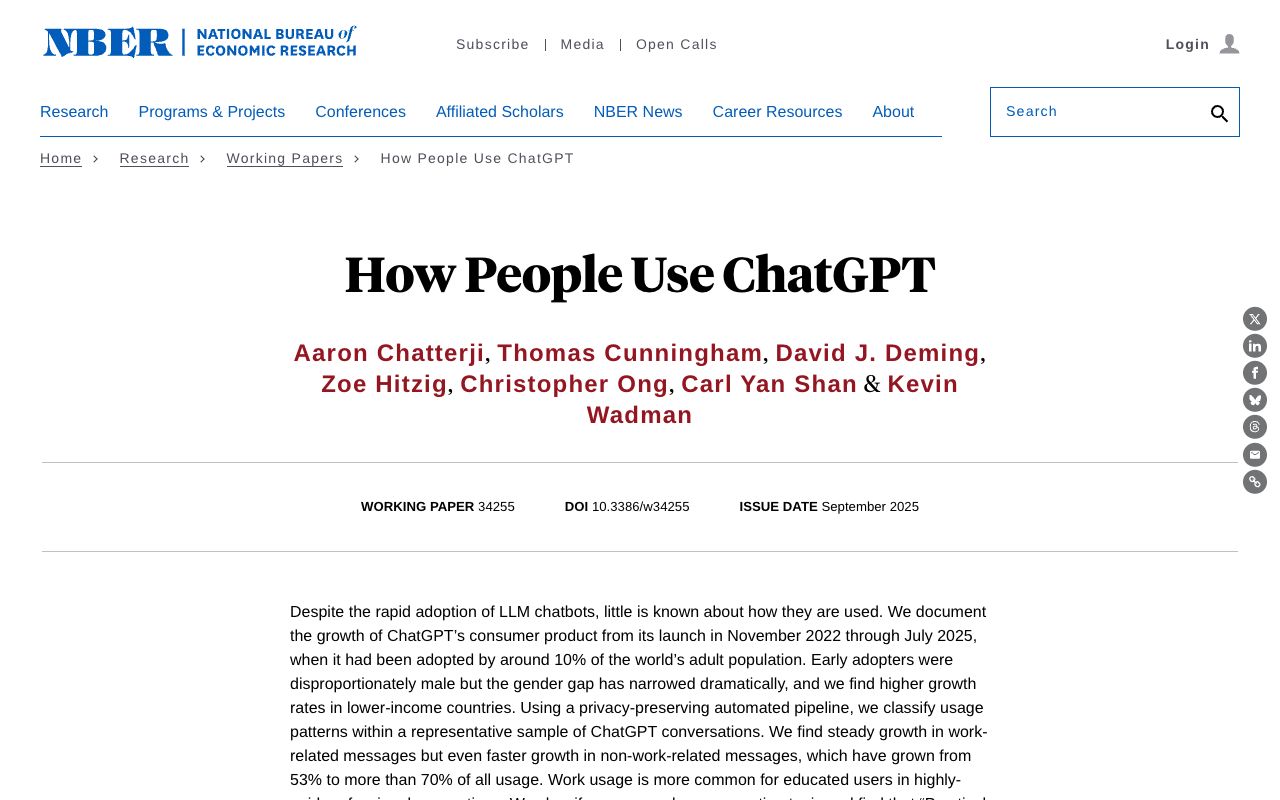
Prompt volume has none of those properties: the platform owners publish nothing, the text rarely repeats, and most prompts match no keyword. The NBER working paper "How People Use ChatGPT" (September 2025, Chatterji et al.) adds that non-work messages grew from 53% to over 70% of usage and that practical guidance, seeking information and writing account for nearly 80% of conversations. A commercial topic count is a thin slice of a large, mostly non-commercial stream.
Your own monitoring counts are not demand data at all. When Kairosy's Prompt Tracking re-runs your tracked questions daily across the engines you chose for a project, it produces answers: mentioned, not mentioned, or a competitor recommended, with a 7-run history per engine. Fifteen prompts a day on Basic, 60 on Pro or 250 on Growth is a sample you control, not an estimate of what the public asks. Treat these as the numerator (how engines answer) and vendor prompt volume as a separate denominator (how often the question is asked); never divide one by the other as if they shared a source.
The consequence: a prompt with high vendor-estimated volume and a 0% mention rate in your tracking is a gap worth money, while a prompt you wrote yourself with no demand estimate can still matter because it is the question your sales team hears. For the measurement side, see how to monitor AI search visibility.
How Should You Combine Prompt Volume Data With Intent, Product Fit and Visibility Gaps?
Use a four-column sheet: demand signal, buyer intent, product fit, visibility gap. Volume ranks topics; the other three columns decide whether a topic deserves a page, a fix, or nothing.
Step 1: run the vendor data-provenance checklist
Before any prompt volume data enters your sheet, answer these from the vendor's own documentation, not a sales deck:
- Measured or derived? Panel-observed prompts (Profound), clickstream clusters (Semrush), or Google volume times a ratio (Ahrefs). Write the method next to the number.
- Which platforms are covered, and which excluded? Google Trends drops AI Mode, Ahrefs separates AI Overviews from assistants, Profound lists four assistants today.
- Which countries? A US panel does not describe a UK buyer.
- What window and refresh? Weekly (Profound), monthly on a 90-day window (Ahrefs), daily rolling (Semrush).
- When does the series start? January 2025 for Profound, August 2026 for Adobe's Topic Volume. Year-over-year history mostly does not exist yet.
- Does the vendor publish its own disclaimer? Ahrefs and Semrush both do. Quote it in your deck.
- Is the upstream shared? Adobe Brand Visibility runs on Semrush market intelligence, so two subscriptions can mean one source.
- How are prompts clustered? This decides whether five rewordings count as one topic or five, which the next table demonstrates.
Step 2: see how rewording changes the aggregate
The table uses a fictional CRM brand, Northwind, and example values only. No row is a measured platform total; the point is the mechanics.
| Prompt wording (example) | Cluster-based vendor groups it as | Keyword-mapped vendor maps it to | Example monthly count |
|---|---|---|---|
| best CRM for small teams | Topic: small-team CRM | "best crm for small business" | 1,200 |
| which CRM should a 10-person startup use | Topic: small-team CRM | "crm for startups" | 480 |
| cheap CRM for a small sales team under $50 a month | Topic: small-team CRM (budget) | "cheap crm" | 310 |
| is Northwind CRM good for small businesses | Topic: Northwind reviews | "northwind crm review" | 90 |
| Northwind vs Salesforce for a startup | Topic: Northwind comparisons | "northwind vs salesforce" | 60 |
A cluster-based vendor would report about 1,990 for "small-team CRM" and keep the two branded prompts separate. A keyword-mapped vendor would report five parent keywords with five Google volumes multiplied by five ratios. Same five questions, two incompatible totals. A prompt volume figure should never appear in a plan without its method attached.
Step 3: score intent and product fit before volume
Tag every topic with the intent its wording implies (research, comparison, purchase, support) and whether your product genuinely fits. The budget prompt above is high intent, but if Northwind starts at $80 a seat, that demand belongs to someone else. Volume ranks the opportunities that survive this filter; it should not rescue the ones that fail it.
Step 4: measure the gap, then fix the page
Add the surviving prompts to tracking and read the gap directly: which engines mention you, which recommend a competitor, which sources they cite. Kairosy's Competitor Comparison shows share of voice and your position among pinned competitors in unbranded and branded views, which separates a mention problem from a sentiment problem. When answers cite third-party pages you do not control, that is the fix target. Confirm the engines can fetch your page with the free AI crawl checker, then use AI brand monitoring to watch whether the mention rate moves. Demand tells you where to look; the answers tell you what to do.
What Else Do People Ask About Prompt Volume Data? FAQs
Is prompt volume data accurate?
It is an estimate with a method, and the vendors say so: Ahrefs calls its figures "directional indicators, not exact traffic counts," Semrush calls them "reliable directional signals." Accurate enough to rank topics, not to forecast traffic.
Can I get prompt volume from ChatGPT or Google directly?
No. OpenAI, Google, Anthropic and Perplexity do not publish per-prompt demand, and Google Trends explicitly excludes AI Mode and AI Overviews searches. Every figure you see is third-party and modeled.
Does Kairosy provide prompt volume data?
No. Kairosy measures the answer side: it runs your tracked questions across the engines you chose, keeps full answers with cited sources, scores sentiment and flags competitor recommendations. Pair it with a demand vendor if you need a volume column, and label both sources.
How many prompts should I track if I already have volume data?
Start with the prompts that pass the intent and product-fit filter, typically 10 to 20 per product, phrased the way customers ask rather than as the vendor's cluster label. See search prompt monitoring for setup detail.
Is Google Trends a good free substitute for AI prompt volume?
Only as a topic-interest proxy. It is normalized 0–100, sampled, shows low-volume terms as zero and omits AI Mode. Use it to spot rising topics, then confirm demand in an AI-specific source before committing content to it.
See what AI says about your brand
Run a free scan across ChatGPT, Gemini, Claude & Perplexity in about 30 seconds.
Run my free scan