Search Prompt Monitoring: How AI Prompt Tracking Works in 2026
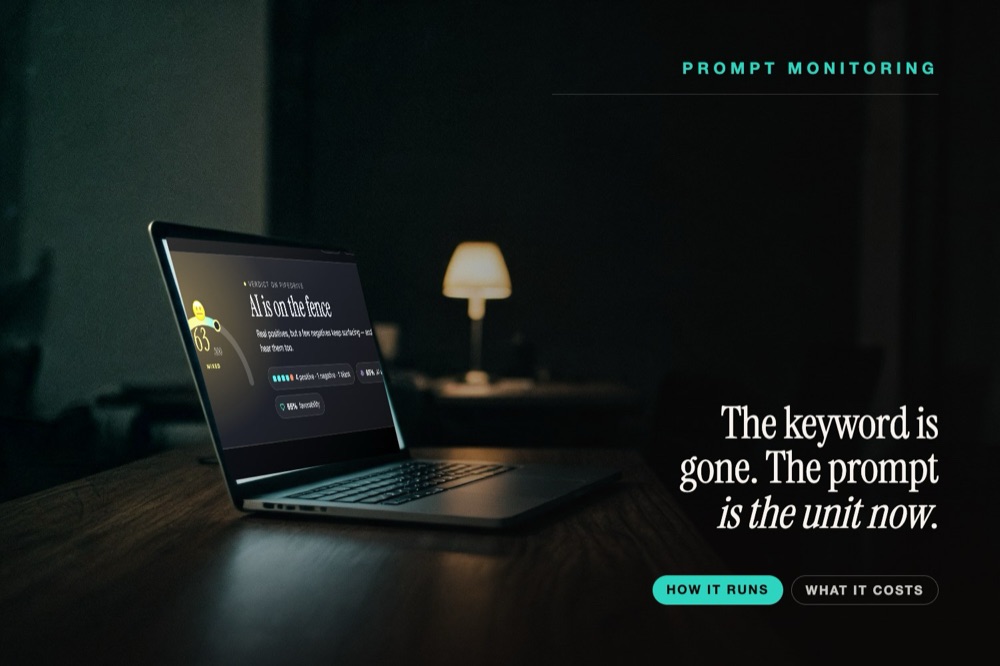
A search prompt is the whole question a buyer types into ChatGPT, Gemini, Claude or Perplexity — "which CRM should a 12-person sales team pick if everyone hates data entry?" — and search prompt monitoring is the discipline of running that exact question on a fixed schedule and recording what came back. Not a rank. The answer text, the brands named inside it, and the URLs the model leaned on.
What follows is mechanics, not pitch: what a prompt set is, how to build one that tracks a real buying journey, and what a platform does between the moment you save a prompt and the moment a chart appears. Still deciding whether this deserves budget? Start with why use AI search monitoring tools instead.
What Is a Search Prompt, and How Is It Different From a Keyword?
A keyword is two to four words thrown at an index, returning ten links you can count off from position one. A search prompt is a sentence carrying constraints: team size, budget ceiling, a required integration, a frustration. The assistant reads those constraints, usually splits the question into several retrieval queries behind the scenes, then writes one paragraph naming three to six products.
That kills the ranking metaphor. There is no position four. There is named or not named; named in the opening sentence or named as an afterthought; named cleanly or named with a caveat attached ("powerful, though users report a steep learning curve").
A prompt set is the finite list of questions you commit to re-running. It plays the role a keyword list plays in rank tracking, with one hard difference: every row costs a real model call every time it fires. A crawler absorbs ten thousand keywords for free; a prompt set cannot. That is why every vendor caps prompts by plan.
Why Track Prompts Instead of Keywords in Generative AI?
Because the answer is the results page. One paragraph settles the shortlist, and if your name is missing, ranking on page one repairs nothing. Vendors sell this under half a dozen labels — AI prompt monitoring, LLM prompt monitoring, tracking prompt in generative AI — and each describes the same loop: ask, capture, parse, compare to last time.
Three things a keyword report cannot tell you. Phrasing swings the brand list violently, so "cheapest project tool for a startup" and "best project tool for an enterprise rollout" pull almost disjoint names from the same model. The answer carries sentiment, so you can be highly visible and still losing. And most engines expose their sources, converting an abstract visibility problem into a concrete list of pages to fix.
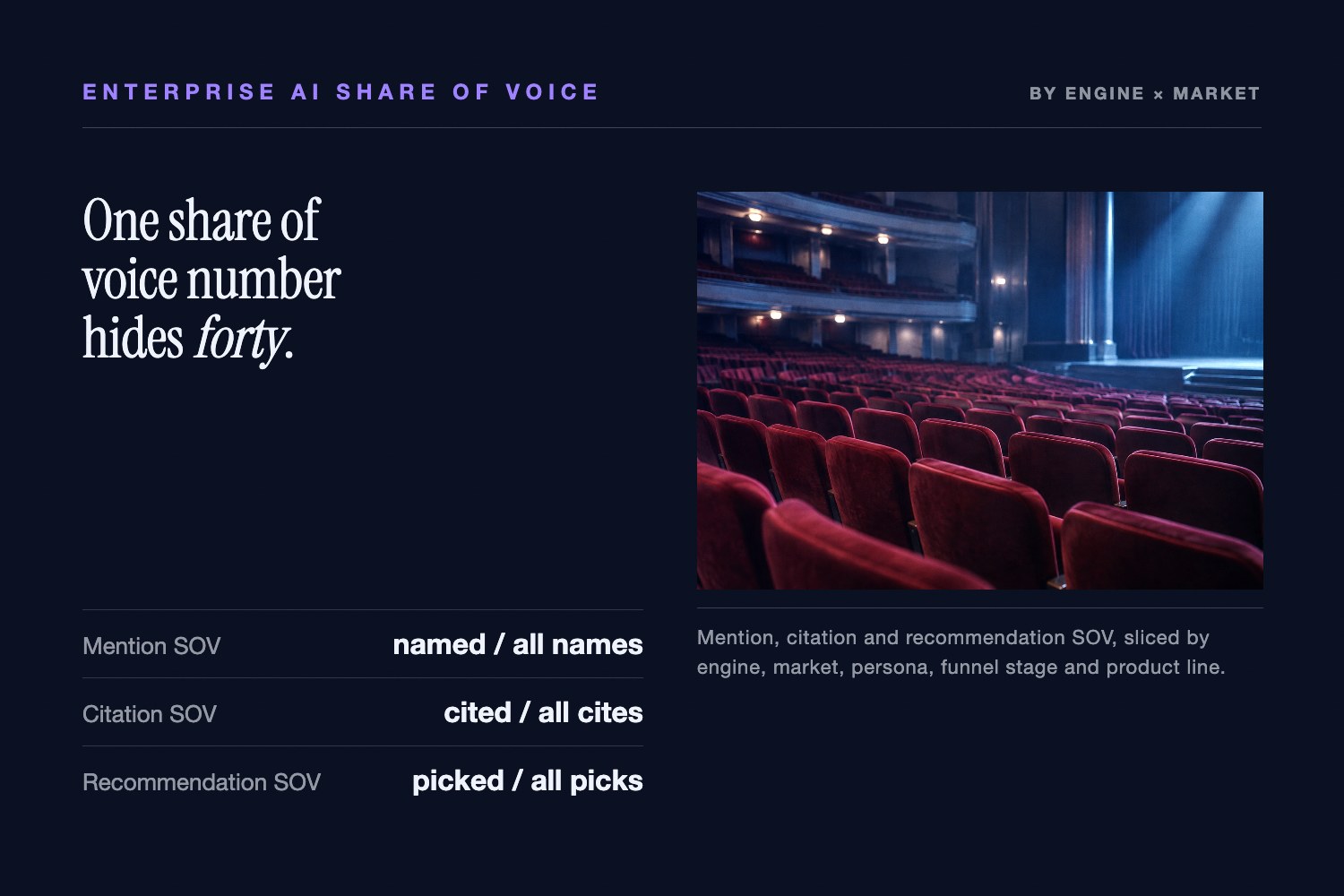
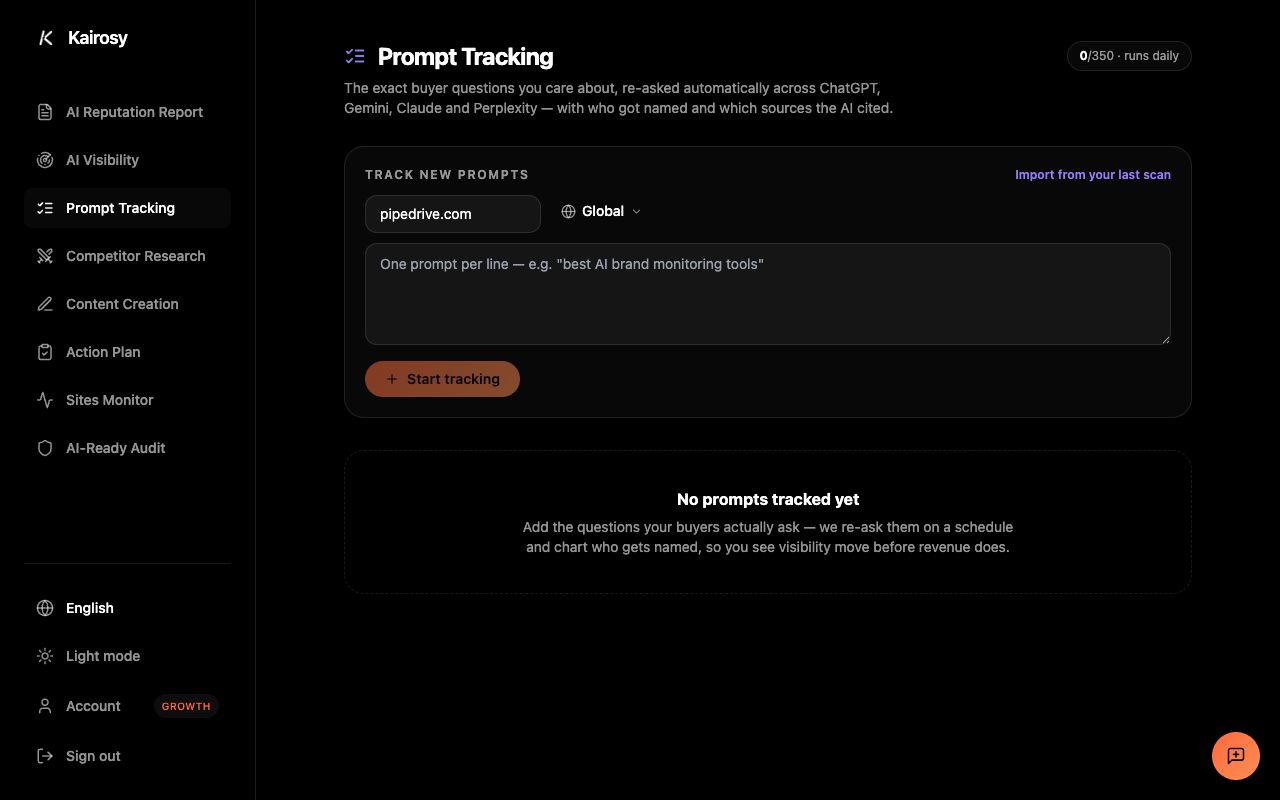
Our published scan of Pipedrive shows what one brand's answer set looks like when the same buying questions go to all four assistants at once.
How Do You Build a Prompt Set That Mirrors the Buyer Journey?
Write prompts the way a buyer says them out loud, spread across the stages of a real purchase rather than piled at the bottom of the funnel. A set made entirely of "best X" questions tells you nothing about the moment someone is still working out which category they need.
| Journey stage | What the buyer is doing | Prompt shape to save |
|---|---|---|
| Problem-aware | Naming a pain, not a product | "how do I stop losing deals in follow-up?" |
| Category | Learning what kind of tool exists | "what software tracks sales follow-ups automatically?" |
| Shortlist | Asking for names | "best CRM for a 12-person sales team" |
| Head-to-head | Narrowing two finalists | "Pipedrive vs HubSpot for a small team" |
| Trust | Hunting for reasons to say no | "is Pipedrive worth it, and what do users complain about?" |
| Post-purchase | Migrating or expanding | "how do I move my pipeline out of a spreadsheet?" |
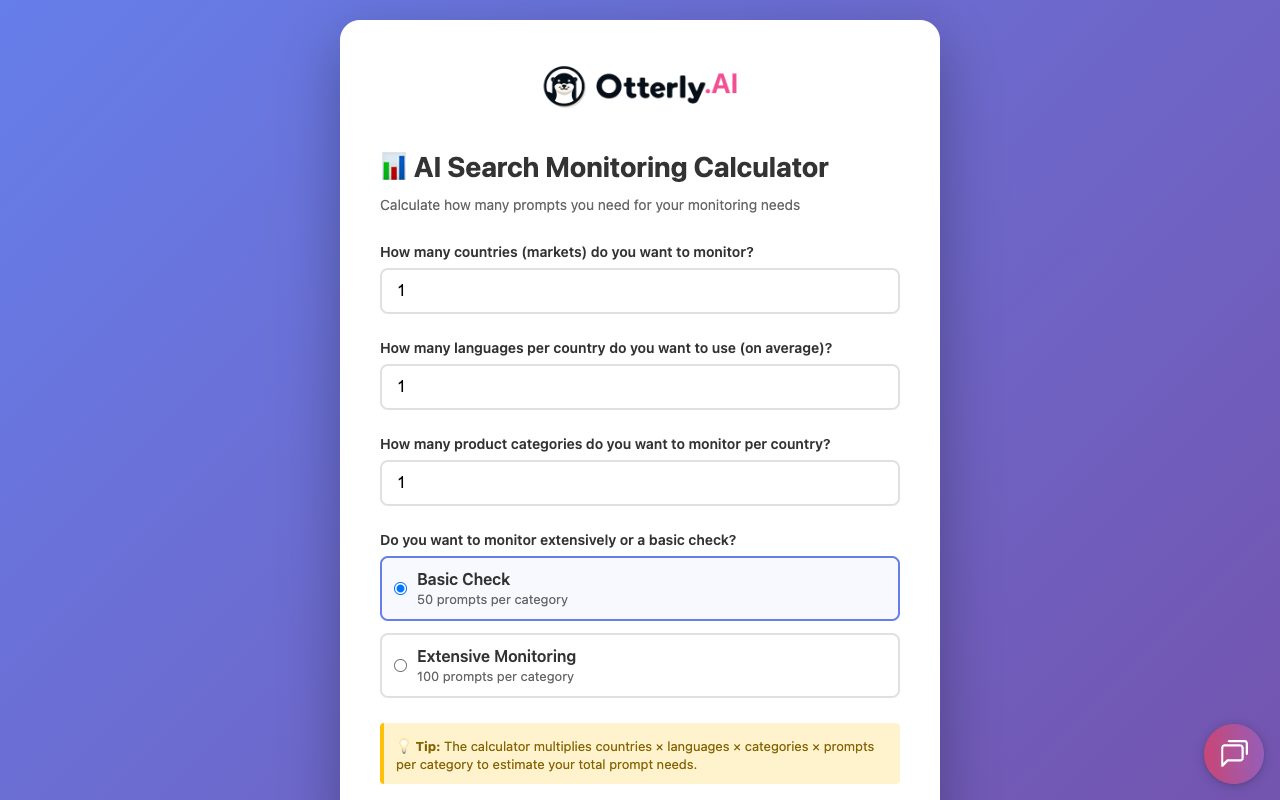
How many rows? The two loudest vendors disagree. Ahrefs argued on February 5, 2026 that a few dozen prompts on a narrow topic is a fine start; Profound's guide of February 10, 2026 tells readers to open with 100 and prune. Both are defensible — your budget decides, because prompts are metered.
Four rules that survive contact with reality:
- Keep the set mostly unbranded — branded prompts flatter you and teach you nothing.
- Change one variable per prompt, so a swing is attributable to the wording that caused it.
- Include the comparison prompt you are afraid of, not only the ones you expect to win.
- Tag prompts by country if you sell in more than one — Kairosy scans 25 countries on paid plans, and the runners-up genuinely differ between Germany and the US.
How Does an AI Search Monitoring Platform Work Under the Hood?
Underneath the dashboard, every search prompt monitoring product is four jobs stitched together: a scheduler, a fan-out worker, a mention parser and a citation store. Here is how ours works, with the numbers, because the trade-offs teach more than the marketing.
How does the platform decide when to run your prompts?
A cron fires daily at 08:30 UTC and does almost nothing — it kicks a background job and returns. That split is deliberate: a scheduled function doing the work inline hits its platform timeout the week your customer count doubles, so the trigger stays thin and the worker gets the long runtime.
The worker reads every active prompt, checks the owner's plan, and works out who is due. Every paid tier runs daily; free accounts never. Anything already recorded for today is skipped, so the job is safe to re-trigger without double-counting a day or double-billing a call.
The fan-out arithmetic explains the pricing of the whole category. One unit of work is one prompt against one engine, and a plan queries four to six. A Pro account holding 28 prompts across all six live platforms generates 168 model calls a day. Our quotas — 15 on Basic, 28 on Pro, 70 on Growth — are an invoice, not a paywall lever.
How does it know your brand was mentioned?
By string matching, and anyone claiming otherwise is overselling. We normalize the answer and the brand name identically — lowercase, strip punctuation and spacing, preserve accented and CJK characters — then test containment. That is what makes "Help Scout", "help scout" and "HelpScout" register as one hit.
Know the failure modes before trusting any mention chart. A short or dictionary-word brand name yields false positives; a brand the model names only by its flagship product yields false negatives. Spot-check both in your first fortnight of AI prompt monitoring, whichever tool you buy.
Sentiment is a separate, costlier step, so it runs only on answers containing your name, batched eight at a time. An answer that never mentions you is stored as unmentioned, with no classifier call. That cost decision has a useful side effect: invisible and negative stay distinct states instead of collapsing into one bucket.
Competitor extraction unions two sources — rival names the classifier pulled from the text, plus competitors you pinned yourself. One filter matters more than it sounds: platform names get stripped, or ChatGPT and Perplexity themselves climb your share of voice table as if they were rivals.
How are citations attributed to a source?
Two routes. Some engines return sources natively — Perplexity's API sends back citations and search_results arrays carrying each source's URL, title, snippet and date, per its chat completions reference. Everything else must be asked for a web-grounded run explicitly, and a grounded call costs several times what a plain one does.
So here is our trade-off, plainly: we refresh citations weekly, not daily. Weekday runs are pure model calls, enough to answer "was I named, and in what tone." Monday runs go out grounded and refresh the source tables with live URLs. The reason is arithmetic — every engine grounded every day, for a maxed-out Pro list, lands near $60 a month in model spend per account on our own figures, against a $99 subscription. When a cheap plan promises daily grounded citations across many engines, one of those numbers is quieter than advertised.
The consequence on Pro: mention and sentiment data daily, citation data weekly. Once you have that source list, push the cited pages through our free index checker — a URL an assistant quotes is worth little if the page is indexed nowhere else.
Why Does the Same Prompt Return a Different Answer Every Run?
Because you are sampling a distribution, not reading a database. We call the models at temperature 0.4 rather than 0, deliberately: pinning the temperature would hide the variance your buyers live with, not remove it.
It would not remove it anyway. Horace He of Thinking Machines Lab showed on September 10, 2025 that the dominant source of nondeterminism in production LLM endpoints is not floating-point luck but server batch size varying with load while the underlying kernels are not batch-invariant. In their test, 1,000 completions at temperature 0 produced 80 distinct outputs; after rewriting the kernels, all 1,000 matched. Public APIs do not ship those kernels, so run-to-run drift is a property of the medium. Ahrefs hit the same wall from the marketer's side, describing a top recommendation for gym software that changed seconds after the previous ask.
Four habits that make AI prompt performance tracking trustworthy:
- Report rates, never events — "named in 62% of the last 30 runs" beats "we showed up Tuesday".
- Cluster near-identical prompts and read the cluster average, not any single row.
- Give a content change three to four weeks before judging it, longer on a weekly cadence.
- Never escalate a one-day swing; across four engines, noise that size is routine.
It is also the fairest question to put to a vendor: how many samples sit behind the number on the dashboard?
Which Search Prompt Monitoring Tools Should You Compare in 2026?
Five worth a shortlist, each strong at something different. Prices were checked on the vendors' own pages in August 2026, and entry tiers are shown because that is where the real differences hide.
| Tool | Entry price / month | Prompts at entry tier | Engines at entry tier | Free trial |
|---|---|---|---|---|
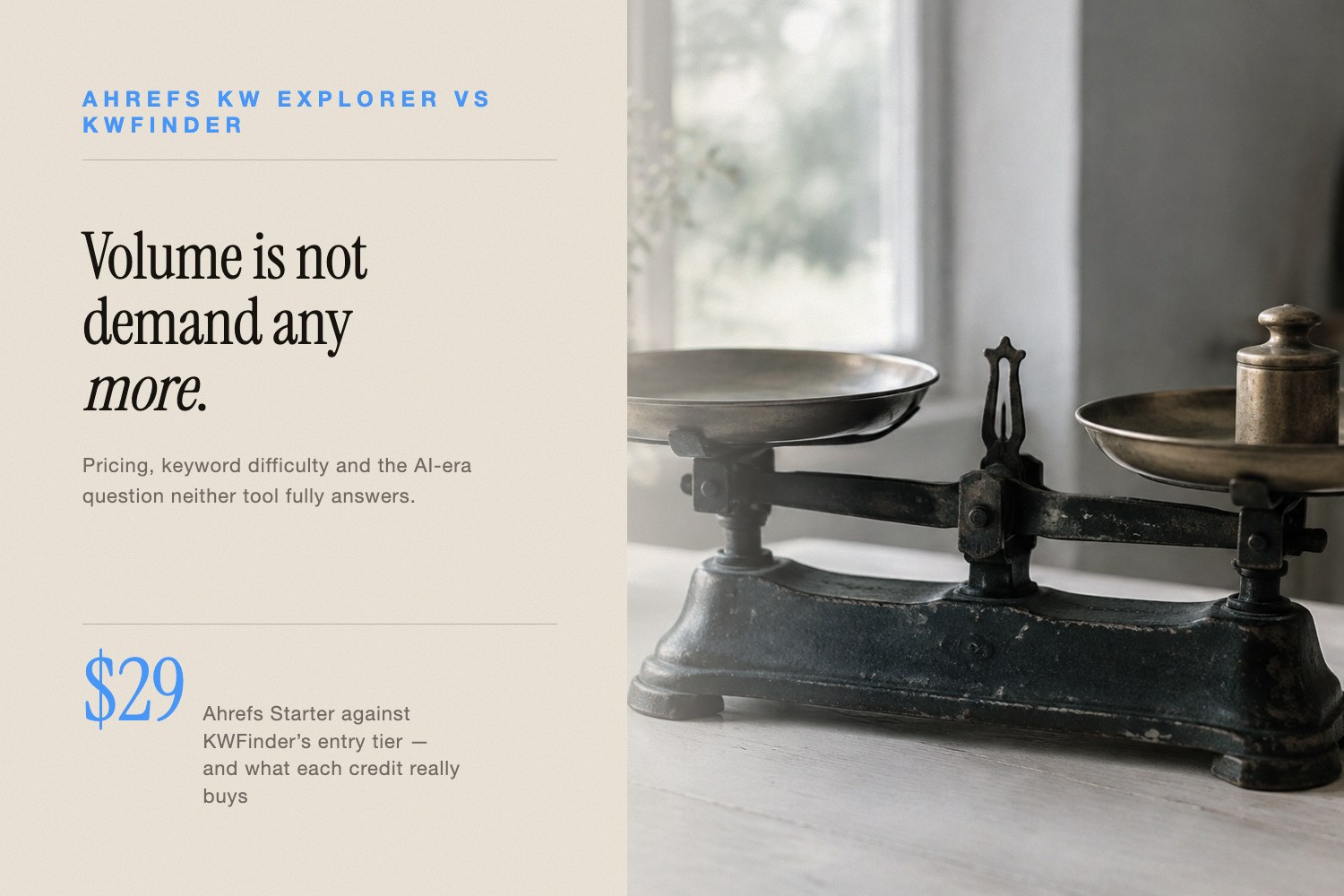
| Kairosy | $29 (Basic) | 25 | ChatGPT, Gemini, Claude, Perplexity | 7-day free trial |
| Otterly.ai | $29 (Lite) | 15 | ChatGPT, AI Overviews, Perplexity, Copilot | Yes, length not stated |
| LLM Pulse | €49 (Starter) | 50 | 5 models incl. AI Mode & AI Overviews | 14 days |
| Peec AI | $95 (Starter) | 50 | 3 models | 7 days, no card |
| Profound | Custom (Enterprise only) | 50 on the free Trial | ChatGPT, Gemini, AI Overviews on the Trial | 7 days |
Kairosy — emphasis: prompt tracking that lives inside a reputation scanner rather than standing alone. It is not a keyword or backlink tool. Basic at $29 tracks 15 prompts daily, Pro at $99 tracks 28, Growth at $399 tracks 70, and Claude is included at every paid tier rather than sold as an add-on: Basic runs four platforms of your choice, Pro and Growth all six. Each result carries sentiment, competitor mentions and a fix plan. See AI brand monitoring for how the weekly deep scan and daily prompt runs fit together.
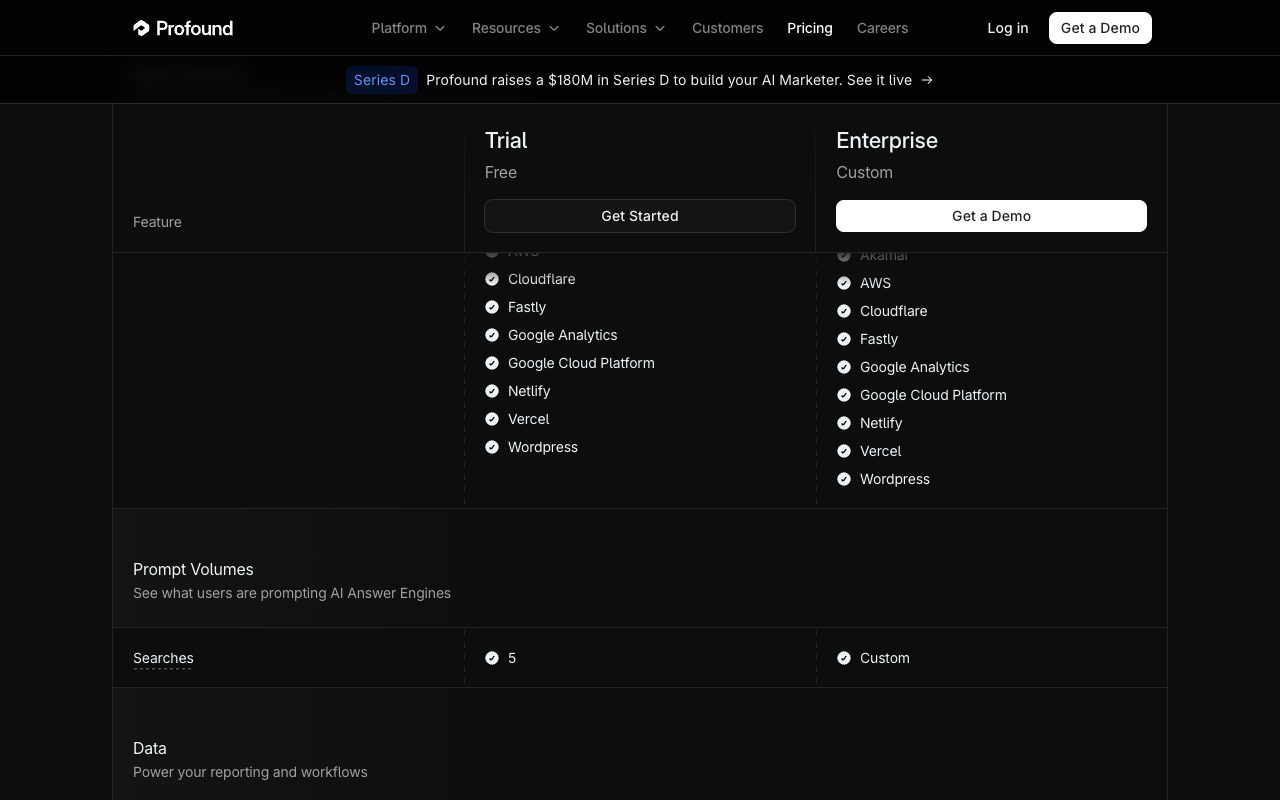
Profound — emphasis: enterprise breadth, sold through sales rather than a checkout. For brands the pricing page (checked September 24, 2026) lists only a free Trial, 50 prompts run daily for 7 days on ChatGPT, Gemini and Google AI Overviews, and custom Enterprise, which reaches nine answer engines with SSO/SAML and SOC 2; Vendr's anonymized buyer data (a third-party source) puts the median contract at $34,500 a year. Built for the procurement questionnaire — see Profound's pricing page.
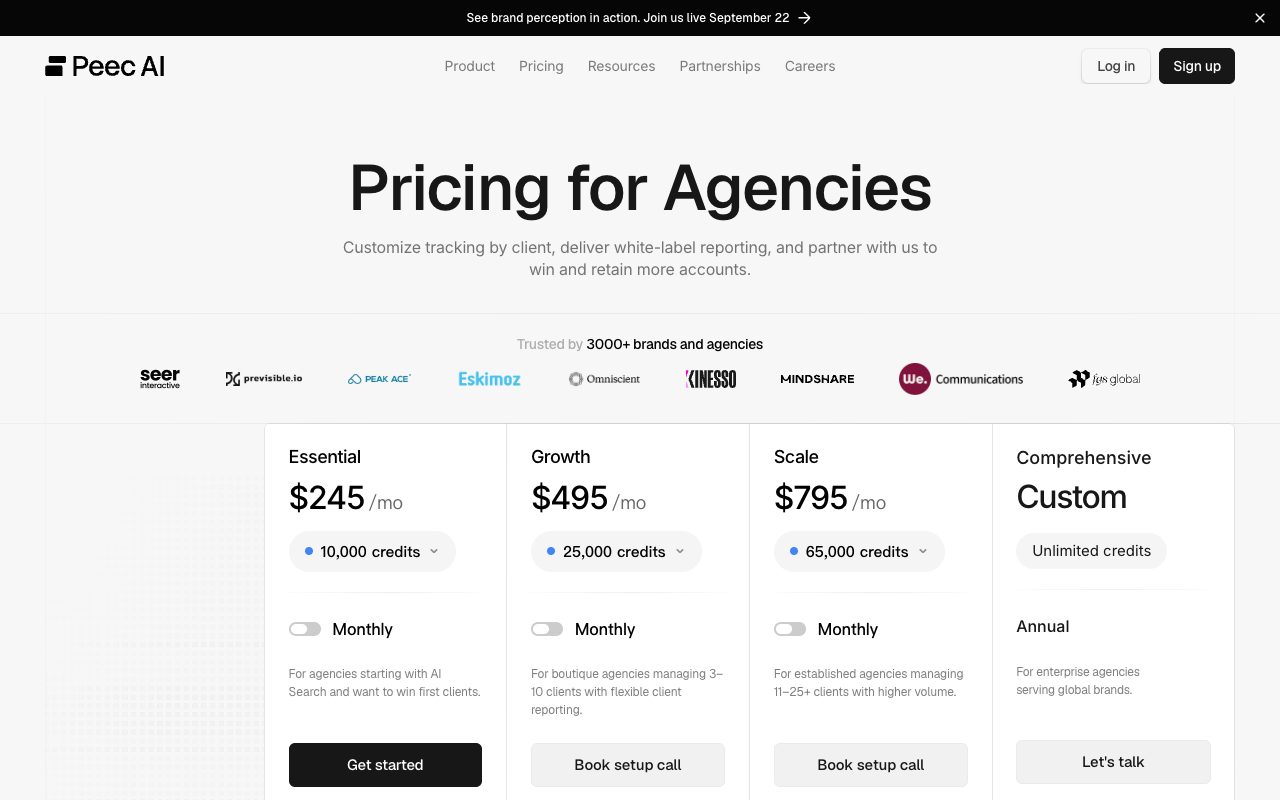
Peec AI — emphasis: agencies juggling several clients. Starter is $95/month for 50 prompts, three models and one project; Pro is $245 for 150 prompts across two projects; Advanced is $495 for 350 prompts, five projects and a Looker Studio connector for client reporting. Seats are unlimited on every tier and extra models are add-ons. Figures match both Peec's pricing page and its Capterra listing as of August 2026.
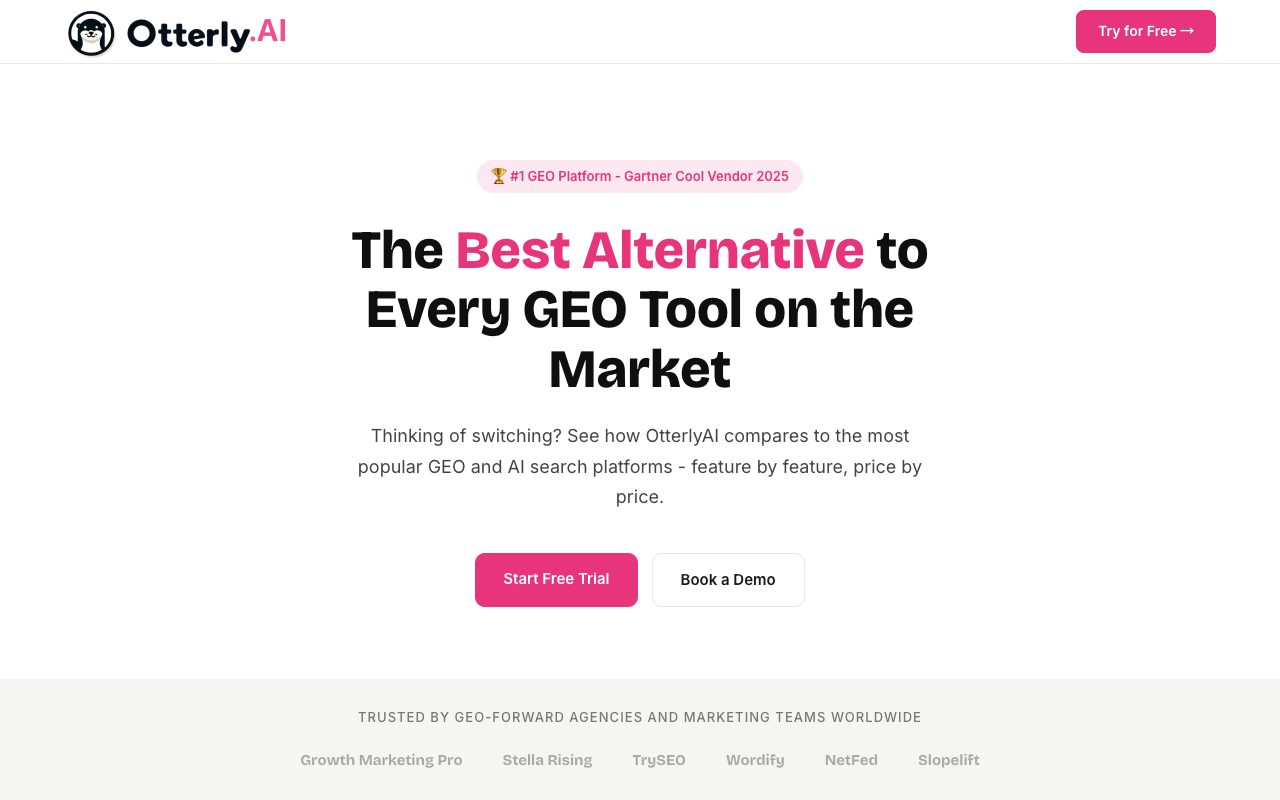
Otterly.ai — emphasis: the clearest per-prompt math at the low end, plus daily runs on every plan. Lite is $29/month for 15 search prompts, Standard $189 for 100, Premium $489 for 400, with roughly 15% off annually. Read the engine list carefully: ChatGPT, Google AI Overviews, Perplexity and Copilot are included, while Claude, Gemini and Google AI Mode are paid add-ons running $9 to $439/month. If Claude matters in your category, the sticker price is not the bill.
LLM Pulse — emphasis: Google's answer surfaces plus unrestricted team access. Plans run €49 Starter, €99 Growth, €299 Scale, €726 Scale+ and €1,453 Scale++, carrying 50, 150, 450, 1,200 and 2,400 prompts, with all five models and unlimited seats at every level and a 14-day trial on the first three. Coverage spans ChatGPT, Perplexity, Gemini, Google AI Mode and AI Overviews, per its pricing page.
One caveat on shopping by engine count: if ChatGPT is the only surface your buyers use, almost any of these works as a chatgpt prompt tracker, and paying for nine engines is waste. Our ChatGPT brand monitoring page covers what a single-engine setup does and does not show.
How Should You Start Search Prompt Monitoring This Week?
Buy the smallest quota that covers your real buying questions, then let the data say which prompts deserve company.
- Write 15 to 25 prompts from the journey table above, mostly unbranded.
- Run them once by hand and read the raw answers before opening any chart.
- Save the set, pick a cadence you can afford, and leave it alone for a month.
- Pull the citation list and fix the two pages most often cited against you.
One cheap win on that last step: assistants quote pages they can parse easily, so run your comparison pages through our free reading level checker first. For the manual version of steps one and two, our guide to tracking brand mentions in ChatGPT needs no tooling at all.
What Teams Ask About Search Prompt Monitoring: FAQs
How does an AI search monitoring platform work?
A scheduler decides which accounts are due, a worker asks each saved prompt of each engine, a parser normalizes the answer text to detect brand and competitor mentions, and a classifier scores tone on answers that name you. Results append to a time series; citations come either from engines that return them natively or from explicitly grounded runs.
Is AI prompt monitoring the same thing as rank tracking?
No. Rank tracking reads a stable ordered list, while prompt monitoring samples a generated paragraph that varies between runs. The output is a mention rate across many samples rather than a position, so the two cannot share a chart.
How many prompts do I need for AI prompt performance tracking?
Between 15 and 50 covers most single-product companies, with vendor guidance ranging from a few dozen up to 100. Add prompts only when you can name the decision each new one informs, since every prompt is a recurring cost rather than a one-off.
Does LLM prompt monitoring work outside English?
Yes, but treat each market as its own prompt set. Kairosy runs market-specific scans across 25 countries on paid plans, and a translated prompt often returns different runners-up than the English original, so one global number hides the gap that matters.
How often should search prompt monitoring runs happen?
Daily if you are shipping content changes or watching a launch, weekly for a slow-moving category. Weekly suits most brands — the trap is judging a change against too few data points, not the cadence itself.
Do I need a separate chatgpt prompt tracker for each engine?
Only if your buyers concentrate on one. Most tools cover several engines from a single prompt set, though entry tiers differ sharply: Profound's free Trial skips Perplexity and Claude, Otterly charges extra for Claude and Gemini, and Kairosy includes all four assistants from $29.
See what AI says about your brand
Run a free scan across ChatGPT, Gemini, Claude & Perplexity in about 30 seconds.
Run my free scan