Tools That Track AI Platform Brand Descriptions: 6 Compared (2026)
Tools that track AI platform brand descriptions do one job a mention counter cannot: they keep the sentence ChatGPT or Gemini used about you, so you notice when "payroll for restaurants" drifts into "an HR suite with a free tier" you never offered. Six are worth a budget line in 2026 — Kairosy, Semrush AI Visibility, Waikay, Otterly.AI, Scrunch and Profound — and they separate on whether you can read the raw answer, compare it with an earlier run, and trace the claim to a cited URL.
Prices below were checked on each vendor's site on 21 October 2026.
Which Brand Description Changes Should You Track in AI Answers?
Mention rate says the assistant used your name, not what followed it. The changes that cost deals sit in six dimensions.
- Identity. Two unrelated firms share the name Fathom, and Kairosy keeps separate public scans of Fathom Analytics and Fathom (AI notetaker). In the analytics scan (5 August 2026) one Claude reply reads "I'm not familiar with a brand or service called usefathom.com" — a gap you only catch by reading the text.
- Category. "Design tool" versus "design platform for product teams" decides which lists you land in.
- Audience. "Mid-market finance teams" compressed to "small businesses" drops you from enterprise shortlists.
- Features. Last quarter's launch is missing and a retired capability is still listed.
- Price. Old tiers, a free plan that never existed, or a rival's price attached to your name.
- Differentiators. Your reason-to-choose replaced by the market leader's.
Why Does AI Get Brand Descriptions Wrong?
Four mechanisms account for most wrong descriptions. Memory versus retrieval: a training-data answer repeats what the web said at the cutoff; a retrieved answer repeats whichever page was fetched, often a comparison post. Source selection: a stale third-party listing wins because it is structured and widely cited. Entity collision: shared names and old domains merge into one profile. Confident paraphrase: a hedge becomes a fact.
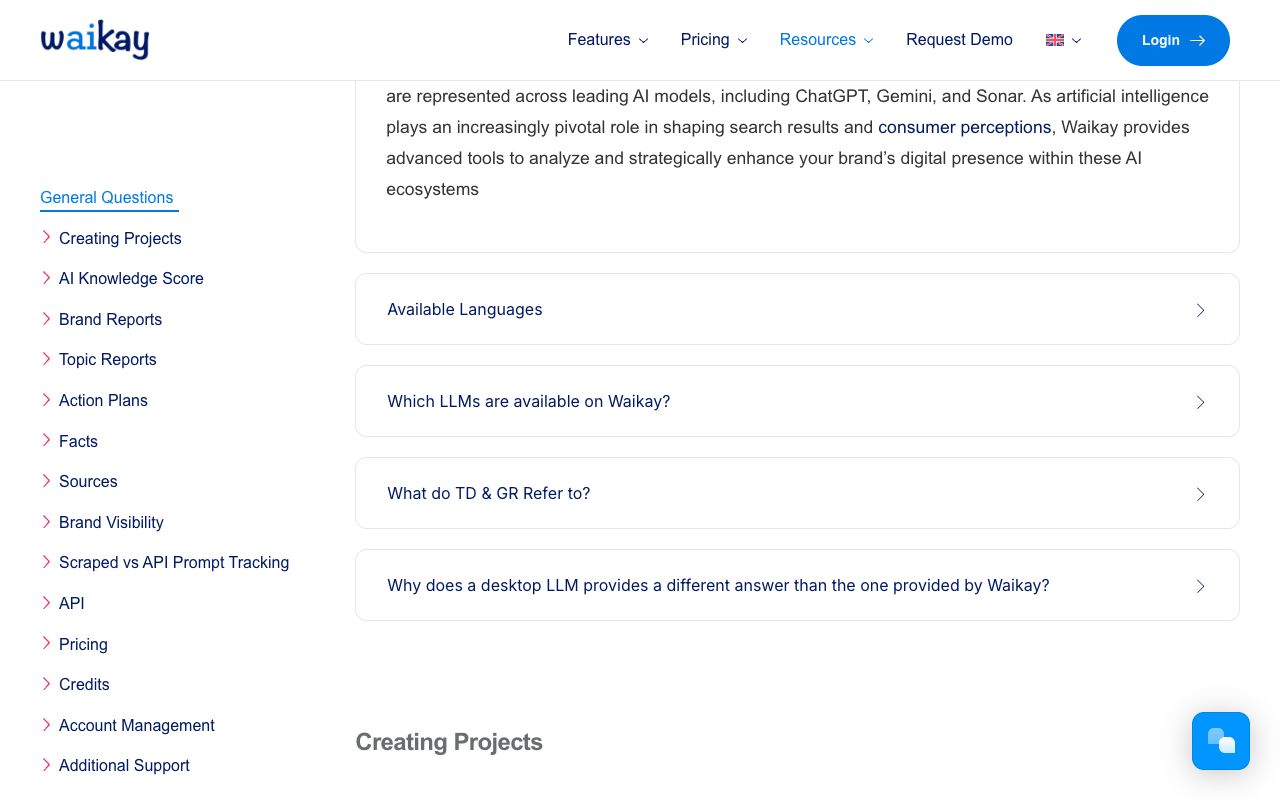
That confidence is measured. The Columbia Journalism Review's Tow Center ran 1,600 queries through eight AI search tools and reported on 6 March 2025 that they "provided incorrect answers to more than 60 percent of queries", with ChatGPT Search misidentifying 134 of 200 articles yet signalling doubt "just fifteen times" (CJR). The European Broadcasting Union's study of 3,000+ responses, published 22 October 2025, found "45% of all AI answers had at least one significant issue" (EBU). Both tested news attribution, not brand profiles, but the mechanism — a fluent sentence built on the wrong page — is the same.
Sentiment scores will not surface it. Peec AI's documentation notes that "most sentiment scores fall between 65 and 85" (Peec AI docs), so a warm, wrong description and a warm, right one can post the same number.
How Do Tools That Track AI Platform Brand Descriptions Compare on Raw Answers, Diffs, Sources and Export?
The table scores six tools on what a description tracker must do: show the raw answer, cover the dimensions above, compare runs, attribute sources and export. "Not advertised" means the vendor page does not say.
| Tool | Raw answer text | Description dimensions | Change comparison | Sources | Export | Entry price |
|---|---|---|---|---|---|---|
| Kairosy | Yes — every answer kept per scan and engine | Per-answer sentiment, negative narratives, mentioned / not / competitor recommended | Scan trend, 7-run prompt history, weekly flags for engine flips | Cited URLs, brand-owned vs third-party | Not advertised | Basic $29/mo; 7-day trial, no card |
| Semrush AI Visibility | Yes — "full, unedited text" in Perception report | Sentiment drivers, "AI Feature Descriptions", perception by platform | Historical selector across answers, sentiment, descriptions, citations | Yes (Narrative Drivers) | CSV/Excel on Narrative Drivers | $99/mo per domain, billed annually; 25 prompts |
| Waikay | Facts extracted from answers, marked accurate or incorrect | AI Knowledge Score, facts, topics | Report updates (daily / weekly / manual), one credit each | Source analytics | Not advertised | Starter $24.95/mo, 8 credits; 3 free credits |
| Otterly.AI | Prompt-level results with sentiment | Net Sentiment Score, brand position, coverage | Coverage trends | Citation tracking | "Detailed Reports & Export"; API on Standard+ | Lite $29/mo (15 prompts); Standard $189 (100) |
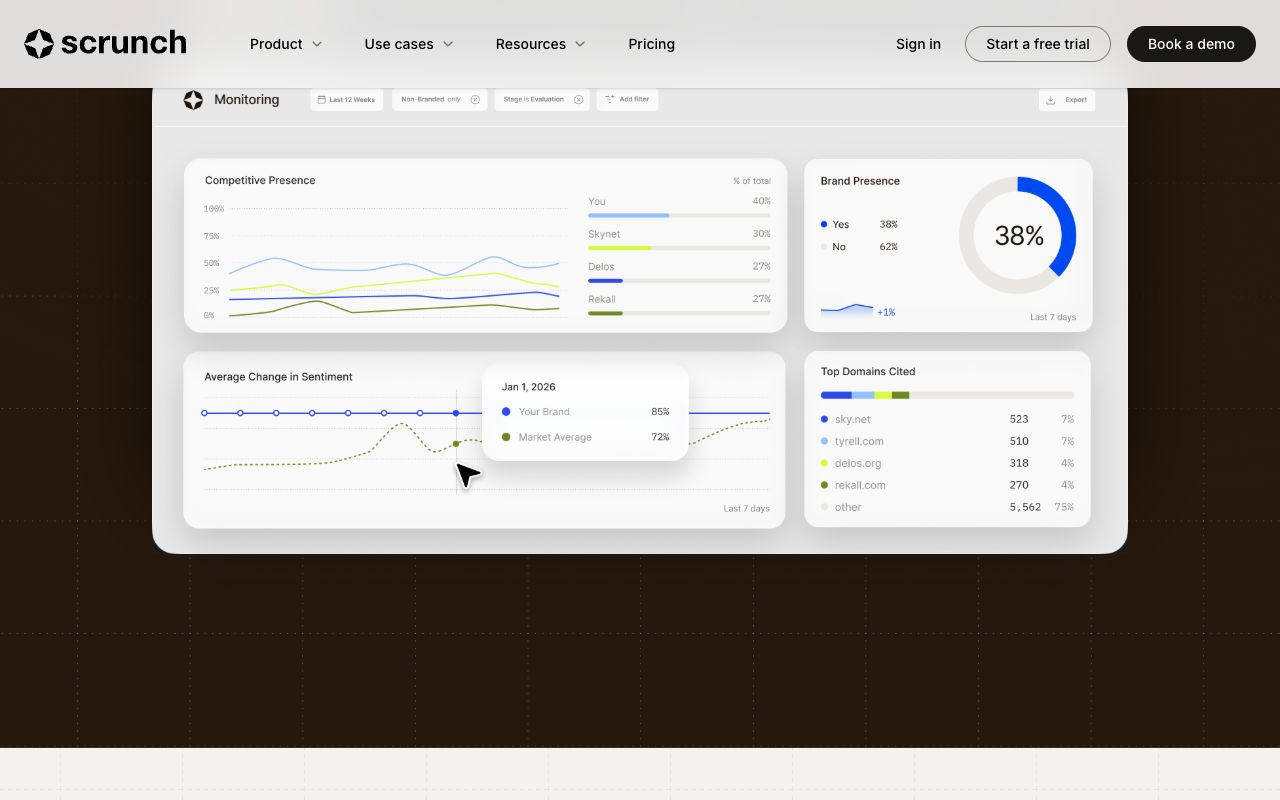
| Scrunch | Mention position (top / middle / bottom) | Entity, claim, pricing and spec gaps by persona | Trends by topic, persona, model, region | Source and page mapping | Not advertised on pricing page | Starter $300/mo ($250 annual); 7-day trial |
| Profound | Answer Engine Insights: citations, sentiment, ranking | Sentiment, competitive presence | Daily tracking | Citations | CSV/JSON + API, Enterprise only | Free Trial (50 prompts, 7 days, 3 engines); Enterprise custom |
Only Kairosy, Semrush and Waikay make the sentence itself something you read and judge; the others summarise it into position, sentiment or gaps. Only Semrush and Profound advertise a structured export of answer-level data.
Which Tool Fits Which Job? Six Tools That Track AI Platform Brand Descriptions, by Differentiator
Kairosy — reads the answer, names the narrative, assigns the fix
Kairosy's differentiator is that kept answer text feeds three derived views, not one score. Each project asks four of six engines (ChatGPT, Gemini, Claude, Perplexity, DeepSeek, Doubao) purchase-stage questions, stores every reply with its citations, rates the tone of each, and groups negative claims into Negative Narratives. Source Analysis splits cited domains into pages you own and pages you don't; Fix Strategy turns each narrative into a task card with a checklist; tracked prompts rerun daily with a seven-run history per engine. Basic is $29/mo for one brand-and-market slot and 15 prompts a day, Pro $99 for five slots and 60, Growth $399 for 20 slots and 250 (annual: $25 / $79 / $299). Limits: no prompt-volume data, no real-time alerting (weekly digest, Monday deep rescan), no client-isolation seats.
Semrush AI Visibility — the Perception report with unedited answers
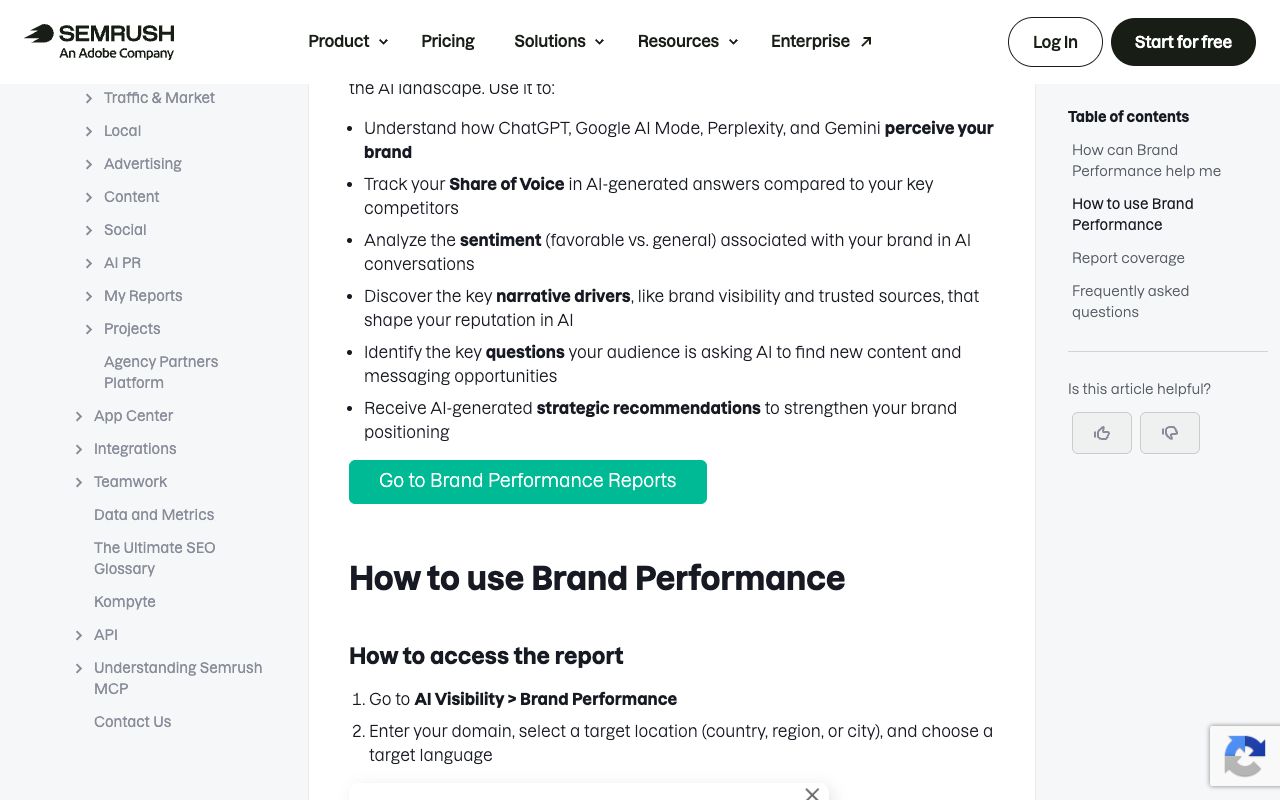
Semrush's Perception report has an "Answers for" panel showing "the full, unedited text of the AI's response", Key Sentiment Drivers, an "AI Feature Descriptions" widget and a historical selector (Semrush KB). The plan is $99/mo per domain billed annually, 25 custom prompts, seven-day trial (Semrush pricing). Limitation: CSV/Excel export is documented on Narrative Drivers, not Perception, and per-domain pricing scales badly.
Waikay — fact-by-fact verification instead of a sentiment number
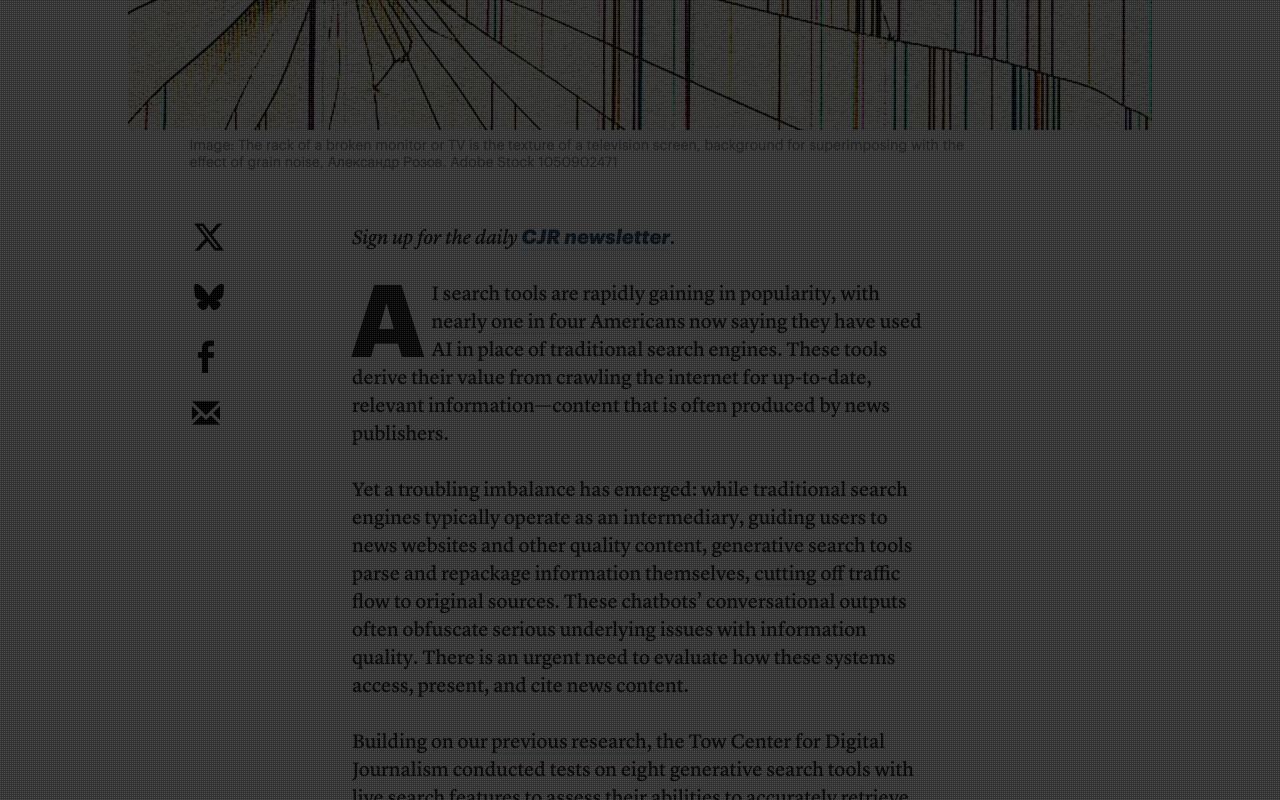
Waikay ("What AI Knows About You") extracts a Facts section on "how AI systems perceive and describe the brand", lets you mark each fact accurate or incorrect, and rolls the result into an AI Knowledge Score built from ChatGPT, Gemini, Claude and Sonar answers. Plans are credit-based: Starter $24.95/mo for 8 credits, Expert $69.95 for 30, Agency $199.95 for 90, plus 3 non-renewable free credits; creating or updating a report costs one credit (Waikay FAQ). Limitation: daily refreshes across several brands burn credits fast.
Otterly.AI — net sentiment and brand position per prompt
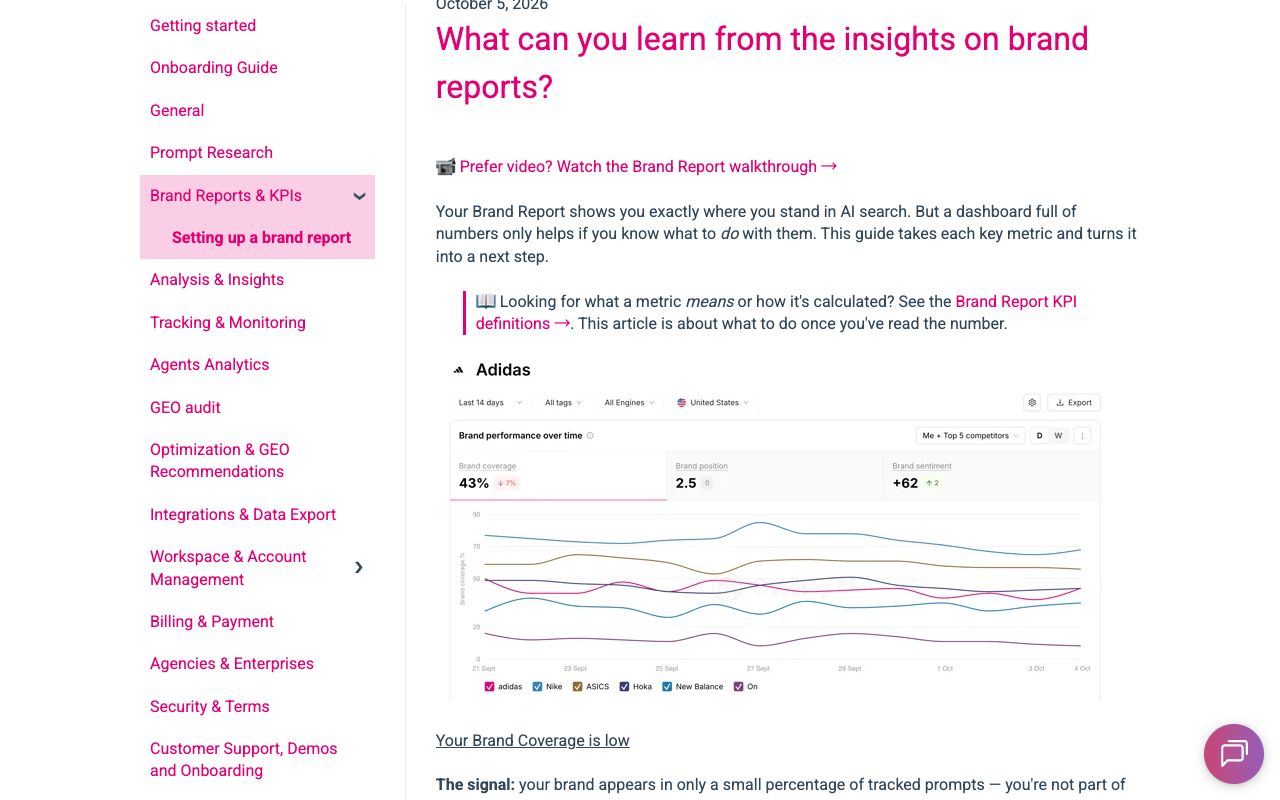
Otterly's brand report reads the narrative through a Net Sentiment Score, Brand Coverage, Share of Voice and Brand Position, and its help centre has you drill into the prompts driving negative sentiment (Otterly help). Lite is $29/mo for 15 prompts (ChatGPT, AI Overviews, Perplexity, Copilot); Standard $189 (100 prompts) and Premium $489 (400) add Claude, Google AI Mode and Gemini as add-ons plus API access; annual billing is 15% lower (Otterly pricing). Limitation: sentiment and citation, no fact-level mark-up of which claim is wrong.
Scrunch — persona-segmented prompts and entity-gap diagnostics
Scrunch's angle is that different buyers trigger different descriptions. Starter includes 350 custom prompts and 3 personas; Growth has 700 and 5. Both filter by topic, persona, model and region, show where in the answer you appear, and diagnose "gaps in entities, claims, pricing, and product specs that AIs look for" (Scrunch platform). Starter is $300/mo month-to-month or $250 annual, Growth $500 or $417, with a seven-day trial and no card (Scrunch pricing). Limitation: the pricing page lists neither sentiment nor an accuracy check, so drift is inferred from gaps and placement.
Profound — nine engines and structured exports, at enterprise prices
Profound's Answer Engine Insights tracks "where and how your brand appears in responses, tracking citations, sentiment, ranking, and competitive presence." The free Trial runs 50 prompts daily for seven days on ChatGPT, Gemini and Google AI Overviews; Enterprise extends to nine engines with CSV/JSON exports and an API (Profound pricing). Limitation: exports are Enterprise-only and pricing is custom, so the most export-friendly option is the one you cannot cost from the site.
How Do You Monitor and Correct AI-Generated Brand Descriptions in Kairosy?
The loop is the same in any tool: write down what the description should say, read what each platform says, diff the two, fix the page the wrong claim came from. In Kairosy (workflow on the AI reputation management page) the kept answers and the source split do the middle two steps.
Step 1 — Build the description baseline and the comparison card
Before scanning, write one line per dimension from your canonical pages: category, audience, three headline features, current price, and the differentiator a buyer should repeat. Note the URL each line comes from, then log every platform answer against it.
Example values — fictional brand "Northwind Payroll"; answer text, differences and citations are illustrative, not measured results.
| Dimension | Official wording (northwind.example) | ChatGPT answer (example) | Gemini answer (example) | Semantic difference | Cited source | Date checked |
|---|---|---|---|---|---|---|
| Category | Payroll software for restaurant groups | "an HR and payroll suite for small businesses" | "restaurant payroll and tip-pooling software" | ChatGPT generalises the category and drops the vertical | example-reviews.com/northwind | 2026-10-21 |
| Audience | Multi-location operators, 50–2,000 staff | "small businesses and startups" | "multi-location restaurant groups" | Audience downsized on one platform only | none cited | 2026-10-21 |
| Features | Tip pooling, scheduling sync, multi-state tax filing | "payroll, benefits and a time clock" | "tip pooling and scheduling integrations" | Benefits and time clock never offered; tax filing missing in both | example-directory.com/listing | 2026-10-21 |
| Price | From $6 per employee per month, no free plan | "has a free tier for teams under 10" | "pricing on request" | Invented free tier; outdated "on request" | example-blog.com/best-payroll-2024 | 2026-10-21 |
| Differentiator | Built-in tip-compliance audits | not mentioned | "known for tip compliance" | Absent on one platform, weakened on the other | northwind.example/blog (Gemini only) | 2026-10-21 |
The Semantic difference column is the deliverable: it records meaning, not counts.
Step 2 — Put the same brand across platforms side by side
Kairosy's Brand Scan runs one brand through the engines you select and lays the answers out one card per platform, each labelled mentioned, not mentioned or competitor recommended, with the merged citation list under the text. That is where you audit AI-generated brand descriptions: read the sentence after your name and fill the card row, cited URL included.
For ongoing tracking, add the same questions to Prompt Tracking: they rerun daily, each engine's card keeps a seven-run history, and label changes — a competitor now recommended, your brand no longer mentioned — are what you diff week to week. The weekly email flags an engine flipping and new negative keywords.
Step 3 — Trace the wrong description to its source and fix that
Source Analysis lists the domains and URLs the answers cited, split into pages you control and third-party pages. Match each wrong row to its cited URL and the fix follows from the owner; how companies fix inaccurate AI brand descriptions comes down to that ownership question.
- Your own pages. Rewrite the exact page with the current category, audience, features and price in plain text near the top, add Organization and Product schema, check it with the schema markup checker, and publish an llms.txt via the llms.txt generator.
- Platforms you can claim. Google's help explains that knowledge panels are "automatically generated" from web sources and that a verified representative can "claim this panel and suggest changes", while anyone can flag a fact with supporting links (Google Knowledge Panel Help).
- Third-party pages. Send stale comparison posts an outreach note with the corrected fact and a link; where that fails, publish a stronger page on the same question so retrieval has a better candidate.
Then wait for the next run: Fix Strategy keeps each task beside its narrative, so you compare the new card with the old one. For the source-level playbook see how to change what ChatGPT says about your brand and AI source monitoring; for the layer above the facts, AI brand perception.
Tools That Track AI Platform Brand Descriptions FAQs
What is the difference between tracking brand mentions and tracking brand descriptions?
A mention tracker records that your name appeared. A description tracker keeps the surrounding sentence and compares it with your official wording and earlier runs: presence versus accuracy.
How often do AI brand descriptions change?
No vendor publishes a reliable rate; it varies by engine and by whether the answer was retrieved live. Treat daily reruns as the sampling rate: one different answer is noise, the same new claim three runs running is a change.
Can you correct a wrong AI brand description directly?
Not inside the model. You correct the pages it reads — your site, claimed profiles, third-party pages — then rerun the prompts and confirm the new wording.
Which description dimension goes wrong most often?
Price and feature lists are the usual first casualties: they change most often and third-party pages copy them once. Identity errors are rarer but worse, because every other dimension is then about someone else.
Do I need a paid tool, or can I log this in a spreadsheet?
Start with the card above and manual queries. The tools earn their price when you need history across engines, citations on each claim and a team workflow for fixes; the entry tiers cost less than an hour a week of copying answers by hand.
Pick the tool that shows you the words. The description a buyer hears is a sentence, and only a tool that keeps it, dates it and ties it to a source lets you monitor and correct AI-generated brand descriptions rather than guess. Build the card, run it across platforms, fix the page behind the worst row first.
See what AI says about your brand
Run a free scan across ChatGPT, Gemini, Claude & Perplexity in about 30 seconds.
Run my free scan