AI Search Visibility Gap Analysis Tools 2026: 6 Compared + Gap Matrix
AI search visibility gap analysis tools find the buyer questions where an AI engine names a competitor and not you, then show you why: the answer text, the URLs it cited and the engine that produced it. Six tools do this well enough to act on in 2026: Kairosy, Otterly.AI, Peec AI, Profound, Ahrefs Brand Radar and Semrush's AI Visibility Toolkit.
Below: the four gap types, what each tool shows, a five-step workflow, and a question × brand matrix that maps each gap to a page. Prices were read on vendor pages on October 21, 2026.
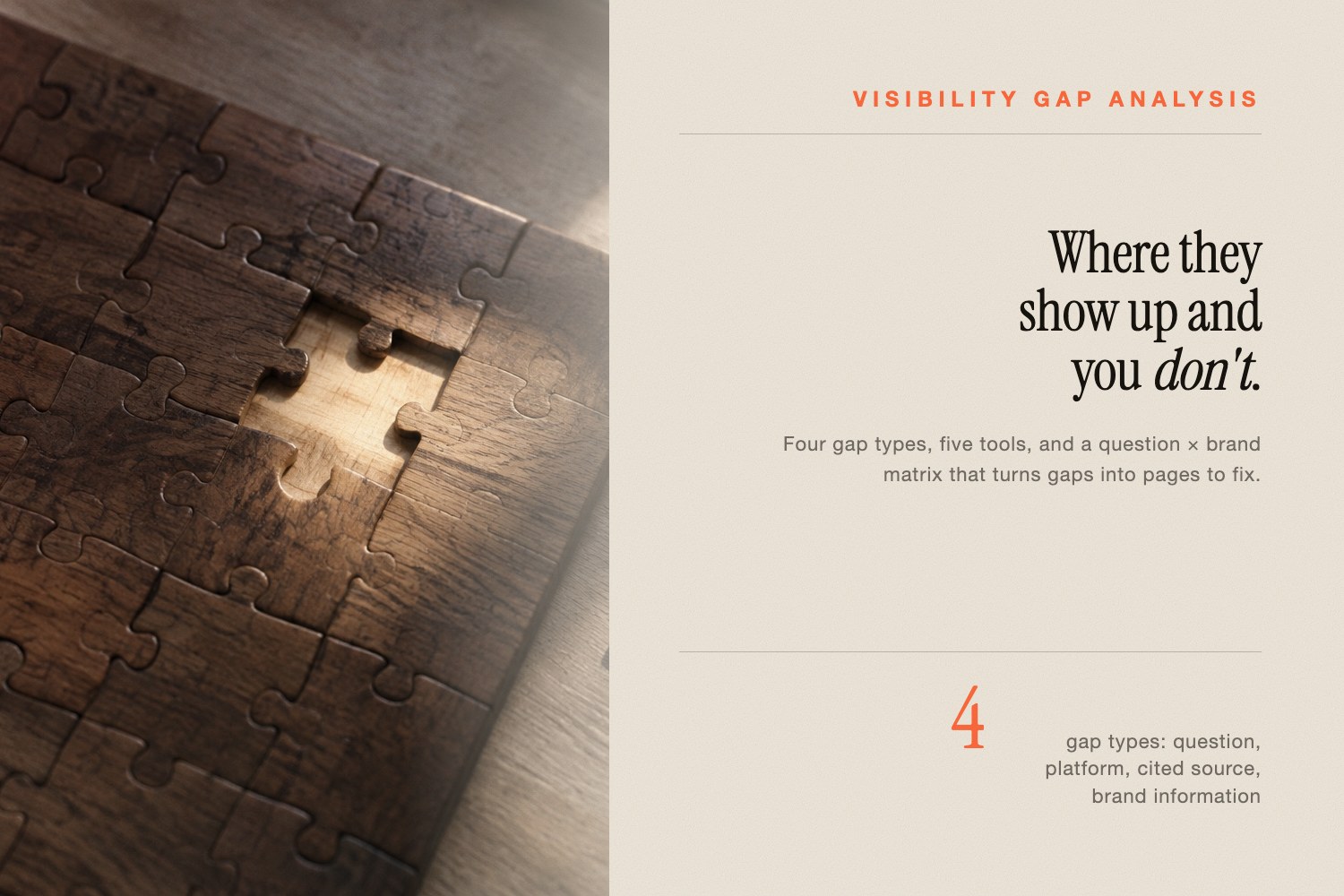
What Are the Four Types of AI Search Visibility Gap?
A gap is a buyer question where a rival is in the answer and you are not, or where you appear with the wrong facts. Each type has a different fix owner.
- Question gap. "Best product analytics for a 10-person startup" returns three names and yours is missing. This is the unit of AI search prompt gap analysis. Roll prompts up by theme and you get what AI search topic gap analysis tools report: you lose the pricing cluster, you win integrations.
- Platform gap. Gemini names you, Perplexity does not, for the same question. Profound's July 1, 2025 study of 100,000 prompts run through ChatGPT and Perplexity found only 11.0% of cited domains were shared (37.4% ChatGPT-only, 51.6% Perplexity-only). This is a retrieval problem for one engine.
- Cited-source gap. The answer leans on a G2 page, a Reddit thread or the rival's comparison page, and nothing you control is retrieved. That discipline has its own guide, how to analyze citation gaps in AI search, so here it is one label in the matrix.
- Brand-information gap. You are named, but with an old price, a shipped feature marked missing, or a 2024 complaint presented as current.
A fifth bucket is not a gap at all: the question describes a buyer you do not serve. Keep it. The costliest mistake in AI competitor visibility gap analysis is writing a page for a deal you would have lost anyway.
Which AI Search Visibility Gap Analysis Tools Show Question-Level Competitor Data?
Three capabilities separate a gap tool from a dashboard: competitor data per question, the raw answer kept so you can read why the rival won, and URL tracking so you know which page did the winning.
Kairosy: question-level competitor data with the answer text
Kairosy asks real buyer questions to the engines you pick (ChatGPT, Gemini, Claude, Perplexity, DeepSeek and Doubao are live; each plan uses 4 of the 6 per project) and keeps full answers with cited sources. Competitor Comparison shows share of voice per rival, unbranded versus branded views, and your position as #k of N. Prompt Tracking re-runs questions daily, labels each engine's answer mentioned, not mentioned or competitor recommended, and keeps a 7-run history, so a one-off absence looks different from a week-long one.
Brand Scan runs your question set against any rival: 12 quick scans a month on Basic ($29), 60 on Pro ($99), 200 on Growth ($399), with 5, 10 and 20 pinned competitors. 7-day trial, no card. Kairosy has no prompt-volume data and no Google rank tracking.
Otterly.AI: a Competitors column per prompt and raw-answer exports
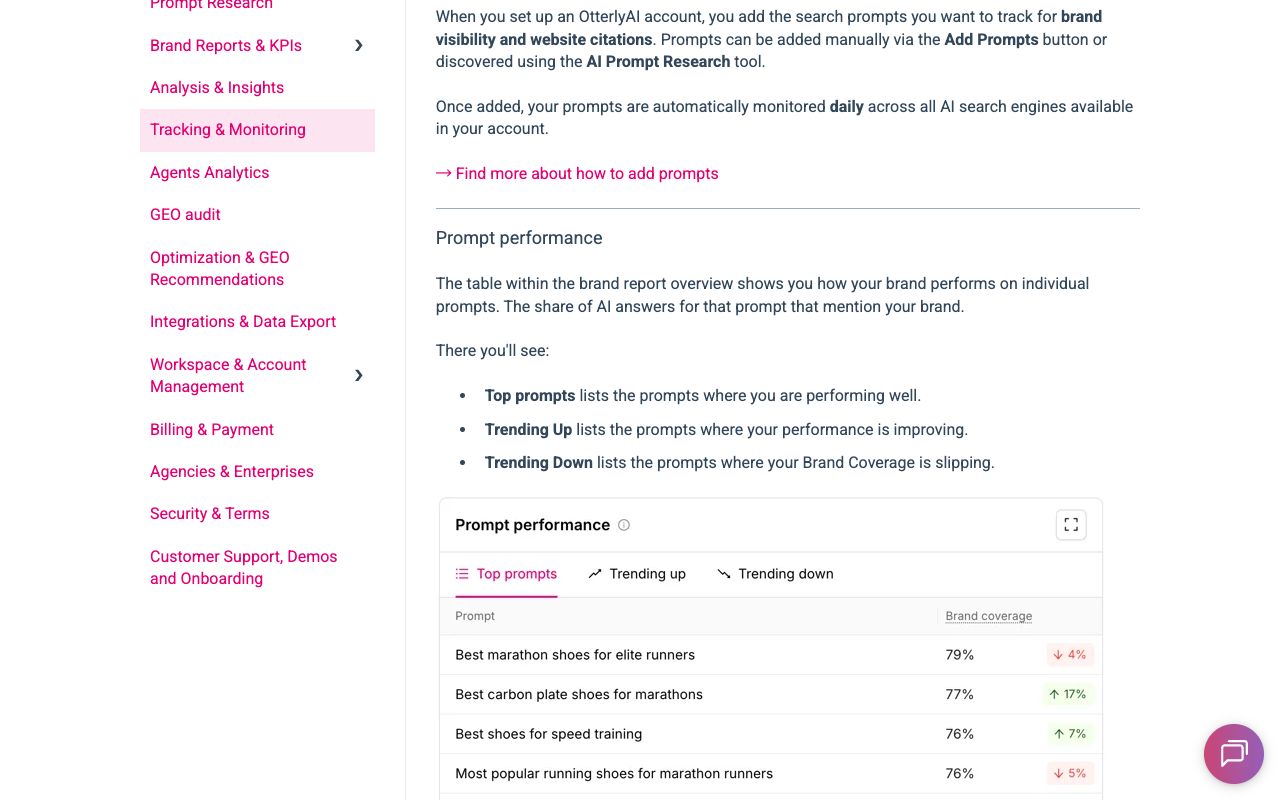
Otterly's Prompts tab has a Competitors column its help center defines as "The competitor brands that appear in AI responses," checked daily. Raw responses export as CSV or JSON on all plans, and citations as CSV, so a gap table takes an afternoon in a spreadsheet. Lite is $29 a month ($25 billed annually) for 15 prompts on ChatGPT, Google AI Overviews, Perplexity and Copilot. Standard is $189 for 100 prompts; Premium $489 for 400.
Peec AI: auto-detected competitors and retrieved-versus-cited URL tracking
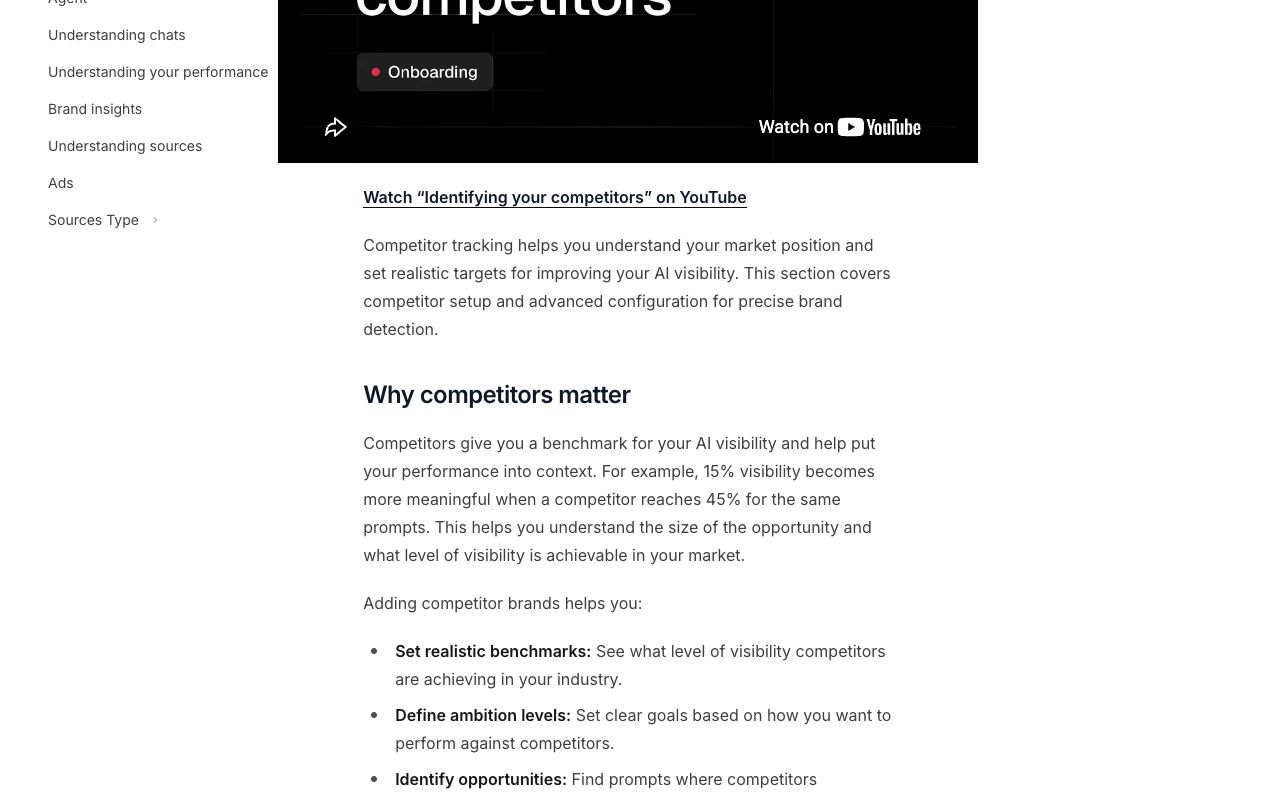
Peec suggests a competitor once a brand appears "at least twice" alongside yours. Its competitor docs frame the gap well: "15% visibility becomes more meaningful when a competitor reaches 45% for the same prompts." The URLs report lists citations per URL, which prompts triggered a URL "regardless of whether it was cited or not," and a Retrieved view that exposes pages engines read but never quote. Starter, Pro and Advanced tiers render on the pricing page and could not be read from its source on October 21, so check there.
Profound: platform comparisons and citation authority
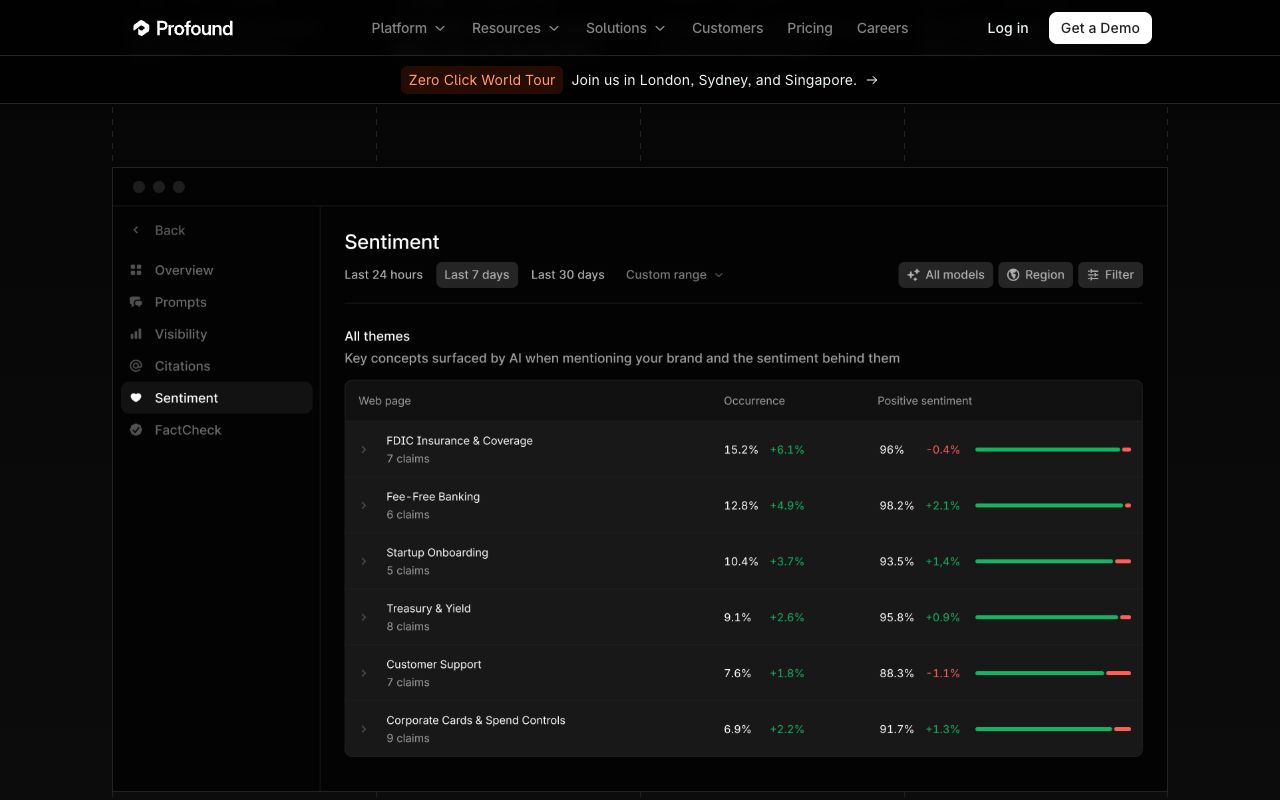
Profound's Answer Engine Insights offers "Competitive Benchmarking," "Platform Comparisons" and "Citation Authority" across eight listed platforms, including Grok and DeepSeek. A free trial runs 50 prompts daily for seven days on three engines; after that it is custom Enterprise pricing, which is also the only tier with Prompt Volumes. Pick it if you need demand numbers next to each gap and have contract budget.
Ahrefs Brand Radar: gaps across prompts you never wrote
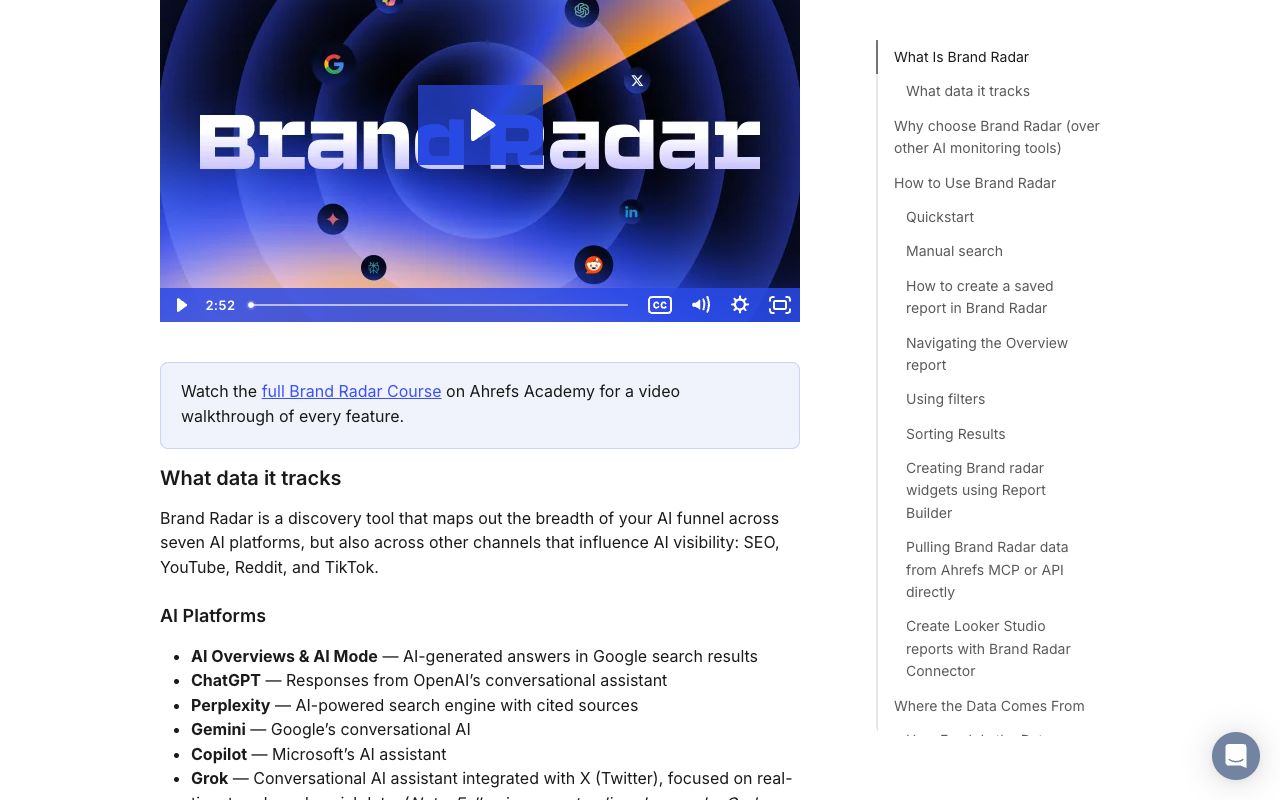
Brand Radar shows which prompts, from what its help article (updated September 3, 2026) calls "405+ million search-backed prompts," mention a rival and not you, with competitor share of voice and top cited pages and domains. It is the best starting point before you have a prompt set. Standalone it is "From $199/mo"; custom prompt checks cost $50 for 2,500, $100 for 7,000 or $250 for 25,000 a month.
Semrush AI Visibility Toolkit: a "missing" filter for prompts and sources
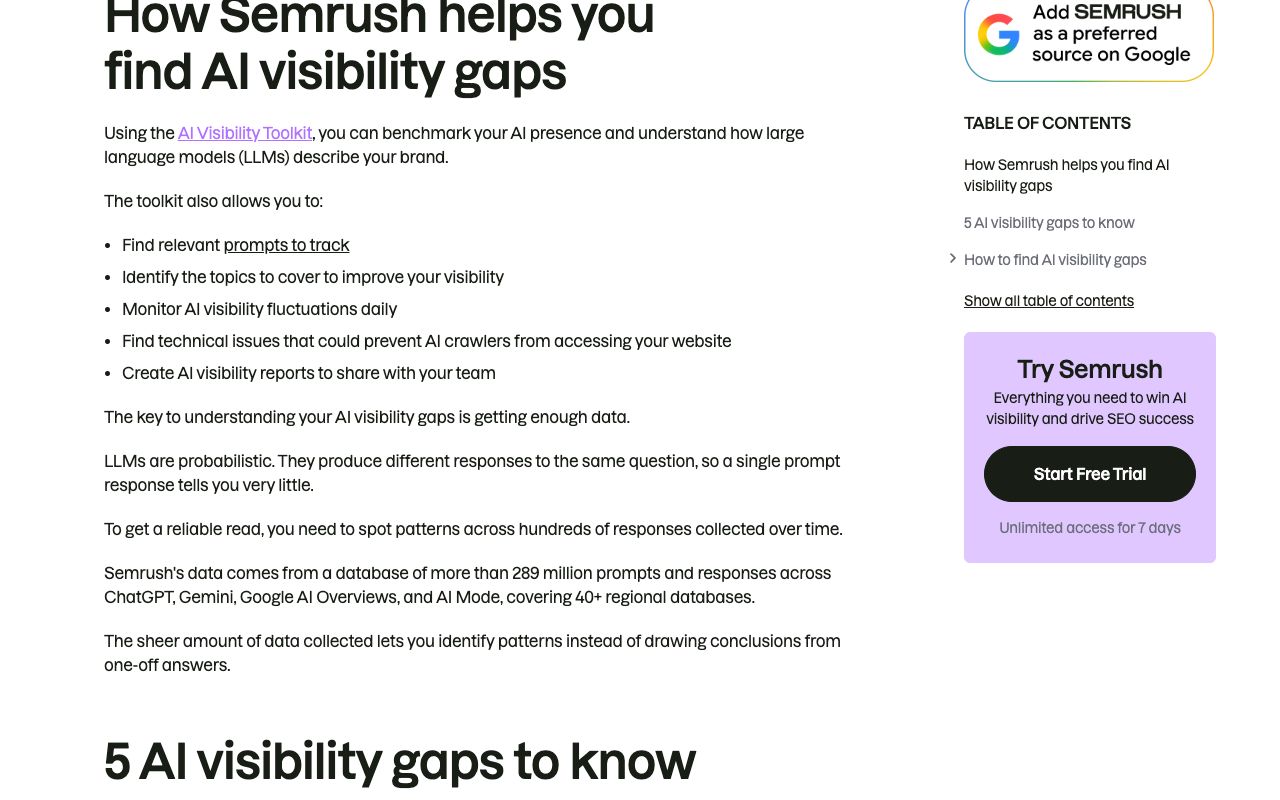
Semrush's Competitor Research compares you with up to four domains and filters "Topics or prompts where competitors are cited but your brand is not," plus a Missing filter on sources. Its July 27, 2026 walkthrough, finding AI visibility gaps with Semrush, sums it up: "You find where competitors are winning and close the gap." The base plan is $99 a month per domain billed annually, with 25 daily custom prompts.
AI search visibility gap analysis tools compared
| Tool | Entry price (Oct 21, 2026) | Competitor data | Raw answers | URL tracking |
|---|---|---|---|---|
| Kairosy | $29/mo, 7-day trial | Per prompt and engine | Yes | Source Analysis |
| Otterly.AI | $29/mo, 15 prompts | Competitors column | CSV/JSON export | Citation exports |
| Peec AI | See pricing page | Auto-detected rivals | Yes | Retrieved vs cited |
| Profound | Trial, then custom | Benchmarking | Yes | Citation Authority |
| Ahrefs Brand Radar | From $199/mo | Prompt database | Custom prompts | Top cited pages |
| Semrush AI Toolkit | $99/mo, annual | Up to 4 domains | Partial | Missing sources |
| Rankscale | $99/mo Pro | Benchmarking | 4,800 answers/mo | Citations |
| Ziptie | From $42.75/mo | Unlimited rivals | CSV export | Yes |
How Do You Identify Gaps in AI Search Visibility Step by Step?
How to identify gaps in AI search visibility (B2B or not): hold everything fixed except the brand, so the only variable in a competitor-won answer is the competitor.
1. Fix the brand, competitors, engines and question set
One brand with aliases, three to five rivals sales actually loses to, the engines your buyers use, and questions across the funnel: "best X for Y," "A vs B," "is A worth it," "A alternatives." Lock the set before reading results.
2. Filter to answers where a competitor appears and you do not
Keep rows where a rival is named and you are not, plus rows where a rival is recommended over you. In Kairosy that is the competitor recommended label; in Semrush, the missing filter.
3. Classify: content gap, source gap or product mismatch
Read the raw answer. Cites a page type you lack, such as a comparison page? Content gap. Cites a third-party list without you, or your page is unreachable? Source gap; run it through the AI crawl checker first. Describes a buyer you do not serve? Product mismatch. Mark it and stop.
4. Rank by purchase value, gap stability and execution cost
Value: closeness to a purchase, plus demand data from Ahrefs, Semrush or Profound if you have it. Stability: did the rival win once or on all seven runs? Cost: editing a page is cheap, a G2 placement is slow, a feature is a roadmap debate. Take the top five.
5. Re-test the same set and measure whether the gap narrowed
After the change and a recrawl, run the identical questions on the identical engines. Are you present now, and is the cited source yours? Kairosy's Monday deep rescan and weekly email cover the before and after.
How Do You Walk From One Competitor-Won Answer to the Page to Update?
The deliverable is a question × brand gap matrix with a to-do per gap. This one uses example values for a fictional analytics vendor, Northwind, against fictional rivals. It is a template, not measured data.
| Question (example values) | Northwind | Contoso | Fabrikam | Gap type | To-do |
|---|---|---|---|---|---|
| Best analytics for a Series A startup | Absent | Recommended | Mentioned | Content | Create /pricing/startups with a worked example |
| Northwind vs Contoso | "Pricing unpredictable" | Recommended | Absent | Brand information | Update /pricing FAQ with 2026 tiers |
| Northwind alternatives | Mentioned | Recommended | Recommended | Source | Complete the cited G2 category profile |
| Free analytics for a personal blog | Absent | Absent | Recommended | Product mismatch | None: not a fit for this buying scenario |
| Analytics with a SOC 2 report | Gemini only | All engines | Absent | Platform | Add /security to sitemap and llms.txt, re-test |
Walk row two. Contoso is recommended and Northwind is called "pricing unpredictable," citing a 2024 review thread and Contoso's comparison page. Nothing of Northwind's is cited. The fix is not a blog post: rewrite the pricing FAQ with current tiers and a worked example, publish a comparison page answering that exact question, and re-test in a week.
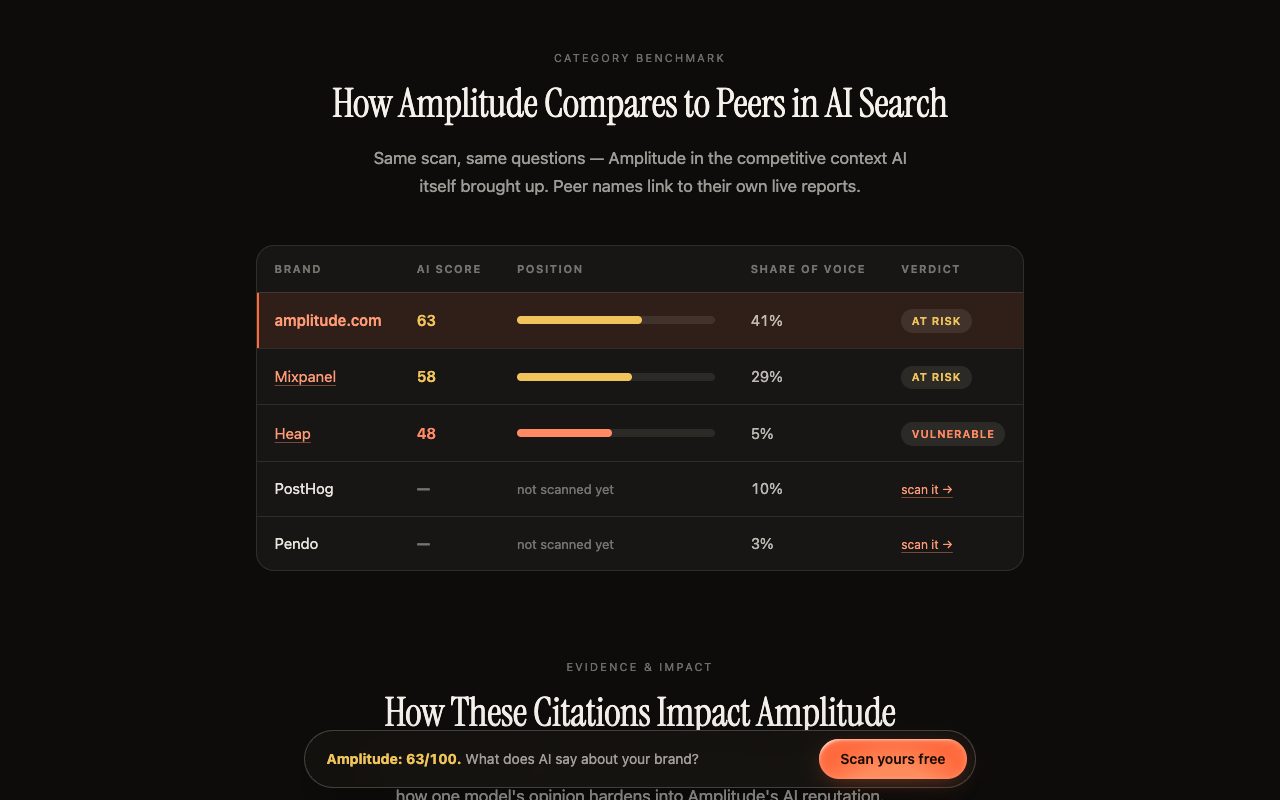
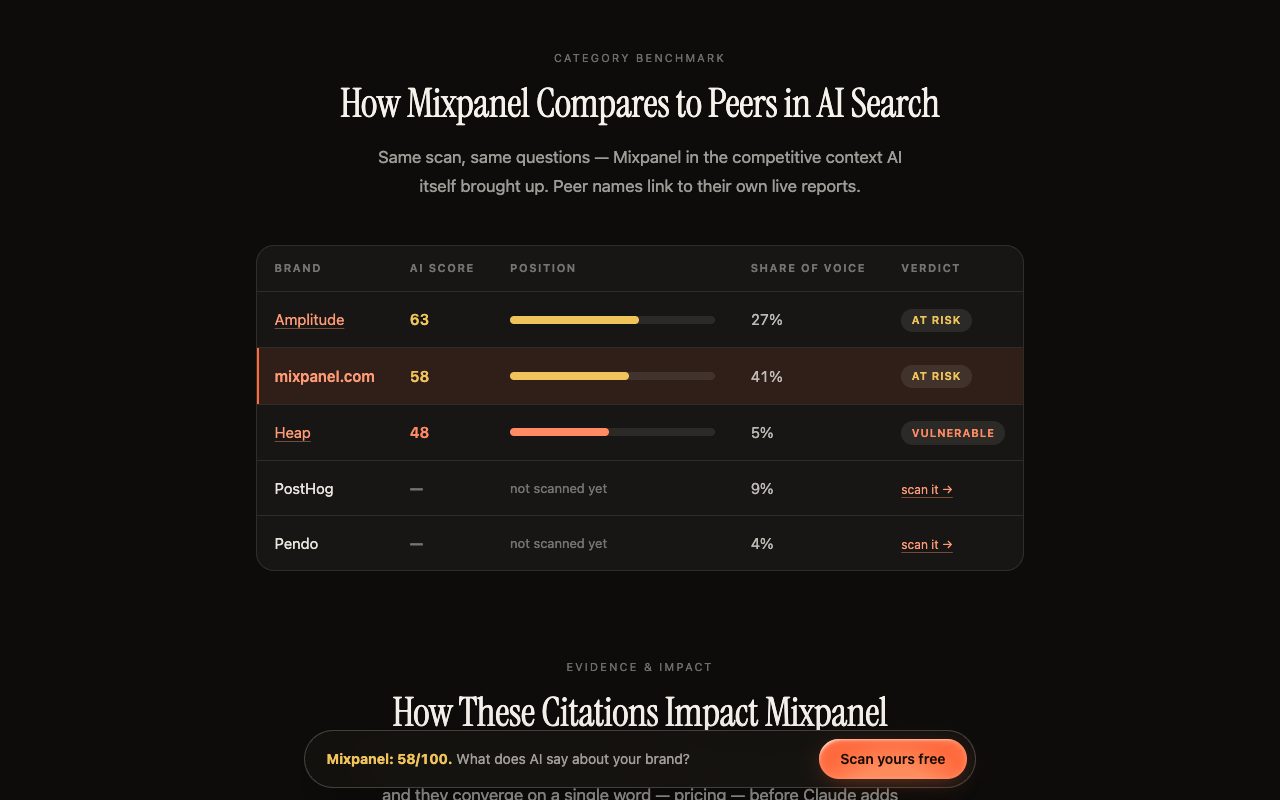
The real version looks the same. Kairosy's public scan of Mixpanel (August 5, 2026) scored it 58/100, "At risk," at 96% visibility, so it is not a mention problem. Amplitude scores 63; the category breakdown bottoms out on Alternatives (37) and Complaints (24), led by pricing unpredictability. The recommended fixes are a head-to-head page against Amplitude and pricing documentation with worked examples: row two with real names.
Why Isn't Every AI Search Visibility Gap a Content Gap?
Only one row in the matrix calls for new writing. Brand-information gaps are fixed by correcting a page the engine already reads, source gaps on G2, Reddit or by unblocking a crawler, platform gaps by making a page retrievable for one engine.
The product-mismatch row calls for nothing. Chasing a hobbyist query with a mid-market product attracts the wrong trials and teaches engines to place you in the wrong segment. Record it and leave it off the list. If you want help separating reputation fixes from content fixes, see AI reputation management.
AI Search Visibility Gap Analysis Tools FAQs
How many prompts do I need before a gap is real?
Ten to twenty buying questions re-run daily for a week tell you more than 200 run once. Repetition, not volume, separates a gap from variance.
Can a free tool do AI search prompt gap analysis?
Partly. Pasting questions into each engine and logging who is named is the manual version of step two. You lose retained answers, cited URLs over time and the rival's side. Kairosy's and Profound's trials and Otterly Lite are the cheapest upgrades.
What is the difference between a topic gap and a prompt gap?
A prompt gap is one question. A topic gap is a cluster (pricing, security) where you lose most prompts. Semrush and Ahrefs work at topic level from prompt databases; prompt trackers work per question and roll up.
Why do I appear in one engine and not another?
Engines retrieve from different sources; Profound found only 11% domain overlap between ChatGPT and Perplexity. Find the page the winning engine cites, then make sure the losing engine can reach yours.
How often should I re-run the analysis?
Weekly for the full matrix, daily for the rows you are fixing. A gap that stays closed four weekly runs in a row is closed.
See what AI says about your brand
Run a free scan across ChatGPT, Gemini, Claude & Perplexity in about 30 seconds.
Run my free scan