AI Search Visibility Metrics (KPIs): How to Set and Track Them in 2026
An AI search visibility KPI is a commitment on a measurable data series — "lift our visibility rate on 25 tracked prompts from 30% to 50% by December" — not a vague ambition to show up in ChatGPT more often. This guide walks the full loop: how to set AI search visibility metrics & KPIs, which data series you can genuinely track, and which software reports the numbers, with GA4, Bing Webmaster Tools, and Kairosy covered in depth.
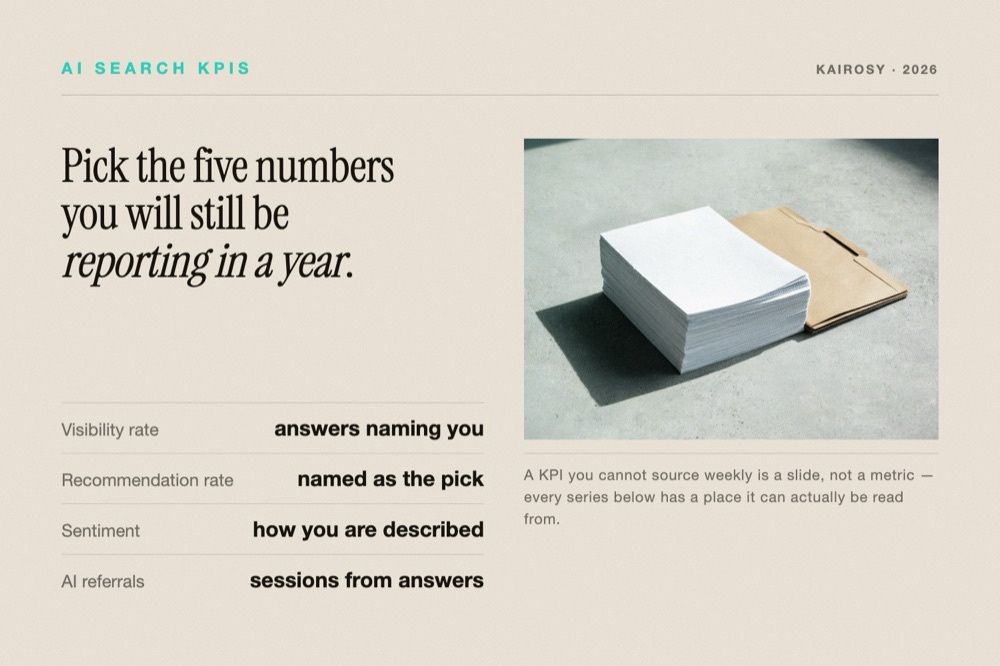
AI answers ship without a rank-tracker feed, yet in 2026 visibility rate, mention counts, sentiment, recommendation rate, citations, and AI-referred revenue are all trackable — and two of those series now come from free first-party consoles.
How Do You Set AI Search Visibility KPIs?
Set the KPI before you argue about tooling. A metric is a data series you observe. A KPI is a promise you make on that series: a number, a segment, a deadline, and a name attached.
Gartner predicted in February 2024 that traditional search engine volume would fall 25% by 2026 as chatbots and virtual agents absorb queries. Whether or not the drop lands exactly there, leadership is already asking what replaces the rank report.
A workable process has four steps:
- Baseline every series first. Scan the engines for your brand, pull your current AI referral sessions, and record the numbers before promising improvement. A target without a baseline is a guess.
- Write the KPI as metric + segment + target + deadline + owner. Example: "Raise our visibility rate on 25 tracked purchase-intent prompts in the US market from 32% to 50% by end of Q4. Owner: head of content."
- Separate leading from lagging. Visibility, mentions, sentiment, and citations move first. Traffic, signups, and revenue move weeks later. Put both on the scorecard, but never judge a content change by the lagging series in week one.
- Fix the cadence up front. AI answers vary run to run. Commit to repeated sampling — daily or weekly per prompt — and grade trends, not snapshots.
Which Data Series Can You Actually Track for AI Visibility?
Six series cover almost everything worth putting a KPI on:
| Data series | Example KPI | Data source |
|---|---|---|
| AI visibility rate — share of tracked prompts where your brand appears | Appear in 50% of 25 tracked prompts by Q4 | Prompt-tracking scanners (Kairosy, Profound, Peec AI) |
| AI mentions and position — how often you are named, and where in the answer | Move from "also mentioned" to top-three placement on shortlist prompts | Scanners plus manual spot checks |
| AI reputation (sentiment) — how the answer characterizes you | Zero engines describing the brand negatively on purchase-intent prompts | Sentiment-classified scans |
| AI recommendation rate — the engine actively endorses you, not just names you | Recommended in 1 of 3 category shortlist answers by year end | Scanners |
| Citations and source share — which pages and domains the engine grounded its answer on | Grow unique pages cited per day in Copilot answers by 2x | Bing Webmaster Tools AI Performance report |
| AI referral traffic and conversions — sessions and signups arriving from AI platforms | Grow AI-referred signups 20% quarter over quarter | GA4 |
The first four describe what the engines say. The last two are consequences: citations show which pages the machines trust, and referral traffic shows when an answer became a visit. A healthy KPI set mixes both.
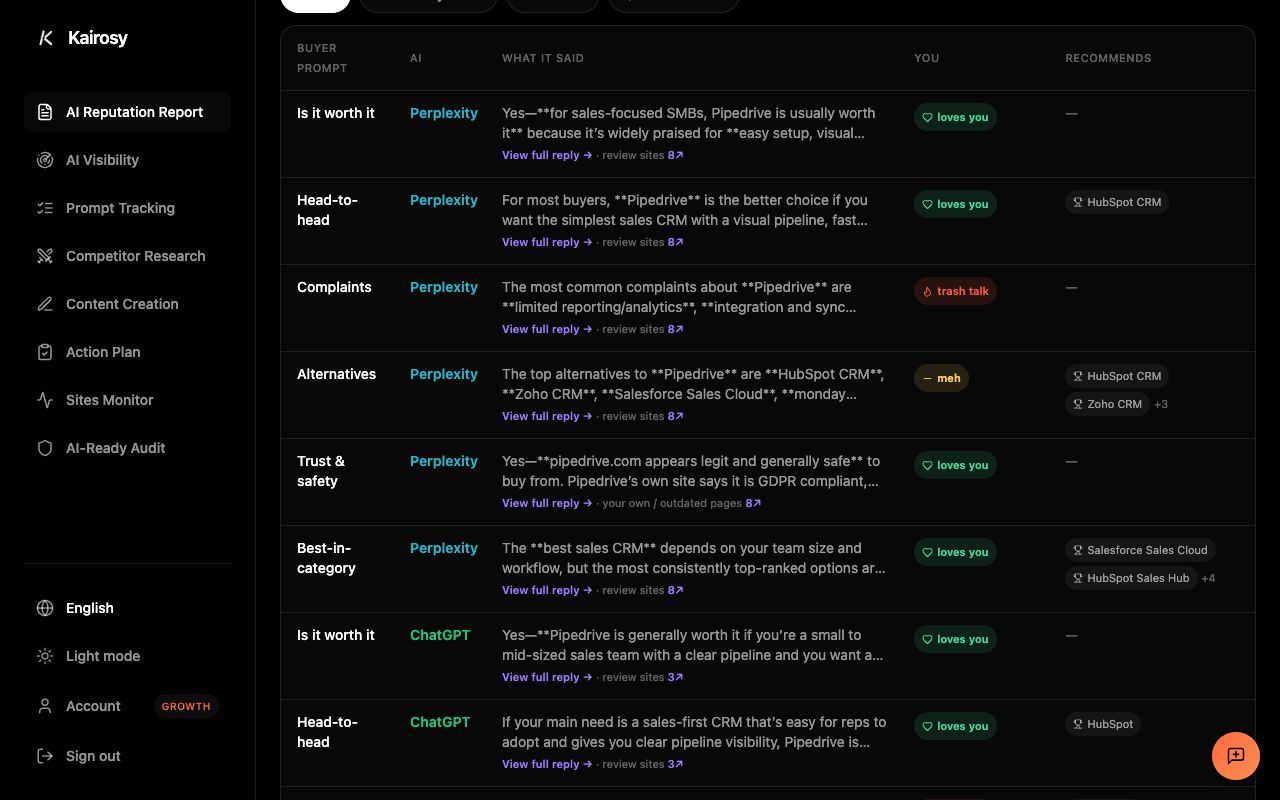
To see how the answer-side series read together in practice, look at a public example: Kairosy's scan of Pipedrive at /reports/pipedrive-ai-performance shows visibility, per-engine sentiment, and competitor mentions for one brand on a single page. That is the shape your own scorecard should take — one brand, all series, one view.
Two of these series have full deep dives on this blog: what an AI presence score is made of and how AI share of voice is calculated. This post stays at the KPI level — read those if you want the metric internals.
Recommendation rate is the series most teams miss, because being named is not being endorsed. Run a category shortlist query on any engine: several brands get listed, one or two get picked. That gap is where deals are won.
What Are the Best Sales Metrics to Track for AI Visibility?
The best sales metrics to track for AI visibility are conversion rate of AI-referred sessions, revenue (or pipeline) per AI visit, and self-reported attribution — in that order. Raw session counts flatter you; conversion quality is where AI traffic earns its line on the dashboard.
The quality signal is well documented. Adobe Analytics reported in March 2025 that generative-AI referrals to US retail sites had grown 1,200% since July 2024. By the 2025 holiday season, Adobe data covered by Digital Commerce 360 in January 2026 showed those referrals up 693% year over year — and converting 31% better than other traffic sources. Small volume, unusually high intent.
Four sales-side series worth a KPI:
- AI-referred conversion rate. Signups or purchases per session from AI referrers, benchmarked against your site average.
- Revenue or pipeline per AI visit. For B2B, tag deals whose first touch was an AI referrer and total the pipeline they influence.
- Self-reported attribution. Add "an AI assistant recommended you" to your how-did-you-hear-about-us field. Many AI answers never produce a click, so this catches conversions your analytics cannot see.
- Assisted branded search. Watch branded query volume alongside your visibility series — when an engine recommends you and the user googles your name later, the correlation is your only evidence.
Treat all four as lagging indicators. If you only track sales metrics, you will learn that your AI visibility collapsed about six weeks after it happened.
How Do You Track AI Search Visibility KPI Data? (Tools Guide)
You need three layers: web analytics for the click side, a search console for the citation side, and a scanner for the answer side. The first two are free.
GA4: free tracking for AI referral KPIs
Google Analytics 4 is free in its standard tier (Analytics 360 is the paid enterprise version). Build a custom channel group or an exploration that filters session source for AI referrers — chatgpt.com, perplexity.ai, gemini.google.com, copilot.microsoft.com — then segment your key events by that channel. That gives you AI-referred sessions, conversion rate, and revenue at no new spend.
Know the blind spot: assistants often strip or generalize referrer data, and answers read inside an app frequently produce no visit at all. GA4 measures the click-through slice of AI visibility, not the whole pie.
Bing Webmaster Tools: free citation data from Copilot
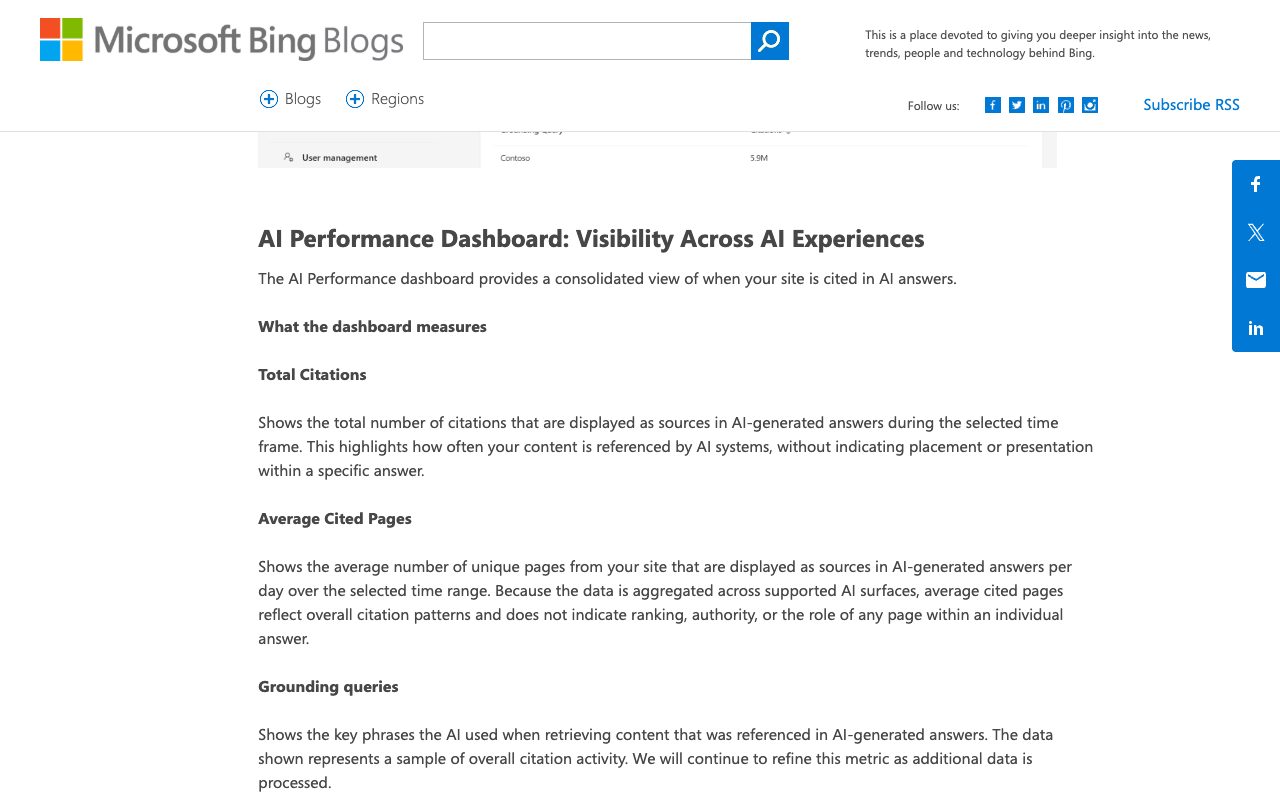
In February 2026 Microsoft shipped an AI Performance report in Bing Webmaster Tools (public preview) — the first first-party console from a major AI search provider. Per Search Engine Journal's February 9, 2026 coverage, it reports total citation counts, average daily unique pages cited, page-level citation activity, and the "grounding queries" the AI used when it retrieved your content for Copilot and Bing's AI summaries.
If you set one new KPI this quarter, unique pages cited per day is a strong candidate — it is free, first-party, and tells you which content the machines actually trust.
Kairosy: the AI reputation scanner for answer-side KPIs
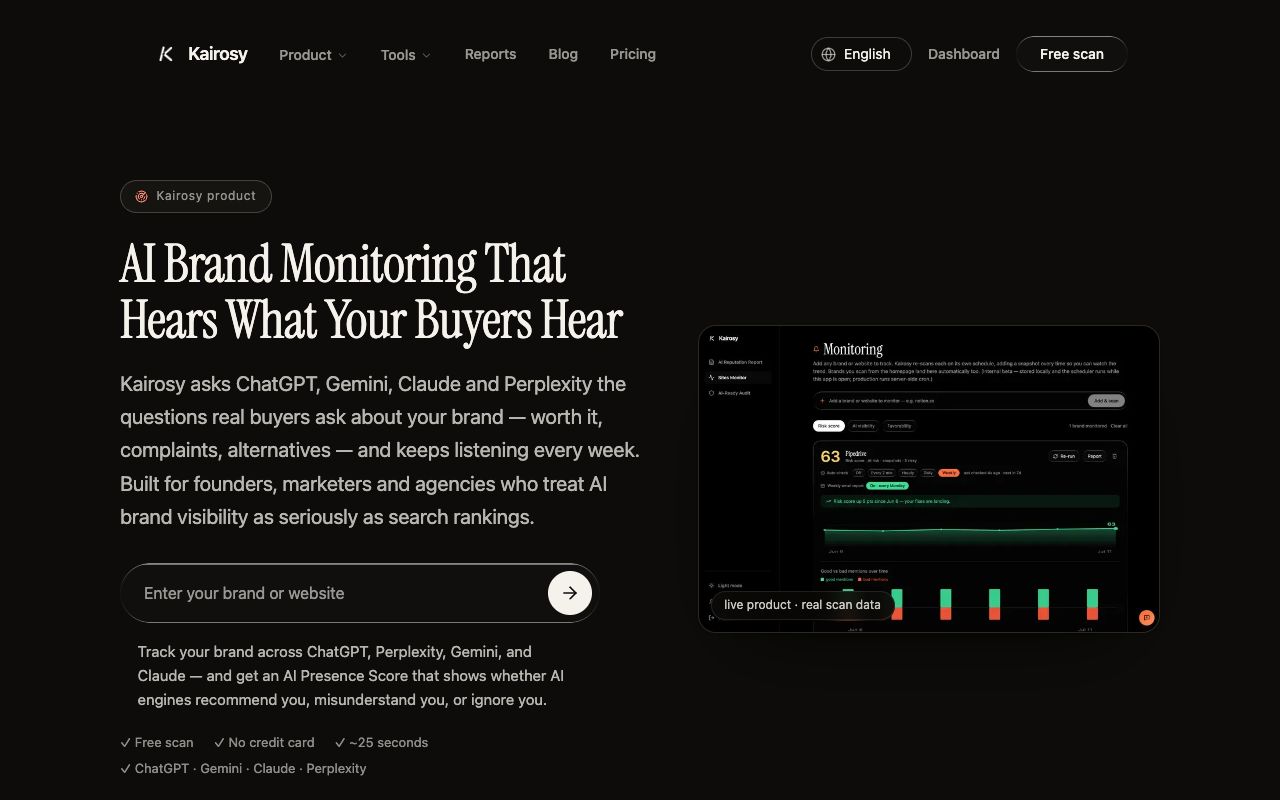
The answer-side series — visibility rate, sentiment, recommendation rate — need a scanner, because no analytics console can tell you what ChatGPT says about you. Kairosy runs your brand through ChatGPT, Gemini, Claude, and Perplexity, grades how each answer treats you, and rolls the results into a scored report with the sources each engine leaned on. The free 7-day trial includes full scans, which is exactly what the baseline step needs. Paid plans (Basic $29, Pro $99, Growth $399 per month) add daily prompt tracking, weekly monitored rescans with email alerts, market-specific scans across 25 countries, and a Fix Plan that turns weak answers into a prioritized to-do list.
Before you put a KPI on visibility, run the two-minute technical pre-check: the free AI crawl checker confirms AI crawlers can reach your site, and the index checker confirms your key pages are indexed. If either fails, your visibility series will flatline for reasons no content strategy can fix.
Which is the most accurate AI visibility metrics software?
There is no single most accurate AI visibility metrics software, and any vendor claiming otherwise is selling. Generative answers are non-deterministic — the same prompt returns different answers across runs, engines, and countries — so accuracy is a function of sampling frequency, prompt coverage, engine coverage, and market coverage. Judge tools on those four axes and on price:
| Tool | What it measures | Pricing (checked August 2026) |
|---|---|---|
| Google Analytics 4 | AI referral sessions, conversions, revenue | Free (Analytics 360 for enterprise) |
| Bing Webmaster Tools | Citations in Copilot and Bing AI summaries, grounding queries | Free (AI Performance in public preview) |
| Kairosy | Visibility, sentiment, recommendations, and citations across ChatGPT, Gemini, Claude, Perplexity | Free 7-day trial. Basic $29, Pro $99, Growth $399/mo |
| Profound | Prompt tracking and answer engine analytics | Free 7-day trial (50 prompts on ChatGPT, Gemini, AI Overviews). Enterprise custom, sales-led (self-serve tiers withdrawn; rechecked September 2026) |
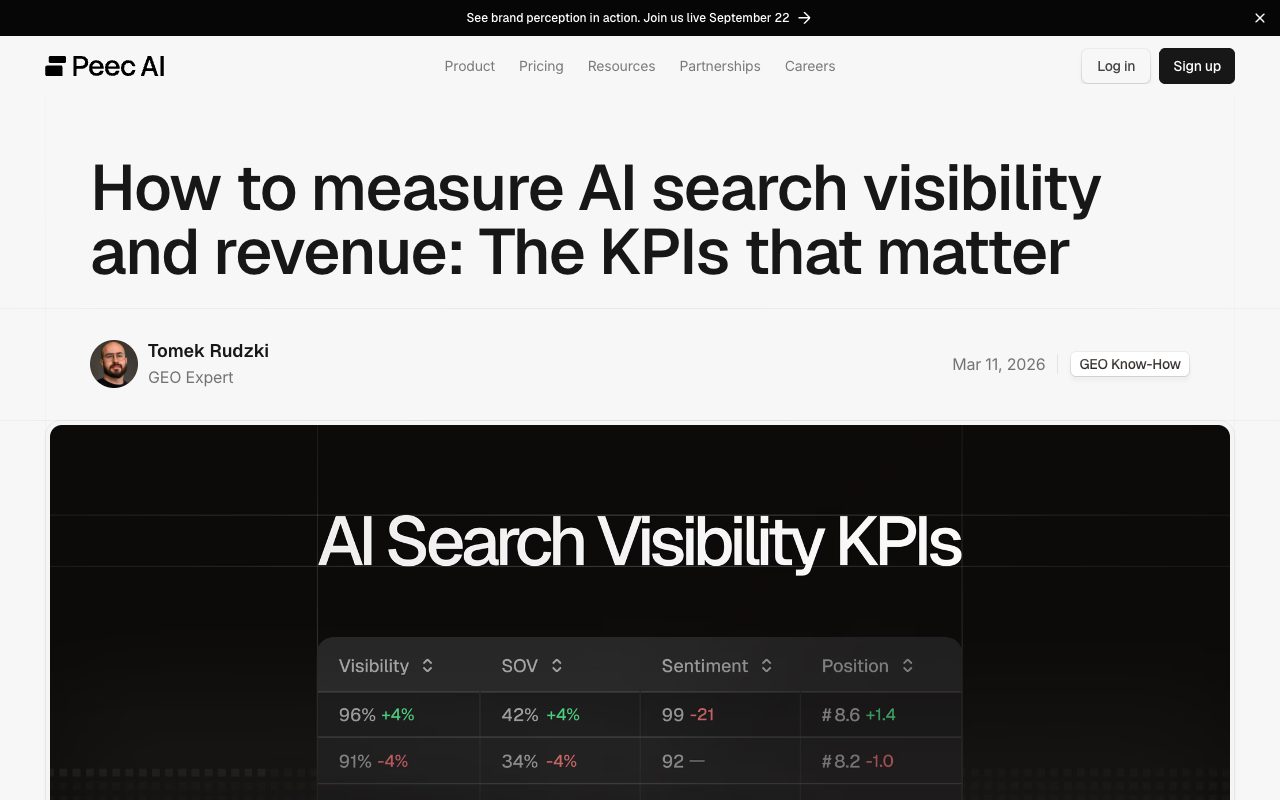
| Peec AI | Prompt-based visibility tracking across six AI models | Four annual tiers (Starter to Enterprise). Prices via sales |
The honest stack for most teams: GA4 plus Bing Webmaster Tools because they are free and first-party, plus one scanner sized to your budget for the answer-side series the free consoles cannot see.
How Do You Report KPIs for Measuring GEO Success (AEO)?
KPIs for measuring GEO success (AEO) belong on a one-page scorecard: three leading series, two lagging, each with baseline, current value, target, and trend arrow. If the page needs scrolling, cut series until it does not.
Cadence matters more than polish. Review trends weekly and targets monthly. Between reviews, rely on alert-on-change rather than dashboard-staring — a notification when a new negative appears, a competitor overtakes you, or your score drops sharply beats a daily ritual nobody sustains. Benchmark against two or three named competitors on the same prompt set, because "visibility rate 40%" means nothing until you know the category leader sits at 70%.
Close the loop or the reporting is theater. Every red cell in the AI search visibility metrics & KPIs scorecard should map to an action — a page to create, a source to fix, a comparison a competitor currently owns — and every action should have a re-measure date. Continuous monitoring is what turns the scorecard from a snapshot into a control system.
AI Search Visibility Metrics & KPIs FAQs
What metrics measure success in AI search engines?
Six series: AI visibility rate, mention count and position, sentiment, recommendation rate, citations, and AI-referred conversions. The first four describe what the engines say about you, and the last two capture the downstream consequences. Put targets on a mix of both.
How often should you review AI search visibility KPIs?
Sample the underlying data daily or weekly, because single AI answers vary run to run and one-off checks mislead. Review trend lines weekly, and revisit the targets themselves monthly or quarterly. Change targets rarely — change tactics often.
Can GA4 alone measure AI search visibility?
No. GA4 only sees sessions that arrive with an AI referrer, and a large share of AI answers never produce a click — the user reads the recommendation and moves on, or searches your brand name later. Pair GA4 with citation data from Bing Webmaster Tools and answer-side scans to see the full picture.
What is a good AI visibility rate benchmark?
There is no universal number worth quoting, because visibility depends entirely on your prompt set and category competition. Baseline yourself, measure two or three competitors on the identical prompts, and set targets relative to the gap. Direction and gap-closing beat absolute thresholds.
Do AI search visibility KPIs replace SEO KPIs?
They run alongside, not instead. Traditional search still carries most discovery volume, and the content work that earns AI citations — clear structure, third-party proof, crawlable pages — overlaps heavily with SEO. Keep both scorecards and watch how movement in one precedes movement in the other.
See what AI says about your brand
Run a free scan across ChatGPT, Gemini, Claude & Perplexity in about 30 seconds.
Run my free scan