ChatGPT Monitoring for Product Pages: The 2026 Setup Guide
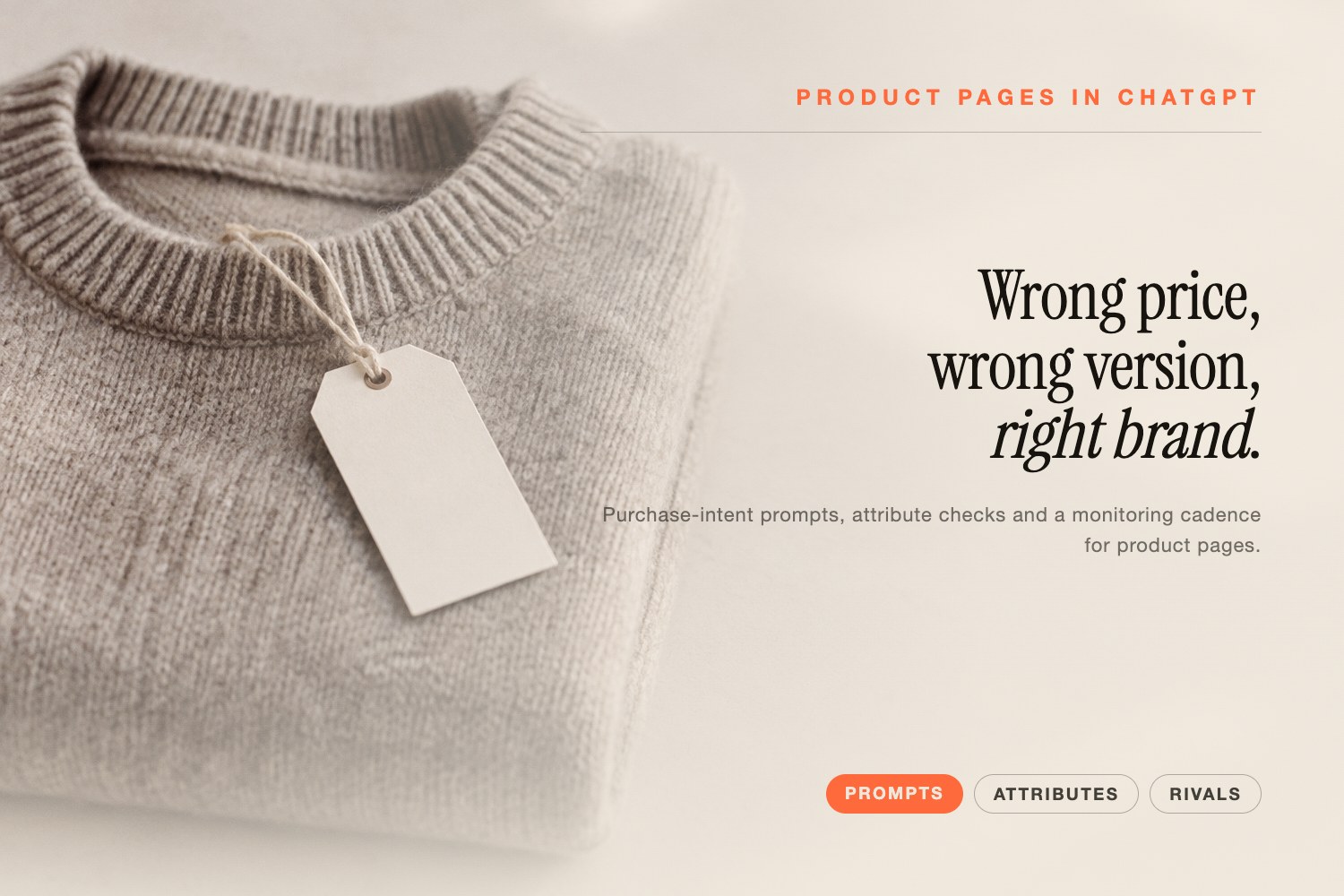
ChatGPT monitoring for product pages means asking ChatGPT the questions a shopper asks the day before checkout ("is the Bonfire 2.0 worth it", "Bombas vs Darn Tough") and logging, per product, whether the answer names your item, whether it quotes the right price, version and stock status, and which rival it puts first. Brand monitoring tells you whether ChatGPT likes the company. Product-page monitoring tells you whether it will sell the SKU.
The traffic is real money now. Adobe Analytics figures reported by Digital Commerce 360 on June 17, 2026 put AI-referred visits to US retail sites up 138% year over year in May 2026, converting 54% better than visits from non-AI sources. The same Adobe data found only 56% of electronics content and 51% of apparel content readable by AI models. Shoppers arrive from ChatGPT ready to buy, sent from pages it could only half read.
Why Do Product Pages Need Different ChatGPT Monitoring Than Brand Pages?
A product page carries five things a homepage does not: a name that has to match what people type, a feature list, a price in a currency, versions or variants, and machine-readable markup. ChatGPT can get each one wrong on its own. It can name the product and quote last month's sale price. It can recommend the generation you stopped shipping.
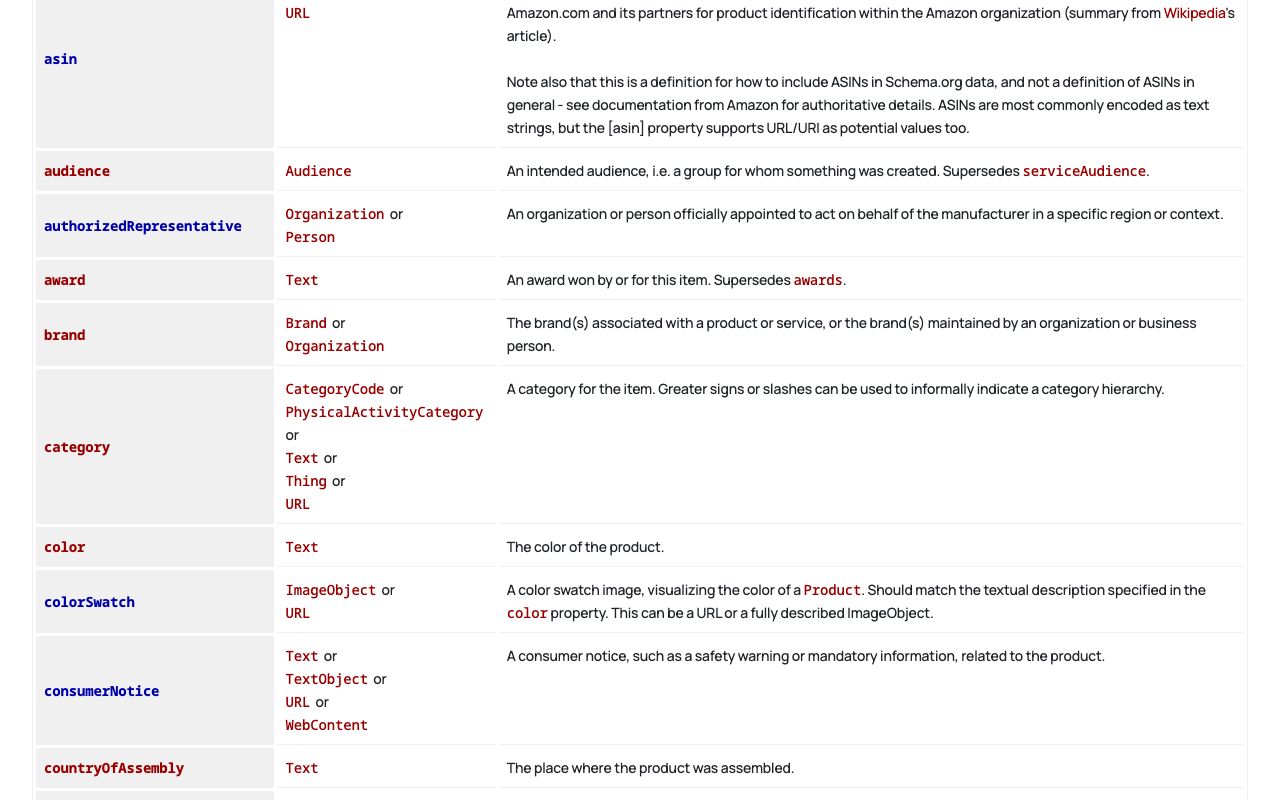
Markup is where most of the drift begins. schema.org/Product defines the fields an engine expects: name, sku, gtin, brand, model, color, size, material, an offers block with price, priceCurrency, availability and priceValidUntil, and variants linked through isVariantOf and hasVariant. When the visible page says $89 and the JSON-LD says $79, a model reading the markup and a shopper reading the page are looking at two different products.
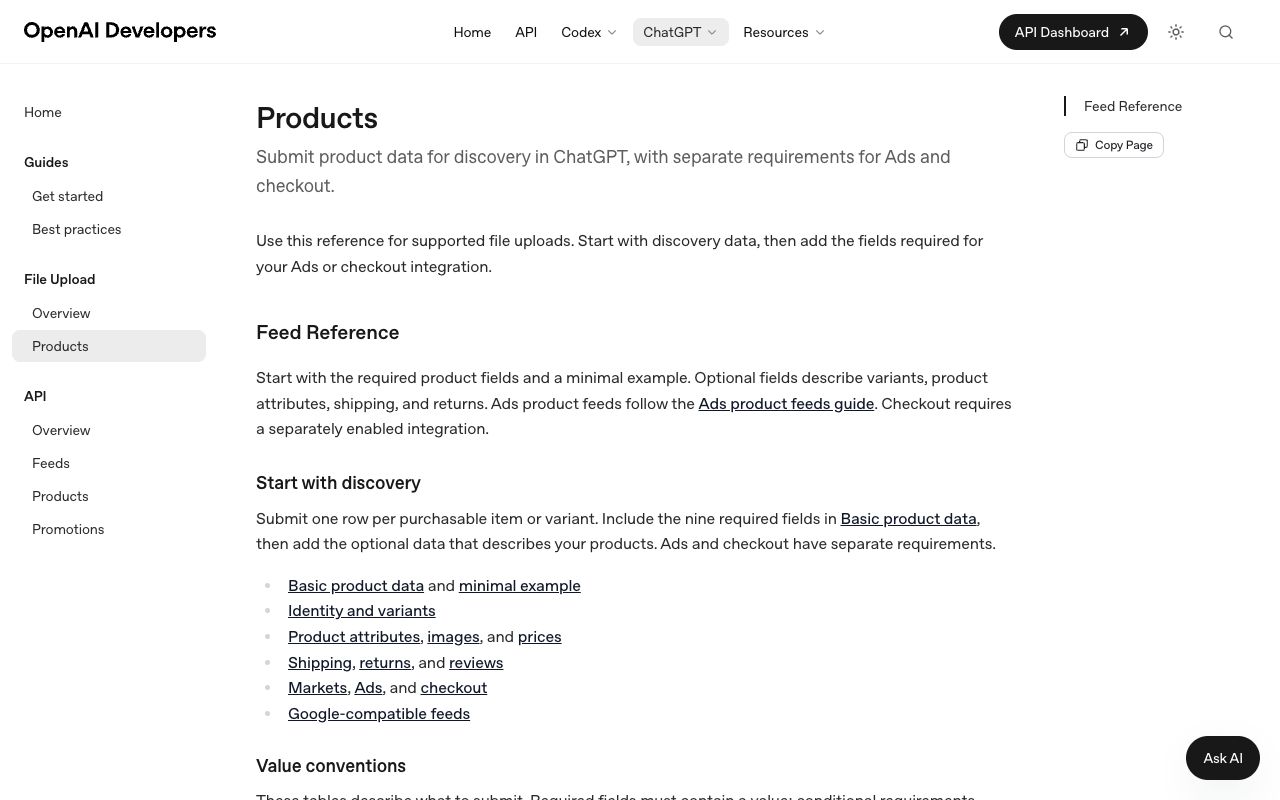
OpenAI's catalog route is stricter. The OpenAI product feed spec makes nine fields mandatory per item (item_id, title, description, url, brand, seller_name, image_url, availability, price), restricts availability to five fixed values such as in_stock and backorder, and groups variants under a group_id. Its freshness rule is one line: "Update the feed when a sale starts or ends." Shopify merchants inherit that plumbing; Shopify's March 24, 2026 announcement of Agentic Storefronts says products "stay synchronized across surfaces, with real-time inventory and pricing." Everyone else verifies by hand.
Which Purchase-Intent Prompts Should You Set Up for Each Product Page?
Write 8 to 12 prompts per product, not per brand, phrased the way a buyer types them the night before ordering. Category prompts ("best smokeless fire pit under $400") tell you whether you are in the consideration set. Product prompts ("Solo Stove Bonfire 2.0 review") tell you what the model believes about that exact SKU. Record identical fields for every prompt so two runs can be diffed line by line.
| Prompt type | Example | What to record |
|---|---|---|
| Category discovery | "best merino running shoes for wide feet" | Named or not, list position, every competitor that appears |
| Direct product | "Is the Allbirds Tree Runner worth it?" | Verdict tone, reasons given, URLs cited |
| Price check | "How much does a 5x7 Ruggable washable rug cost?" | Price quoted vs. live price, currency, stale sale price |
| Version / spec | "Difference between Solo Stove Bonfire 1.0 and 2.0?" | Version named, spec claims, superseded version recommended |
| Compatibility / fit | "Does a Ruggable pad work with a non-Ruggable cover?" | Yes / no claim, conditions attached, source |
| Availability / shipping | "Is Bombas in stock and how long is delivery?" | Stock claim, delivery window, return terms quoted |
| Comparison | "Bombas vs Darn Tough for hiking" | Who wins, the deciding attribute |
| Alternatives | "Alternatives to Brooklinen Luxe sheets" | Full list in order, whether you appear as someone else's alternative |
| Complaints | "Common problems with Solo Stove fire pits" | Complaint themes, citation domains, review dates |
Once the set is live, freeze the wording. Editing a prompt breaks that row's trend line, so retire it and add a new one instead. Kairosy's Prompts module tracks 15, 28 or 70 prompts depending on plan and re-checks them daily.
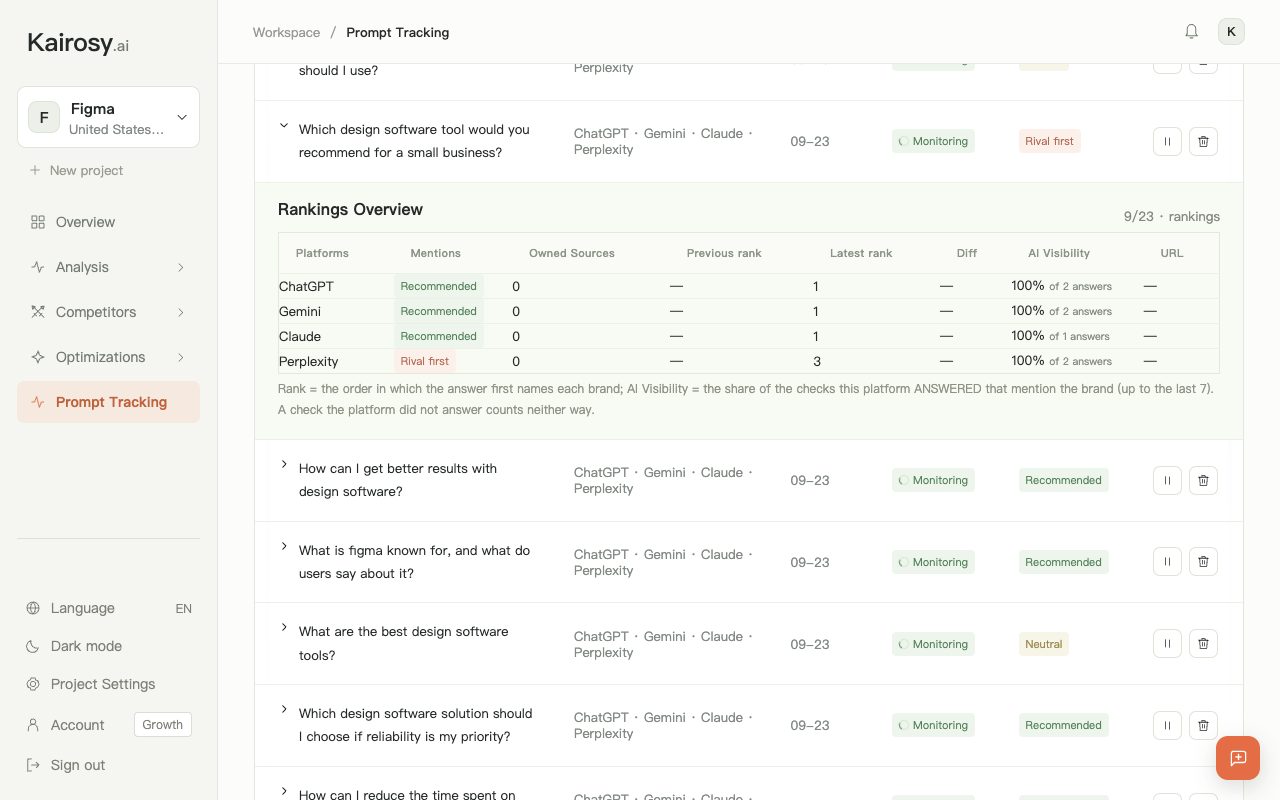
How Do You Find Which Competitors ChatGPT Puts Next to Your Product?
Run the category and alternatives prompts first and tally every brand and product name across the answers. Share of voice is the number of answers naming each brand divided by total answers. Track it per product, because the rival to your entry model is not the rival to your flagship.
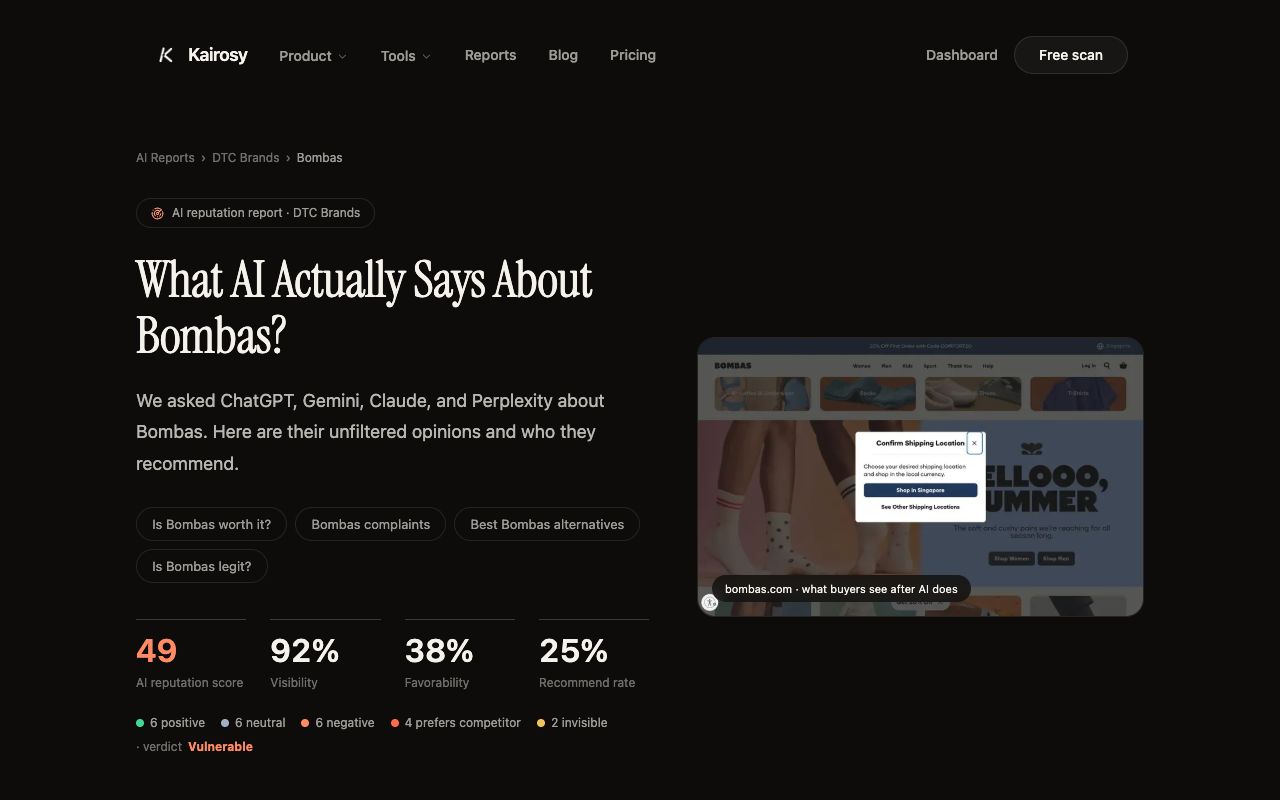
Kairosy's scan of Bombas (2026-08-07) shows the shape of the problem. Visibility was 92% but the recommend rate was 25%, and the alternatives answers were filled by Darn Tough, Pair Thieves, Stance, Happy Socks and Mack Weldon. Perplexity's comparison answer read: "Darn Tough is the better pick if durability and a lifetime-style wear profile matter." Being named in nine answers out of ten is worth nothing when the closing sentence sends the shopper elsewhere.
| Brand (Kairosy report) | Score | Favorability | Recommend rate | Rival the answers favored | Report date |
|---|---|---|---|---|---|
| Allbirds | 71/100 | 65% | 63% | Rothy's, Cariuma | 2026-08-01 |
| Ruggable | 71/100 | 65% | 63% | Tumble | 2026-08-01 |
| Solo Stove | 66/100 | 58% | 46% | Breeo X Series 24 | 2026-08-07 |
| Brooklinen | 58/100 | 48% | 38% | Parachute | 2026-08-01 |
| Bombas | 49/100 | 38% | 25% | Darn Tough | 2026-08-07 |
All five were visible in 92% to 100% of answers. The gap between "named" and "recommended" is where product-page monitoring earns its keep.
What Do Comparison Prompts Reveal That Single-Product Prompts Miss?
A review prompt gives you tone. A "vs" prompt gives you the attribute the model uses to decide. In Kairosy's scan of Brooklinen (2026-08-01), Claude settled a head-to-head with "Brooklinen is the better choice if you want affordable luxury with more variety, while Parachute is better if you prioritize premium feel and durability." That sentence is a content brief: durability is the attribute on which the page loses.
For every comparison, record who wins, the deciding attribute, and whether your page states that attribute clearly, weakly, or not at all. Most losses come from the third bucket. Run each comparison in both directions, since the tie-breaker shifts with order, and run it per market: Kairosy scans Global plus 25 countries on paid plans, and a UK shopper's rival set is not the US set.
Where Does Your Product Land in ChatGPT's Recommendation Order?
Position is the number that predicts clicks. For every list-style answer, log the rank of your product, the rank of the first competitor, and whether the answer closes with a single pick. A product listed fourth of five is technically visible and practically invisible.
Three positions matter: the first product named, the explicit recommendation ("if you buy one, buy…"), and the conditional pick ("if weather resistance matters, Vessi"). Kairosy's scan of Allbirds (2026-08-01) recorded exactly that pattern: 100% visibility, yet answers such as "Rothy's and Cariuma are probably the closest top picks, while Vessi is best if weather resistance matters." Allbirds was the subject of the question and not the answer to it. Weight conditional picks heavily; a rival that owns "best for wide feet" across your set has found a page-content gap, not an awareness gap.
How Do You Catch Negative Citations and Wrong Product Attributes?
Negative citations are third-party pages the model leans on when it criticizes a product. Wrong attributes are factual errors about the product itself. Both require the source URL, so capture it for every answer. Kairosy stores the real citation URLs behind each engine's reply, which turns "ChatGPT says our service is bad" into "ChatGPT cited pissedconsumer.com."
Kairosy's scan of Solo Stove (2026-08-07) holds one of each in a single sentence. Claude's complaints answer read: "Pissedconsumer.com reports recurring complaints about unresponsive customer service, slow replies, and a 15% restocking fee on returns." The first half is a negative citation, answerable with a public support-response page. The second half is an attribute claim with a specific number in it. Whether or not that figure matches the live policy, the repair is a returns page stating the actual terms in plain text and markup, so engines cite the merchant instead of a complaints site.
Which Attributes Belong on the Wrong-Attribute Checklist?
- Price: quoted price against live price, the currency, a lapsed promotion still circulating, and whether the quote matches
offers.pricein your markup. - Version: is the answer describing the current generation, a superseded one, or a blend of two spec sheets?
- Availability: "in stock" and "discontinued" claims, delivery windows, regional availability.
- Compatibility: what the product supposedly works with (pads, chargers, platforms), the category most often answered from forum threads rather than your page.
- Materials and sizing: fabric, weight, dimensions and fit claims that contradict the spec table.
- Policy terms: return window, restocking fees and warranty length, the numbers in the Solo Stove example.
- Identifiers: GTIN, SKU and model number. Under the GS1 GTIN system each trade item and packaging configuration carries its own number, so reusing one GTIN across sizes invites engines to merge variants.
Score each error on two axes: how much it moves a purchase decision, and how many answers repeat it. A wrong price in six of eight prompts outranks a wrong color in one.
How Do You Fix Wrong Prices, Versions and Lost Comparisons on the Page?
Findings sort into four repair buckets, and the log tells you which one each belongs to.
- Markup mismatch. Google's merchant listing documentation requires
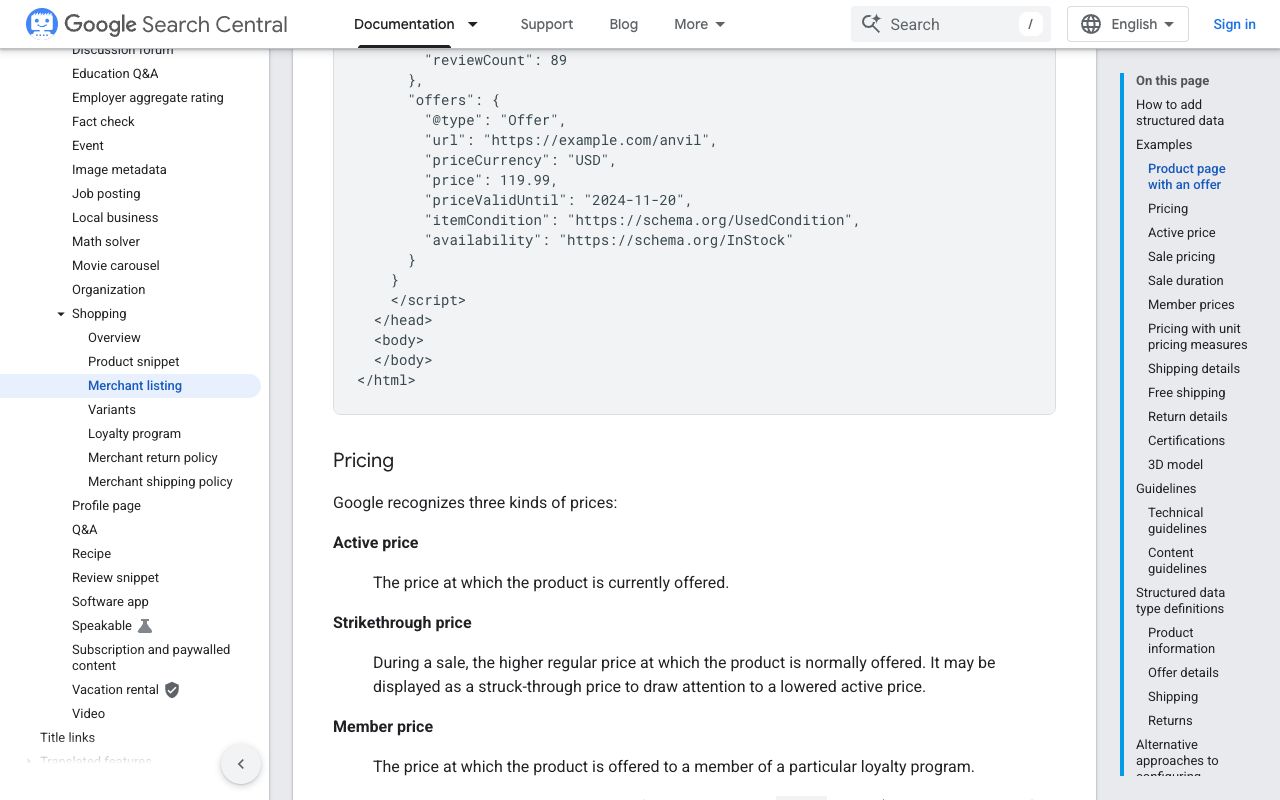
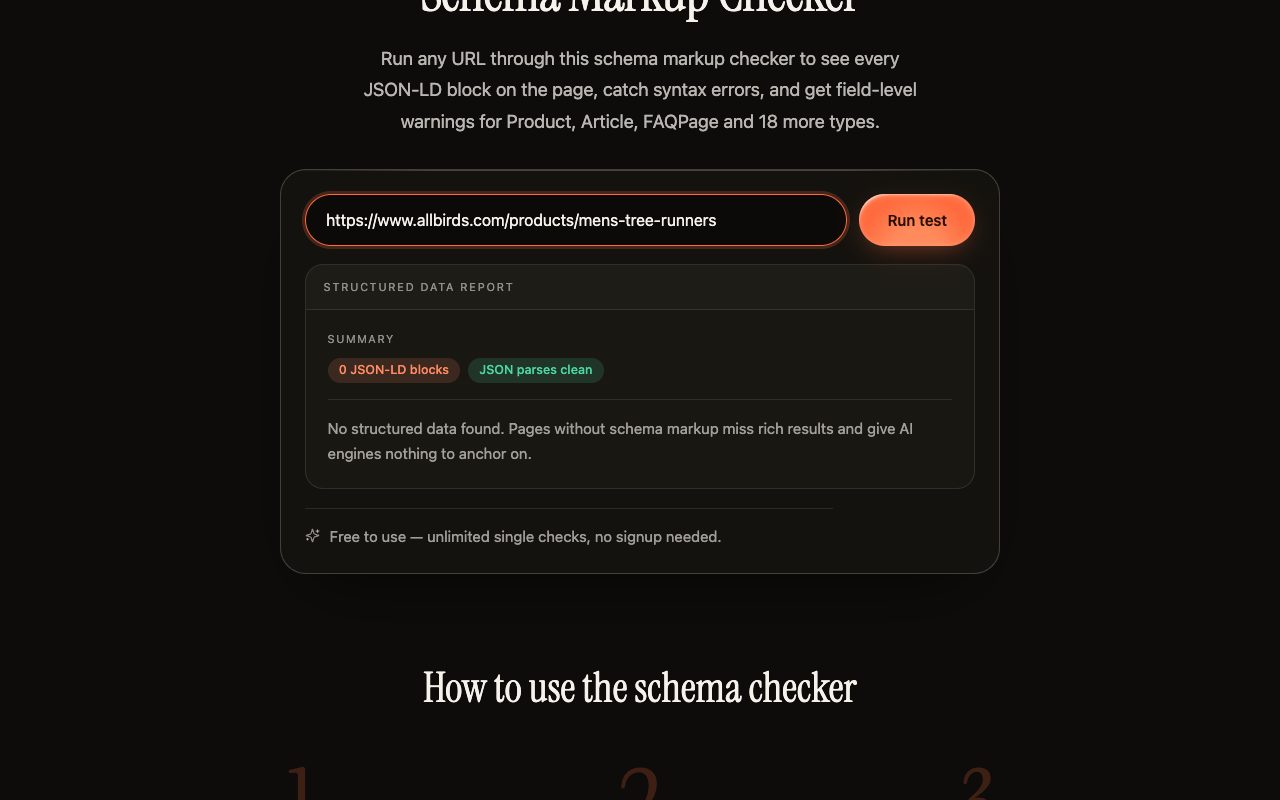
name,imageand anoffersobject withpriceandpriceCurrency, and notes that "merchant listing experiences require a price greater than zero"; recommended fields includesku,gtin,availability,priceValidUntil,shippingDetailsandhasMerchantReturnPolicy. Paste the page into the free schema markup checker and repair the fields the engine misquoted first. - Variant confusion. Google's product variant guidance models a family as a
ProductGroupwithproductGroupID,hasVariantandvariesBy(color, size, material, pattern, suggestedAge, suggestedGender) and states that "the site must have the ability to preselect each variant directly with a distinct URL." If ChatGPT keeps describing the old generation, check whether the old page is still live with no pointer to its successor. - Missing attribute. When a comparison is lost on a property your page never states, add it as visible text: a spec-table row or a sentence under the heading, not a tab and not an image. Kairosy's AI-Ready Page Audit runs 33 checks across access, readability, structured data, citability and trust, and shows what changed since the previous audit.
- Negative citation. Publish the page the engine should be citing instead: a returns and warranty page with the real numbers, a support-response page, a dated durability test. Then re-run the complaint prompts and watch the cited domain change. Store-level tactics are covered in ecommerce ChatGPT optimizations.
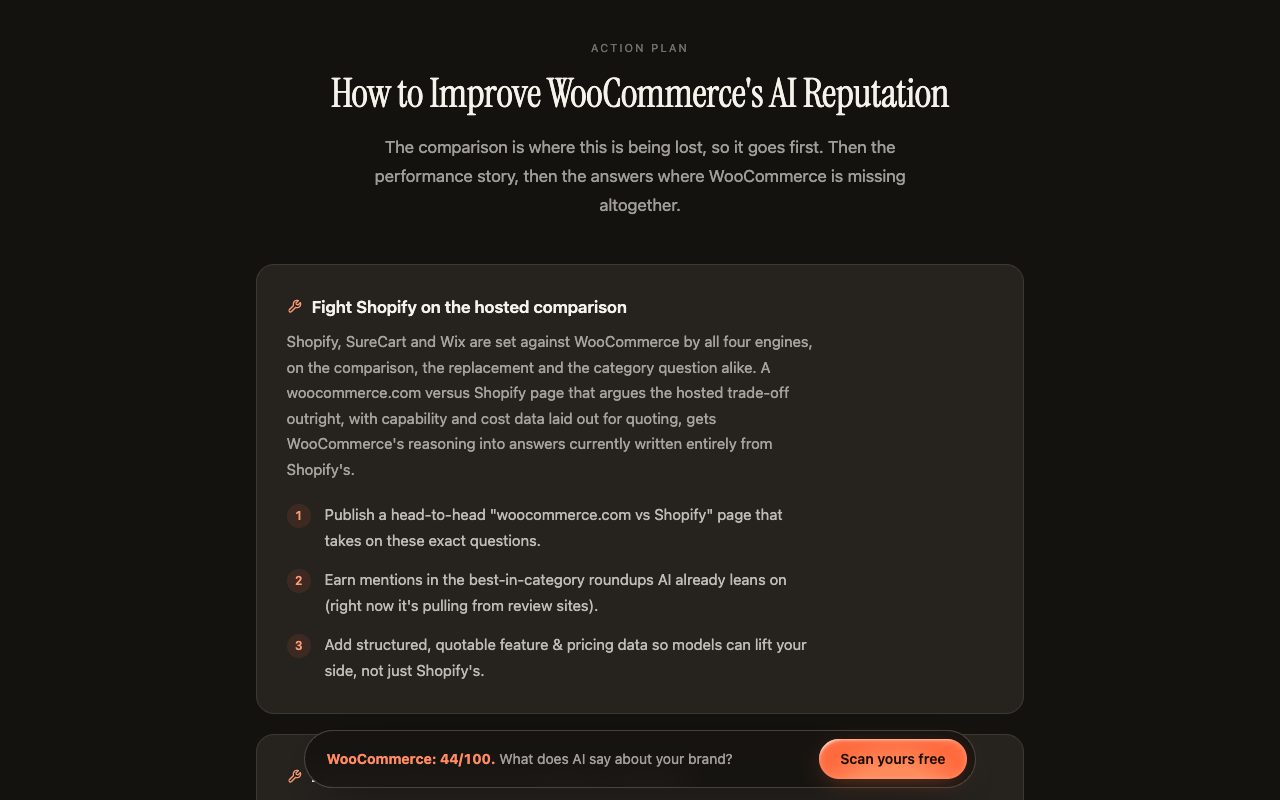
Kairosy's Fix Plan turns each report into ranked action cards, so a price mismatch on the bestseller sits above a thin description on a page nobody asks about.
How Often Should ChatGPT Monitoring for Product Pages Run?
Daily for prompts, weekly for full re-scans, and immediately after any price, version or policy change. A Tuesday price change can be quoted wrong by Wednesday if your feed and your markup do not update in the same deploy.
A minimum setup on Kairosy looks like this: one tracking slot per product brand and market (3, 6 or 20 slots on Basic at $29, Pro at $99 and Growth at $399 per month, as of September 2026), prompts checked every day, a Monday re-scan with an emailed digest, and alerts when a new negative keyword shows up, a competitor turns into the preferred pick, the score falls, or one engine flips its tone. Signup opens a 7-day trial with no card. The ChatGPT brand monitoring page shows what the ChatGPT-only view looks like.
Whatever tool you use, keep three trend lines per product: mention rate, recommendation rate, and attribute-error count. The first two should climb; the third should reach zero and stay there. ChatGPT monitoring for product pages is not a report you read once. It is a weekly diff against the page you are trying to sell.
ChatGPT Monitoring for Product Pages FAQs
Does ChatGPT read product schema markup?
OpenAI has not published a statement that ChatGPT parses JSON-LD on a page. What it has published is a product feed spec whose fields (price, availability, brand, variants, GTIN) mirror the schema.org Product and Offer vocabulary Google requires for merchant listings. Treat feed and markup as two copies of one truth and keep them equal.
How many prompts does one product page need?
Eight to twelve, spread across the nine types in the table above, with comparison and alternatives prompts run in both directions. Fewer than eight and one odd answer swings the rate; more than twelve per product and the set becomes hard to keep frozen.
What counts as a wrong product attribute?
Any checkable claim about the product that disagrees with the live page: price, sale status, version, stock, delivery window, compatibility, materials, dimensions, return terms, warranty length. Opinions ("feels thin") are sentiment, not attribute errors, and belong in a different column.
Can you monitor product pages that are not on Shopify?
Yes. Monitoring reads the answers, not the platform. Shopify stores get automatic feed sync; stores elsewhere can apply for OpenAI's direct feed program or rely on the crawled page and its markup, which makes the markup-mismatch check more important, not less.
See what AI says about your brand
Run a free scan across ChatGPT, Gemini, Claude & Perplexity in about 30 seconds.
Run my free scan