European SEO in 2026: Search Share, Hreflang and EU Rules
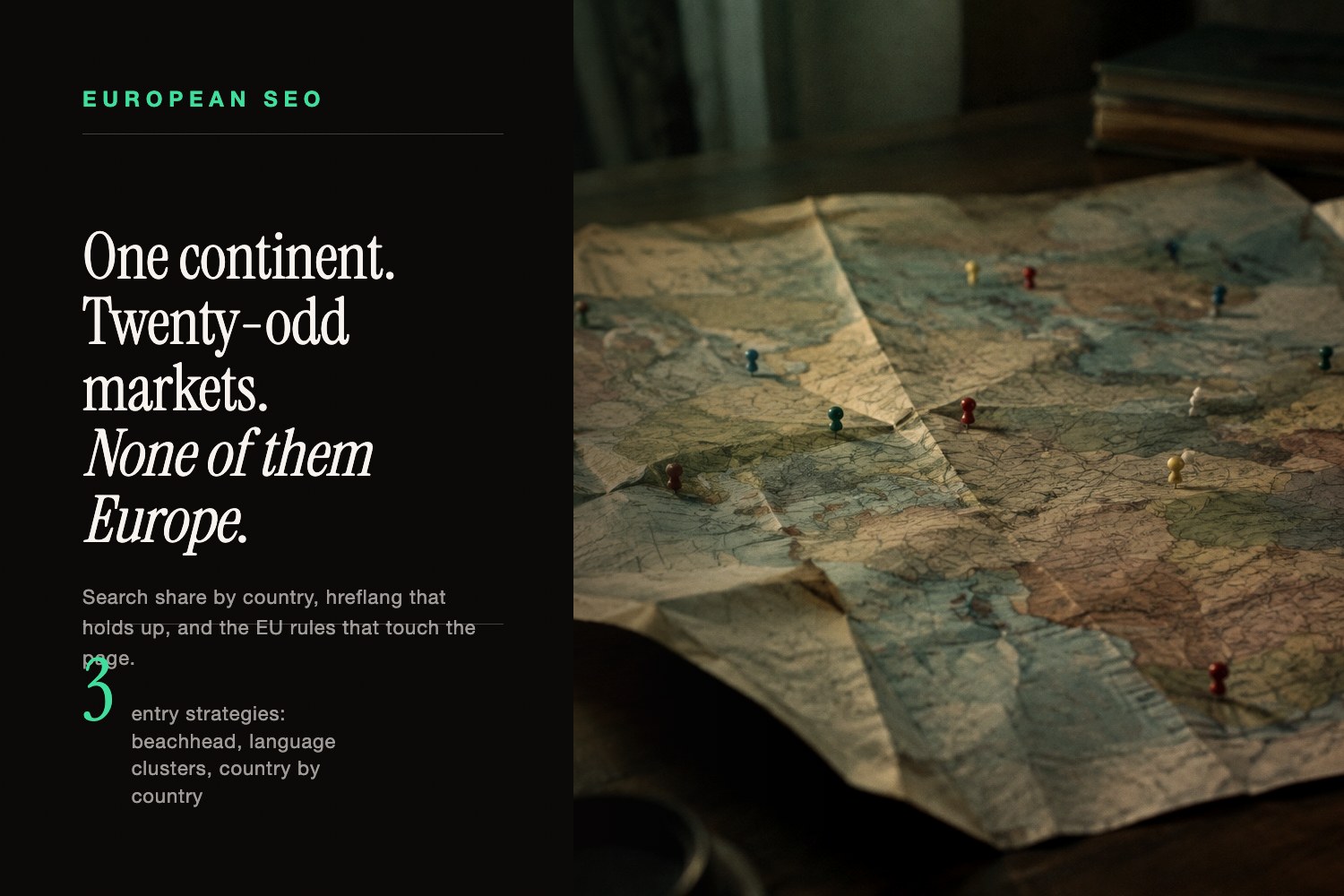
European SEO is not one market with a translation layer bolted on. It is 27 member states, 24 official EU languages, a search landscape that is 89% Google everywhere except the places it isn't, and a legal stack that changes what your pages are allowed to say and show.
This guide covers the factors that actually decide outcomes in European SEO, three rollout strategies to choose between, and five practices worth shipping first. It closes with the surface almost nobody has audited yet: what ChatGPT, Gemini, Claude and Perplexity tell a buyer sitting in Munich rather than Manhattan.
What Makes European SEO Different From a Single-Country Program?
Six factors do most of the damage when a US or UK playbook is copied across the Channel. None of them show up in a standard technical audit.
- Language is not a market. German is the working language of Germany, Austria and much of Switzerland, but the pricing, the delivery promise, the competitors and the payment methods differ in all three.
- A minority of buyers will read English. CSA Research surveyed 8,709 consumers across 29 countries for its 2020 Can't Read, Won't Buy report and found 76% prefer to buy where the product information is in their own language, and 40% will not buy from a foreign-language site at all. Germany was the most extreme case, with 57% buying only at local-language sites.
- Consent law rewrites your measurement. A cookie banner that a German user actually has to answer removes a share of your analytics before the SEO work is even judged.
- Pages carry legal obligations. VAT-inclusive prices, imprint and returns pages, accessibility conformance. These are page requirements, not footer decorations.
- Domain registries have rules. Some country domains require a local presence before you can register at all, which turns a URL decision into a legal-entity decision.
- The SERP competitors change per border. The aggregator that owns "cheap train tickets" in France is not the one that owns it in Germany, and neither is the one AI models name.
Budget for the friction: an SEO EU rollout carries a legal and translation review cycle that a domestic program never pays for. Plan calendars in quarters, not sprints.
Which Search Engines Matter for European SEO in 2026?
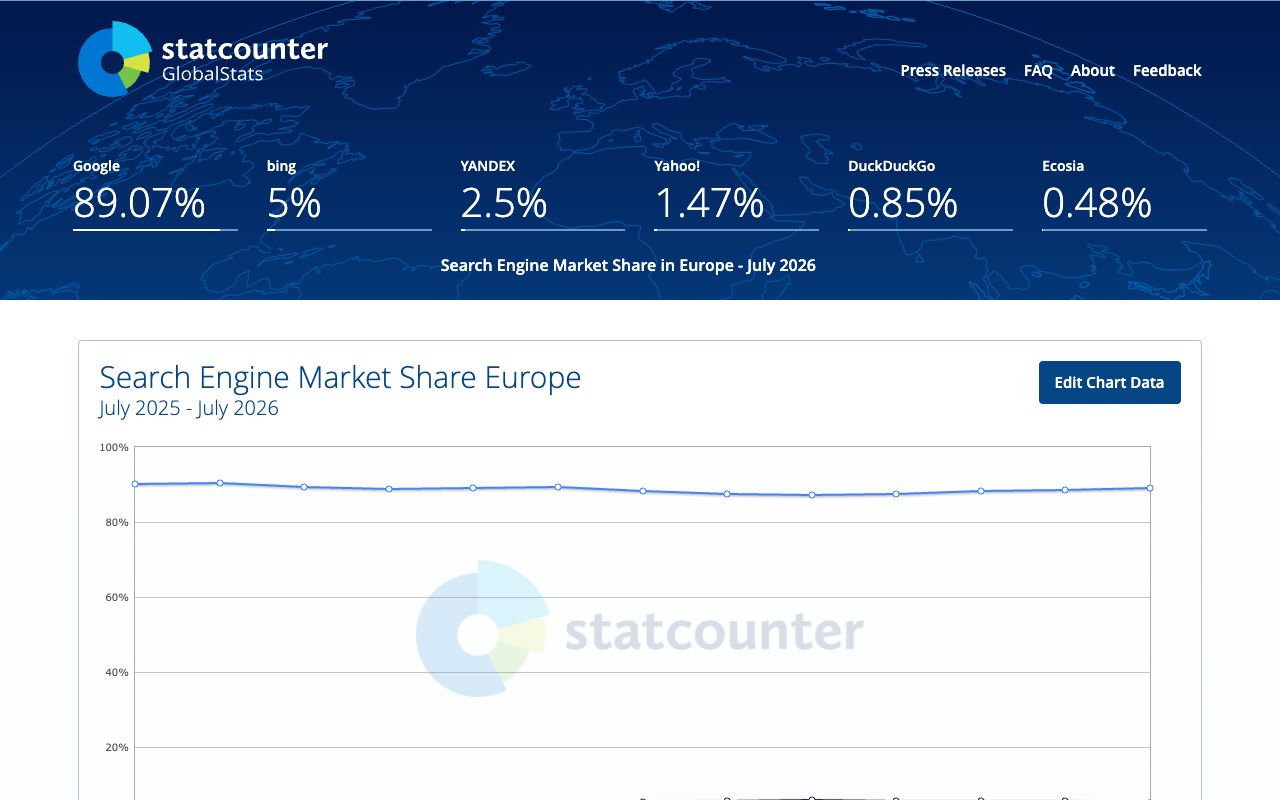
Google, mostly — but "mostly" hides two markets where ignoring the runner-up costs real revenue. Here is Statcounter's all-device search share for July 2026.
| Market | Runner-up | Third | |
|---|---|---|---|
| Europe (all countries) | 89.07% | Bing 5.0% | Yandex 2.5% |
| Poland | 89.46% | Bing 7.16% | Yandex 1.35% |
| Germany | 85.59% | Bing 7.12% | Yandex 2.14% |
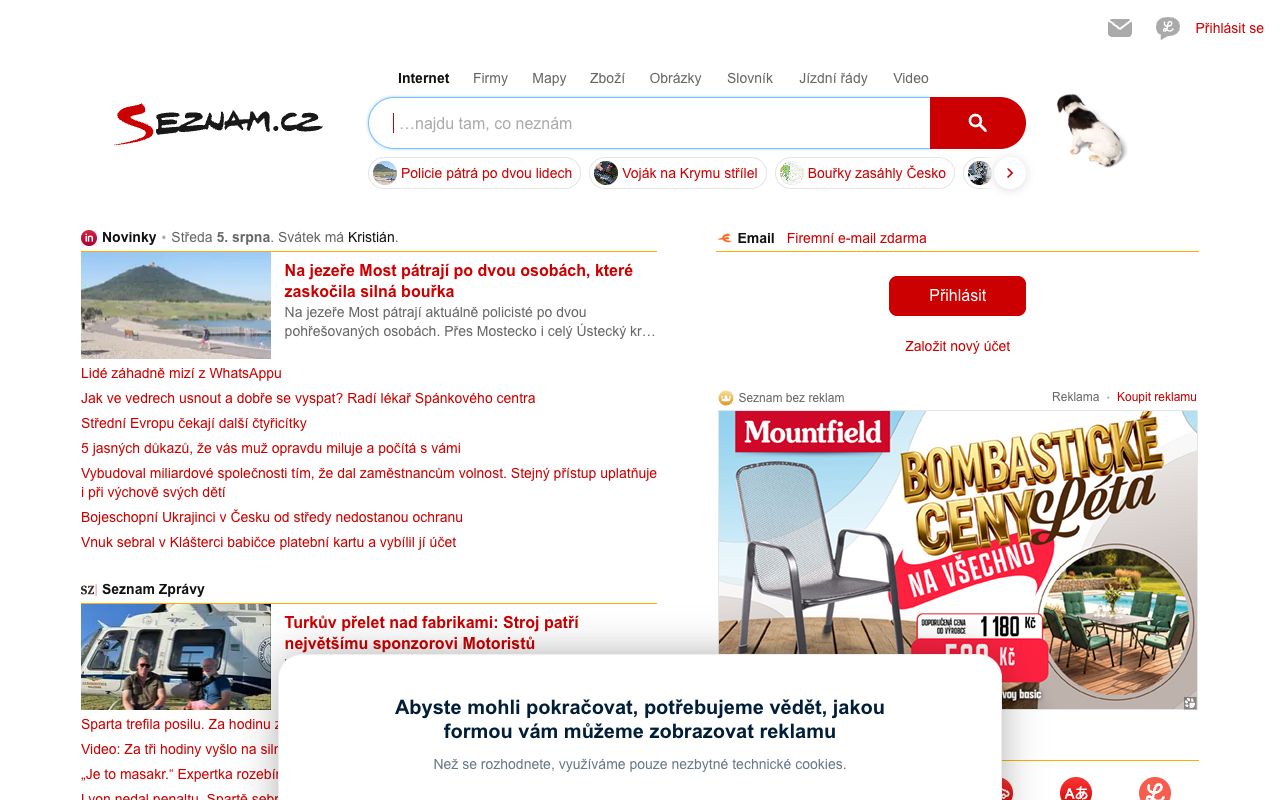
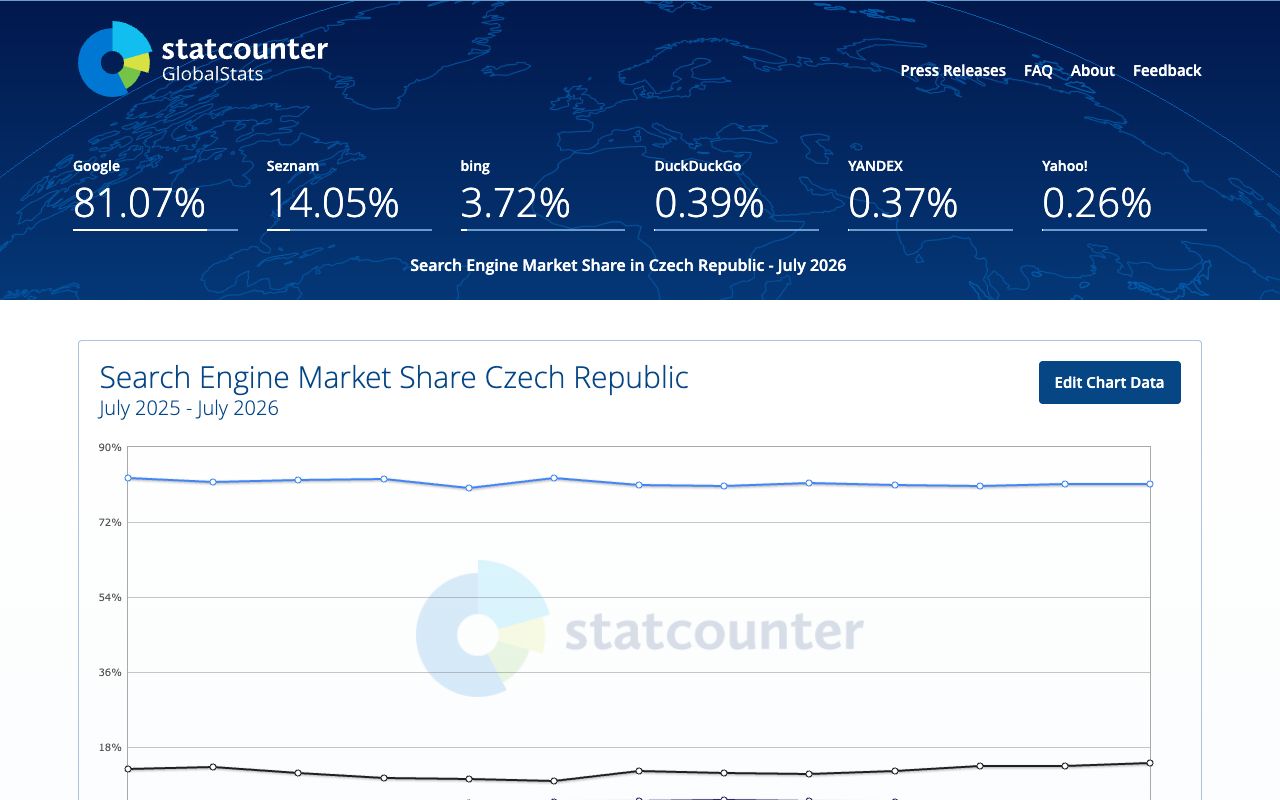
| Czechia | 81.07% | Seznam 14.05% | Bing 3.72% |
| Russia | 25.48% | Yandex 72.85% | Mail.ru 0.69% |
Two takeaways. In Czechia, roughly one search in seven happens on Seznam, a homegrown engine with its own crawler, its own webmaster tools and its own portal traffic — a Czech launch that only optimizes for Google leaves that share on the table. And in Russia, Google is the challenger, not the incumbent, with Yandex holding 72.85%.
Everywhere else the sensible read is that Bing sits at 5–7% and is worth caring about mainly because it feeds Microsoft Copilot. Watch one more thread: Ecosia and Qwant's joint venture, European Search Perspective, began serving French results from its own index in August 2025 and has since added a German index. Its share is negligible today. It is also the first serious European-owned web index to reach real users in years, and worth a line in any long-range plan.
Should You Use ccTLDs or Subfolders for a Multi-Country Site?
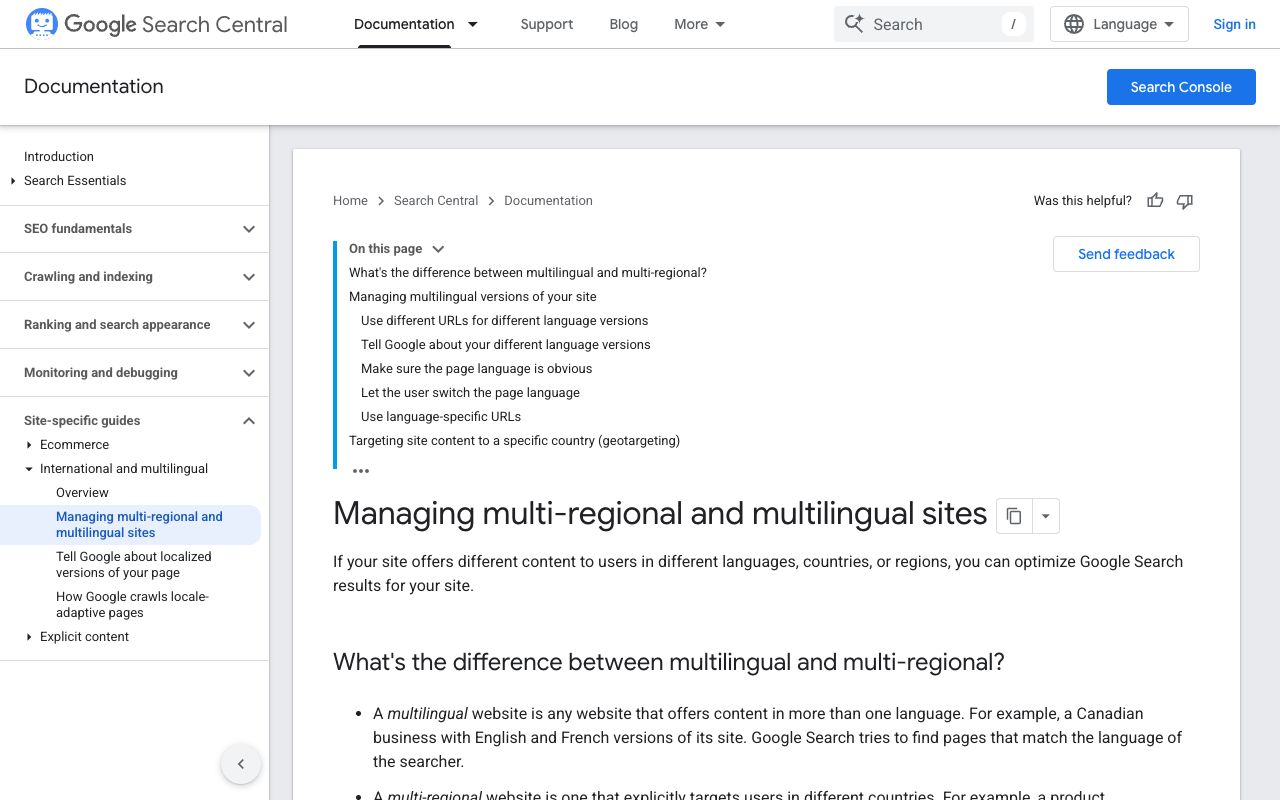
Google's multi-regional site documentation lays out four structures and is unusually blunt about the trade-offs. Its own summary, plus the registry constraints that make the decision expensive:
| Structure | Google's stated pro | Google's stated con | Practical catch |
|---|---|---|---|
| ccTLD (example.de) | "Clear geotargeting" | Expensive, targets one country only | DENIC requires an admin contact with a physical German address for .de |
| Subdomain (de.example.com) | "Easy to set up" | Users may not recognize geotargeting | Authority is split unless internal linking is deliberate |
| Subdirectory (example.com/de/) | "Easy to set up," low maintenance | Single server location, harder to separate | Default choice for most teams and usually the right one |
| URL parameters (?loc=de) | — | Not recommended by Google | Avoid |
The .eu domain has its own gate. EURid accepts only citizens of an EU member state, Iceland, Liechtenstein or Norway regardless of where they live, residents of one of those countries, or organisations established in one — and it verifies the registration data. A US company with no European entity cannot hold a .eu at all.
One rule survives every structure debate: never auto-redirect users by IP. Google crawls from a single source and says it does "not attempt to vary the crawler source used for a single site," so an IP redirect can bury every version except the one your server thinks Googlebot lives in. Serve a suggestion banner instead, and confirm nothing is silently bouncing with a redirect checker.
How Do Hreflang and Country Targeting Actually Work?
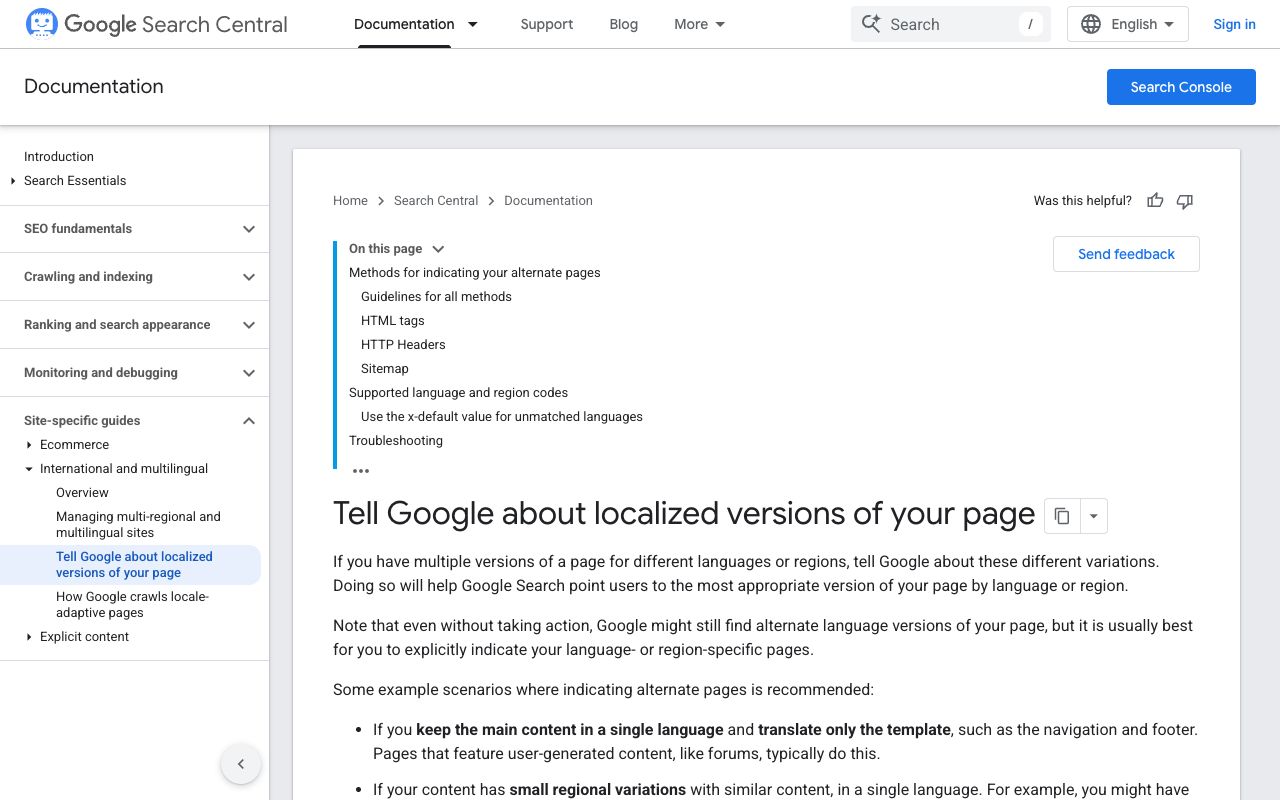
Hreflang tells Google which version of a page to show to whom. The syntax is stricter than most implementations assume: per Google's localized versions guide, the first code is the language in ISO 639-1, the optional second is the region in ISO 3166-1 Alpha 2, and "you can't specify the country code by itself."
So de targets German speakers anywhere, de-AT targets German speakers in Austria, and at alone is invalid and will be ignored. That single detail explains a large share of failed rollouts.
The second rule is reciprocity. Google states plainly: "If two pages don't both point to each other, the tags will be ignored." Every version must reference itself and every sibling. Semrush audited 20,000 multilingual sites in February 2017 and found 58% carried hreflang conflicts in the page source, with a missing self-reference in 96% of those cases. The study is old, but the failure mode has not changed: one bad node invalidates the whole cluster silently, with no error anywhere in Search Console.
Practical guidance: declare the cluster in your XML sitemap rather than in page head tags once you pass a few hundred URLs, add x-default for your language-selector or fallback page, and then confirm the country versions are actually in the index with a free index checker before you blame hreflang for a traffic gap.
Why Do GDPR and Consent Mode Distort Your European SEO Data?
Your European numbers are not measured the way your US numbers are, and comparing them directly produces bad decisions.
Google made Consent Mode v2 mandatory for EEA and UK advertisers using its measurement products in March 2024. When a visitor denies consent, Google's documentation says that "instead of storing cookies, tags send pings to Google" carrying only coarse dimensions, and that Analytics uses those cookieless pings for "behavioral and conversion modeling, to fill the gaps in your data."
Three consequences for anyone reporting on European SEO:
- A share of your EU organic sessions and conversions is modeled, not observed. Small-market segments can fall below the volume where modeling is reliable.
- Banner design moves the number. Tightening a consent banner can cut recorded organic traffic in a market without a single ranking changing.
- Server logs and Search Console are consent-independent, which makes them the honest baseline for crawl and impression trends in the EU.
Report EU markets on impressions and clicks from Search Console alongside GA4, and label modeled data as modeled when it reaches the board.
What EU Rules Change the Pages Themselves?
Three obligations touch the same templates SEO teams own.
Prices must be final and VAT-inclusive
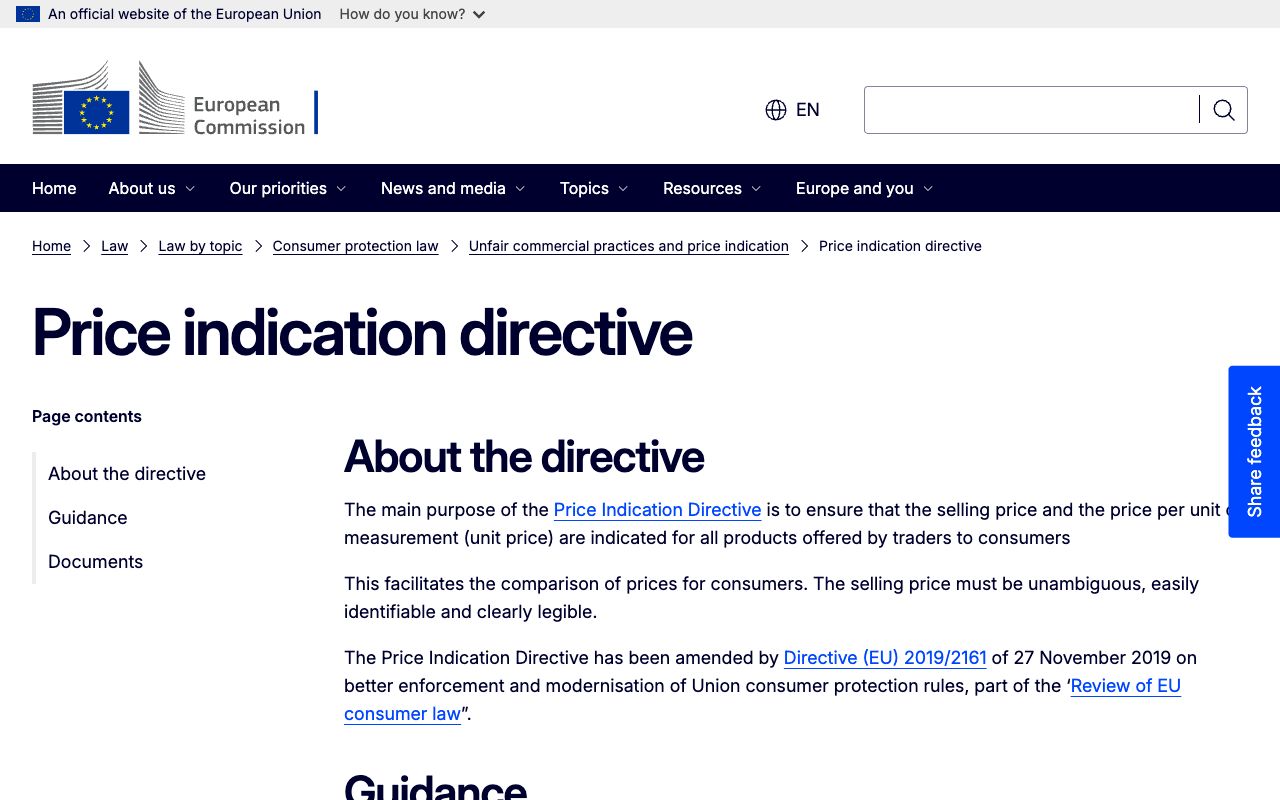
Directive 98/6/EC defines the selling price as "the final price for a unit of the product, or a given quantity of the product, including VAT and all other taxes," and the Price Indication Directive requires it to be shown unambiguously and legibly. A US-style ex-tax price revealed at checkout is not compliant, and it also puts your Product structured data out of step with the page a shopper actually sees.
VAT rate follows the buyer past €10,000
Under the EU's One Stop Shop, live since 1 July 2021, cross-border B2C sales below EUR 10,000 a year can carry your home VAT rate. Above it, "the place of supply of intra-Community distance sales is in the Member State in which the transport of the goods ends" — so displayed prices have to vary by country, which forces per-market templates whether you wanted them or not.
Accessibility is now a market-access condition
The European Accessibility Act lists e-commerce among the covered services, and it applied from 28 June 2025. The technical yardstick, EN 301 549, leans on WCAG 2.1 Level AA. Headings, contrast, focus order and form labels are now compliance items as well as ranking hygiene.
What Are the 3 Best European SEO Strategies for Entering the EU?
The SEO strategy Europe rewards is sequential, not simultaneous. Pick one of three shapes and be honest about which you can staff.
1. Beachhead: one country, done properly
Launch a single subfolder with native copy, local pricing, local payment methods and local PR. Prove unit economics in one market, then clone the template. Slowest to look impressive, fastest to reach payback, and the right default for anyone under 50 people.
2. Language clusters: one site per language
One German site serving DE, AT and CH, one Spanish site serving ES, one French site serving FR and BE. Cheapest way to cover the continent and genuinely effective for software and information products. It breaks the moment shipping, tax or regulation differs between the countries sharing a language.
3. Country-by-country: the full matrix
Separate URL paths, hreflang, local entities and local link building per market. This is where European enterprise SEO lives, and the cost is governance rather than content: a translation memory, a per-market legal reviewer, a release train and someone who owns the hreflang cluster as a system. Only worth it when several markets already produce revenue.
Which 5 European SEO Best Practices Move Revenue Fastest?
Ranked by return per hour of effort, based on what usually breaks first.
1. Localize the money pages, translate the rest
Machine translation is fine for a documentation archive. Homepage, category pages, pricing and checkout need a native writer who changes the examples, the objections and the social proof — not just the words. Localization means a French pricing page that argues with French competitors.
2. Do keyword research in-market, never by translating
Germans search "Zugticket" and "Bahn," not the literal rendering of "train ticket." Pull the seed list from local autocomplete, local competitor pages and your own local site search before any translation vendor is briefed.
3. Fix the hreflang cluster before you scale content
Return links, self-references, canonical agreement and an x-default. One broken node makes Google discard the group, and every article you publish afterwards inherits the fault.
4. Ship the legal layer as templates, not one-off pages
Imprint, returns, VAT display and cookie banner belong in the market template so a new country launch cannot forget them. Validate the structured data on localized product pages with a schema markup checker — currency and price fields break silently during translation.
5. Measure each market as its own P&L
Separate Search Console properties, separate revenue reporting and separate AI visibility tracking. An averaged European number describes no country you actually sell in.
How Do You Check What AI Tells a German or French Buyer?
Every factor above assumes the buyer starts at a search box. A growing share start by asking an assistant, and the answer they get is country-specific.
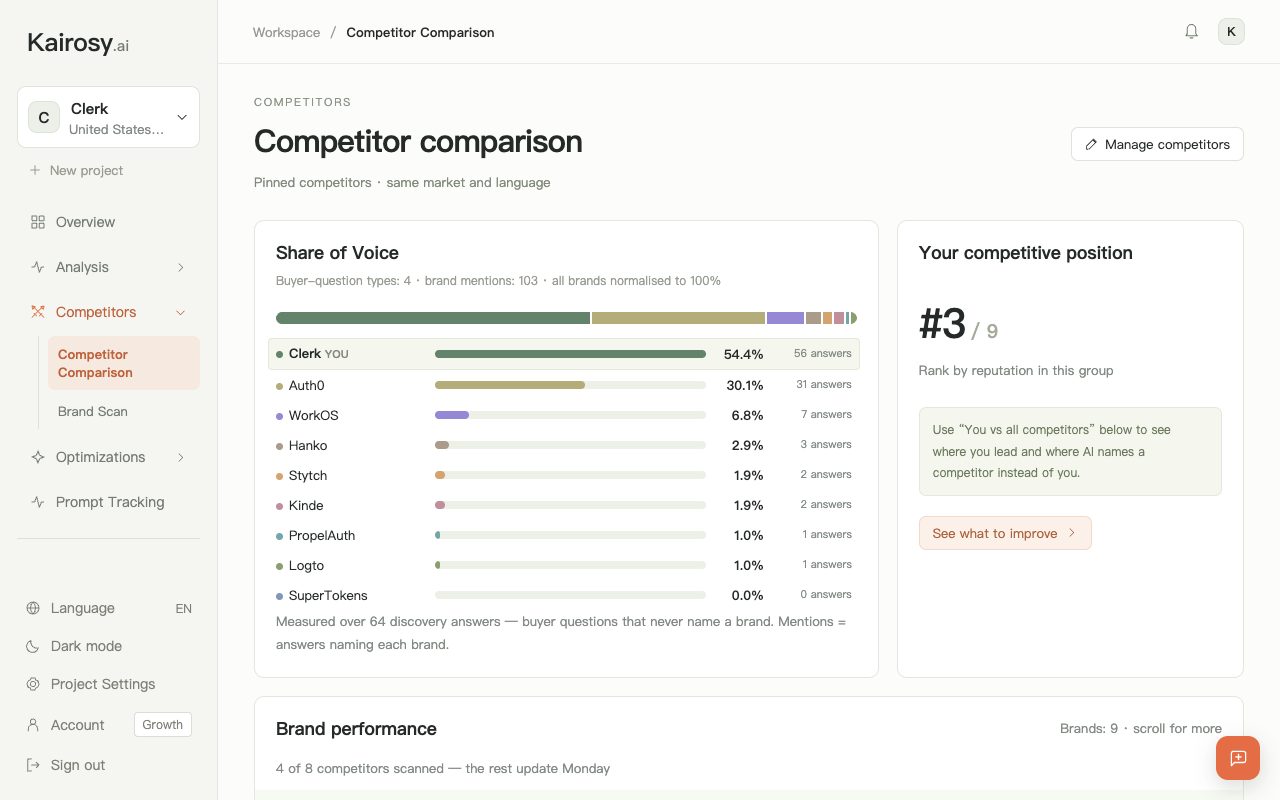
Kairosy scans that surface per country — 25 markets plus a Global baseline — with the buyer's country written into the prompt itself and the question asked in the market's language. The answers genuinely differ: same brand, same question, different recommendation set and different competitors named. A single English scan tells you what an unlocated English speaker hears, which is not what a German or French buyer hears.
The Omio case makes the stakes concrete. Kairosy's Global scan of the European travel aggregator, published in Omio's AI performance report, scored it 59/100 and found Trainline tied with Omio at 28% share of the recommendations, with Deutsche Bahn already surfacing at 6%. Deutsche Bahn is a national incumbent — the number worth knowing is what it looks like when the buyer is in Germany asking in German, and only a Germany-market scan answers that.
The same split shows up in hospitality and tours. In CitizenM's report, Perplexity answered the "most common complaints" question by describing the brand's deliberate compact-room design as a downside, while GetYourGuide's report shows Gemini steering the alternatives question straight to Viator. Those are brand-positioning arguments happening in a channel with no SERP to audit.
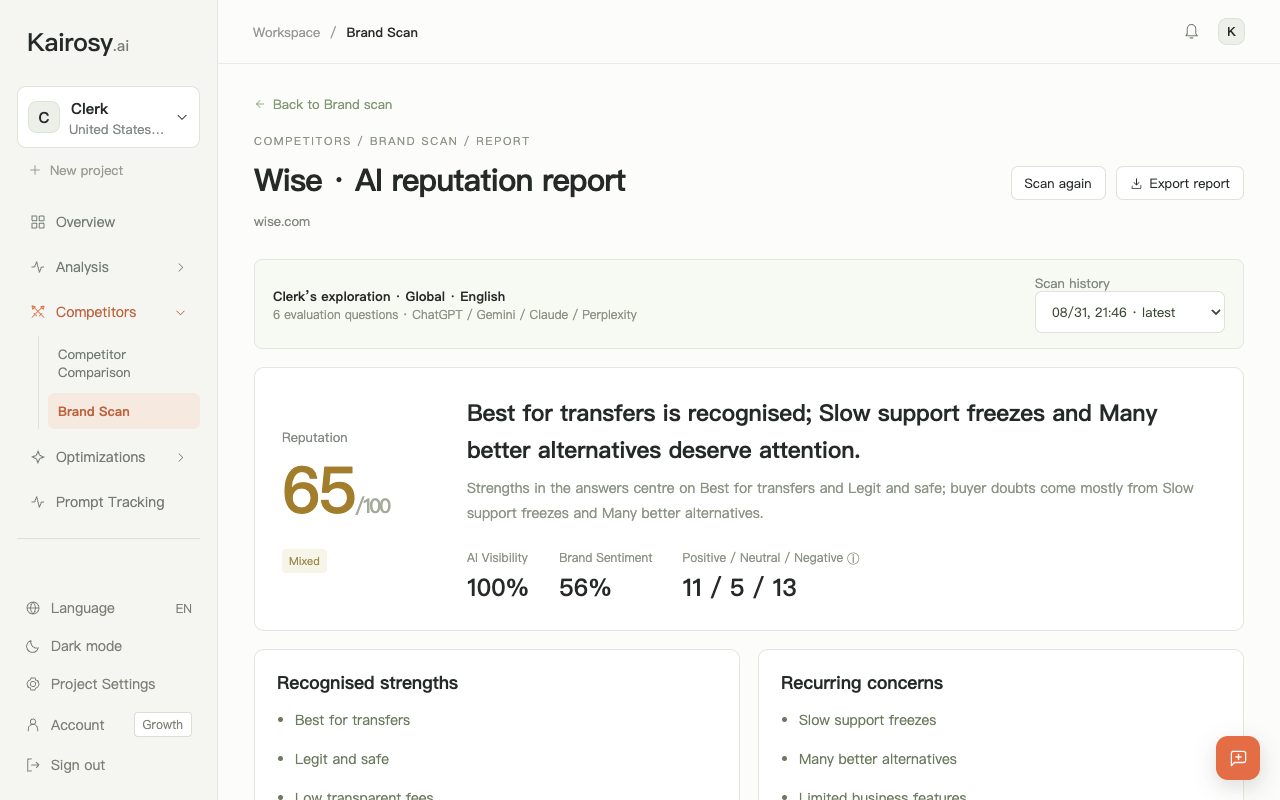
Practically, add three things to your European program. Track the mention rate and sentiment per market with AI brand monitoring rather than one global figure. Route anything negative into a fix queue the way you would a review crisis, which is the job AI reputation management does. And treat the citation sources in each answer as the local link-building target list, because that is what the model reads. If the split between classic rankings and generated answers is new to you, our breakdown of GEO vs SEO covers the mechanics.
European SEO FAQs
Is European SEO different from international SEO?
European SEO is a subset with unusually dense regulation. The technical work — hreflang, URL structure, localization — is standard international SEO. What is specific to Europe is that consent law, VAT display, accessibility and domain-registry rules all bind at once, and they differ by member state.
Do you need a ccTLD for every EU country?
No. Subdirectories on one strong domain are Google's "easy to set up, low maintenance" option and suit most companies. ccTLDs are worth the cost when local trust drives conversion, such as retail and finance, or when a market's buyers visibly distrust foreign domains. Some registries also require a local contact, so check eligibility before promising a domain.
Does GDPR affect SEO rankings?
Not directly. It affects what you can measure. Consent refusals remove analytics events, so EU organic performance is partly modeled rather than observed, and a banner change can move your reported numbers without any ranking change.
Which European countries have a non-Google engine worth targeting?
Czechia is the clear one — Seznam held 14.05% in July 2026 per Statcounter. Russia is a separate market rather than a pocket, with Yandex at 72.85%. Everywhere else in Europe, Bing at 5–7% matters mainly as the pipe into Microsoft Copilot.
How is European enterprise SEO different from a mid-market rollout?
The bottleneck moves from production to governance. Enterprise programs need a translation memory, a named legal reviewer per market, a release process for template changes and one owner of the hreflang cluster. Content volume stops being the constraint. Approval throughput becomes it.
Do AI assistants give different answers in different European countries?
Yes. Recommendation sets, named competitors and tone shift once the buyer's country and language are part of the question. That is why per-market scanning exists, and why an English-only check understates the risk in your largest non-English market.
See what AI says about your brand
Run a free scan across ChatGPT, Gemini, Claude & Perplexity in about 30 seconds.
Run my free scan