How to Improve Visibility in AI Search (2026): Diagnose, Then Fix
To improve visibility in AI search, first find which of five things is failing — Mention, Citation, Sentiment, Recommendation or Source — then run the one action that fixes that failure. A brand ChatGPT has never heard of and one it describes accurately but steers buyers away from need opposite work; a generic tips list sends both to the wrong job.
This is the diagnosis-led version of how to improve visibility in AI search: measure, read the result as one of five failure types, act on that row, re-measure.
How to Improve Visibility in AI Search: Measure, Diagnose, Fix
Measure. Write 15–30 questions a buyer types at the point of choosing: "best X for Y", "X vs Z", "alternatives to X", "complaints about X". Run each on ChatGPT, Gemini, Claude and Perplexity and log five yes/no facts per answer: named, linked, positive, picked, and which domains it leaned on.
Diagnose. Those five facts are a funnel: an answer cannot link you if it never named you, and will not pick you after calling your pricing opaque. Read the log top-down; the first stage with a high "no" count is the failure you are losing at. Fixing a later stage while an earlier one is broken changes nothing measurable.
A Kairosy scan does the logging: it puts purchase questions to the four engines, labels each answer positive, neutral or negative, keeps the real citation URLs and averages per-engine scores into a 0–100 headline. Signup is a 7-day trial, full reports, no card.
Which of the Five AI Search Failure Types Are You Losing At?
"Signal" is what the answer log shows; each example is a live public report from August 2026.
| Failure type | Signal in the answer log | Root cause | First action | Example (Kairosy public scan) |
|---|---|---|---|---|
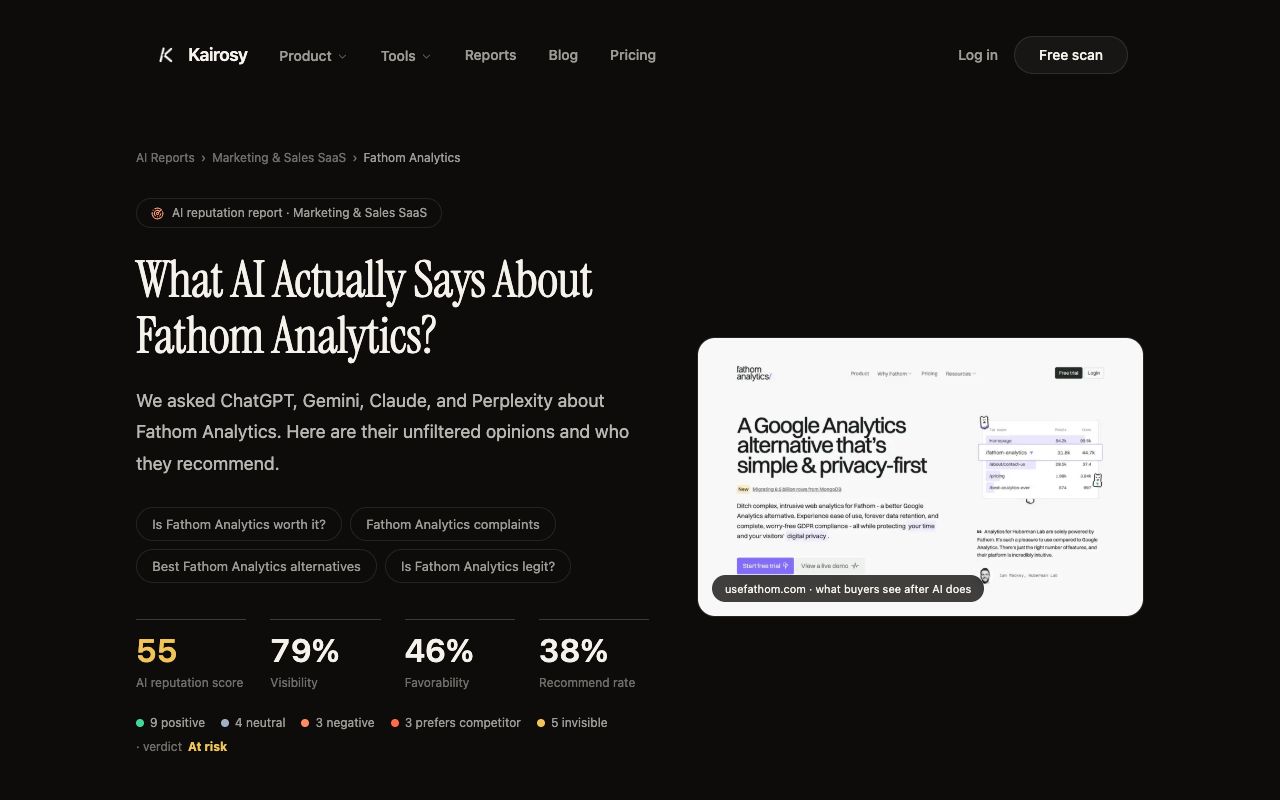
| Mention | Answers skip you or say they do not know the brand | Few third-party mentions, blocked crawlers | Open the search crawlers, earn mentions | Fathom Analytics: 79% visibility, "Five of the 24 answers end this way" |
| Citation | Named, but the linked evidence is someone else's page | No citable page of yours answers the prompt | One answer-first page per prompt cluster | Siftly: 75% visibility, a rival's comparison pages get cited |
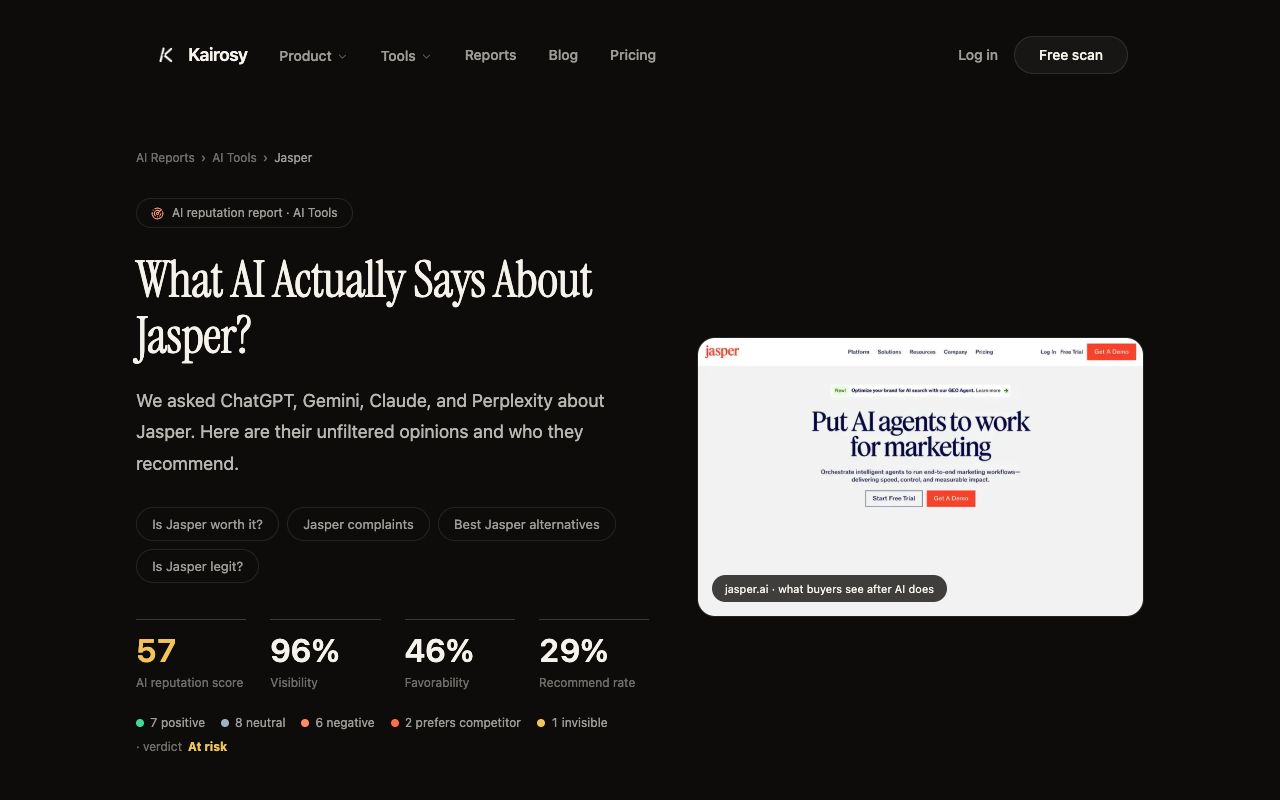
| Sentiment | Named and linked, but the answer repeats complaints | Reviews outweigh your own claims | Verify each complaint, fix or rebut it with a date | Jasper: 96% visibility, 46% favorability, 29% recommend rate |
| Recommendation | Tone is fine, a rival is the pick | Rivals own the comparison and "best X" pages | Own the comparison pages and lists | Kustomer: 100% visibility, 38% recommend rate, Zendesk 29% share |
| Source | Answer domains are pages you do not control or that are stale | Thin profiles where engines already read | Populate the source pool | Rebuy: 71% visibility, Trustpilot and a news site in the source list |
Two companion posts go deeper: the five cases of a missing brand for Mention, and citation engineering by source type for Citation and Source.
How Do You Fix a Mention Failure When AI Engines Don't Know Your Brand?
Signal. A fifth or more of answers do not name you. Kairosy's scan of Fathom Analytics shows 79% visibility, yet a Claude answer opens "I'm not familiar with a brand or service called 'usefathom.com'…" and "Five of the 24 answers end this way."
Root cause. Engines recognize entities from what the rest of the web says. Ahrefs' May 2025 study of 75,000 brands put the correlation between branded web mentions and AI Overview visibility at 0.664, against 0.218 for backlinks. Its December 2025 update added YouTube mentions at roughly 0.74, the strongest signal measured.
Action.
- Confirm the answer-feeding crawlers can reach you; the AI crawl checker reads your robots.txt against the agents in the table below.
- Make the entity unambiguous: one canonical name, an About page stating what you are and who runs it, Organization schema with sameAs links (validate with the schema markup checker).
- Earn independent mentions where the correlations point: category listicles, YouTube reviews, podcasts — the pages that already name your competitors.
| Engine | Agent that affects answers | Vendor documentation | robots.txt |
|---|---|---|---|
| ChatGPT | OAI-SearchBot | "OAI-SearchBot is for search" (OpenAI bots docs) | Respected; ChatGPT-User: "robots.txt rules may not apply" |
| Perplexity | PerplexityBot | "designed to surface and link websites in search results on Perplexity" (Perplexity crawler docs) | Respected; Perplexity-User "generally ignores robots.txt rules" |
| Claude | Claude-SearchBot | "navigates the web to improve search result quality for users" (Anthropic crawler article) | Respected, including Crawl-delay |
| Gemini / AI Overviews | Googlebot; Google-Extended is a separate control | Google-Extended "does not impact a site's inclusion in Google Search nor is it used as a ranking signal" but governs grounding (Google crawler docs) | Blocking it removes your pages from Gemini grounding |
How Do You Fix a Citation Failure When You're Named but Never Linked?
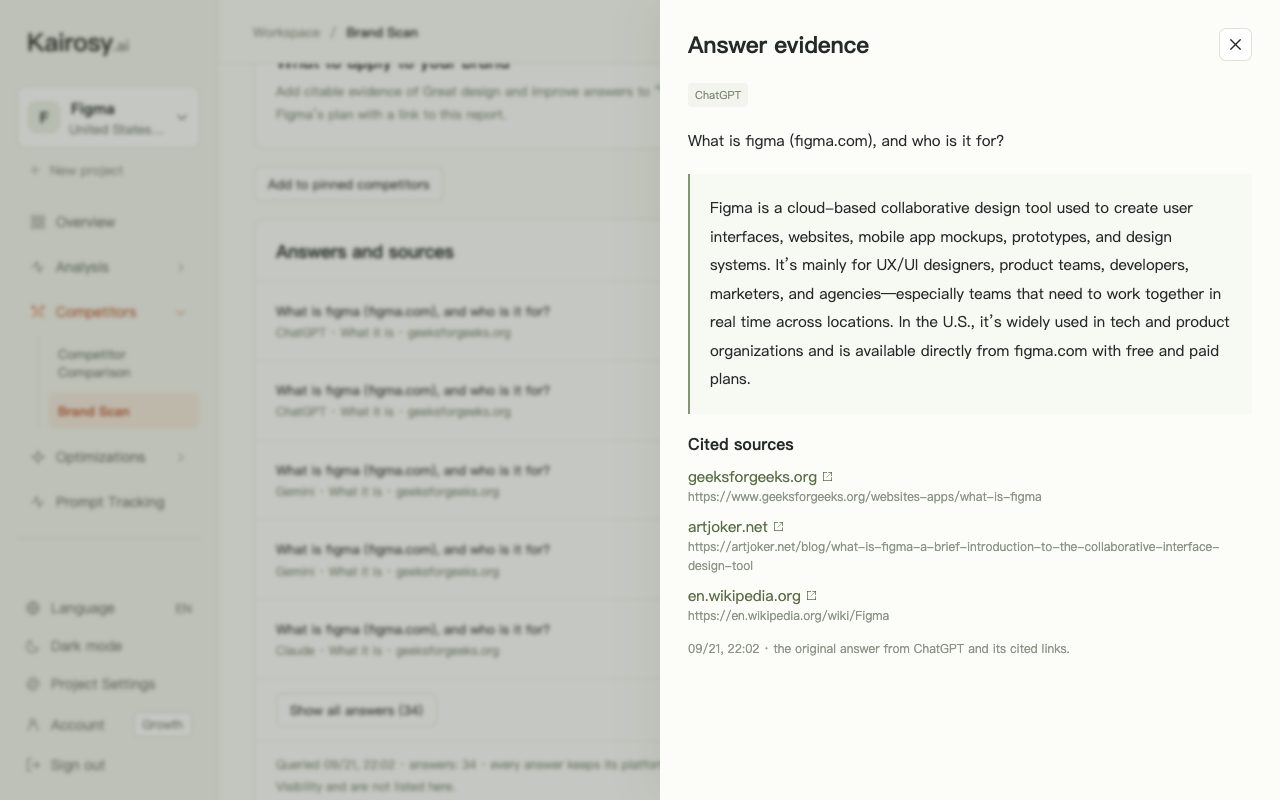
Signal. The engine knows you, but the URL under the answer belongs to a reviewer, a rival or a forum. Kairosy's scan of Siftly scored 54/100 at 75% visibility, with two engines leaning on a competitor's head-to-head pages: "Siftly's content is powering an answer that ends on the competitor's name — the worst possible return on a published guide."
Root cause. Citation is decided per page, after retrieval. Ahrefs' April 2026 analysis of 1.4 million ChatGPT prompts found the model cites only about half of the URLs it retrieves (49.98%), that cited pages had higher title-to-prompt similarity (0.602 vs 0.484), and that search results with natural-language slugs were cited 89.78% of the time against 81.11% without.
Action.
- For each prompt cluster, build one page whose title uses the buyer's words and whose first 100 words answer outright, followed by figures, named sources and a short quote. The GEO paper (KDD 2024) measured up to 40% visibility gains in generative responses from those additions.
- Update in place instead of republishing at a new URL; the median cited search result in the Ahrefs data was about 500 days old.
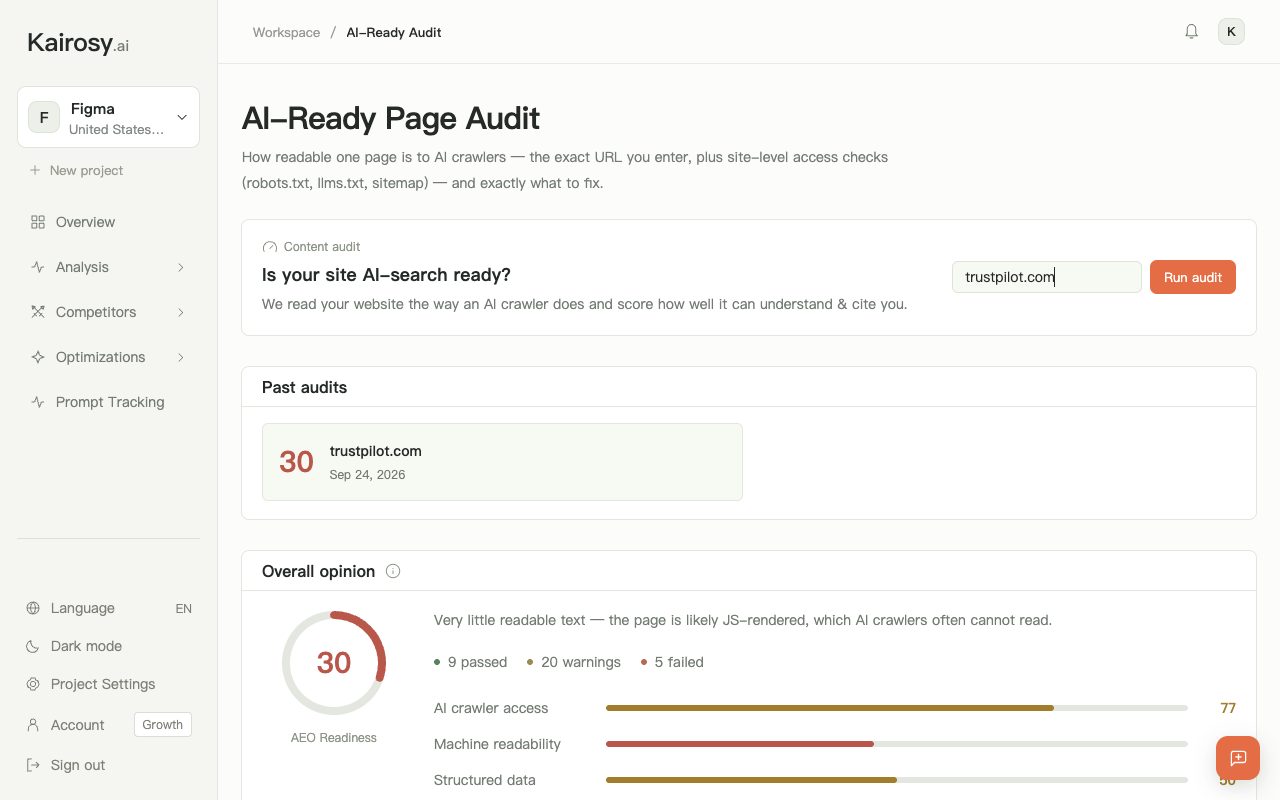
- Run the page through the AI-Ready Page Audit — 33 checks across access, readability, structured data, citability and trust.
How Do You Fix a Sentiment Failure When AI Repeats Old Complaints?
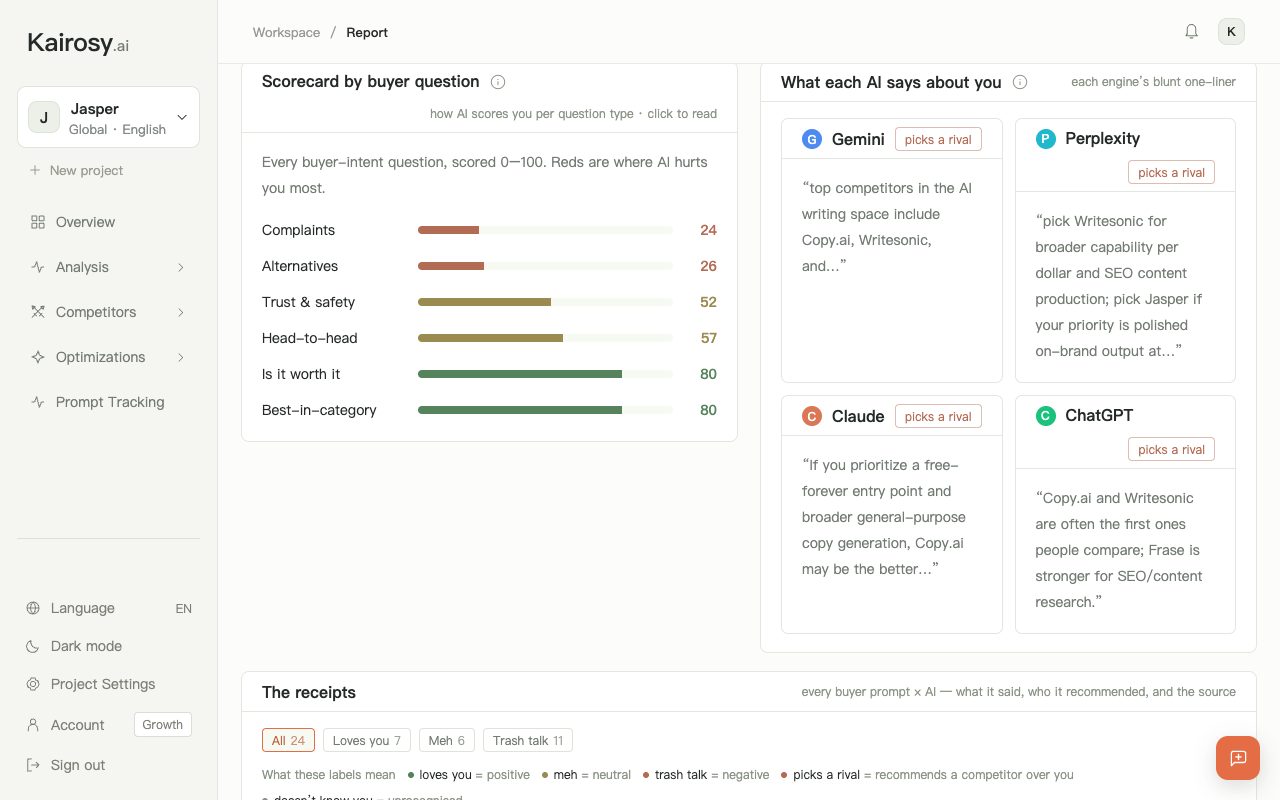
Signal. Named, linked, and the answer still reads like a warning. Kairosy's scan of Jasper: 96% visibility, 46% favorability, 29% recommend rate. ChatGPT: "The most common complaints about Jasper.ai are billing and cancellation issues, especially people saying they were charged after canceling." Perplexity scored the brand 40/100.
Root cause. Complaint questions are answered from reviews. Feefo's August 2025 travel-prompt research found Perplexity "uses reviews 100% of the time" and ChatGPT and Gemini in 58% and 56% of responses. Seer Interactive's May 2026 study of 804,491 AI responses found review sites are 1.51% of citations at the awareness stage and 24.27% at the intent stage.
Action.
- Truth-test every repeated complaint. True and current: fix it and publish the fix with a date. Resolved: say so on a crawlable page. False: publish the correction with evidence. Rebutting a complaint that is still true makes the next answer worse.
- Respond where the engines read. SE Ranking's January 2026 review of 22,729 AI Overviews found 34.5% cited a review platform, led by Gartner Peer Insights (26.0%), G2 (23.1%) and Capterra (17.8%).
- Track negative keywords, not the score; a weekly re-scan that flags a new negative keyword shows which complaint reached the answer layer. AI reputation management is that loop on a schedule.
How Do You Fix a Recommendation Failure When AI Picks a Rival?
Signal. Tone is fine; you are still not the answer. Kairosy's scan of Kustomer: 100% visibility, 38% recommend rate, Zendesk at 29% share of voice to Kustomer's 26%. Perplexity: "If you want the safest overall pick for scale and integrations, Zendesk is the most consistently cited #1 alternative."
Root cause. Engines answer "best" and "vs" prompts by borrowing an existing comparison. Ahrefs' December 2025 study of 26,283 source URLs found "best X" blog lists were 43.8% of all cited page types, 79.1% of them updated in 2025, and a brand's own list "still showed up in more than a third of ChatGPT responses in the software category."
Action.
- Publish the comparison yourself: a "[You] vs [Rival]" page for each competitor the engines name, plus an alternatives page with an honest table of who each option is best for. A page that only flatters you is not the one the engine repeats.
- Get onto the third-party best lists updated this year; your answer log names them.
- Give the engine a "best for" sentence to quote: a segment, a price band, an integration. Kustomer loses on "safest pick for scale"; a specific true claim beats a general one.
How Do You Fix a Source Failure When the Wrong Pages Feed the Answer?
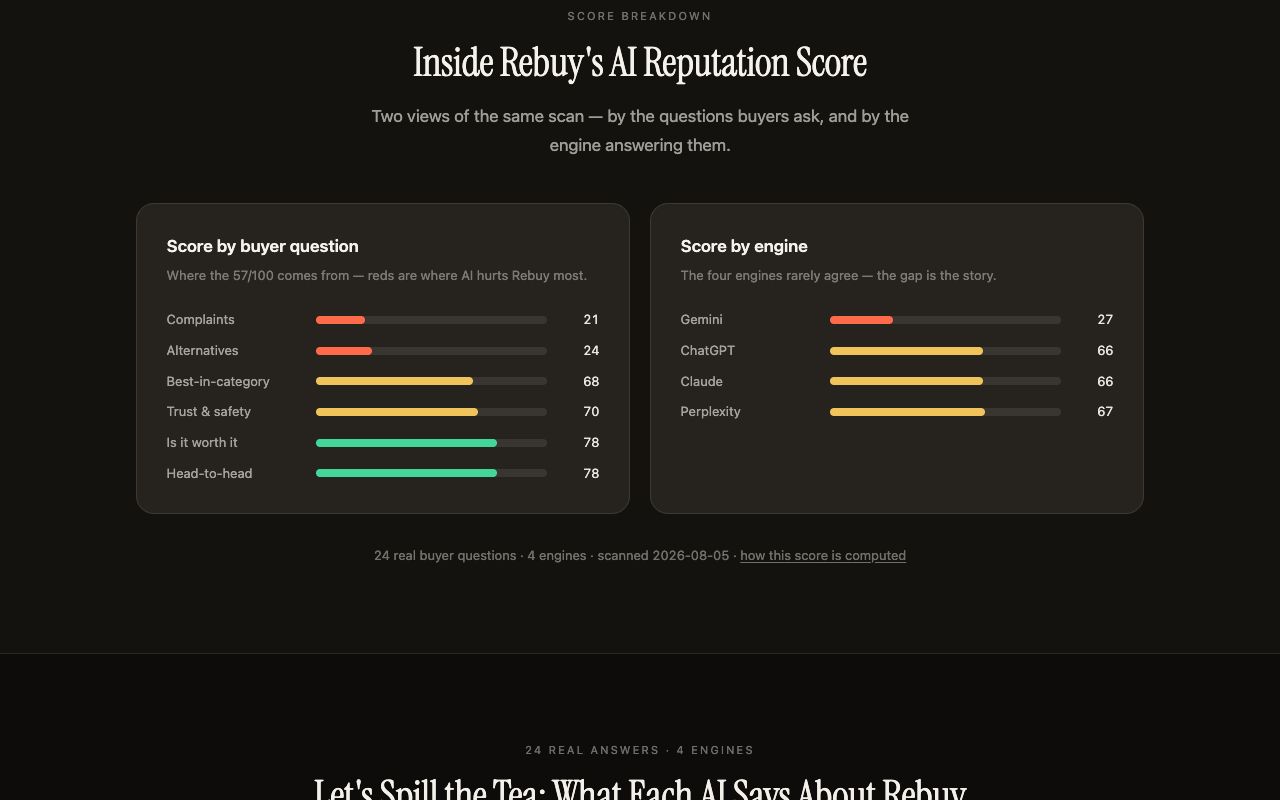
Signal. The domains behind the answers are outside your control, and some are stale. Kairosy's scan of Rebuy lists source share as rebuyengine.com 42%, onlinestorenews.com 5%, Shopify 4%, LimeSpot 4% and Trustpilot 4%; Claude repeats "a Rebuy deployment broke checkout functionality on a Shopify store, preventing customers from completing…" on a 57/100 report.
Root cause. Source pools move. Semrush's November 2025 study of 230,000+ prompts tracked Reddit falling from close to 60% of ChatGPT responses to around 10% after September 2025. Seer's May 2026 data shows how thin the threshold is: no Trustpilot profile, 1% median citation rate; one to thirteen reviews, 53.5%.
Action.
- Map source domains per engine from your log, then claim and populate the profiles already appearing there before creating new ones.
- Replace stale narratives with dated ones: an incident page, a versioned changelog, a pricing page that states the number.
- Where a thread is the source, answer in it under your own name. Do not seed threads: 67.8% of non-cited URLs in the Ahrefs citation study were Reddit pages.
How to Improve Brand Visibility in ChatGPT: Which Fixes Are Engine-Specific?
The five rows apply everywhere, but three ChatGPT quirks change the action when you work out how to improve brand visibility in ChatGPT.
- Access is a separate switch. Allowing GPTBot does nothing for search; OAI-SearchBot must be allowed, and ChatGPT-User may fetch live regardless of robots.txt.
- Retrieval is not citation. Search-result URLs were cited 88.46% of the time in the 1.4M-prompt data, Reddit 1.93%, YouTube 0.51% — the Citation fix is a ranking page, not a video or a thread.
- Recommendation is list-driven. With listicles at 43.8% of cited page types, the fix is a place on updated lists plus your own "best for" comparison.
Related: the ChatGPT ranking factors and ChatGPT brand monitoring, which tracks your prompts on ChatGPT daily.
When Should You Re-Scan, and What Counts as Improvement?
Re-run the same prompts on the same engines seven days after each change, then weekly. "Improved" depends on the row:
- Mention: share of answers naming you, per engine. A jump on Perplexity with none on Claude means live retrieval moved and the entity layer did not.
- Citation: share of answers linking your URL, and which URL. If it is not the page you built, the title still misses the prompt.
- Sentiment: the negative-keyword list. A complaint that stops appearing is the win; a two-point drift is noise.
- Recommendation: recommend rate and the rival's share of voice.
- Source: your populated profiles and dated pages appearing, the stale page gone.
Two cautions. Answers vary between sessions, so read 20 or more, not one chat. Engines disagree — Fathom scores 74 on Perplexity and 27 on Gemini — so report per engine and average only for the headline. That re-measure step turns how to improve visibility in AI search from a project into a loop.
Kairosy's tracking slots run the loop on a schedule: one brand in one market, re-scanned every Monday, with alerts on a new negative keyword, a competitor becoming the preferred pick, a score drop or an engine flipping sentiment, and a Fix Plan ordered by failure type. For which tools do what, see the optimization tool comparison; for the always-on version, AI brand monitoring.
How to Improve Visibility in AI Search FAQs
How to improve brand visibility in AI search engines?
Log whether each engine answer names, links, praises and picks you, find the first stage with many "no"s, and fix only that stage: crawler access and mentions for Mention, an answer-first page for Citation, verified fixes for Sentiment, owned comparisons for Recommendation, populated profiles for Source.
How to improve brand visibility in AI search results without a large brand?
Start with the two rows a small brand controls, Citation and Source. One accurate comparison page and a review profile with a dozen real reviews changes what engines can quote; Seer's May 2026 data puts no Trustpilot profile at a 1% median citation rate and a handful of reviews at 53.5%.
How long does it take to improve visibility in AI search?
Live-retrieval paths (Perplexity, ChatGPT search, grounded Gemini) can reflect an updated page within days of it ranking; entity recognition in ungrounded answers follows the third-party web and takes months. Track per engine to see which layer moved.
Does blocking GPTBot hurt visibility in ChatGPT?
Not directly. OpenAI documents GPTBot as the training crawler and OAI-SearchBot as the one "for search." Blocking OAI-SearchBot removes you from ChatGPT search answers; blocking GPTBot only affects future training data.
Which failure type should you fix first?
The earliest funnel stage with a high "no" count: Mention, then Citation, Sentiment, Recommendation, Source. Fixing sentiment while a fifth of answers do not know the brand produces no measurable change — that ordering is the whole of how to improve visibility in AI search.
See what AI says about your brand
Run a free scan across ChatGPT, Gemini, Claude & Perplexity in about 30 seconds.
Run my free scan