Ahrefs KW Explorer vs KWFinder (2026): Pricing, KD, AI-Era Verdict
Short answer: pick KWFinder when you want the cheapest dependable way to surface low-competition keywords in an interface a new hire learns in an afternoon, and pick Ahrefs Keywords Explorer when you need the biggest database, click-based traffic estimates and competitor keyword gaps across many sites. That is the Ahrefs KW Explorer vs KWFinder verdict in one line. Numbers were checked on both vendors' sites on September 17, 2026; the closing sections ask what search volume still means once AI answers the query.
Ahrefs KW Explorer vs KWFinder: What Is Each Tool Built For?
What Ahrefs Keywords Explorer does
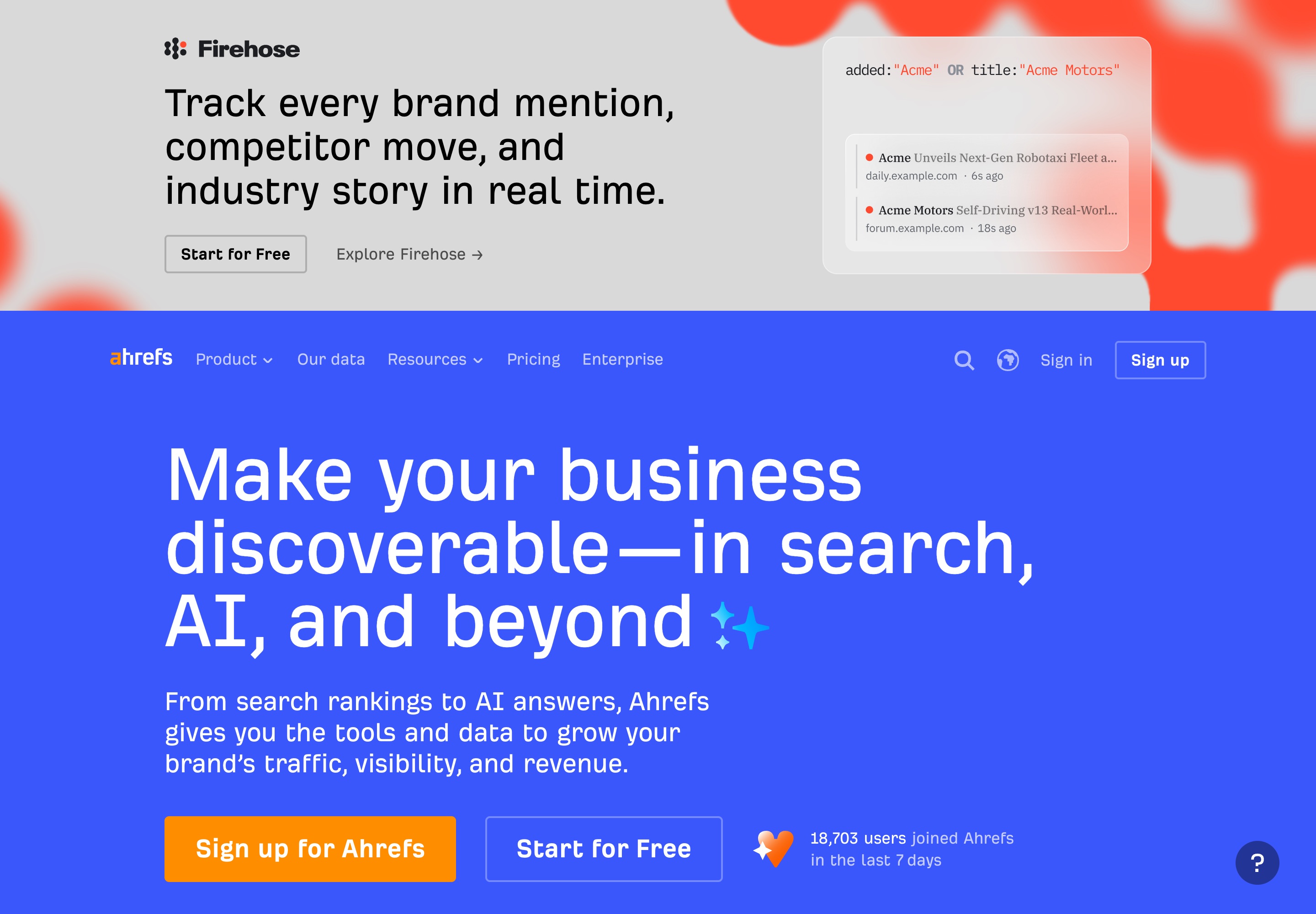
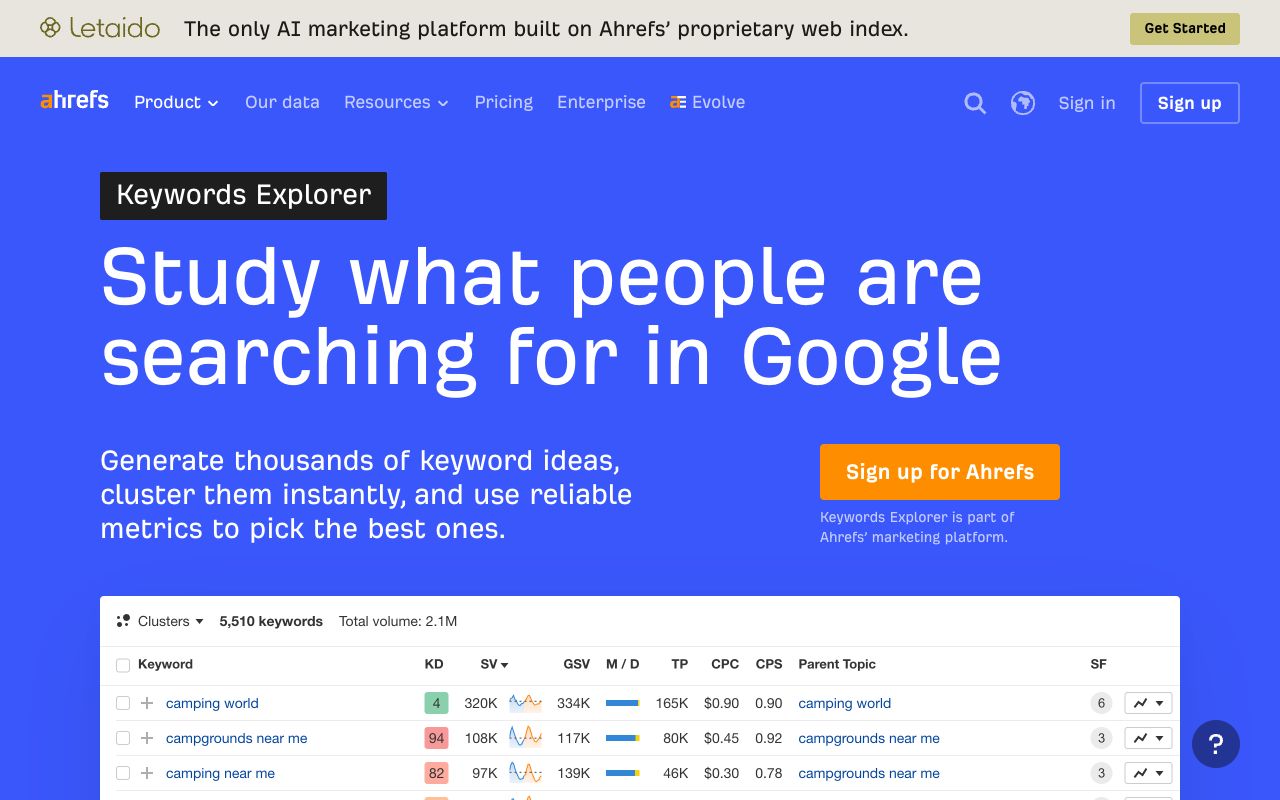
Keywords Explorer is the keyword module of the Ahrefs suite. The product page claims "28.7B keywords filtered from 110B discovered in total", "2.7B keywords in the US alone" and "217 locations". Each row carries Search Volume, Keyword Difficulty, Clicks, Traffic Potential (the traffic the top page earns from every query it ranks for) and a Parent Topic that clusters variants under one head term.
What KWFinder does
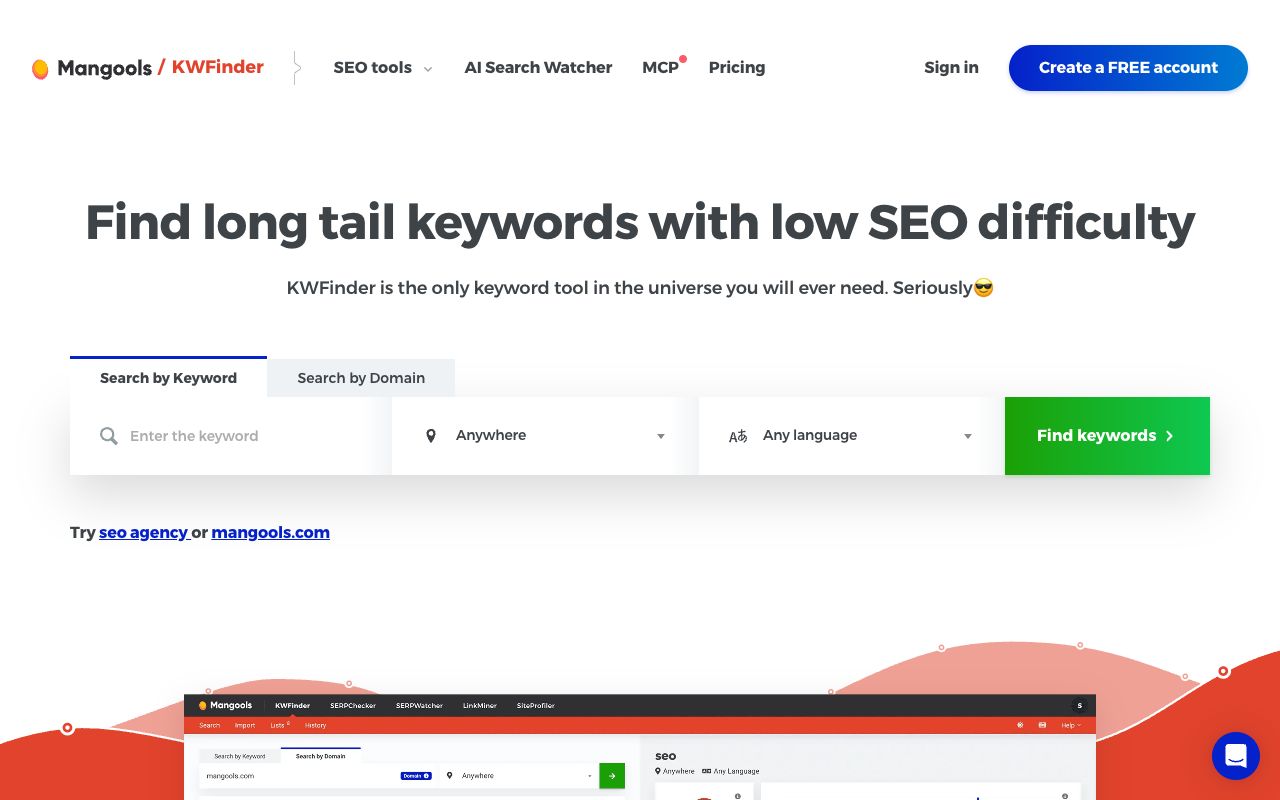
KWFinder is the keyword tool inside Mangools, a five-app bundle (KWFinder, SERPChecker, SERPWatcher, LinkMiner, SiteProfiler) sold as one subscription. The KWFinder page leads with "Find long tail keywords with low SEO difficulty" and cites "2.5 billion related keywords" and "more than 65k locations" down to city level. Without paying you get 5 lookups per 24 hours with 15 related and 5 competitor keywords each.
How Much Do Ahrefs Keywords Explorer and KWFinder Cost in 2026?
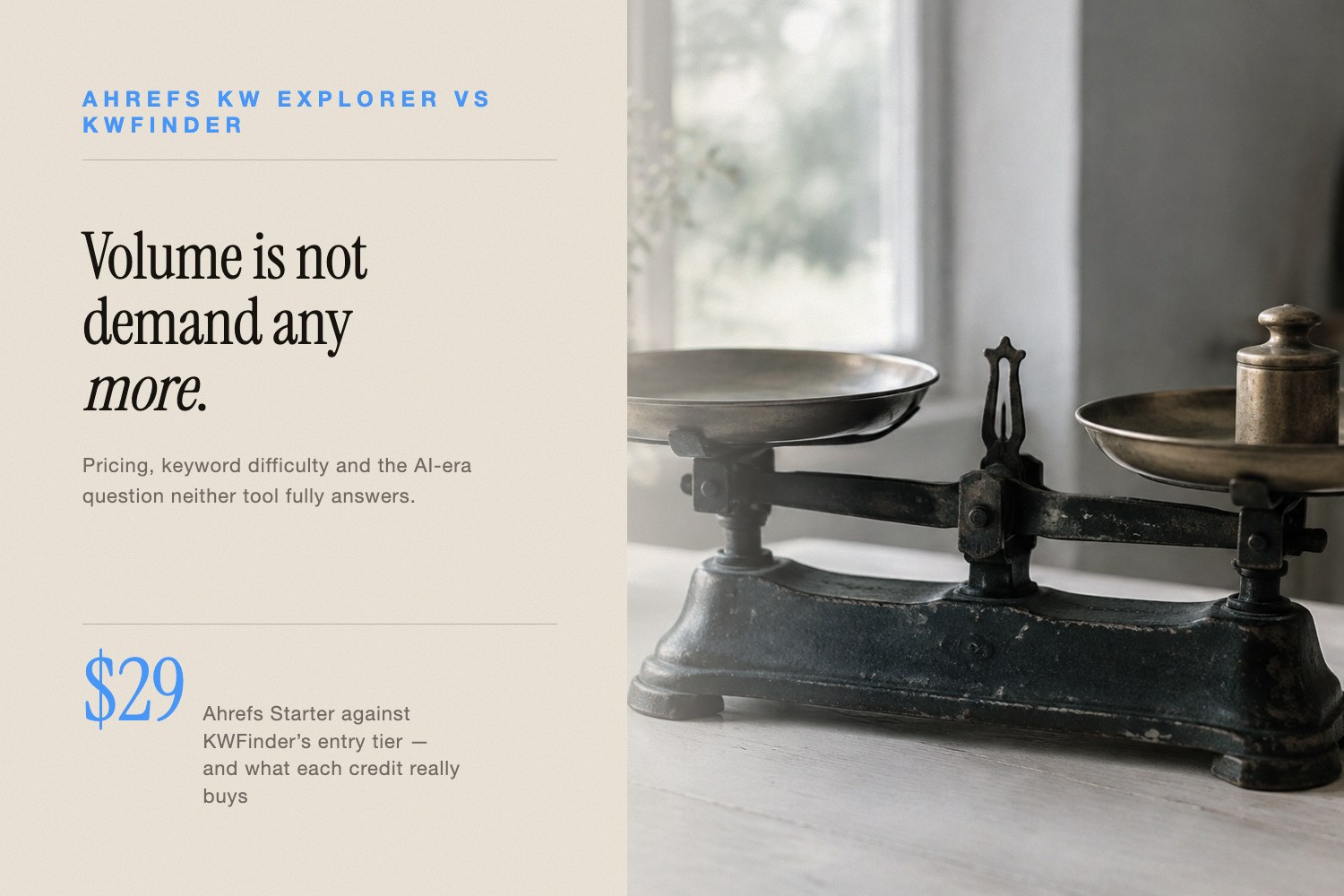
Ahrefs figures come from ahrefs.com/pricing and the Help Center article on the Starter plan, read on September 17, 2026 at monthly billing (annual is advertised as "save up to 17%"). Mangools renders its dollar amounts with JavaScript: a plain fetch of mangools.com/plans-and-pricing confirmed the three tier names, a "48-hour money back guarantee" and a 35% saving on annual billing, but not the prices, so check the page for today's figure. Lookup limits are from Mangools' own KWFinder guide.
| Plan | Monthly price (Sep 2026) | Keyword-research allowance |
|---|---|---|
| Ahrefs Starter | $29 | 200 credits/mo, 1 unverified project, 250 rows per report, 1 month of history, 50 Rank Tracker keywords, monthly renewal only |
| Ahrefs Lite | $129 | 1,000 credits per user, 750 tracked keywords, 5 projects, 6 months of history |
| Ahrefs Standard | $249 | Unlimited credits per user, 2,000 tracked keywords, 20 projects, 2 years of history, Content Explorer |
| Ahrefs Advanced | $449 | Unlimited credits, 5,000 tracked keywords, 50 projects, 5 years of history |
| Ahrefs Enterprise | $1,499 (annual commitment) | Advanced plus uncapped API access and unlimited history |
| Mangools Basic | As shown on the pricing page | 100 keyword lookups per 24 hours, 200 keywords per import, all five apps |
| Mangools Premium | As shown on the pricing page | 500 lookups per 24 hours, 700 keywords per import |
| Mangools Agency | As shown on the pricing page | 1,200 lookups per 24 hours, 700 keywords per import |
Note the meters: Ahrefs bills Starter and Lite in credits, Mangools in lookups per day, so Basic's 100 a day is roughly 3,000 a month against Starter's 200 credits.
Ahrefs KW Explorer vs KWFinder Compared: Database, KD, Volume, SERP and Ease of Use
| Criterion | Ahrefs Keywords Explorer | KWFinder (Mangools) |
|---|---|---|
| Pricing floor | $29/mo Starter with 200 credits | Free tier of 5 lookups a day, then Basic, Premium, Agency |
| Keyword database | 28.7B keywords, 2.7B in the US, 217 locations | 2.5B related keywords, about 65k locations |
| KD methodology | "Based solely on the average number of backlinks to the top-ranking pages" | Link Profile Strength of every page-one URL from Moz DA/PA and Majestic CF/TF, cached up to 30 days |
| Search volume source | Google Keyword Planner, Google Trends and third-party clickstream data, "ungrouped" from GKP clusters | "Often identical to the ones in Google Keyword Planner" |
| Long-tail discovery | Matching and related terms, AI keyword generation, Parent Topic clustering, 12-month forecasts | Related, Autocomplete and Questions modes, up to 10,000 suggestions per search by plan |
| SERP analysis | SERP overview with backlink and traffic metrics, historical volatility, AI Overview filter | SERPChecker: "localized SERP results including SERP features and 49 metrics" |
| Competitor research | Site Explorer organic keywords and Content Gap across the suite | Search by Domain shows what a competitor ranks for |
| Ease of use (Trustpilot) | 2.1/5 from 321 reviews, 50% one-star | 4.4/5 from 165 reviews, 90% five-star |
Why a KD of 30 means two different things
Ahrefs says its score is "based solely on the average number of backlinks to the top-ranking pages", so a keyword whose page-one results have few links reads as easy even when those pages sit on strong domains. Mangools' keyword difficulty page instead builds a Link Profile Strength for each ranking URL from Moz Domain Authority and Page Authority plus Majestic Citation Flow and Trust Flow. Moz's own definition of Domain Authority is a ranking-likelihood prediction, so KWFinder leans toward domain strength and Ahrefs toward page-level links; neither reads the content, so treat KD as a filter, not a verdict.
Where the search volume actually comes from
The Ahrefs Help Center says the tool "uses a combination of Google Keyword Planner (GKP), Google trends data and other third party data sources" to "'ungroup' similar keyword clusters", and in Ahrefs' own test against Search Console impressions its estimates were "roughly accurate for 60% of the studied keywords" versus 45% for Keyword Planner. Mangools is candid about the alternative: its KWFinder FAQ says "the data that we use are often identical to the ones in Google Keyword Planner".
The review numbers come from Trustpilot's Mangools page (praise for the interface and support, complaints about the free tier and slow rank-data refreshes) and its Ahrefs page (account lockouts by automated fraud checks, the credit system, doubts about traffic estimates). Trustpilot over-samples billing disputes, so read it as a map of irritations, not a quality score.
Which Tool Should You Pick for Each Keyword Research Use Case?
- Niche or affiliate site on one domain: KWFinder Basic. Autocomplete and Questions modes plus a KD filter cover most of a solo publisher's needs.
- Under $30 a month: compare the meters. Starter gives 200 credits a month with 250 rows per report, Mangools Basic gives 100 lookups a day. Bursty researchers do better on Starter, daily ones on Mangools.
- Local SEO for service businesses: KWFinder. Its 65k-location picker reaches cities and districts; Ahrefs lists 217 locations and works best at country level.
- Content team forecasting traffic: Ahrefs. Clicks, Traffic Potential and Parent Topic turn a keyword list into a page plan with expected visits.
- Agency with 20 or more client sites: Ahrefs Standard removes the credit meter and adds 20 projects. Mangools Agency is cheaper when backlink auditing is not part of the retainer.
- Competitor keyword gaps: Ahrefs. Content Gap compares several domains at once; Search by Domain covers one competitor at a time.
If Ahrefs is the fixed side of your shortlist, we ran the same exercise for Long Tail Pro vs Ahrefs, Ahrefs vs Raven Tools and BuzzSumo vs Ahrefs. For suite-level swaps, see Ubersuggest alternatives and Serpstat vs Semrush.
Does Traditional Search Volume Still Predict Demand in the AI Era?
Less than it did, and measurably so. Pew Research Center tracked 900 US adults through 68,879 Google searches in March 2025 and found that 18% produced an AI summary. When one appeared, users "clicked on a traditional search result link in 8% of all visits"; without one they clicked "nearly twice as often (15% of visits)". The keyword's volume did not change; the share of it that reaches a website did.
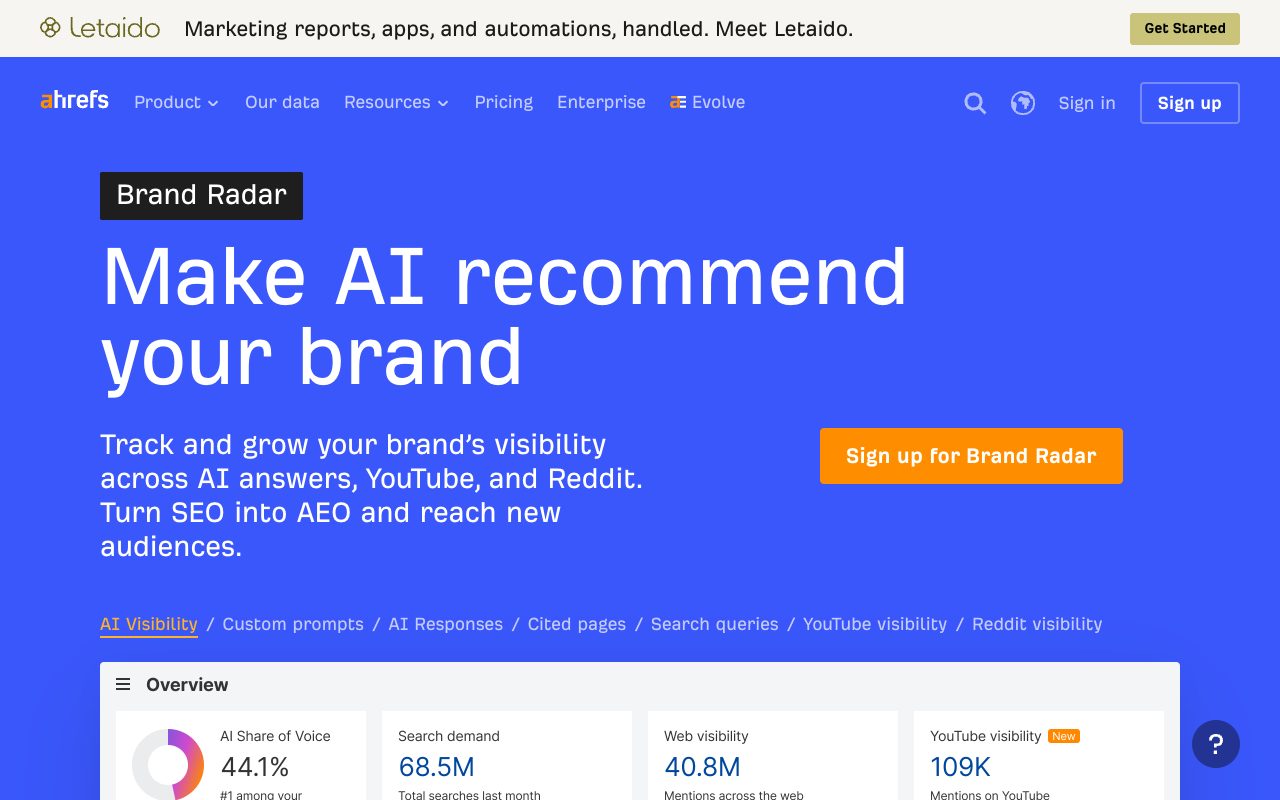
A second gap no keyword database closes is prompt demand. A question typed into ChatGPT or Perplexity is not a Google query, so it never enters Keyword Planner and never becomes a volume row in either tool. The nearest proxy is the Ahrefs Brand Radar prompt pool, which its product page sizes at "456M+ total monthly prompts" (the pricing page says 475M+), 310.7M of them from AI Overviews. Treat search volume as a ceiling on Google demand, and observe AI demand by asking the assistants directly.
How Do AI Overviews Cannibalize Clicks, and Which Keywords Are Still Worth Targeting?
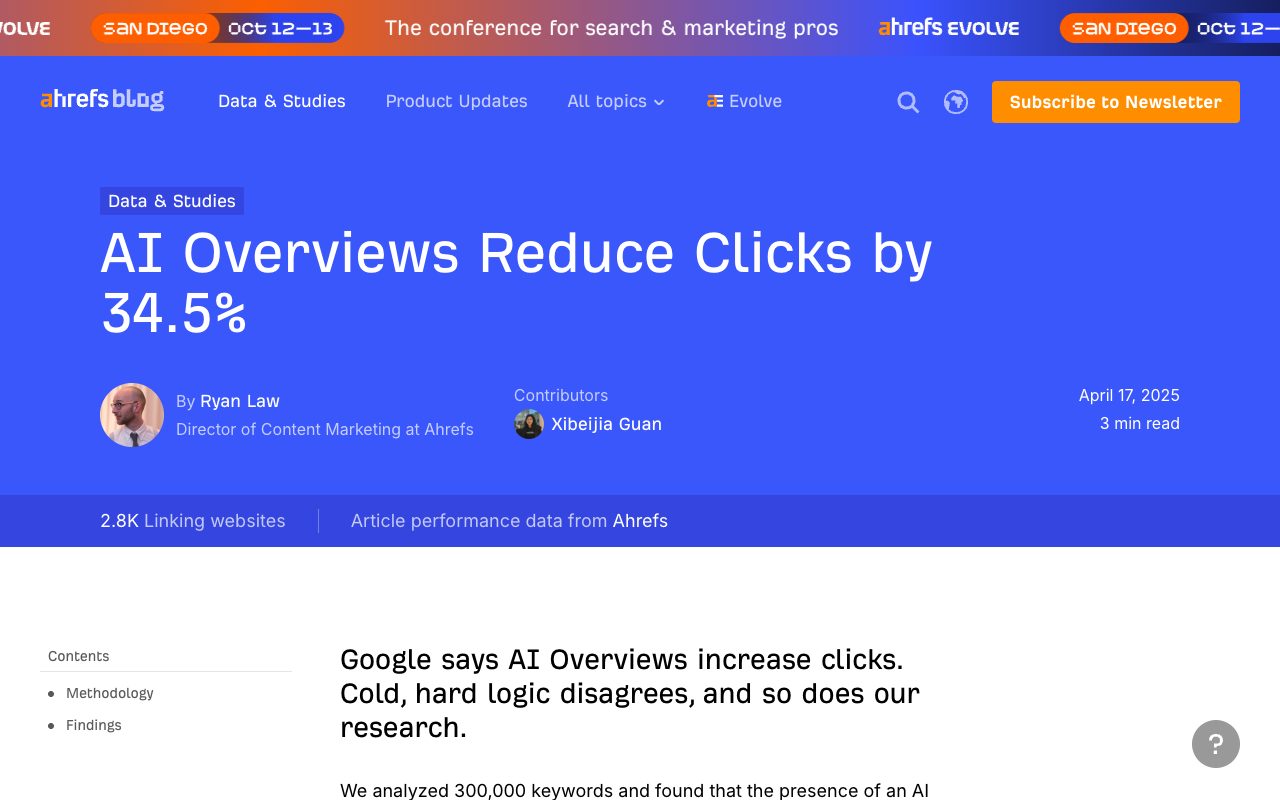
Ahrefs' 2025 study of 300,000 keywords compared Search Console data from March 2024 and March 2025 and found "a 34.5% lower average clickthrough rate (CTR) for the top-ranking page" when an AI Overview was present. An earlier Ahrefs analysis (October 2024) found that "71% of AI Overview keywords have a Keyword Difficulty score below 30, with the median average being 12" and that "99.2% of all AI Overview keywords are informational". The easy informational keywords KWFinder is best at finding are precisely the ones a summary absorbs. Google's AI features documentation offers no workaround: "There are no additional requirements to appear in AI Overviews or AI Mode, nor other special optimizations necessary." So score the list differently, in either tool:
- Commercial comparison queries still pay. "X vs Y", "best X for Y" and pricing questions send readers to a page because the answer is a table, not a sentence. This post targets a 720-a-month query at Semrush KD 3 for that reason.
- Check the SERP before trusting the volume. Keywords Explorer has an AI Overview option in its SERP features filter and SERPChecker lists the features present. If an AI Overview already sits on top, size the keyword by Ahrefs' Clicks column or your own Search Console CTR.
- Local and transactional intent holds. Map packs, product grids and booking flows still require a click.
- Definitional queries are the loss column. "What is X" keywords with KD 5 look like gifts in KWFinder and are the exact queries a summary answers in full. Publish them for authority, not traffic.
- Add a column neither tool has: does an assistant cite you? A keyword where ChatGPT already names your brand is worth more than its volume suggests, and one where it recommends a competitor is worth less.
Do Ahrefs or KWFinder Show AI Visibility Data?
Both vendors have added something, and neither has folded it into the keyword tool you are comparing. Ahrefs sells Brand Radar, whose page lists AI Overviews, AI Mode, ChatGPT, Perplexity, Gemini and Copilot, reports mentions, citations and an AI share of voice, and says custom prompt tracking is "Free in every Ahrefs paid plan" from Lite up; the AI Visibility Index is a separate add-on the pricing page lists from $199/mo as of September 2026. Mangools ships AI Search Watcher, which tracks "ChatGPT, Google AI Overviews, Google AI Mode, Gemini, Claude, Grok, Mistral, and Llama" (Perplexity is not listed), reruns each prompt several times for stable averages, and reports positions, visibility scores and citations under the same Basic, Premium and Agency tiers as KWFinder.
What neither product does is grade the answers, and appearing in a ChatGPT reply is not the same as being recommended in it. That narrower job is what Kairosy does: it puts purchase-stage questions to ChatGPT, Gemini, Claude and Perplexity, classifies each reply as positive, neutral or negative with the reason, keeps the cited URLs and turns the negatives into a Fix Plan. It is a reputation scanner, not a keyword tool, and sits beside either of these two.
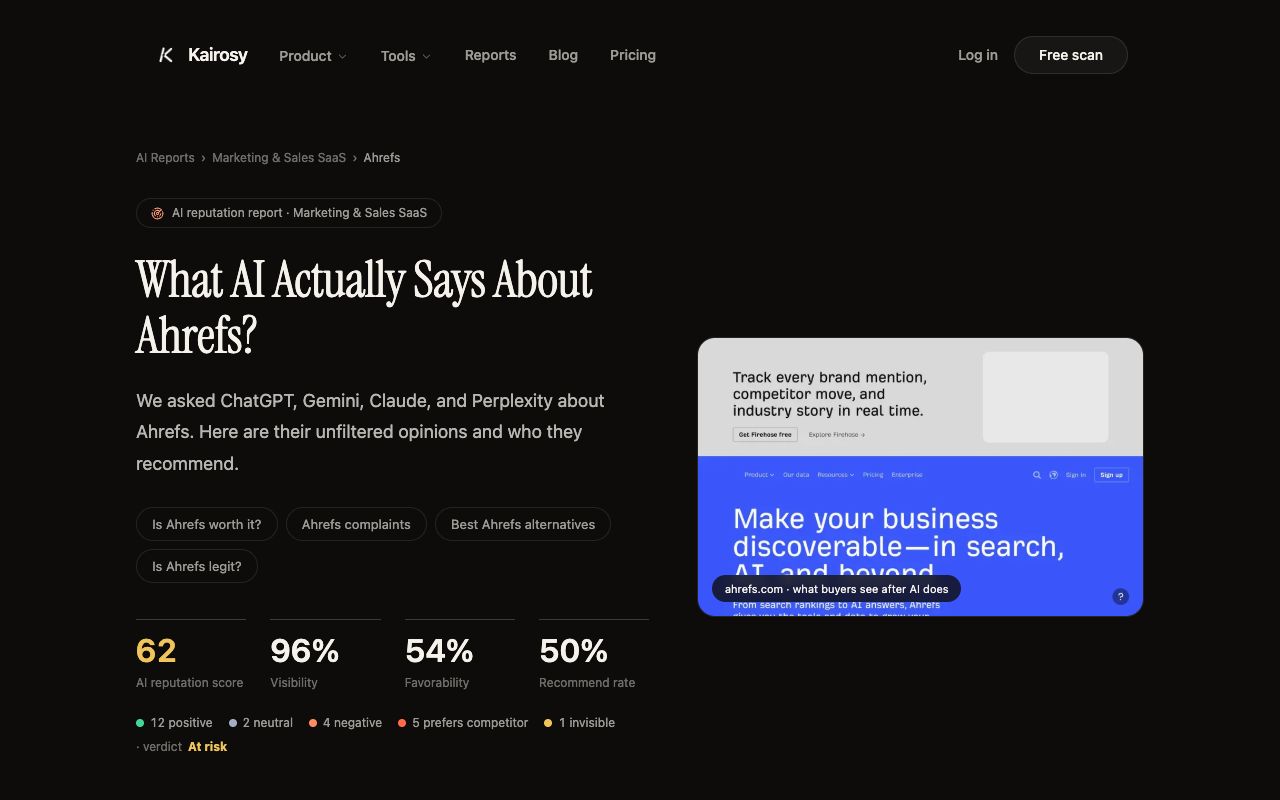
The public scans make the distinction concrete. Kairosy's scan of Ahrefs (August 5, 2026) scored it 62/100, "At risk", with ChatGPT at 81 but Perplexity at 52; ChatGPT summarized the downside as "high and rising pricing, credit-based limits that can feel restrictive", and Perplexity told buyers that "Semrush is the leading alternative most buyers should choose". Kairosy's scan of Mangools the same day came in at 57/100, where Claude concluded that "Mangools is best for budget-conscious solo operators and small teams, while Ahrefs is the choice for serious SEO work at scale". The full answer sets are at Ahrefs' AI performance report and Mangools' AI performance report. Before publishing the pages on your list, the free AI crawl checker shows whether your robots rules block GPTBot, ClaudeBot or PerplexityBot, and the AI-Ready Page Audit runs 33 checks across access, readability, structured data, citability and trust.

Ahrefs KW Explorer vs KWFinder FAQs
Is KWFinder more accurate than Ahrefs for keyword difficulty?
They measure different things: KWFinder averages Moz and Majestic authority metrics across page one, Ahrefs counts backlinks to the top pages. Calibrate to whichever scale matches keywords you already rank for.
Can I use Ahrefs Keywords Explorer for free?
Ahrefs lists an "Ahrefs Free" tier, but Keywords Explorer proper starts with the $29/mo Starter plan and its 200 monthly credits, as of September 2026. Starter renews monthly only and cannot buy extra credits or seats.
Does KWFinder have a free trial?
Mangools offers 5 free lookups per 24 hours with 15 related and 5 competitor keywords each, no card required, plus a 48-hour money-back guarantee on paid plans.
Which is better for long-tail keywords in the Ahrefs KW Explorer vs KWFinder matchup?
KWFinder is built around the long tail, with Autocomplete and Questions modes and a KD filter. Ahrefs finds more because its database is roughly ten times larger and Parent Topic shows which phrases share a page, but you pay for that depth.
Do I still need a keyword tool if AI Overviews take the clicks?
Yes, used differently: volume is the ceiling of Google demand, SERP-feature data shows how much can still reach a page, and an AI visibility check shows whether assistants send buyers to you or to a competitor.
See what AI says about your brand
Run a free scan across ChatGPT, Gemini, Claude & Perplexity in about 30 seconds.
Run my free scan