Enterprise AI Share of Voice: Measure It by Engine and Market (2026)
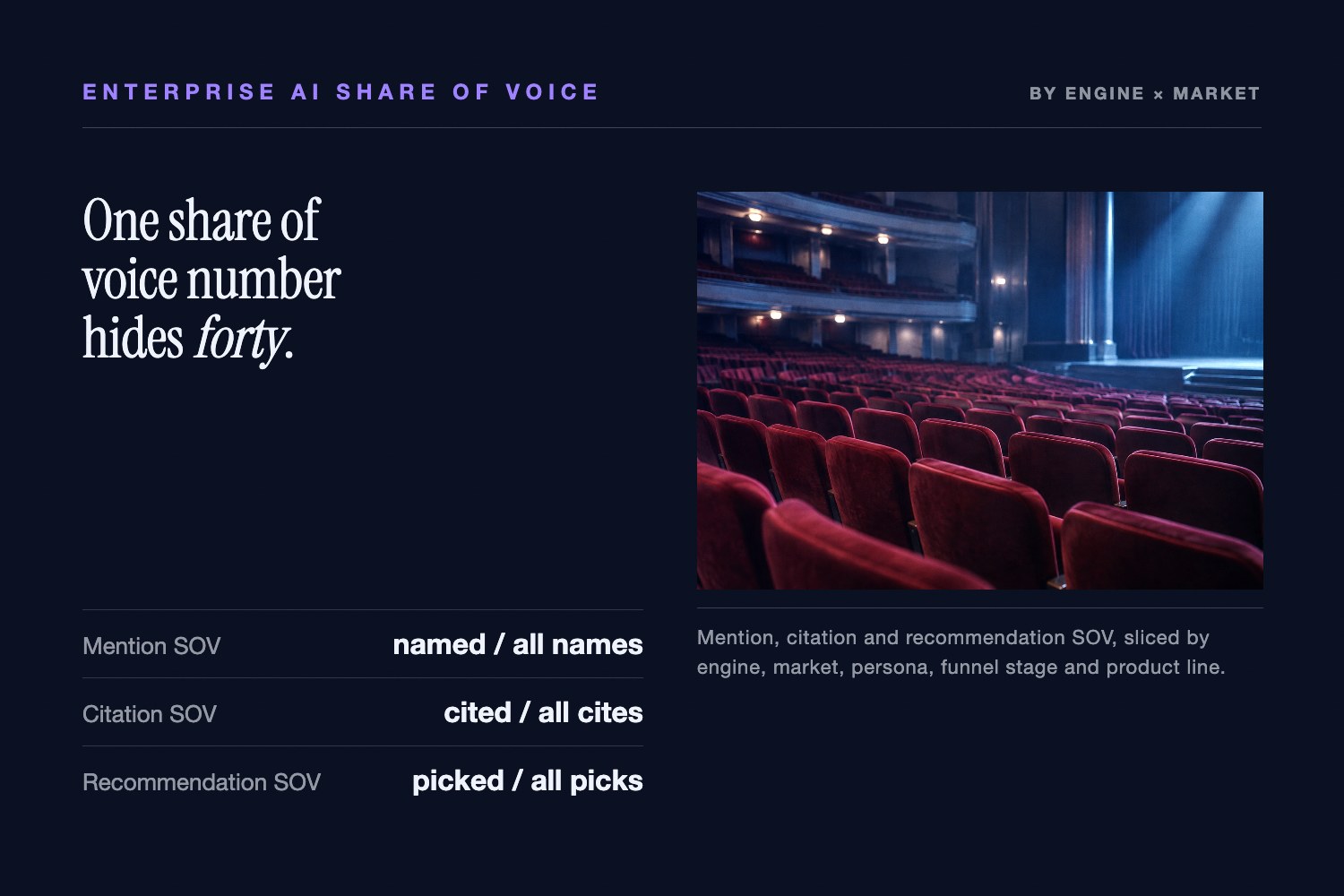
Enterprise AI share of voice is the percentage of AI answers, inside a fixed prompt set, in which your brand is mentioned, cited or recommended, measured separately for every engine, market, buyer persona, funnel stage and product line. The enterprise version is a matrix rather than one number, because a company selling six product lines into 25 countries cannot act on a global average.
If you need the basic definition, start with AI share of voice: what it is and how to measure it. This post covers the enterprise layer on top of it.
What Is Enterprise AI Share of Voice, and How Is It Different From Plain AI SOV?
Plain AI SOV asks: of all the brands an engine names for our category, what fraction is us? Enterprise AI share of voice adds five dimensions, and each is a place where the average hides a problem:
- Engine. ChatGPT, Gemini, Claude and Perplexity pull from different sources and reach different verdicts.
- Market. A buyer in Germany and a buyer in Texas get different answers, because the engines localize retrieval.
- Persona. A CFO asks "is it worth the price", a developer asks "does it have an API", and the answers name different rivals.
- Funnel stage. "What is marketing automation" and "X vs Y for a 200-person team" produce different mention rates.
- Product line. An enterprise with a CRM and a support desk has two share-of-voice numbers, not one.
Bain's February 19, 2025 research found that "80% of consumers now rely on AI-written results for at least 40% of their searches" and that "60% of searches now terminate without the users clicking through to another website."
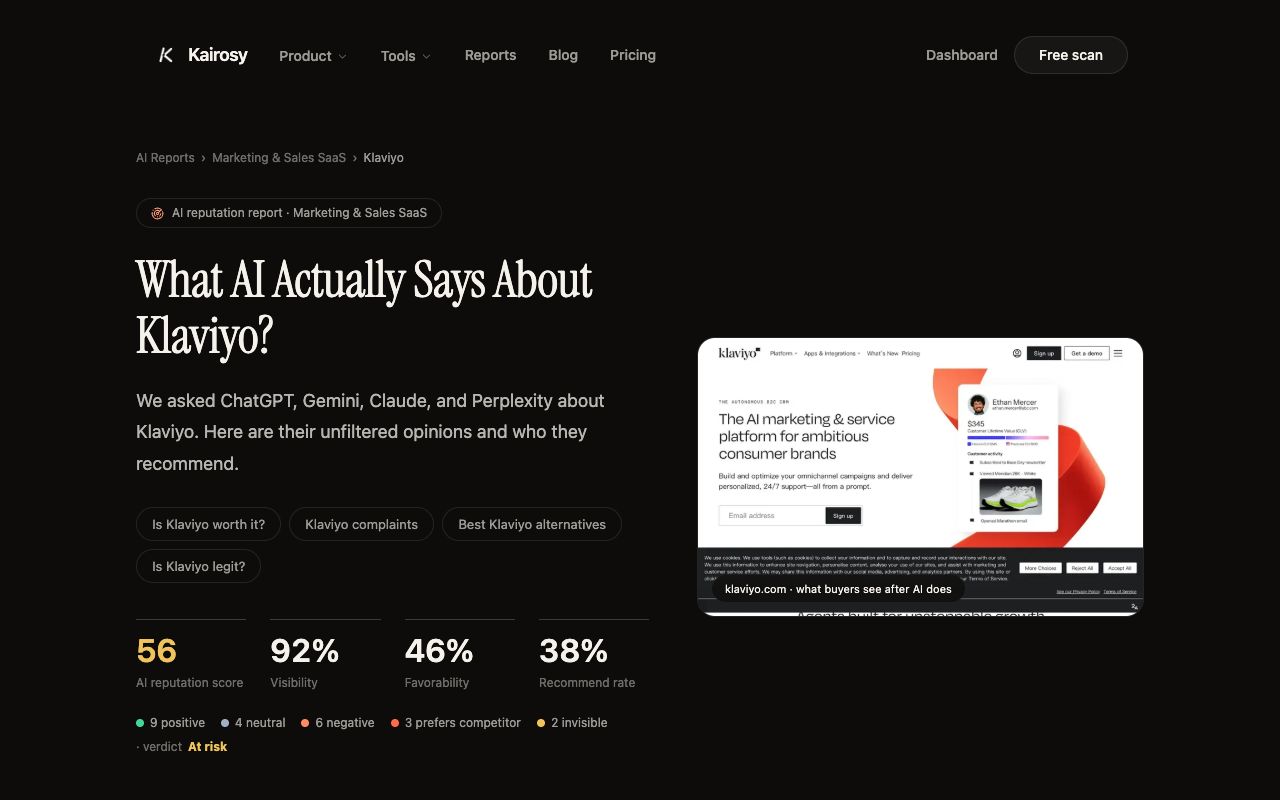
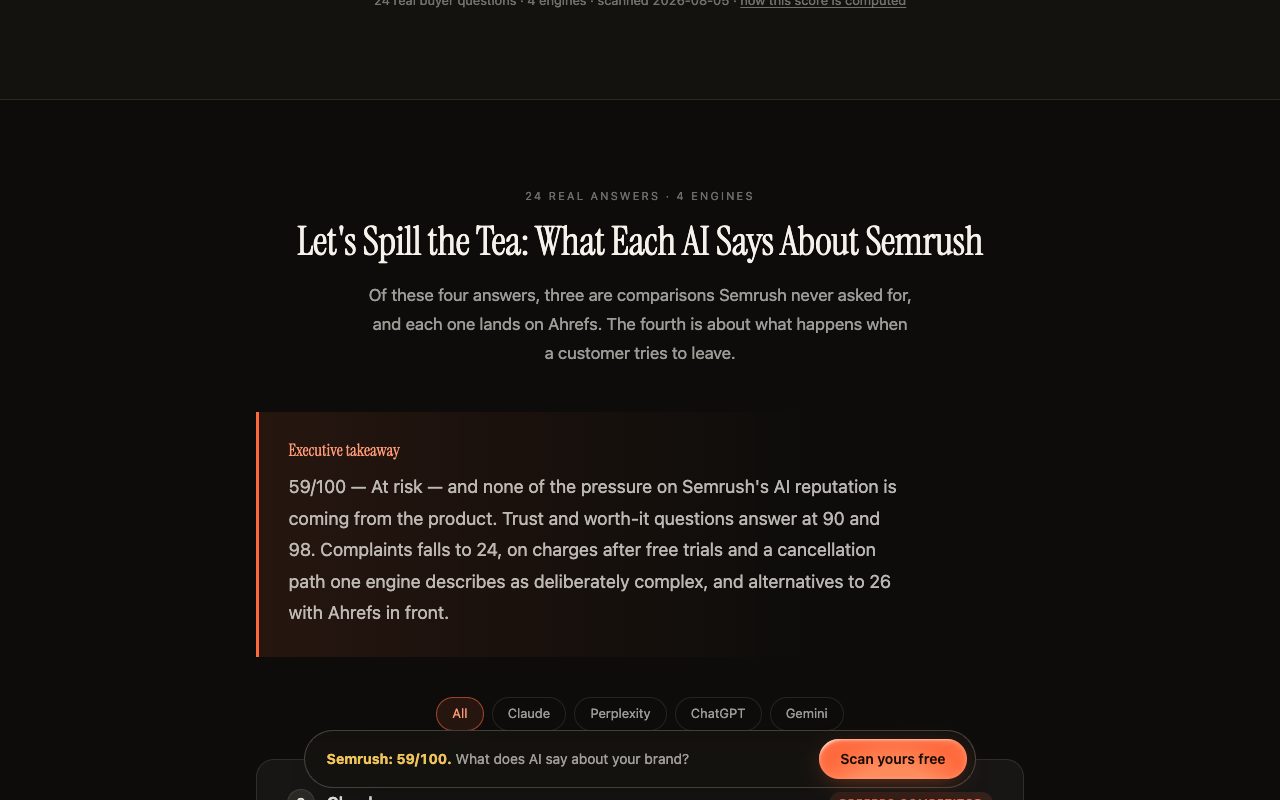
Why one number fails: in Kairosy's scan of Klaviyo (2026-08-05), ChatGPT named Omnisend as the preferred pick while Gemini pointed buyers to Mailchimp "due to its lower cost and simpler setup." A blended score of 56 shows none of that.
Which Three SOV Types Should You Track: Mention, Citation or Recommendation?
Track all three and never add them together. They measure different things and respond to different fixes.
| SOV type | Numerator | Denominator | What a low number means |
|---|---|---|---|
| Mention SOV | Answers in the prompt universe that name your brand | All answers in the prompt universe (per engine, per market) | The engine does not associate you with the category |
| Competitive mention share | Your brand mentions | All mentions of you plus every brand in the fixed competitor set | You are present but a rival owns the airtime |
| Citation SOV | Answers that cite at least one URL on a domain you own | All answers that cite any URL from you or the competitor set | Your pages are not usable as evidence |
| Recommendation SOV | Answers where you are the stated preferred pick | All answers that state a preference for any brand in the set | Buyers who ask "which one" are told someone else |
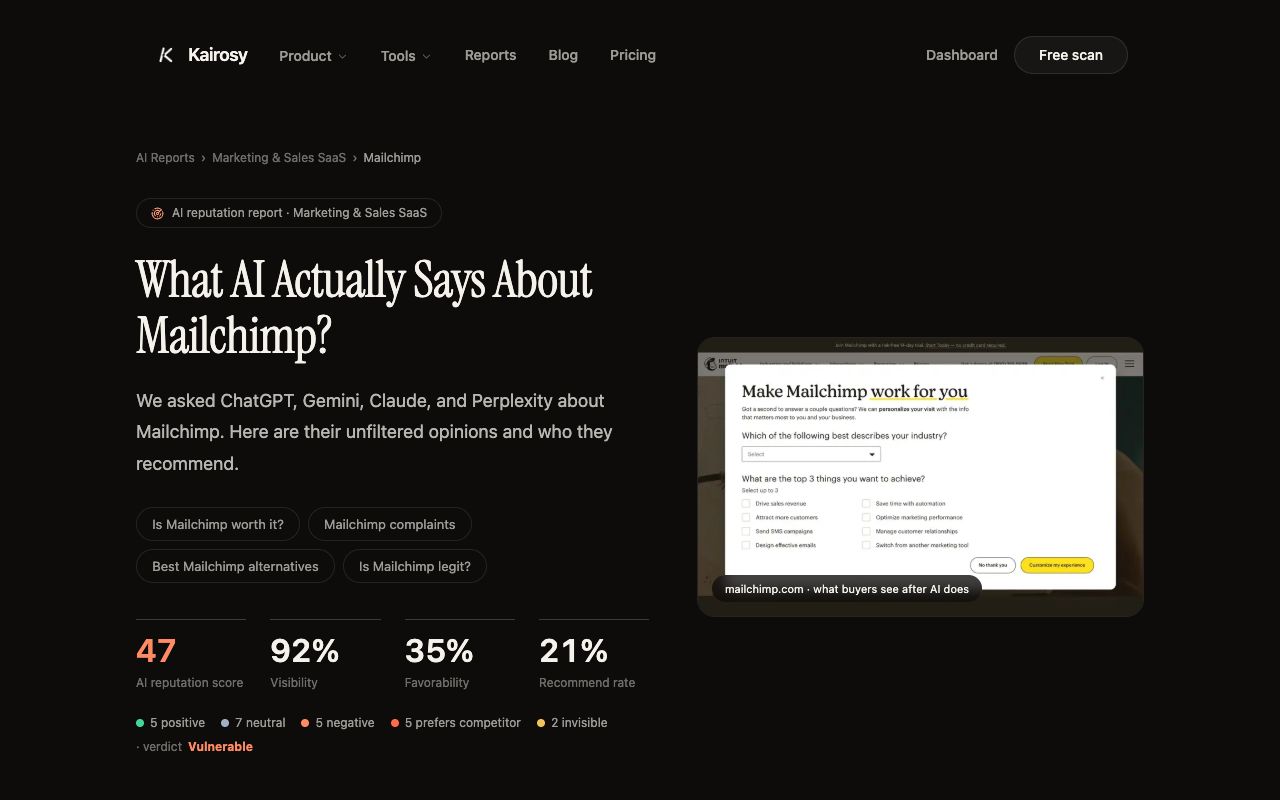
In Kairosy's scan of Mailchimp (2026-08-05) the brand posted 92% Visibility but a 21% Recommend rate, and the report's takeaway was that "Brevo is the answer three of the four engines give when a buyer asks what to use instead of Mailchimp."
Citation SOV is measured, not guessed, because the engines return their sources. OpenAI's docs state that "the model's response will include inline citations for URLs found in the web search results", Perplexity's API returns citations, "URLs of sources used to generate the response", and Gemini's docs describe annotations linking "parts of the response to their sources."
What Is the Right Denominator for AI Share of Voice for Enterprise?
The denominator makes or breaks AI share of voice for enterprise reporting. Three rules keep it honest.
Count answers, not prompts. One prompt sent to four engines is four answers. Kairosy's public reports state their base as "24 real answers · 4 engines" from six questions. Publish the count next to every percentage.
Do not let missing answers shrink the base silently. Divide by answers received instead of answers requested and a bad infrastructure day raises your SOV with nothing changing in the market. Report both.
Use a different denominator per SOV type, in writing. Mention SOV divides by all answers. Competitive share divides by all brand mentions in the fixed set. Recommendation SOV divides only by answers that state a preference, because a list of five tools with no pick is not a lost recommendation.
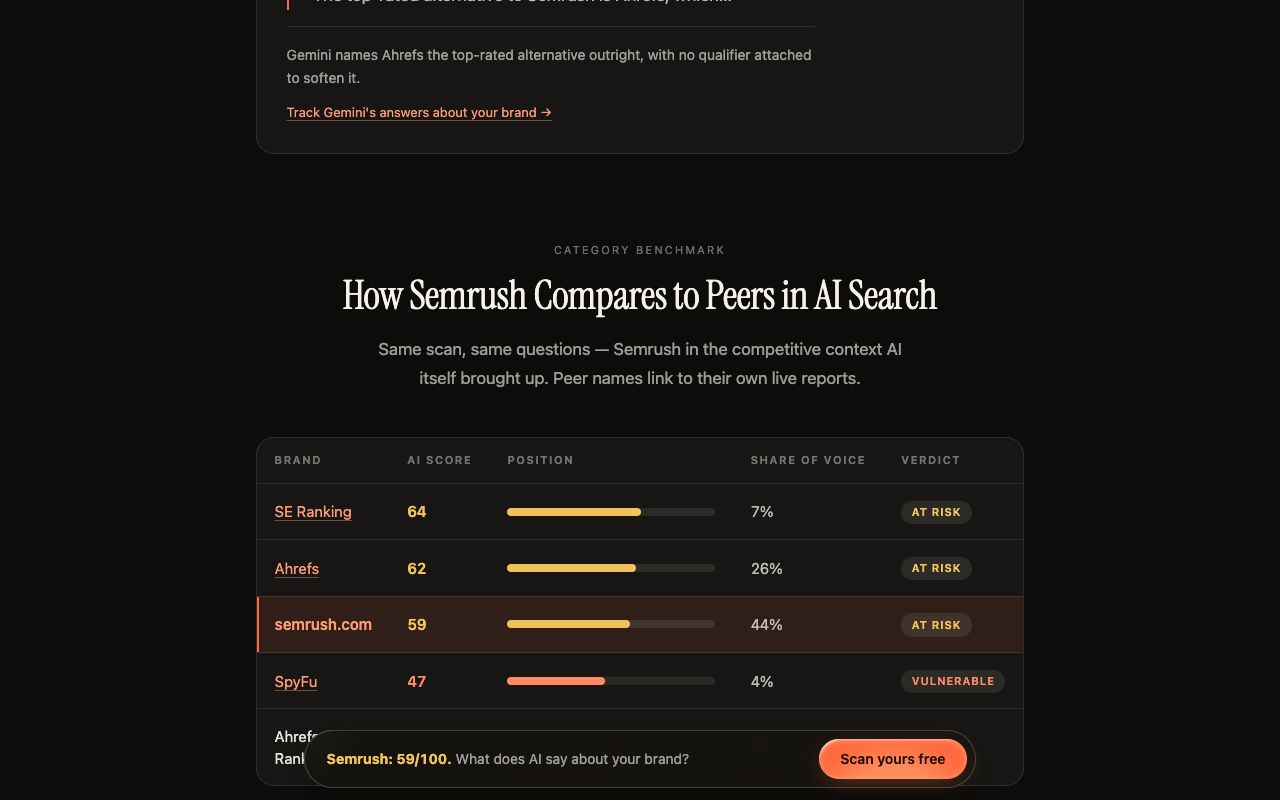
Fixed-denominator competitive share in practice, verbatim from the category benchmark tables of three Kairosy public reports (all scanned 2026-08-05, same four engines):
| Category scan | Brand | AI score | Share of voice | Verdict |
|---|---|---|---|---|
| Semrush report | Semrush | 59 | 44% | At risk |
| Semrush report | Ahrefs | 62 | 26% | At risk |
| Semrush report | SE Ranking | 64 | 7% | At risk |
| Semrush report | SpyFu | 47 | 4% | Vulnerable |
| Mailchimp report | Mailchimp | 47 | 26% | Vulnerable |
| Mailchimp report | Brevo | 56 | 21% | At risk |
| Mailchimp report | Omnisend | 61 | 6% | At risk |
| Mailchimp report | MailerLite | 62 | 5% | At risk |
| Zapier report | Zapier | 61 | 37% | At risk |
| Zapier report | Make | 62 | 16% | At risk |
| Zapier report | n8n | 75 | 6% | Healthy |
Read the Semrush row against its own headline metrics: 96% Visibility, 44% share of voice, 42% Recommend rate. Three denominators, three stories, and only the third is a revenue problem.
How Do You Build a Fixed Prompt Universe and Competitor Set That Survive Audit?
A trend is only meaningful if the prompts and the competitor list stay constant between measurements.
Prompt universe
Generate prompts from the dimension grid, not a brainstorm: for each product line, the questions a buyer asks at each funnel stage, in each persona's vocabulary, in each market's language. Version it. Additions go into the next version, never the running one, so quarter-over-quarter stays like-for-like.
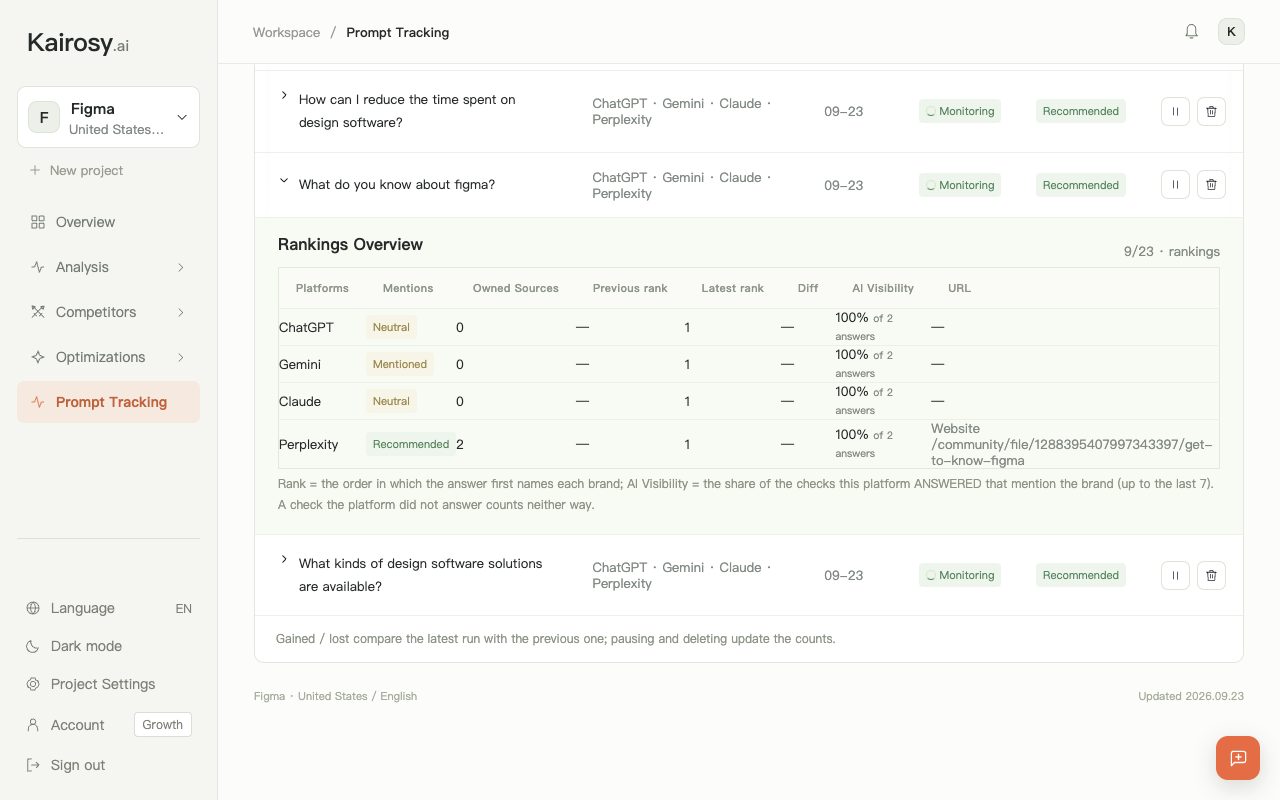
Recommendation wording shifts week to week, so pipeline-critical prompts need daily checks and the full universe weekly. As a reference point, Kairosy tracks 15, 28 or 70 prompts daily on Basic, Pro and Growth, with a weekly re-scan of each tracked brand-by-market project.
Competitor set
Fix the set per product line and market, then add one bucket called "other named brand" so surprises are counted without polluting the named rows. Kairosy's scan of Zapier surfaced n8n and Make as the engines' preferred alternatives, with Perplexity stating that "Make is the leading alternative to Zapier because it offers more visual control, deeper branching logic, and better cost efficiency."
Two exclusions are mandatory. Review platforms (G2, Trustpilot, Reddit) are named as places to check, not as competitors: count them as sources, never as brands in the denominator. And merge your parent company, subsidiaries and legacy product names into your row, or you will report a share-of-voice loss to yourself.
Why Does Enterprise Brand Share of Voice in AI Have to Be Measured Per Engine?
Because the engines do not share a source pool, and the pool moves. Profound's analysis of 680 million citations from August 2024 to June 2025 found Wikipedia leading ChatGPT's citations at 7.8% while Reddit led Perplexity's at 6.6% and Google AI Overviews' at 2.2%. Semrush's 13-week study of 230K prompts (July 14 to October 12, 2025) saw ChatGPT cite Reddit in "close to 60% of prompt responses in early August" before collapsing to around 10% by mid-September.
If your enterprise brand share of voice in AI is one blended line, a source-mix change inside one engine shows up as a mysterious wobble. Split by engine and the same event reads as "ChatGPT dropped Reddit, our Reddit-driven mentions fell on ChatGPT only, Perplexity unchanged."
Per-engine measurement also exposes disagreements: in Kairosy's Semrush scan, ChatGPT scored the brand 74 and Perplexity 45, a 29-point spread inside a headline of 59. The multi-LLM monitoring post covers why the engines disagree. For SOV the rule is that the unit of reporting is engine × market and the blended number is a footnote; an engine that dominates your buyers' research, for instance Perplexity in B2B, gets its own line.
How Should You Segment AI Share of Voice by Market, Persona and Funnel Stage?
Market. The engines localize on purpose. OpenAI's web search tool lets a caller "specify an approximate user location using country, city, region, and/or timezone", and Perplexity's API accepts a user_location with an ISO 3166-1 alpha-2 country code, city and region. Kairosy scans per market, Global plus 25 countries, and treats each brand × market pair as its own project with its own weekly re-scan and trend line.
Persona. Write the same question in three vocabularies: "best CRM for a sales team of 50" (sales leader), "CRM with the best REST API and webhooks" (developer), "CRM total cost of ownership at 500 seats" (procurement).
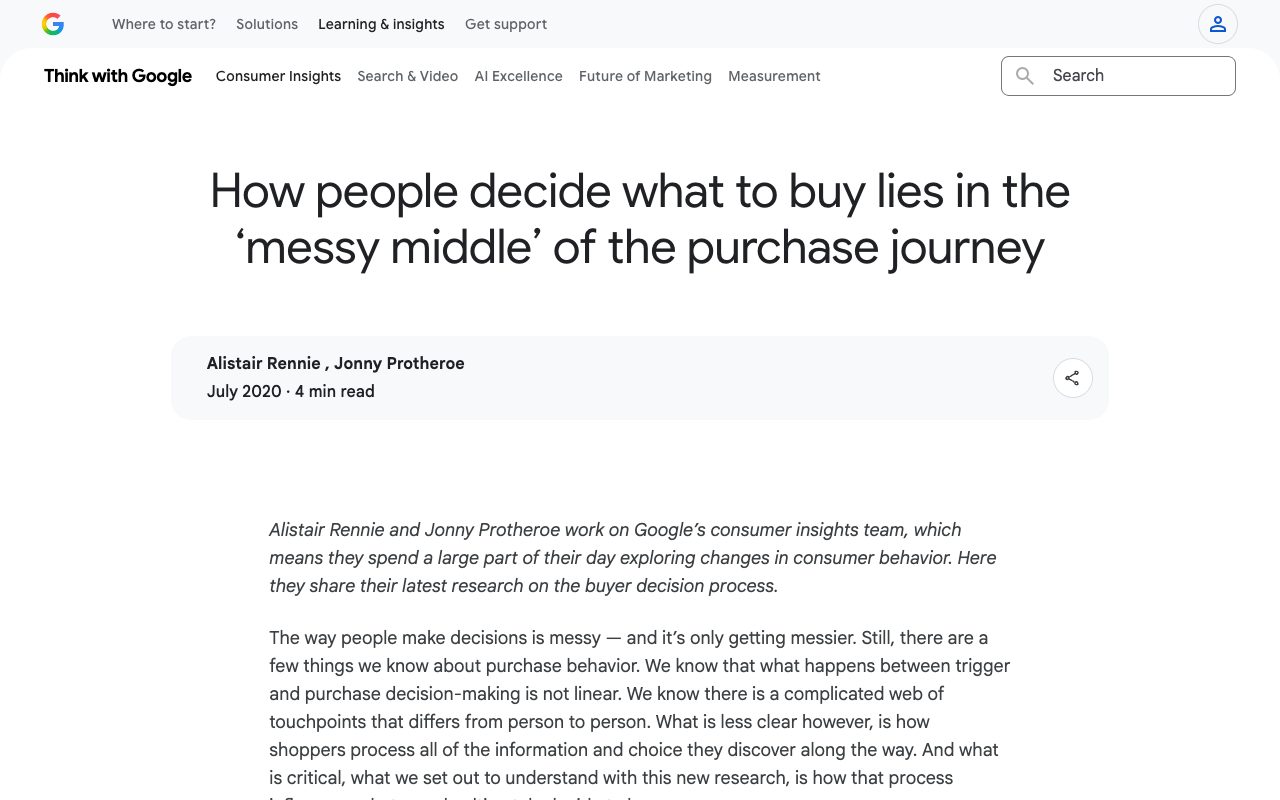
Funnel stage. Google's research on the "messy middle" describes buyers cycling between "exploration, an expansive activity, and evaluation, a reductive activity." Map prompts to both modes plus post-purchase. Recommendation SOV at the evaluation stage is the number closest to pipeline.
| Funnel stage | Example prompt (persona) | Market variants | Measured per engine | Primary SOV type |
|---|---|---|---|---|
| Awareness / exploration | "What is customer data platform software?" (marketing lead) | US, UK, DE, JP | ChatGPT · Gemini · Claude · Perplexity | Mention SOV |
| Consideration / evaluation | "Best CDP for a retailer with 2M customers" (CMO) | US, UK, DE, JP | ChatGPT · Gemini · Claude · Perplexity | Recommendation SOV |
| Decision / evaluation | "Does [brand] have a real-time API?" (developer) | US, UK, DE, JP | ChatGPT · Gemini · Claude · Perplexity | Citation SOV |
| Retention / re-evaluation | "[Brand] complaints and alternatives" (procurement) | US, UK, DE, JP | ChatGPT · Gemini · Claude · Perplexity | Recommendation SOV (defensive) |
How Do You Report Enterprise AI Share of Voice and Read the Trend Honestly?
The report has a fixed shape: one engine × market grid per SOV type, the answer count in every cell, the prompt-universe and competitor-set versions in the header. Four reading rules keep the trend from lying:
- Compare only cells with the same prompt version, engine set and market. A new prompt batch starts a new series.
- Set a minimum answer count before a movement counts.
- Watch received versus requested answers alongside the share.
- Pair every cell with a sentiment reading. Mention SOV can rise because a scandal is being discussed.
The IPA-databank work by Les Binet and Peter Field, summarized by LinkedIn's B2B Institute, holds that "in B2B, brands that set their share of voice (SOV) above their share of market (SOM) tend to grow." The AI analogue: put recommendation SOV per market next to revenue share in that market. Cells where AI share sits well below market share are where competitors are taking your renewals. The AI search analytics guide covers feeding these cells into a wider reporting stack.
Which Actions Move Enterprise AI Share of Voice, and How Do You Keep Monitoring It?
Each SOV type points at its own lever, which is the practical reason to keep them apart.
- Low mention SOV is an association problem: the engines do not connect you to the category. The fix is third-party presence, category listings, comparison coverage and localized pages.
- Low citation SOV is a page problem. Check crawl access with the AI crawl checker, then run an AI-ready page audit on the pages you want cited (33 checks across access, readability, structured data, citability and trust). The Princeton-led GEO paper on arXiv reports that "GEO can boost visibility by up to 40% in generative engine responses".
- Low recommendation SOV is a narrative problem. In Kairosy's Semrush scan the engines' objections were about billing and cancellation, not the product. Rebutting those on the pages the engines already cite moves the recommendation cell faster than awareness spend.
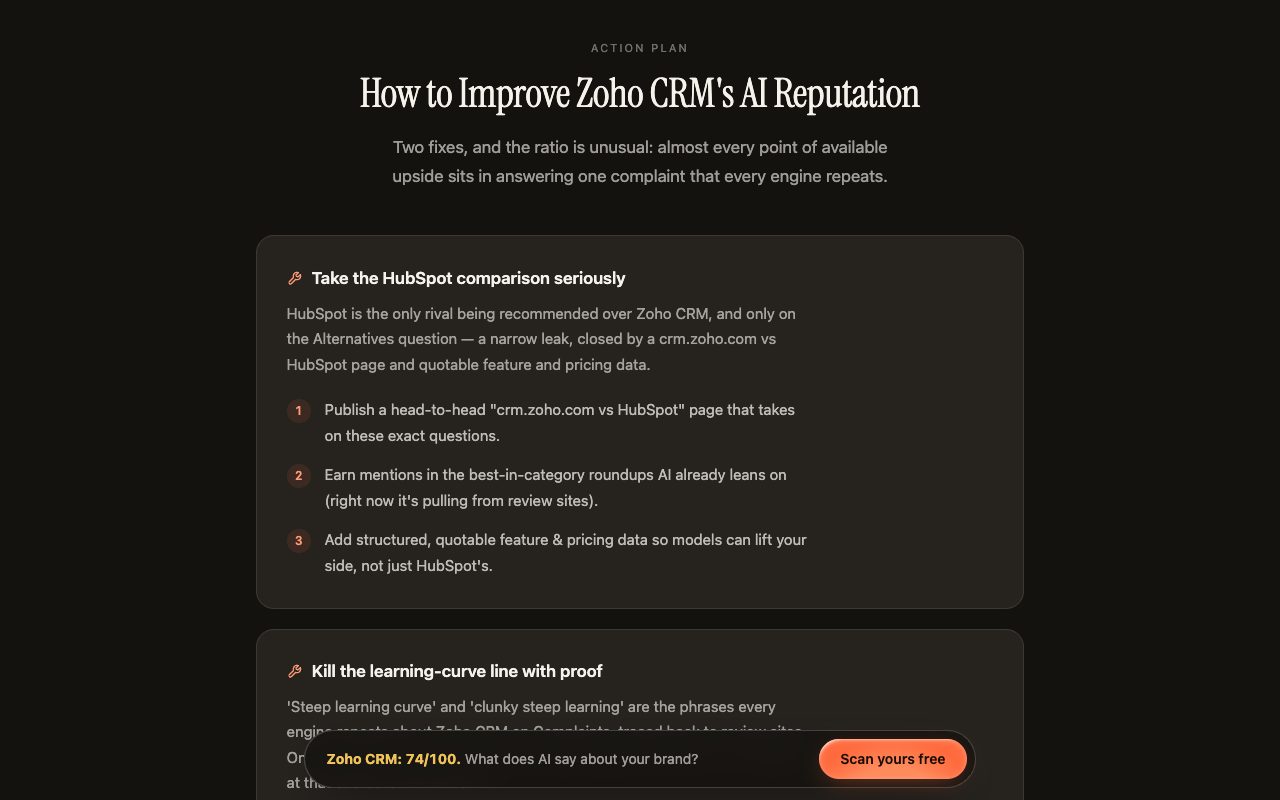
Monitoring closes the loop: a weekly re-scan of every brand × market project, daily checks on pipeline prompts, and alerts on four events, a competitor becoming the preferred pick, a score drop, an engine flipping sentiment and new negative keywords. Kairosy's AI brand monitoring runs that cadence with 3, 6 or 20 tracking slots by plan, each slot one brand in one market, and attaches a prioritized Fix Plan to every report. See AI brand awareness for the funnel side.
Enterprise AI Share of Voice FAQs
What is a good enterprise AI share of voice?
There is no universal benchmark; it depends on the size of your competitor set and the denominator. In Kairosy's 2026-08-05 category scans, the leading brand held 37% to 44% of mentions in three software categories, with the runner-up at 16% to 26%.
How is brand share of voice in AI different from advertising share of voice?
Advertising SOV, as Wikipedia defines it, "measures the percentage of media spending by a company compared to the total media expenditure for the product, service, or category." Brand share of voice in AI measures presence in answers, not spend, and cannot be bought directly.
How many prompts do you need for AI share of voice for enterprise?
Enough to fill the segmentation grid with a defensible count per cell. One product line, four markets, three personas and four stages is 48 base prompts, times four engines, times repeated runs.
Should review sites count as competitors in the denominator?
No. G2, Trustpilot, Capterra and Reddit are named as places to verify, not alternatives to buy. Treat them as citation sources.
How often should enterprise brand share of voice in AI be measured?
Weekly for the full universe per market, daily for pipeline prompts, always on the same prompt version. Engine source mixes shift within a month, so a quarterly reading reports the effect and misses the cause.
See what AI says about your brand
Run a free scan across ChatGPT, Gemini, Claude & Perplexity in about 30 seconds.
Run my free scan