GEO Implementation Guide for Technical Teams (2026 Playbook)
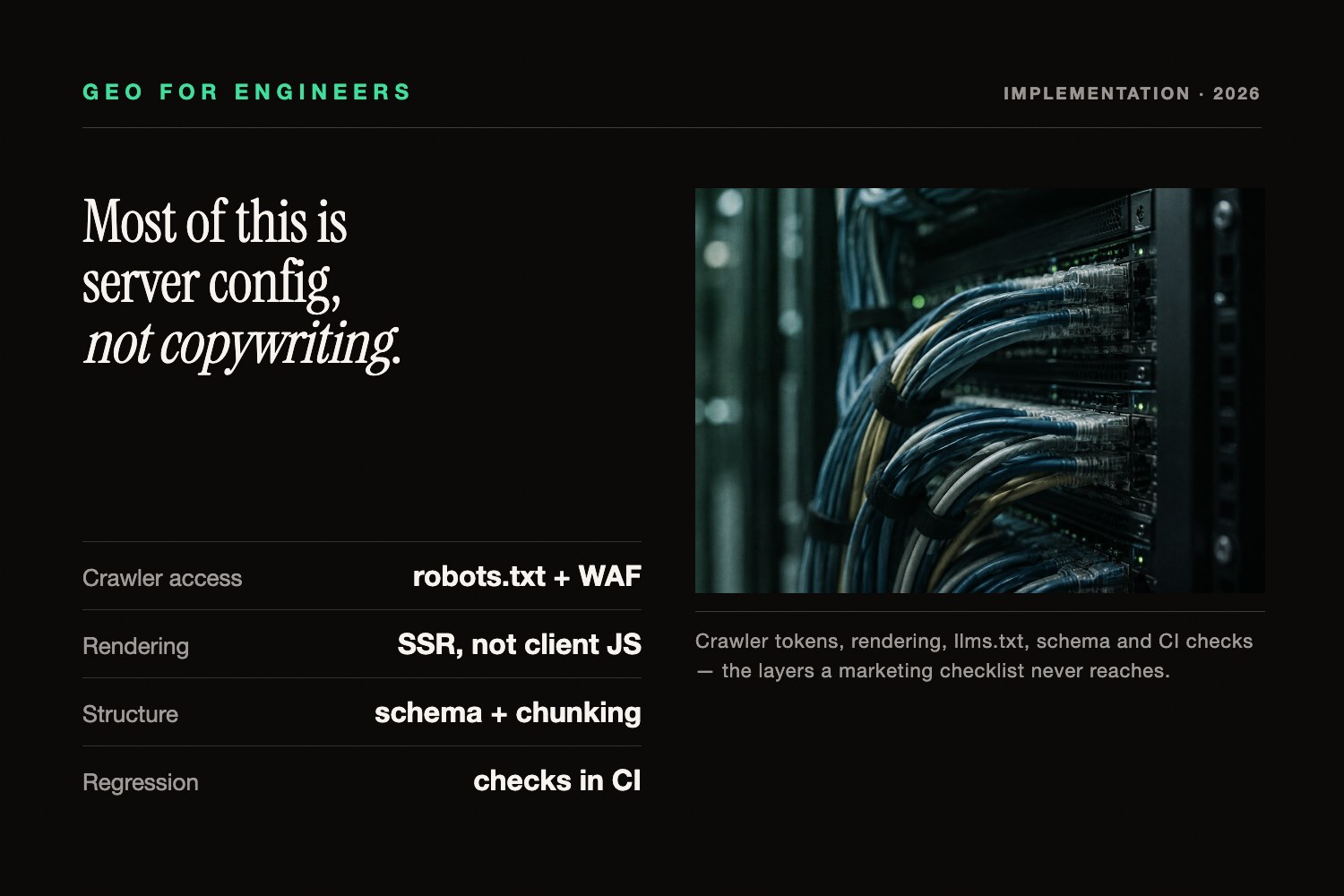
Most GEO advice is aimed at marketers. This one is aimed at whoever owns robots.txt, the CDN config, and the render pipeline — because that is where answer-engine visibility is usually lost, long before anyone rewrites a headline.
The short version: answer engines fetch your raw HTML from user agents your WAF has probably never been told about, and most of them never run your JavaScript. Fix access, then rendering, then structure, then measurement, in that order.
This geo implementation guide for technical teams gives you the four-week sequence, a checklist to ship against, and a free verification step at every stage.
What Does a GEO Implementation Guide for Technical Teams Cover?
Generative engine optimization is the work of making a site readable, quotable, and attributable by systems that summarize instead of link. If you want the concept-level background first, our explainer on what GEO is covers it. This post is the build ticket, not the theory.
Five technical GEO elements carry nearly all the weight:
- Access — can each engine's crawler reach the page at all?
- Rendering — does the answer exist in the HTTP response, or only after hydration?
- Semantics — is there valid JSON-LD naming your entity, product, and facts?
- Chunking — can a retriever lift one self-contained passage that answers one question?
- Measurement — do you have a repeatable read on whether any of it moved?
Diagnosis is a separate job from delivery. If nobody has mapped current state yet, read how to conduct a GEO audit first and come back with a findings list. Everything below assumes you already know what is broken and now need it shipped.
How Do You Give AI Crawlers Server-Level Access?
Start in robots.txt and name the bots explicitly. A blanket User-agent: * rule is not enough once a security team has added a deny list downstream, and the tokens are not interchangeable — OpenAI alone documents four.
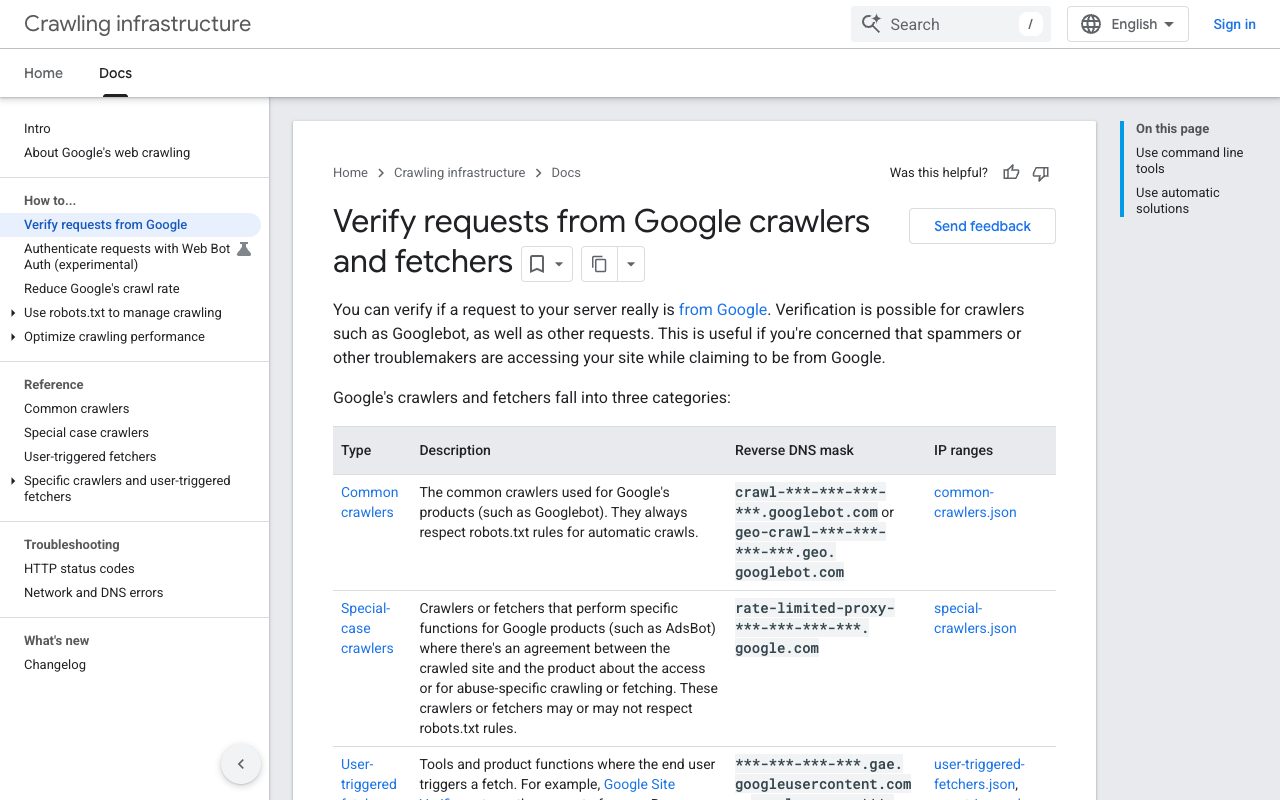
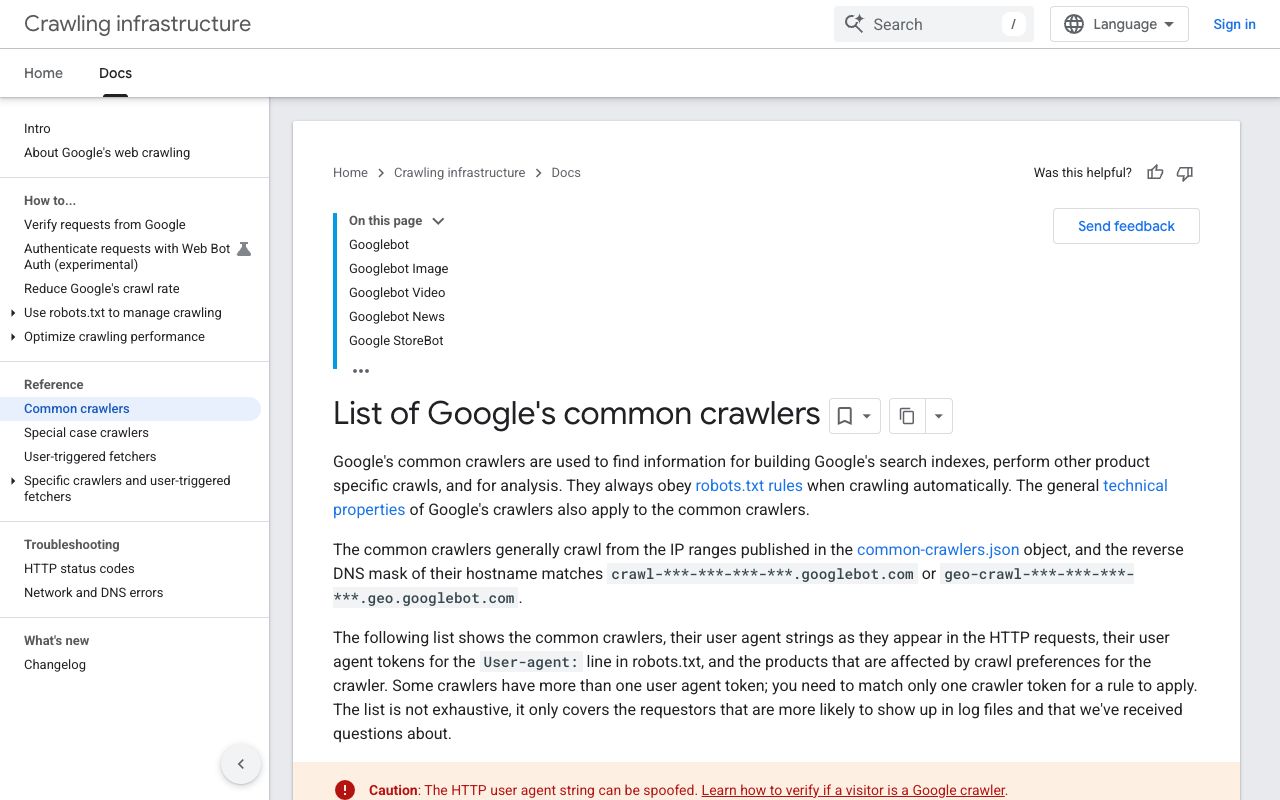
Every operator publishes both the token and a JSON file of authorized IP ranges, which is how you verify a hit is genuine rather than spoofed. Google's crawler documentation warns directly that the HTTP user agent string can be forged, so reverse-DNS or IP matching is the only trustworthy check.
| Token | Operator | Job | What blocking it costs you |
|---|---|---|---|
| GPTBot | OpenAI | Crawls content for foundation-model training | Training inclusion only |
| OAI-SearchBot | OpenAI | Powers ChatGPT's search surface | Appearing in ChatGPT search answers |
| ChatGPT-User | OpenAI | User-initiated page visits from ChatGPT and custom GPTs | Live fetches when someone asks about you |
| ClaudeBot | Anthropic | Collects web content for model training | Future training sets |
| Claude-SearchBot | Anthropic | Improves Claude's search result quality | Claude search visibility |
| Claude-User | Anthropic | Fetches pages to answer a user's question | Real-time answers about your brand |
| PerplexityBot | Perplexity | Indexes pages to surface and link them in results | Perplexity citations |
| Perplexity-User | Perplexity | User-triggered fetch, generally ignores robots.txt | Little, since the rule is often skipped |
| Google-Extended | Gates Gemini training and grounding use | Gemini grounding, not Search ranking |
Sources: OpenAI's bot documentation, Anthropic's crawler support article, Perplexity's bot guide, and Google's common crawlers reference.
Two rules fall out of that table. Blocking the training crawlers is a licensing decision with no direct visibility cost — Google states plainly that Google-Extended is not a Search ranking signal. Blocking the retrieval crawlers removes you from the answers themselves. Teams that paste a "block all AI" snippet from a forum thread almost always do the second by accident.
Which CDN and bot-management rules silently break GEO?
robots.txt can be perfect while the edge returns 403. Managed challenges, rate limits, geo-fencing, and "block unknown bots" rules all fire before your origin sees the request, and none of them show up in a robots.txt review.
Cloudflare's July 1, 2026 announcement replaced the old single "block AI bots" toggle with three independent controls — Search, Agent, and Training — and set new defaults taking effect September 15, 2026, under which Training and Agent crawlers are blocked by default on pages that display ads while Search crawlers stay allowed. If your marketing site runs ads anywhere, read that default carefully before it lands.
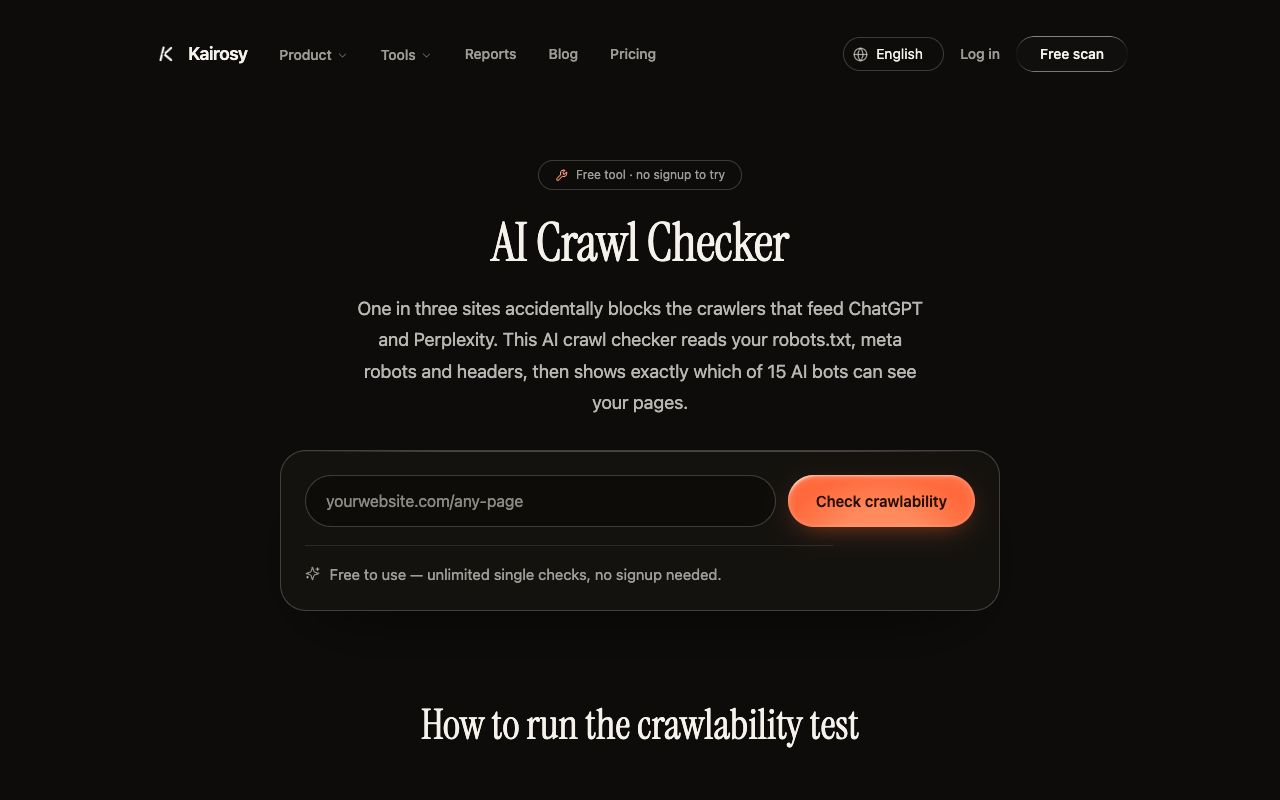
Verify from outside your network, not from a laptop on the office VPN. Send a request with each token as the user agent and compare status codes, then confirm the same result at page level with the free AI crawl checker, which reads robots.txt, meta robots, and X-Robots-Tag headers together and tells you which rule is doing the blocking.
Why Does JavaScript Rendering Break GEO, and How Do You Fix It?
This is the single most expensive bug on the list, and it is invisible in a browser. Vercel's analysis with MERJ, published December 17, 2024, found that OpenAI's bots, Anthropic's ClaudeBot, PerplexityBot, Meta-ExternalAgent, and Bytespider do not execute JavaScript at all. Only Google's Gemini crawling, which rides on Googlebot infrastructure, and AppleBot render it.
They still download script files — 11.50% of ChatGPT's fetches and 23.84% of Claude's were JavaScript assets in that dataset — they just never run them. Volume-wise this is not a rounding error: GPTBot made 569 million fetches across Vercel's network that month, Claude 370 million, and PerplexityBot 24.4 million.
The test takes thirty seconds. Fetch the page with a crawler user agent and no browser, then search the response body for the sentence you most want quoted:
curl -A "Mozilla/5.0 (compatible; OAI-SearchBot/1.4; +https://openai.com/searchbot)" \
     -s https://example.com/pricing | grep -i "starts at"
If it is missing, it does not exist as far as three of the four major engines are concerned. Practical fixes, in order of payback:
- Server-render or statically generate any page carrying facts you want cited, especially pricing and comparison pages.
- Move specs, prices, and feature grids out of client-only tabs and accordions into the initial HTML, hidden with CSS if you must.
- Stop lazy-loading body copy on scroll, since there is no scroll event in a crawler fetch.
- Fix dead internal links, because the same study saw ChatGPT spending 34.82% of its fetches on 404 pages and Claude 34.16%.
That 404 number is worth a sprint on its own. Run your sitemap through the redirect checker and kill the chains before you spend anything on content.
Is llms.txt Worth Implementing in 2026?
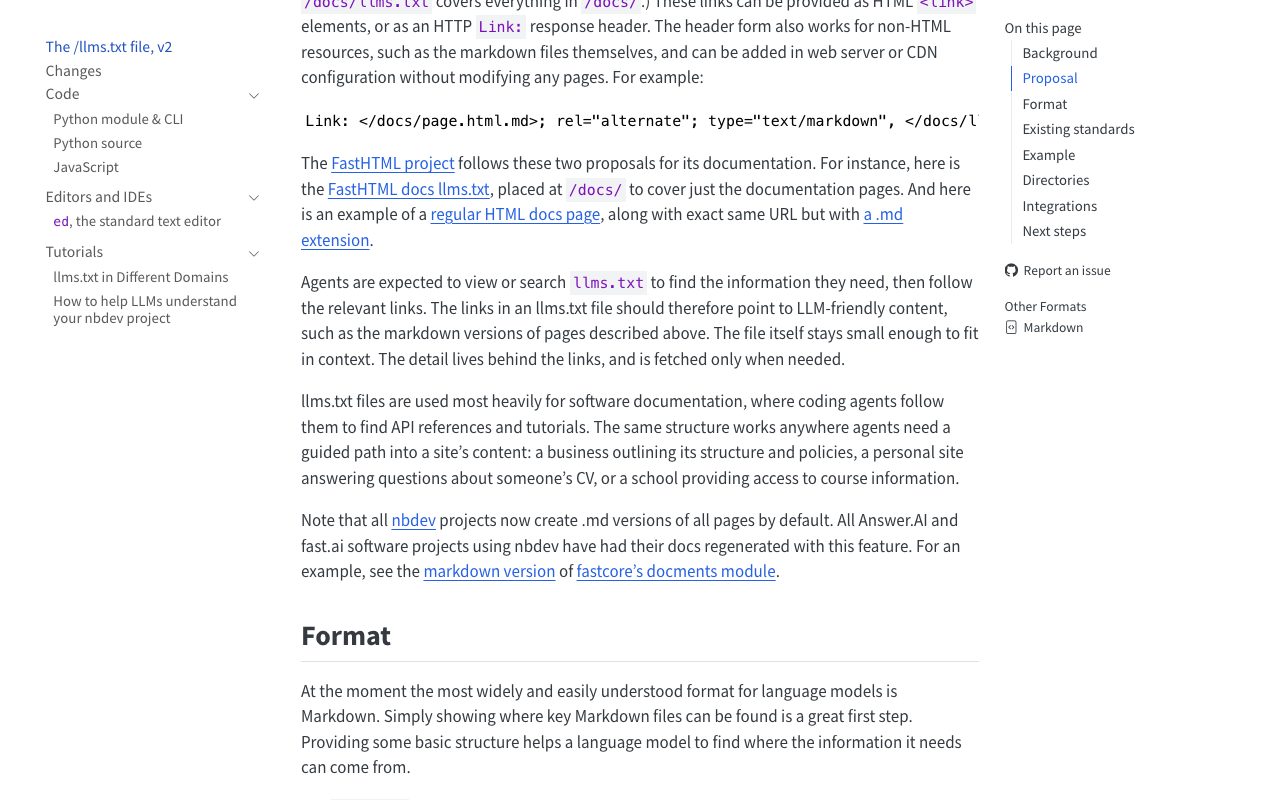
Ship it, but budget it as an afternoon, not a quarter. The llms.txt spec, proposed by Jeremy Howard on September 3, 2024, defines a markdown file at /llms.txt containing an H1 with the project name, a blockquote summary, optional prose, and H2-delimited sections of markdown link lists. It is trivially cheap to produce and it cannot hurt you.
The honest counterweight: an Ahrefs study published June 15, 2026 checked 137,210 domains, found 38,360 serving a valid llms.txt, and reported that 97% of those files received zero requests during May 2026. Google is blunter still. Its AI features documentation, last updated December 10, 2025, says:
You don't need to create new machine readable files, AI text files, or markup to appear in these features.
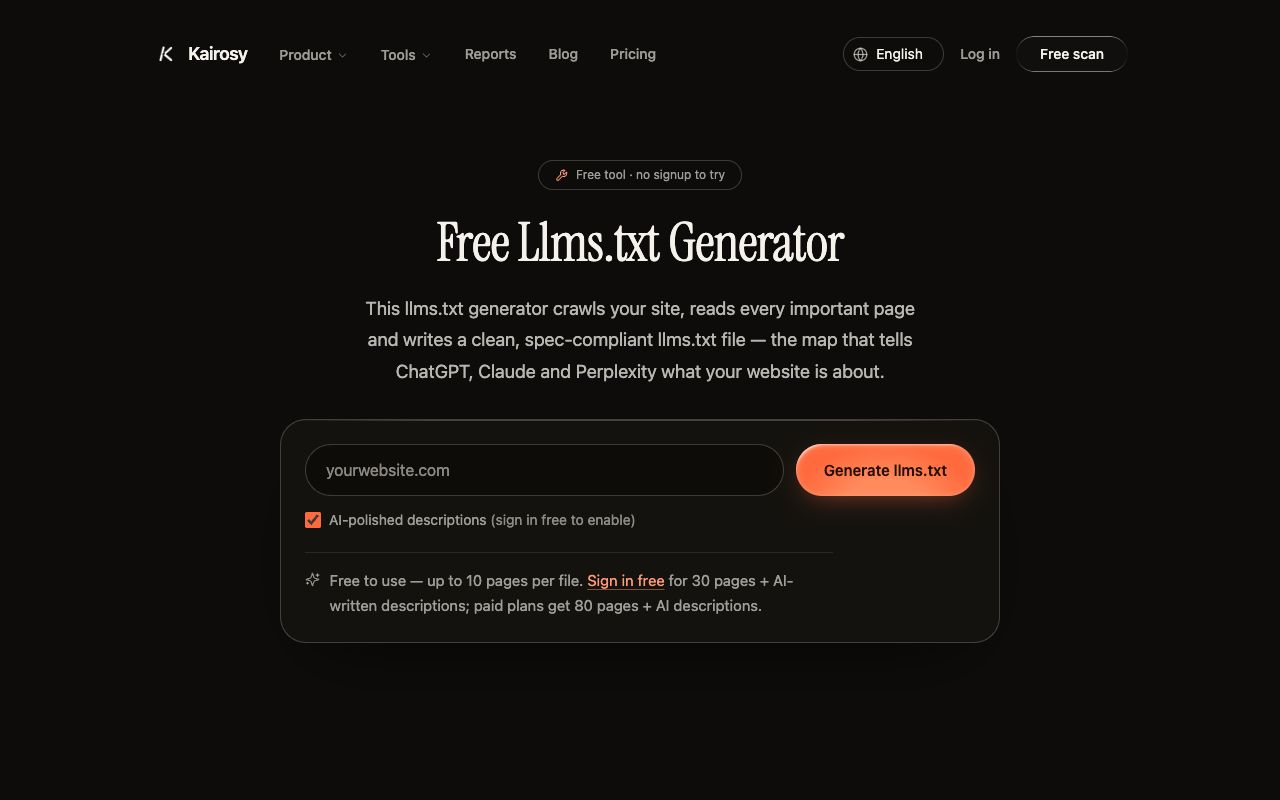
So treat it as a low-cost bet on future retrieval behavior, not as a lever. Generate one with the free llms.txt generator, then run the output through the llms.txt validator so you are not shipping a file that breaks the spec on the one day a crawler decides to read it.
How Do You Implement Structured Data and Content Chunking?
Structured data does two jobs here. It disambiguates your entity for models that have to decide whether "Apollo" is your company or a Greek god, and it hands retrievers clean field-value pairs instead of prose they have to parse.
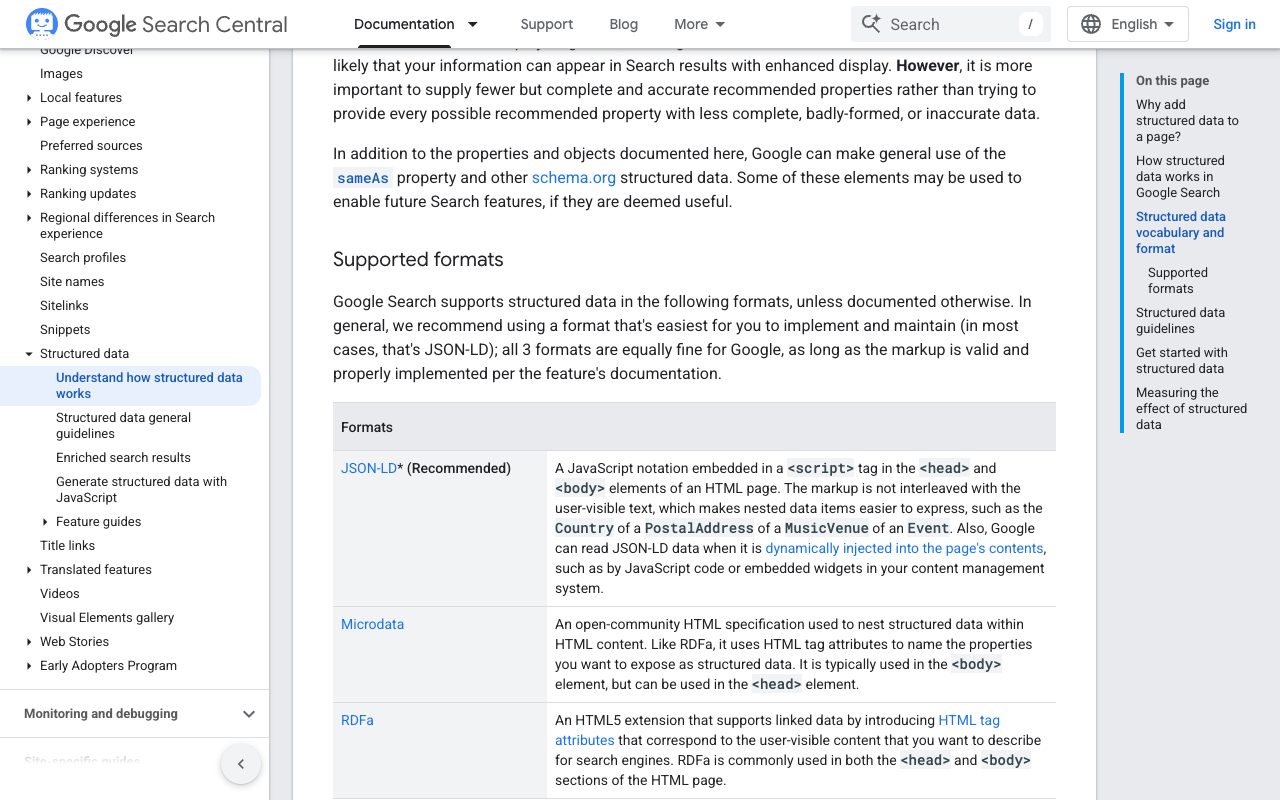
Google recommends JSON-LD over microdata and RDFa because it is easiest to maintain at scale. Ship Organization with a full sameAs array pointing at your LinkedIn, Crunchbase, G2, and Wikipedia entries, plus Product or SoftwareApplication with real offers, and FAQPage where the questions are genuine. Group them in an @graph so entities cross-reference by @id instead of repeating.
Validate in the build, not by eye. Use the Schema.org validator for spec conformance, Google's Rich Results Test for feature eligibility, and the free schema markup checker for a fast field-level pass across 21 types on a live URL.
Chunking is the half most engineering teams skip. Retrievers score passages, not pages, so structure the DOM to produce clean passages:
- One question per heading, phrased the way a buyer would type it.
- The answer in the first 40 to 60 words under that heading, before any setup.
- Self-contained paragraphs with no "as mentioned above" back-references.
- Real
tablemarkup for specs and pricing rather than styled lists. - Named, dated sources inline, since the Princeton GEO paper presented at KDD 2024 found that adding citations, quotations, and statistics lifted visibility in generative responses by up to 40%.
How Do You Sequence an Enterprise GEO Implementation Plan?
An enterprise geo implementation plan fails when it starts with content. Content changes are slow, political, and unmeasurable until the plumbing is fixed. Sequence it the other way:
- Week 1 — access. Audit robots.txt across every subdomain, pull 30 days of logs filtered to the nine tokens above, and open tickets for every 403, 429, and challenge response. Deliverable: each retrieval crawler returns 200 on your top 50 URLs.
- Week 2 — rendering. Run the curl test against the top 50 URLs and diff the raw HTML against the hydrated DOM. Deliverable: every fact you want quoted appears in the initial response.
- Week 3 — semantics and chunking. Ship the
@graph, fix headings to question form, and front-load answers. Deliverable: zero validator errors and a heading map reviewed by whoever owns the messaging. - Week 4 — measurement. Wire the CI checks below, stand up a bot-traffic dashboard, and capture a baseline of what the engines currently say about you. Deliverable: a repeatable weekly number.
At enterprise scale add two weeks: one for multi-domain and localized properties, where robots.txt and CDN rules are usually inconsistent per region, and one for legal sign-off on which training crawlers you actually want to allow. If you would rather have the week-one findings handed to you, the AI-ready audit covers the access and rendering layers in a single pass.
Which Items Belong on a GEO Implementation Checklist?
Keep the geo implementation checklist in the repo next to the deploy runbook, and make each row provable by a command or a URL rather than an opinion.
| Layer | Check | How to verify | Pass condition |
|---|---|---|---|
| Access | Retrieval bots allowed in robots.txt | Fetch /robots.txt, grep each token | No Disallow on OAI-SearchBot, Claude-SearchBot, PerplexityBot |
| Access | Edge does not challenge AI user agents | curl with each UA from off-network | HTTP 200, not 403 or 429 |
| Access | Sitemap declared and reachable | Sitemap line in robots.txt, then fetch it | 200 and valid XML |
| Rendering | Key facts in the initial HTML | curl the URL, grep the target sentence | Match found without JS |
| Rendering | Internal links resolve | Crawl sitemap URLs, log status codes | Under 1% 404s |
| Semantics | JSON-LD parses and validates | Schema.org validator plus Rich Results Test | Zero errors on templates |
| Semantics | Entity identity is consistent | Compare Organization name and sameAs to live profiles | All URLs live and matching |
| Chunking | Headings are questions with front-loaded answers | Manual review of top 50 pages | Answer within 60 words of the heading |
| Access | llms.txt served and spec-valid | Fetch /llms.txt, run the validator | 200 and no structural errors |
| Measurement | AI bot hits visible in logs | Filter 30 days of logs by token | Non-zero hits from at least three operators |
What Are the Best Technical GEO Tips for Monitoring in CI?
The best technical GEO tips are the boring ones that stop regressions, because every item above can be undone by a routine deploy. A framework upgrade flips a page to client rendering, a security ticket adds a bot rule, a CMS migration drops the JSON-LD block. Nobody notices for a quarter.
Add these as build or smoke tests:
- Snapshot-test robots.txt and fail the build on any unreviewed diff.
- Fetch three representative URLs with a crawler user agent and assert a known string appears in the raw response.
- Parse every JSON-LD block in the built output and fail on invalid JSON or a missing required field.
- Assert /llms.txt and /sitemap.xml both return 200 after deploy.
- Alert when weekly AI-bot log hits drop more than 50% week over week, which usually means an edge rule, not a crawler policy change.
One expectation to set with stakeholders early: this work will not show up in your analytics as traffic. Cloudflare's crawl-to-refer data from August 29, 2025 put Anthropic's ratio at 38,065 pages crawled per referral in July 2025 and OpenAI's at 1,091, against Google's 5.4. Clicks are the wrong success metric. What you can measure is whether the engines mention you, how they characterize you, and who they name instead.
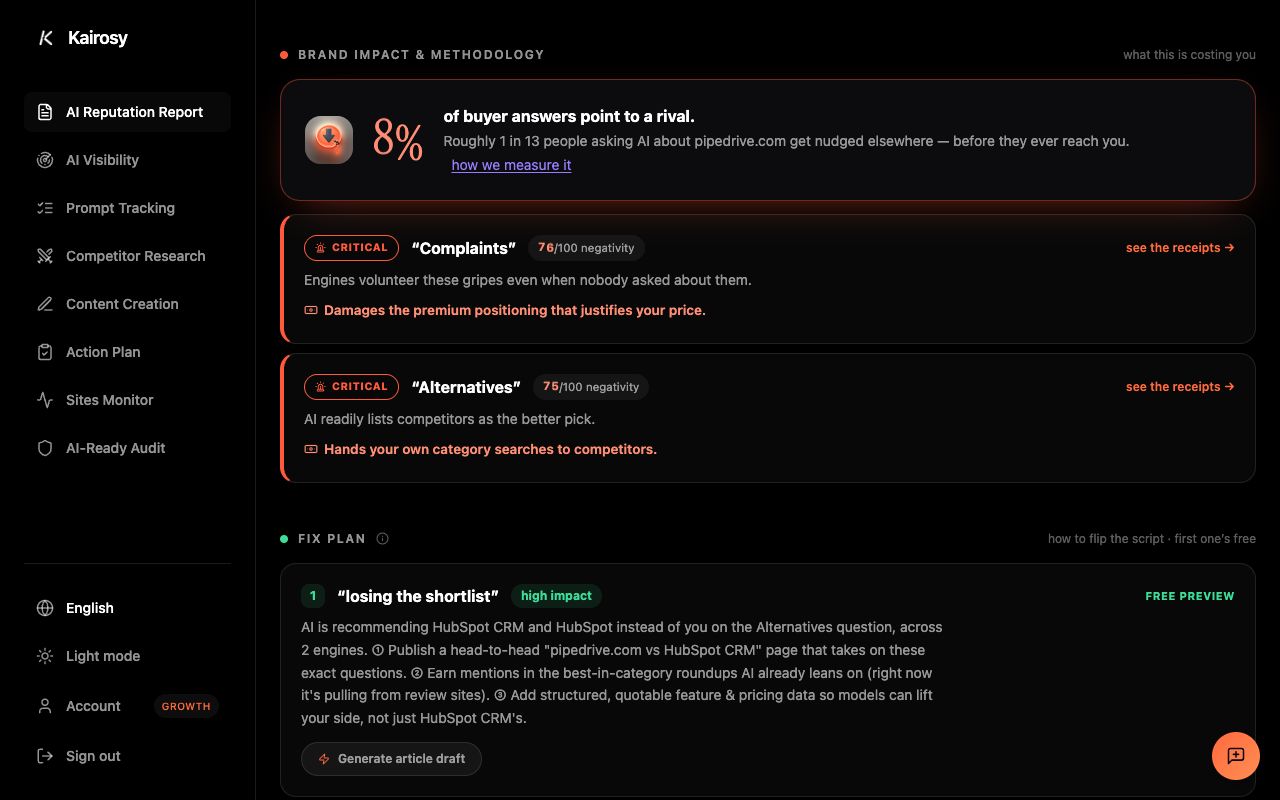
That distinction matters more than access alone. Kairosy's scan of Smartsheet returned 100% visibility — every engine mentioned it — but only 58% favorability and a 66/100 result, with several engines steering the buyer to monday.com and Asana. Perfect crawlability, losing answer. Rolling that into a single GEO score is fine for a status page, as long as the inputs behind it stay stable; the GEO audit guide covers how those inputs are built.
Which Free Tools Belong in a Technical GEO Toolchain?
You can cover the whole implementation with free tooling and one paid measurement layer.
- Access: the AI crawl checker for robots, meta, and header rules in one pass, plus your own server logs for ground truth.
- Rendering: curl with a crawler user agent, and the index checker to confirm the page is indexed at all.
- Semantics: the schema markup checker for field-level warnings, the Schema.org validator for conformance.
- Retrieval hints: the llms.txt generator and validator.
- Outcome: a scanner that queries ChatGPT, Gemini, Claude, and Perplexity with the questions your buyers ask and scores what comes back.
Kairosy is the last item only. It is an AI visibility and reputation scanner, not a crawler, rank tracker, or backlink tool — it runs the questions, classifies sentiment per engine, records the sources each answer cited, and produces a fix list. The first 7 days are free, with paid plans from $29 for weekly rescans and prompt tracking. Together with the free tools above, that closes the loop: reachable, renderable, structured, and verified against what the engines say.
GEO Implementation Guide for Technical Teams FAQs
Do AI crawlers execute JavaScript?
Mostly no. Vercel and MERJ's December 2024 analysis found no JavaScript execution from OpenAI's bots, ClaudeBot, PerplexityBot, Meta-ExternalAgent, or Bytespider. Google's Gemini crawling and AppleBot are the exceptions, both riding on infrastructure that already rendered pages for search.
Should you block GPTBot if you want ChatGPT to recommend you?
No — and blocking it does not do what most people assume. GPTBot is the training crawler. The bot that fetches pages for ChatGPT's search answers is OAI-SearchBot, and ChatGPT-User handles live user-initiated visits. Blocking GPTBot alone is a training-data decision, but a careless wildcard rule can catch all three.
How long does an enterprise GEO implementation plan take?
Four weeks for a single domain if access and rendering fixes can get into a normal sprint, and six for multi-domain or localized estates where robots.txt and CDN rules differ per region. The content work continues after that, but it is wasted effort until the technical layers pass.
Does llms.txt affect Google rankings?
No. Google's AI features documentation states you do not need new machine-readable files, AI text files, or markup to appear in its AI surfaces, and no schema is required either. Ship llms.txt as an inexpensive hedge on other engines, not as an SEO tactic.
What is the fastest way to confirm AI crawlers can reach your site?
Two steps, about five minutes. Run your homepage and two money pages through a crawl checker that reads robots.txt, meta robots, and X-Robots-Tag together, then grep 30 days of access logs for the crawler tokens. Hits from at least three operators means access genuinely works, not just theoretically.
See what AI says about your brand
Run a free scan across ChatGPT, Gemini, Claude & Perplexity in about 30 seconds.
Run my free scan