Google AIO Monitoring: How to Track AI Overviews in 2026
An AI Overview (AIO) is the AI-written summary block at the top of an ordinary Google results page. AI Mode is the separate conversational tab you switch into. Same technology family, two different surfaces — this guide covers the summary block, and if you need the other one, start with our rundown of AI Mode trackers.
Google AIO monitoring means checking, on a repeating schedule, whether your target queries produce an AI Overview and whether your pages are among the links that summary cites. It is not rank tracking. There is no "position 4" inside an AI Overview — your URL is either attached to it or it isn't.
Below: how unstable this surface really is, what Search Console gives you today, seven tools priced as of August 2026, and a manual method that costs nothing.
What Does Google AIO Monitoring Actually Track?
Three different measurements hide behind the same phrase, and most of the confusion in this category comes from mixing them together.
- Trigger rate — the share of your tracked keywords that produce an AI Overview at all. This number moves whether or not you touch your site.
- Citation — whether your domain is one of the source links attached to that summary.
- Competitive share — how your citation count stacks up against named rivals on the same keyword list.
Only the second is under your direct influence, and even that is filtered through the first: a keyword you "won" last month can vanish from your report because Google stopped generating a summary for it.
One quirk to know before reading any vendor dashboard: Semrush's documentation states that when your domain is cited in an AI Overview, Position Tracking records it as a #1 ranking — regardless of where the page sits in the blue links underneath. Reasonable modeling, but it inflates your average-position chart unless you segment AIO keywords out.
How Does Google Decide What to Cite in AI Overviews?
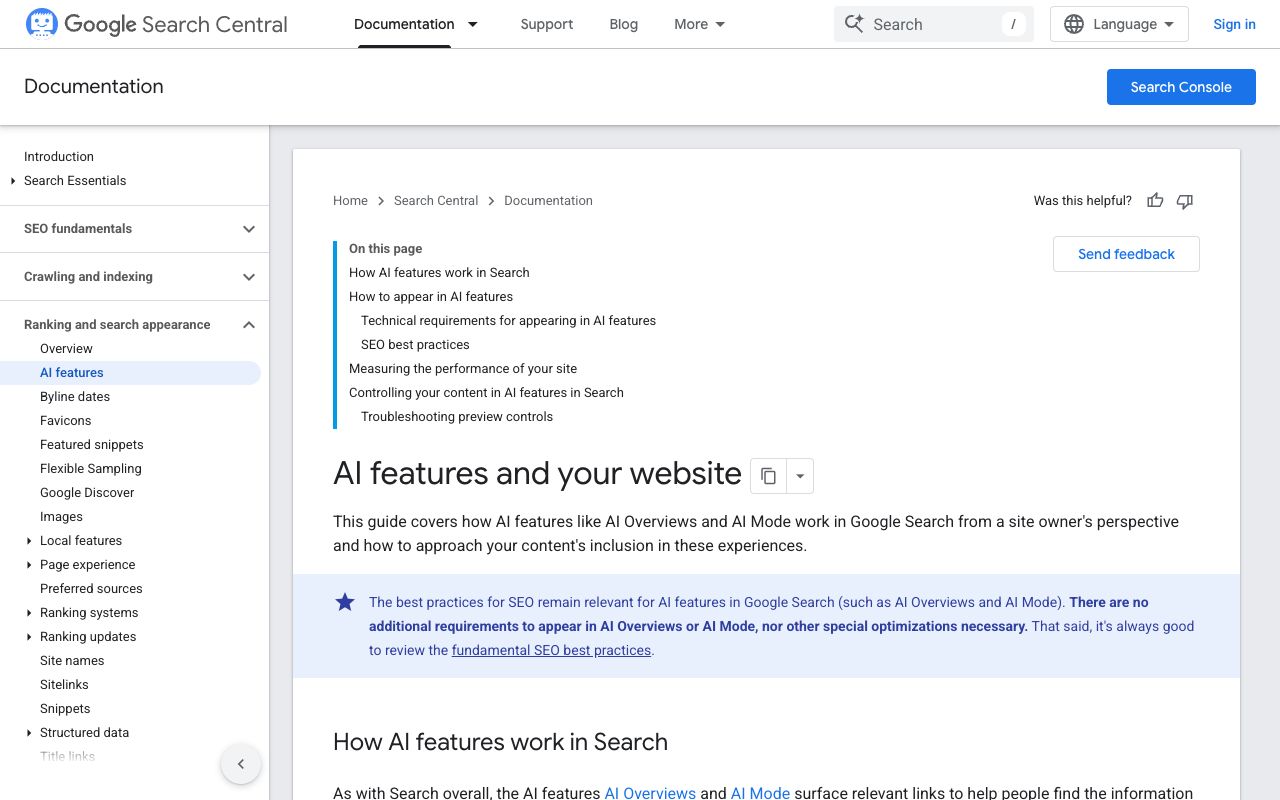
Google's own documentation is unusually blunt. In its AI features and your website guidance, Search Central writes: "There are no additional requirements to appear in AI Overviews or AI Mode, nor other special optimizations necessary." It then rules out the shortcuts people keep selling: "You don't need to create new machine readable files, AI text files, or markup to appear in these features. There's also no special schema.org structured data that you need to add."
What it does specify is a floor: "a page must be indexed and eligible to be shown in Google Search with a snippet." Three practical consequences follow.
- An unindexed page cannot be cited. Run your key URLs through our free index checker before you blame the model.
noindex,nosnippet,data-nosnippetand a tightmax-snippetvalue all restrict what can be pulled into a summary. Aggressive snippet limits are a common self-inflicted wound.- Crawling has to be permitted "in robots.txt, and by any CDN or hosting infrastructure" — bot-blocking WAF rules count.
Structured data is not a ticket in, but Google does ask that "your structured data matches the visible text on the page." Mismatches are cheap to catch with the schema markup checker and they affect classic rich results too.
Why Is Google AIO Visibility So Volatile?
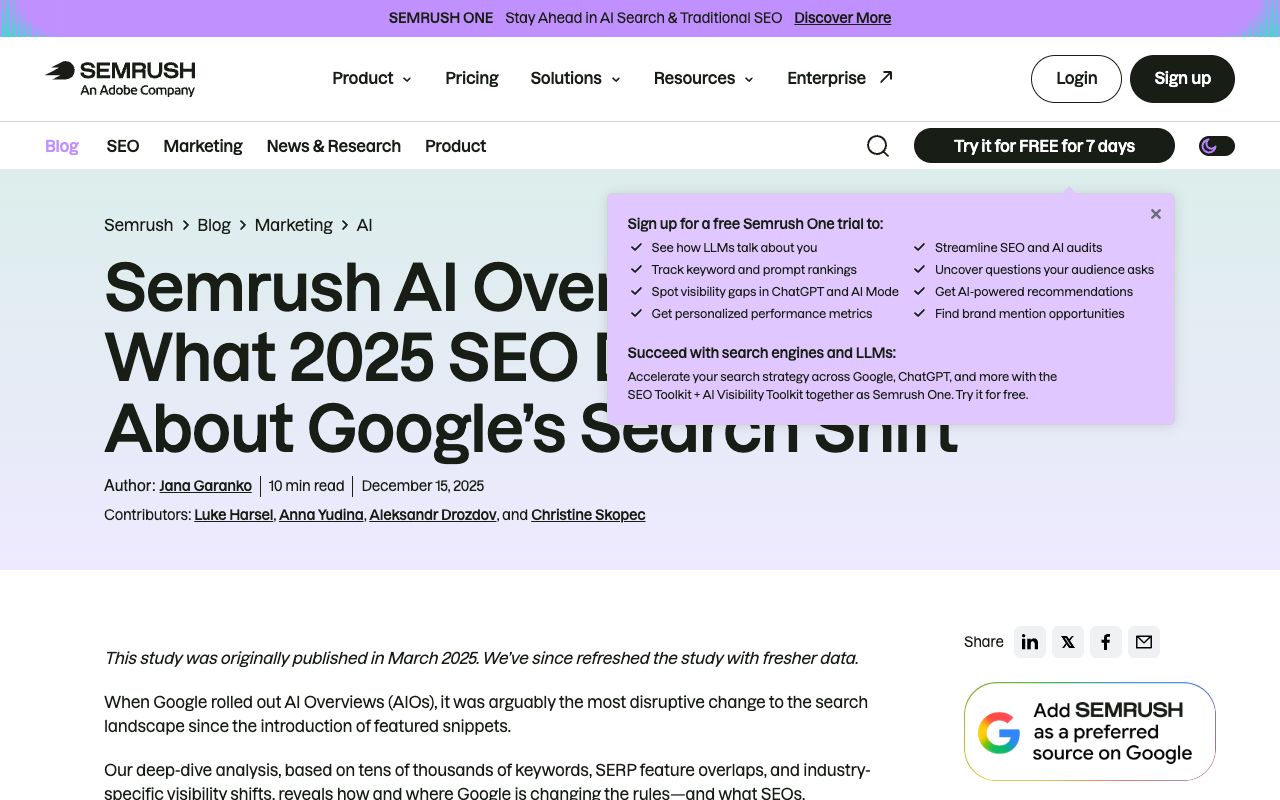
Because the surface itself keeps moving. Semrush's AI Overviews study, built on 10M+ keywords, tracked the trigger rate across 2025: AI Overviews appeared for 6.49% of queries in January, peaked at 24.61% in July, then fell back to 15.69% in November. A fourfold swing in eleven months, driven entirely by Google.
The source pool moved just as hard. Ahrefs re-ran its citation analysis across 863,000 keyword SERPs and roughly 4 million AI Overview URLs, publishing the update on March 2, 2026: only 38% of pages cited in AI Overviews also rank in the top 10. Its July 2025 study had put that near 76%. As the authors summarized it, "Google is selecting far fewer pages straight from the original SERP." YouTube alone accounted for 5.6% of all cited URLs.
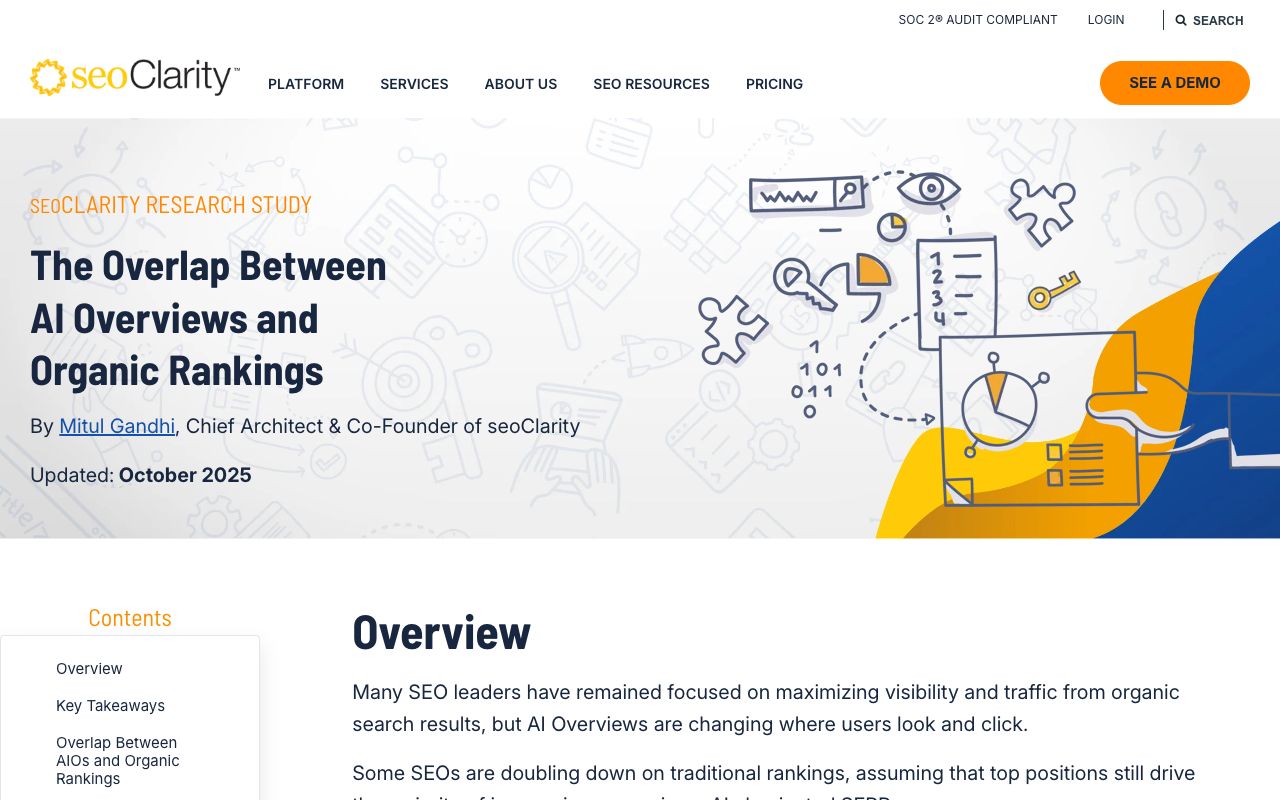
seoClarity's overlap research, run on 362,000 US desktop queries on October 12, 2025, shows the same shift from the other side: 94% of AI Overviews shared at least one citation with the top 20 organic results, yet across 5.1 million citations 44% came from outside the top 20 entirely. A URL ranking first was cited 43% of the time, dropping to 7% at position 20.
Add personalization and you have the real reason single-day checks are useless. Ahrefs' September 12, 2025 piece on AI tracking put it plainly: results are probabilistic, positions aren't fixed, prompt demand is hidden. Useful AIO tracking is a weekly trend line over a fixed keyword set on a fixed device and location — which is why serious Google AIO monitoring is a reporting habit before it is a software purchase.
Can Google Search Console Show Your AI Overview Data Yet?
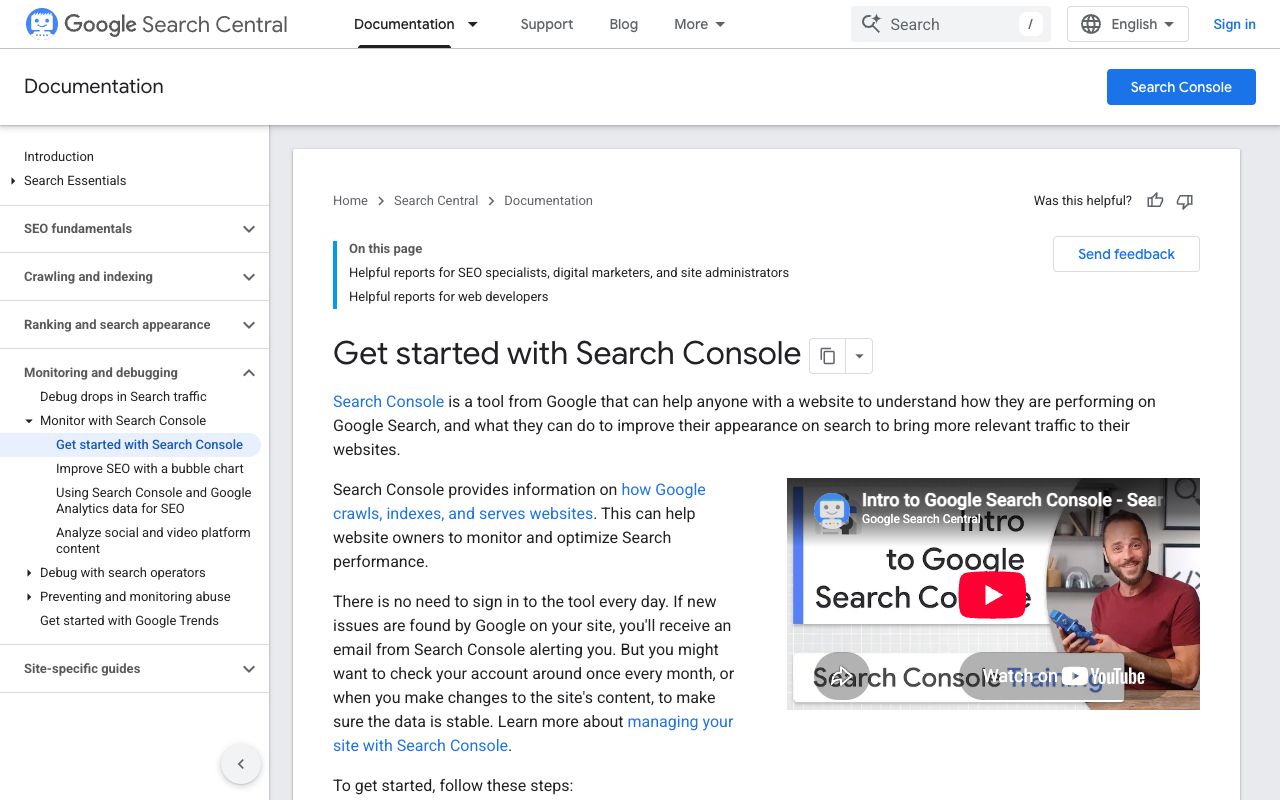
Partly, recently, and not for everyone. On June 3, 2026 Google introduced Search generative AI performance reports in Search Console — the first first-party view of how your pages surface inside AI features.
What you get, per Google's Search Console Help documentation, is impressions: "how many times links to your site were shown to a user in a generative AI feature on Google Search," split by page, country, device and date, from hourly to monthly granularity.
What you don't get matters more. The documentation describes no clicks, no CTR, no average position and no query dimension. Search Engine Journal, covering the June 3, 2026 launch, noted the omission of click and query-level metrics and quoted Google as "continuing to work with website owners to understand what insights will be most helpful" — more metrics promised, no date attached.
Availability is the other catch, and Google says so directly: "We're rolling out this report to a subset of website owners, allowing for thorough testing before rolling it further," adding that "Not all properties have access to the report, as we're rolling out over time." Search Engine Journal reported the first wave went to a subset of UK sites. If the panel isn't in your property, your Google AIO monitoring stays vendor-dependent in the meantime.
One more limit: the Search report covers generative AI features as a group — AI Overviews and AI Mode together — and the documentation describes no control for splitting them. Search Labs experiments are excluded because they remain "in active development." Google shipped a toggle alongside it to block your content from those AI features, which forfeits the impressions without changing standard Search ranking.
Which Google AIO Monitoring Tools Are Worth the Money?
Since Google publishes no query-level AIO data, every commercial tool here works the same way underneath: it scrapes SERPs on a schedule and parses the summary block. Advanced Web Ranking is refreshingly explicit about the cost — its help docs notes AI Overviews "load dynamically and require an additional query (so two queries per keyword) to be reported accurately." That is why AIO tracking burns through plan credits far faster than plain keyword rank tracking. Prices below were checked on each vendor's own site on August 5, 2026, monthly billing in USD unless noted.
| Tool | What it reports for AI Overviews | Entry price | Free option |
|---|---|---|---|
| Google Search Console | Impressions in generative AI features (AI Overviews and AI Mode combined), by page, country, device, date | Free | Yes — subset rollout only |
| Semrush | Keywords triggering AIO, whether your domain is cited, feature prevalence by industry via Sensor | SEO plan $139 ($117.33 billed annually) | Limited free account |
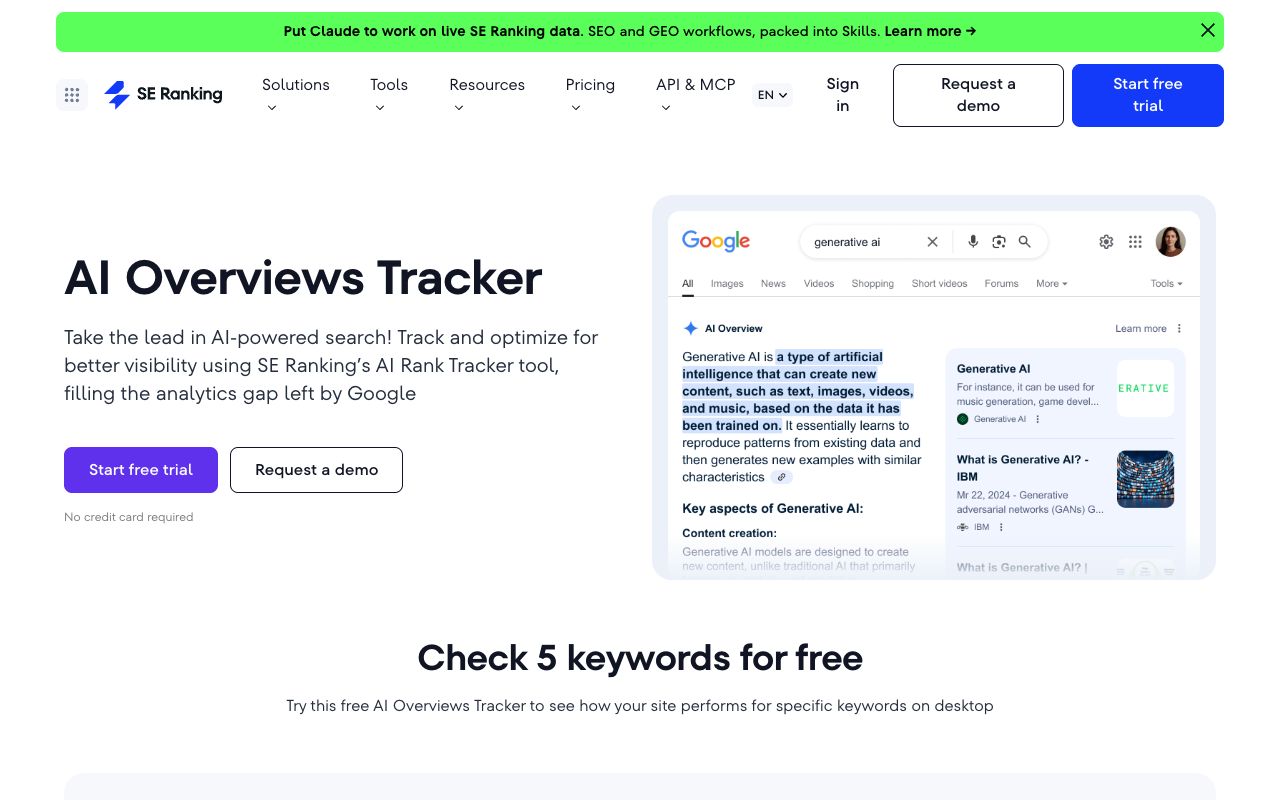
| SE Ranking | AI Results Tracker: AI Overviews, AI Mode, Perplexity, ChatGPT — presence, source domains, day-by-day changes | Core $129 plus AI Search add-on $89 | 14-day trial, no card |
| Ahrefs Brand Radar | Brand and competitor appearances across AI Overviews, ChatGPT and Perplexity, plus the pages cited | Lite $129 (5 tracked AI prompts) | Ahrefs free tier for your own site |
| seoClarity | AIO coverage, citations, brand-vs-competitor comparison, trended CTR impact at enterprise scale | Custom — demo required | No |
| Advanced Web Ranking | Dedicated "Google Search + AIO" engine, desktop and mobile, AI Rankings Rate % | Pro $139 (7,000 keywords) | 30-day money-back |
| ZipTie | AI Overviews, ChatGPT and Perplexity visibility plus content suggestions, 28 countries | Basic $69 (500 AI searches) | 14-day trial, 75 AI searches |
Semrush
Broadest coverage if you already pay for it. Five Semrush tools surface AIO data: Position Tracking, Organic Research, Domain Overview, Keyword Overview and Sensor. Plans run SEO $139, Starter $199, Pro+ $299 and Advanced $549 per month, with 500 tracked keywords at entry and daily prompt allowances layered on top (50 on Starter, 100 on Pro+, 200 on Advanced). Right pick when AIO is one report among many.
SE Ranking
The cleanest dedicated AIO product at mid-market pricing. Core is $129/mo for 2,000 keywords and Growth is $279/mo, but the AI Results Tracker sits behind an AI Search add-on at +$89/mo. It reports the share of keywords triggering AIOs, source domains categorized by type, historical change and cached SERP copies. Budget for the add-on — the base plan alone won't do this job.
Ahrefs Brand Radar
Brand Radar ships on every main Ahrefs plan — Lite $129, Standard $249, Advanced $449 — with tracked AI prompt allowances of 5, 10 and 20 respectively. It shows which engines mention your brand, how you compare against named competitors, and which pages were cited. Those allowances are small at entry, so it fits brand-level monitoring better than long keyword lists.
seoClarity
seoClarity tracks AIOs against a research grid it describes as "over half a billion keywords," and adds the metric most rivals skip: AI Overview traffic impact down to keyword and URL level, including trended CTR. No public price — a demo-and-quote enterprise product sized for tens of thousands of keywords.
ZipTie
The cheapest credible entry point. ZipTie starts at $69/mo for 500 AI searches, with Standard at $99 and Pro at $159, covering Google AI Overviews plus ChatGPT and Perplexity across 28 countries. Its 14-day trial includes 75 AI searches with no card — enough to validate a keyword list before committing.
How to Monitor Google AI Overviews Without a Paid Tool
If you're still deciding whether this category deserves budget, run it by hand for a month. The method matters more than the software.
- Write 25 to 40 queries buyers actually type, weighted toward comparison and "best" phrasing — those trigger summaries far more often than navigational terms.
- Fix your variables: same browser profile, signed out, same country and language parameters every run. Google AIO SERP tracking is a sampling exercise, and unfixed variables make samples incomparable.
- Log four fields per query per week — AIO present, your domain cited, competitor domains cited, and non-web sources such as YouTube or Reddit.
- Run it the same weekday at roughly the same hour. Weekly is right: daily reads mostly noise, monthly misses the swings.
- If your property has the generative AI report, pull impressions weekly beside your manual log. Impressions confirm scale, your log explains cause.
After four weeks you'll know your real trigger rate and citation rate. If fewer than a third of your queries return a summary, a $200/mo tracker isn't your bottleneck.
What Should You Do When Your AIO Citations Drop?
Diagnose before you rewrite. Two failures look identical on a chart and need opposite responses.
The summary stopped generating. Nothing about your page changed — Google pulled the feature for that query class, exactly as the 24.61%-to-15.69% slide in Semrush's 2025 data shows happening at scale. Check a competitor's keywords too. If they dropped as well, it's Google, and the response is patience plus reallocating effort to queries that still trigger.
The summary generates but cites someone else. Now it's yours to solve. Verify indexation and snippet eligibility first, then look at where the citations came from: with 44% landing outside the top 20 in seoClarity's October 2025 sample, the winning source is often a forum thread, review roundup or video rather than a competitor's landing page. Earning a mention inside that third-party asset often beats another round of on-page edits.
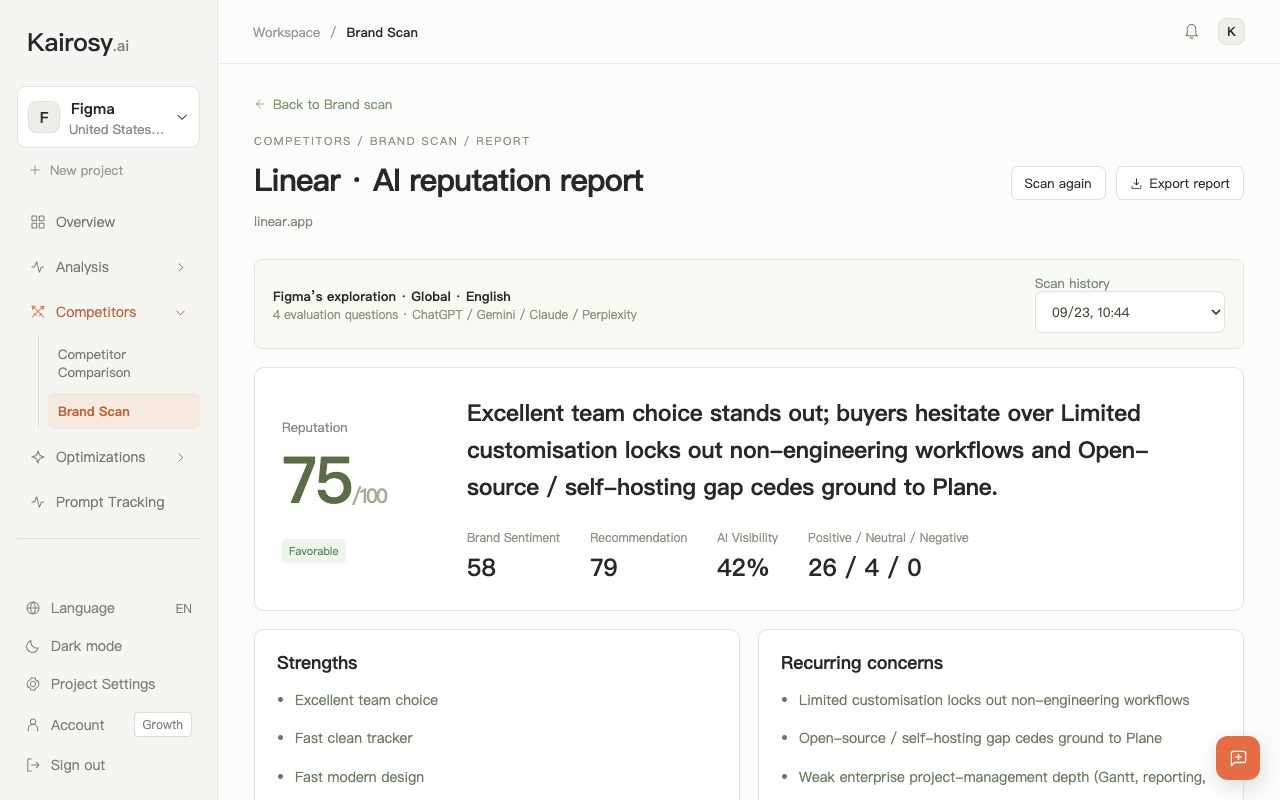
Google AIO monitoring only covers half the story, though. The buyer who sees an AI Overview on Monday asks ChatGPT or Gemini the same question on Tuesday, and those answers are assembled from a different index with different citation behavior. Neither Search Console nor a SERP scraper can see them.
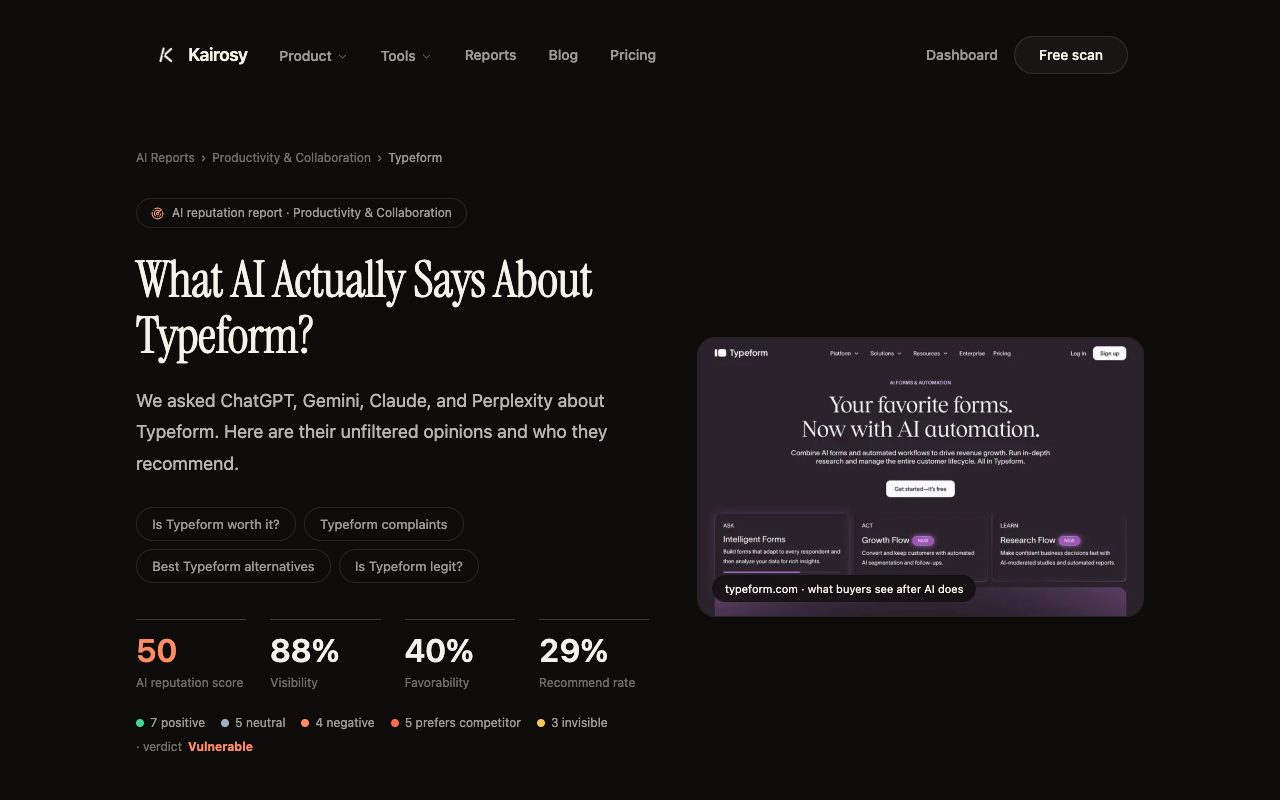
That's the gap Kairosy fills — and to be clear about what it is not: Kairosy does not track the Google SERP and is not an AIO rank tracker. It runs real purchase-stage questions through ChatGPT, Gemini, Claude and Perplexity, classifies each answer's sentiment, extracts the URLs every engine cited, and scores the result out of 100. Our public scan of Typeform shows the difference: 49/100 overall, 75% visibility but only 38% favorability, Gemini scoring 27/100 against Claude's 61/100, and Google Forms taking 15% share of voice in answers about form builders. A rank tracker would have surfaced none of that.
The free trial covers 7 days of scanning with the full report. Paid plans — Basic $29, Pro $99, Growth $399 per month — add weekly rescans with email alerts, daily prompt tracking and market-specific scans across 25 countries. See AI brand monitoring for the ongoing setup, or Gemini brand monitoring if Google's assistant is your priority. Pair an AIO tracker with an assistant scanner and you cover both Google AIO visibility and the answers around it.
Google AIO Monitoring FAQs
Does Search Console show AI Overview clicks?
No. As of the June 2026 launch, the Search generative AI performance report documents impressions only, split by page, country, device and date. Google has said more metrics will follow but published no timeline.
How often should I run Google AIO SERP tracking?
Weekly, on a fixed keyword set and fixed location. Daily checks mostly capture personalization and rollout noise, and the 2025 trigger-rate swings Semrush documented only become readable across multiple weeks.
Is there a free way to check Google AIO visibility?
Two, and they complement each other. Search Console's generative AI report is free where it has rolled out, and a manual weekly log across 25 to 40 queries costs only time. Most paid tools also run trials — SE Ranking and ZipTie both offer 14 days without a card.
Does ranking #1 guarantee an AI Overview citation?
No. In seoClarity's October 2025 study of 362,000 queries, a URL ranking first was cited 43% of the time. Ahrefs' March 2026 analysis found only 38% of cited pages rank in the top 10 at all.
Can I opt out of AI Overviews without hurting my rankings?
Google shipped a Search Console control to block content from generative AI features in June 2026 and states it does not affect standard Search ranking. You lose the AI impressions and any traffic they carry, so treat it as a last resort.
Do AIO tracking and AI assistant monitoring replace each other?
No — they measure different surfaces. AIO tracking watches Google's summary block on the classic results page, while assistant monitoring watches what ChatGPT, Claude, Gemini and Perplexity say inside their own products. Buyers use both, so you need coverage of each.
See what AI says about your brand
Run a free scan across ChatGPT, Gemini, Claude & Perplexity in about 30 seconds.
Run my free scan