How to Fix Negative Brand Sentiment in AI? 6 Tested Solutions That Really Work
Knowing how to fix negative brand sentiment in AI is necessary for almost business (espcially for small ecommerce and online services), since AI search is now directly shapes user behavior. After receiving an AI recommendation, nearly 49% of consumers visit the recommended website, according to Yext's 2026 Consumer Search Behaviors Report.
You may question that does negative brand sentiment influence AI product recommendations? Yes — and it works in both directions: 36% of surveyed Americans have discovered a new product or brand through ChatGPT, according to Adobe's research. So we can assume that if ChatGPT, Gemini, Claude or Perplexity describe your brand vaguely or negatively, you get filtered out before a buyer ever reaches your site.
Then how can you track what LLMs are telling your customers about your brand, analy your brand sentiment and find out potential misinformation? This article would show you the 7 measurements and 6 solutions.
TL;DR - Insights on Brand Sentiment in AI
49% of users visit a website after an AI recommendation (Yext).
36% of Americans have discovered new brands or products through ChatGPT (Adobe).
In Kairosy AI's 205 real brand scans we ran across four engines, every single report named at least one competitor — and 55% of brands scored below 50% favorability. Negative AI brand sentiment doesn't argue with you, it quietly routes buyers elsewhere.
What Does Negative Brand Sentiment in AI Look Like? 7 Examples
Before beginning, you must acknowledge that not all negative brand sentiment in AI can be totally resolved—no matter how well-crafted the messaging is, issues regarding substantial price disparities will inevitably resurface.
However, you should prioritize the following 7 types of negative AI brand negative sentiment, as they largely caused by outdated, insufficient, or inconsistent information.
Type | What the AI actually says | Fixable? |
|---|---|---|
Pricing | "Too expensive for small teams — probably not worth it at this tier." | Partly — publish current plans and who each is for |
Learning curve | "Powerful but difficult to start; documentation doesn't match real workflows." | Yes — task-based guides and quick-start pages |
Adaptability | "Weak for enterprise use cases like SSO or multi-region teams." | Yes, if untrue — state supported scenarios explicitly |
Accessibility | "No mobile app, and the web experience is dated." | Yes — ship and document the surfaces you do have |
Customer service | "Users report slow support and unanswered tickets." | Yes — respond publicly where complaints live |
Recommends your competitor | "X is fine, but Y is the better pick for most buyers." | Hardest — win the comparison content head-on |
Vague brand description | "It's maybe a data tool? It probably offers analytics." | Yes — the easiest and most common fix |
The last row is the sleeper. For example, when we scanned Kling AI, Claude answered a switching question with: "Google Veo 3 — best overall choice, especially if you're leaving Kling over billing." One vague or negative answer becomes the buyer's shortlist.
>> You can preview Kling AI brand sentiment breakdown in this Kling AI reputation report.
Taking corrective measures to address these 7 specific negative brand sentiment issues often yields the quickest results, making this the most worthwhile to focus on for AI search optimization efforts.
How to Fix Negative Brand Sentiment in AI? 6 Tested Solutions
1. Update the claims on your brand website
53% of users search Google or Bing to verify or learn more about a brand after an AI answer (Yext), and both search engines and AI bots will re-crawl your pages to ground what they say. So you can try to rewrite key pages to ensure your claims are concrete and match your target audiences' intents.
For example, you can add questions like who the product is for, what it costs, what it integrates with.
Also, you should avoid hedge words like "maybe" and "probably" in your own copy, since AI models prefer specifics and would skip adjectives with abstract meaning.
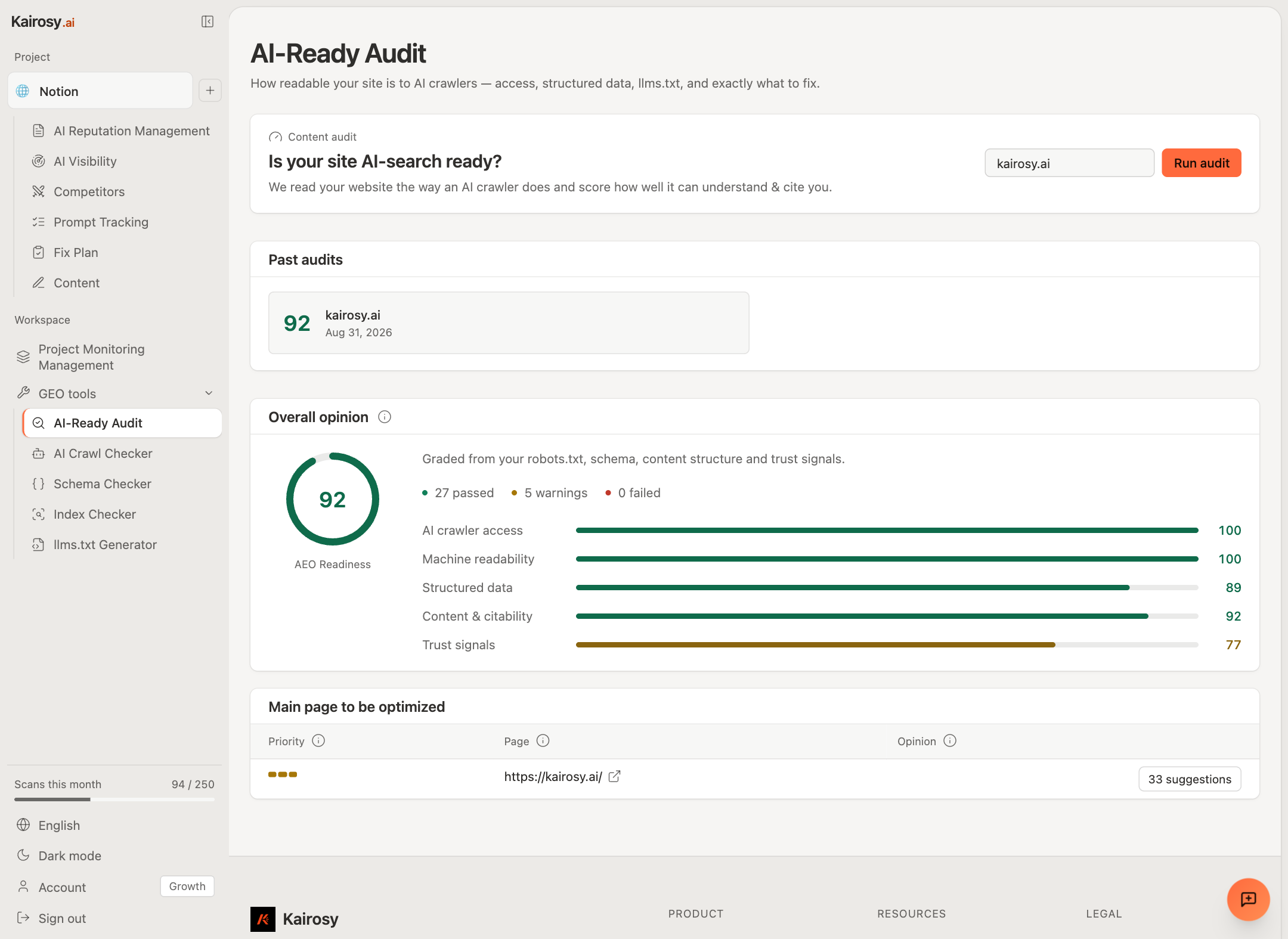
Tip: you can run your homepage through Kairosy AI free AI crawl checker first: if GPTBot or ClaudeBot is blocked, engines can't read your corrections at all, and an AI-ready audit will show which structural signals (schema, llms.txt, answer-first copy) are missing:
2. Add the negative comments to your FAQ pages
Your silence would be read as confirmation, whereas a dated, specific rebuttal reads as the newer fact in AI search tools. So whatever AI search platforms hold against you — pricing, onboarding, a missing feature — you can answer it by name in an FAQ with the "FAQPage" schema markup.
>> Not sure if your markup is validated? Try Kairosy AI Schema markup checker for 100% free!
Usually, a question the AI models can quote ("Is it worth it for small teams?") followed by a direct two-sentence answer is exactly the shape generative engines lift into LLMs responses. You should review your FAQ section and consider optimizing the structure of your answers.
3. Distribute updates to authoritative third-party sources
AI engines weigh independent sources more than your own site for brand sentiment. When you fix a complaint, like launched a new pricing tier, faster customer support, a new shipped feature, you can push the update to the places AIs already and love to cite: industry directories, comparison sites, analyst write-ups and news coverage.
A lot of researches show AI citation sources differ sharply by AI engines, so you'd better check and know some most cited AI sources before spending outreach effort.
4. Engage in the forums your buyers read
Reddit, Quora and the active forums of your industry feed AI training data and live retrieval. You can answer real threads about your category honestly — as the brand, not as a fake fan.
But there is an inportant shift to note: ChatGPT's citations of Reddit have dropped significantly since the mid-August in 2026, so you'd better not build the whole brand sentiment management plan on just one platform. On controvary, you should spread genuine participation across the two or three more communities where your buyers actually compare tools.
5. Monitor and respond on review platforms
An unanswered one-star review from 2024 can outrank your 2026 product in an AI answer's memory of you.
Yext shows that 28% of users look for reviews on Google, Yelp or similar platforms right after getting an AI recommendation, and those platforms are highly liked by AI search engines as well. Now that both human and AI read those real reviews when they summarize or choose you, you can respond to those substantive negative review with what changed.
6. Manage your social media
20% of users check a business's social profiles after an AI recommendation (Yext). And dormant or inconsistent profiles amplify vague brand descriptions — the "it's maybe a data tool" problem in AI replies. Besides, consistency across channels is a trust signal engines can verify, as LLM-answer repair guides keep finding.
So you should keep names, positioning lines(or just your brand slogan) and links identical across social media platforms.
All in all, the core action in fixing negative brand sentiment in AI is to ensure that the information across all channels driving your brand's conversions remains consistent and positive.
This is by no means an easy task, monitoring alone consumes a significant amount of your and your brand team's time and energy. Therefore, using an AI brand sentiment management tool is undoubtedly the best and most effective solution.
Here, we introduce Kairosy AI brand sentiment and reputation management to you.
Kairosy AI: Monitor and Fix Your Brand Sentiment in AI Easily
Kairosy AI is an online tool to measure, monitor and fix brand sentiment in AI. Its workflow is intuitive, making your brand sentiment management easy and simple to kick off.
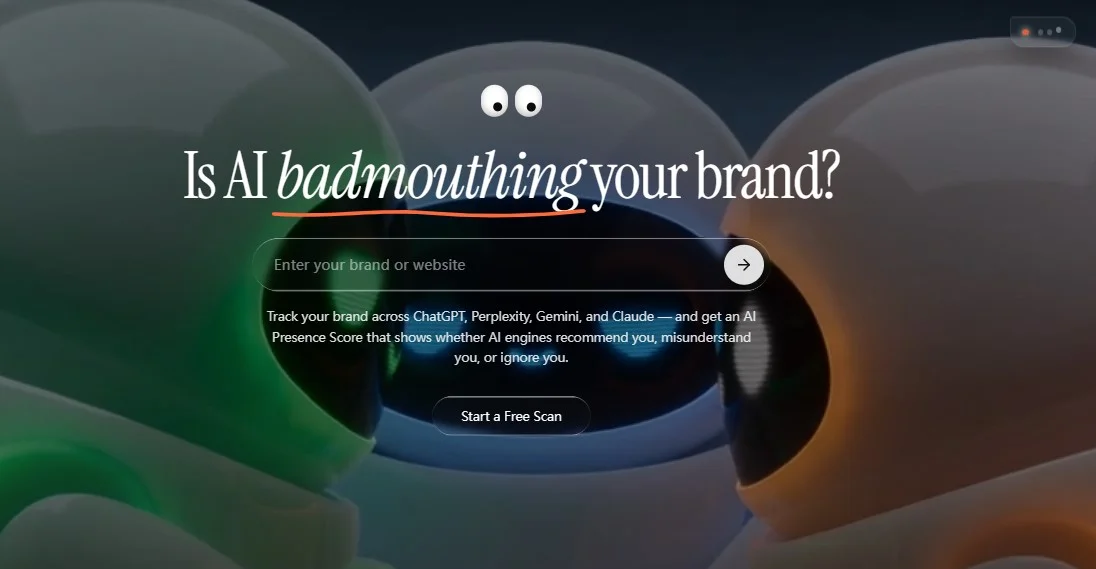
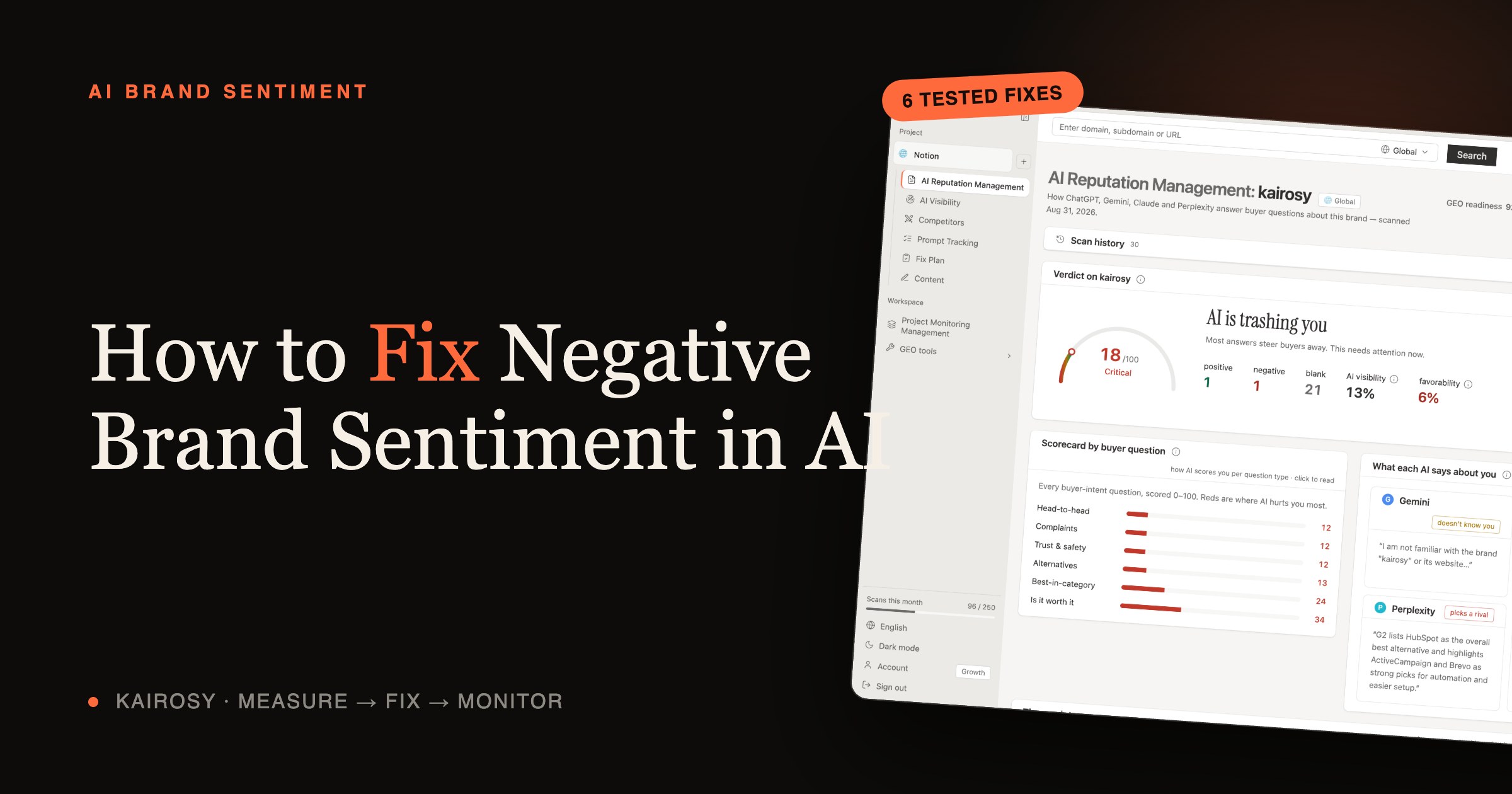
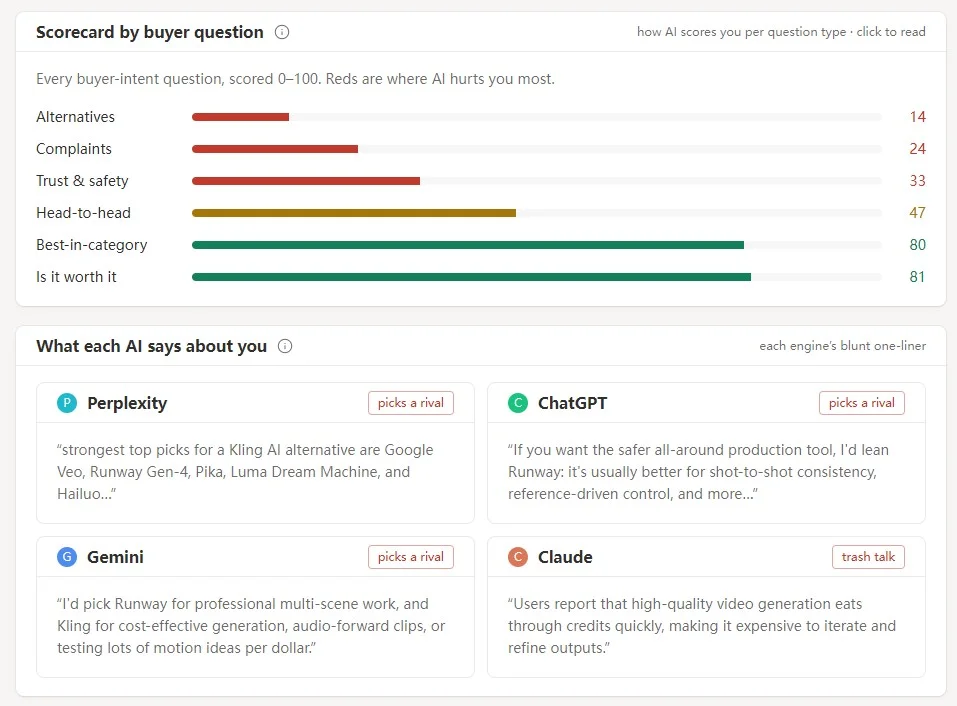
Firstly, it asks ChatGPT, Gemini, Claude and Perplexity the questions that real buyers ask, like is X really useful? Then Kairosy AI would collects AI answers and turns them into a dedicated AI reputation score and report, which includes AI visibility, AI favorability, the per-question scorecard, specific AI responses for a questions, how those smears impact your business, and how to fix those negative AI brand sentiments.
Also, its competitor analysis allows you to know your rivals and your share of voice in your market, with real AI cited sources, and head-to-head comparison, so that you can easily find the gap between your competitors and your own brands.
Kairosy AI offers not only insights but also practical fix suggestions. It will rank those implementations from high to low risk levels. After that, you can set up an AI brand sentiment monitor to track your brands' performances continuously. To ensure you can catch up your brand sentiment changes, Kairosy AI would send you alert and report weekly by email.
Now, you can claim Kairosy AI 7-day free trial to access the full AI brand sentiment improvement and monitoring by just signing up, no credit card needed.
3 Steps to Measure and Fix Brand Sentiment in AI with Kairosy AI
Step 1: Benchmark your AI brand sentiment
Firstly, you can run a scan on your brand by just putting your URL. You get a 0–100 reputation score, a verdict, positive/negative counts per AI engine, and a scorecard by buyer question — so your doubt about "how to fix negative AI brand sentiment" stops being abstract and becomes "the 'Alternatives' question scores 26/100."
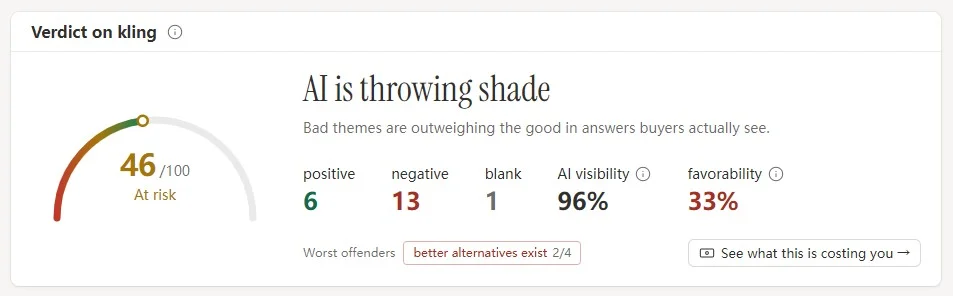
Across the 205 brand scans in our public report library, the average favorability was just 48%, so you don't need to be shocked by your first brand sentiment score, it is the baseline you improve against.
Step 2: Find and categorize the negative AI brand sentiment
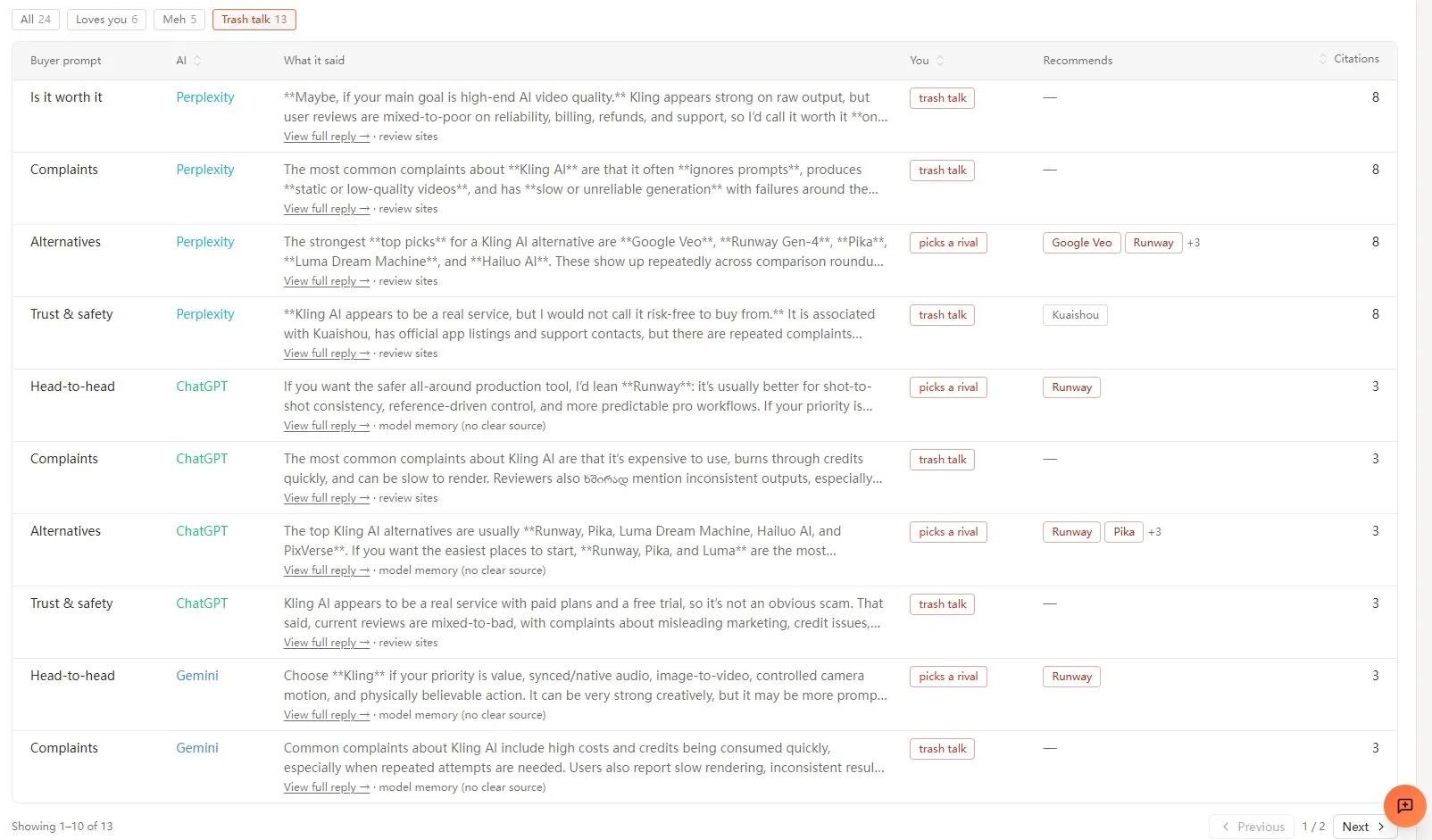
Next, you can open the evidence rows and see those AI answers. They carries AI search engine's exact words and the sources it cited.
Kairosy AI reputation management will group those negative sentiment per AI engine and per market, and tell you how those comments will affect on your business:
Step 3: Fix and monitor negative brand sentiment continuously
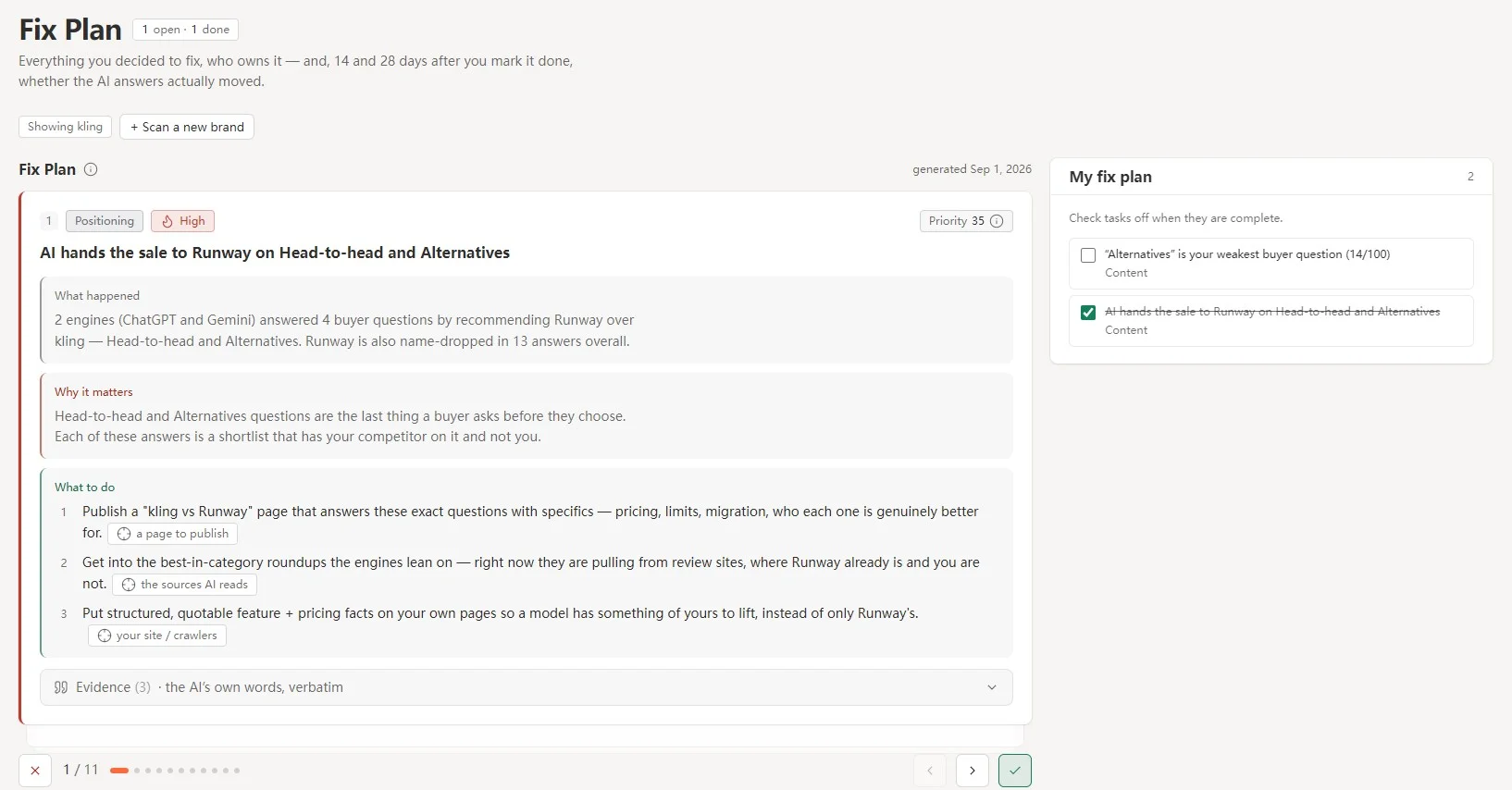
Finally, you will get fix suggestions and take actions. The concrete cards will be ranked by priority, each with what happened, why it matters and what to do:
To control your brand sentiment in AI effectively, you’d better continuously monitor and optimize your brand reputation. You can add a monitor on Kairosy AI.
With a monitor on, your brand gets a full four-engine re-scan every week, tracked prompts re-run every morning, and the changes land in your inbox — so you see whether the fixes moved the answers, and catch new negative sentiment while it is one answer old instead of one quarter old.
FAQs on Fixing Negative Brand Sentiment
How to manage negative brand sentiment effectively?
Measure first, then fix by type. Benchmark what each engine says, categorize the negatives (vague description, competitor preference, stale complaints), apply the matching fix from the six above, and re-measure weekly (our guide to fixing negative AI mentions covers the takedown-vs-outrank decision in more depth). Managing negative brand sentiment effectively is a loop, not a one-off cleanup.
How long does it take to fix negative sentiment in LLM responses?
Retrieval-backed engines like Perplexity and Gemini can reflect updated pages and sources within days to a few weeks. Answers grounded in older training data move slower — often one to three months after your corrections spread across cited sources. Weekly monitoring tells you the moment each engine flips.
Can I use ChatGPT for brand sentiment analysis?
Not reliably. ChatGPT stores memory from your past conversations, so asking it about your own brand returns a personalized, non-neutral answer. A fair read requires asking many buyer-style questions across several engines from a clean context and compiling the results — which is exactly the time-consuming part a dedicated monitor automates. You can try Kairosy AI free to measure your current AI brand sentiment.
Does negative brand sentiment influence AI product recommendations?
Yes, directly. Engines compress sentiment into their shortlists: a brand described negatively or vaguely gets skipped, and the engine recommends a competitor it can describe confidently. In our 205-brand scan library, every report contained at least one competitor recommendation.
How to improve brand sentiment in AI search results?
Fix the source material engines read: concrete website claims, FAQ answers to the actual complaints, updated third-party pages, active review responses and consistent social profiles. Then track weekly. Improving brand sentiment in AI search results is mostly a freshness-and-consistency game — the engines follow the evidence.
Conclusion
Negative AI brand sentiment costs you buyers you never meet: 49% follow AI recommendations to a website, and 36% discover brands inside ChatGPT itself. Knowing how to fix negative brand sentiment in AI comes down to six moves — precise website claims, FAQ rebuttals, third-party updates, forum presence, review responses, consistent socials — wrapped in a measure → fix → monitor loop.
You can run a free AI brand sentiment scan with Kairosy AI to see your score and your weakness, and start fixing those negative sentiments from evidence instead of guesswork. Now, scan and enjoy brand sentiment fixing!
See what AI says about your brand
Run a free scan across ChatGPT, Gemini, Claude & Perplexity in about 30 seconds.
Run my free scan