The Most Cited AI Sources in 2026: Top Domains, Engine by Engine
The most cited AI sources are not the sites winning classic SEO. Every major public study lands on the same short list: Wikipedia, Reddit, and YouTube at the top, trailed by review platforms (G2, Gartner, Yelp), business media (Forbes, Business Insider), and community networks (Quora, LinkedIn). The order shuffles by engine — and, awkwardly, by who did the measuring and when.
This post sticks to named, dated, public research: a 680-million-citation dataset from Profound, a 13-week Semrush tracking study, Ahrefs' July 2026 analysis of Google AI Overviews, and Otterly.ai's citation-economy report. You get the per-engine lists side by side, an honest note where no study exists (Claude), and a playbook for getting your own domain cited by AI platforms.
What Are the Most Cited AI Sources? The 2026 Answer
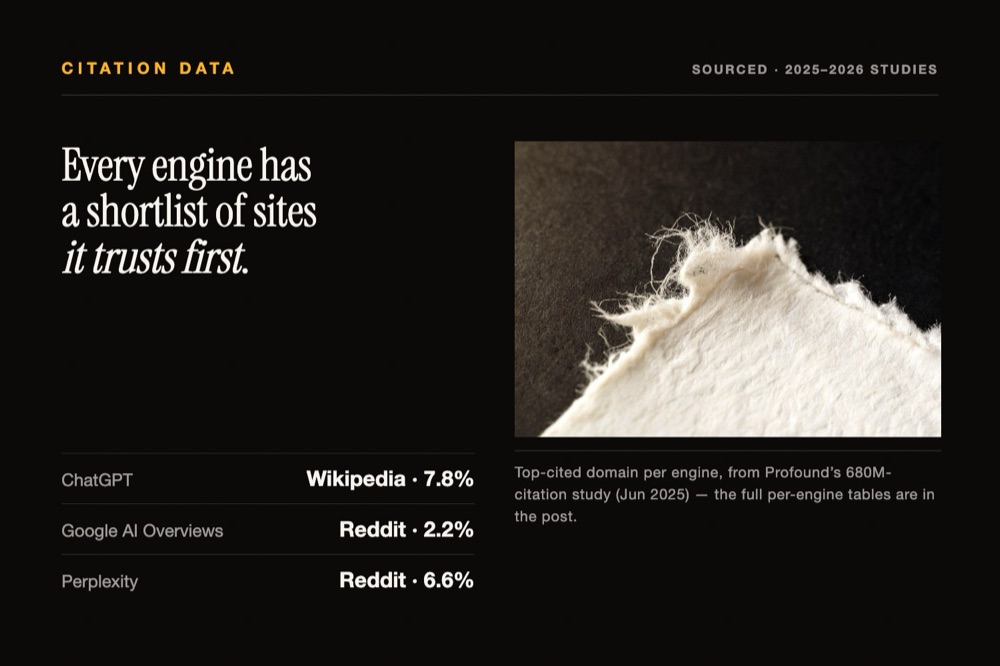
The cleanest apples-to-apples comparison comes from Profound's "AI Platform Citation Patterns" study (published June 5, 2025, updated August 2025), which analyzed 680 million citations collected between August 2024 and June 2025 across ChatGPT, Google AI Overviews, and Perplexity. Here are its top ten domains per engine, with each domain's share of all citations in the dataset:
| Rank | ChatGPT | Google AI Overviews | Perplexity |
|---|---|---|---|
| 1 | Wikipedia (7.8%) | Reddit (2.2%) | Reddit (6.6%) |
| 2 | Reddit (1.8%) | YouTube (1.9%) | YouTube (2.0%) |
| 3 | Forbes (1.1%) | Quora (1.5%) | Gartner (1.0%) |
| 4 | G2 (1.1%) | LinkedIn (1.3%) | Yelp (0.8%) |
| 5 | TechRadar (0.9%) | Gartner (0.7%) | LinkedIn (0.8%) |
| 6 | NerdWallet (0.8%) | NerdWallet (0.6%) | Forbes (0.7%) |
| 7 | Business Insider (0.8%) | Forbes (0.6%) | NerdWallet (0.6%) |
| 8 | NY Post (0.7%) | Wikipedia (0.6%) | TripAdvisor (0.6%) |
| 9 | Toxigon (0.7%) | Business Insider (0.5%) | G2 (0.6%) |
| 10 | Reuters (0.6%) | Medium (0.4%) | PCMag (0.5%) |
Two things jump out. First, only three domains — Reddit, Forbes, and NerdWallet — appear in all three top-ten lists, so a strategy tuned for one engine does not automatically transfer. Second, even the biggest winner (Wikipedia on ChatGPT) holds under 8% of citations. The other 90%+ is a long tail of ordinary sites, which is the real opening for your domain.
Which Studies Track the Top Cited Domains in AI Search?
A warning before the numbers: the web is full of "citation index" listicles with confident rankings and no methodology. For this post, a study only counted if it names its dataset, its date range, and its measurement — because the top cited domains in AI search look very different depending on all three. These four qualify:
| Study | Published | Scale | Engines | What it counts |
|---|---|---|---|---|
| Profound, "AI Platform Citation Patterns" | Jun 5, 2025 (upd. Aug 2025) | 680M citations, Aug 2024–Jun 2025 | ChatGPT, AI Overviews, Perplexity | Domain's share of all citations |
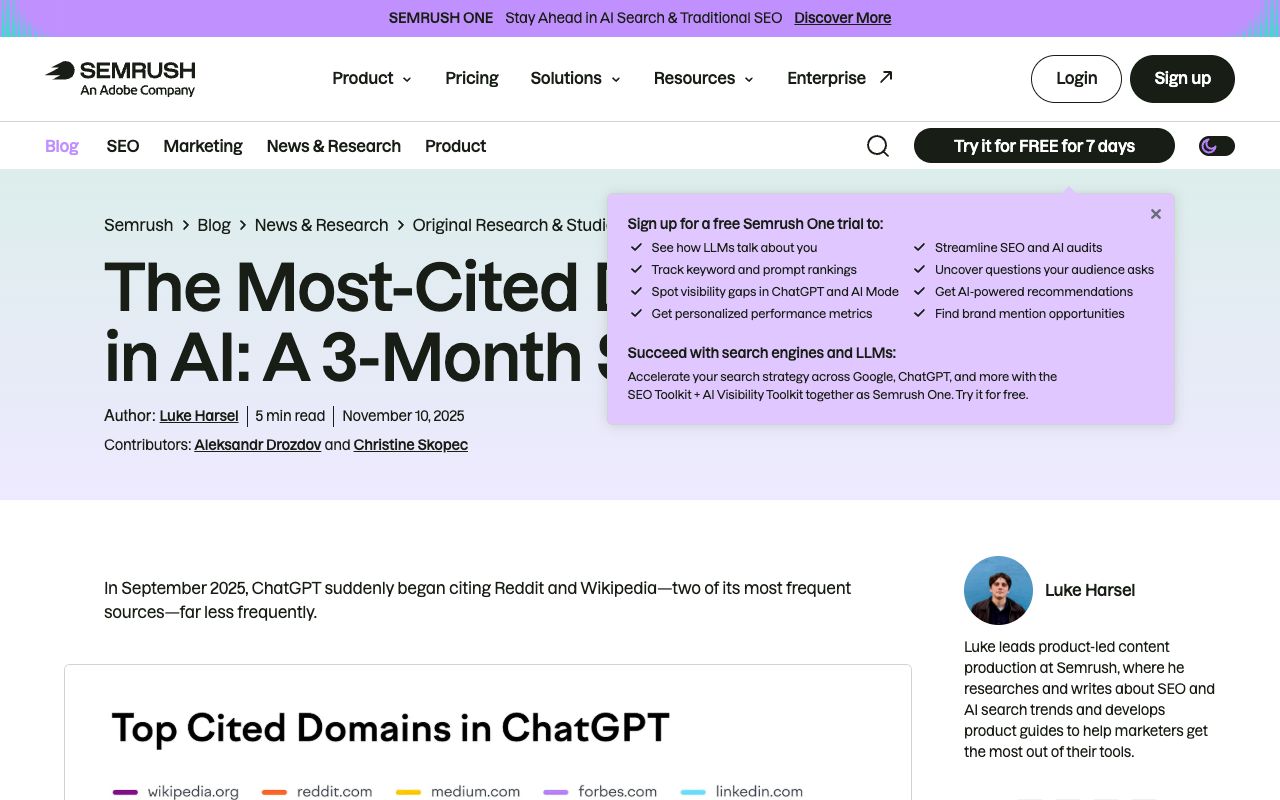
| Semrush, "The Most-Cited Domains in AI" | Nov 10, 2025 | 230K+ prompts, 100M+ citations, Jul 14–Oct 12, 2025 | ChatGPT, Google AI Mode, Perplexity | % of responses citing the domain, weekly |
| Ahrefs, "The 50 Most-Cited Websites in Google AI Overviews" | Jul 21, 2026 | 3M+ US queries | Google AI Overviews | Share of the top-50 citation pool |
| Otterly.ai, "The AI Citation Economy" | Feb 1, 2026 | 1M+ citations, Jan–Feb 2026 | ChatGPT, AI Overviews, Perplexity | Citation mix by source type |
Note what is missing: no large public study isolates Claude or the Gemini app. More on the sourced proxies for both below — nobody should hand you a "Claude top ten" without explaining where it came from.
Why Do AI Platforms Cite These Domains?
Four forces decide which domains become the most cited AI sources.
Authority. Encyclopedic and institutional pages dominate because they are dense, factual, and internally consistent — exactly what a model wants to ground an answer. Profound found commercial .com domains take 80.41% of all citations, but the single biggest domain on ChatGPT is still Wikipedia.
Activity. Engines over-index on places where humans keep talking. In Otterly.ai's February 2026 report, community platforms like Reddit and Quora captured 52.5% of citations versus 47.5% for brand-owned domains. Fresh threads signal that a topic is alive.
Freshness. These rankings churn violently. Semrush's tracking showed ChatGPT citing Reddit in close to 60% of responses in early August 2025, collapsing to around 10% by mid-September — a retrieval-pipeline change, not a slow editorial drift.
Retrievability. A model can only cite what its search layer can fetch. Otterly.ai found 73% of sites carry technical barriers that block AI crawler access. Blocked means invisible, whatever your authority.
What Are the Top ChatGPT Citation Domains?
Per Profound's dataset, the top ChatGPT citation domains are Wikipedia (7.8%), Reddit (1.8%), Forbes (1.1%), G2 (1.1%), TechRadar (0.9%), NerdWallet (0.8%), Business Insider (0.8%), NY Post (0.7%), Toxigon (0.7%), and Reuters (0.6%). The pattern: one giant reference layer (Wikipedia), then a band of media and review sites. G2 in the top four is why B2B SaaS brands feel review pages shaping their AI answers so strongly.
Semrush's three-month study (November 10, 2025) broadly agrees — its post-shakeup ChatGPT top five was Wikipedia, Reddit, Medium, Forbes, LinkedIn — but adds the volatility story: Wikipedia fell from appearing in roughly 55% of responses to under 20% during September 2025, while PR Newswire, Forbes, and Medium gained. The two studies also count differently. Semrush measures how many responses cite a domain, Profound measures share of total citations, so their percentages are not comparable even where the names match.
One oddity worth naming: Toxigon, an obscure blog, sits at #9 in Profound's ChatGPT list. Citation frequency is a statistical artifact of retrieval, not an editorial quality stamp — which is exactly why brands watch what ChatGPT cites about them specifically instead of trusting global averages.
What Are the Most Cited Domains in AI Overviews?
The freshest data here is Ahrefs' July 21, 2026 study of 3+ million US queries. Its most cited domains in AI Overviews, by share of the top-50 citation pool:
- YouTube — 21.1% (1.7 million pages cited)
- Reddit — 18.5%
- Facebook — 10.7%
- Google — 7.1%
- Instagram — 5.8%
- Quora — 5.0%
- Wikipedia — 4.8%
- Amazon — 3.5%
- TikTok — 3.2%
- Walmart — 1.0% (Edmunds, Healthline, Forbes, and KBB follow at 0.8–0.9%)
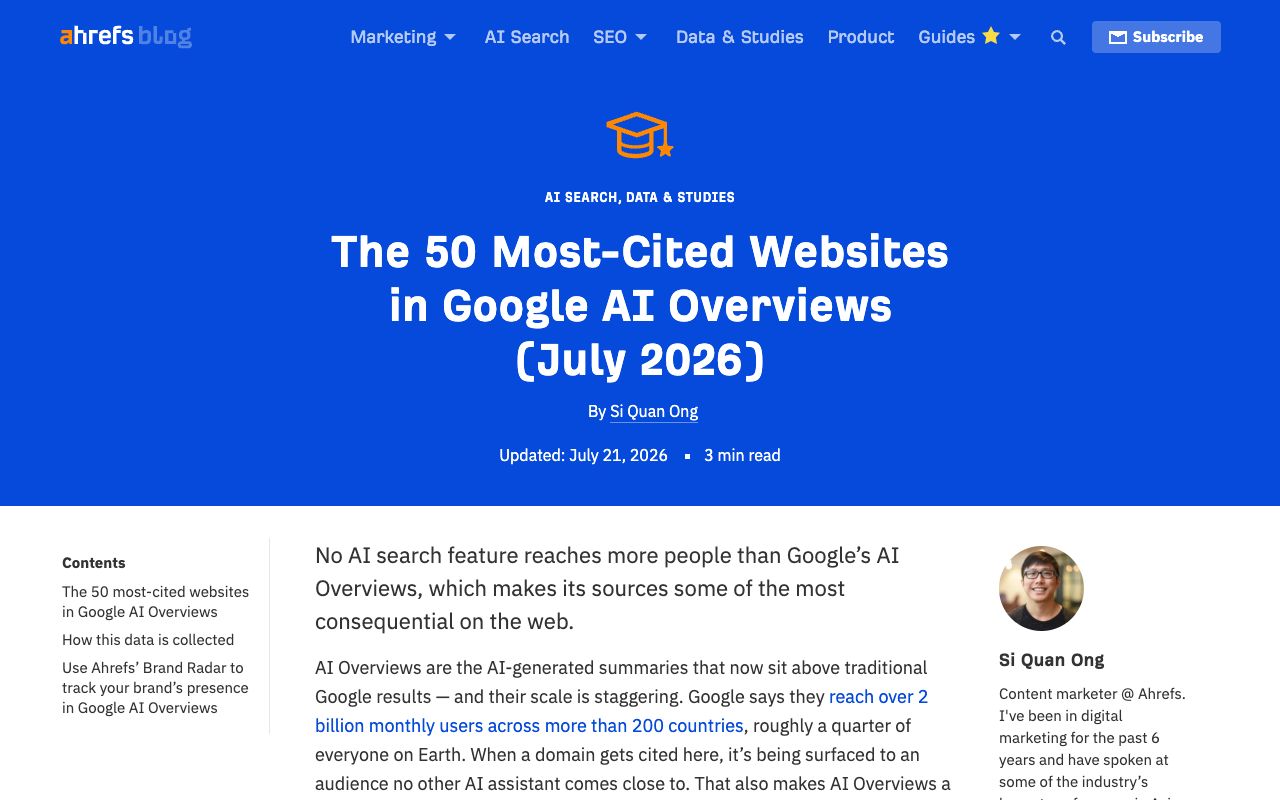
Compare that with Profound's earlier AI Overviews list (Reddit, YouTube, Quora, LinkedIn, Gartner on top) and the disagreement is instructive. Three reasons they differ: the window (2024–25 versus mid-2026, and video citations kept climbing), the metric (Ahrefs' percentages are shares of the top-50 pool, Profound's are shares of all citations, so Ahrefs' numbers run much higher), and the query mix. Both agree on the headline, though — social and video platforms rule AI Overviews, and Wikipedia matters far less here than in ChatGPT.
The other AI Overviews finding worth your attention: an Ahrefs analysis of 863,000 keywords, covered by Search Engine Journal on March 2, 2026, found only 38% of pages cited in AI Overviews also rank in Google's top ten for that query — down from 76% in July 2025. Ranking well and getting cited are now substantially different games.
What Are the Most Cited Domains on Perplexity?
Profound's Perplexity top ten: Reddit (6.6%), YouTube (2.0%), Gartner (1.0%), Yelp (0.8%), LinkedIn (0.8%), Forbes (0.7%), NerdWallet (0.6%), TripAdvisor (0.6%), G2 (0.6%), PCMag (0.5%). Perplexity leans harder on community discussion than any other engine, and it is the only top-ten list where Yelp and TripAdvisor appear — local and travel reputation flows straight into its answers.
Semrush's later snapshot names Reddit, LinkedIn, NIH, Microsoft, and Google as Perplexity's top five — the NIH entry reflecting how often health questions dominate real prompt mixes. Again: different months, different prompt sets, different lists. Treat any single Perplexity ranking as a photograph, not a portrait.
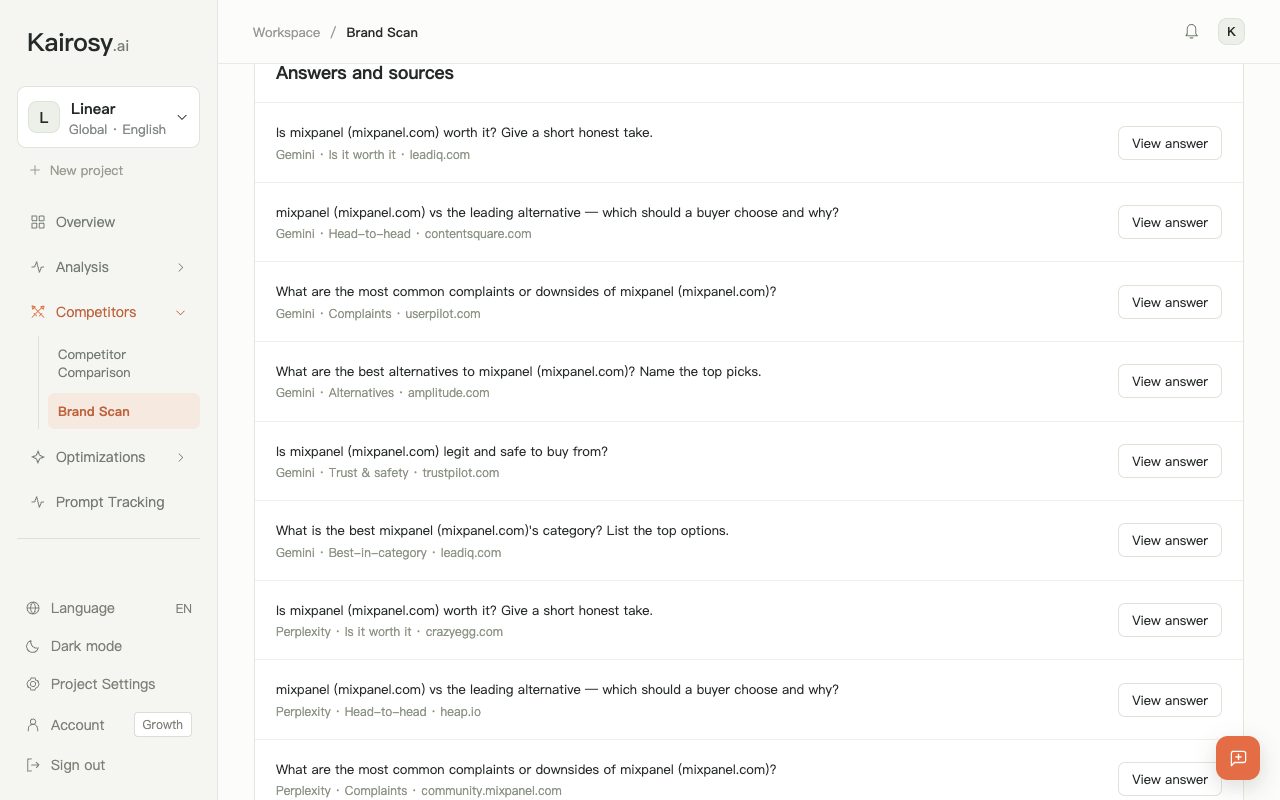
If you sell travel, that TripAdvisor line is not abstract. Kairosy's scan of GetYourGuide (full report here) lists the exact URLs each engine leaned on when describing the brand — the per-brand version of the global table above.
Do Claude and Gemini Have Public Citation Studies?
No — and anyone selling you a "Claude top ten domains" list without a methodology is guessing. Here is what can actually be sourced.
Claude: no large-scale public citation study exists. The best proxy is its search backend: TechCrunch reported on March 21, 2025 that Anthropic added Brave Search to its subprocessor list, and developer Simon Willison found a "BraveSearchParams" parameter plus identical citation sets between Claude and Brave. Practical translation: content Brave Search can find and rank is content Claude can cite.
Gemini: no isolated study of the Gemini app either. The nearest sourced proxies are Google's other Gemini-powered surfaces: Semrush's Google AI Mode tracking (top five: LinkedIn at roughly 15% of responses, YouTube, Reddit, Google, Google Blog — with Wikipedia in only about 2% of responses) and the AI Overviews data above, since both are grounded in Google Search.
This blind spot is measurable at the brand level even though it is not measured globally. Kairosy runs real buyer questions through ChatGPT, Gemini, Claude and Perplexity by default and shows the actual sources each one cited when answering about your brand, including the two engines no public study covers. The free scan (7-day trial, full report) is the fastest way to see your own citation column. Details on the AI reputation management page.
How Do You Get Your Domain Cited by AI Platforms?
Five moves, in rough order of leverage.
1. Show up where the engines already look
The lists above are a to-do list in disguise. Answer real questions in relevant Reddit threads, keep review profiles current on G2, Gartner, Yelp, or TripAdvisor depending on your category, and publish on YouTube if you target AI Overviews at all. Getting mentioned on a top-cited domain is often faster than making your own domain a top citation.
2. Make your pages quotable
The academic paper that named the field — "GEO: Generative Engine Optimization" (Aggarwal et al., KDD 2024) — tested nine on-page tactics and found the winners were citing sources, adding quotations, and including statistics, boosting generative-engine visibility by up to 40%. Concrete numbers, named sources, and clean claim-per-paragraph writing give a model something to lift. (This shift is the heart of how GEO differs from SEO.)
3. Structure answers for extraction
Lead sections with the answer, keep one idea per heading, and mark up question-style content — our FAQ schema guide covers why that structure still pays in AI answers even after Google dropped most FAQ rich results.
4. Stay retrievable
Remember Otterly.ai's 73% figure: most sites block at least some AI crawlers, often by accident via CDN defaults. Check yours with the free AI crawl checker, and publish an llms.txt file with the llms.txt generator so engines get a clean map of your best pages.
5. Re-measure on a schedule
The Semrush data shows the roster of most cited AI sources can invert inside six weeks. A domain cited by AI platforms in August can be gone by October, so check quarterly at minimum — weekly if AI answers drive pipeline. Kairosy's monitors re-scan a brand every week per market and email you when the sources shift.
Most Cited AI Sources FAQs
Is Wikipedia the most cited AI source?
Only on ChatGPT, where Profound measured it at 7.8% of all citations — the largest single share anywhere in the data. In Google AI Overviews it ranks just seventh (4.8% of the top-50 pool in Ahrefs' July 2026 study), behind YouTube, Reddit, and Facebook.
Do AI Overviews cite the same pages that rank in Google's top ten?
Less and less. Per the Ahrefs analysis covered by Search Engine Journal in March 2026, only 38% of cited pages also rank top-ten for the same query, and citations from beyond position 100 account for 31% — traditional rank is a weak predictor of citation.
How fast do the most cited AI sources change?
Fast enough to invalidate a stale list. Semrush's weekly tracking caught ChatGPT's Reddit citation rate falling from about 60% of responses to about 10% in roughly six weeks of late 2025. Always check a study's date range before acting on it.
Can a small brand become a domain cited by AI platforms?
Yes — the head is smaller than it looks. In Profound's ChatGPT data the entire top ten sums to about 16% of citations, leaving 84% for everyone else. Niche, specific, statistics-rich pages win citations on niche, specific queries where no giant competes.
Which list should I trust for my own brand?
None of them, directly — global averages hide your reality. The domains cited when an engine discusses your brand are knowable: run a per-brand scan that captures each engine's actual sources, then fix or feed those specific domains.
See what AI says about your brand
Run a free scan across ChatGPT, Gemini, Claude & Perplexity in about 30 seconds.
Run my free scan