Vendors Monitoring AI Answer Engines: 2026 Procurement Guide
Buy evidence, not dashboards. The vendors monitoring AI answer engines that deserve a contract all do three things you can test in a trial: they re-run a fixed question set on a schedule you control, they keep every full answer with its cited URLs, and they let you export that history before you decide whether to renew.
This is a procurement guide, not a ranking: a shortlist by team type, a working definition of "continuous monitoring", seven vendors in three tiers, then a vendor questionnaire and a two-week acceptance checklist. If you still need the case for monitoring, start with why use AI search monitoring tools. Every price and limit below was checked on the vendor's site on October 21, 2026.
Which Vendors Monitoring AI Answer Engines Fit Your Team? (TL;DR Shortlist)
- Solo founder or two-person team: Kairosy Basic ($29/mo, one brand × one market, 15 prompts a day) or Otterly.AI Lite ($29/mo, 15 prompts).
- SEO team already paying for a suite: the add-on inside the suite you own (Semrush, Ahrefs or SE Ranking): one invoice, less sentiment detail.
- Mid-market brand with several products or markets: Peec AI Advanced (350 prompts, 5 projects) or Kairosy Pro or Growth (5 or 20 slots).
- Enterprise with a security review: Profound or Peec Enterprise (SSO and API on both, SOC 2 stated by Profound), custom-priced.
- No internal owner: an agency (Percepture, Netpeak) reporting monthly on top of a platform above.
What Counts as Continuous Monitoring: Fixed Questions, Scheduled Reruns and a Change Log?
"Continuous" is the most abused word in this category. Hold every vendor to three tests before you compare AI search monitor vendors on price.
Fixed questions. The same prompts, worded identically, against the same engines and location every time; adding or rewriting prompts opens a new baseline. A tool that rotates "suggested prompts" under your score samples a different population each week.
Scheduled reruns. One answer is a sample, not a measurement. SparkToro's study of January 28, 2026 (2,961 runs of 12 prompts on ChatGPT, Claude and AI Overviews) found under a 1-in-100 chance that two runs return the same brand list, yet concluded that visibility measured across many prompts run repeatedly is a reasonable metric. Daily prompt reruns, a weekly deep run and a monthly modeled index are three different numbers, so the cadence is the contract.
History and a change log. You need each run's answer text, timestamp, engine, location and cited URLs, plus a view of what moved between runs: a brand dropped, a competitor added, a sentiment flip, a new source. A rolling score with no per-run evidence cannot be audited or point to the page to fix.
Which Vendors Should Be on the Shortlist? Standalone Monitors, SEO Suites and Agency Services
The AI answer engine monitoring tools below are grouped by how they are bought: standalone monitors sell prompts and engines, suites sell an add-on, agencies sell a report plus a person.
Standalone monitors
Kairosy
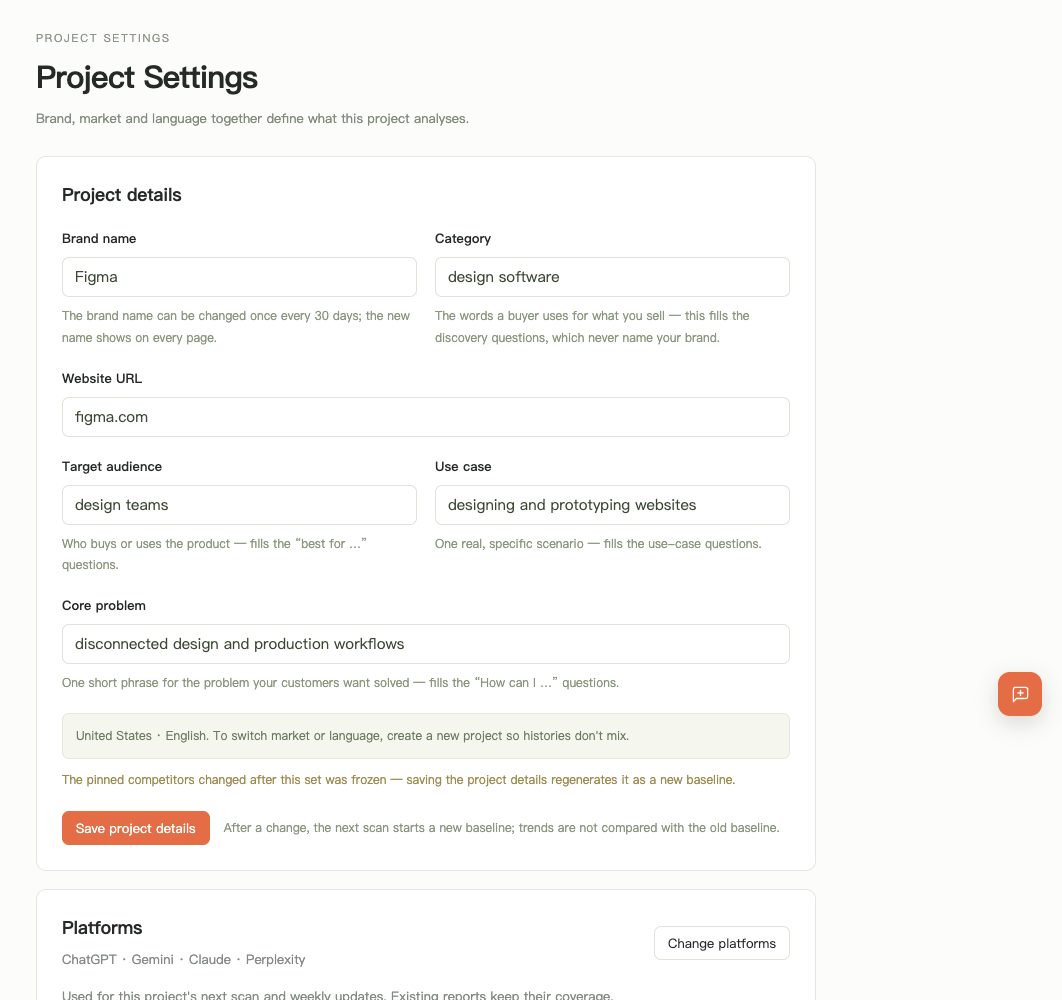
Kairosy asks real buyer questions to six engines (ChatGPT, Gemini, Claude, Perplexity, DeepSeek, Doubao; each project picks 4 of the 6), keeps every answer with its cited sources, scores sentiment per answer and turns negative narratives into a fix strategy. Tracked prompts re-run daily, each brand × market slot gets a deep rescan every Monday, and a weekly email flags score drops, a competitor being preferred, an engine flipping and new negative keywords. Basic $29, Pro $99 and Growth $399 a month buy 1 / 5 / 20 slots and 15 / 60 / 250 prompts a day ($25 / $79 / $299 annual) after a 7-day trial with no card, plus per-country scans (25 countries + Global) on paid plans. Not offered: seats or client isolation (Growth is 20 slots in one account), prompt-volume data, SERP rank tracking, and alerts faster than the weekly email.
Otterly.AI
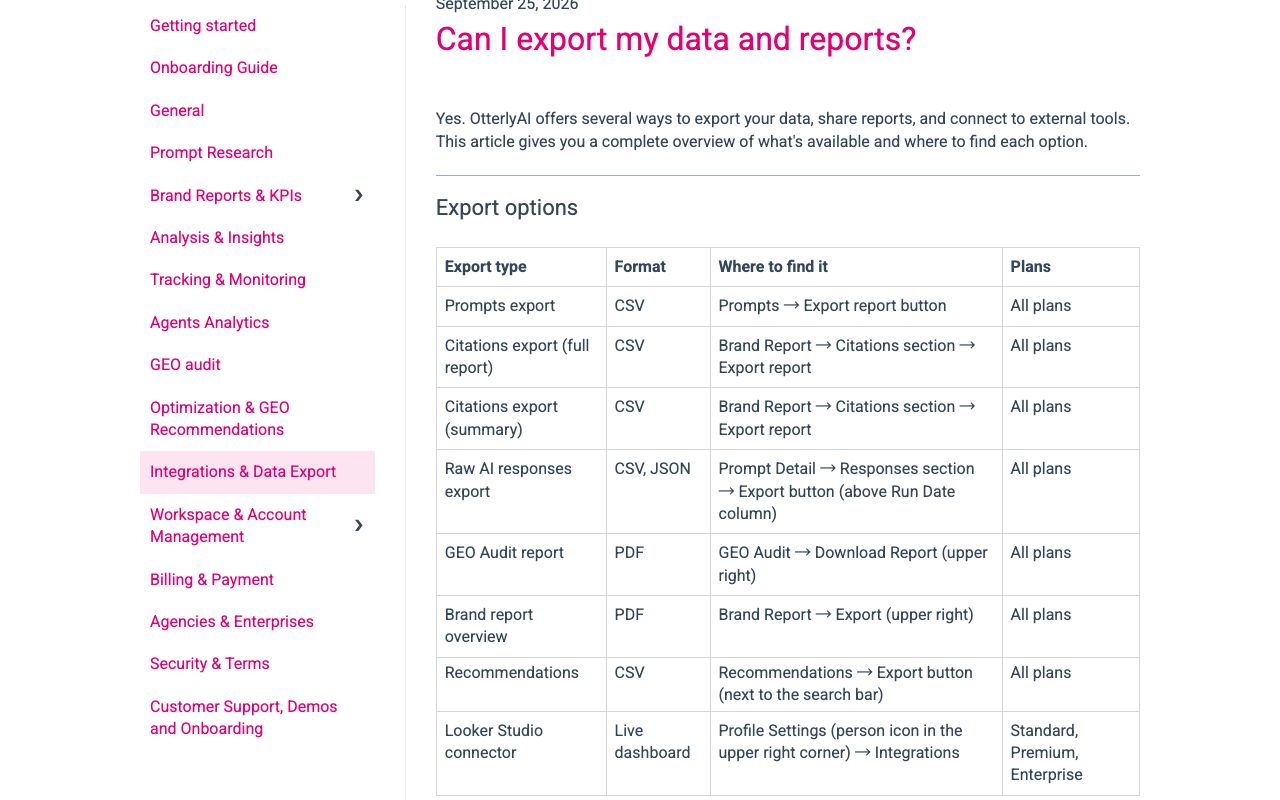
Lite is $29/mo for 15 prompts on ChatGPT, Google AI Overviews, Perplexity and Copilot, (Claude, Gemini and AI Mode are add-ons at $9–$439/mo each); Standard is $189/mo for 100 prompts plus API access. Prompts run daily across 70+ countries in any language, and the export article shows raw AI responses leaving as CSV or JSON on every plan.
Peec AI
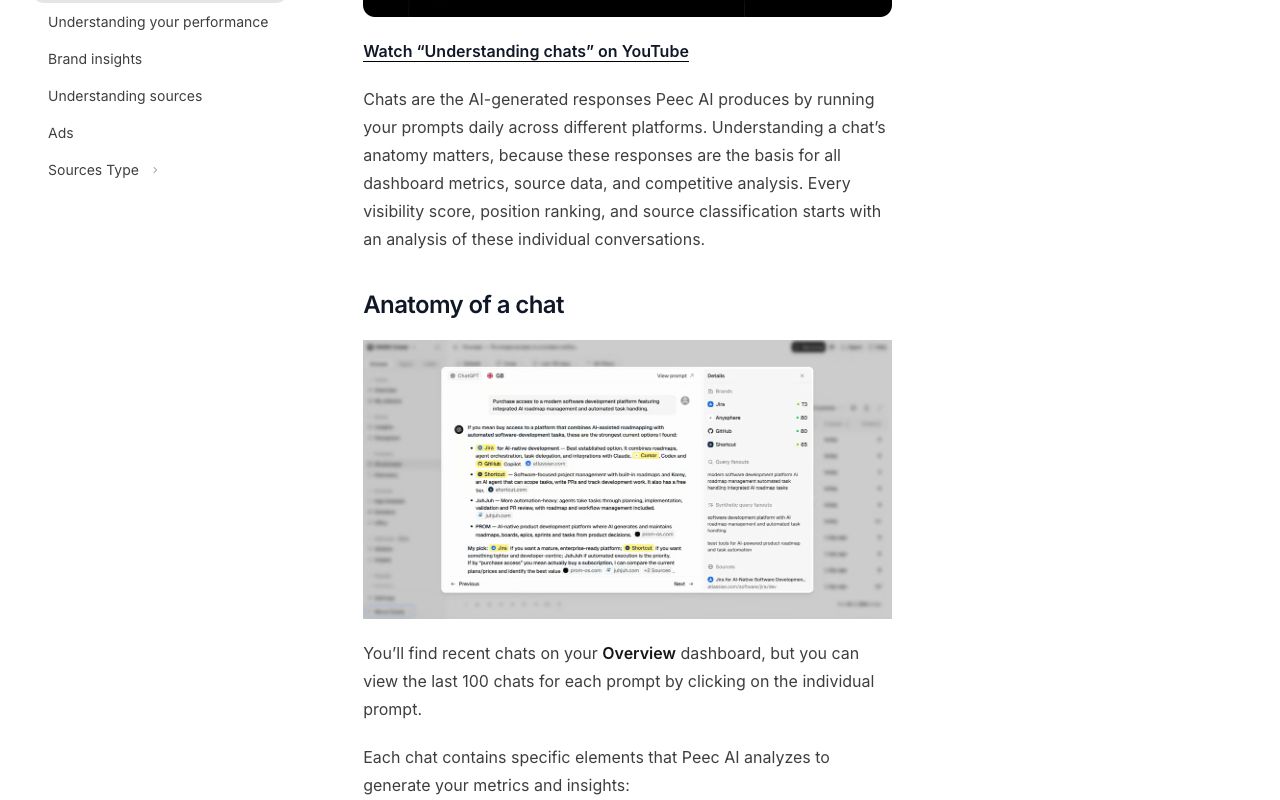
Starter, Pro and Advanced carry 50, 150 and 350 prompts, 3 active models, daily tracking and 1, 2 or 5 projects; Advanced adds multi-country tracking and Looker Studio, annual billing is 15% off, extra countries are free. Prices are in euros on peec.ai/pricing and not reproduced here. The chats documentation describes the last 100 chats per prompt with main response, 0–100 sentiment, mentioned brands, position and sources, plus an account-wide chat export; API access is Enterprise-only.
Profound
The free trial runs 50 prompts daily for 7 days on ChatGPT, Gemini and Google AI Overviews in one region and one language, with no export. Everything else is custom-priced Enterprise: up to 9 engines, CSV/JSON export, SSO, SOC 2 and a REST API returning raw per-execution responses, mentions and citations (600 requests an hour by default).
SEO suites
Semrush AI Visibility Toolkit
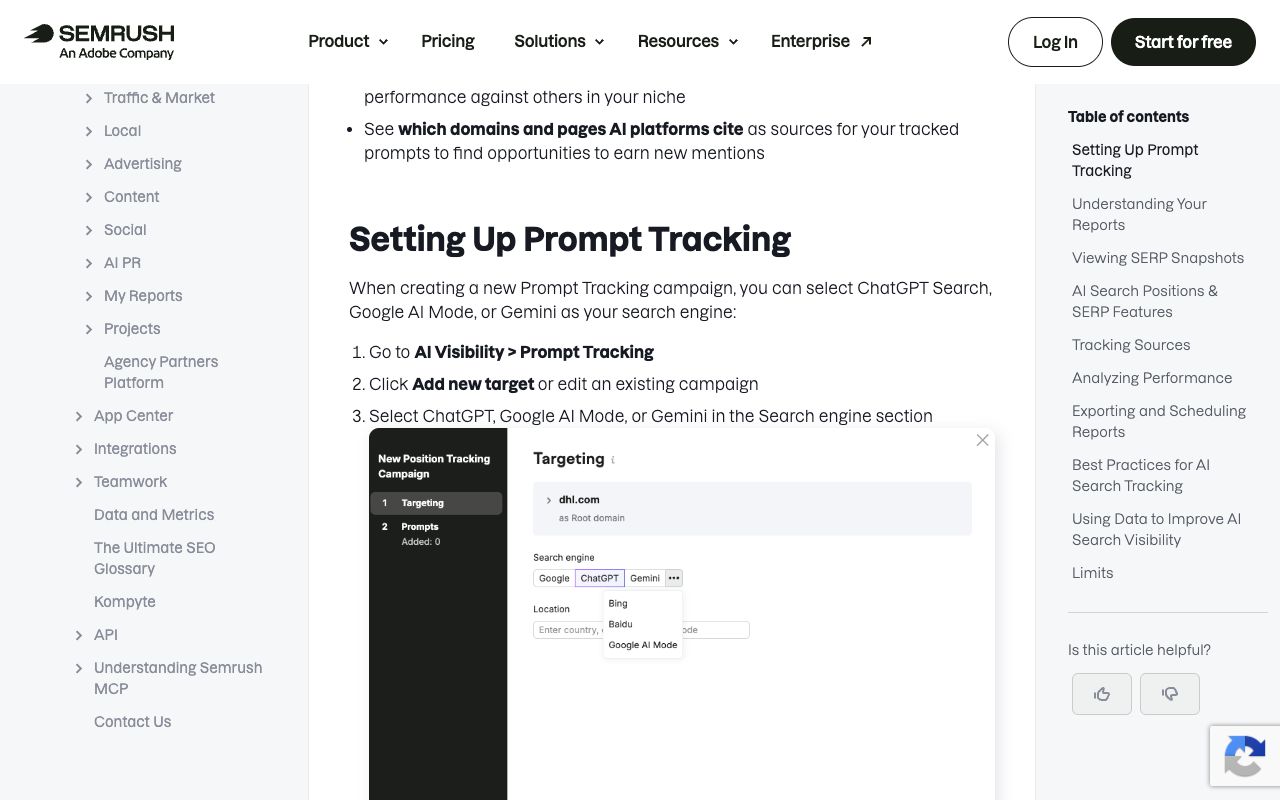
The toolkit is $99/mo billed annually for 25 custom prompts tracked daily on one domain, covering ChatGPT, Google AI Mode, Gemini and, in Brand Performance, Perplexity. Its knowledge base states: "Prompt responses are captured from real requests and not via any APIs of LLMs." Prompt Tracking exports to CSV, Excel or Google Sheets (1,000 rows a file) and its documentation does not mention sentiment.
Ahrefs Brand Radar
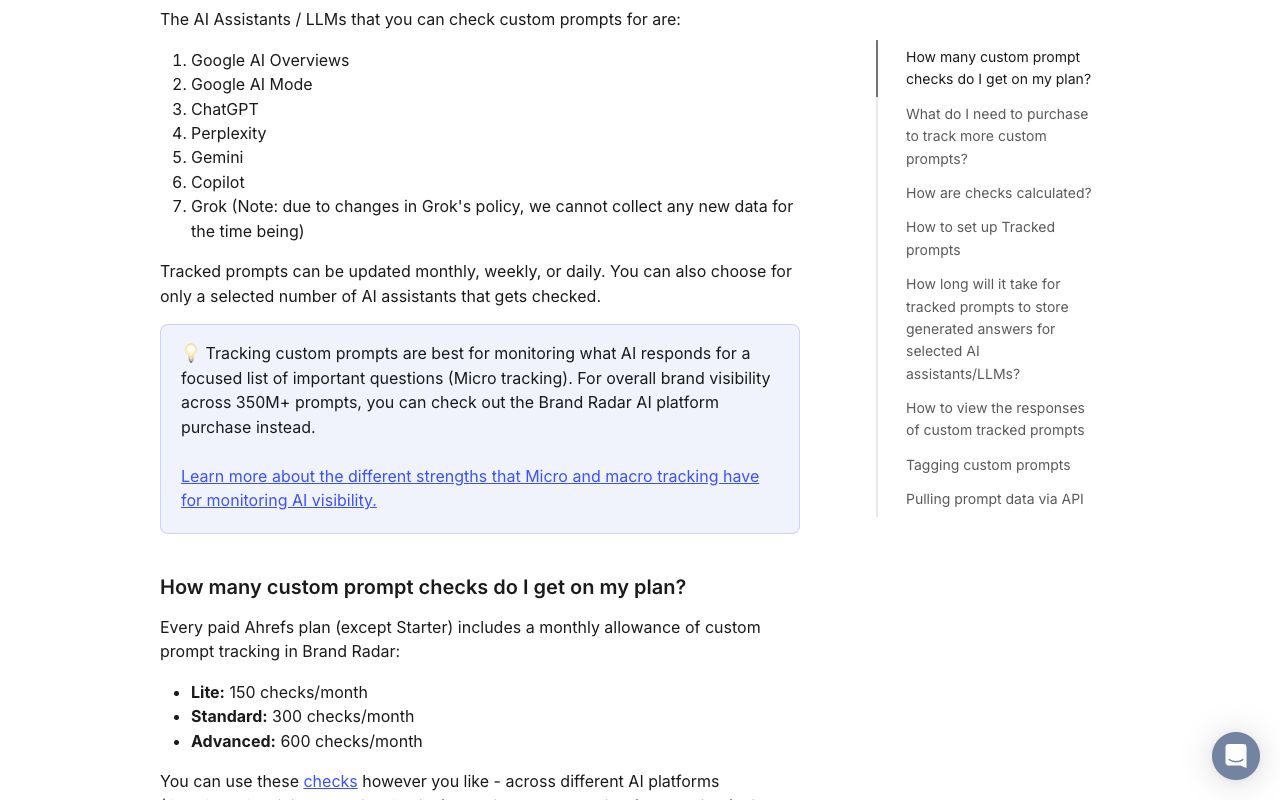
Two products, two cadences. The modeled index ($199/mo add-on) refreshes ChatGPT, Perplexity, Gemini and Copilot monthly over a 90-day window, per the methodology post of February 26, 2026, which also says prompts run through each platform's free public web interface. Custom prompts are the monitoring product: daily, weekly or monthly refresh per platform, 1 check = 1 prompt × 1 LLM × 1 location, 150 checks a month on the $129/mo Lite plan, packs from $50 for 2,500, API pulls free of units.
SE Ranking AI Visibility Tracker
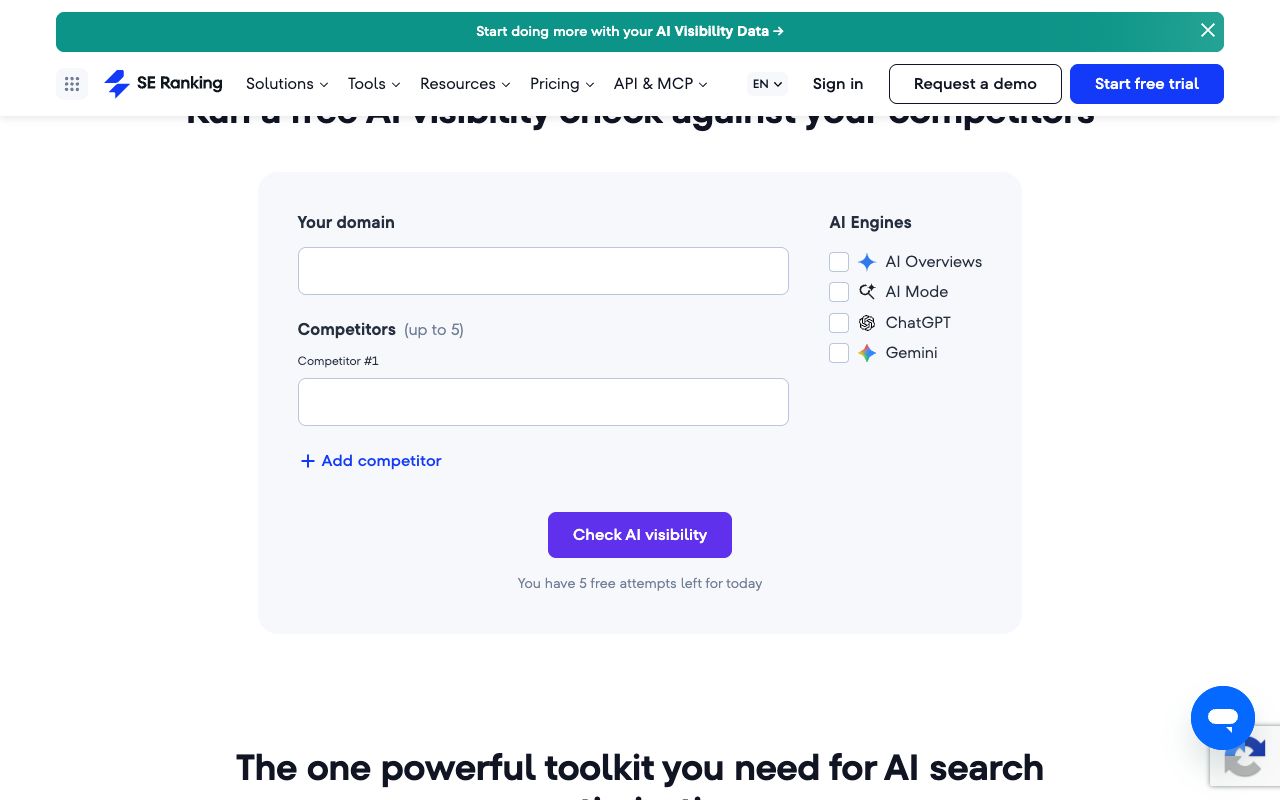
An $89/mo add-on ($71.20 on annual billing) on top of Core at $129/mo, which itself includes 100 AI prompts a day. Coverage is Google AI Overviews, AI Mode, ChatGPT and Gemini, with CSV download: cheapest for a team already in SE Ranking, narrowest engine list here.
Agency services
Agencies run a platform and add judgment. Percepture is custom-priced and promises a monthly report "showing where your brand appears, how often, and what sentiment AI platforms associate with you" across ChatGPT, AI Overviews, Gemini, Perplexity and Grok. Netpeak is also custom, with monthly reports on GEO visibility changes and a 10–14 day launch. As an anchor, LLM Pulse's agency guide of May 11, 2026 suggests $500–$1,500 a month for a monitoring tier, a vendor's suggested band rather than an observed rate. Two questions decide this tier: which platform produces the numbers, and whether the raw answers stay yours when the retainer ends.
How Do the Shortlisted Vendors Compare? The Procurement Table
Two tables: operations first, coverage second. "Not verified" means the claim was not on the vendor's public pages on October 21, 2026; it is a trial question, not a no.
| Vendor | Engines | Regions / languages | Cadence | Evidence kept | Permissions | Export / API | Entry price |
|---|---|---|---|---|---|---|---|
| Kairosy | 4 of 6 | 25 countries + Global | Daily; weekly deep rescan | Full answers + sources | One account, no seats | Verify in trial | $29/mo |
| Otterly.AI | 4 + 3 add-ons | 70+ countries, any language | Daily | Raw responses + citations | Unlimited members | CSV/JSON; API from $189 | $29/mo |
| Peec AI | 3 active models | Multi-country on Advanced | Daily | Last 100 chats per prompt | Unlimited users | Chat export; API Enterprise | EUR, see site |
| Profound | 3 trial, 9 Enterprise | 1 region on trial | Daily | Per-execution responses | SSO, SOC 2 | CSV/JSON + API, Enterprise | Custom |
| Semrush | 3 (+Perplexity) | 14 countries for volumes | Daily | Cited pages per prompt | Users from $45/mo | CSV, 1,000 rows | $99/mo annual |
| Ahrefs | 6 (+Claude custom) | Per-location checks | Index monthly; prompts daily–monthly | Per-check responses | Plan seats | API, no units used | $129/mo + packs |
| SE Ranking | 4 | Not verified | Daily | Mentions and links | Plan seats | CSV | $89/mo add-on |
| Vendor | Mentions | Citations | Sentiment | Brand accuracy |
|---|---|---|---|---|
| Kairosy | Yes | Yes, Source Analysis | Yes, per answer + 0–100 | Negative narratives, no fact-check |
| Otterly.AI | Yes | Yes | Yes, score | Not verified |
| Peec AI | Yes, with position | Yes | Yes, 0–100 per chat | Yes, fact-checked prompts |
| Profound | Yes | Yes | Yes (API) | Yes (factcheck) |
| Semrush | Yes | Yes | Not advertised | Not verified |
| Ahrefs | Yes | Yes | Not verified | Not verified |
| SE Ranking | Yes | Yes | Not verified | Not verified |
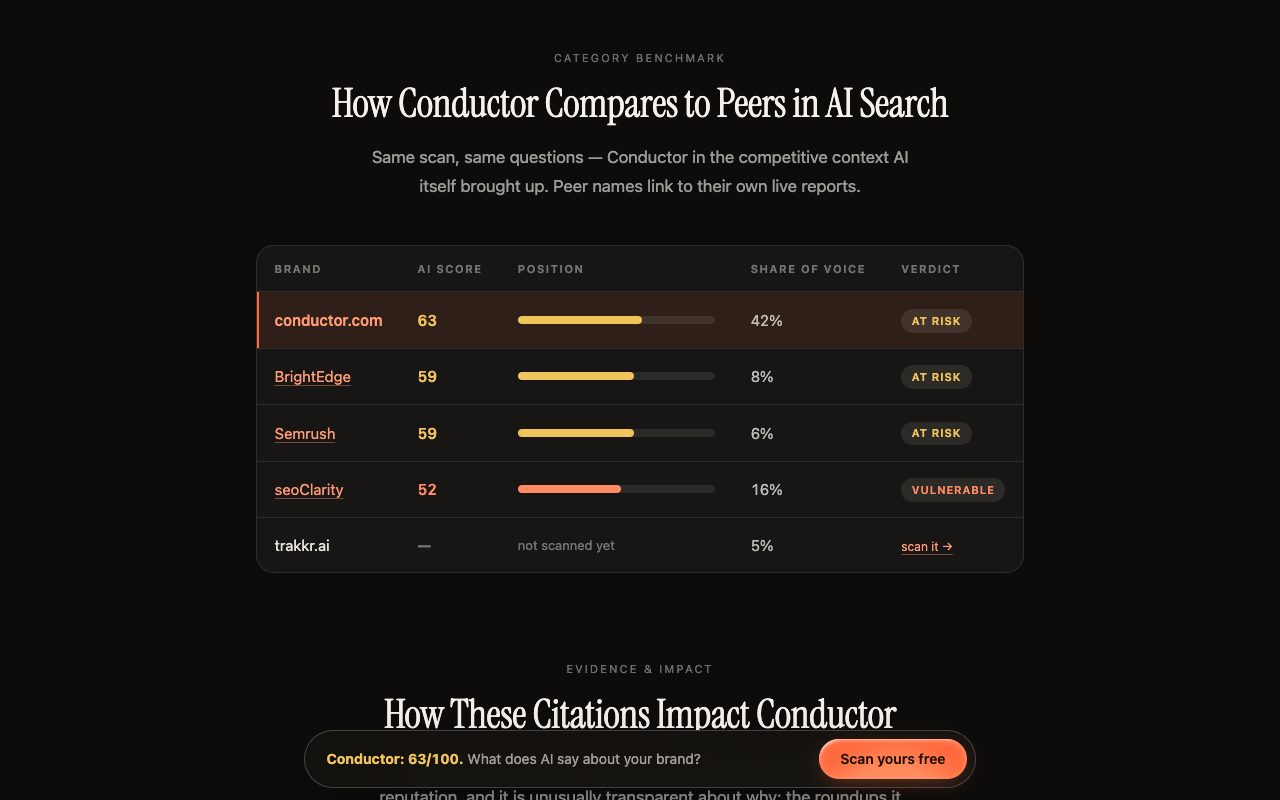
What good evidence looks like: Kairosy's public scan of Conductor (August 5, 2026) pairs a 63/100 reputation score and 92% AI visibility with what each engine in that scan said and cited, so the "expensive and complex" narrative traces to review sites, not product pages. Demand that trail from every vendor.
What Should You Ask Each Vendor Before the Trial Starts? (Vendor Questionnaire)
A template: send it in writing and keep the answers next to the trial results.
- Collection: consumer interface or model API per engine, and which search mode?
- Cadence and location: the rerun schedule per engine, whether a manual rerun counts against quota, and whether a second country costs a prompt, check or credit.
- Evidence: full answer text, cited URLs, timestamp and model stored per run, and for how long?
- Change log: run-to-run differences per prompt (mentioned, not mentioned, competitor recommended, new source)?
- Coverage: which of mentions, citations, sentiment and factual accuracy are measured, and how is sentiment scored?
- Permissions: seats, roles, SSO, client isolation between brands, audit logs.
- Export: format, row and rate limits, and whether raw answers are included.
- Pricing unit: prompts, checks, credits, slots or engines, and the formula for adding a brand, market or engine.
- Exit: what we keep after cancellation, in what format, and whether a paused account can read history.
How Do You Run a Two-Week Acceptance Checklist Before You Sign?
Also a template: run it on the trial with 20–30 buyer questions you will keep for a year, and decide on evidence you produced, not the demo.
Week 1: can you reproduce the answers?
- Day 1: load the fixed prompt set, lock engines and country, record the first full run as the baseline.
- Days 2–3: open five answers in the tool and ask the same questions yourself in each engine that day; wording will differ, but reject if full text, timestamp and cited URLs are missing.
- Days 4–5: confirm the schedule fired without you and that history is per run, not a rolling average.
- Also: check the most-cited pages with the free AI crawl checker; an unfetchable citation is a fix, not a win.
Week 2: can you locate changes, export the data and price the portfolio?
- Days 8–9: pick two prompts where a competitor is recommended and confirm the change view shows which run flipped and which source appeared.
- Day 10: export everything and re-open it: every row needs prompt, engine, country, timestamp, full answer and URLs.
- Days 11–12: price the real portfolio in the vendor's unit, not the headline plan (example below).
- Days 13–14: write the acceptance memo: reproduced, change log, export complete, total monthly cost, questionnaire answers still missing.
| Vendor (unit) | Example values: Northwind, 3 brands × 30 prompts × 4 engines × 1 country, daily |
|---|---|
| Kairosy (slots + prompts/day) | 3 slots, 90 prompts a day → Growth ($399/mo); Pro stops at 60 a day |
| Otterly.AI (prompts + engine add-ons) | 90 prompts → Standard ($189/mo) plus any engine outside the base four |
| Peec AI (prompts × models × days) | 90 × 3 × 30 = 8,100 chats a month, under Pro's 13,500, but 3 projects need Advanced |
| Ahrefs custom prompts (checks) | 90 × 4 × 1 × 30 = 10,800 checks a month → $250 Scale pack on top of an Ahrefs plan |
Example arithmetic from published units, not quotes.
What Do Buyers Ask About Vendors Monitoring AI Answer Engines? FAQs
Do API results differ from what users see in the consumer interface?
Yes. Semrush says its responses come from real requests rather than LLM APIs, Ahrefs runs prompts through the public web interfaces, Profound exposes raw per-execution responses through its API. Ask every vendor, including Kairosy, which path each engine uses, because an API call can skip the search mode, personalization and location signals that shape the answer a buyer reads.
How long is answer history retained, and what happens if we cancel?
None of the seven pricing pages checked states a retention period, so retention belongs in the questionnaire and the order form. Peec shows the last 100 chats per prompt, and a Kairosy account that drops to free after the trial can still read past reports but cannot scan. Export during the acceptance test so the history exists outside the vendor.
How do vendors monitoring AI visibility handle multiple brands?
Three models. Kairosy and Peec sell projects or slots (a brand × market, or a project with its own prompts). Ahrefs and Peec's agency plans sell a pooled unit, checks or credits, that you allocate across brands. Agencies sell a report per client. If clients must be invisible to each other, only vendors with client isolation and roles qualify; Kairosy does not offer that layer.
Is daily monitoring necessary, or is weekly enough?
Daily reruns are about sample size, not speed: five daily runs make a weekly trend readable, while one weekly run says little about whether a change was real. Daily prompts plus a weekly deep run per brand, the Kairosy cadence, is a reasonable floor for a single-market brand.
Can one vendor cover mentions, citations, sentiment and accuracy?
Mentions and citations are table stakes across all seven. Sentiment is verified on Kairosy, Otterly, Peec and Profound; accuracy, meaning claims checked against the brand's own facts, only on Peec and Profound, while Kairosy surfaces negative narratives without a fact-check step. Whatever you pick, write the rerun schedule, retention period and export format into the order form, with the right to export full history at cancellation.
See what AI says about your brand
Run a free scan across ChatGPT, Gemini, Claude & Perplexity in about 30 seconds.
Run my free scan