Why Use AI Search Monitoring Tools in 2026? The Evidence
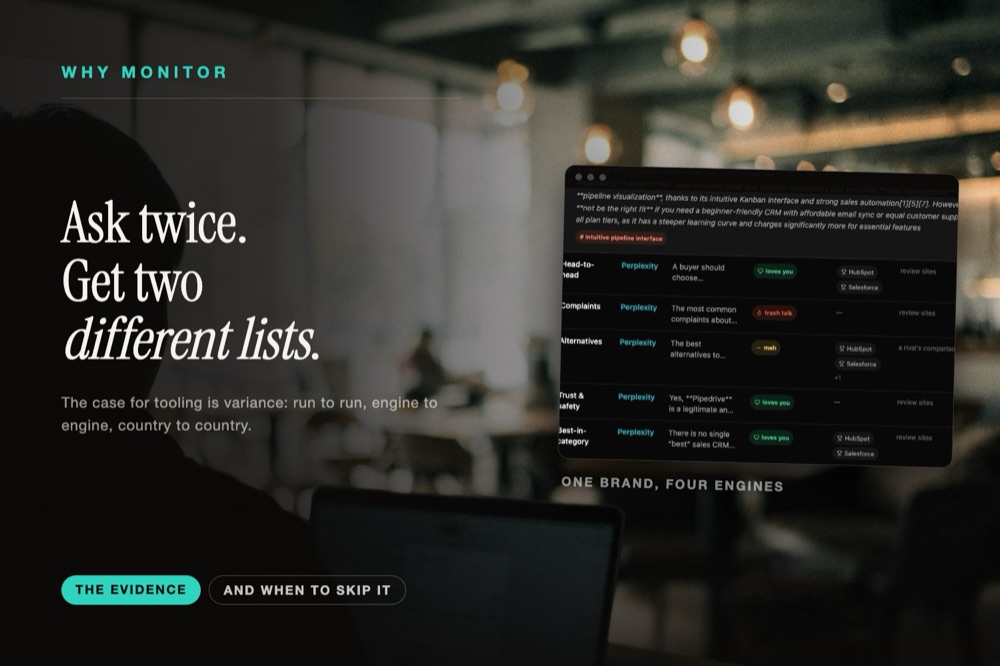
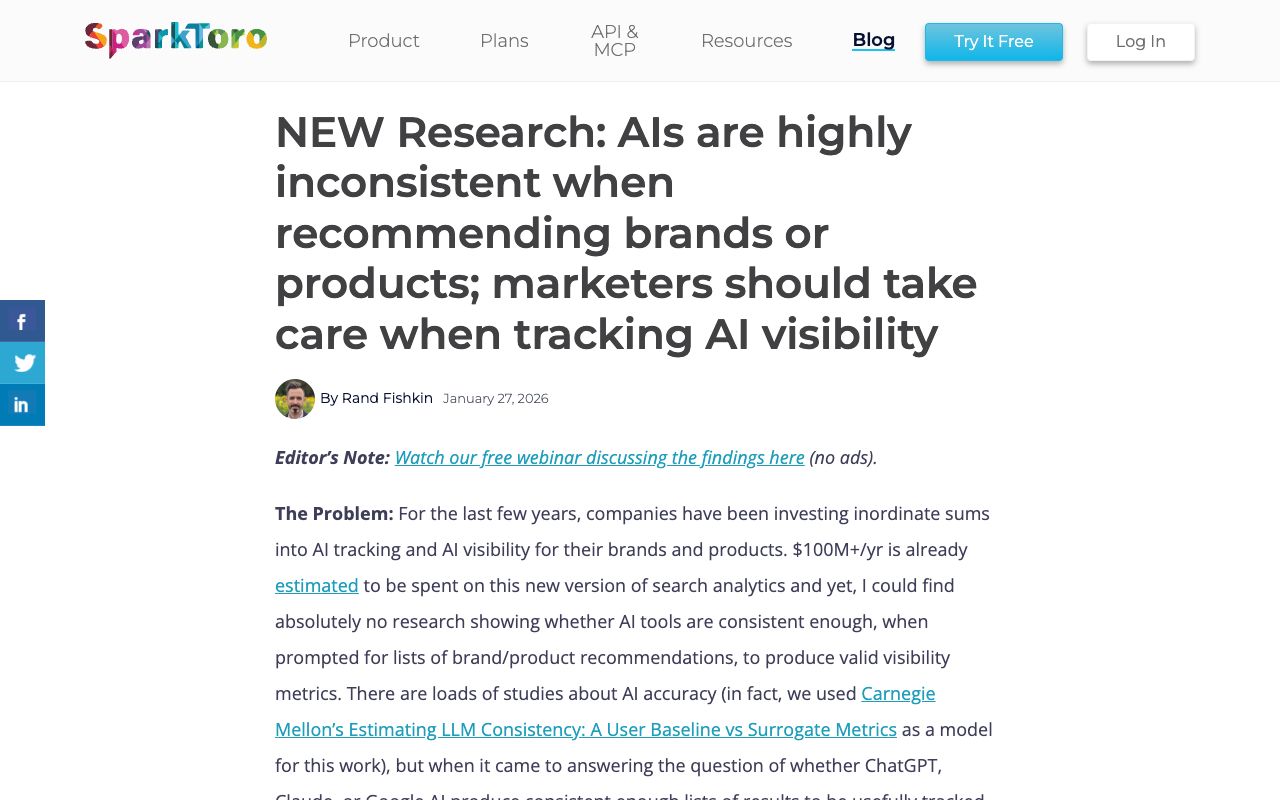
Because one manual lookup is a sample of one, and AI answers do not repeat. SparkToro's consistency research, published January 28, 2026, had 600 volunteers run 12 brand-recommendation prompts through ChatGPT, Claude and Google's AI a combined 2,961 times. The odds of seeing the identical brand list twice came out below 1 in 100. Whatever you concluded from opening ChatGPT once last Tuesday was noise you mistook for a reading.
That is the case in a paragraph, but the real question — why use AI search monitoring tools rather than checking by hand — deserves evidence. Below: four dated studies on how far AI answers drift, the blind spots a manual check can never close, an honest section on when you should not buy anything yet, and six tools with pricing checked on August 5, 2026.
Why Use AI Search Monitoring Tools at All?
The short version, before the sourcing:
- Buyers now build shortlists inside chat assistants, and those sessions never appear in your analytics.
- A single answer carries almost no statistical signal about your brand — measured, not asserted.
- Four engines can disagree wildly about the same brand on the same day.
- What matters is the change, and you cannot detect a change you never had a baseline for.
Why Track AI-Driven Search Engines in the First Place?
Four reasons, each with a source and a date attached. Two of them concern revenue you will never see attributed.
1. The shortlist is written inside the chat. G2's "Answer Economy" report, published May 2026 from a survey of 1,076 B2B software buyers run in March 2026, found 51% now start software research in an AI chatbot more often than in Google — up from 29% in G2's 2025 edition. Sixty-nine percent said a chatbot surfaced something that made them pick a different vendor than planned.
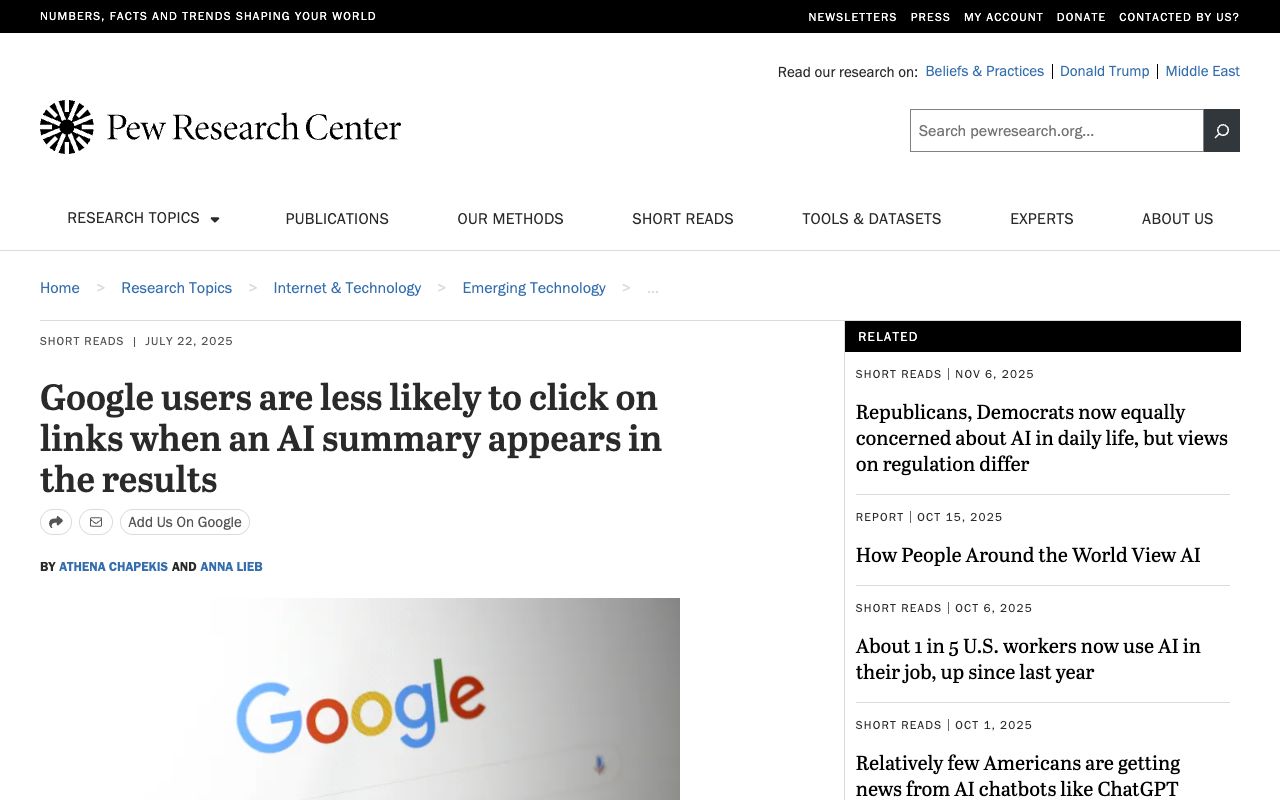
2. The click that would have told you never happens. Pew Research Center, publishing July 22, 2025 on 68,879 Google searches from 900 U.S. adults in March 2025, found users clicked a traditional result on 8% of visits when an AI summary appeared, versus 15% when it did not — and clicked a link inside the summary on 1%. Your referral logs are not a proxy for your presence.
3. Being mentioned is not being recommended. This distinction is invisible to a casual look, and it is where most brands lose. Kairosy's scan of Bombas shows 86% visibility — the engines bring the brand up in nearly every relevant answer — alongside a 9% recommend rate and a 52/100 overall score. Present in the conversation, absent from the endorsement.
4. Most categories are still unowned. Semrush's study of 50,000+ brands across 1,094 U.S. topics from January to June 2026, published July 20, 2026, found a clear category owner in only 15.2% of topics; another 53.7% were fully unsettled. The land grab is open, which argues for measuring now rather than after someone plants a flag.
How Much Do AI Answers Change Between Runs and Engines?
This is the section that decides the question. If answers were stable, a quarterly manual check would be fine. They are unstable in four separate dimensions, and each has been measured.
| Study (published) | Scale | What it measured | Result |
|---|---|---|---|
| SparkToro (Jan 28, 2026) | 600 volunteers, 12 prompts, 2,961 runs across ChatGPT, Claude, Google AI Overview | Run-to-run repeatability of brand lists | Under 1 in 100 chance of the same list twice; under 1 in 1,000 in the same order |
| arXiv 2607.13304 (Jul 14, 2026) | 12,933 responses, 20 brands, 8 languages, 3 models | Where the noise actually comes from | Single-answer brand signal ICC 0.0146; query language alone = 26.5% of variance |
| SISTRIX (17 weeks, Dec 17, 2025 – Apr 8, 2026) | 82,619 prompts, 6 countries, 3 platforms | Weekly turnover of cited domains | AI Overviews 5%; Google AI Mode 56%; ChatGPT Search 74% new domains per week |
| Profound (Jun 5, 2025, upd. Aug 2025) | 680M citations, Aug 2024 – Jun 2025 | Which sources each engine leans on | Wikipedia = 47.9% of ChatGPT's top-10 share; Reddit = 46.7% of Perplexity's |
The arXiv paper is the one to read if you read only one. Its authors decomposed brand-answer variance into resampling, prompt paraphrase, model identity and query language, and found a single response carries a brand-ranking reliability of roughly 0.01. Across their full crossed design — many prompts, many repeats, three models, eight languages — that rose to 0.36, with returns flattening fast: a repeat past the fifth cut relative-error variance by only 0.0003. So one answer tells you nothing, five repeats tell you a little, and only breadth produces a defensible number. That is arithmetic nobody does by hand every Monday.
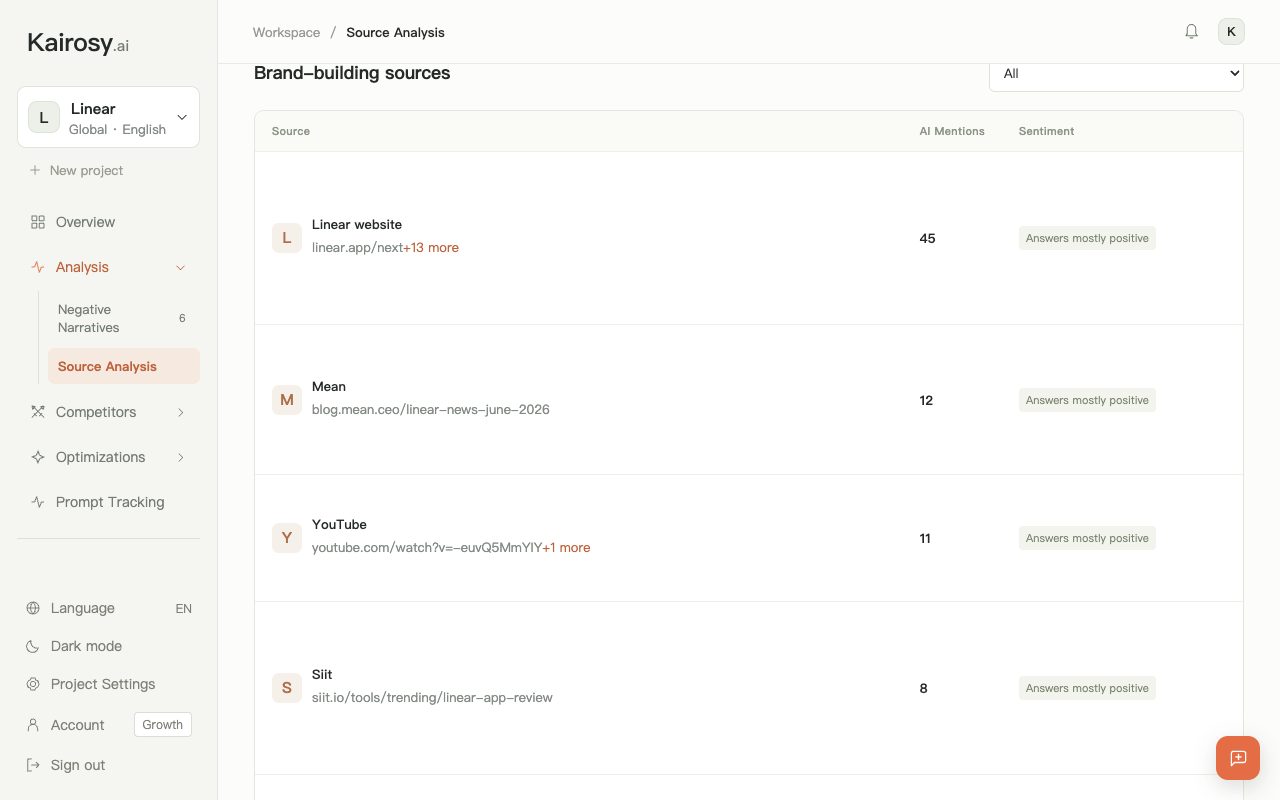
Engine disagreement is the part people underestimate. Kairosy's scan of Vacasa put Claude at 98/100 and Perplexity at 46/100 for the same brand in the same run — 100% visibility, 42% favorability, and every engine steering buyers to competitors on head-to-head questions. Check only ChatGPT and you would have filed a decent-looking result.
What Can Manual Spot-Checks Never Show You?
Manual checking is not lazy — it is structurally incapable of producing certain facts. Five of them:
Sample size. The reliability numbers above are the whole argument. Nobody repeats a prompt thirty times across four engines, in two languages, every week, by hand.
Your session is not your buyer's session. A signed-in assistant carries your chat history, saved context and location; your buyer's carries theirs. You are reading a personalized answer and treating it as the market's.
Language and market. The variance decomposition put 26.5% of the movement on query language alone, the largest systematic factor it isolated. If you sell in Germany and France and check in English, you have not checked.
History. A screenshot is not a time series. When a competitor starts appearing in the "alternatives to" answer, what tells you is a diff against last week — not a memory of what you read a month ago.
Attribution. An answer tells you what the model said, not which URL produced it. Without the source list you are guessing at what to fix — and if your site is blocked to AI crawlers, no amount of content work moves the number. Our free AI crawler checker settles that in seconds.
Why Choose an AI Search Monitoring Platform for Your Business?
Flip the blind spots around and you get the buying case. Why choose an AI search monitoring platform for your business over a spreadsheet and a calendar reminder? Four things a manual routine cannot manufacture:
- Sampling at volume. SparkToro's own conclusion was that position tracking is unreliable but visibility percentage across dozens to hundreds of prompts, run repeatedly, is a sound metric.
- A defensible time series. Scheduled rescans produce the deltas that make a report worth reading, and alerts on the deltas that matter.
- Source attribution. Citation URLs per answer turn "the AI says we are expensive" into a specific review page you can go address.
- Market coverage. Running the same prompts by country and language is the only way to catch the 26.5% of variance that language contributes.
Aggregate visibility across a prompt set is the metric that survives the noise — we broke down how to compute it in our guide to AI share of voice. For the mechanics of setting monitoring up, the companion piece is the best ways to monitor brand mentions in AI search. This post is the argument; that one is the procedure.
When Should You Skip These Tools for Now?
An honest answer, because this category is full of people who will tell you the answer is never. Four situations where the budget belongs elsewhere:
Nobody is prompting for your category yet. If your product invented its category last quarter, there is no buyer question for you to appear in. Build demand first, measure second.
You are invisible and have not fixed the basics. If crawlers are blocked, your pages carry no structured data and you have three reviews on the entire internet, a subscription just re-confirms that weekly. Run a free AI-readiness audit, fix what it finds, then measure.
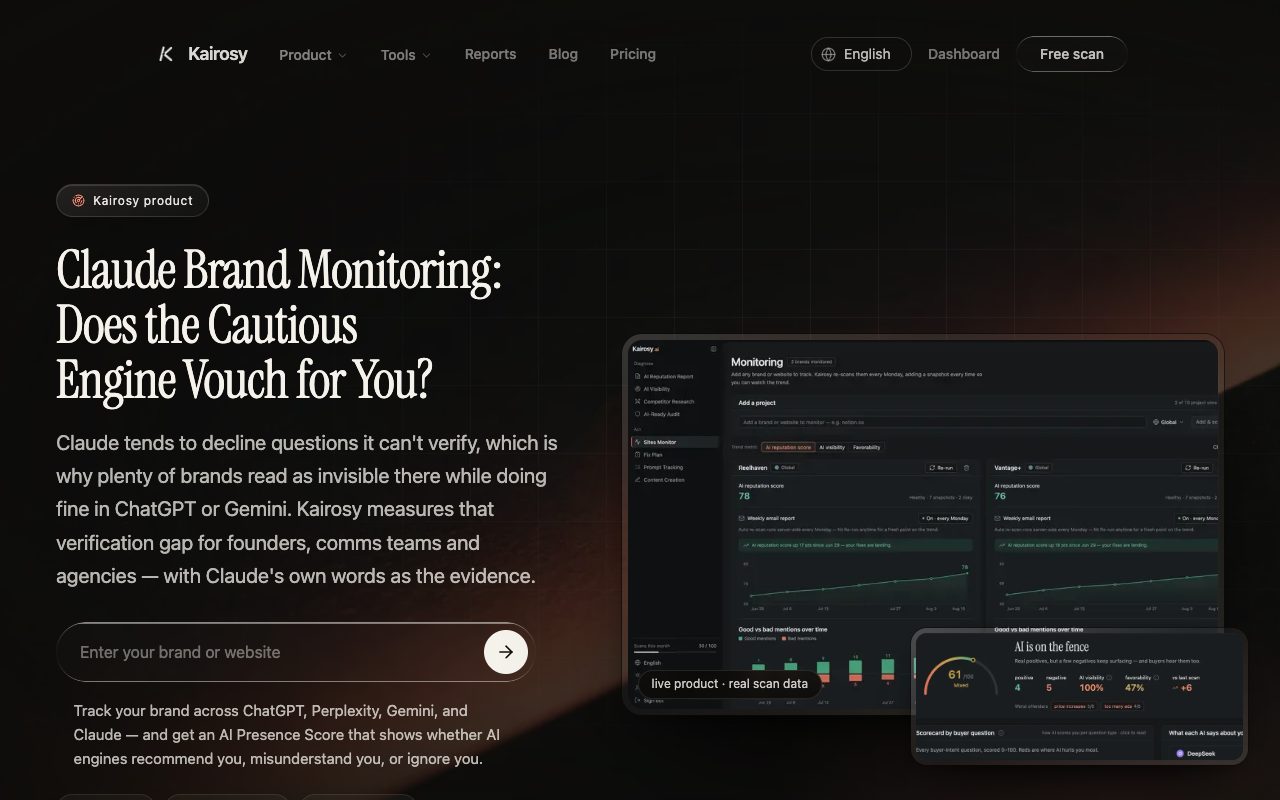
One brand, one market, tiny budget. A free trial scan plus a quarterly manual sanity check is defensible for a solo founder. Kairosy's free tier exists for exactly this: 7 days of full reports across ChatGPT, Gemini, Claude and Perplexity, no card.
Nobody owns acting on it. Monitoring with no assigned owner is a dashboard that gets opened twice. If nobody has time to chase a bad review page or publish a comparison article, the data will not help.
Which AI Search Monitoring Tools Are Worth Paying For in 2026?
There is no single best AI search monitoring tool — the right pick depends on how many engines you need, whether you want a diagnosis or a dashboard, and what you can spend. All prices below were read on the vendors' own pages on August 5, 2026; this market re-prices often, so verify before you buy.
| Tool | Engines at entry tier | Entry price | Cadence / allowance |
|---|---|---|---|
| Kairosy | ChatGPT, Gemini, Claude, Perplexity | Free 7-day trial; Basic $29/mo | Weekly brand rescans; daily prompt tracking on Pro+ |
| Profound | ChatGPT, Gemini, AI Overviews on the Trial | Free 7-day trial; Enterprise custom | Trial: 50 prompts daily for 7 days |
| Peec AI | 3 engines of your choice | €89/mo Starter | Prompt-credit based allowance |
| Otterly.ai | ChatGPT, AI Overviews, Perplexity, Copilot | $29/mo Lite ($25 annual) | 15 prompts; Claude and Gemini cost extra |
| Semrush AI Visibility Toolkit | ChatGPT, Google AI, Gemini, Perplexity | $99/mo per domain, billed annually | 25 prompts, daily rankings |
| SE Ranking AI Search | AI Overviews, AI Mode, Perplexity, ChatGPT | $89/mo add-on (+$129/mo Core plan) | Add-on to an existing SE Ranking plan |
Kairosy
Kairosy is a reputation scanner, not a rank tracker. It asks ChatGPT, Gemini, Claude and Perplexity the questions a buyer would actually type, classifies each answer as positive, neutral or negative, and returns a scorecard with the citation URLs behind every verdict plus a Fix Plan. Paid plans add weekly rescans per brand and market with email alerts on drops, daily prompt tracking, and market-specific scans across 25 countries. Basic is $29/mo, Pro $99, Growth $399; the free tier gives 7 days of full reports. What it is not: a keyword tool, a backlink index, or a Copilot tracker. See AI brand monitoring.
Profound
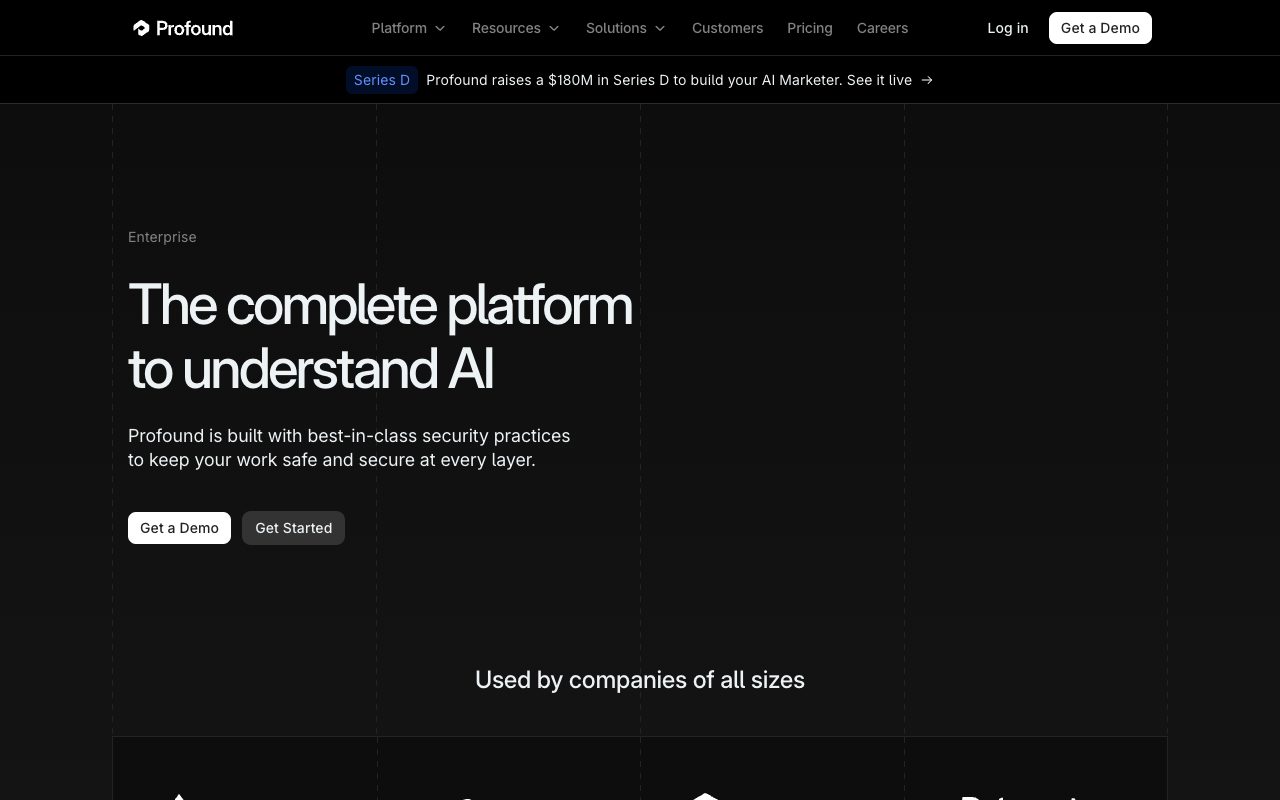
Profound is the enterprise end of the market, and publishes some of its best public research — including the 680-million-citation study above. For brands there is no longer a self-serve paid tier: a free Trial runs 50 prompts daily for 7 days on ChatGPT, Gemini and Google AI Overviews, and everything else is a custom-priced Enterprise contract with up to nine engines, SSO/SAML and SOC 2, which tells you where this is aimed. Vendr's anonymized buyer data (a third-party source) puts the median contract at $34,500 a year.
Peec AI
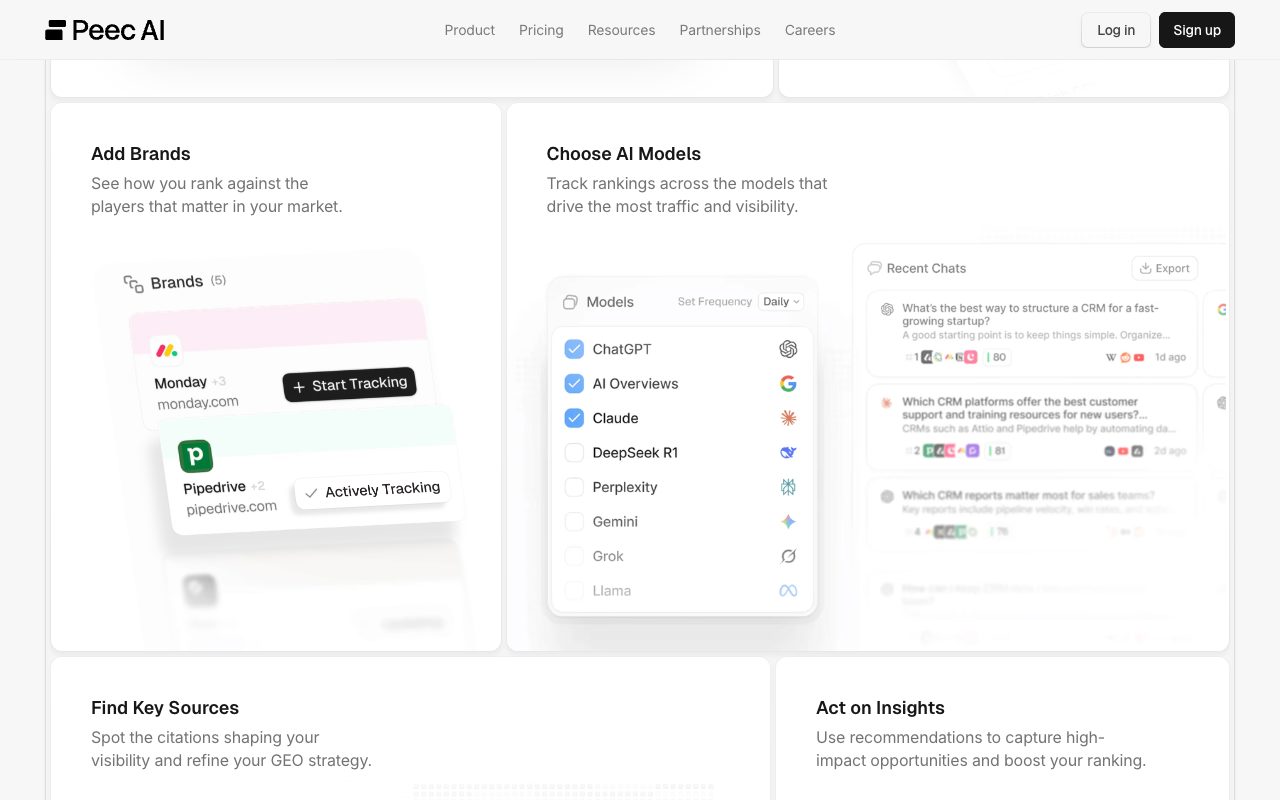
Peec AI targets marketing teams and agencies, tracking visibility, position and sentiment per prompt and per competitor. Lower tiers let you pick three engines from ChatGPT, Perplexity, Google AI Mode and AI Overviews; Enterprise covers nine or more including Claude, DeepSeek, Llama and Grok. Its comparison pages list Starter at €89/mo and Pro at €199/mo, Enterprise from $499/mo — but the pricing page renders numbers client-side and third-party roundups disagree, so confirm with Peec directly.
Otterly.ai
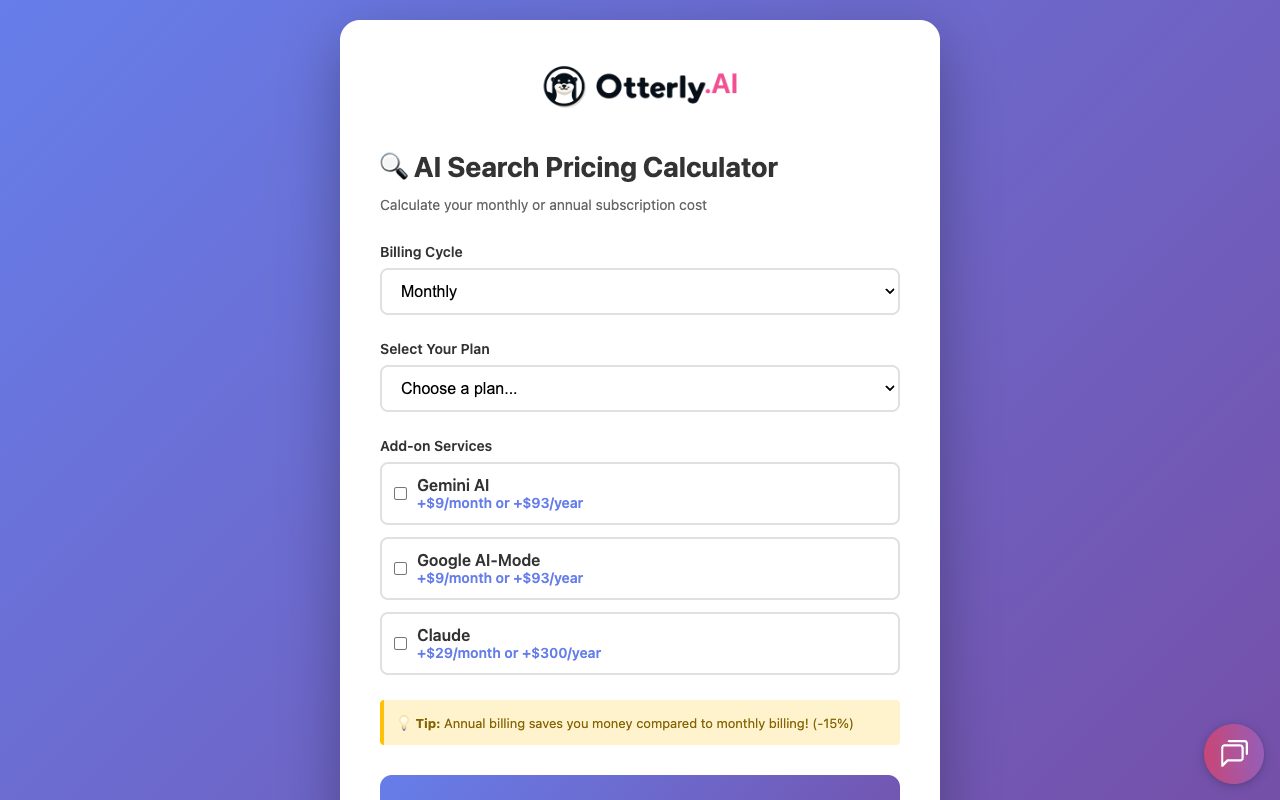
Otterly.ai has the cheapest genuine entry point among dedicated tools: Lite at $29/mo ($25 billed annually) for 15 prompts across ChatGPT, Google AI Overviews, Perplexity and Microsoft Copilot. Standard is $189/mo for 100 prompts with API and MCP access; Premium is $489/mo for 400. The catch is the add-on structure — Claude, Gemini and Google AI Mode bill separately, Claude from $29 to $439/mo by tier. A free trial is available, but budget the add-ons before comparing headline prices.
Semrush AI Visibility Toolkit
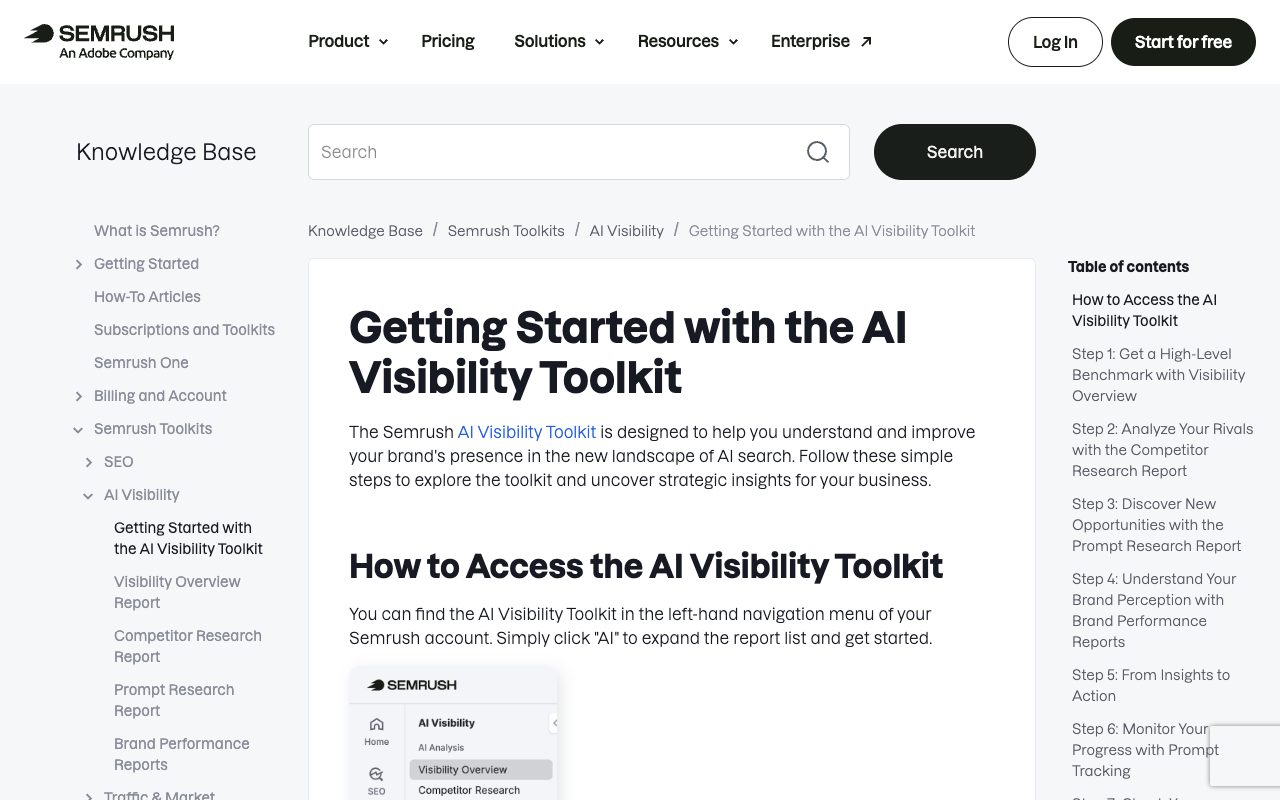
If your team already lives in Semrush, the AI Visibility Toolkit is the least disruptive option: $99/mo per domain billed annually for 25 custom prompts with daily AI rankings, pulling mentions from ChatGPT, Google AI, Gemini and Perplexity, plus competitor analysis and an AI-readiness site audit. Additional domains cost another $99/mo each, which gets expensive fast for agencies.
SE Ranking AI Search
SE Ranking sells AI tracking as an $89/mo add-on ($71.20/mo billed annually) on top of a platform plan — Core $129/mo, Growth $279/mo. It tracks AI Overviews, Google AI Mode, Perplexity and ChatGPT, with unlimited competitor research across those four. For an agency already running client rank tracking here, it is the cheapest way to bolt AI results onto reports clients already get.
Why Use AI Search Monitoring Tools FAQs
Are AI search visibility tools actually useful, or just dashboards?
They are useful in one specific way: they turn an unrepeatable observation into a number you can trend. A tool that only shows today's answer adds little over opening a chat window yourself. One that runs a prompt set repeatedly, keeps the history, and names the source URL behind a negative verdict is doing work you cannot do by hand. Judge any vendor on those three things.
Which is the best AI search monitoring tool for ChatGPT specifically?
If ChatGPT is your only concern, Profound's free Trial covers it, plus Gemini and AI Overviews, for one week before an Enterprise contract; Otterly.ai's $29/mo Lite tier includes ChatGPT among four engines for less. In practice the best AI search monitoring tool for ChatGPT is one that also covers the rest, because engine disagreement is what you are trying to catch — see ChatGPT brand monitoring for what that setup looks like.
How many vendors monitoring AI answer engines do I actually need?
One. Stacking two vendors monitoring AI answer engines mostly buys two slightly different numbers for the same brand, because each picks its own prompts, repeat counts and scoring. Choose the one whose engine coverage matches where your buyers are, then stay with it long enough for the trend line to mean something.
How often should AI search monitoring run?
Weekly is the sensible default for full brand scans, and daily is worth it for a small tracked prompt set if you are in an actively contested category. The SISTRIX data justifies the cadence: ChatGPT Search turned over 74% of its cited domains week to week, so a monthly check misses three-quarters of the movement.
Does AI search monitoring replace SEO reporting?
No, and be suspicious of anyone who says it does. Semrush's topic study found traditional SEO metrics predicted category ownership in AI answers only about half the time, branded search volume being the strongest single correlate at 55.7%. Both reports belong in the deck; they answer different questions.
What is the cheapest honest way to start?
Run one free full scan, read the source URLs behind any negative answers, and fix the two worst pages before subscribing. If the same complaints return on the next scan, that is when a paid tool starts paying for itself.
See what AI says about your brand
Run a free scan across ChatGPT, Gemini, Claude & Perplexity in about 30 seconds.
Run my free scan