Why Does ChatGPT Say Negative About a Brand? 5 Causes, Traced (2026)
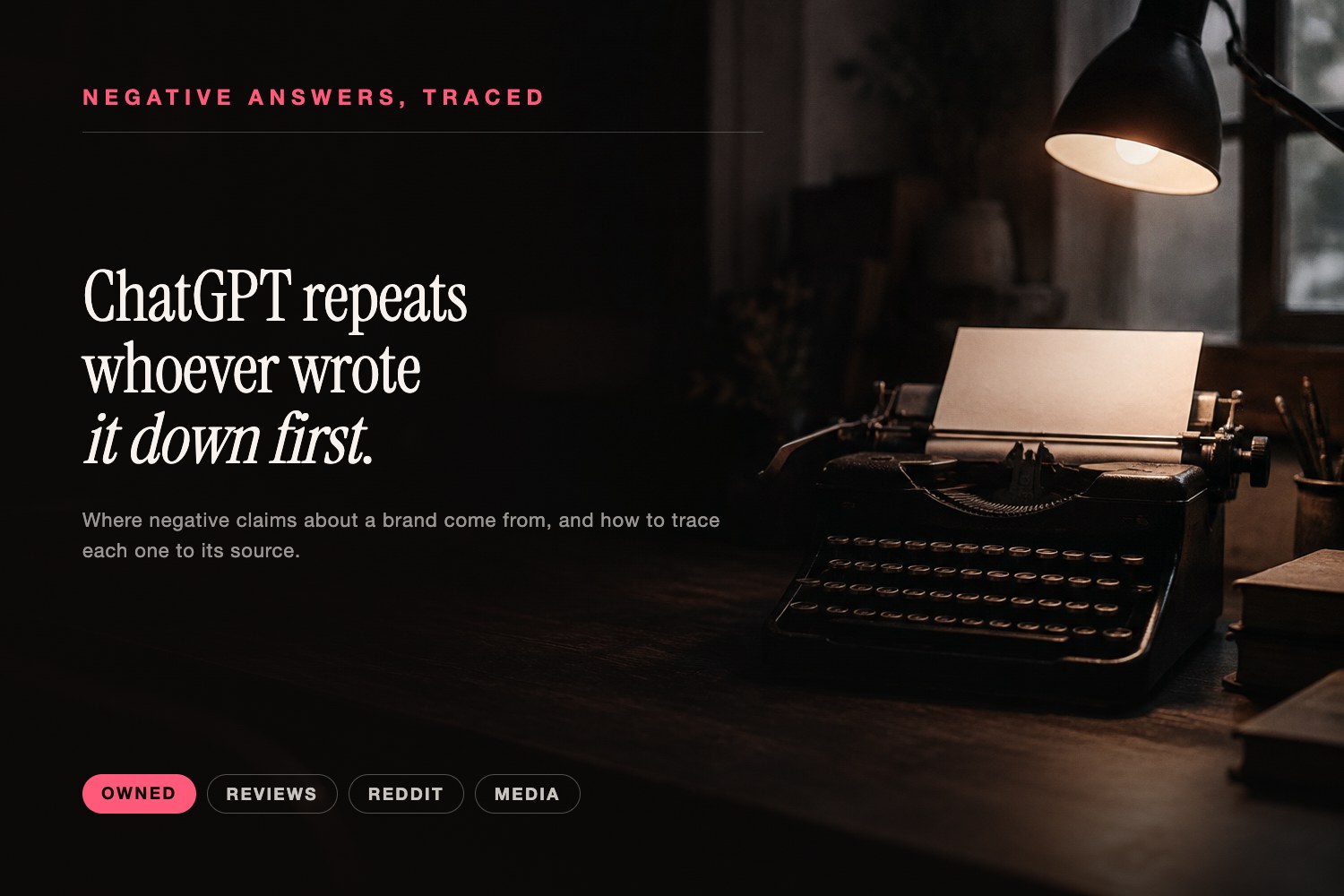
ChatGPT says negative things about a brand because that negative framing already exists somewhere on the public web, or inside the model's training data, and a buyer's question pulled it forward. The engine did not form an opinion; it retrieved one, compressed it, and presented it as advice. So the practical version of "why does chatgpt say negative about a brand" is a sourcing question: which page, thread, listing or article supplied the claim, and did it arrive through live search or through memorized text.
This post is the diagnosis: the five kinds of negative claims engines make, the public sources each comes from, real examples of a review site and a news event being echoed, and a repeatable way to trace any claim to its origin. The repairs live in a separate guide, how to fix negative AI mentions; here the goal is knowing what you are fixing before you touch anything.
What types of negative claims does ChatGPT make about a brand?
Almost every negative AI statement falls into one of five buckets, each with a different usual origin and repair path. Teams searching "why does chatgpt say negative about a brand" often spend a month on new content when the real problem was a stale Better Business Bureau record.
| Claim type | What the answer sounds like | Usual origin | Fixability |
|---|---|---|---|
| Quality / service | "Common complaints center on inconsistent quality and slow support" | Review sites, Reddit, app stores | Medium: respond and resolve, cannot delete |
| Pricing | "Costs grow significantly when you add features" | Comparison articles, forums, an unclear pricing page | High: clarify the page and the claim loses its source |
| Trust / scam | "Reviews are mixed-to-poor, so I would be cautious" | Trust-score directories, BBB profiles, scam checkers | Medium: claim the listing, answer complaints |
| Outdated | An old price or past incident presented as current | News archives, training snapshots, unchanged third-party pages | High: publish dated updates engines can retrieve |
| Wrong entity | Another company's complaints attached to your name | Name collisions in search results and review URLs | High: disambiguate with structured data |
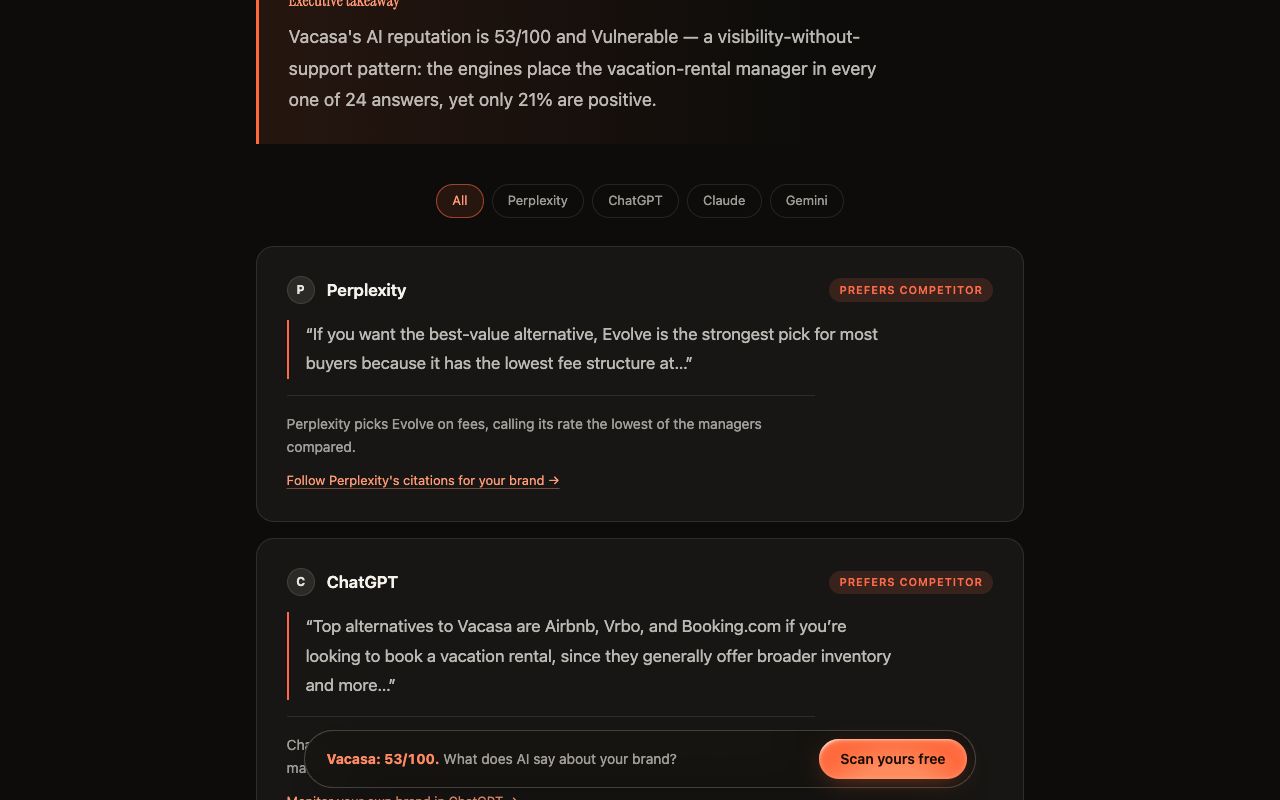
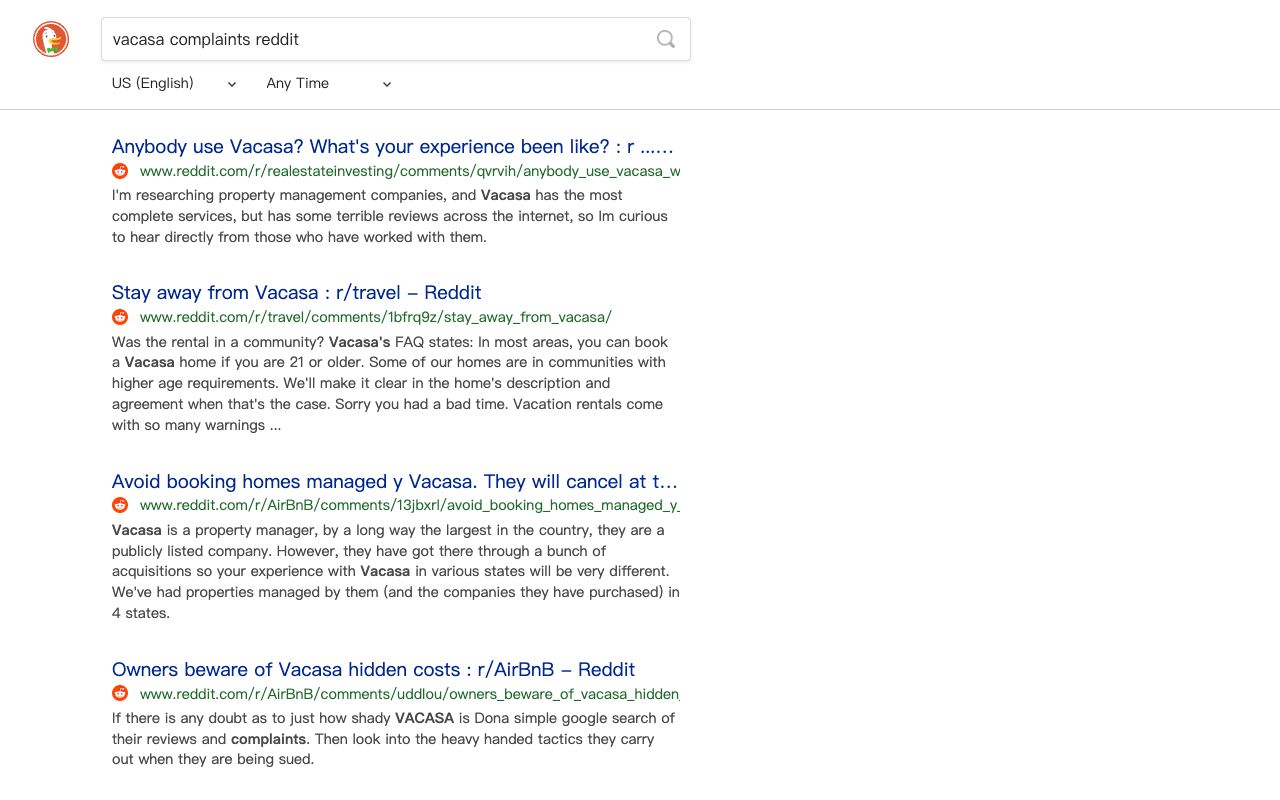
Kairosy's scan of Vacasa (2026-08-01, score 53/100, verdict "Vulnerable") is a quality-type example. Perplexity answered the complaints question with "The most common complaints about Vacasa are cleanliness problems, poor customer service / slow communication, and maintenance or amenity issues," and the report notes that engines keep echoing "inconsistent service", "slow support" and "limited inventory", traced back to review sites. Nothing in that sentence originated with the engine.
Where Does AI Get Negative Information About Your Brand?
Two channels feed an answer. The first is live retrieval: OpenAI's documentation describes web search as letting models "access up-to-date information from the internet and provide answers with sourced citations" (OpenAI developer docs). The second is memory: text absorbed during training and frozen at a cutoff. OpenAI's model reference lists the GPT-5.6 family with a knowledge cutoff of February 16, 2026 (OpenAI models page, checked September 2026). A claim can arrive through either channel, and the trace method differs for each.
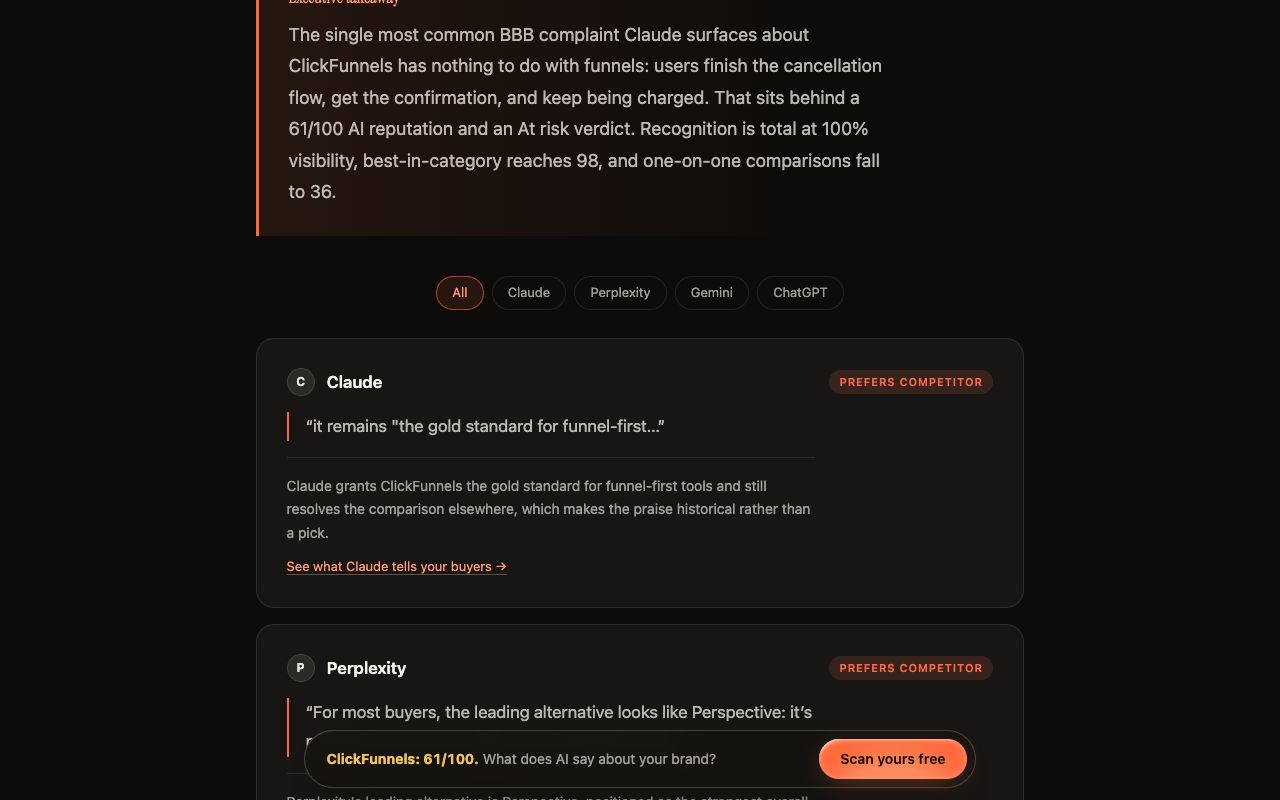
Within retrieval, the web is not weighted evenly. Profound's analysis of 680 million citations across ChatGPT, Google AI Overviews and Perplexity (August 2024 to June 2025) found Wikipedia was ChatGPT's largest source at 7.8% of all citations, while Reddit led on Perplexity at 6.6% (Profound). 5W's Q1 2026 synthesis of nine studies put Wikipedia at 13.15% and Reddit at 11.97% of U.S. ChatGPT citations, together more than a quarter of everything ChatGPT cites (5W release, May 11, 2026). Our breakdown of those datasets is in the most cited AI sources.
Brand-specific negativity clusters into five source groups, and sorting a claim into the right one is most of the diagnosis.
Owned pages
A pricing page that hides the number behind "contact us", a changelog that stops in 2024, a returns window buried in a PDF: engines read these gaps and phrase them as downsides, and the fix is entirely yours.
Review sites
Trustpilot, G2, Capterra, Yelp, the BBB and app stores answer "most common complaints" questions. 5W notes that brands listed across G2, Capterra, Trustpilot and Yelp see roughly a 3x citation multiplier versus brands without profiles, which cuts both ways: a 2.1-star profile is cited as readily as a 4.7.
Reddit and forums
Threads titled "Is X a scam?" are phrased exactly like buyer questions, so they match retrieval queries almost word for word. They carry no verification, which engines rarely mention when paraphrasing them as "users report".
Directories and trust scanners
Scam checkers and automated trust-score pages get pulled for "is it legit" questions. Kairosy's scan of Instantly (63/100, "At risk") captured Claude answering the trust question with "has a relatively low trust score (32%) primarily due to GDPR compliance…", a number that reads like a scanner's output, not a human review.
Media and news
Lawsuits, layoffs, outages and bankruptcies are the highest-authority negative sources because engines treat established outlets as reliable.
How Negative Reviews Influence ChatGPT Answers
Reviews supply pre-written, sortable complaint language. When a buyer asks "what are the downsides of X", retrieval looks for pages that already list downsides, and review aggregators are built that way. The engine then presents the top-ranked complaint as consensus, even when it reflects a handful of the loudest cases.
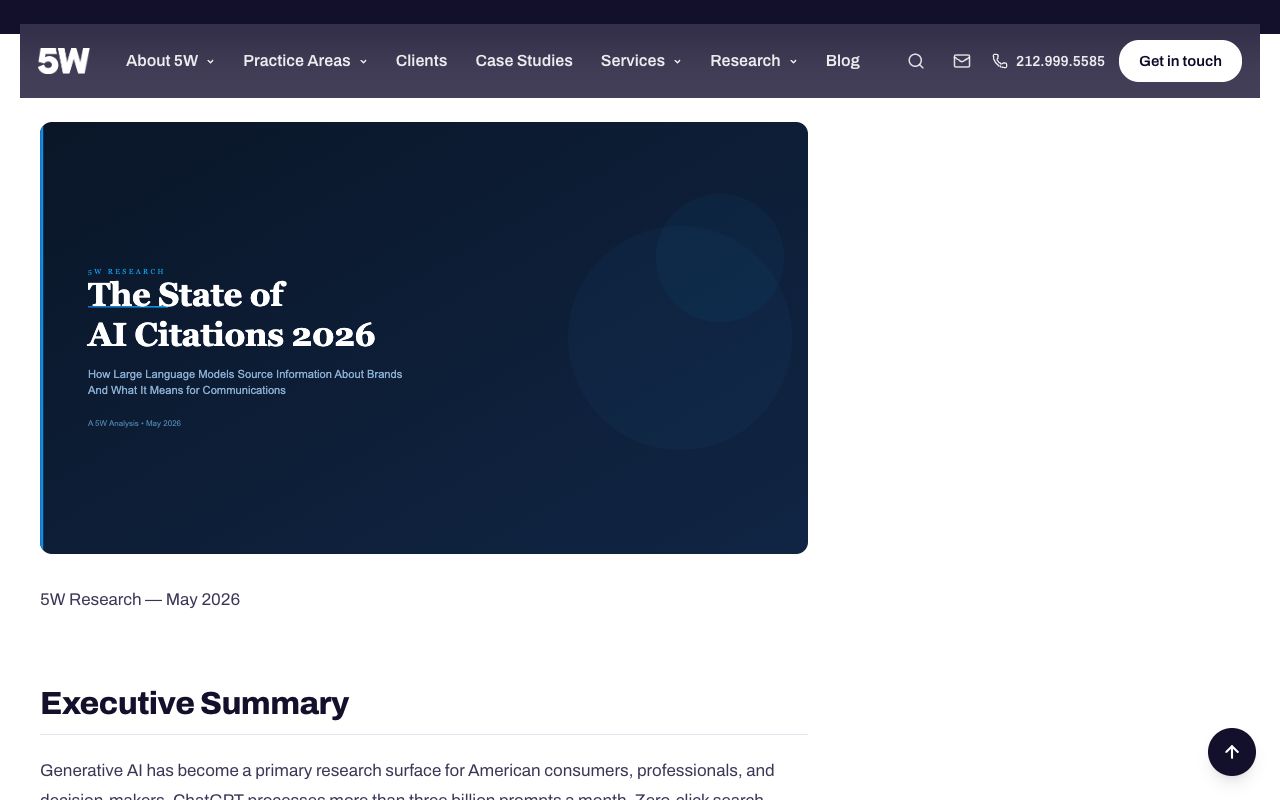
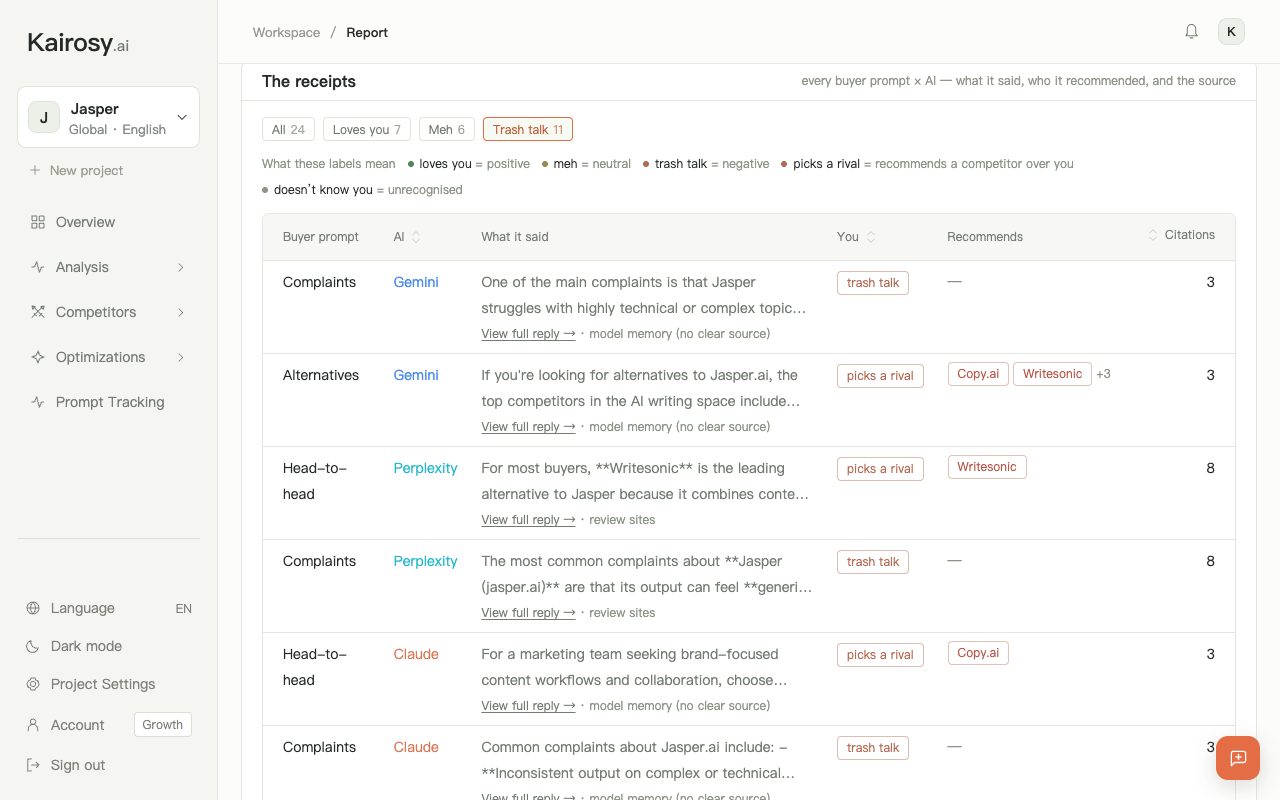
Kairosy's scan of ClickFunnels (2026-08-05, 61/100, "At risk") shows the mechanism. Asked "What are the most common complaints or downsides of clickfunnels.com?", Claude answered: "the single most common BBB complaint involves users going through the cancellation process, seeing confirmation, then continuing to get…". The report's takeaway: because Claude attributes it to the BBB, "the charge carries an institutional name rather than an anonymous review." One voice on a forum becomes a citation-backed fact once it sits in a BBB profile.
Three platform rules explain why such claims persist:
- You cannot delete them. Trustpilot's reviewer guidelines (v2.2, June 2026) state that "businesses have no control over review removal, whether or not they pay for our services, and we won't remove a review just because a business dislikes or disagrees with it" (Trustpilot guidelines).
- Silence is scored. The BBB gives a business 14 calendar days to respond, warns that failure to respond "may have a negative impact on the BBB rating," and keeps closed complaints on the profile for three years (BBB complaint process).
- Suppression is illegal. The FTC's final rule of August 14, 2024 bans fake and AI-generated reviews, undisclosed insider reviews and "unfounded or groundless legal threats" against reviewers, with civil penalties for knowing violators (FTC press release).
For diagnosis, a review-sourced claim is rarely false; it is a true minority experience presented without proportion, so the lever is response history, not removal.
How Reddit Influences Your Brand Reputation in AI
Reddit is a first-class input. In May 2024 OpenAI and Reddit announced a partnership giving OpenAI access to Reddit's Data API; as Time reported, "the agreement will enable OpenAI's AI tools to better understand and showcase Reddit content, especially on recent topics" (Time, May 17, 2024). Reddit was Perplexity's most-cited domain in Profound's dataset.
That weight is unstable: the same 5W report documents that Reddit's ChatGPT citation share "collapsed from ~60% to ~10% of prompt responses in two weeks in September 2025." A Reddit-sourced negative can appear one week and vanish the next, which is why one-off manual checks mislead.
Three properties make Reddit content disproportionately negative in AI answers:
- Question-shaped titles. "Why does everyone hate X's support?" matches a buyer's prompt better than any product page.
- Upvote sorting. The complaint that resonated most ranks, regardless of how many customers had the opposite experience.
- Anonymity flattening. "One user in 2023 said" becomes "users report" once paraphrased, and the date disappears.
Why does ChatGPT repeat outdated or wrong-entity claims?
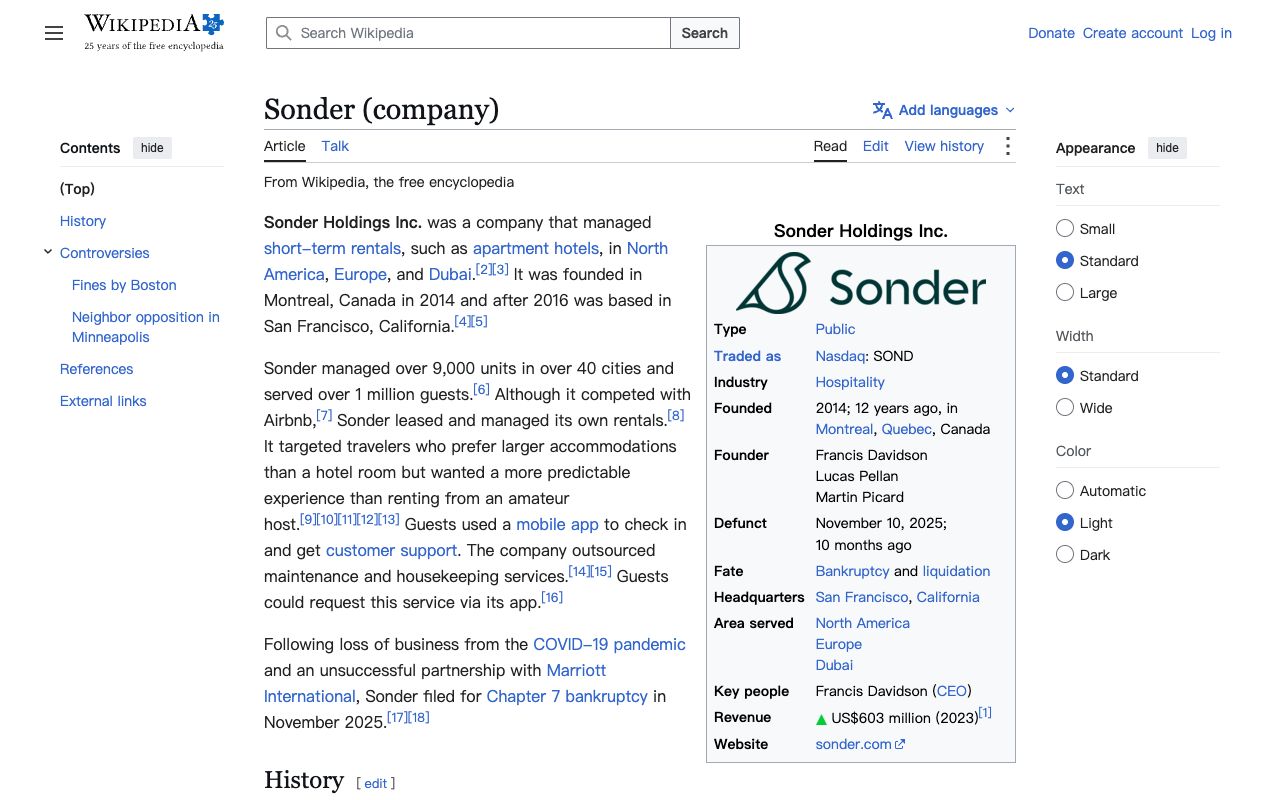
Outdated claims come from the memory channel and from third-party pages that never update. Kairosy's scan of Sonder (36/100, "Vulnerable") captured Claude stating that "Sonder announced in November 2025 that it was 'winding down operations immediately' and liquidating its U.S. business after Marriott terminated their licensing…". That is accurate: Wikipedia records that Marriott terminated the agreement on November 9, 2025, Sonder ceased operations on November 10 and filed for Chapter 7 liquidation on November 13 (Sonder, Wikipedia). The diagnostic point: if the name is ever revived, engines will repeat the shutdown until newer, equally authoritative pages outrank the old ones. A negative claim expires when its sources do, not when your situation changes.
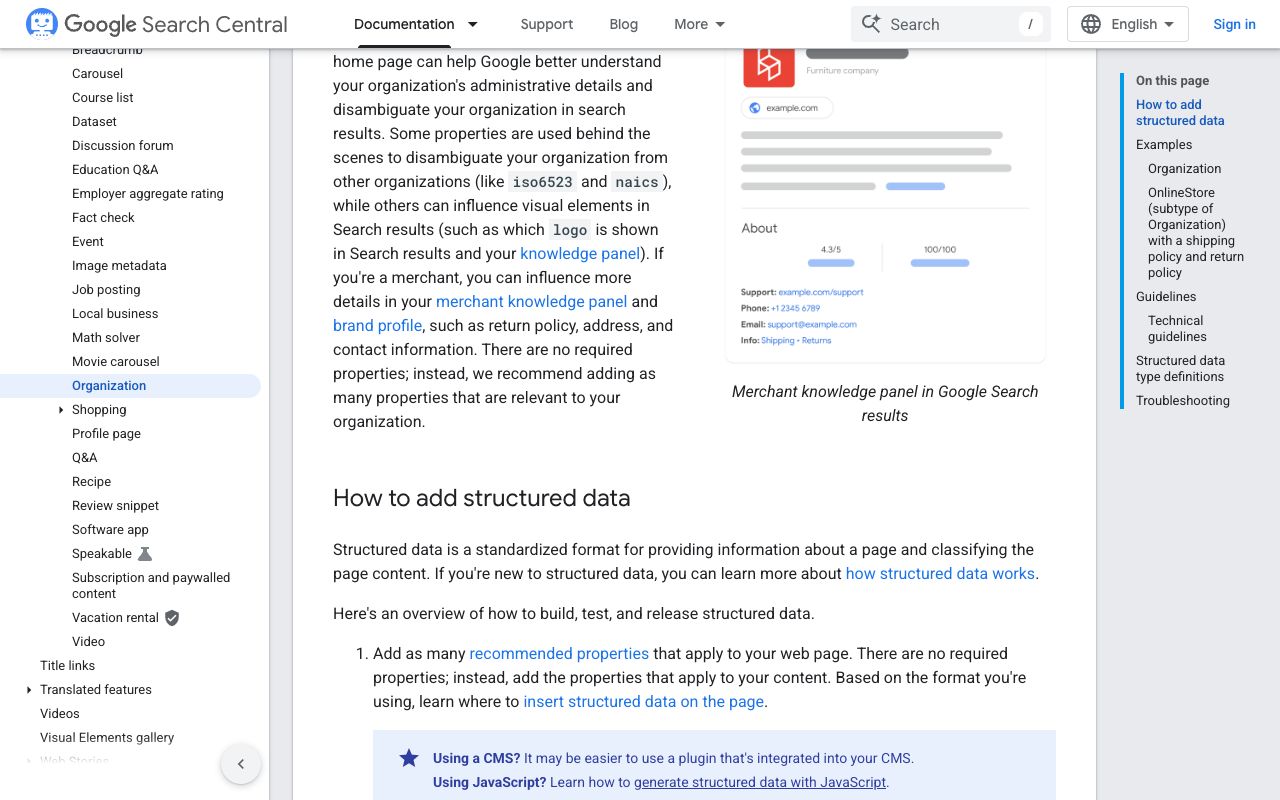
Wrong-entity claims are the most damaging and the most fixable: your brand shares a name or near-name with another company, and the engine attaches that company's complaints or review URLs to you. Research describes hallucination as "generating plausible yet nonfactual content" (Huang et al., 2023, revised 2024), but in practice the false content usually has a real source that belongs to someone else. Google's guidance on Organization structured data exists for this: adding it "can help Google better understand your organization's administrative details and disambiguate your organization in search results" (Google Search Central). The free schema markup checker shows whether your homepage declares name, legalName, alternateName and sameAs.
How do you locate the exact source behind a negative AI claim?
Tracing is mechanical once you read citations instead of prose. For each negative statement:
- Reproduce it with the buyer's wording, web search on, in ChatGPT, Gemini, Claude and Perplexity separately. Engines source differently, so a negative may be Perplexity-only.
- Read the citation list first. An attached URL means the claim came through retrieval and that page is your source; note its group: owned, review, forum, directory or media.
- Search the distinctive phrase in quotes. Put the most specific fragment ("seeing confirmation, then continuing to get charged") into a search engine; the page containing it is the origin even when the engine did not cite it.
- No citation means memory. Look for what existed about you before the model's cutoff, especially press coverage and old review pages; those claims move only when new retrievable pages outweigh them.
- Check for a name collision. Search your brand name alone; a cited review URL on a similarly spelled domain is a wrong-entity problem, not a reputation problem.
This step is slow by hand and fast with tooling. Kairosy stores the citation URLs behind every answer, groups them by source domain in the Visibility module, and re-runs the questions every Monday so you see when a source enters or leaves the answer set (see ChatGPT brand monitoring). Either way, the output is a table: claim, engine, source URL, source group, date first seen.
Which negative sources should you fix first? Impact × fixability
Order that table by impact (how much the source shapes the answer) and fixability (how much control you have). Sources high on both come first; the rest are sequenced, not ignored.
| Source group | Impact on answers | Fixability | First move |
|---|---|---|---|
| Wrong-entity citations | High: imports another company's record | High: you control your identity signals | Organization schema, legal name, sameAs links |
| Owned pages | High when quoted verbatim | High: edit directly | Clear pricing, dated changelog, current policies |
| Outdated facts | Medium to high | High: new dated pages outrank old ones | Dated update posts, refreshed comparisons |
| BBB profile | High: cited with institutional authority | Medium: respond within 14 days, no removal | Answer every open complaint |
| Review sites | High for complaint questions | Medium: respond and resolve, no removal | Reply publicly, close recurring themes |
| Directories / trust scanners | Medium: mostly trust questions | Medium: claim and correct the listing | Verify the profile, fix inaccurate fields |
| Reddit and forums | High on Perplexity, volatile on ChatGPT | Low: cannot edit others' posts | Factual reply from a named account |
| Media and news | High and durable | Low: corrections at the outlet's discretion | Request a correction, publish a dated response |
The ordering reveals two things: the most fixable problems (wrong entity, owned pages, outdated facts) are the ones teams miss most, because they do not look like reputation issues, and the least fixable sources (Reddit, media) are where "just write more content" fails. Per-group repairs are in the fix guide; the broader program is on the AI reputation management page.
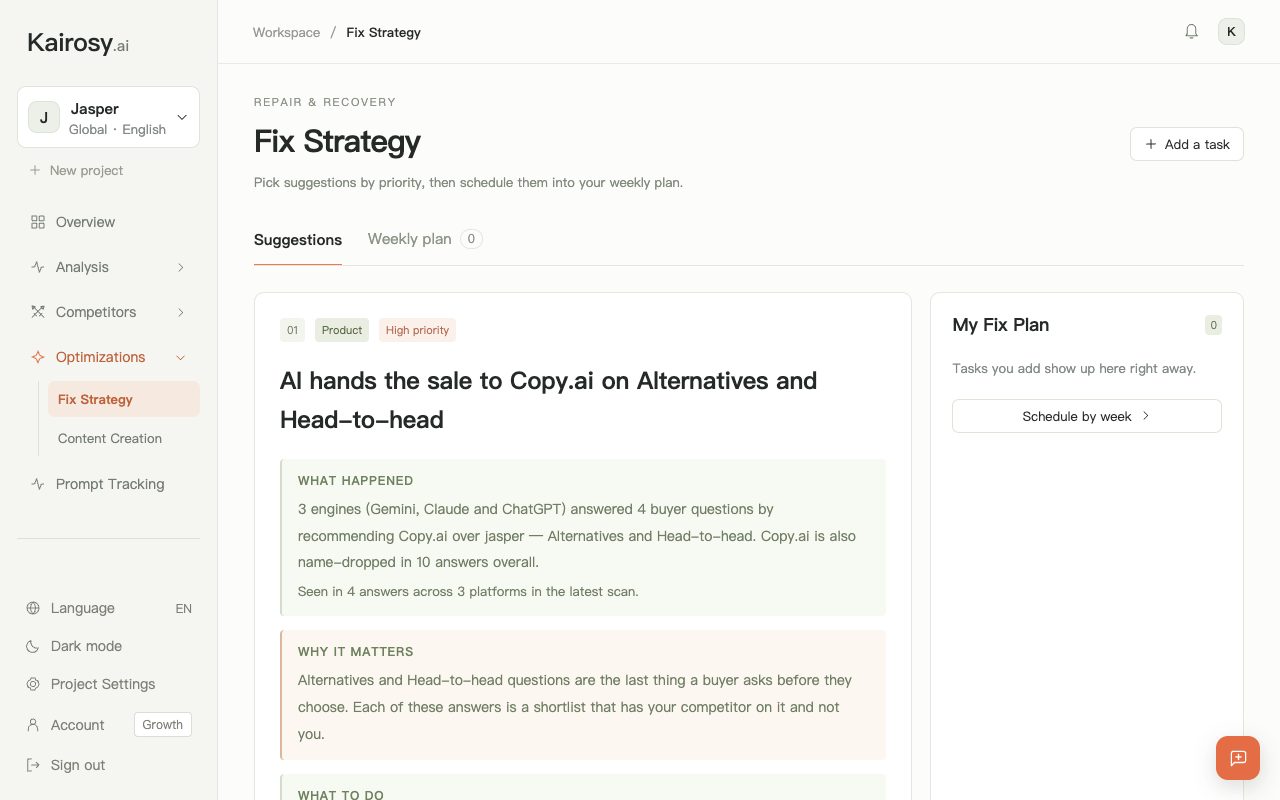
To have the diagnosis done for you: a Kairosy scan asks the buyer questions in each AI platform your plan runs, classifies each answer as positive, neutral or negative with reasons, and attaches the real citation URLs, so the source group is visible without a manual trace. The 7-day trial needs no credit card.
Negative ChatGPT brand answers FAQs
Why does ChatGPT say negative about a brand when its Google reviews are good?
Because it retrieved a different source than the one you are looking at. Google Business reviews are rarely the top-cited page for a "complaints" question; a BBB profile, a Trustpilot page or a Reddit thread usually is.
Can you ask ChatGPT to remove a negative statement about your brand?
Not by editing the model. You can report an inaccurate answer through the product's feedback controls, but a claim with a live source returns the next time the question is asked; the durable route is changing or outranking the source.
Does ChatGPT read Reddit directly?
Yes. OpenAI has had a data partnership with Reddit since May 2024, and 5W's synthesis puts Reddit at about 12% of U.S. ChatGPT citations. Its share swings sharply, so its influence varies week to week.
Is a negative AI claim always based on a real source?
Usually, but not always about you. Many "false" claims are real complaints about a similarly named company, or true facts that are years out of date; pure fabrication is the least common case and the easiest to displace.
See what AI says about your brand
Run a free scan across ChatGPT, Gemini, Claude & Perplexity in about 30 seconds.
Run my free scan