AI Brand Awareness: The Five-Stage Funnel and How to Measure It (2026)
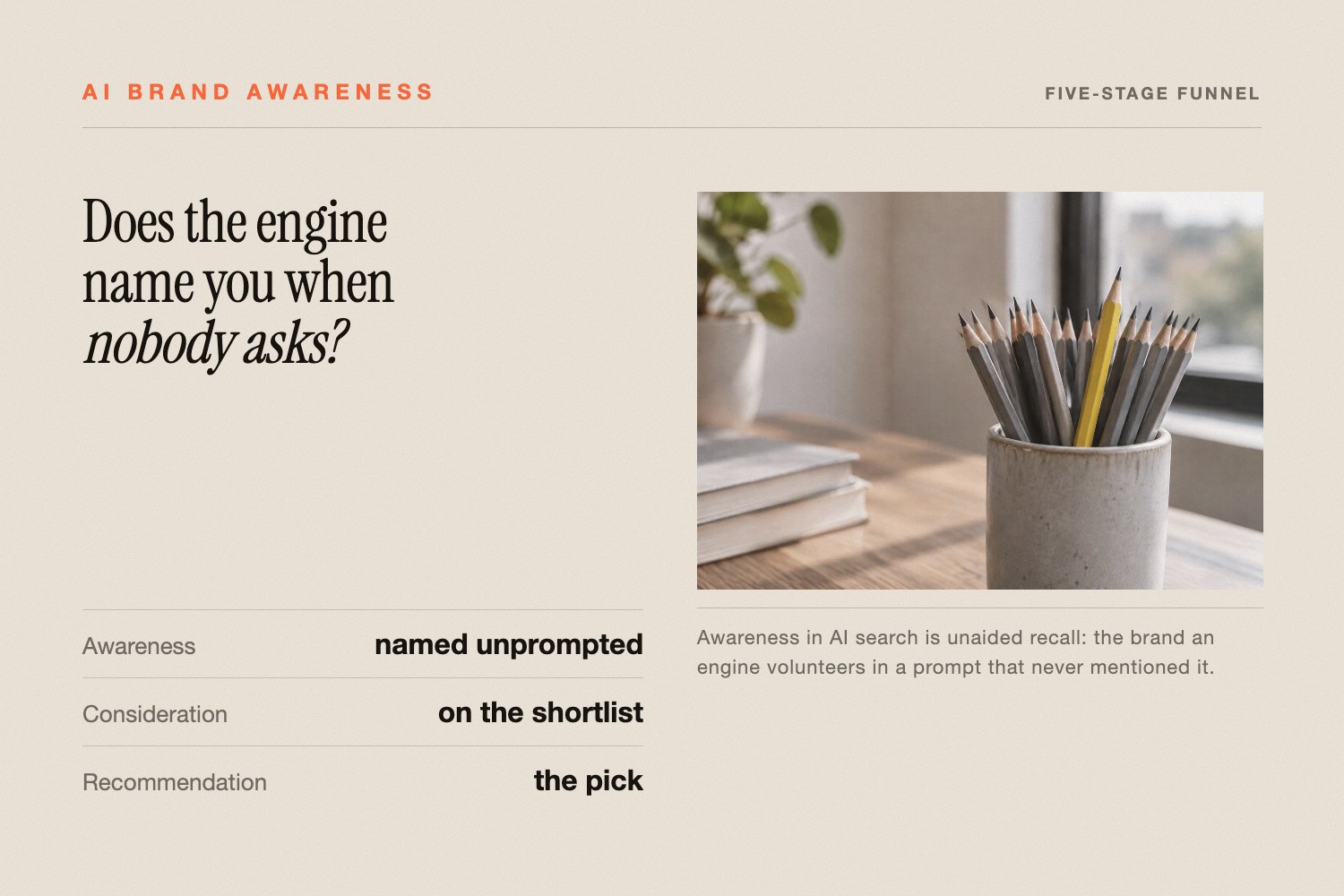
AI brand awareness is how often ChatGPT, Gemini, Claude and Perplexity bring up your brand on their own when a buyer asks a question that does not contain your name. It is unaided recall measured against a language model instead of a survey panel, and it sits at the top of a five-stage funnel: Awareness → Mention → Consideration → Recommendation → Citation.
This guide defines each stage with a metric and an example prompt, then shows public scan numbers where brands with near-perfect awareness still lose the recommendation. Being known by an engine and being picked by it are different measurements; most teams only track the first.
What is AI brand awareness?
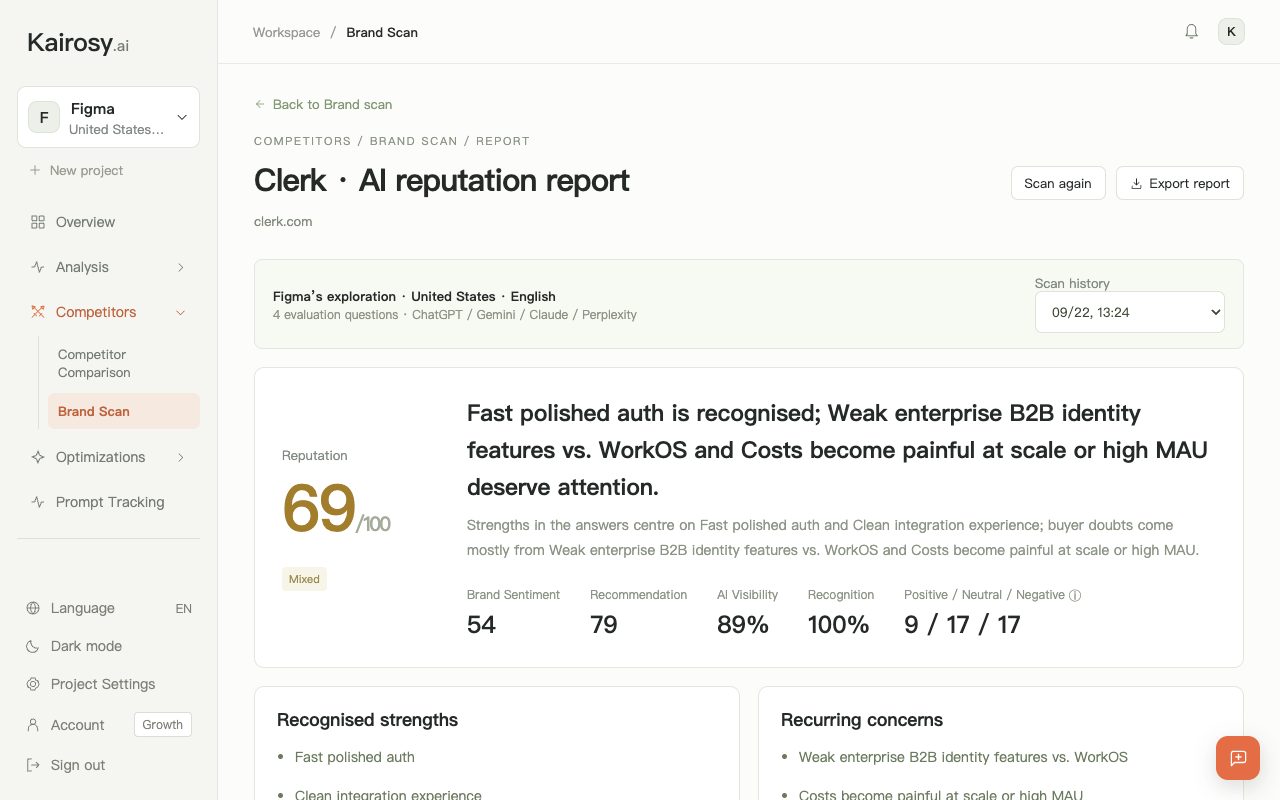
Classic brand awareness has two levels. Wikipedia's definition of brand recall is "the ability of the consumer to correctly generate a brand from memory when prompted by a product category", while recognition only asks whether someone has heard of you once the name is shown. AI brand awareness applies the harder test, recall, to an answer engine: you give the model a category question and check whether your name comes back unprompted.
The branded test is almost always easier. Ask ChatGPT "What is Klaviyo?" and it describes the product accurately; ask "Which email platform should a Shopify store use?" and the answer may skip Klaviyo, list it third, or name it and steer the buyer elsewhere. Only the second prompt measures awareness.
Three properties make the number trustworthy: an unbranded prompt set written the way buyers ask, the same prompts run on more than one engine, and a repeat on a schedule, since one pass captures a day's answer, not a position.
How is generative AI reshaping brand discovery and awareness?
The buyer journey now starts inside a chat window often enough to change what awareness is worth. IBM and the NRF surveyed 18,000-plus consumers in 23 countries in Q3 2025 and reported in their January 7, 2026 release that 45% "turn to AI for help during their buying journeys" and 41% use it to research products.
BCG's Consumer Radar, published January 2, 2026 from waves of 9,000-plus respondents in nine countries, found that shopping-related GenAI use grew 35% between February and November 2025 and that "more than 60% of consumers express high trust in GenAI results". A shortlist from a trusted assistant is one the buyer rarely reopens.
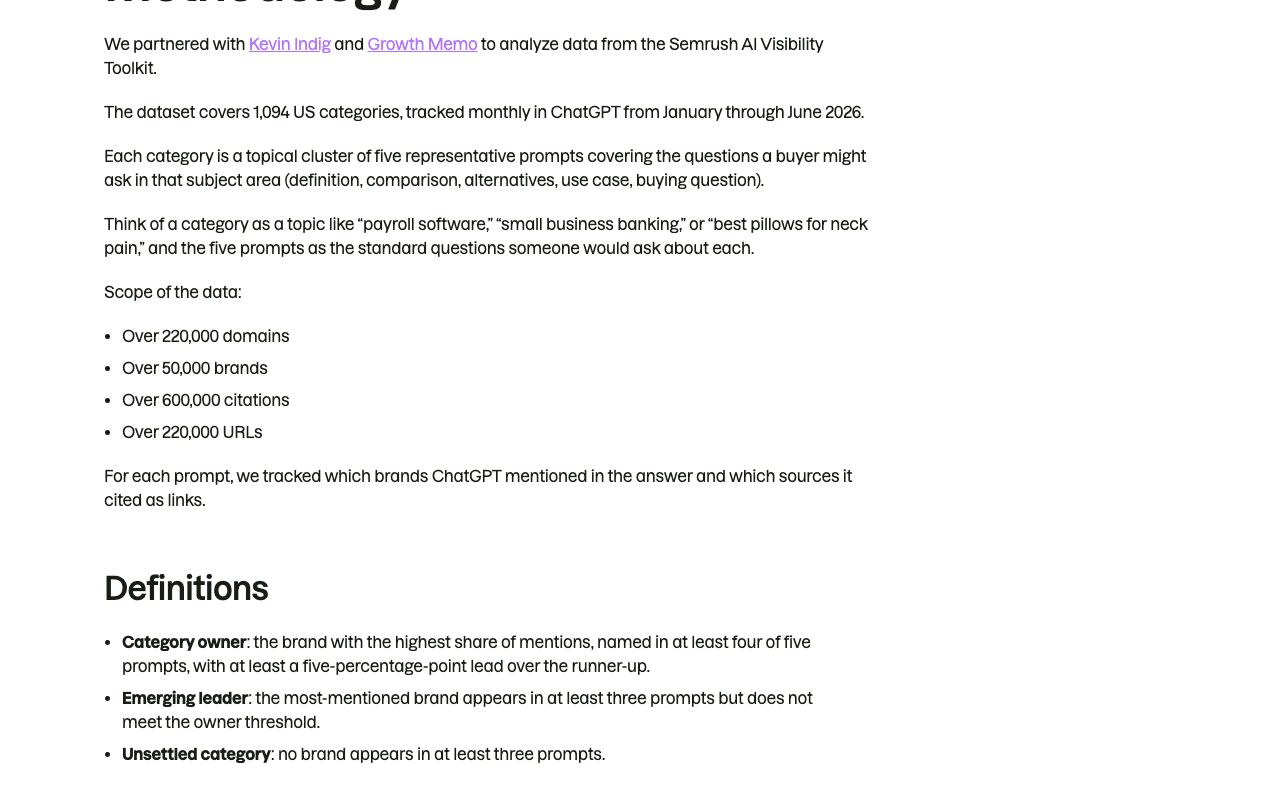
Discovery is also concentrating. Semrush tracked 1,094 US buying categories in ChatGPT from January to June 2026, five prompts each, and reported on July 20, 2026 that 15.2% of categories already have a clear owner (one brand in at least four of five prompts with a five-point lead), 31.2% have an emerging leader and 53.7% are unsettled. Clear owners kept first place in 90.4% of month-over-month comparisons, so an open seat does not stay open.
What is the AI influence on brand visibility?
The AI influence on brand visibility is easiest to see where old signals stop predicting the new outcome. In the same Semrush dataset, the brand that owned a topic in ChatGPT had higher branded search volume than its rival in only 55.7% of comparisons, higher organic traffic in 48.4% and a higher authority score in 52.5%. Those are coin-flip odds; ranking in Google does not carry a brand into the answer.
Wording matters less than teams assume. Peec AI's study of 1,754 prompts and 37,804 responses on five engines, covered by Search Engine Journal on June 15, 2026, found brand visibility "remained stable" while two phrasings stayed above a 0.50 to 0.60 cosine similarity, and that concise keyword-style prompts surfaced up to 25% more brand mentions than conversational ones. Intent decides who appears; wording changes how many names get listed.
The engines are shifting too. Similarweb's AI search stats update of July 29, 2026 puts ChatGPT at roughly 53% of generative AI site visits in May 2026, down from about 76% a year earlier, with Gemini near 27–28% and Claude close to 9%. Awareness measured on one engine is a shrinking partial number.
What are the five stages of the AI brand awareness funnel?
Each stage is a yes/no question you can ask of one AI answer; roll the answers up across your prompt set and engines and you get a rate per stage. The notes after the table explain where brands usually fall off.
| Stage | Question the answer must pass | Metric | Example prompt |
|---|---|---|---|
| 1. Awareness | Does the engine know the brand and describe it correctly? | Recognition accuracy: share of engines that identify the brand without confusing it with another company | "What does Omnisend do and who is it built for?" |
| 2. Mention | Does the brand appear in an answer to an unbranded category question? | Mention rate (visibility): share of unbranded answers naming the brand | "What are the best email marketing tools for a Shopify store?" |
| 3. Consideration | Is the brand on the shortlist with accurate strengths? | Share of voice among brands named, plus sentiment per answer | "Compare Klaviyo, Omnisend and Mailchimp for a 10-person DTC team" |
| 4. Recommendation | Does the engine pick the brand first for the stated need? | Recommend rate: share of answers endorsing the brand; "prefers competitor" rate as the inverse | "Which one should I choose if I need SMS and email in one tool?" |
| 5. Citation | Does the answer link to the brand's own pages, or to pages that support it? | Citation share: share of answers citing a brand-owned URL; list of source domains | Same prompts on web-grounded engines, reading the sources block |
Stage 1: Awareness
Awareness is the only stage tested with a branded prompt, and it exists to catch two failures: the engine has never heard of you, or it confuses you with a company that shares your name. Both show up as an "invisible" answer on the public reports below, and a mention of the wrong company inflates every later rate.
Stage 2: Mention
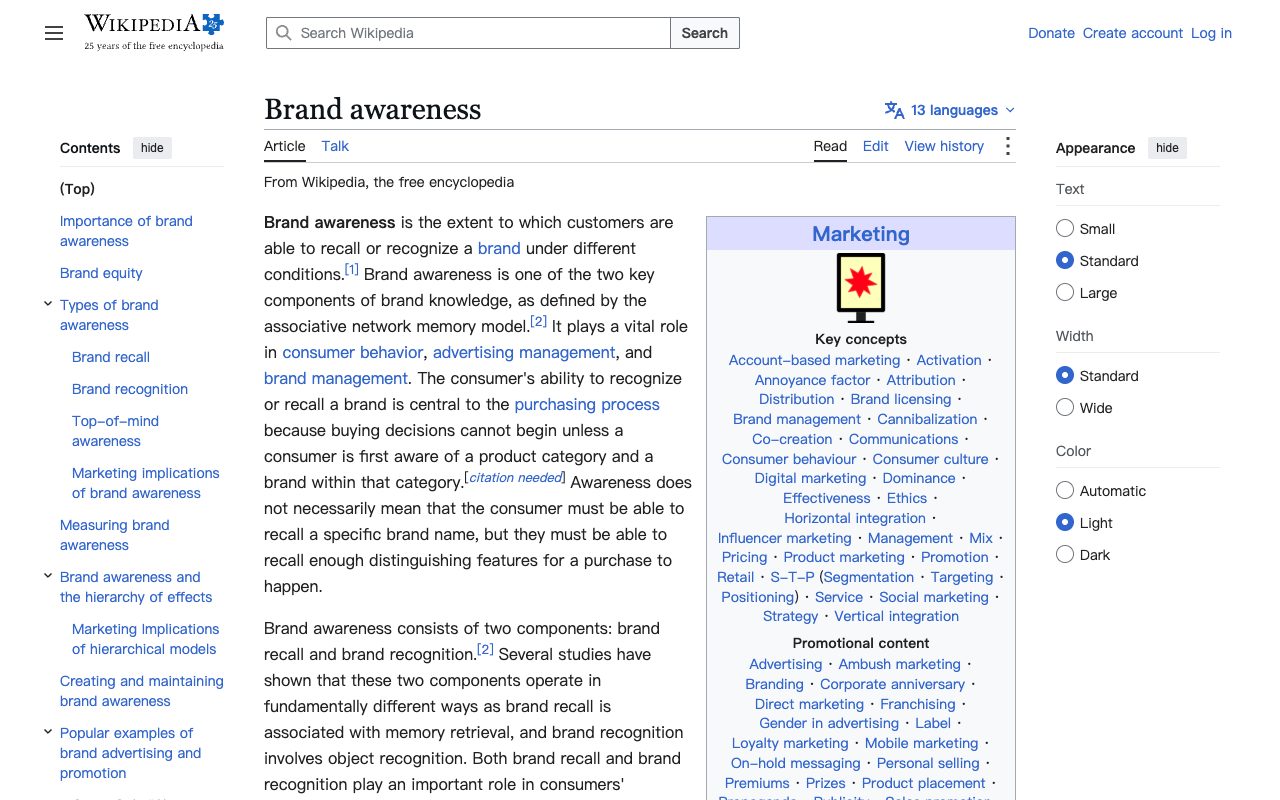
Mention rate is the true AI brand awareness figure. Run 20 to 30 category prompts in the buyer's words on every engine that matters in your market and record whether your brand is named at all. On Kairosy's public brand reports this is labeled Visibility, and for established SaaS names it routinely sits at 92% to 100%, which is why it is the wrong place to stop.
Stage 3: Consideration
Consideration asks whether the mention did you any good; an engine can name you inside a list of six and attach a complaint about pricing. Track your share of voice among the brands named and the sentiment of the sentence that names you. The companion posts on AI share of voice and AI brand perception cover each half.
Stage 4: Recommendation
Recommendation moves revenue and has the widest spread between brands: the engine has to pick you for a stated need, not merely list you. Score each answer as recommends you, neutral, or prefers a competitor, and report the recommend rate next to the mention rate; the gap is your awareness-to-recommendation leak.
Stage 5: Citation
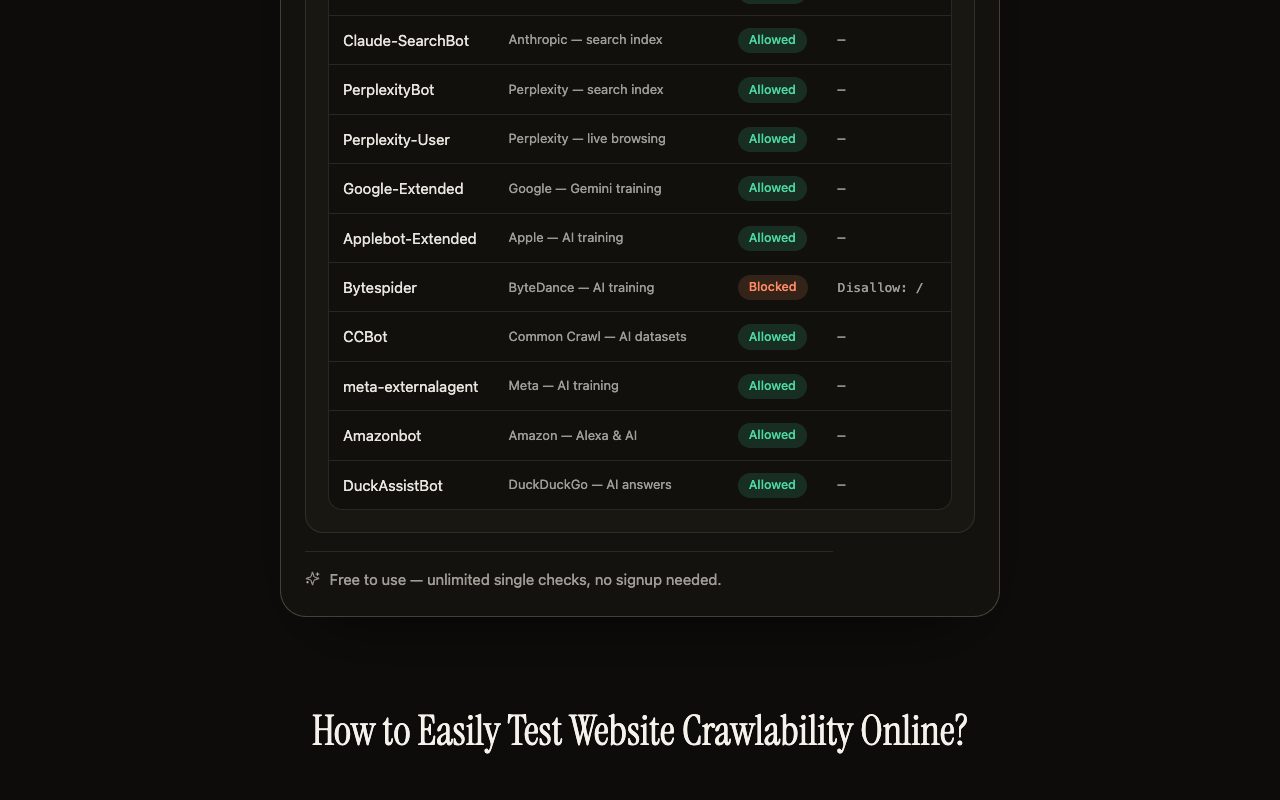
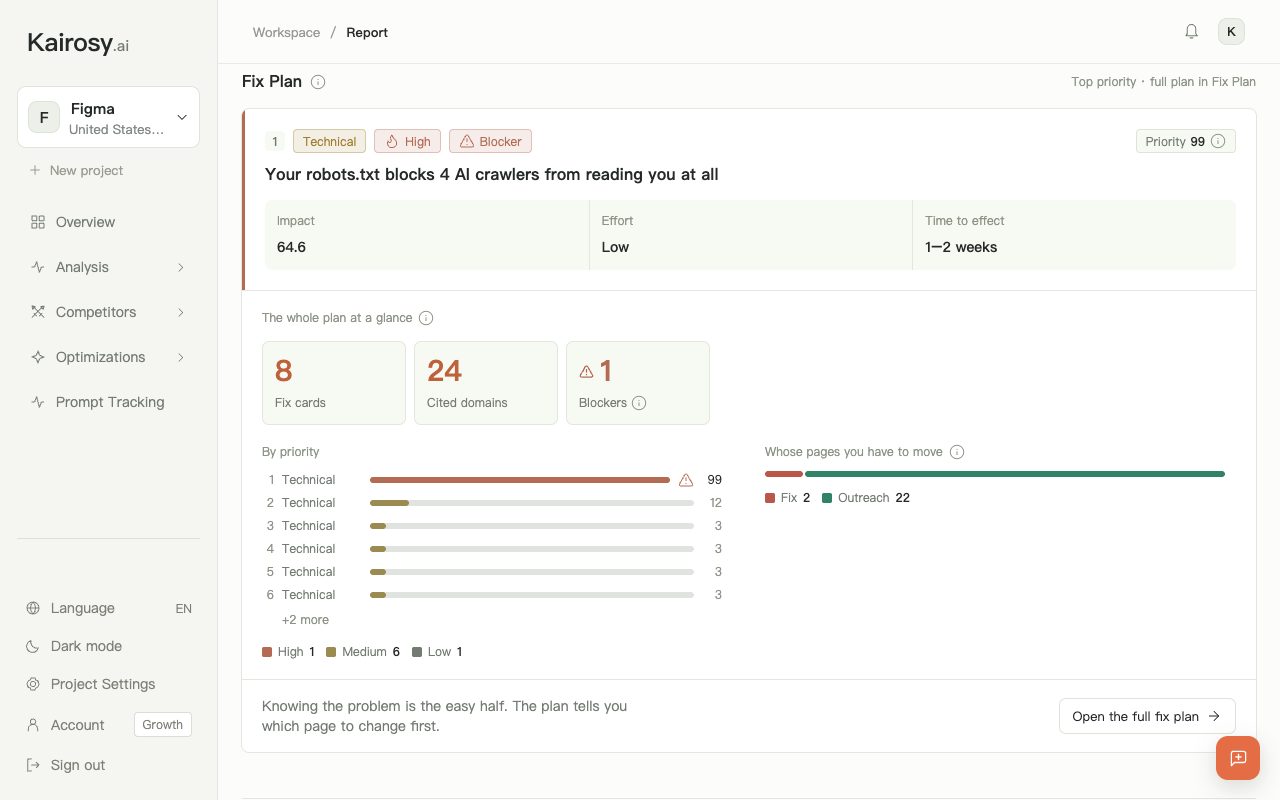
Citation is whether the answer links to you. Similarweb's July 2026 data shows US ChatGPT prompts returning citations climbing from about 1.6% in June 2025 to roughly 6.8% in May 2026: small, but growing fast. A brand cited from its own docs controls the words the engine reads; one carried by third-party reviews does not. Confirm those pages are fetchable with the AI crawl checker before spending effort on earning the link.
Which are the top AI optimization brands for brand recognition in 2026?
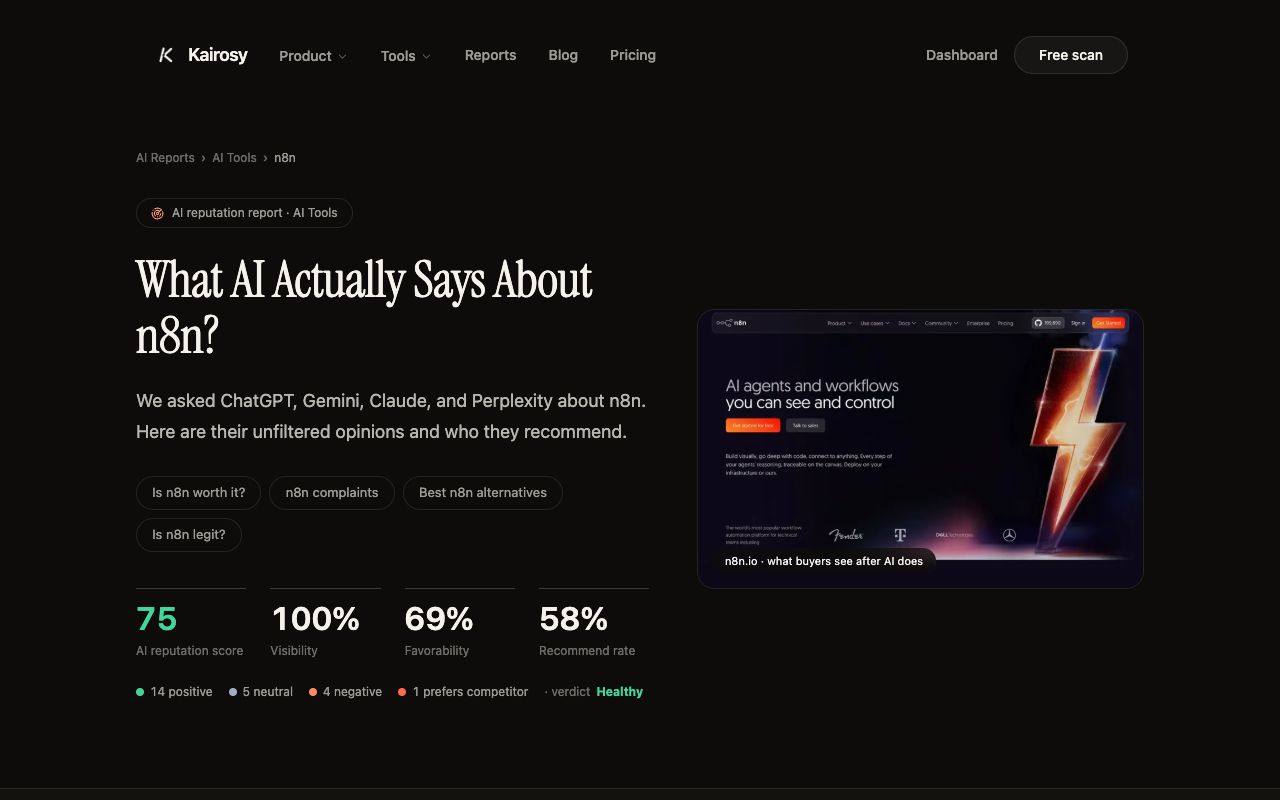
Two public sources show who wins unbranded prompts without you running anything. The first is Kairosy's library of scanned brand reports, where every page shows Visibility (mention rate across 24 buyer questions on four engines) next to Recommend rate; the table lists B2B SaaS brands as scanned in early August 2026.
| Brand (category) | Visibility | Recommend rate | AI score | Scan date |
|---|---|---|---|---|
| n8n (automation) | 100% | 58% | 75 / 100 | 2026-08-05 |
| ActiveCampaign (email) | 96% | 54% | 64 / 100 | 2026-08-01 |
| Webflow (site builder) | 92% | 50% | 64 / 100 | 2026-08-05 |
| Ahrefs (SEO) | 96% | 50% | 62 / 100 | 2026-08-05 |
| Zapier (automation) | 96% | 46% | 61 / 100 | 2026-08-05 |
| Semrush (SEO) | 96% | 42% | 59 / 100 | 2026-08-05 |
| Klaviyo (email) | 92% | 38% | 56 / 100 | 2026-08-05 |
| Mailchimp (email) | 92% | 21% | 47 / 100 | 2026-08-05 |
Read the two percentage columns together. Every brand clears 92% at the Mention stage, yet Recommendation runs from 58% down to 21%. Kairosy's scan of Mailchimp shows the leak: Perplexity's answer on alternatives reads "they should choose Brevo if they want the strongest leading alternative overall, because multiple recent comparison guides rate it as the best Mailchimp…", and the report notes Brevo as the dominant alternative across three of the four engines. The engines know the brand perfectly and send buyers elsewhere.
The second source is independent testing. A March 2026 test by Friction AI ran 50-plus prompts across four categories three times each on GPT-4o and found HubSpot and Mailchimp named first in every phrasing tested, Shopify consistently first for ecommerce platforms, and QuickBooks, Xero, FreshBooks and Wave leading accounting. The authors call the results a test window, not a permanent leaderboard, which is how to read any list of top AI optimization brands for brand recognition: the names show who wins today; only repeated measurement shows whether you are catching up.
How do you track AI brand awareness over time?
A one-off check is a screenshot; awareness is a trend. Semrush's 90.4% retention figure means the seat rarely changes hands by accident, so you need a cadence that catches the exceptions.
- Write 20 to 30 unbranded prompts per market, grouped by stage, and freeze the wording so changes come from the engines, not from you.
- Run every prompt on all four major engines; in the ActiveCampaign report above, ChatGPT and Claude score the brand 73 while Perplexity scores it 52.
- Score each answer on the five stages plus sentiment, and keep the answer text and citation URLs as evidence.
- Re-run weekly for the core set and daily for the prompts that decide deals, and alert on new negative keywords, a competitor becoming the preferred pick, and score drops.
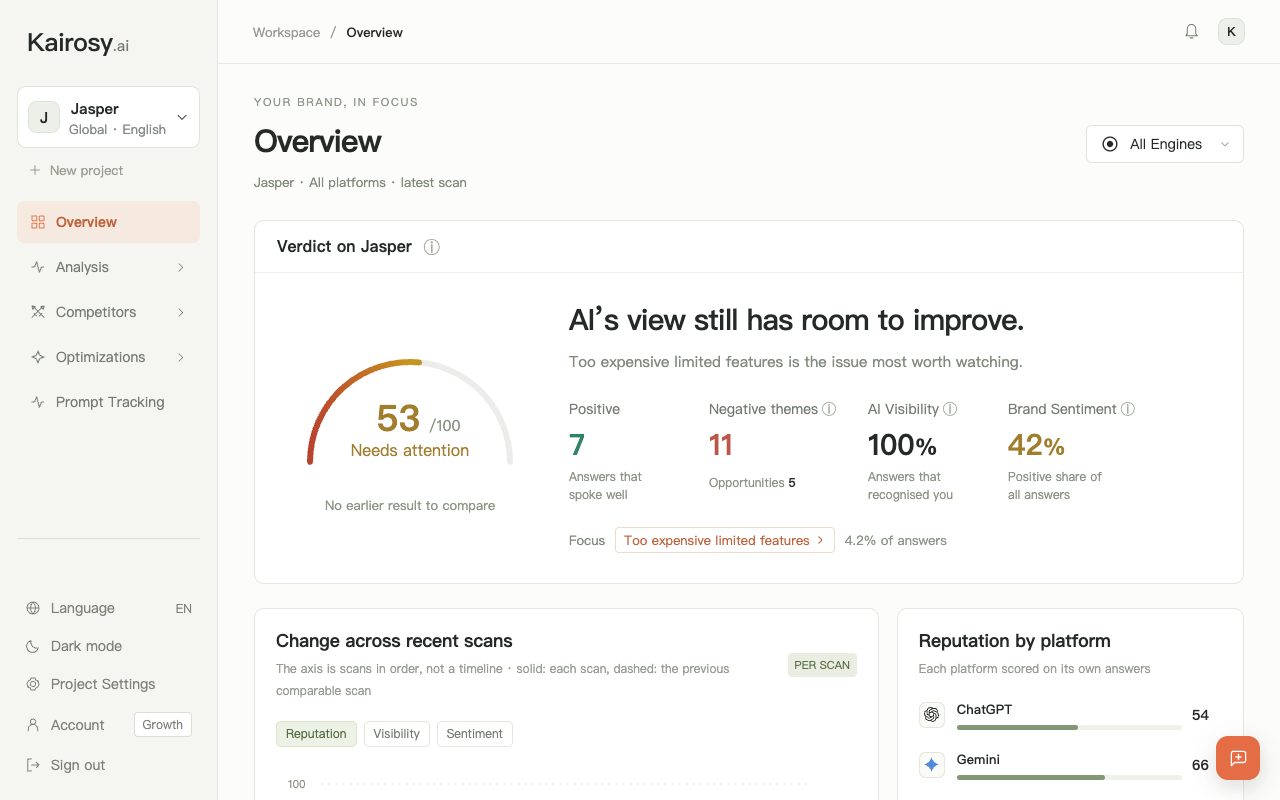
Kairosy automates that loop. A tracking slot is one brand in one market, re-scanned every Monday with an email digest and alerts for new negative keywords, a competitor becoming the preferred pick, score drops and an engine flipping sentiment; tracked prompts are checked daily on every paid plan. Plans are Basic $29, Pro $99 and Growth $399 per month as of September 2026 (3 / 6 / 20 slots, 15 / 28 / 70 daily prompts), and signup starts a seven-day trial with full reports and no credit card. The AI brand monitoring page lists the modules.
How do you show investors your brand awareness on AI platforms?
Investors want a number that moves, a benchmark and evidence. Give them the five-stage funnel for your brand next to two or three competitors on the same prompts, month and engines, plus the mention-rate and recommend-rate trend over at least eight weekly points. Attach three verbatim answers where an engine recommends you, three where it prefers a competitor, and the source URLs behind each; shared report links work because anyone on the cap table can open them. Pair the AI numbers with your aided-awareness survey so the board reads AI brand awareness as an extension of a metric it already trusts.
AI brand awareness FAQs
How do AI brand visibility platforms compare to awareness platforms?
Awareness platforms survey people and report aided and unaided recall for a sample. AI visibility platforms query the engines directly, so the "respondent" is ChatGPT or Gemini and the sample is a prompt set. The AI number is cheaper and repeatable daily but measures what the models say, not what humans remember; most teams run both.
How do you grow AI automation agency brand awareness in 2026?
Measure the Mention stage for the prompts prospects use, such as "best AI automation agency for ecommerce" or "who can build an n8n workflow for a clinic". Publish specific, citable pages for the niches where you were absent, with prices and steps an engine can quote, then re-run the prompts weekly and watch which pages appear as sources.
Is AI brand awareness the same as AI share of voice?
No. Awareness is whether your brand appears at all in unbranded answers (the Mention stage). Share of voice is your slice of all brand mentions inside those answers, a Consideration-stage metric that only makes sense once you are being mentioned. A brand can have 90% awareness and 15% share of voice if it is always named fourth in a list of six.
How many prompts do you need for a reliable AI brand awareness score?
Enough that one flipped answer cannot move the rate by more than a few points: 20 to 30 unbranded prompts per market on four engines gives 80 to 120 answers per measurement. Since Peec AI found that intent, not wording, decides which brands appear, cover different intents rather than paraphrasing one question.
See what AI says about your brand
Run a free scan across ChatGPT, Gemini, Claude & Perplexity in about 30 seconds.
Run my free scan