AI Search Analytics in 2026: The Three-Tier Framework and Its Risks
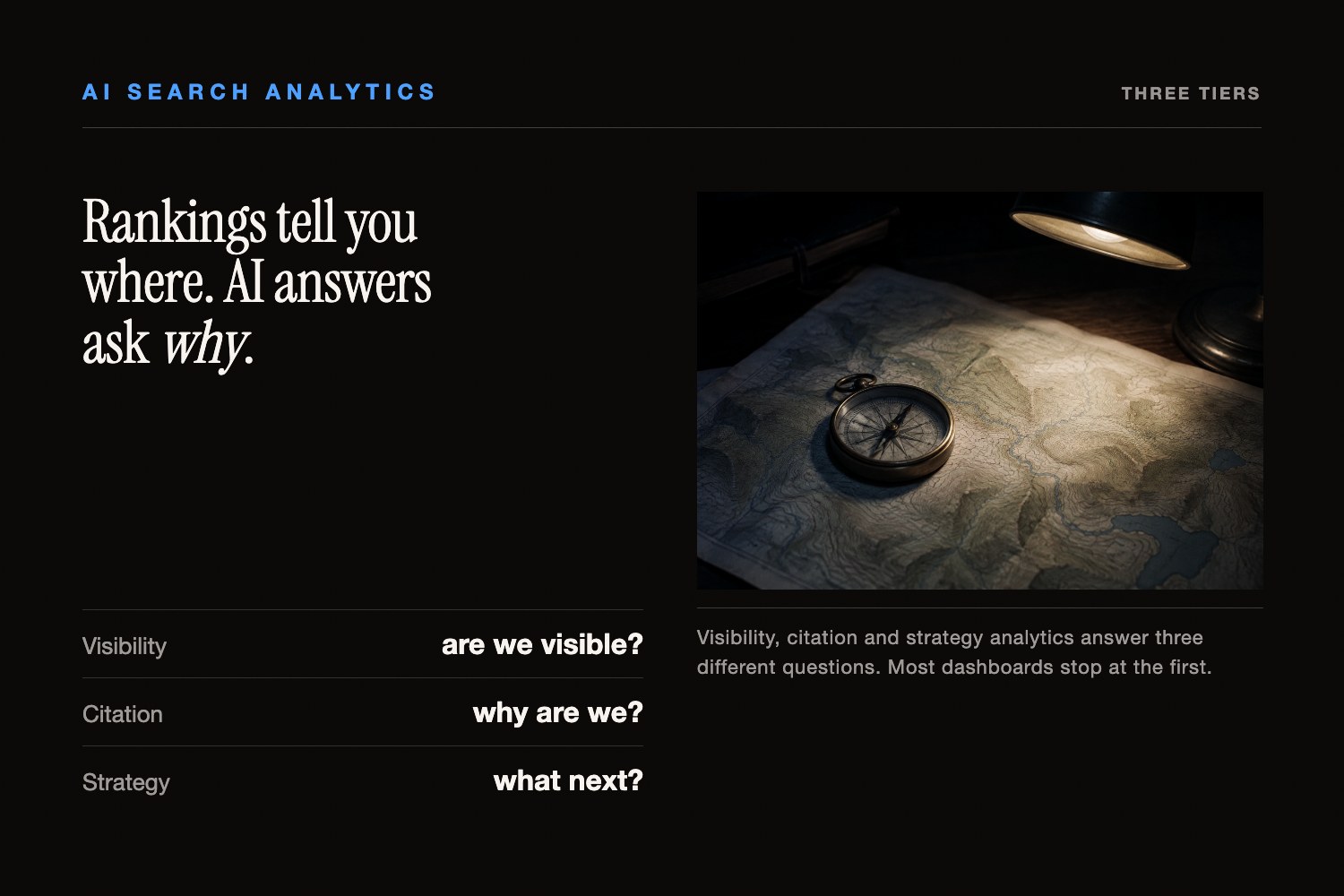
AI search analytics is the measurement of how answer engines — ChatGPT, Gemini, Claude, Perplexity, Google's AI Overviews and AI Mode — mention, recommend, cite and describe your brand when someone asks them a buying question. It replaces the rank-and-click model with three questions: are we visible, why are we visible, and what should we do next.
Below: the three-tier model behind those questions, seven ways the data misleads teams, a 10-step method, a priced tool table, and the trends worth watching weekly. Already tracking AI visibility? Jump to the risk section.
What Is AI Search Analytics, and Why Isn't Rank Tracking Enough?
Classic search analytics rests on rankings, clicks, impressions and click-through rate. All four assume a results page, a position on it, and a user who clicks. Answer engines break every one of those assumptions.
Start with the click. A Pew Research Center study published July 22, 2025 (68,879 Google searches by 900 US adults, March 2025) found users clicked a traditional result on 8% of visits when an AI summary appeared versus 15% when it did not, and clicked a link inside the summary on just 1% of visits. The answer is consumed on the page; your analytics never sees it.
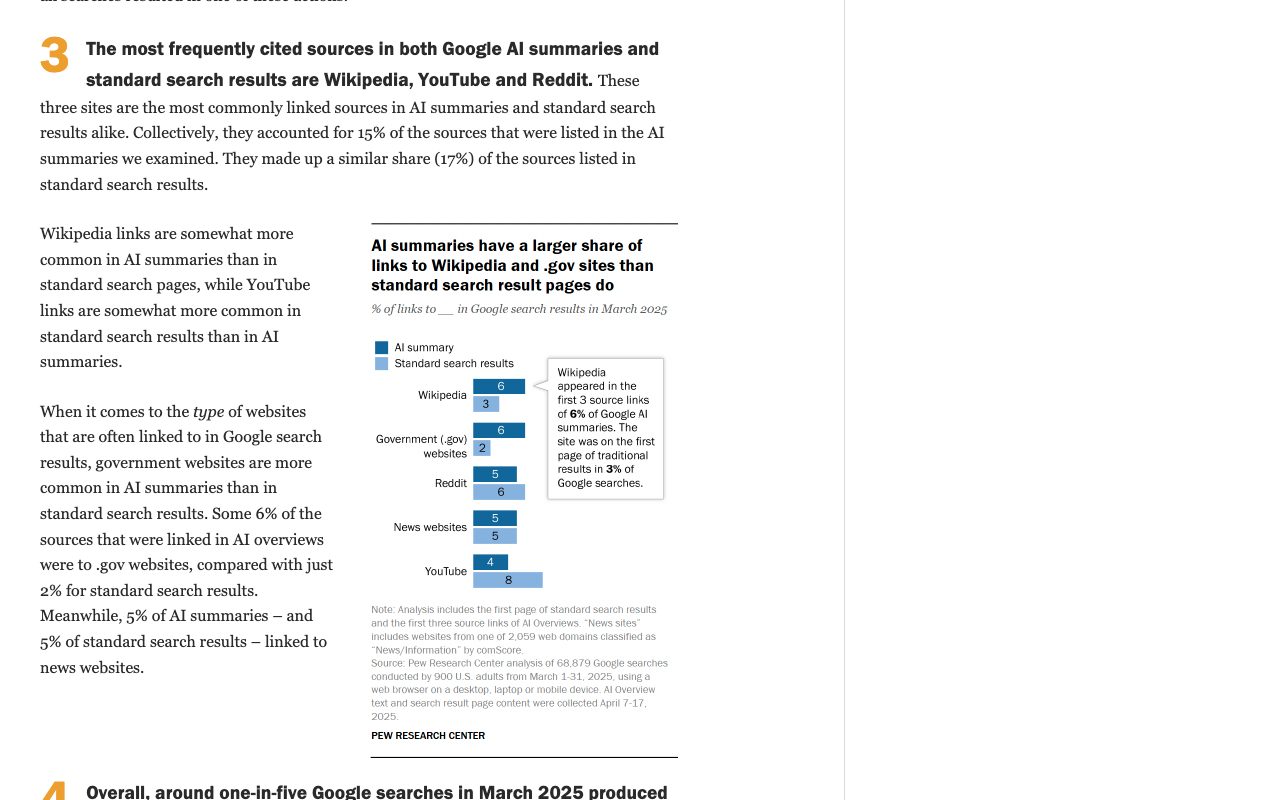
Then the impression. Google's AI features documentation says AI Overviews and AI Mode clicks are "included in the overall search traffic in Search Console" under the Web search type — no row says whether the feature named you or steered the searcher to a rival.
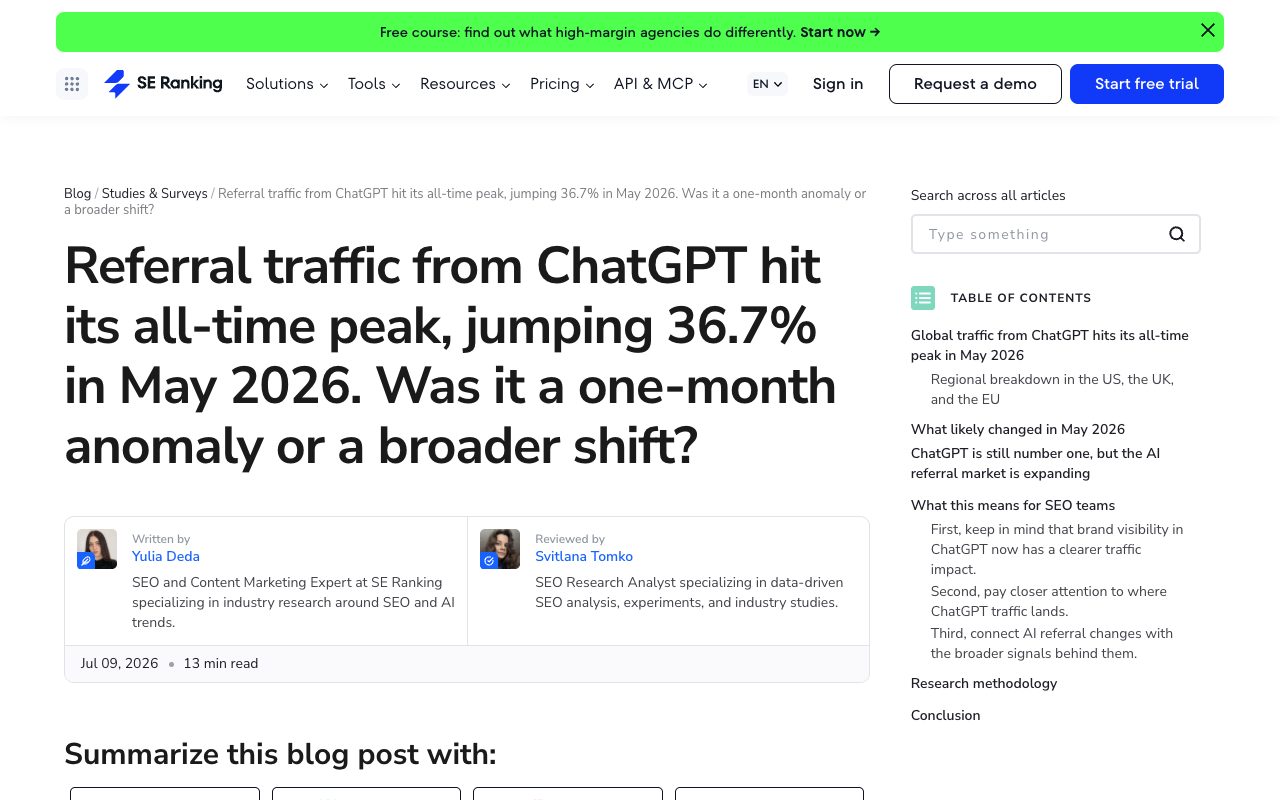
Chat engines send no impressions at all, and referral traffic is a thin proxy: SE Ranking's July 2026 analysis put ChatGPT at 0.32% of worldwide website referrals in May 2026, up from 0.23% in April. The recommendation happens; GA4 records nothing.
Which Signals Does AI Search Analytics Track That SEO Analytics Misses?
Eight signals separate AI search analytics from a rank tracker with a new label:
| Signal | Question it answers | Nearest SEO metric, and why it falls short |
|---|---|---|
| Mentions | Did the answer name us? | Impressions — chat answers log none |
| Recommendations | Did it tell the user to pick us? | Position 1 — positions do not exist inside a paragraph |
| Citations | Which URL did it link as evidence? | Backlinks — engines choose sources per answer, not per page |
| Source selection | Which domains shaped the answer, linked or not? | No equivalent |
| Sentiment | Was the description positive, neutral or negative? | No equivalent — rankings are sentiment-blind |
| Competitor presence | Who else was named, and were they preferred? | SERP share of voice — one answer can list you and dismiss you |
| Answer variability | Does the same prompt give the same answer tomorrow? | Rank volatility — far smaller in classic search |
| Cross-LLM differences | Do the engines agree about us? | No equivalent — several models, separate retrieval |
The last two rows are the ones no SEO stack was built for. Everything above them sorts into three tiers.
What Does AI Search Visibility Analytics Measure? (Are We Visible?)
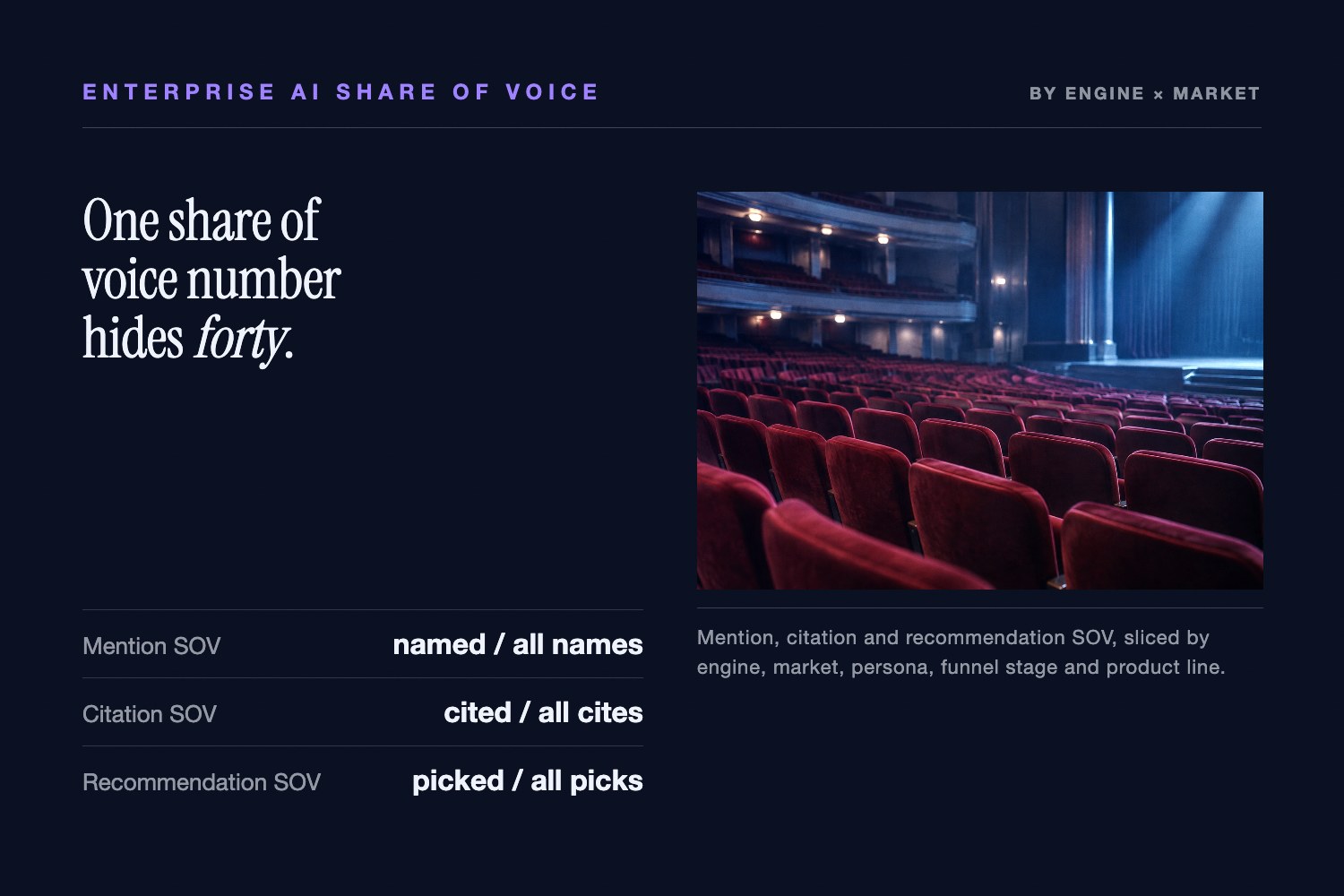
The first tier, AI search visibility analytics, answers a yes-or-no question at scale: across the prompts your buyers ask, do the engines name us? Six numbers cover it.
- Mention rate — share of answers, across all prompts and engines, that name you.
- Prompt coverage — share of your prompt set where you appear at least once.
- Share of voice — your mentions divided by all brand mentions in the same answers.
- Competitor visibility — the same numbers for every rival the engines bring up.
- Visibility by model — mention rate per engine.
- Visibility trend — all of the above on a fixed prompt set, so movement is real.
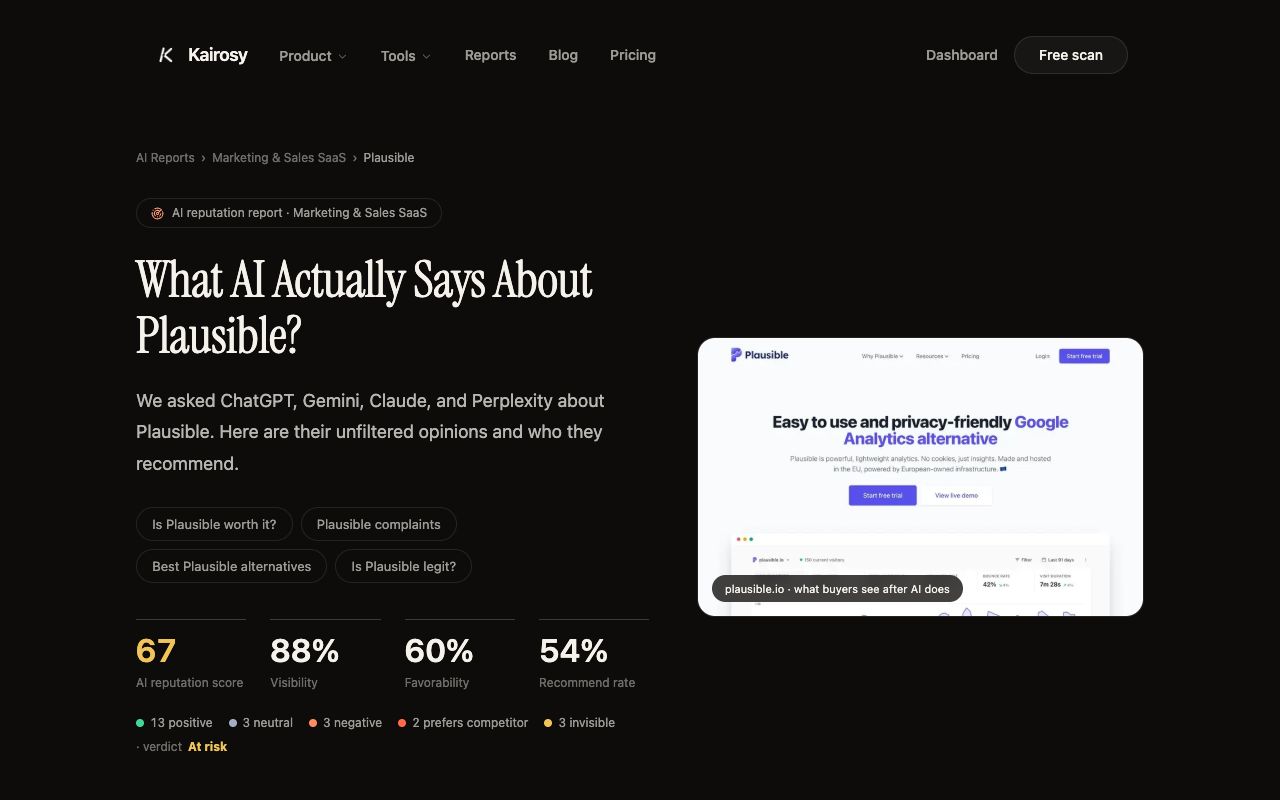
The per-model cut decides where the work goes. In Kairosy's scan of Plausible (August 5, 2026), visibility was 88% and the headline score 67/100, "At risk" — but per-engine scores ran from Claude at 44 to ChatGPT at 81, with Gemini at 72 and Perplexity at 73. A blended number would hide that 37-point gap.
For targets and cadences, see AI search visibility metrics and KPIs; tracking this tier continuously is what AI brand monitoring means.
Why Are We Visible? What AI Search Citation Analytics Reveals
The second tier, AI search citation analytics, explains the first: which pages an engine read to name you, and which it read to name a competitor instead.
- Citation rate — share of answers linking to any URL you control.
- Cited URLs and domains — the exact pages and hosts used as evidence, per engine.
- Source type — editorial, review platform, community thread, vendor docs, video.
- Owned vs. third-party — pages you control versus Reddit threads and G2 profiles you do not.
- Competitor citation gaps — domains that cite rivals and never cite you.
- New and lost citations — week-over-week churn in the source set.
This tier must be measured per engine and dated. Peec AI's analysis of 30 million cited sources, reported by Search Engine Land on March 31, 2026, found Reddit the most-cited domain across five engines, yet ChatGPT leaned on Wikipedia, Reddit and Forbes while Google leaned on Facebook and Yelp. Semrush's 13-week study (230,000+ prompts, 100 million+ citations, published November 10, 2025) adds time: Reddit and Wikipedia sat near 60% and 55% of ChatGPT citations in early August 2025, then fell sharply in mid-September, and "the Reddit and Wikipedia drop in citations was isolated to ChatGPT."
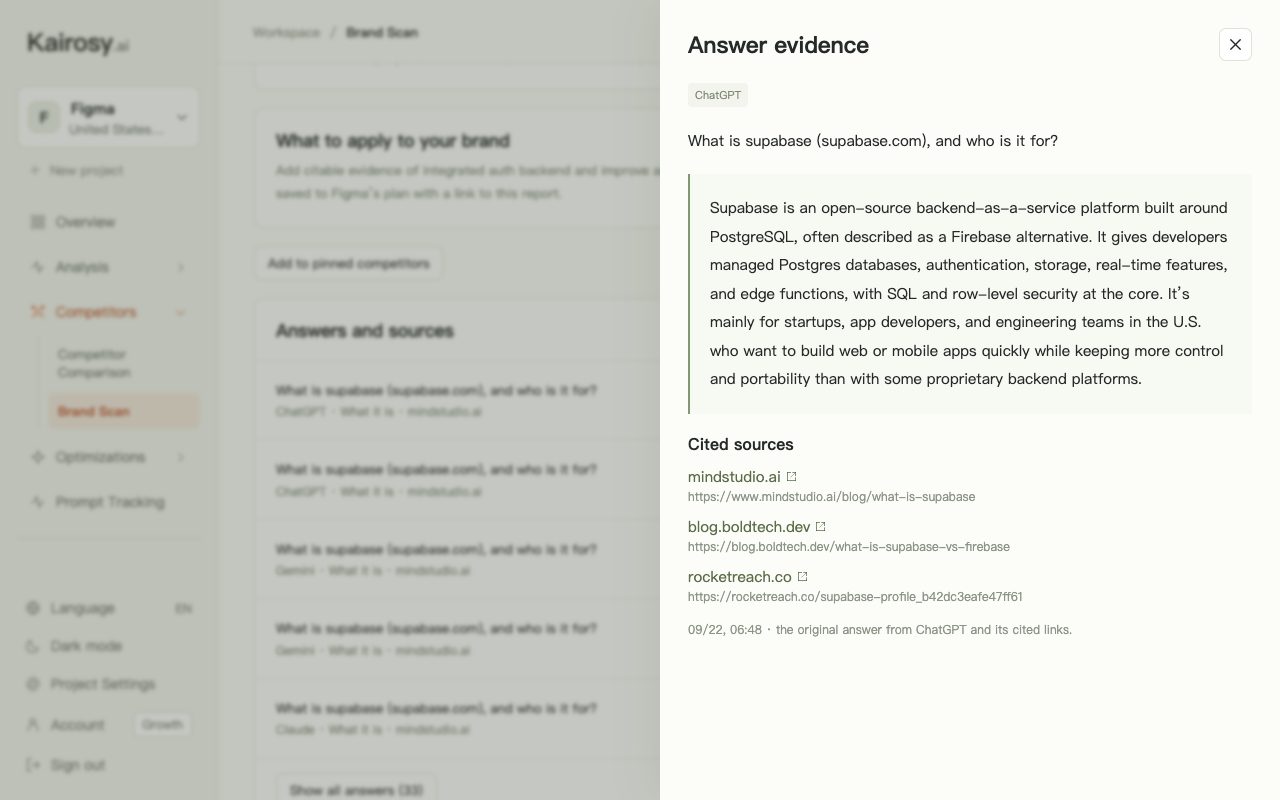
The same Plausible report records Perplexity answering an alternatives prompt with "Top picks for Plausible alternatives are PostHog, Umami, Fathom, and Matomo." Mentioned, yes; recommended, no. For tool-by-tool coverage see AI citation analytics tools, and for the engine that shows its sources inline see Perplexity brand monitoring.
What Should We Do Next? How AI Search Strategy Analytics Sets Priorities
The third tier, AI search strategy analytics, turns the first two into a ranked work queue. It adds no new raw inputs; it recombines visibility and citation data by gap and by fixability.
- Missing topics — prompt clusters where you never appear and a competitor does.
- Weak prompts — below share-of-voice parity, or present on only one engine.
- Competitor gaps — which rival takes the recommendation, on which prompts and engine.
- Weak source coverage — source types that cite rivals and not you.
- Negative sentiment — the specific complaint the engines repeat, with the answers that carry it.
- Content opportunities — pages to create or rewrite, each mapped to the prompt it must win.
- High-priority fixes — all of the above ordered by prompt importance × gap size × effort.
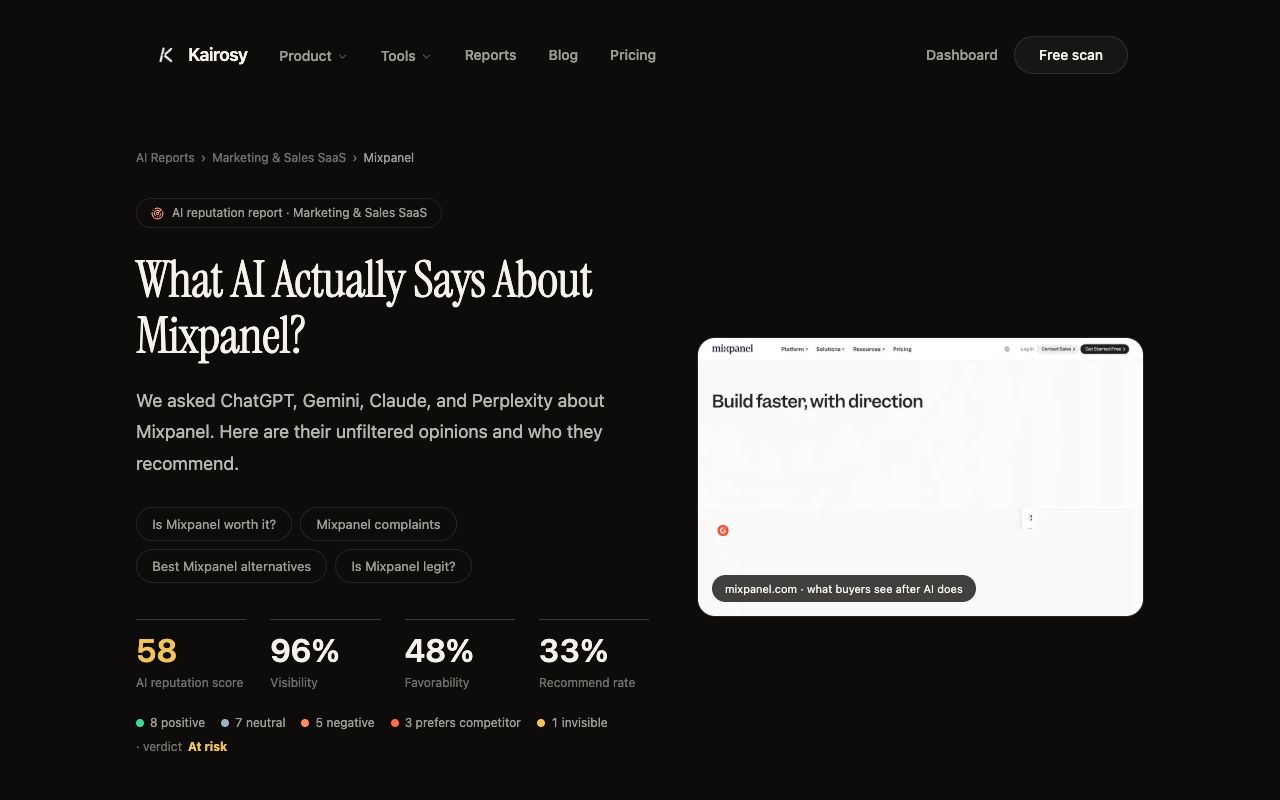
Sentiment is where this tier earns its keep, because it can invert a visibility win. Kairosy's scan of Mixpanel (August 5, 2026) scored 58/100, "At risk," with 96% visibility but a 33% recommend rate; Claude's complaint summary opened with "Pricing unpredictability — This is the single most frequent complaint." That sentence is a content brief, not a call for more mentions.
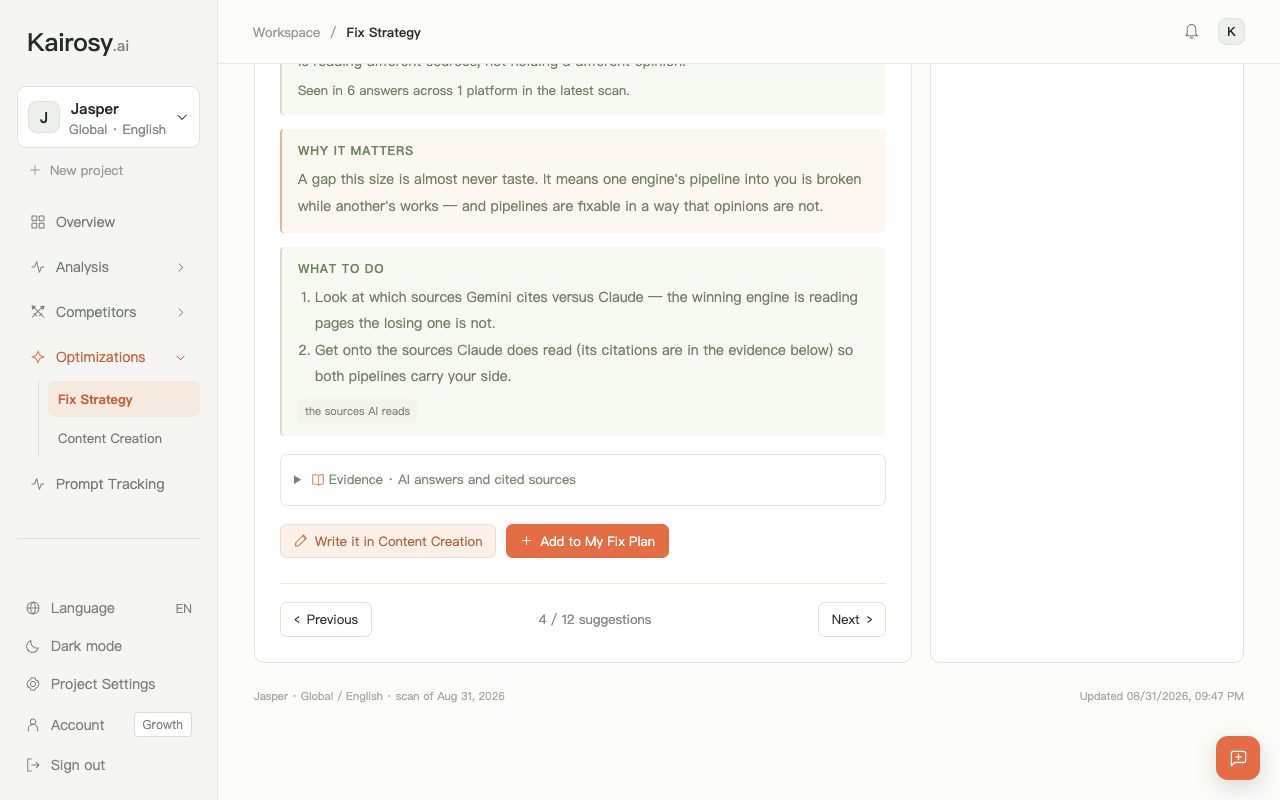
Strategy analytics must also cover retrievability, because an engine cannot cite a page it cannot fetch or parse. An AI-ready page audit checks access, readability, structured data, citability and trust; the free AI crawl checker and llms.txt generator handle the access half in minutes. Aggarwal et al.'s GEO paper (arXiv, revised June 2024) reports that generative engine optimization "can boost visibility by up to 40% in generative engine responses."
What Are the Biggest Risks in AI Search Analytics?
Each risk below produces a confident chart that is wrong.
1. A single ChatGPT test is an anecdote
Similarweb's June 8, 2026 review cites Thinking Machines Lab running one prompt 1,000 times at temperature 0 and getting 80 different responses, and an ACM study in which 43–76% of prompts returned non-identical responses across five runs. A screenshot proves nothing; a mention rate across repeated runs does.
2. The engines disagree with each other
Plausible's 44 on Claude against 81 on ChatGPT, same prompts, same day, is typical. An average hides it; a per-engine view surfaces it, and the Semrush data shows the same pattern at source level.
3. Sessions differ, though phrasing matters less than you think
Memory, location, login state and model version move answers between sessions. Wording moves them less: Peec AI's 37,804-response study, summarized by Bluehost in June 2026, found brand recommendations "stayed fairly consistent even when the prompt changed." Rerunning a fixed prompt set beats rewording it.
4. Mention is not citation
An engine can name you from training data without fetching your site. That mention will not survive a retrieval-heavy answer whose sources say something else.
5. Citation is not recommendation
An engine can link your pricing page as evidence while telling the user to choose a competitor. Only a verdict classification catches it.
6. High visibility can carry negative sentiment
Mixpanel's 96% visibility with 48% favorability is the textbook case. A visibility-only dashboard calls it a win; a strategy dashboard flags it as the top fix.
7. Data without diagnosis
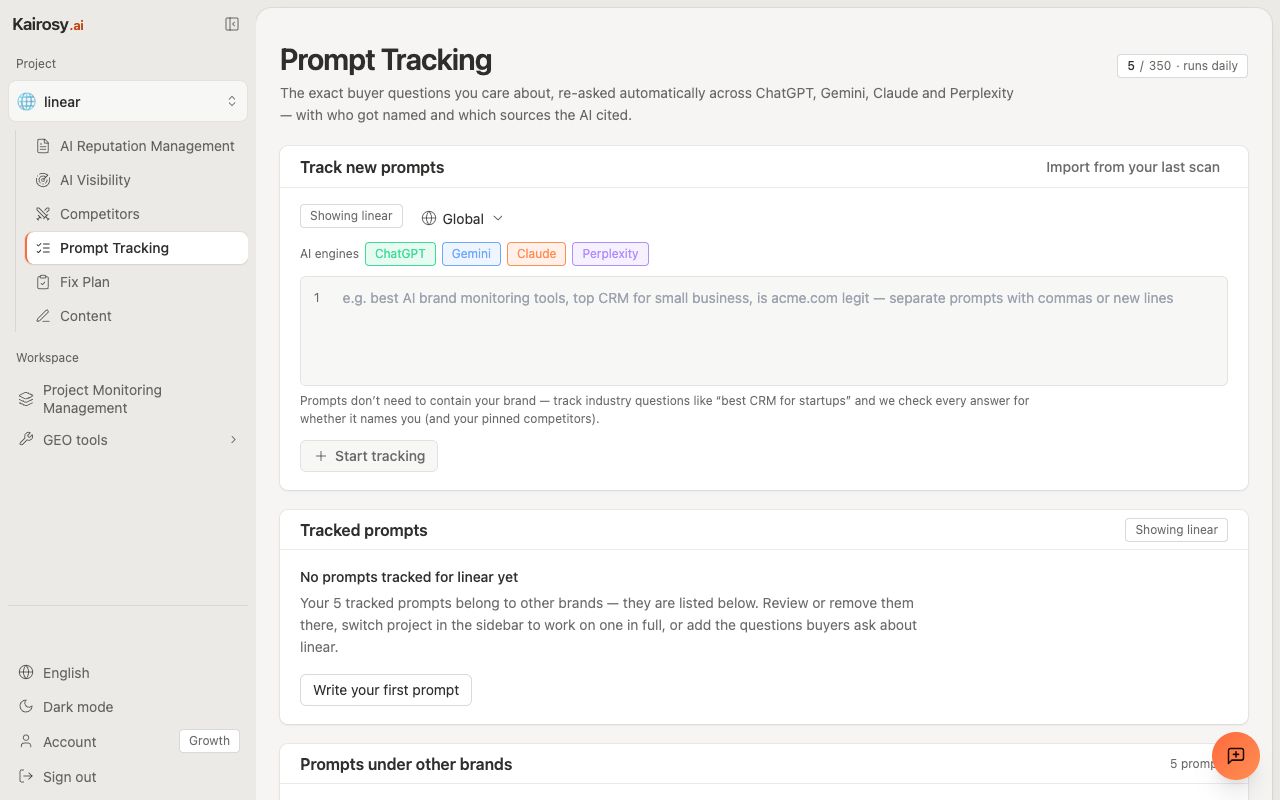
One hundred prompts × four engines × daily runs is 12,000 answers a month. Without a layer that names the page, the complaint, the competitor and the fix, that is a warehouse, not analytics.
Good AI search analytics should explain not only what changed, but why it changed and what to do next. A number that moves without a reason attached is a rumor.
How Do You Measure AI Search Effectively? A 10-Step Method
- Define the prompt universe. Pull questions from sales calls, support tickets and category searches; 25 to 100 prompts is enough to start.
- Group prompts by funnel stage, topic and persona. "Best X for small teams" and "X vs. Y pricing" need different fixes.
- Track across several LLMs. ChatGPT, Gemini, Claude and Perplexity at minimum; add AI Overviews and AI Mode if Google is your channel.
- Measure visibility. Mention rate, prompt coverage and share of voice, each cut by engine.
- Measure citations. Record the actual URLs and domains behind every answer; split owned from third-party.
- Compare competitors. Same prompts, same engines, same period, or share of voice is meaningless.
- Analyze sentiment and representation. Label every answer and keep the sentence that justifies the label.
- Identify source influence. List the domains that recur behind competitor wins; those are your citation gaps.
- Prioritize opportunities. Score each gap by prompt importance, gap size and effort; ship the top five.
- Re-test after changes. Same prompt set, at least a week later, several runs per prompt, compared per engine.
Two sample-size rules: run each prompt more than once before you believe a change, and average within each engine before averaging across engines.
Which AI Search Analytics Tool Should You Use? (Pricing Compared)
Three shapes: dedicated prompt trackers, AI modules inside SEO suites, and enterprise platforms with custom pricing. Prices were checked on each vendor's pricing page as of September 2026; they change monthly, so verify before buying.
| Tool | What it measures | Engines covered | Entry pricing (Sept 2026) |
|---|---|---|---|
| Kairosy | Visibility, per-answer sentiment with reasons, real citation URLs, share of voice, prioritized Fix Plan, page audit | ChatGPT, Gemini, Claude, Perplexity | Basic $29/mo (3 tracking slots, 15 daily prompts); Pro $99; Growth $399; 7-day free trial, no card |
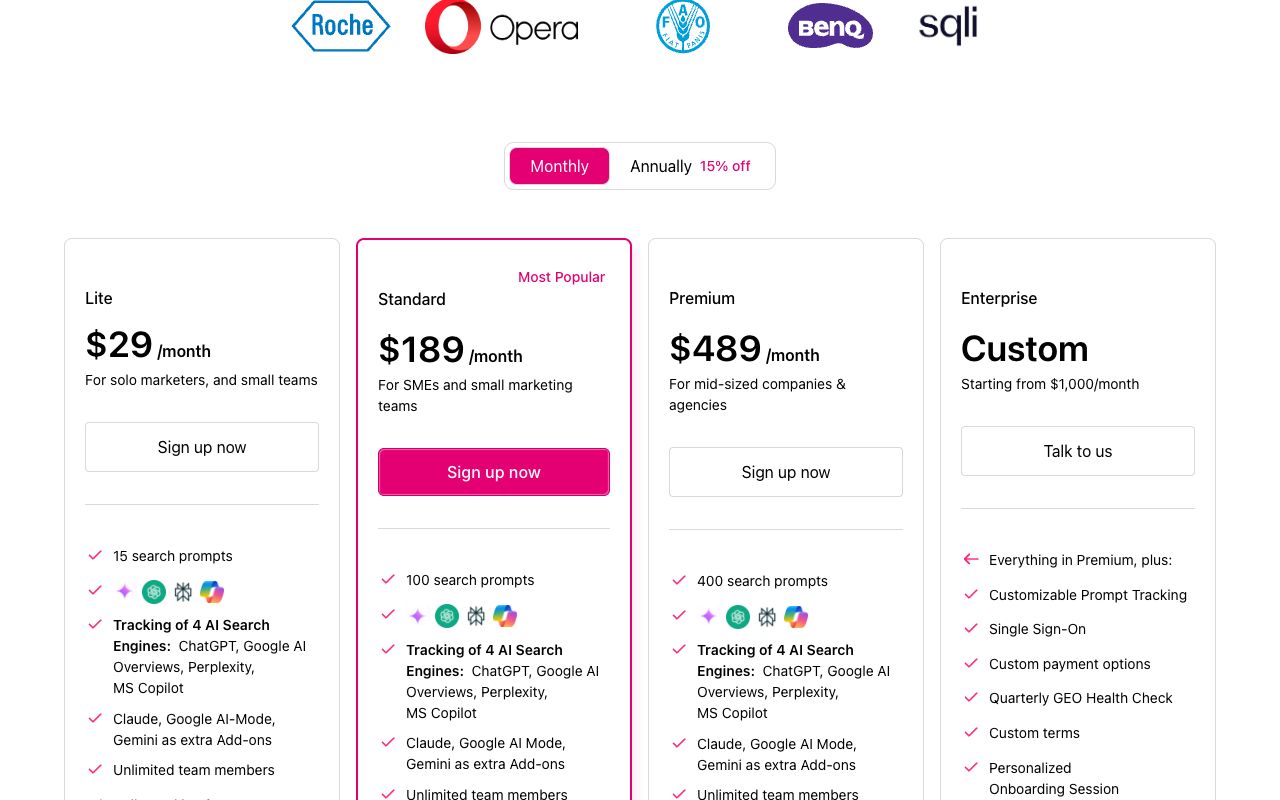
| Otterly.AI | Prompt tracking, citations, GEO URL audits | ChatGPT, Google AI Overviews, Perplexity, Copilot; Claude and Gemini as paid add-ons | Lite $29/mo (15 prompts); Standard $189/mo (100 prompts); free trial |
| Ziptie | Usage-based prompt monitoring, UGC impact add-on | Selectable from 7 AI platforms | Starter preset from $42.75/mo, billed per prompt slot; 7-day no-card trial (25 daily prompts on 3 engines) |
| Ahrefs Brand Radar | AI mentions and citations inside the Ahrefs suite | AI Overviews, AI Mode, ChatGPT, Perplexity, Gemini, Copilot, Claude | Custom Prompts add-on from €47/mo, bundled into paid Ahrefs plans; standalone AI Visibility Index €179/mo (83 daily prompts) |
| Semrush AI Visibility | AI prompt tracking inside the SEO plans | Google, ChatGPT, Perplexity, Gemini and others | SEO plan from $117.33/mo billed annually, with 50 daily tracked prompts |
Above this band, Profound tracks up to nine answer engines on its Enterprise tier, publishes no monthly price, and limits its free trial to 50 prompts a day for seven days on ChatGPT, Gemini and Google AI Overviews; Peec AI lists four tiers without showing prices on the page we checked.
How to choose: if you already pay for Ahrefs or Semrush and only need mention counts, the bundled module is cheapest. If citations and prompt volume are the job, a dedicated tracker scales by prompt. If the question is "why is the answer negative and what do we change," you need the sentiment and fix layer, which is what Kairosy is built for. No single AI search analytics tool covers all three tiers at every price; buy for the tier where you are stuck.
How Do You Monitor AI Search Analytics Over Time?
A one-off report answers "where are we." Monitoring answers "what moved, and did our fix cause it." Eight trend lines cover it:
- Visibility trend — mention rate on the fixed prompt set, per engine, weekly.
- Citation trend — owned-URL citation rate, per engine.
- Share-of-voice trend — you versus each named competitor.
- Source churn — domains entering or leaving the citation set; the mid-September 2025 Reddit and Wikipedia collapse on ChatGPT is exactly what this line exists to catch.
- Competitor changes — a rival newly becoming the preferred pick on a prompt.
- Sentiment movement — new negative keywords, or an engine flipping from positive to negative.
- Model disagreement — the spread between best and worst engine score; widening usually means one engine changed sources.
- Before and after fixes — same prompt set, several runs, compared per engine against the pre-fix baseline.
Cadence matters more than volume. Daily runs on a tracked prompt set catch flips; a weekly deep re-scan with an emailed digest catches slower shifts in sources and competitors; alerts should fire only on a new negative keyword, a competitor becoming the preferred pick, a score drop, or an engine changing its verdict.
The loop is short: Measure → Diagnose → Prioritize → Fix → Monitor. Visibility measures, citations diagnose, strategy prioritizes, audit and content work fix, trend lines confirm — then the cycle restarts on next week's answers.
AI Search Analytics FAQs
What is AI search analytics?
The measurement of how AI answer engines mention, recommend, cite and describe a brand across a defined set of buyer prompts, tracked per engine and over time, then turned into prioritized fixes.
What is Ziptie AI search analytics?
Ziptie is an AI search intelligence platform that monitors how AI engines describe a brand across a selectable set of seven platforms, including ChatGPT, Google AI Overviews and Perplexity. As of September 2026 its pricing is usage-based per monitored prompt slot, from a $42.75-a-month Starter preset, with a seven-day, no-card trial.
Why choose Ziptie AI search analytics over an SEO suite's AI module?
Choose a dedicated tracker like Ziptie when prompt volume and engine breadth are the constraint; usage-based pricing and seven selectable platforms scale in a way a 50-prompt bundled module does not. Choose the bundled module when you already pay for the suite and only need counts, and a sentiment-and-fix tool when the problem is what the engines say.
How do marketing teams use AI search analytics with web analytics?
Two joins. First, segment GA4 referrals from chatgpt.com, perplexity.ai, gemini.google.com and claude.ai and compare their conversion rate with organic search; volumes are small but intent is high. Second, line prompt-level mention and citation trends up against those segments and against Search Console's Web report, which folds AI Overview clicks in without a breakdown. Together they show whether an answer change reached revenue.
See what AI says about your brand
Run a free scan across ChatGPT, Gemini, Claude & Perplexity in about 30 seconds.
Run my free scan