AI Citation Analytics in 2026: 7 Tools Compared and Priced
AI citation analytics is the practice of measuring which URLs an AI engine actually pulls into its answer about you, your category, and your competitors — then working out why those pages won the slot. It is not rank tracking, and it is not the same thing as counting mentions.
One clarification before anything else, because the phrase collides with two older meanings. AI citation analytics has nothing to do with local business citations (your NAP listings on Yelp or a Google Business Profile), and nothing to do with academic citation analysis in Scopus or Web of Science. Here, a citation means a source link an answer engine attaches to a claim.
This guide covers the workflow, the seven tools worth knowing, a side-by-side table with prices verified on August 5, 2026, and a categorized verdict at the end. It closes a three-part series: part one covers citation gap analysis against competitors, and part two segments citation tracking tools by audience and budget.
What Is AI Citation Analytics, and What Is It Not?
Three things get measured in AI search and people mix them constantly. A mention is your name in the answer text, a citation is a linked source the engine attributes a claim to, and a recommendation is the engine telling the user to pick you. All three can occur independently — you can be cited while a rival gets recommended — so analytics that counts only one will mislead you. Part one of this series unpacks that distinction in detail.
Citations deserve their own measurement layer because they are the only part of an answer you can trace to a document and change. Pew Research Center's study published July 22, 2025 — 900 U.S. adults, 68,879 searches logged in March 2025 — found users clicked a cited source on just 1% of visits, and clicked any traditional result on 8% of visits with a summary versus 15% without.
If almost nobody clicks the citation, referral traffic is not the citation's job. Its job is to decide what the answer says. That is the case for AI citation analytics as a discipline separate from the analytics you already run.
How Do You Run AI Citation Analytics in Five Steps?
The mechanics are the same whether you do it manually in a spreadsheet or buy a platform.
1. Build a prompt set from real buying questions. Twenty-five to fifty prompts covering category discovery ("best CRM for a 5-person agency"), direct brand checks, comparisons, and objections ("is X worth the price"). Freeze the wording so runs stay comparable.
2. Run them across engines, not one engine. ChatGPT, Gemini, Claude and Perplexity retrieve differently and cite different domains for the same prompt. A single-engine sample is a single-engine opinion.
3. Capture the full answer plus every source URL. This is where DIY breaks. The citation only matters in context — a source cited to support a criticism of you is not a win.
4. Classify each source. Owned (your domain), earned (press, reviews, Reddit, YouTube), competitor-owned, or aggregator/listicle. The split tells you which lever to pull.
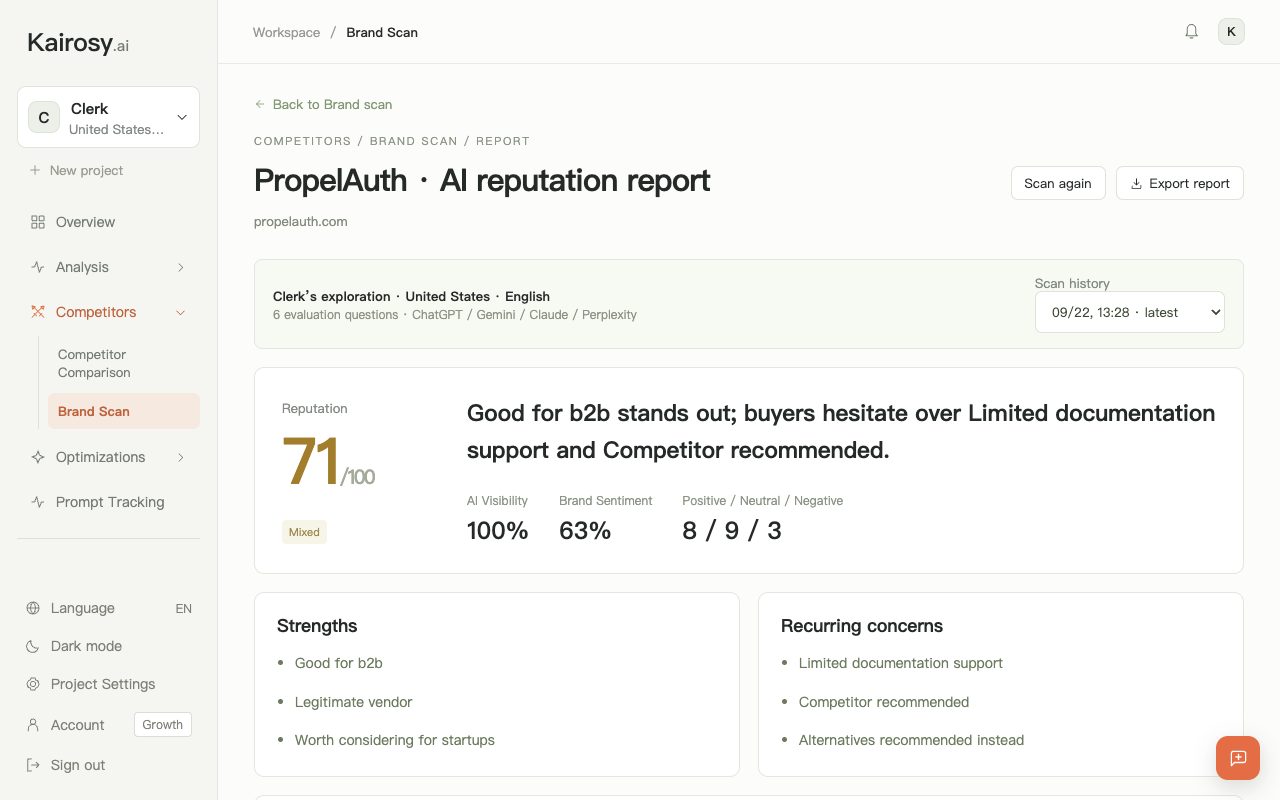
5. Re-run on a schedule and diff. Answers drift week to week without anyone touching anything. One snapshot is an anecdote. Kairosy's public scan of Pipedrive's AI performance shows what a single-point read looks like — useful, but the value compounds when you have twelve of them in a row.
Two free checks belong in this loop. Run your domain through the AI crawler checker to confirm GPTBot and friends are not blocked, and through the schema markup checker to see what machine-readable context your pages expose.
Which Three Tool Categories Cover AI Search Citation Analytics?
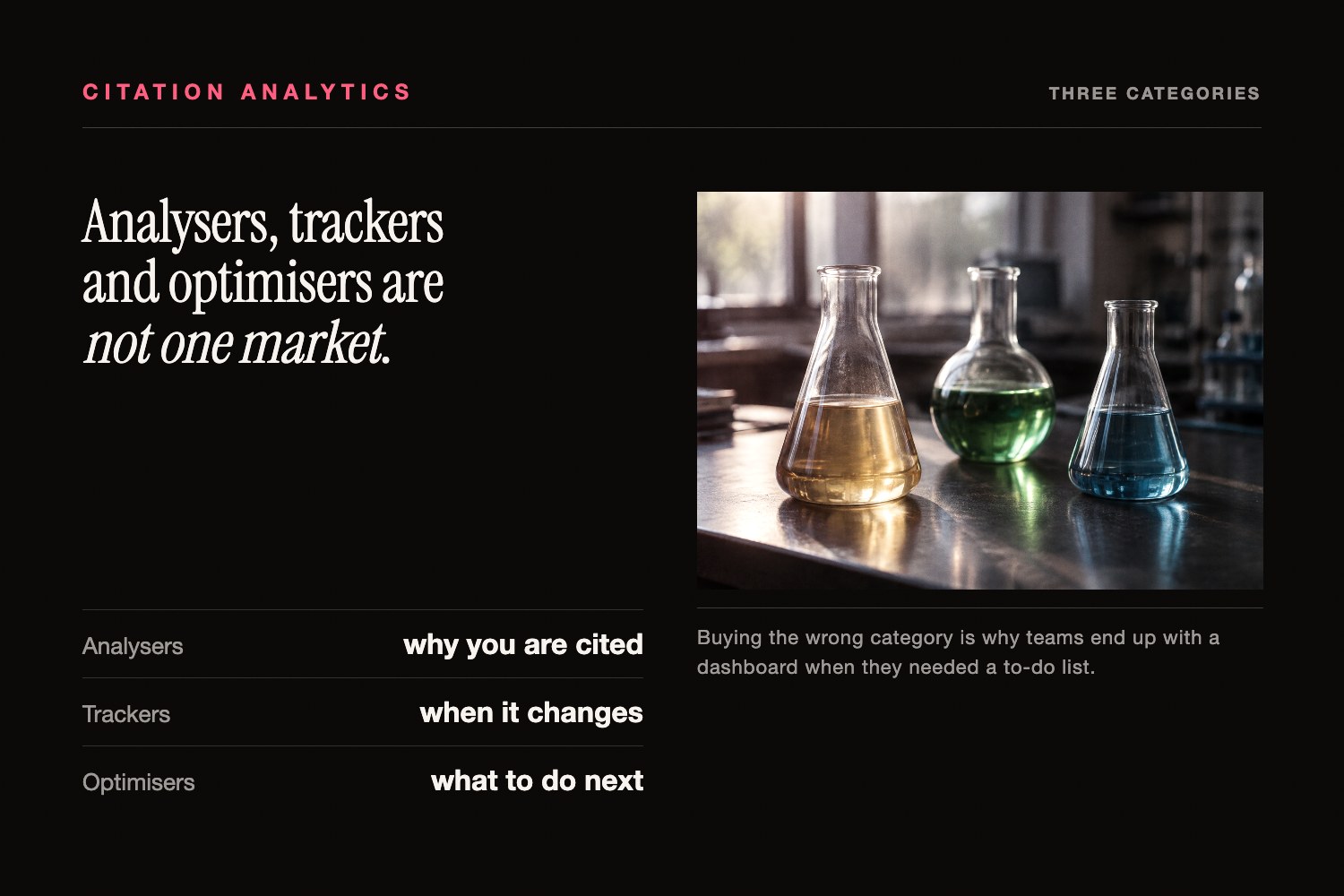
Every vendor calls itself an "AI visibility platform," which hides a real functional split. Sorting them into three buckets makes the buying decision obvious, and it is the frame missing from most AI search citation analytics comparisons.
Analysis tools answer "why does the answer say that." They surface the answer text, the sources behind it, and the tone. Depth over breadth — you reach for these when something is wrong and you need the cause.
Trackers answer "is the number moving." Share of voice, prompt-level position, citation counts over time, competitor benchmarks, alerts. Breadth over depth, for reporting and early warning.
Optimizers answer "what do I change on Tuesday." Content briefs, AI-readiness audits, structured-data checks, fix queues. Almost nobody buys a pure optimizer — it ships bolted onto one of the other two.
Most teams need one of each function, not three subscriptions. The practical question is which platform covers two of the three well enough that you only buy one more.
Which AI Citation Analytics Tools Are Worth Paying For?
1. Kairosy — analysis plus optimization, with sentiment attached
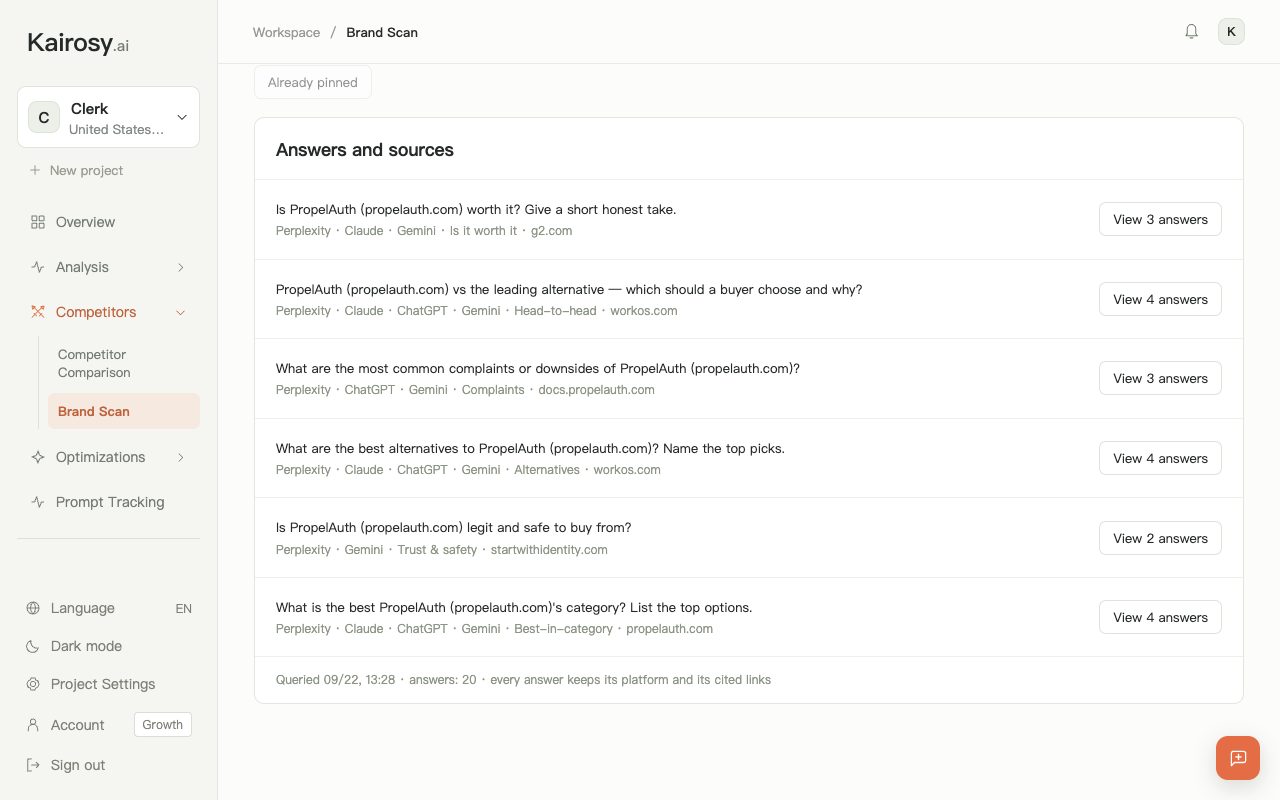
Kairosy runs your prompt set through ChatGPT, Gemini, Claude and Perplexity, keeps the complete answer next to the source URLs the engine cited, scores sentiment, and outputs a Fix Plan of prioritized changes. Storing answer and citation together is what lets you see that a rival's comparison page is why an engine hedged about your pricing.
Paid plans add 25 country markets, weekly brand rescans with email alerts, and daily prompt tracking. The free tier is a 7-day trial — the whole report, not a teaser. Paid: $29 Basic, $99 Pro, $399 Growth per month.
Honest limits: it is not a backlink-citation tool, not a local-citation manager, and it does not track blue-link Google rankings. See AI reputation management for the sentiment side and AI brand monitoring for the tracking side.
2. Profound — analysis with agent traffic attribution
Profound pairs answer analytics with Agent Analytics, which watches AI crawlers and AI-referred sessions hitting your domains, with integrations listed for Google Analytics, Cloudflare and AWS. That server-side view is the closest thing on the market to closing the loop between a citation and a visit.
Pricing on its pricing page (checked September 24, 2026): the self-serve tiers for brands are gone. What remains is a free Trial, 50 prompts run daily for 7 days on ChatGPT, Gemini and Google AI Overviews, and a custom Enterprise plan with up to 9 answer engines, sold through sales. Note that the trial is a one-week, three-engine sample.
3. SE Ranking AI Visibility Tracker — citation reporting inside an SEO suite
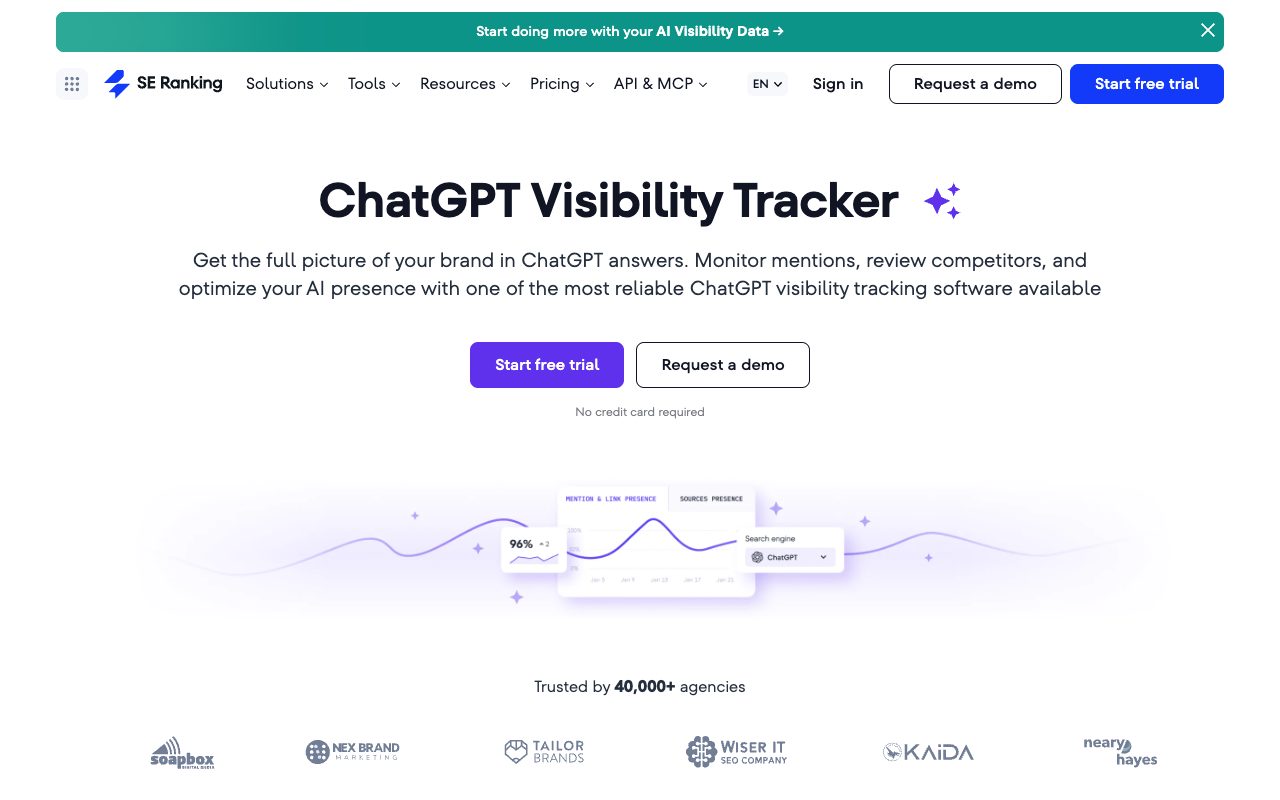
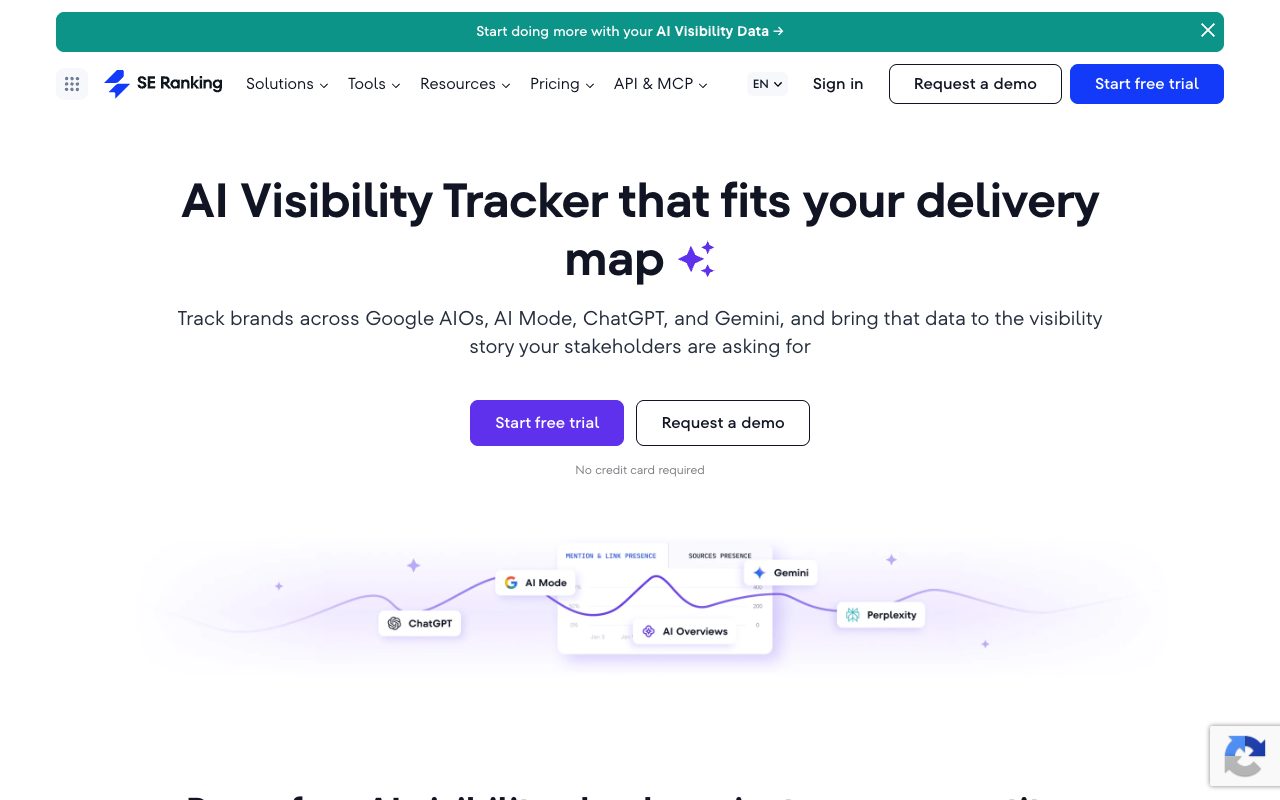
SE Ranking tracks Google AI Overviews, AI Mode, ChatGPT, Gemini and Perplexity, and explicitly separates "mentions in AI answer texts with and without site links" from "links to websites that AI use the most." That distinction is exactly the mention-versus-citation split, built into the reporting.
Its AI Visibility Tracker page does not publish a price — it advertises a 14-day trial and 5 free checks per day, with paid tiers on the subscription page. Best fit if your agency already reports out of SE Ranking.
4. Peec AI — daily tracking for agencies and multi-market brands
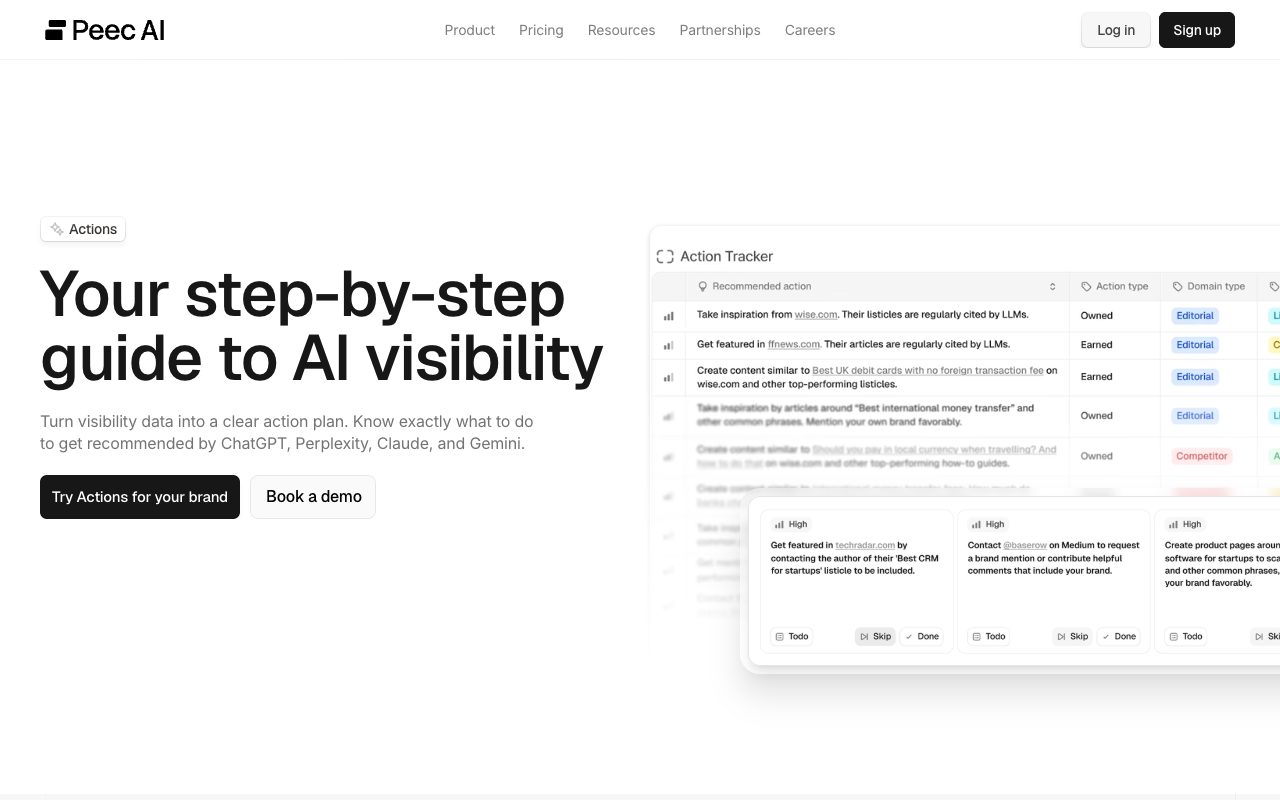
Peec covers ChatGPT, Perplexity, Gemini, Microsoft Copilot, AI Mode and AI Overviews, with daily or weekly runs, multiple projects, per-project countries, competitor benchmarking, plus Looker, API and MCP access on higher tiers. The site claims 3,000+ brands and agencies and a 4.9/5 rating on G2.
A note on numbers: Peec's pricing page lists Starter, Pro, Advanced and Enterprise, but the amounts render client-side and are absent from the served HTML. Third-party blogs quoting exact Peec prices are quoting stale figures — check in a browser before you budget.
5. Otterly.ai — the cheapest real entry point
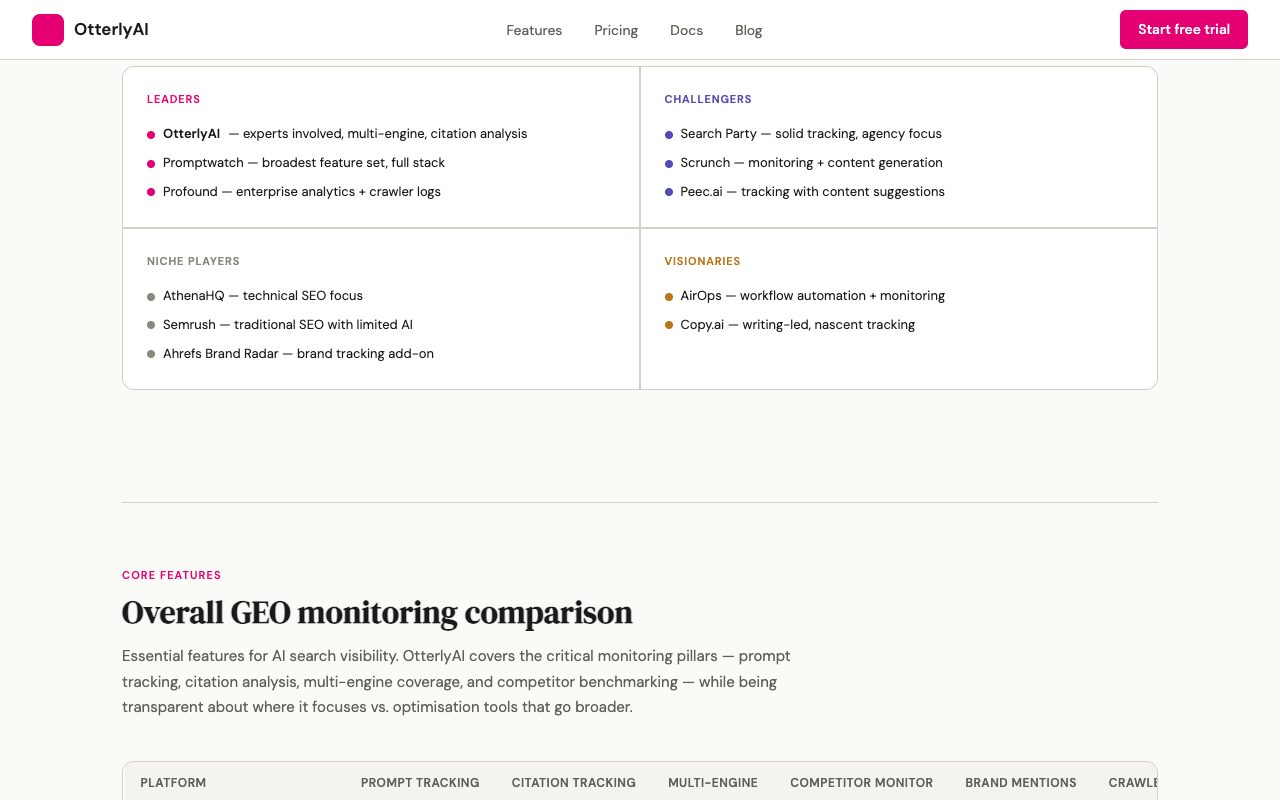
Otterly's pricing page lists Lite at $29/month for 15 search prompts, Standard at $189/month for 100 prompts, and Premium at $489/month for 400 prompts, each with unlimited team members and a monthly GEO URL audit allowance (1,000 / 5,000 / 10,000). Annual billing takes 15% off.
All tiers track ChatGPT, Google AI Overviews, Perplexity and Microsoft Copilot. Google AI Mode, Gemini and Claude are paid add-ons at $9–$29/month depending on engine and tier — worth pricing in before you compare $29 against anything.
6. Ahrefs Brand Radar — the widest platform list
Brand Radar covers AI Overviews and AI Mode, ChatGPT, Perplexity, Copilot, Gemini and Grok, and markets three jobs: tracking mentions across AI answers, benchmarking against competitors, and finding "valuable AI citations." YouTube, TikTok and Reddit visibility are in beta. Pricing is listed at $398/month for select platforms and $699/month for all platforms.
7. Semrush AI Toolkit — tracking with an optimization layer
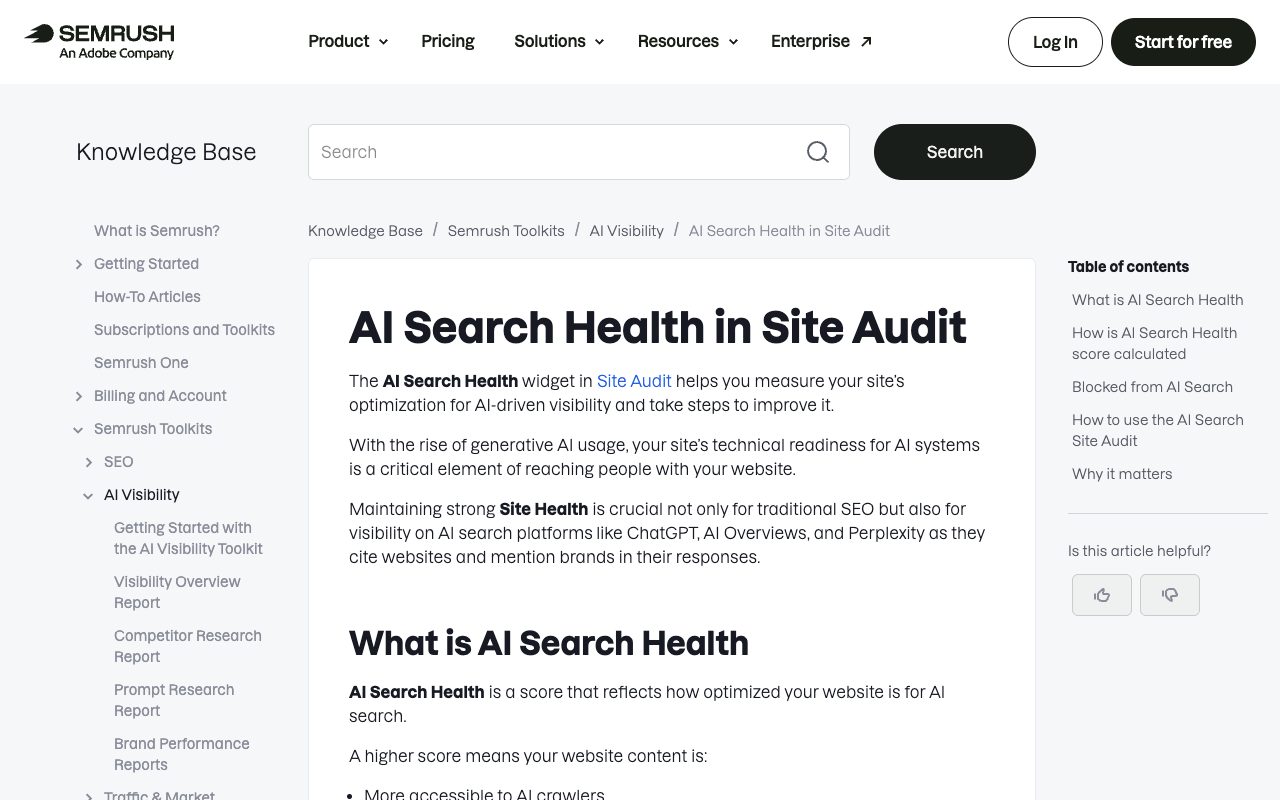
The Semrush AI toolkit is $99/month billed annually per domain: AI visibility reports, 25 custom prompts with daily rankings, mentions from ChatGPT, Google AI, Gemini and Perplexity, competitor and prompt research, and a site audit for AI readiness. Add-ons cost extra (additional users from $45/month, lead generation $90/month). That site audit is what earns the optimizer label — it pairs prompt tracking with a technical readiness check in one subscription.
AI Citation Analytics Tools Compared: Coverage and Pricing
Prices below were read directly from each vendor's official page on August 5, 2026. Where a vendor does not publish a number, the cell says so rather than guessing.
| Tool | Category | Engines covered | Citation-level output | Entry price |
|---|---|---|---|---|
| Kairosy | Analysis + optimizer | ChatGPT, Gemini, Claude, Perplexity | Cited URLs per answer, with full answer text and sentiment | Free 7-day trial; $29 / $99 / $399 |
| Profound | Analysis + attribution | ChatGPT, Gemini, AI Overviews (Trial); up to 9 (Enterprise) | Answer analytics plus AI agent and referral traffic | Free 7-day trial; Enterprise custom |
| SE Ranking | Analysis in an SEO suite | AI Overviews, AI Mode, ChatGPT, Gemini, Perplexity | Mentions with and without links, most-used source domains | Not published on the tracker page; 14-day trial |
| Peec AI | Tracker | ChatGPT, Perplexity, Gemini, Copilot, AI Mode, AI Overviews | Sources and competitor benchmarking, daily or weekly | 4 tiers listed; amounts render client-side |
| Otterly.ai | Tracker | ChatGPT, AI Overviews, Perplexity, Copilot (others as add-ons) | Link citations per tracked prompt | $29/mo (15 prompts) |
| Ahrefs Brand Radar | Tracker | AI Overviews, AI Mode, ChatGPT, Perplexity, Copilot, Gemini, Grok | Mentions and AI citations, competitive benchmarking | $398/mo select platforms |
| Semrush AI Toolkit | Tracker + optimizer | ChatGPT, Google AI, Gemini, Perplexity | Mentions, 25 daily-tracked prompts, AI-readiness audit | $99/mo per domain, billed annually |
Which Citation Analysis Service Is Best for AI SEO?
There is no single winner, so here is the verdict by situation rather than a leaderboard. Which citation analysis service is best for AI SEO depends almost entirely on whether your bottleneck is diagnosis, reporting, or execution.
Best free way to start: Kairosy's free 7-day trial. Full multi-engine reports with cited sources and sentiment, no card.
Best for diagnosing a bad answer: Kairosy. Storing the answer text next to the citation and the sentiment score is what turns "we lost visibility" into "this review page is why."
Best for proving AI drives revenue: Profound, on an Enterprise contract. Agent Analytics connects citations to server-side traffic, which is the argument a CFO accepts.
Best on a tight budget: Otterly.ai Lite at $29/month — but only if ChatGPT, AI Overviews, Perplexity and Copilot are the engines you care about, since Gemini and Claude cost extra.
Best for agencies running many brands and markets: Peec AI, for per-project countries and the Looker and API layer. Confirm current pricing in-browser first.
Best if you already pay for a suite: Semrush AI Toolkit at $99/month, or SE Ranking if that is your reporting home. Adding a module beats adding a vendor.
Best for the widest platform net: Ahrefs Brand Radar, the only one here listing Grok alongside the mainstream six.
How to Increase AI Citations Once the Data Is In
Analytics that never changes a page is a hobby. AI citation optimization means acting on the source classification from step four, and each class has a different lever.
Competitor-owned sources cited about you. You cannot edit their page. You can publish the comparison they are winning — a factual, current, clearly-structured page on your own domain covering the same matchup.
Aggregators and listicles. These are the highest-leverage targets because engines lean on them for "best X" prompts. Get listed, get your entry corrected, get the pricing updated. That is outreach work, not content work.
Your own pages cited weakly or not at all. Make them extractable: a direct answer in the opening lines, specific numbers, dates on claims, clean headings. Publish an llms.txt file to declare your key URLs, and check that crawlers can reach them.
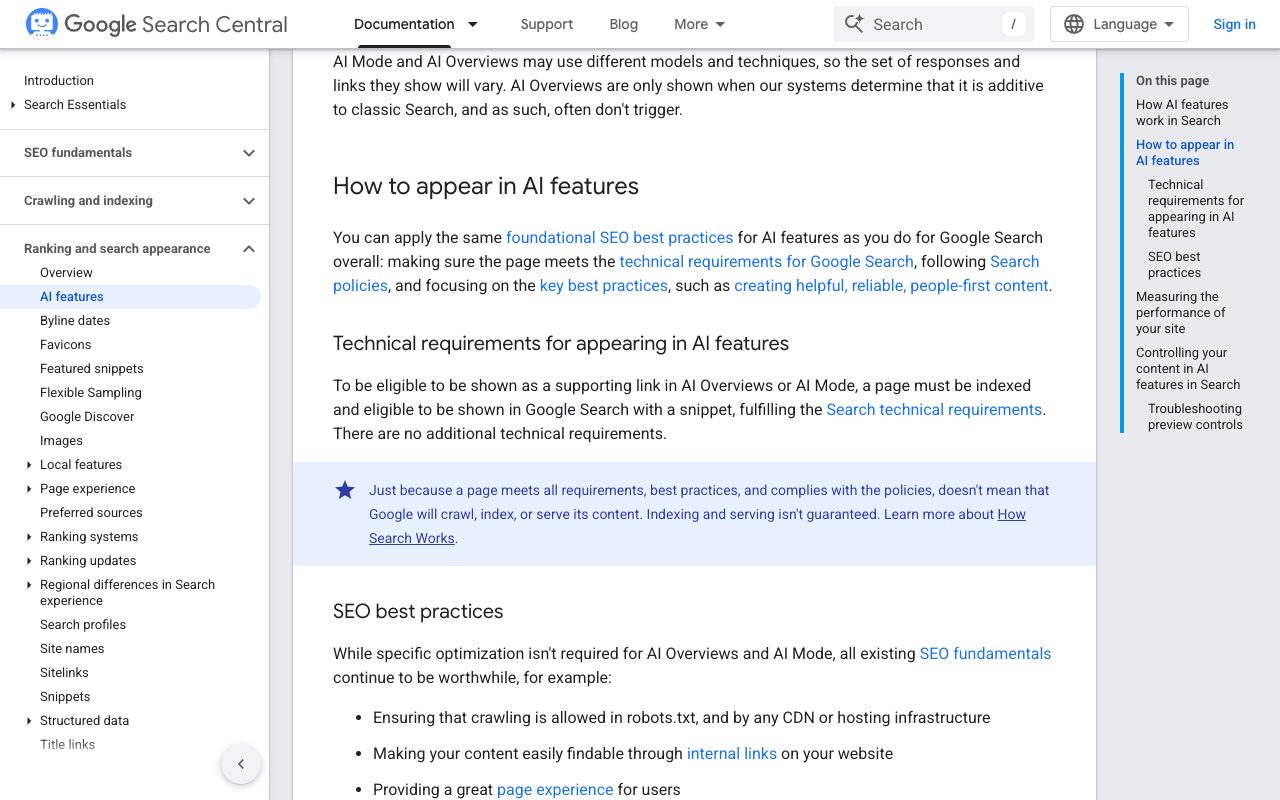
One caution against over-engineering. Google's documentation on AI features states plainly: "You don't need to create new machine readable files, AI text files, or markup to appear in these features. There's also no special schema.org structured data that you need to add." Treat llms.txt and schema as useful hygiene for the wider engine set, not as a Google ranking hack.
Then re-measure. Running AI citation analytics on a schedule is what lets you attribute a citation gain to a specific change — the listicle correction that landed in week three, or the comparison page that started getting pulled in week six. Without the before-and-after, every improvement is a guess. Our breakdown of the sources AI engines cite most shows which domain types keep surfacing.
AI Citation Analytics FAQs: Tools, Pricing, and Metrics
Is AI citation analytics the same as local citation management?
No. Local citation management is about consistent name, address and phone listings across directories for local map rankings. AI citation analytics measures which URLs generative engines cite when answering questions. Different data, different tools, different teams.
How many prompts do I need to track?
Twenty-five well-chosen prompts beat 200 lazy ones. Cover category discovery, direct brand queries, head-to-head comparisons, and objections. Entry plans reflect this range — Semrush includes 25 tracked prompts, Otterly Lite includes 15, Profound's free Trial includes 50.
How to increase AI citations without buying anything?
Fix the three cheapest things first: unblock AI crawlers, get your entry corrected on the aggregator pages that rank for your category terms, and rewrite your top pages so the answer sits in the first two sentences. Verify with a free multi-engine scan monthly.
Do citations from AI answers actually send traffic?
Rarely, at the current click rates. Pew Research Center measured citation clicks at 1% of visits to pages with an AI summary, in data collected in March 2025. Value citations for influence over the answer, and measure referral traffic separately.
Which engines should AI search citation analytics cover?
At minimum ChatGPT, Gemini, Perplexity and Google's AI surfaces. Add Claude if you sell to technical or enterprise buyers, and Copilot if your buyers live in Microsoft 365. Check whether extra engines are included or sold as add-ons before comparing headline prices.
See what AI says about your brand
Run a free scan across ChatGPT, Gemini, Claude & Perplexity in about 30 seconds.
Run my free scan