Enterprise SaaS SEO in 2026: Strategy, Issues, and Best Tools
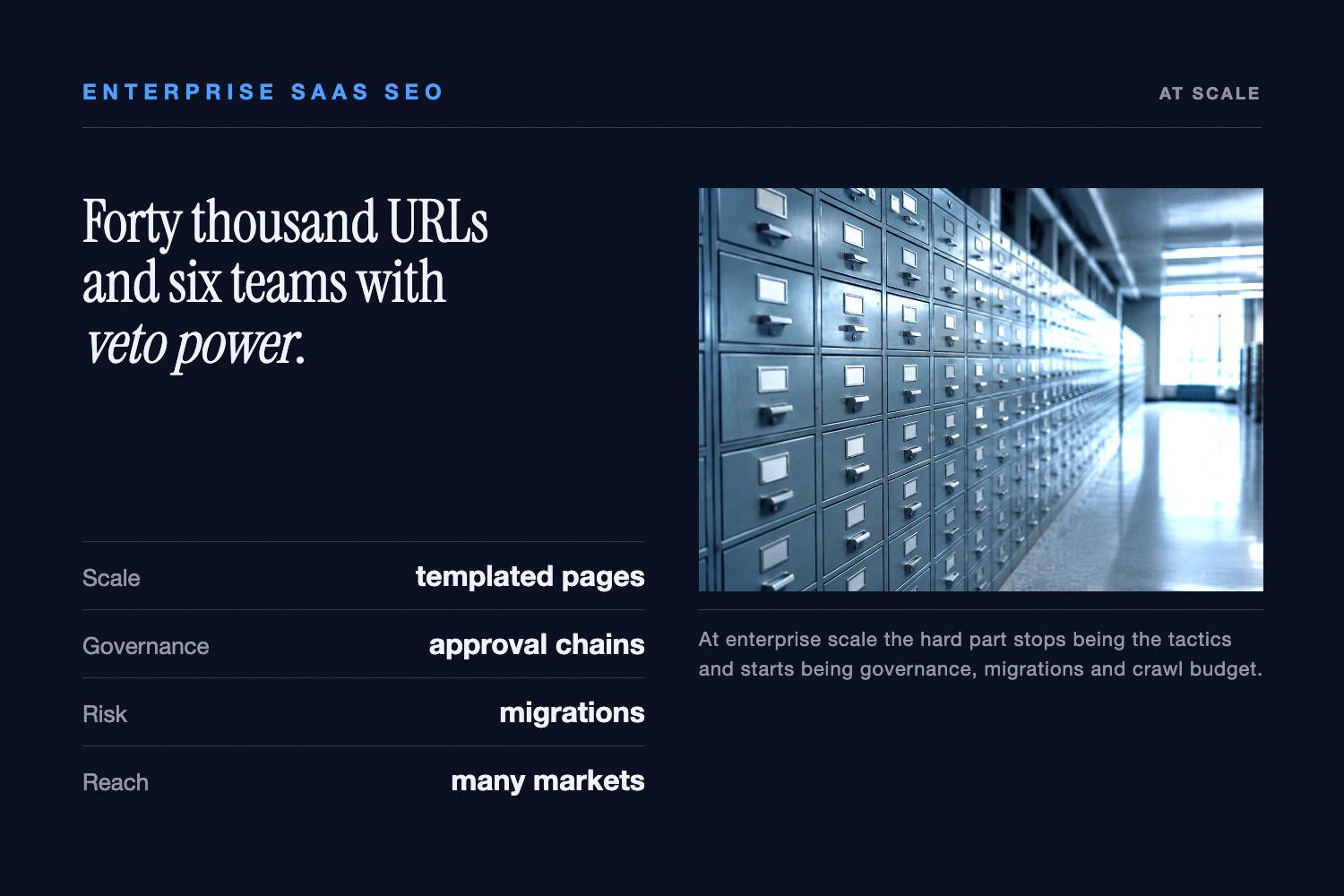
Enterprise SaaS SEO is what the discipline turns into once your site carries 20,000 URLs, four teams can edit a shared template, and a legal reviewer sits between every copy change and production. The tactics barely change. The bottlenecks do — crawl allocation, template governance, redirect maps, hreflang reciprocity, and an approval chain that stretches a two-hour fix into a six-week ticket.
Below: where enterprise scale actually begins, what the channel returns at that size, the failure modes that only surface above ten thousand pages, five strategies built for that volume, and which platforms earn their quote. Running something smaller? Our complete SaaS SEO guide is size-agnostic, and the startup edition covers the zero-budget end.
What Is Enterprise SaaS SEO, and at What Scale Does It Start?
Enterprise SaaS SEO is organic search run for a software company whose site is too large for the single page to be the unit of work. Templates, crawl rules, and governance become the unit instead: you merge one component change and 8,000 URLs inherit it, for better or worse.
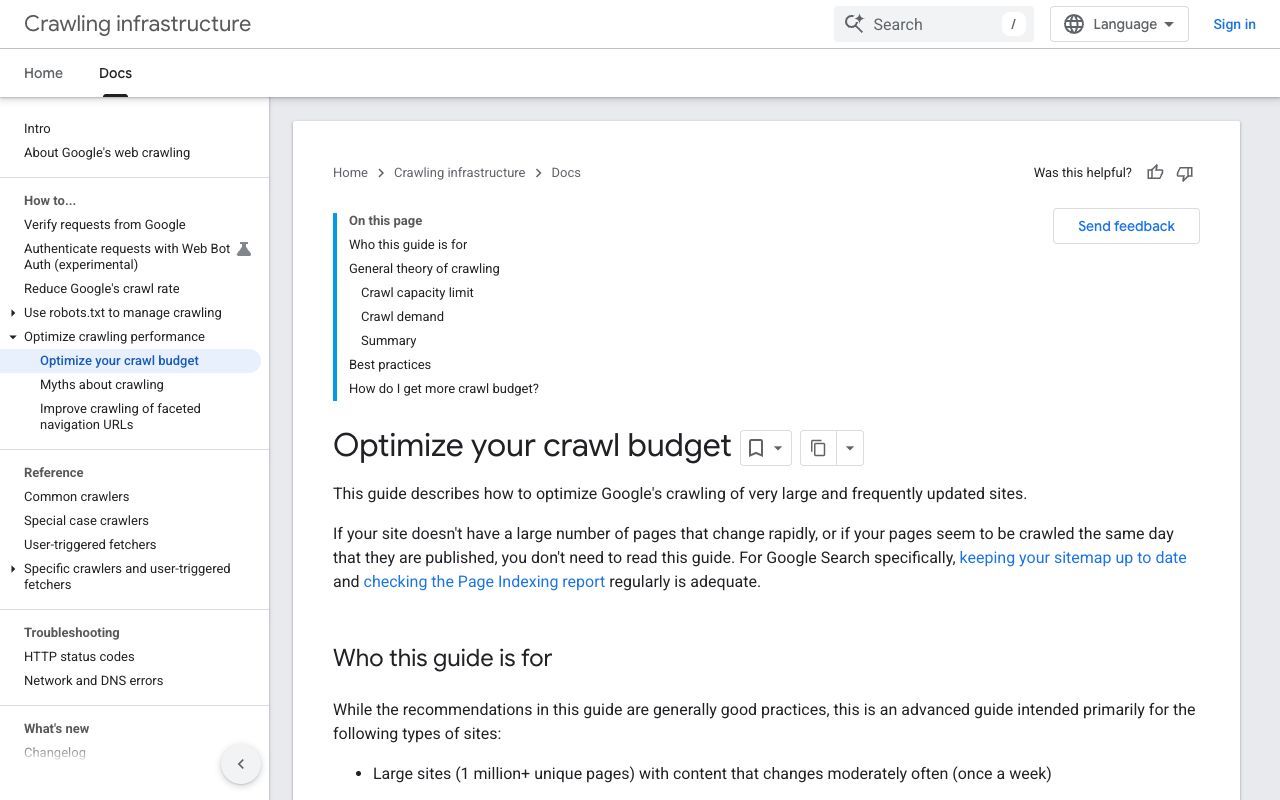
Google draws a usable line under the term. Its crawl budget guidance for large site owners states that the subject only becomes relevant for "large sites (1 million+ unique pages) with content that changes moderately often (once a week)" or "medium or larger sites (10,000+ unique pages) with very rapidly changing content (daily)." Below those marks, Google says ordinary crawling handles you fine.
Lumar used the same boundary to define its research population: 204 digital leaders, every one of them responsible for a site of 10,000+ URLs. So a workable threshold for enterprise level SEO is roughly ten thousand indexable URLs — or any org where more than three teams can ship HTML without asking anyone.
Two definitions collide here, and it matters which you adopt. Vendors define enterprise by org chart; Conductor's 2026 research, for example, sampled companies with 500+ employees. Practitioners define it by surface area. A 90-person SaaS with 40,000 programmatic integration pages has every enterprise problem in this article. A 2,000-person company with a 300-page marketing site has almost none of them.
How Enterprise SEO Will Help Your Business: 4 Effects That Compound at Scale
The argument is not "more traffic." It is that four specific effects only exist above a certain size, and each one strengthens as the URL count grows.
1. Fixes amortize across thousands of pages. Repairing a title pattern on a 300-page site is a pleasant afternoon. Repairing the same pattern inside a component that renders 25,000 integration pages is a quarter of impact from one pull request. Cost per optimized page falls toward zero, which is the whole economic case for tooling that bills five figures a year.
2. Organic absorbs the tail paid search cannot bid on. Nobody profitably buys clicks for "[product] SOC 2 export" or "[product] vs [rival] for 500 seats." Templated pages capture that demand at a fixed engineering cost instead of a per-click one, across tens of thousands of queries that each convert two or three times a year.
3. It creates a moat rivals must out-wait. Indexed depth, entity recognition, and accumulated links cannot be bought in a quarter. A challenger can copy your pricing page in a week and your 30,000-page documentation graph in about three years.
4. The same assets feed AI answers. Structured, well-sourced pages are what language models quote when a buyer asks a category question — so the work has two payoffs from one budget line.
Be honest about the input side, though. In Lumar's enterprise SEO survey of 204 digital leaders, published February 14, 2023, 66% of respondents employed six or more in-house SEO staff and 93% also retained external agencies. At this scale the channel is cheap per page and expensive per program.
Which Enterprise SEO Issues Break Large SaaS Sites First?
The same Lumar study asked what those 204 leaders actually struggle with. The top answer — 60% — was executing SEO improvements and monitoring at scale. Second, at 53%, was managing SEO tasks across multiple departments. Site speed and UX came third at 46%, and building efficient internal processes fourth at 45%.
Read that ranking again: three of the top four enterprise SEO issues are operational, not algorithmic. Nobody in that survey was stuck on keyword research.
| Site size | Failure mode that dominates | Typical owner |
|---|---|---|
| Under 10,000 URLs | Thin templated variants and duplicate parameter pages | Content ops |
| 10,000+ URLs, fast-changing (Google's "medium or larger" threshold) | Crawl waste: faceted URLs, staging leakage, app subdomains | SEO plus platform engineering |
| 100,000+ URLs | Indexation ceilings; log analysis stops being optional | Platform engineering |
| 1,000,000+ URLs (Google's "large sites") | Crawl scheduling against server capacity limits | Infrastructure plus SEO |
Four more issues show up specifically at software companies:
- Approval chains. A meta description edit that takes ninety seconds can wait six weeks behind brand, legal, and a release train. The fix is a standing pre-approval for defined change classes, not faster reviewers.
- Re-platforms. Marketing sites migrate from one CMS to another roughly every three years, and each move puts the entire indexed footprint at risk in a single deploy.
- Market sprawl. Localized subfolders get launched by regional teams, then quietly diverge from the canonical English source until hreflang stops reciprocating.
- Unowned AI answers. Nobody's OKR covers what Claude tells a procurement lead, so the surface goes unmeasured for quarters at a time.
Which 5 Enterprise SEO Strategies for SaaS Work Past 10,000 URLs?
An enterprise SEO strategy for SaaS is mostly a set of constraints rather than a list of tactics. These five are the operational core of enterprise SaaS SEO: they barely matter below ten thousand URLs and dominate above it.
1. Budget crawl with log files, not opinions
Above 100,000 URLs you cannot reason about indexation from a crawler alone — you need to see which URLs bots actually requested. Server logs answer that; nothing else does. Google's own remedy list is blunt: consolidate duplicates, block low-value URLs in robots.txt rather than with noindex, return 404 or 410 for permanently removed pages, and keep <lastmod> honest in your sitemaps.
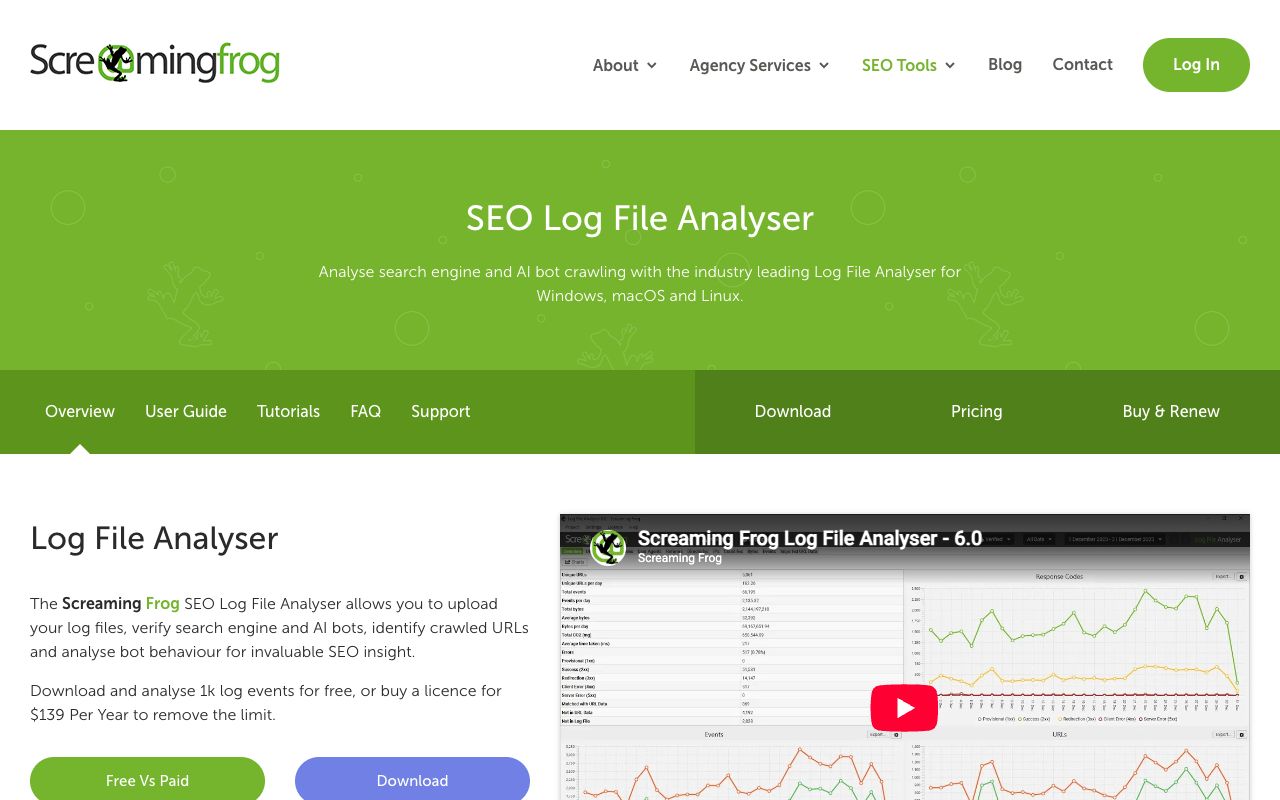
You do not need an enterprise contract to start. The Screaming Frog Log File Analyser is free for up to 1,000 log events and one project, with an unlimited license at $139 per year — enough to prove where crawl is being wasted before you ask finance for a platform.
2. Build templated pages that survive a scaled-content review
Programmatic pages are how SaaS companies reach five-figure URL counts: one integration page per connector, one comparison per rival, one template per role or industry. They are also the fastest way to trip Google's spam policies. Google defines scaled content abuse as when "many pages are generated for the primary purpose of manipulating search rankings and not helping users," and doorway abuse as pages "created to rank for specific, similar search queries."
The practical test before you generate 5,000 pages: does each one carry a unique data payload a human could not get faster elsewhere — real configuration steps, real limits, real screenshots? If the only variable is the noun in the H1, build 50 pages instead and make them good.
3. Treat internal linking as architecture, not a plugin
At ten thousand pages, link equity distribution becomes a design decision. Hubs need to sit no more than two clicks from the homepage, every templated set needs a curated parent, and orphan detection has to run on a schedule rather than during an annual audit.
The cheapest audit is a diff: crawl your sitemap, pull the URLs bots visited from logs, and inspect the gap. Pages in one list but not the other are either orphaned or blocked, and both are fixable in a sprint.
4. Run migrations as an engineering project with a real redirect map
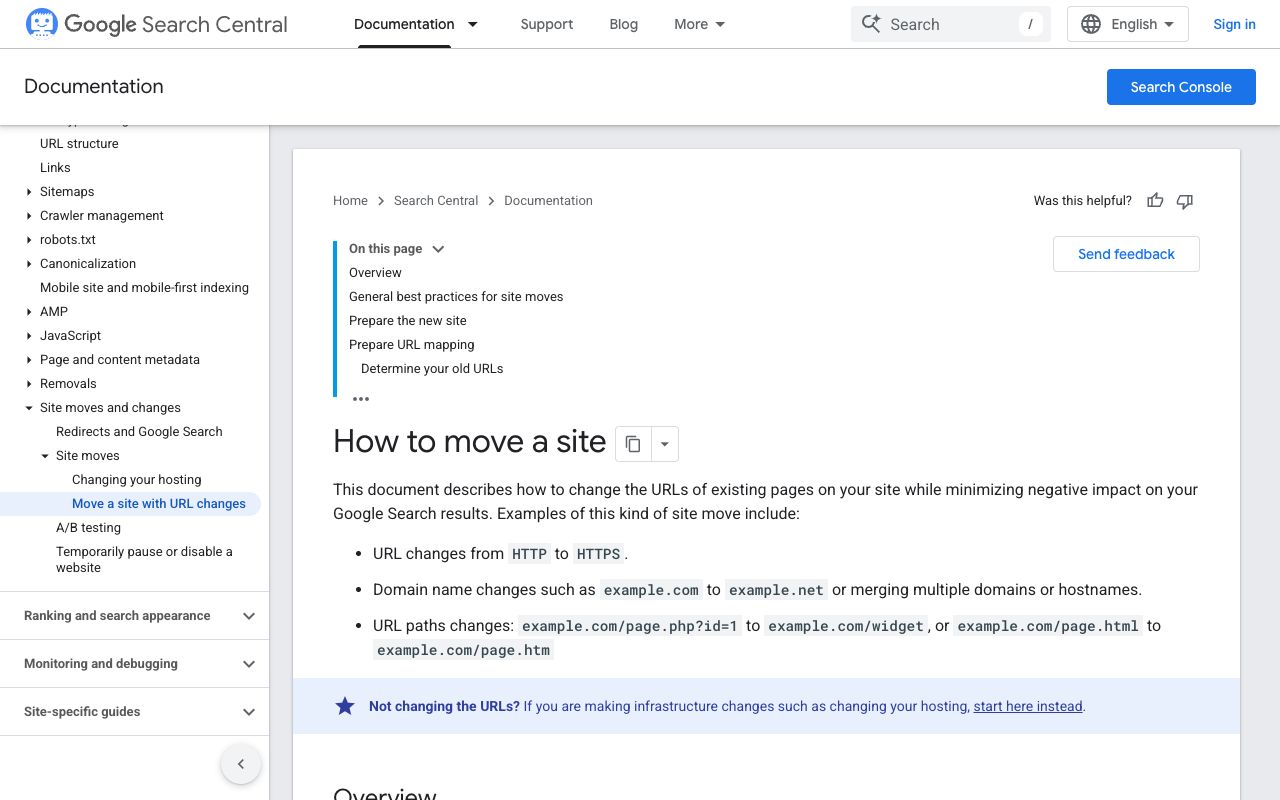
Re-platforms are where enterprise programs lose a year of compounding in one weekend. Google's site move documentation is explicit about the timeline: use server-side permanent redirects, and "keep the redirects for as long as possible, generally at least 1 year." Small and medium sites take a few weeks for most pages to move; larger ones take longer.
Build the old-to-new URL map before the new templates exist, then sample it hard. Spot-check redirect chains with a redirect checker and confirm the new URLs are actually in the index with an index checker — on a 40,000-page move, a 1% chain rate is 400 broken paths.
5. Localize only where hreflang can reciprocate
Internationalization is where multi-team autonomy turns into technical debt. Google's rule for localized versions allows no ambiguity: every language version must list itself and all others, and "if two pages don't both point to each other, the tags will be ignored." Region-only codes such as "UK" or "EU" are invalid and silently discarded.
The governance rule that follows is simple. A market launches only when someone owns the reciprocal annotations for it, forever. Five well-maintained locales beat fourteen that half-point at each other.
Why Is Enterprise AI Visibility Now a Board-Level Risk?
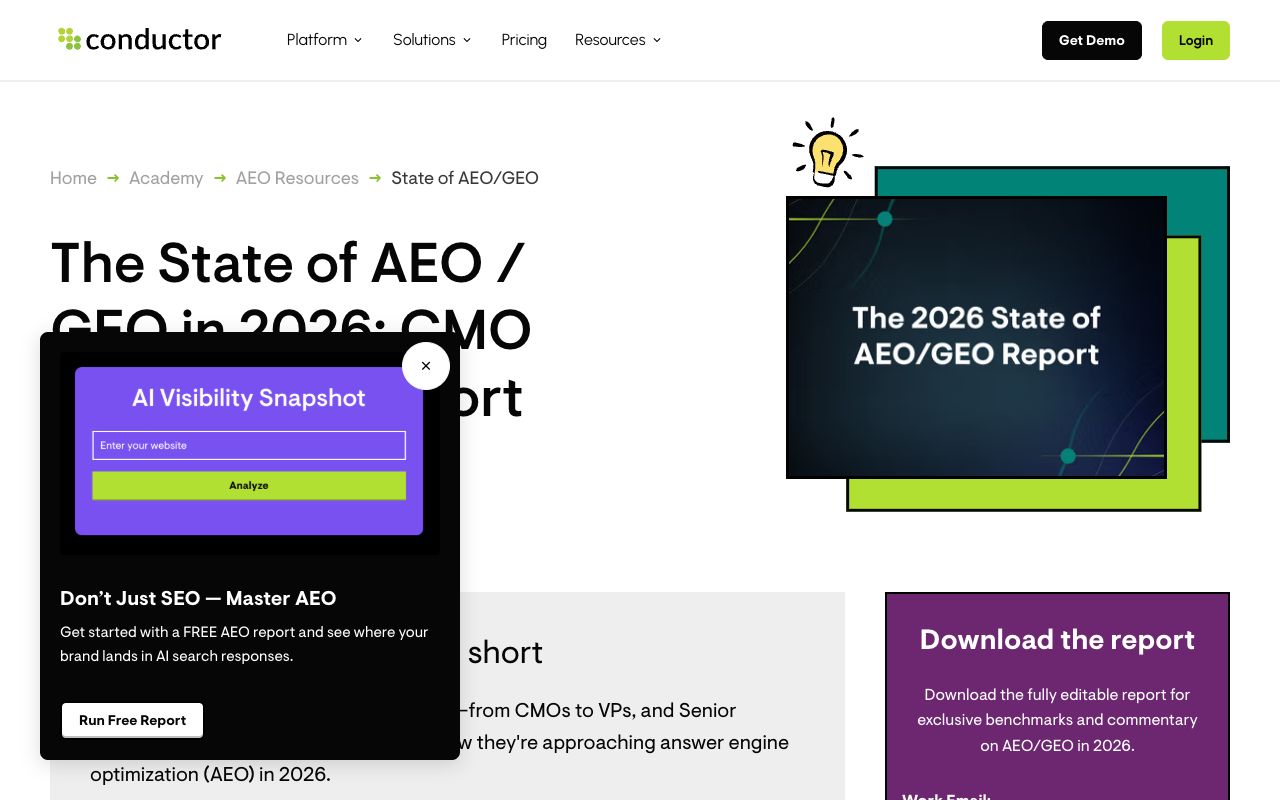
Because the buying committee has started asking the model first. Conductor's 2026 State of AEO/GEO report, last updated April 14, 2026, surveyed 250+ C-suite leaders and senior directors at organizations with 500+ employees: 97% said answer engine optimization had a positive effect on their funnel in 2025, enterprises put an average of 12% of digital budget behind it, and 94% planned to increase that spend in 2026.
What makes it a board conversation rather than a marketing one is that the exposure is reputational and invisible at the same time. Kairosy's scan of Smartsheet is a clean example: the brand appeared in 100% of relevant answers yet scored 66/100 overall, with favorability at 58% and only 54% of answers actually recommending it. Share of voice went to monday.com at 20% and Asana at 12%, and the engines recycled the same four objections — pricing, learning curve, performance, and support.
Engine disagreement is the part manual checks miss. Kairosy's BambooHR scan landed at 63/100 overall, but Claude rated the brand 45 while ChatGPT and Gemini both gave it 73 — and Perplexity told buyers outright that a rival "is the leading choice" for HR plus payroll. One person spot-checking one chatbot would report back with a completely wrong picture.
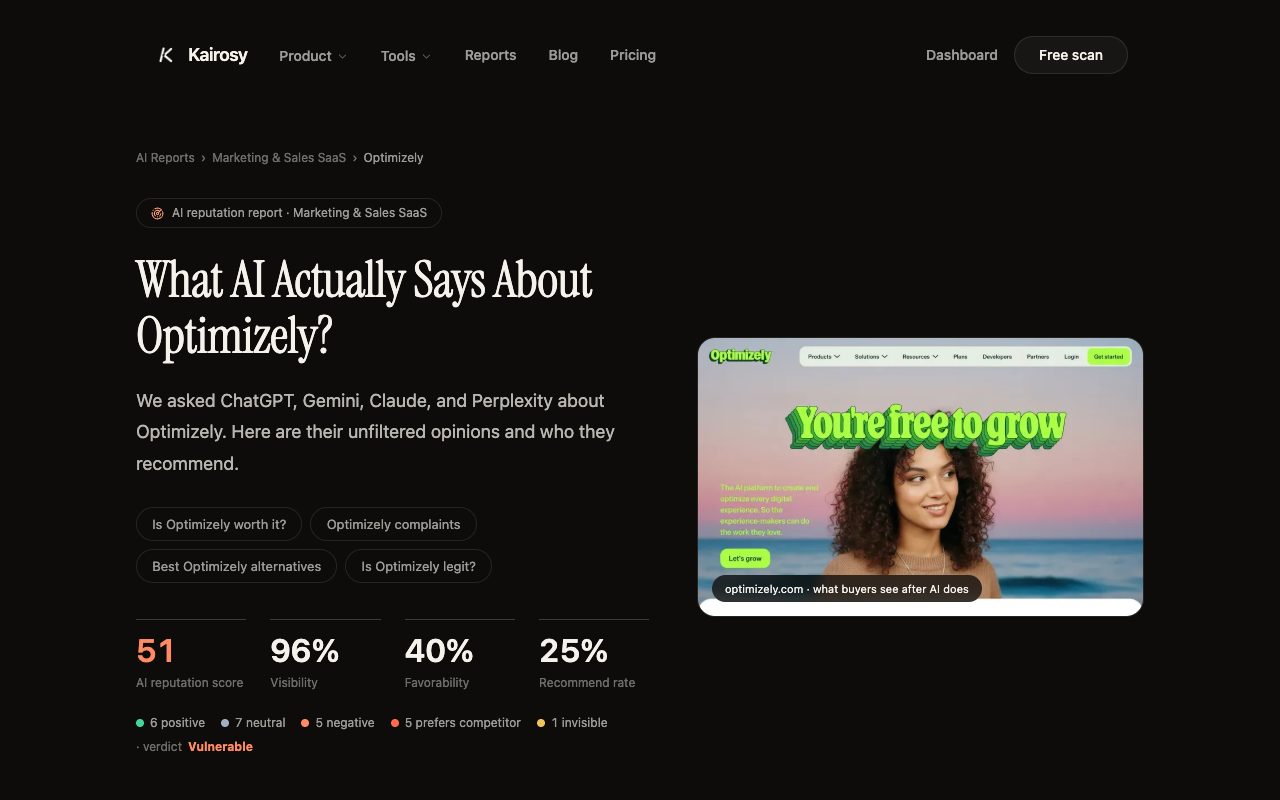
Multinationals have a second axis to worry about: the answer changes by country, because the model is drawing on different local sources and review sites. That is why market-level checks matter more at enterprise scale than at any other size — Kairosy runs country-specific scans across 25 markets, so a German buyer's shortlist and a US buyer's shortlist can be compared side by side instead of assumed identical.
The operating pattern that works: baseline once with an AI-readiness audit, then put the brand under continuous AI brand monitoring so the number lands in the same dashboard as your Search Console data rather than in someone's memory.
What Is the Best Enterprise SEO Software for SaaS Teams?
Disclosure first: Kairosy is our product. It measures what AI assistants say about a brand. It is not a crawler, a rank tracker, or a backlink index, so it sits alongside the platforms below rather than replacing any of them.
Most enterprise SaaS SEO stacks end up as two platforms plus a log analyzer, not one tool that covers everything. The other thing to know about procurement here is that most of this category refuses to publish a price. Where that is true, the table says demo-and-quote and cites third-party contract benchmarks instead of guessing.
| Platform | Enterprise pain point it targets | Published pricing (checked August 2026) |
|---|---|---|
| Kairosy | AI answer visibility, sentiment, and citation sources across four engines and 25 country markets | 7-day free trial; Basic $29/mo, Pro $99/mo, Growth $399/mo |
| Botify | Crawl budget and indexation on very large catalogs and doc sets | No published price — demo and quote. Vendr's buyer guide, updated February 2026, puts the median contract at $74,200/year |
| Conductor | Content intelligence plus continuous site monitoring, priced on usage rather than seats | No published price — Essentials, Growth, and Enterprise tiers all route to sales. Vendr's February 2026 guide puts the median at $49,510/year |
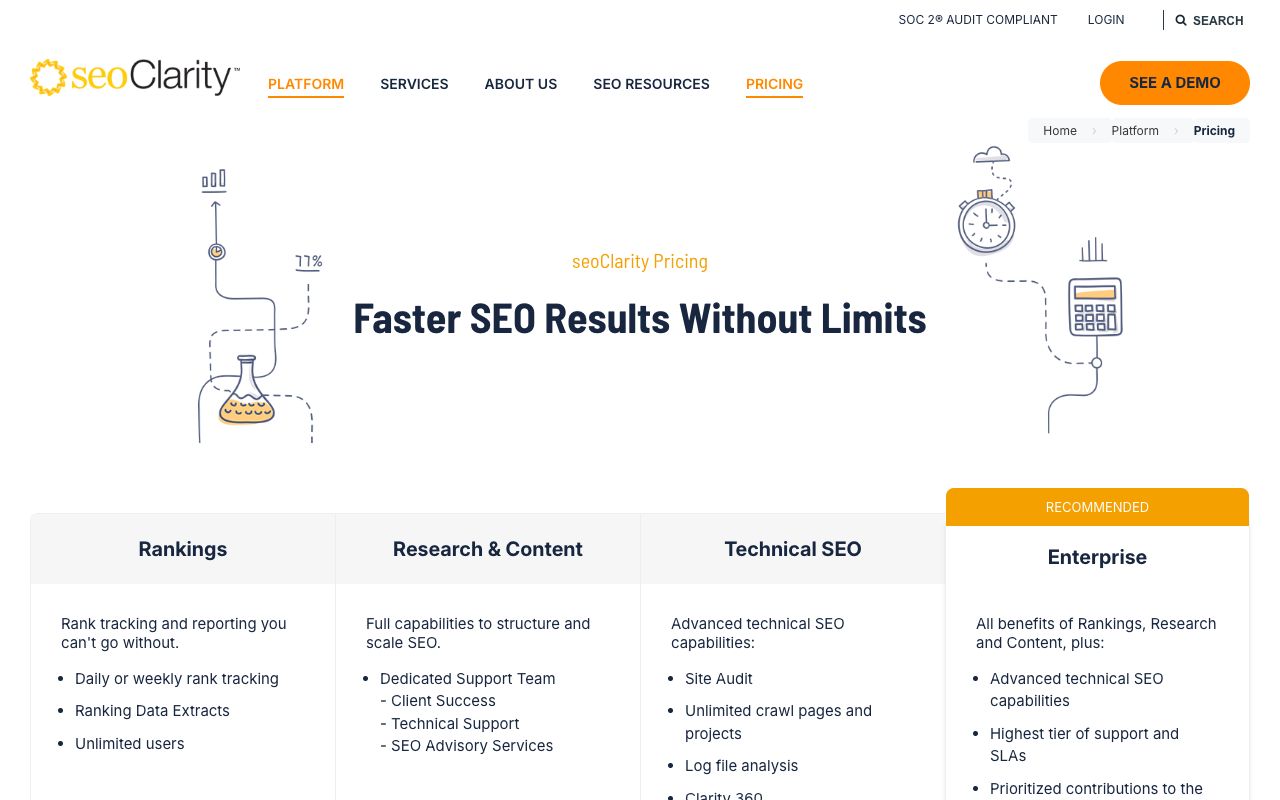
| seoClarity | Global keyword coverage and technical auditing across many domains | Research & Content from $2,500/mo; Technical SEO from $3,200/mo; Enterprise from $4,500/mo |
| Semrush Enterprise | One console for SEO, AI optimization, and site intelligence across brands | No published price — book a demo. Self-serve Advanced is $549/mo for comparison |
| Ahrefs Enterprise | Keyword and backlink data with uncapped API access | $1,499/mo, annual commitment — the only published enterprise list price here |
Kairosy
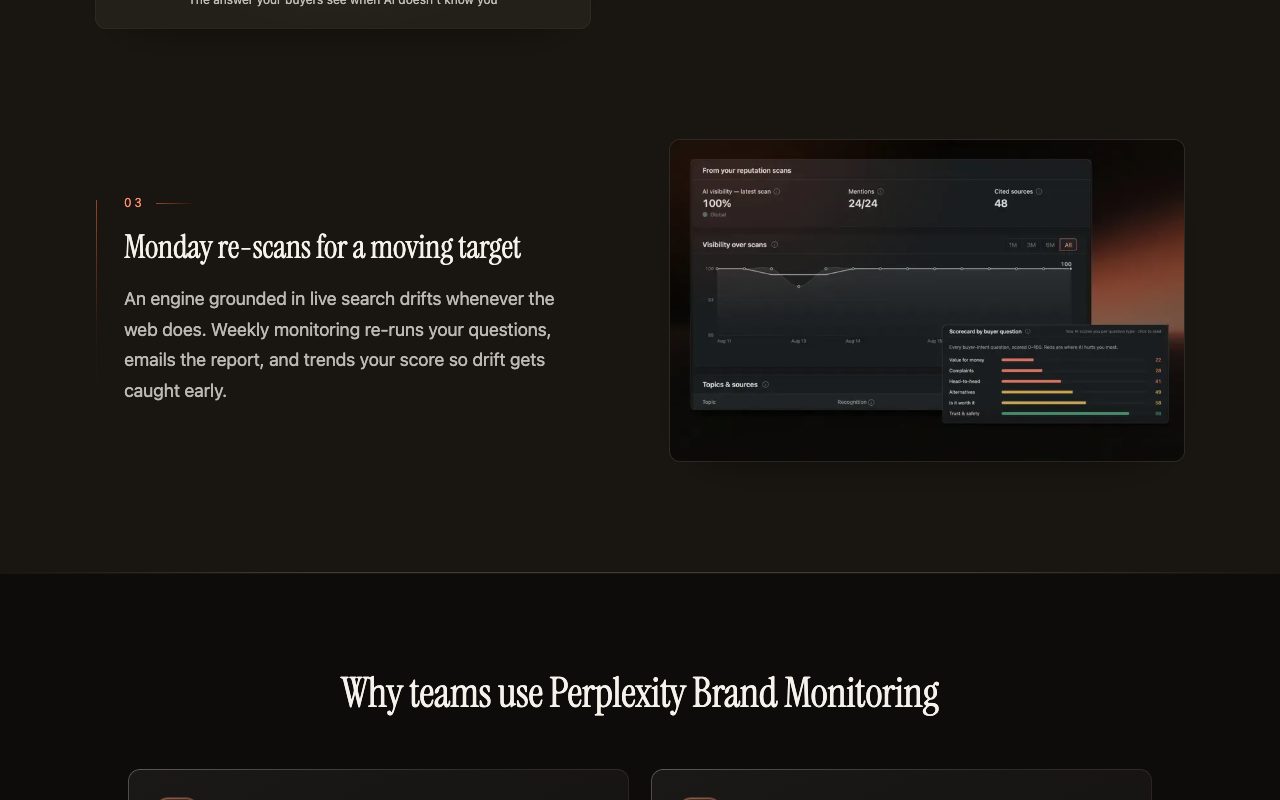
Kairosy poses the questions a procurement committee would type — into Claude, ChatGPT, Perplexity, and Gemini — then scores what comes back: whether you appear at all, whether the answer endorses you, which rival gets named instead, and which URLs the model leaned on. Paid plans add weekly rescans per brand-and-market pairing with email alerts, daily prompt tracking from Pro upward, and a ranked fix plan. The first 7 days cost nothing, so baselining a portfolio brand needs no purchase order.
Botify
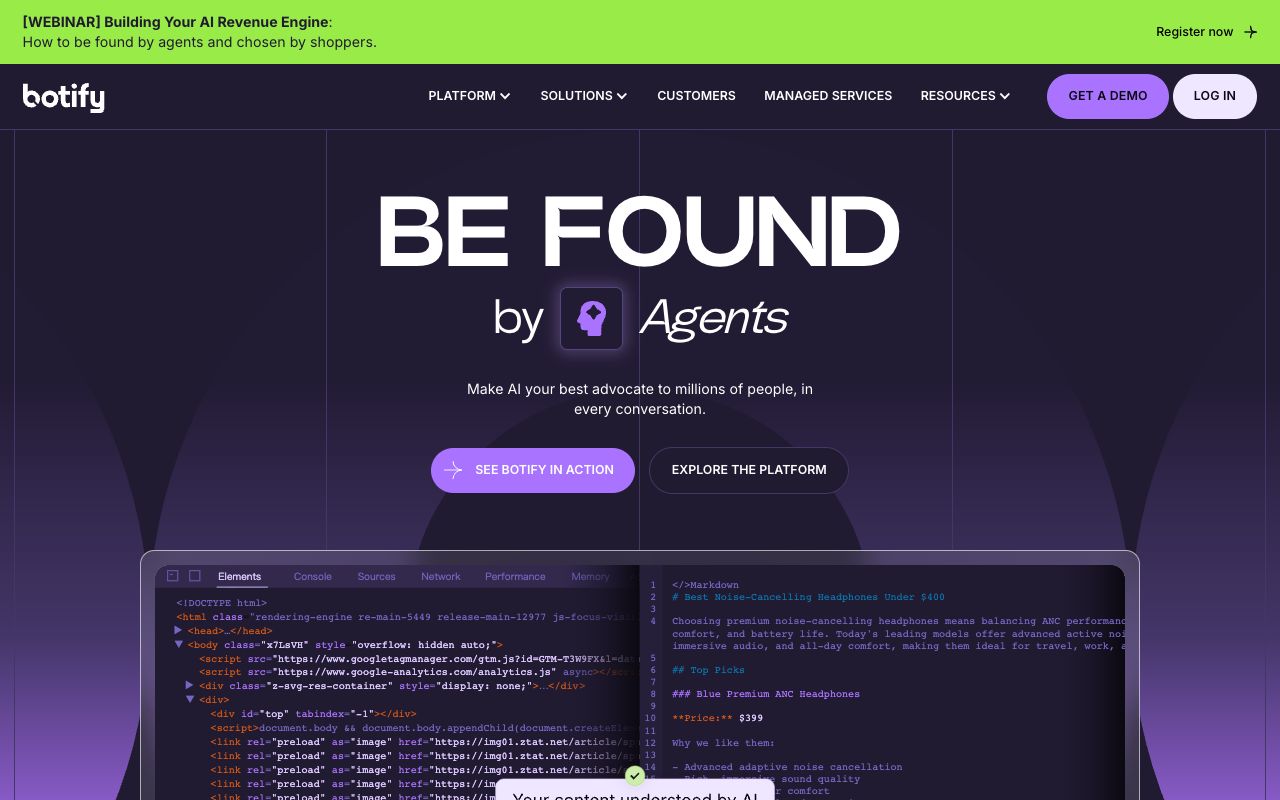
Botify is the choice when crawl budget is the binding constraint — it pairs log analysis with site crawling and content activation, organized around AI readiness, visibility, and automation modules. Pricing is quote-only; Vendr's anonymized contract data is the closest public benchmark.
Conductor
Conductor splits into Creator, Intelligence, Monitoring, and an AgentStack module aimed at LLM visibility, and it prices on usage rather than per seat. Its published tiers name limits — Enterprise lists 125,000+ pages analyzed and 60,000+ tracked keywords — without naming a figure.
seoClarity
seoClarity is the transparent one: it publishes starting prices by package, from $2,500/mo for Research & Content up to $4,500/mo for the Enterprise tier recommended to teams tracking 5,000+ keyword queries across multiple domains. Final pricing still scales with domains and keyword volume.
Semrush Enterprise
Semrush's enterprise line bundles SEO, AI Optimization, Site Intelligence, journey tracking, and social listening into one platform pitched at multi-brand organizations. Nothing is priced publicly — the page routes to a demo — but the self-serve Advanced plan at $549/mo sets a useful floor for what the data alone is worth.
What Are the Top Enterprise SaaS SEO FAQs?
What counts as enterprise level SEO?
Two tests, and either one qualifies you. Structurally: 10,000+ indexable URLs, which is where Google says crawl budget begins to matter and where Lumar drew its enterprise research line. Organizationally: more than three teams able to change the site, and an approval path between a fix and production.
How will enterprise SEO help your business if you already rank well?
Rankings you hold today are a snapshot of decisions made by a smaller company. At scale the value shifts to defense and efficiency — protecting an indexed footprint through re-platforms, keeping crawl aimed at revenue pages, and making one template fix pay out across thousands of URLs.
What are the biggest enterprise SEO issues at software companies?
Execution and monitoring at scale, named by 60% of the 204 leaders in Lumar's survey, followed by cross-departmental coordination at 53%. In SaaS specifically, add migrations, hreflang drift across regional teams, and AI answers that no team's goals cover.
What is the best enterprise SEO software if you can only buy one?
It depends which constraint is actually binding. Buy Botify if crawl and indexation are the problem, seoClarity if keyword and domain coverage is, and Conductor if content workflow governance is. Layer an AI visibility scanner on top regardless — none of the three tells you what a model says about you in a specific market.
Does an enterprise SEO strategy for SaaS need a separate AI plan?
Not a separate content plan, but a separate measurement plan. The pages are the same. The reporting is not: Search Console never records the buyer who asked ChatGPT for a shortlist and never clicked through to anyone.
How long should a re-platform take to recover?
Google says small and medium sites see most pages move within a few weeks, with larger sites taking longer, and advises keeping redirects live at least a year. Plan for a full quarter of noisy data on a six-figure URL count, and hold every 301 far longer than feels necessary.
See what AI says about your brand
Run a free scan across ChatGPT, Gemini, Claude & Perplexity in about 30 seconds.
Run my free scan