SEO for SaaS Startups in 2026: Budget, Tools, First 90 Days
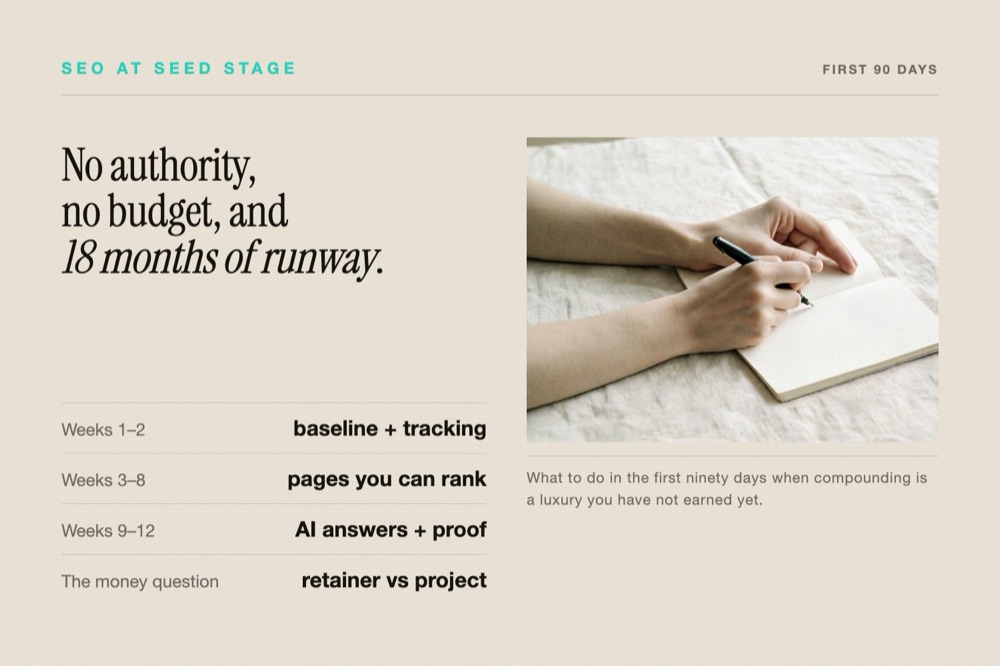
SEO for SaaS startups is a different job than SEO at a company with a decade-old domain and a content team. You have no authority, no link profile, and a runway clock ticking behind every decision. What works at seed stage is not publishing sixty posts — it is picking the two or three surfaces where a brand-new domain can actually place, then deliberately ignoring everything else until revenue pays for more.
This is the constrained playbook: a realistic first 90 days, the free tooling that covers most of the work, how to pick one paid platform, and the question founders argue about hardest — retainer, fixed project, or in-house. For the size-agnostic version, read our complete guide to SEO for SaaS.
Why Does Startup SEO Need a Different Playbook Than Mature SaaS?
Three constraints separate SEO for SaaS startups from an established program, and each of them invalidates advice written for bigger teams.
You start from zero authority
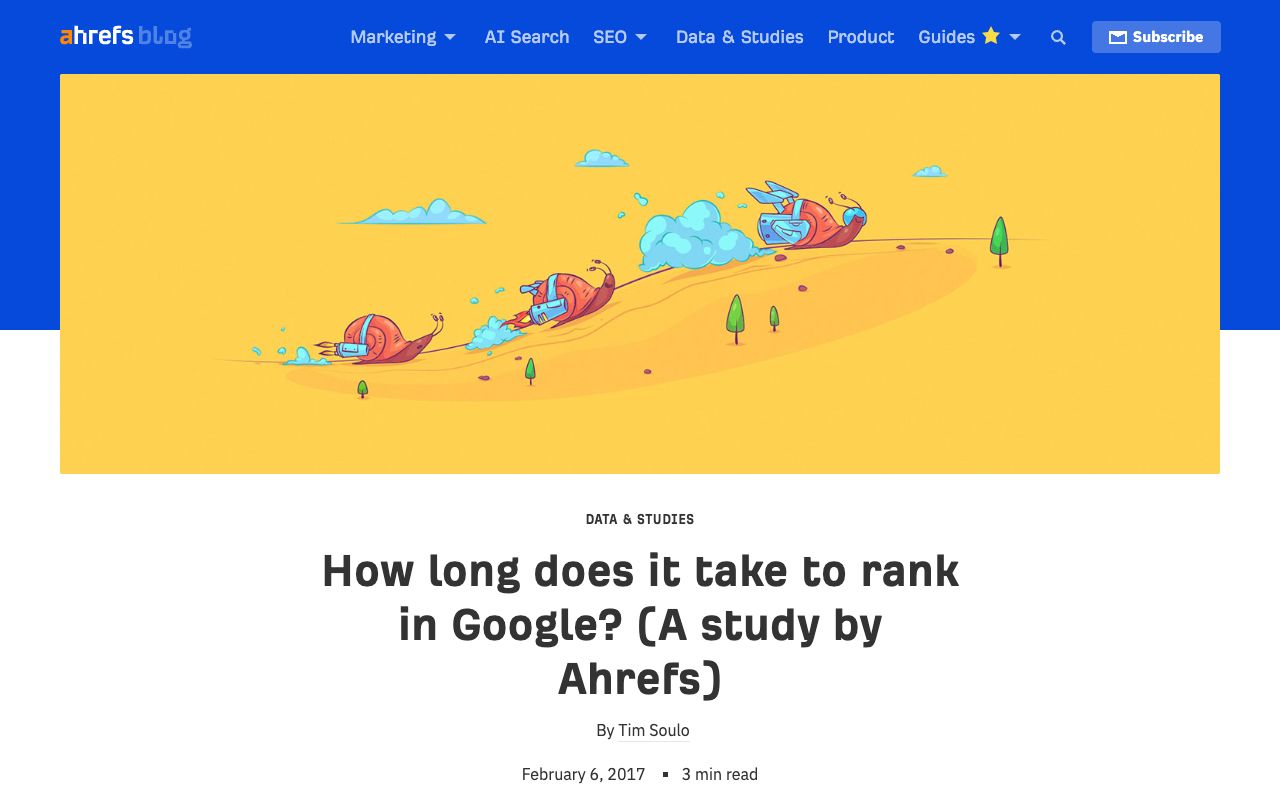
Ahrefs tracked 2 million randomly selected pages for a year and reported that only 5.7% of them cracked Google's top 10 for even one keyword inside twelve months. For high-volume terms the number fell to 0.3%. The study, published in February 2017, also found that pages on higher-rated domains fared substantially better — precisely the advantage you don't have.
The practical read: assume your first ten pages will not rank on merit. They earn their keep as sales collateral and as the raw text AI engines read when a buyer asks about your category.
Your budget is a rounding error
An established team argues over which $400/month suite to standardize on. You are deciding whether $29 is defensible this month. Free tiers are therefore not a compromise — they are the plan for your first two quarters.
Runway makes patience expensive
Content that compounds over eighteen months is a fine investment at Series C and a dangerous one with fourteen months of cash. Sequence for early signal instead: pages that convert on day one from any traffic source, and channels where a small brand can appear immediately rather than after a link-building campaign.
What Should the First 90 Days of SEO for SaaS Startups Look Like?
Ninety days is enough to be indexed, to own your comparison layer, and to complete one topic cluster. It is not enough to win a head term, so don't plan around that.
Days 1–14: instrument everything, publish nothing
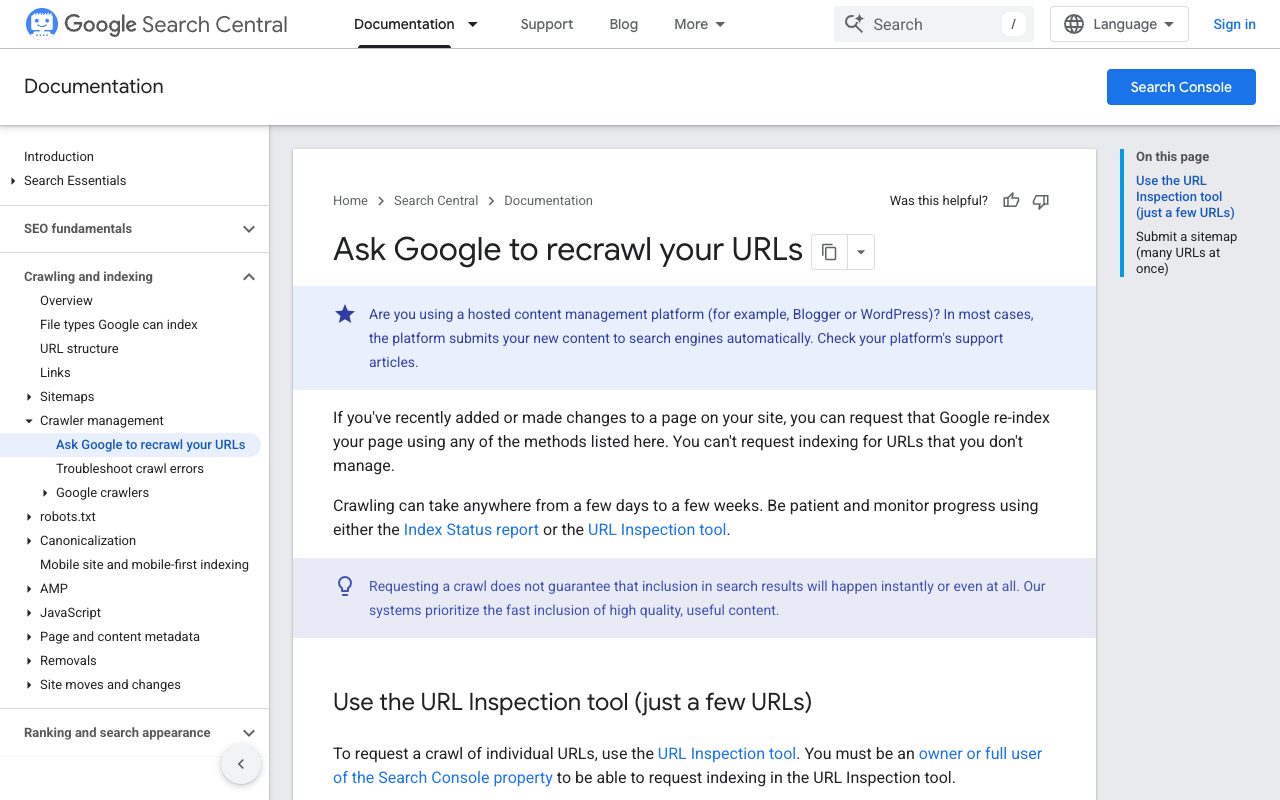
Verify the domain in Google Search Console, submit a sitemap, and confirm your homepage, pricing page, and top feature pages are genuinely in the index — put them through a free index checker rather than assuming. Crawl the whole site once to find redirect chains and orphaned pages before there are hundreds of them.
Then baseline what AI assistants currently tell buyers about you. It takes minutes, costs nothing, and unlike rankings it can move inside a quarter.
Days 15–45: build the pages that close deals
Write the bottom-of-funnel set before anything else. One "alternatives to [rival]" page per competitor that comes up on sales calls, one honest head-to-head comparison each, and a pricing page with real numbers rather than a contact form. Search volume here is small and intent is enormous.
Honesty is not a moral flourish, it is a citation strategy. Pages that concede where a competitor is genuinely better get linked to and quoted. Pages that pretend otherwise get neither.
Days 46–90: one cluster, then stop
Pick the single topic your product legitimately owns and build one hub page plus six to ten supporting posts, all interlinked in both directions. Then stop and wait — resist the second cluster until Search Console shows the first one gaining impressions.
How Can AI Answers Give a Startup Visibility Before Rankings Arrive?
Here is the asymmetry worth exploiting. Ranking in Google demands authority you have not earned. But when an assistant answers "best [category] tool for a small team," it builds that shortlist from review profiles, documentation, forums, and comparison content — sources a two-month-old company can influence in weeks, not years.
The traffic that comes back is unusually qualified. Shopify's Q1 2026 commerce data, published May 11, 2026, found that AI-referred visitors converted at nearly 50% higher rates than organic search on product pages, with 14% higher average order values, while AI referral sessions grew more than 8x year over year.
It is also a channel where established brands are wide open. Kairosy's scan of Coda scored the brand 59/100: visible in 92% of relevant answers, but favorable in only 50% of them — and the engines disagreed violently, with Gemini rating it 37 while Perplexity gave it 81. Typeform landed at 49/100, appearing in 75% of answers and holding just 28% of brand mentions in its own category, behind a field that included Google Forms at 15%.
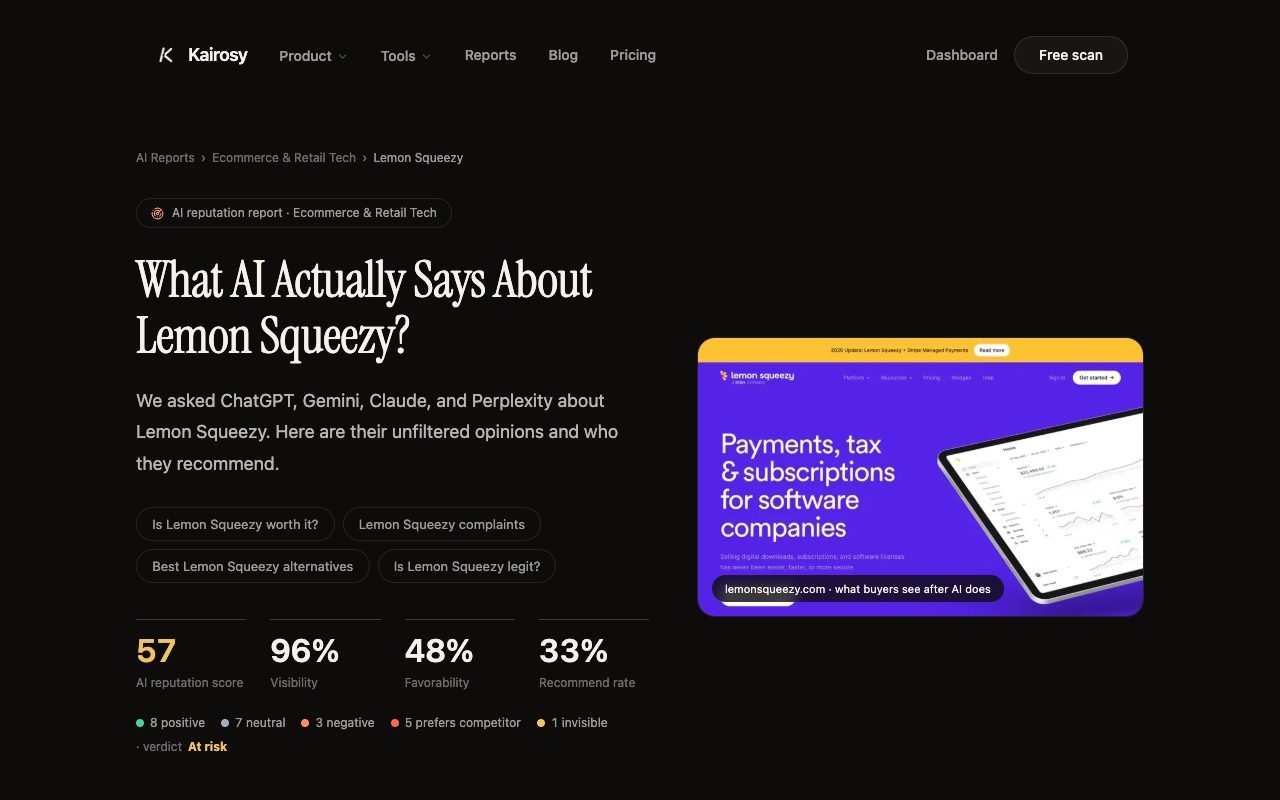
Those are funded, well-known products. A startup with a clear comparison page, a current review profile, and machine-readable docs can realistically beat them inside an answer long before it beats them in a SERP.
Three concrete moves, all free. Publish an llms.txt file so assistants can find your canonical explanations — our llms.txt generator writes one from your sitemap. Get listed on the review platforms your category actually uses. Then measure: full AI visibility scans are free for 7 days on Kairosy, enough for a week-one baseline you re-check monthly. For the concepts behind it, see how GEO and SEO differ in 2026.
When you are ready to make it continuous rather than a monthly spot-check, an AI-readiness audit tells you what to fix, and AI brand monitoring watches whether the fixes moved anything.
Which SEO Tools Are Free or Nearly Free for a Startup?
You can run a competent program for $0 through at least the first quarter, which is why SEO for SaaS startups should never begin with a software purchase. Every free tier below was checked in August 2026 against the vendor's own page.
| Tool | Free tier (checked August 2026) | What it covers |
|---|---|---|
| Google Search Console | Free, no paid upgrade exists | Index coverage, query and click data, Core Web Vitals |
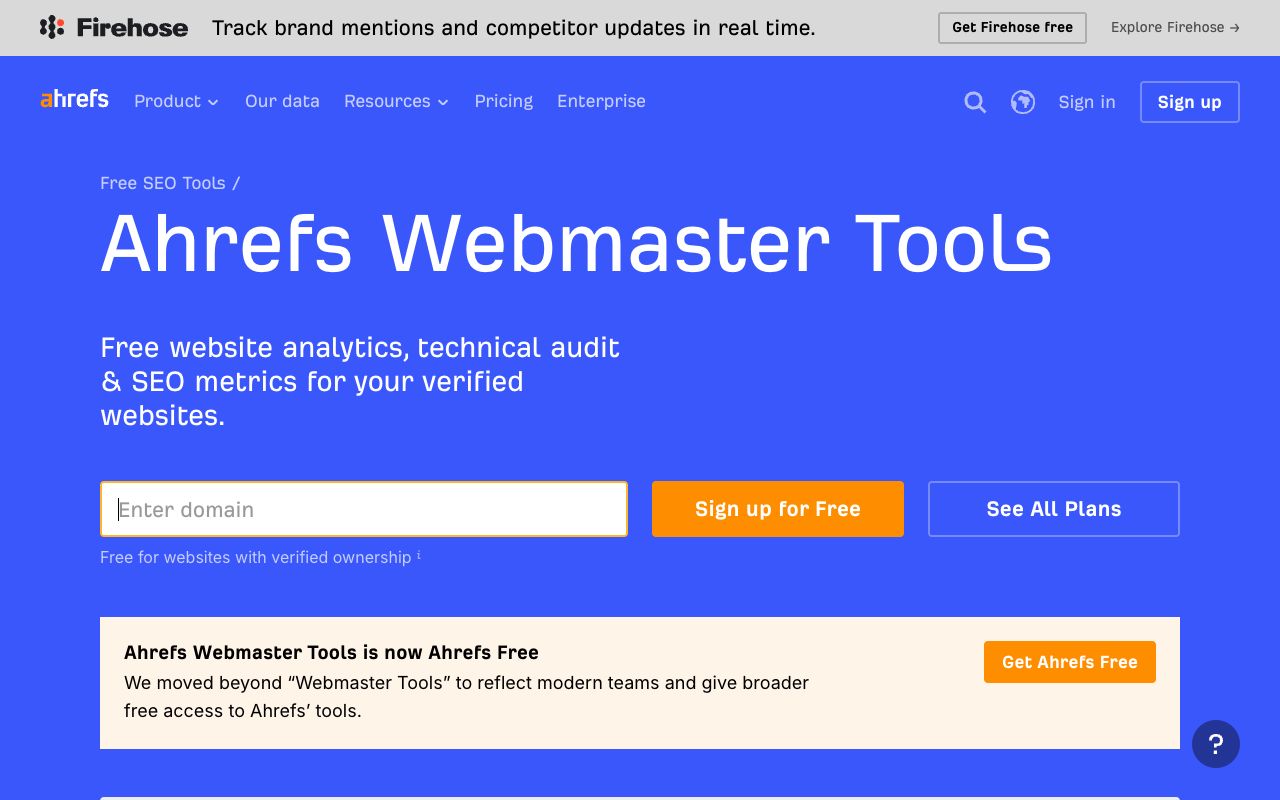
| Ahrefs Webmaster Tools | Free — unlimited verified sites, 5,000 Site Audit crawl credits per project per month, 1,000 backlink rows and 1,000 keyword rows visible at once | Technical audit plus a backlink and keyword snapshot for sites you own |
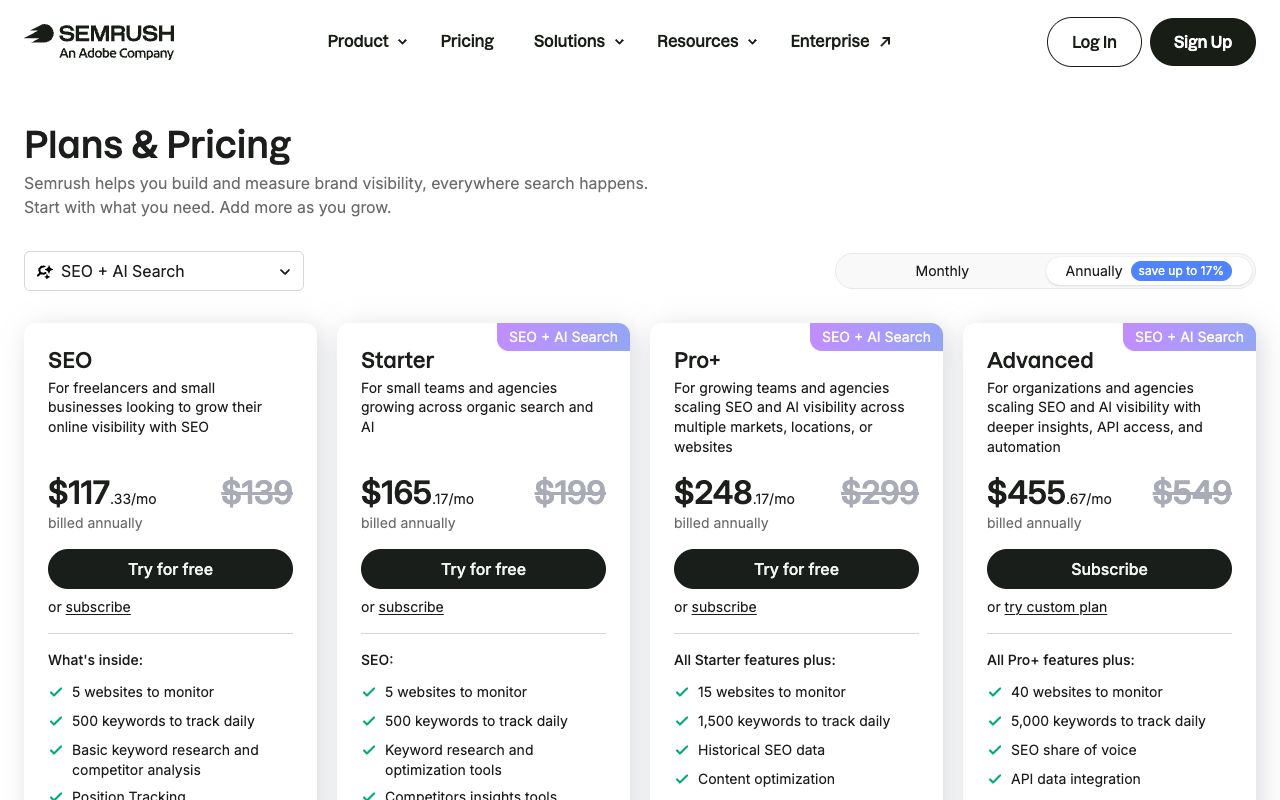
| Semrush Free | $0 — 1 demo project and 10 reports per day, no credit card | Keyword and competitor spot checks |
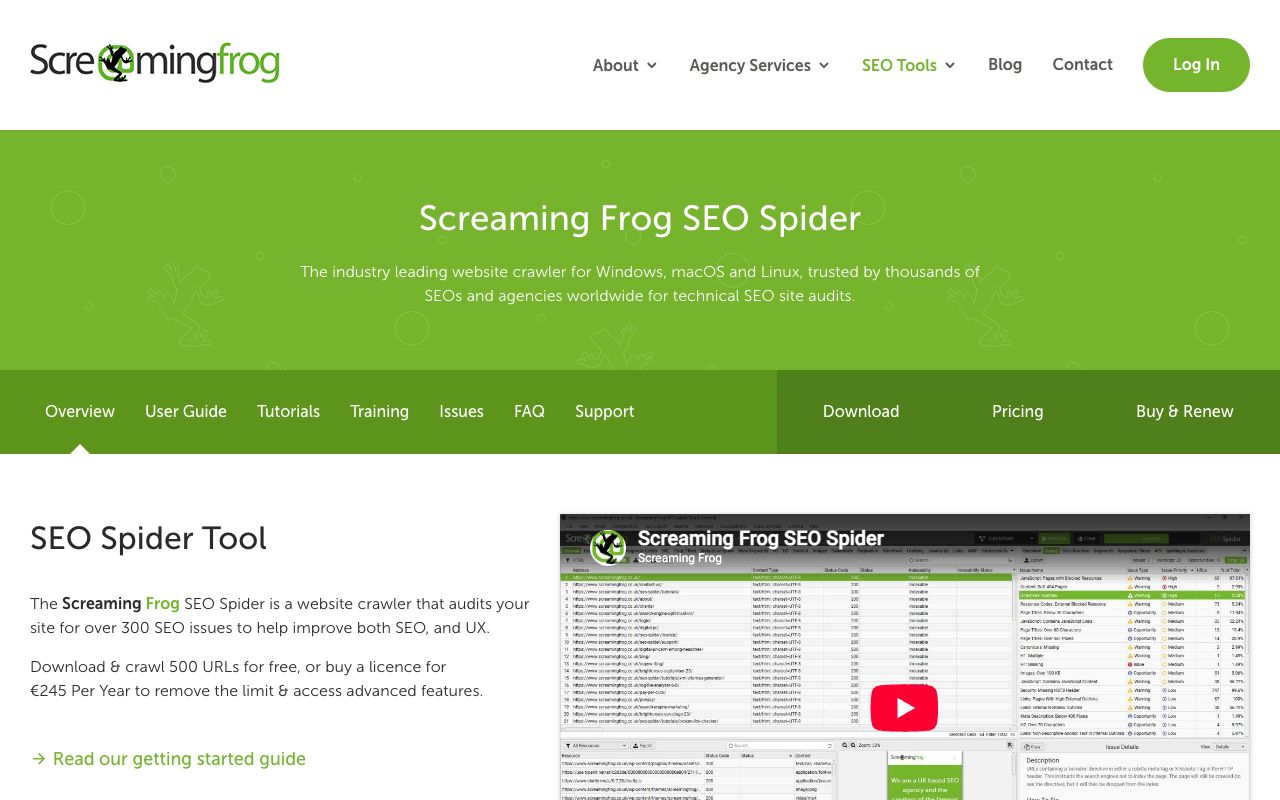
| Screaming Frog SEO Spider | Free up to 500 URLs per crawl (paid licence $279/year) | Full desktop crawl: redirects, titles, orphan pages |
| Kairosy | 7-day free trial, full AI visibility scans | What ChatGPT, Gemini, Claude and Perplexity say about your brand |
Ahrefs Webmaster Tools is the highest-value free account on that list: site audit and backlink data for domains you verify, which is much of what people buy the paid product for. Its limits bite only when you want competitor data.
Screaming Frog is the other one to install on day one. A startup marketing site rarely exceeds 500 URLs, so the free licence often covers you entirely until the blog grows.
What Is the Best SEO Platform for SaaS on a Seed-Stage Budget?
Once free tiers stop being enough, the honest answer to "what is the best SEO platform for SaaS at this stage" depends on which limit you hit first — competitor keyword data, or breadth of features.
- Ahrefs Starter, $29/month. One of the cheapest credible entry points for keyword research and competitor lookups, and the natural upgrade once Webmaster Tools stops answering your questions. Lite runs $129/month when you need the full toolset.
- Semrush SEO plan, $139/month. The broadest suite of the group, with a 7-day free trial. Worth it only if you will genuinely use rank tracking, site audit, and competitive research rather than one of the three. Pricing runs up to $549/month on the Advanced tier.
- SE Ranking Core, $129/month. Frequently the better value per feature for small teams, with a 14-day trial that requires no credit card. Growth is $279/month.
- Search Atlas Starter, $99/month. Bundles AI-oriented workflows into the suite, with a 7-day trial. Its published tiers run to $999/month for agencies.
For most pre-Series A teams the right answer is Ahrefs Starter plus free Search Console plus a free monthly AI scan — roughly $29/month total. Buy a full suite when you have someone whose job is to open it daily, not before.
Which Is Better for a Startup: SEO Retainer vs Project Fee vs In-House?
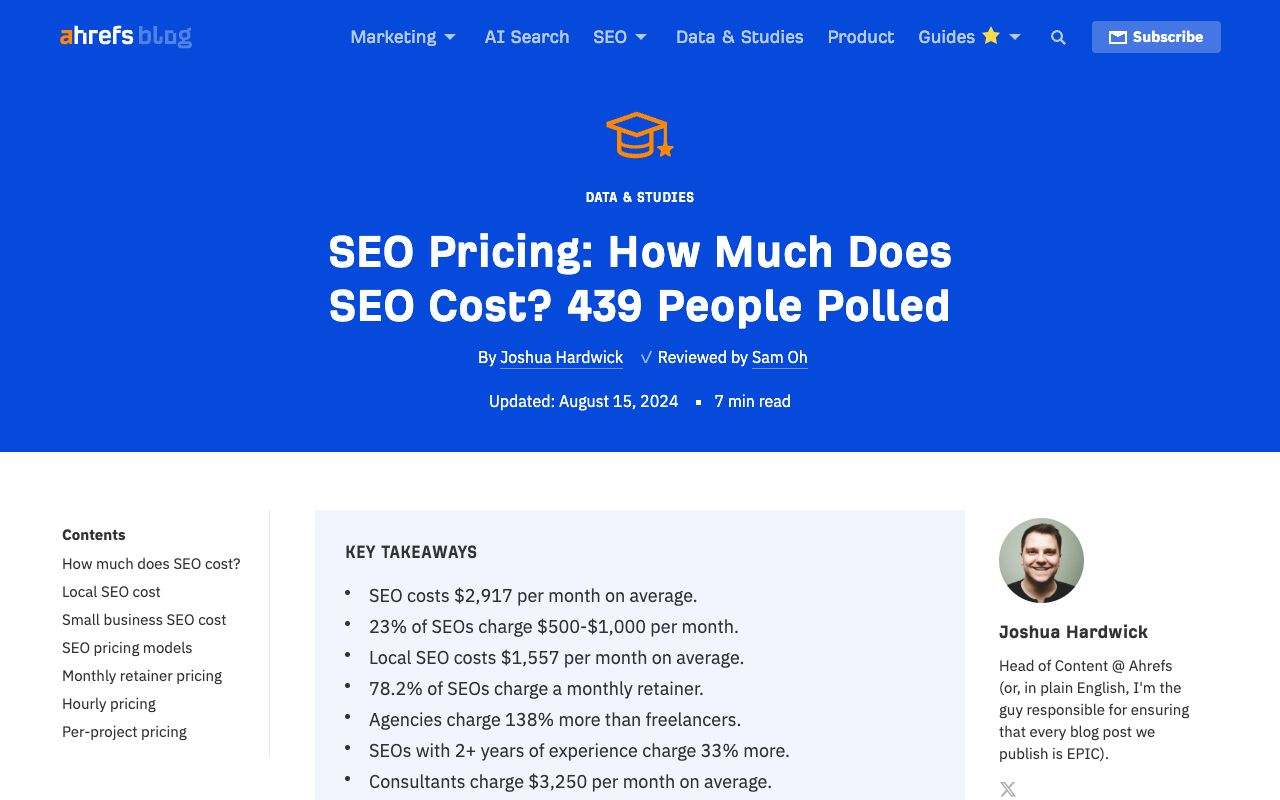
This is the decision that actually consumes founder time, so it deserves real numbers. Ahrefs surveyed 439 SEO service providers and manually vetted their sites for its SEO pricing study, last updated August 15, 2024. Those figures describe what providers charge, not what you should pay — but they set the frame for any proposal you receive.
| Engagement model | What providers charge (Ahrefs survey, updated Aug 2024) | Best when | Main risk |
|---|---|---|---|
| Monthly retainer | Offered by 78.2% of providers. $2,917/month average, with $501–$1,000 the single most common band at 20.4% of respondents | You are funded and need sustained execution you cannot staff | Spend continues whether or not output lands |
| Fixed project | Offered by 48.9%. $2,501–$5,000 is the most common per-project band, at 21.2% | Discrete jobs: a migration, a technical audit, a comparison-page build | Nobody owns the follow-through after delivery |
| Hourly consulting | Offered by 34.8%. $111/hour average, $75–$100 most common at 24% | You execute and want an expert reviewing the plan | Quality varies enormously between providers |
| In-house / founder-led | Tool cost only — $0 on free tiers, up to $139/month for the platforms above | Pre-seed and seed, with a founder who can write | Founder hours are the scarcest resource you have |
The practical rule on SEO retainer vs project-based for SaaS startup spending: buy projects before you buy retainers. A fixed-scope technical audit or a batch of ten comparison pages produces an asset you keep. A retainer at seed stage usually funds someone learning your product on your dime.
Flip to a retainer when two things are true at once: organic already produces signups you can count, and the bottleneck is throughput rather than strategy. Always ask for a scoped proposal with named deliverables instead of a package price, and check whether AI visibility work is included or quietly excluded.
What Kills a SaaS Startup's First Year of SEO? 5 Budget Traps
Most of the money wasted on SEO for SaaS startups goes to one of these five, and every one of them is a decision rather than an execution error.
- Chasing the category head term. "Project management software" is owned by companies with ten-year link profiles. Your seed-stage version of that keyword is "[rival] alternative for [specific use case]."
- Buying a suite before you have a user. A $139/month platform that gets opened twice a quarter is worse than a free Search Console account someone checks weekly.
- Publishing volume instead of assets. Forty thin posts and one abandoned cluster lose to twelve interlinked pages that answer real buying questions.
- Outsourcing before you can judge the work. Run the first three months yourself, even badly. You will not be able to evaluate an agency's plan until you have done the work once.
- Measuring Google only. If a prospect asks ChatGPT about your category tomorrow and you cannot say what comes back, a growing share of your funnel is invisible to you.
Startup SEO FAQs: Top Questions Answered
How much should a SaaS startup spend on SEO per month?
At pre-seed and seed, tools plus founder time — realistically $0–$150/month in software. Ahrefs' provider survey puts the average agency retainer at $2,917/month, which is rarely defensible before organic produces countable signups.
Is SEO for SaaS startups worth doing before product-market fit?
Partly. Skip the content engine, but do the cheap durable work: get indexed, publish honest comparison pages, and baseline your AI visibility. Those assets survive a pivot in positioning far better than forty blog posts about a category you may leave.
What is the best SEO platform for SaaS if I can only pay for one?
Ahrefs Starter at $29/month, paired with free Google Search Console and Ahrefs Webmaster Tools, covers more ground per dollar than any other combination at this budget. Move to Semrush or SE Ranking when rank tracking and site audit become someone's daily job.
How should you decide SEO retainer vs project-based for SaaS startup work?
Project first, nearly always. Fixed-scope work delivers an asset you own and a cost you can cap. Ahrefs' 2024 survey puts the most common per-project fee at $2,501–$5,000, which buys a technical audit or a comparison-page batch without an open-ended commitment.
How long does SEO for SaaS startups take to produce signups?
Bottom-of-funnel pages can convert within weeks because they capture people already comparing vendors. Broad informational rankings take far longer — Ahrefs found only 5.7% of pages reach the top 10 within a year. AI answers sit in between and often move fastest for small brands.
Can a startup appear in ChatGPT answers without backlinks?
Yes, and this is the most under-exploited part of SEO for SaaS startups. Assistants lean on review platforms, documentation, and comparison content rather than link authority alone, so a current G2 profile and a clear "vs" page can put you in a shortlist your domain rating would never earn in a SERP.
See what AI says about your brand
Run a free scan across ChatGPT, Gemini, Claude & Perplexity in about 30 seconds.
Run my free scan