How to Track Brand Sentiment in AI Answer Engines: 6 Steps (2026)
Here is how to track brand sentiment in AI answer engines without fooling yourself: fix a question set, fix the conditions you run it under, keep every full answer, label each brand in each answer, and report negative share next to the sample size it came from. The rest of this guide is the detail, plus a labeled example set and a two-reviewer rule you can copy.
Brand sentiment in an AI answer is the stance ChatGPT, Gemini, Claude, Perplexity, DeepSeek or Doubao takes toward your brand when a buyer asks a question. It is not what people say about you; it is what the engine says, built from whatever it retrieved. For the concept, read what AI brand sentiment is. This post is the procedure.
Why Is Tracking Sentiment in AI Answers Different From Social Listening?
Social listening watches humans. Hootsuite's definition (September 23, 2026) is "the practice of tracking social media platforms, websites, forums, and even podcasts to understand what people say about your brand name, competitors, or industry" (Hootsuite). Every data point has an author and a timestamp.
An AI answer has neither. The engine composes a fresh answer each time, from a different set of sources, and often skips you entirely. Three consequences:
- You generate the data yourself by asking; nothing accumulates on its own.
- "Not mentioned" is a real outcome social listening never produces, and it needs its own bucket.
- The reader is already acting on the answer. Bain's February 19, 2025 analysis of a December 2024 Bain–Dynata survey (n=1,117) found about 80% of consumers rely on zero-click results in at least 40% of their searches (Bain).
How Do You Build a Brand, Competitor and Buying-Stage Question Set? (Step 1)
Write questions a buyer would type, not keywords. A workable starter set is 20 to 40 questions in three groups, frozen word-for-word before the first run.
- Brand questions (about 30%): "Is Northwind reliable?", "What are the downsides of Northwind?". The most direct sentiment signal.
- Competitor and comparison questions (about 30%): "Northwind vs Contoso for small agencies". Where a competitor gets labeled as preferred over you.
- Buying-stage questions that never name you (about 40%): "Best project tool for a remote design team". These measure whether you show up at all, and what tone you get when you do.
Spread the third group across awareness, evaluation and decision stages, one question per intent. Five paraphrases of one question get five answer distributions and double count a theme.
Which Conditions Do You Freeze: Engine, Market, Language, Time and Prompt Version? (Step 2)
A sentiment number is comparable to the last one only if everything except the answer stayed constant. Freeze five things in the run log.
- Engine and mode. ChatGPT with search on is a different instrument from ChatGPT with search off. Never mix them in one series.
- Market. Ask from the country your buyers are in; the US and Germany return different brands and complaints.
- Language. A German-language series is a separate series, not extra samples for the English one.
- Time window. Run the whole set inside one day so a mid-week model update does not split the sample.
- Prompt version. Any edit to a question starts a new version; old answers are archived, not compared.
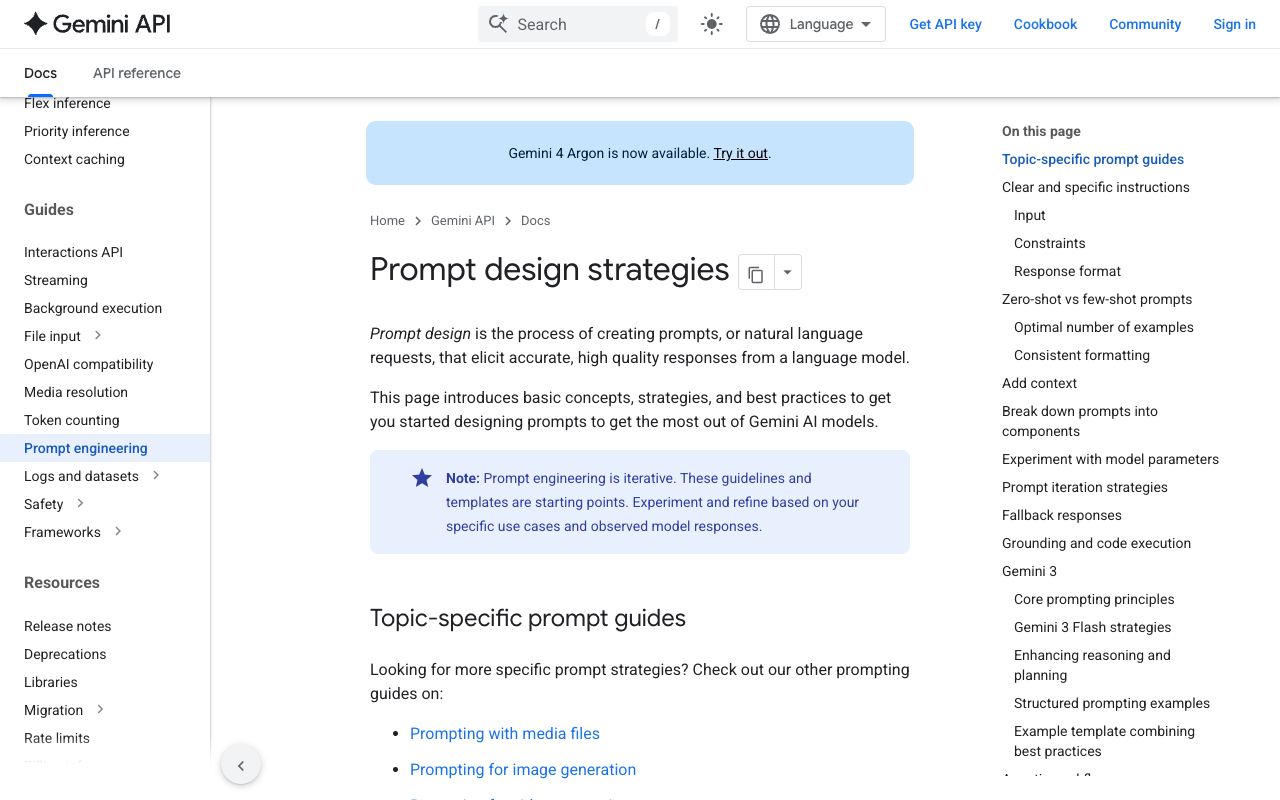
Expect variation even then. Google's Gemini prompting documentation says temperature "controls the degree of randomness in token selection" and that a temperature of 0 is deterministic (Google AI for Developers). Consumer chat products do not expose that dial, so the fix is repetition: ask each question more than once per run and treat the run, not the single answer, as the unit. That is the only honest way to track brand sentiment in AI-powered search engines, where the same prompt can come back friendlier on Tuesday than on Monday for no reason that involves you.
How Do You Capture Full Answers and Label Each Brand Positive, Neutral, Negative or Mixed? (Step 3)
Keep the whole answer, its cited URLs, the engine, market, date and prompt version. A label without the text behind it cannot be audited, and you will be audited the first time someone asks "negative according to whom?"
Then label per brand, not per answer; one comparison answer carries three labels. Five values: Positive (recommended, no stated reservation), Neutral (described, no stance), Negative (a complaint, a warning, or a loss in a direct comparison), Mixed (praise plus a stated buying concern) and Not mentioned (absent; logged, never folded into Neutral).
The table is a labeled example set. Brands and answers are fictional and the values are examples, not measured results; it shows how the labels and the reviewer rule behave on the hard cases.
| Prompt (example) | Answer excerpt (example) | Northwind | Others | Reviewer A | Reviewer B | Final and rule |
|---|---|---|---|---|---|---|
| Best project tool for a 10-person agency | "Northwind is a solid pick, though pricing jumps sharply at the 5-seat tier." | Mixed | — | Mixed | Positive | Mixed. Rule 2: a price objection caps the label. |
| Northwind vs Contoso for small teams | "For small teams Contoso is the better value; Northwind wins on reporting but costs more." | Negative | Contoso: Positive, preferred | Negative | Mixed | Negative. Rule 3: comparative loss. |
| Which task apps have the best free plan | "Top free plans: Contoso, Fabrikam and Tailspin." | Not mentioned | All three: Positive | Not mentioned | Not mentioned | Not mentioned. Rule 4: counts in visibility only. |
| Is Northwind reliable | "Northwind launched in 2015 and offers Gantt charts and 40+ integrations." | Neutral | — | Neutral | Neutral | Neutral. No stance. |
| Northwind support quality | "Review sites mention slow support responses and a two-day email backlog." | Negative | — | Negative | Negative | Negative. Theme: support. Source: the review site cited. |
Two of five rows disagreed on the first pass, both between Mixed and a neighbor. That is normal. The two-reviewer rule makes the disagreement productive instead of silent.
| Rule | What it says | Why |
|---|---|---|
| 1. Independent first pass | Both reviewers label everything before seeing each other's labels. | No anchoring. |
| 2. Buying-concern cap | A stated price, reliability, support or lock-in objection can never be Positive; best case is Mixed. | A total score hides the objections that stop a purchase. |
| 3. Comparative loss is Negative | If the engine names a competitor as better for the use case asked, label you Negative and them Preferred. | A lost recommendation is a lost deal. |
| 4. Not mentioned stays separate | Never label absence as Neutral; keep it out of the sentiment denominator and in visibility. | Absence folded into Neutral dilutes negative share. |
| 5. Disagreement path | A tie goes to a third reviewer or a ten-minute sync; the reason goes into the codebook. | Each resolved tie becomes a rule. |
| 6. Agreement check | Compute Cohen's kappa each cycle; below 0.60, recalibrate before publishing any number. | McHugh (2012) calls kappa below 0.60 inadequate. |
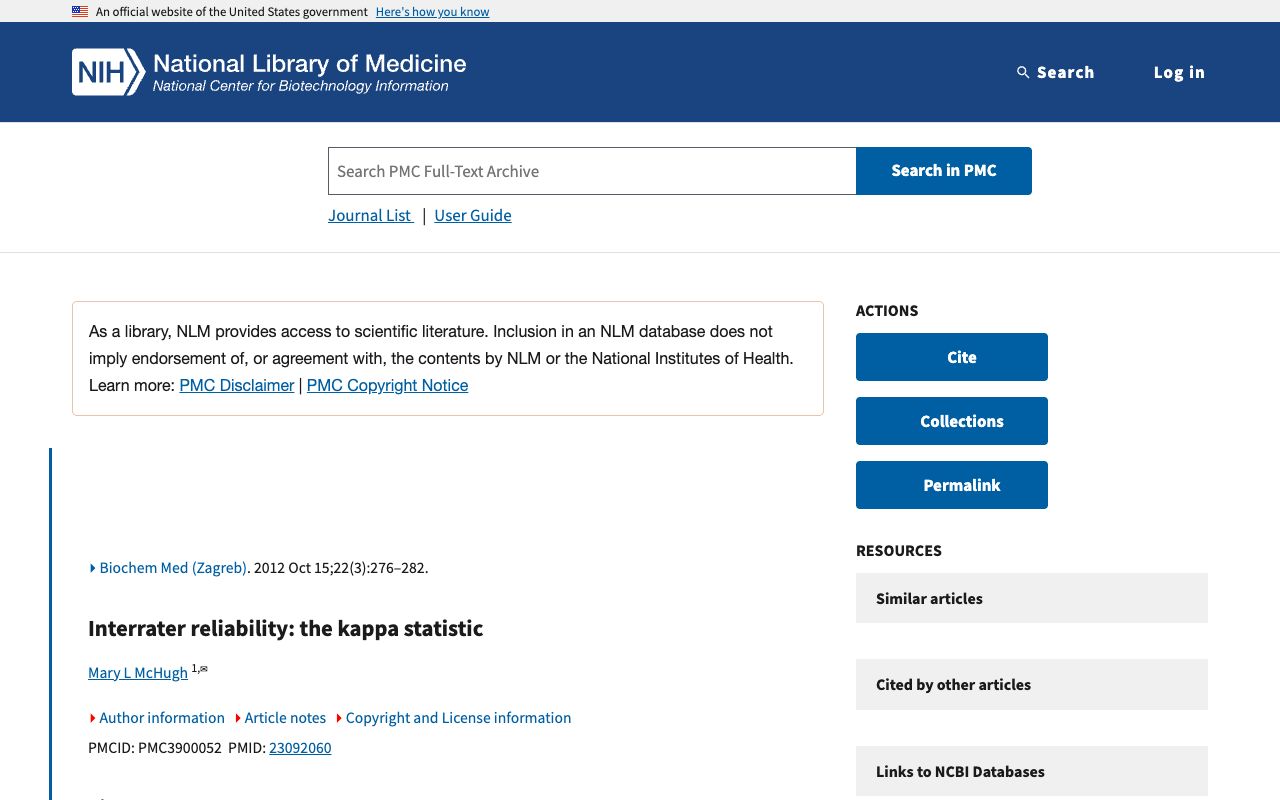
The thresholds come from Mary McHugh's "Interrater reliability: the kappa statistic", Biochemia Medica, 2012, which rates 0.60–0.79 moderate, 0.80–0.90 strong and above 0.90 almost perfect (PMC). A spreadsheet formula over two label columns is enough.
How Do You Calculate Negative Share With Sample Size, and Track "Not Mentioned" Separately? (Step 4)
Report three numbers every cycle, each with its denominator beside it.
- Visibility = answers that mention you ÷ all answers in the run.
- Negative share = Negative labels ÷ answers that mention you, with "Negative or Mixed" as a second line, because Mixed is where the buying concerns live.
- Competitor preferred = answers where another brand got the recommendation ÷ answers that mention you.
Why the denominator matters: Kairosy's public scan of ClickUp (August 1, 2026) shows 96% AI visibility and a 57/100 reputation score, and its 24 answers break down as 10 positive, 3 neutral, 4 negative, 6 preferring a competitor and 1 where the brand was invisible (ClickUp report). "96% visibility" reads as healthy, and the total alone hides that a quarter of the answers handed the recommendation to monday.com or Asana. The line that explains the score is competitor preferred, and it only exists because "not mentioned" was kept out of it.
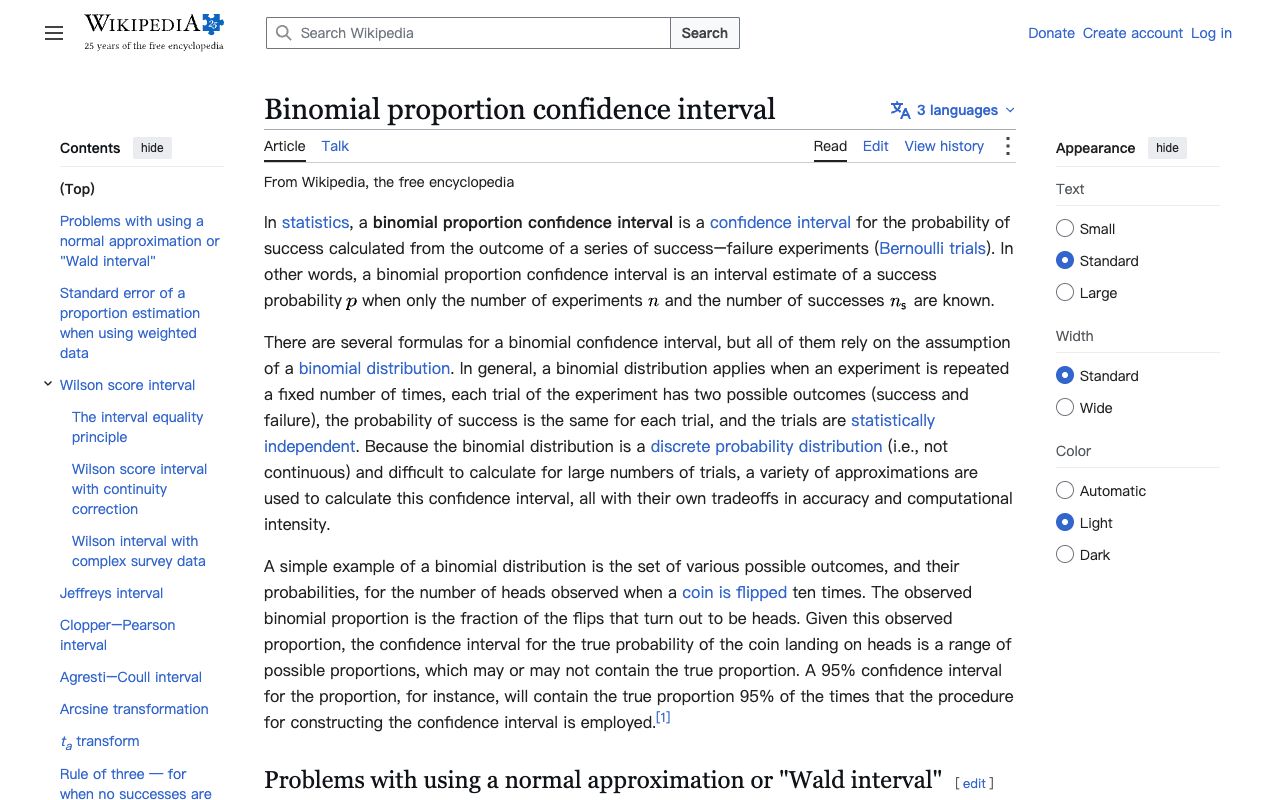
Sample size is the second thing a total hides. The intervals below are computed with the Wilson score method, which Wikipedia's entry on binomial proportion confidence intervals describes as safe for small samples and skewed observations, unlike the plain normal approximation (Wikipedia). They are calculations, not survey results.
| Negative / mentions | Observed negative share | 95% Wilson interval (computed) |
|---|---|---|
| 5 / 20 | 25% | 11.2% – 46.9% |
| 20 / 80 | 25% | 16.8% – 35.5% |
| 50 / 200 | 25% | 19.5% – 31.4% |
With 20 mentions, a move from 25% to 35% is noise. With 200, it is a signal. Set a floor (40 mentions is reasonable for a weekly series) and print "n=" on every chart.
How Do You Locate Sentiment Shifts by Theme and Cited Source? (Step 5)
A negative share that rose from 20% to 30% tells you to look, not where. Two fields on each labeled answer make it actionable: the theme the complaint belongs to and the URL the engine cited when it made it.
Tag themes from a short fixed list: pricing, performance, usability, support, reliability, security, lock-in, "better alternative exists". Keep it under ten so two people tag the same way. Kairosy's public scan of Mailchimp (August 5, 2026) shows why the theme matters more than the score: 92% visibility, 47/100, and the leading negative theme is an "expensive pricing structure", specifically charging for inactive contacts, with Brevo positioned as the alternative in several answers (Mailchimp report). That is a concrete purchase objection with a fix path, which a bare 47 never gives you.
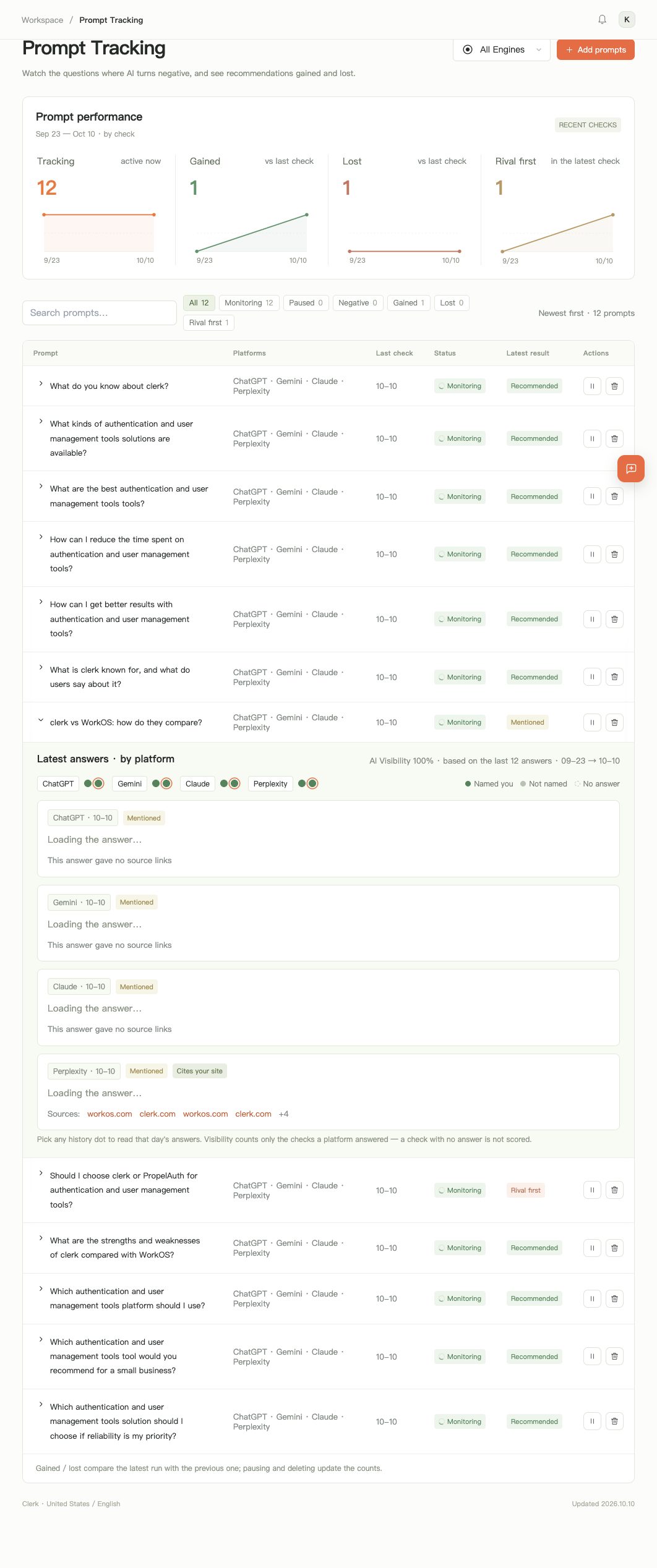
Then attribute. For every Negative or Mixed label, record the cited domains and count which appear under which theme. A handful of review pages, Reddit threads and comparison articles usually produce most of the negative claims, and you only learn that by joining labels to citations. In Kairosy this join is the Negative Narratives page: each narrative lists the answers that carry it, the engines that repeat it and the sources they cited.
Attribution also tells you who can fix it: your own docs mean a copy edit, a review site means outreach, a comparison article means a content job. The fix playbook covers each path.
How Do You Turn a Recurring Sentiment Report Into Fix Tasks? (Step 6)
Ship the same one-page report on the same day every week:
- Headline numbers with n: visibility, negative share, negative-or-mixed share, competitor preferred, each with its denominator and the change since last week.
- Movers: the prompts whose labels changed, with the full answers linked.
- Theme table: counts per theme this week and last, sorted by growth.
- Concern ledger: every Mixed answer's stated objection, quoted. This section ends the "75, looks fine" conversation.
- Fix tasks: one row per theme-plus-source, with an owner and a re-check date.
The re-check date makes it a loop: a fix is done when the next two runs stop showing that theme from that source, not when the page was edited. To track brand sentiment in AI answers over time with a trend you can defend, you need weekly runs, frozen conditions, a minimum sample and a ledger of what changed and why. The companion guide on monitoring AI search visibility covers the visibility half of the same report.
How Does Kairosy Track Brand Sentiment in AI Answer Engines?
Kairosy runs this procedure as a product. You pick a brand, a market and any 4 of the 6 live engines (ChatGPT, Gemini, Claude, Perplexity, DeepSeek, Doubao); it asks buyer questions, keeps every full answer with its cited sources, classifies sentiment per answer and extracts the negative narratives. The Overview shows a Reputation score (0–100 with a verdict), positive-answer and negative-theme counts, AI Visibility as a percentage and Brand Sentiment on a 0–100 scale, with a trend across scans and a per-engine breakdown so an engine that flipped stands out.
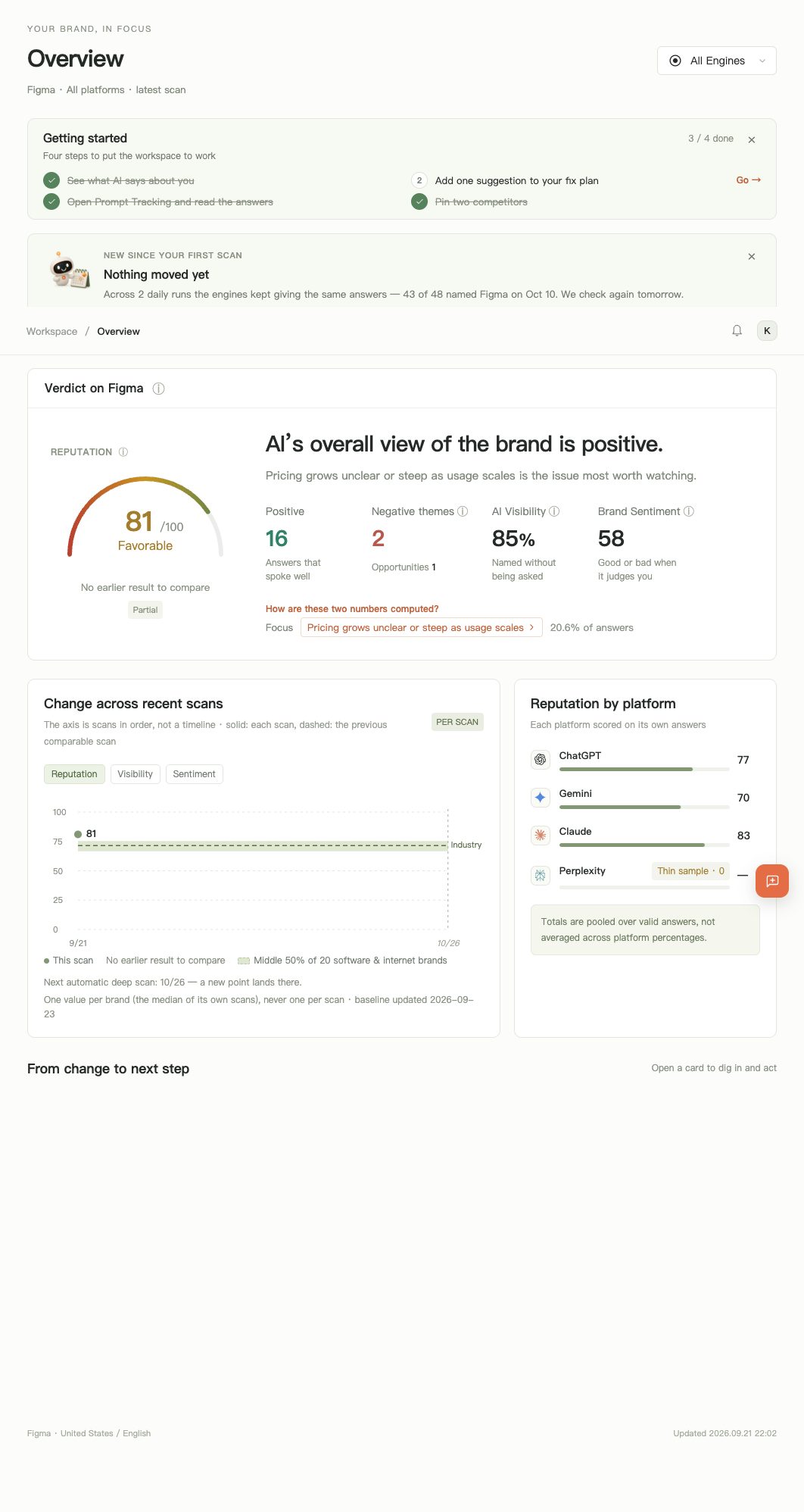
Three things to know first. Tracked prompts re-run daily and each brand gets a deep rescan every Monday; the weekly email flags score drops, a competitor being preferred, an engine flipping and new negative keywords, but there are no real-time alerts. The classifier produces positive, neutral and negative labels plus "competitor preferred" and "not mentioned" states; the Mixed label in this guide is a manual overlay for borderline answers you review in the full text. And it measures answers, not demand: there is no prompt-volume data. Plans start at $29 per month for one brand-and-market slot, with a 7-day trial that needs no card. The AI reputation management page describes the loop from scan to fix, and ChatGPT brand monitoring covers the single-engine setup. If the sources you want cited are your own pages, check they are crawlable with the free AI crawl checker first.
How to Track Brand Sentiment in AI Answer Engines FAQs
Which tools for tracking brand sentiment in AI answer engines are worth paying for?
The ones that keep full answers, label per brand and show sample size. Prices were read from each vendor's pricing page on October 21, 2026, monthly billing unless stated.
| Tool | Entry price (verified 2026-10-21) | Entry tier includes | Sentiment handling |
|---|---|---|---|
| Kairosy | $29/mo Basic; $99 Pro; $399 Growth; annual works out to $25 / $79 / $299 | 1 brand × market slot, 15 tracked prompts/day, 4 of 6 engines, 5 pinned competitors | Per-answer sentiment, Brand Sentiment 0–100, Negative Narratives with sources |
| Otterly.AI | Lite $29/mo; Standard $189; Premium $489; annual about 15% less | 15 search prompts; ChatGPT, Google AI Overviews, Perplexity, Copilot; other engines as add-ons | Mention and visibility tracking; check sentiment depth on the trial |
| Profound | Free trial (50 prompts daily for 7 days on ChatGPT, Gemini, AI Overviews); Enterprise is custom pricing | Enterprise adds Perplexity, Copilot, DeepSeek, Claude and more | Sentiment benchmarking and theme views in the enterprise product |
| Peec AI | Starter, Pro, Advanced, Enterprise; prices not displayed on the pricing page on 2026-10-21 | AI search visibility tracking for SEO teams | Ask for sentiment specifics on the demo |
How many prompts do you need before a negative share means anything?
Count mentions, not prompts. Twenty prompts on 4 engines give 80 answers; at 60% visibility that is about 48 mentions, where a 25% negative share carries a Wilson interval of roughly 15% to 39%. You can detect a large move, not a five-point one. Forty mentions is a sensible floor; 150 or more is where week-to-week changes become readable.
Should "not mentioned" count as negative?
No. It is a visibility problem, not a sentiment problem, and the fixes differ. The one exception is a branded prompt where the engine answers about a different company: log it as not mentioned and flag the entity confusion as a theme.
Can you track brand sentiment in AI answers over time without a tool?
Yes, for a small set. A spreadsheet with one row per answer (prompt, version, engine, market, date, full text, cited URLs, label per brand, theme, reviewer A, reviewer B, final) works up to about 30 prompts on two engines weekly. Past that, capture eats the week and labeling drifts. The steps for how to track brand sentiment in AI answer engines are the same either way.
Why do two reviewers disagree so often on Mixed versus Negative?
Because the engine hedges. "Great tool, but expensive" reads Positive to one person and Negative to another. Rule 2 settles it: a stated buying concern caps the label at Mixed, and a comparative loss makes it Negative. Write the tie-break into the codebook and the disagreement rate drops within two cycles.
See what AI says about your brand
Run a free scan across ChatGPT, Gemini, Claude & Perplexity in about 30 seconds.
Run my free scan