What Is AI Brand Sentiment? Types, Measurement and Why LLMs Disagree
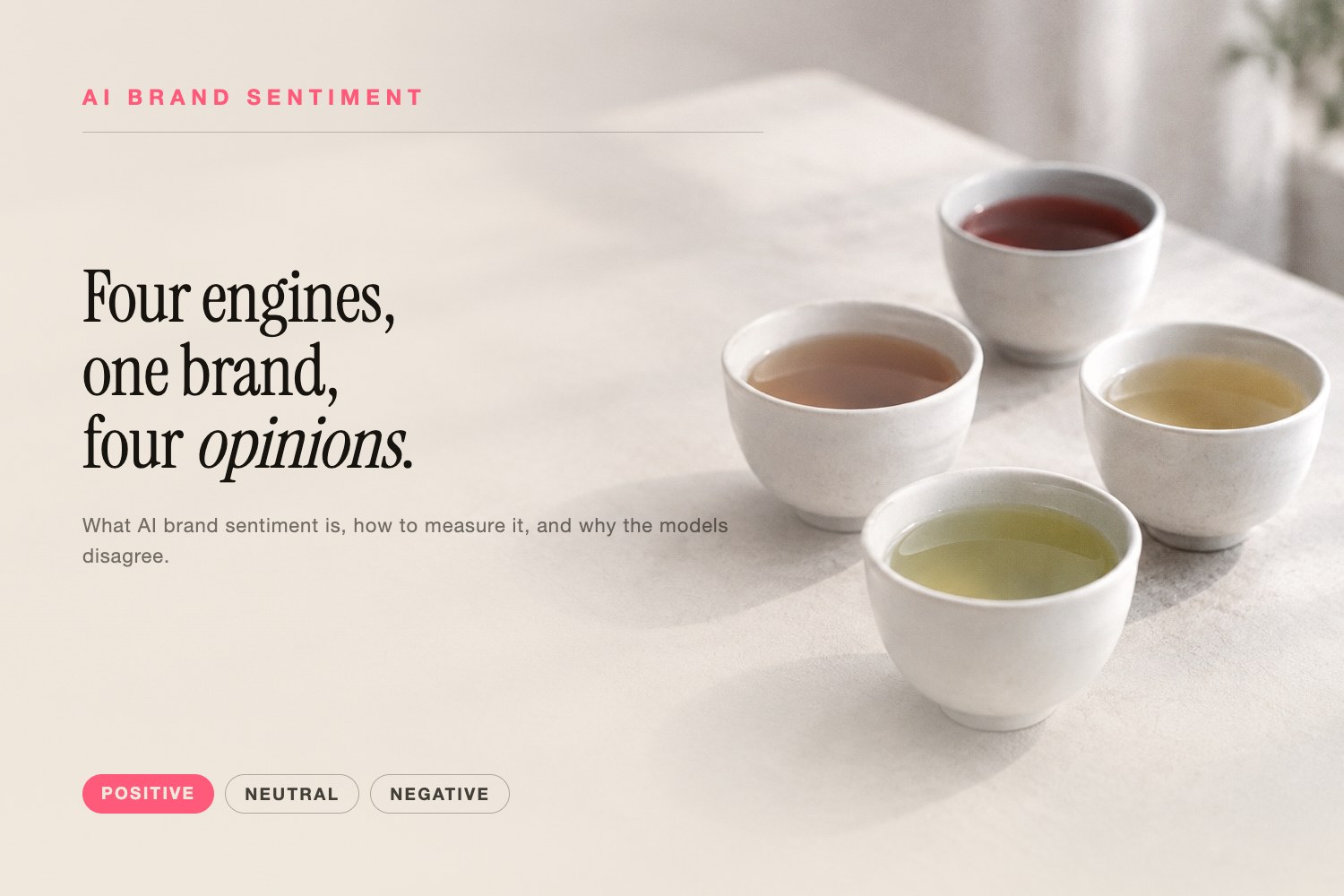
AI brand sentiment is the tone an AI assistant takes when it describes, compares or recommends your brand inside an answer: positive, neutral or negative, plus two states that only exist in AI answers, "prefers a competitor" and "does not mention you at all." If you are asking what is AI brand sentiment in practical terms, it is the opinion ChatGPT, Gemini, Claude or Perplexity hands a buyer who asks "is X worth it?" or "what are the downsides of X?", measured across many such questions and turned into a number you can track.
What is AI brand sentiment and why does it matter in 2026?
Every time a generative engine answers a brand question, it takes a position: "the safer pick for enterprise," "pricing is a common complaint," "start with a rival instead," or silence. AI brand sentiment is that position, classified per answer and aggregated across a fixed set of questions and engines into a score.
The stakes are concrete. Semrush's March 5, 2026 survey of 1,030 U.S. consumers who have tried AI tools found that 55% use AI for product research at least weekly, 50% have made a purchase after using AI during research, and 43% discovered a new brand through AI. Capital One Shopping's research page (updated September 1, 2026) reports that 36% of consumers have used GenAI tools like ChatGPT for online shopping, and 80% plan to use GenAI to shop in 2026. A negative verdict never shows up in analytics as a lost click; it shows up as a buyer who never arrived.
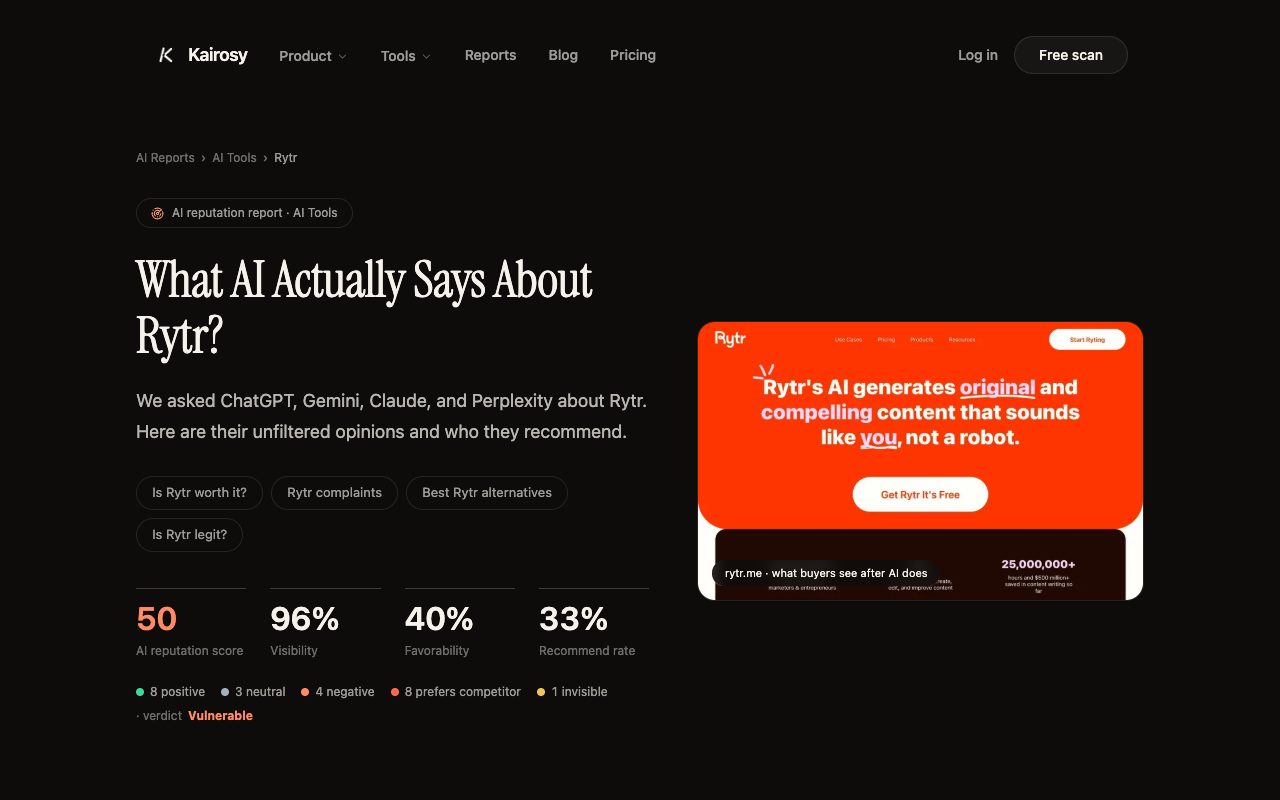
How does AI brand sentiment differ from traditional sentiment analysis?
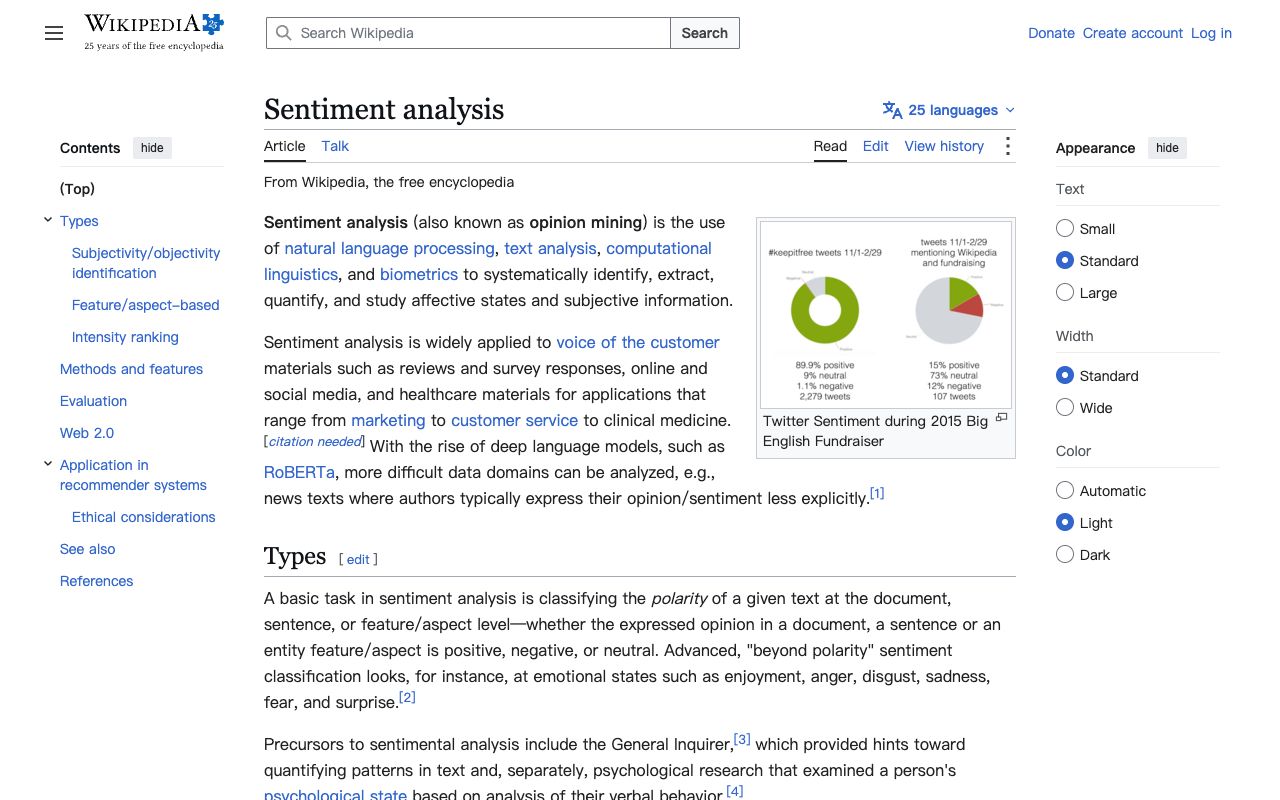
Classic sentiment analysis, as Wikipedia defines it, "is the use of natural language processing, text analysis, computational linguistics, and biometrics to systematically identify, extract, quantify, and study affective states and subjective information," typically applied to reviews, survey responses and social media. The unit of analysis is a human utterance that already exists; you collect thousands and count.
AI brand sentiment inverts that. The text does not exist until you ask for it. The engine reads whatever it retrieves or remembers, synthesizes one verdict, and presents it as advice to every buyer who asks. There is no crowd to average, only one synthetic reviewer per engine.
| Dimension | Traditional sentiment (reviews, social) | AI brand sentiment (LLM answers) |
|---|---|---|
| Unit measured | Existing posts by many authors | Generated answers to your own questions |
| How you collect it | Listening: crawl, scrape, API feeds | Asking: a fixed prompt set, per engine, on a schedule |
| Volume | Thousands of data points, weighted by reach | Dozens of answers, weighted by how often buyers ask |
| Outcome classes | Positive / neutral / negative | Plus "prefers competitor" and "invisible" |
| Provenance | Author and platform are known | Cited URLs reveal which sources shaped the verdict |
| Stability | Moves with real events | Moves with retrieval, model updates and sampling noise |
The "invisible" state matters most. In a review corpus, absence means nobody wrote about you. In an AI answer, it means the engine considered the category and left you out, which to a buyer reads like a bad review. That is why AI brand perception work treats omission as a sentiment outcome.
What are the three types of AI brand sentiment?
Every answer gets one label. Engines rarely say "positive" or "negative" outright, so a classifier reads the answer for the buyer's takeaway.
Positive: the engine endorses you for the buyer's job
Illustrative shape (not a quoted engine answer): "For teams that need natural-sounding voices with a large language library, ElevenLabs is the strongest option; its voice quality is consistently rated above competitors." The answer names you, names the use case, and gives a reason a buyer can act on.
Neutral: the engine describes you without a verdict
Illustrative shape: "ElevenLabs offers text-to-speech, voice cloning and dubbing, with a free tier and paid plans by character volume." Accurate and useless for persuasion; the engine has facts but no opinion to borrow.
Negative: the engine leads with a downside
This one is real. In Kairosy's scan of ElevenLabs on August 5, 2026, Claude answered one question with "the free tier is quite limited, and the paid plans can feel expensive for high-volume…" and ChatGPT with "pricing/usage limits that can feel restrictive for heavy users, occasional voice artifacts or…". Both are negative because the takeaway is a caution, even though neither says "avoid."
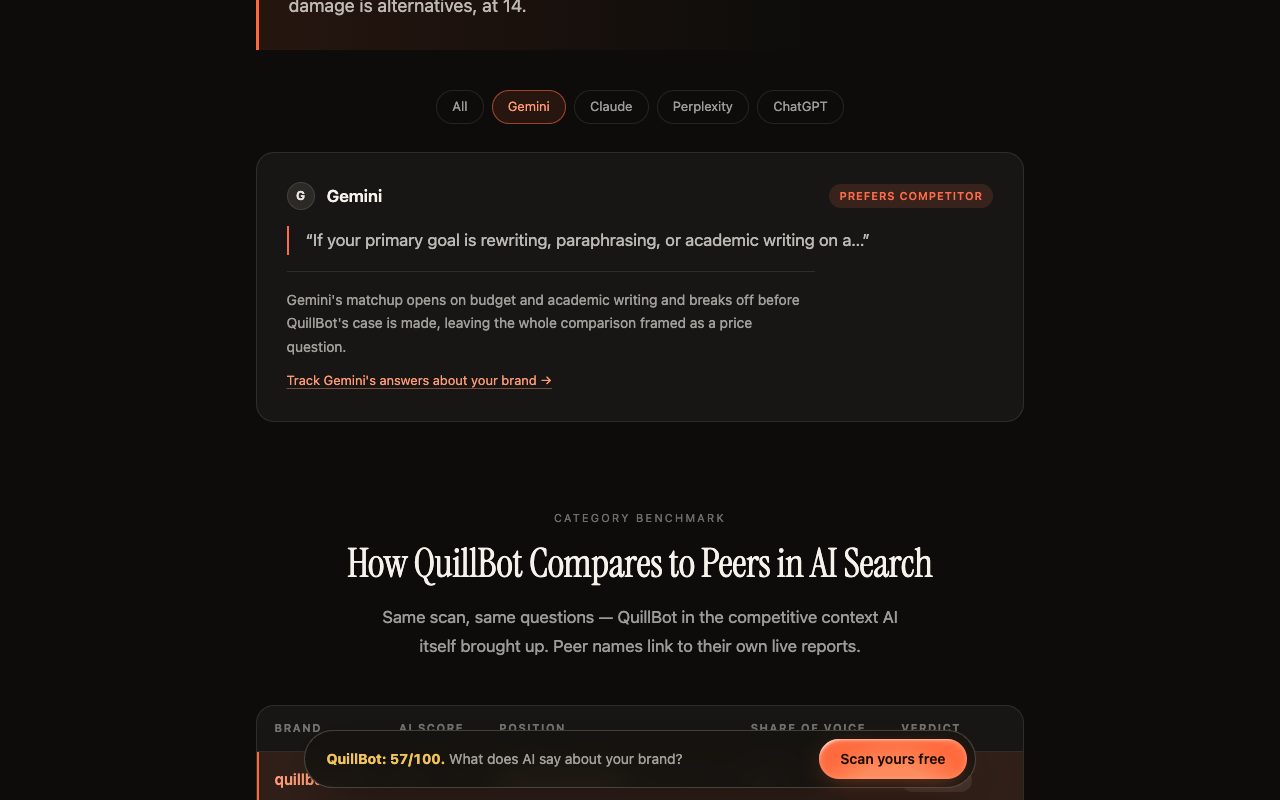
Two adjacent outcomes count as much as the core three. Prefers competitor: in Kairosy's scan of KKday, Claude answered "For Asia-focused activities, start with Klook; for worldwide tours, compare GetYourGuide and Viator." KKday was the brand asked about and was not recommended once. Invisible: the engine answers the category question and never says your name.
How do you measure AI brand sentiment?
Measurement is a repeatable experiment, not a one-off chat. Five parts:
- A fixed question set. Six to twenty-five prompts phrased the way buyers phrase them ("is X legit," "X vs Y," "common complaints about X"), held constant so a change in answers is a change in sentiment.
- Every engine, separately. Each retrieves and reasons differently, so each gets its own sub-score.
- Per-answer classification with reasons. Each answer is labeled, and the label carries the phrase that triggered it. A score without the quote is unfalsifiable.
- Citation capture. The URLs behind each answer are stored with the label, so a negative can be traced to a source.
- A schedule. The same set, re-run weekly, turns a snapshot into a trend.
This is the design behind Kairosy's AI brand monitoring reports: the headline score from 0 to 100 is the average of the per-engine scores of the engines that answered, and every answer carries its label, its reasons and its real citation URLs. Tracked prompts on paid plans are re-checked daily, and each tracked brand is re-scanned every Monday with an email digest. One scan answers what is AI brand sentiment for your own brand instead of in the abstract.
Why does the same brand get different sentiment on ChatGPT, Gemini, Claude and Perplexity?
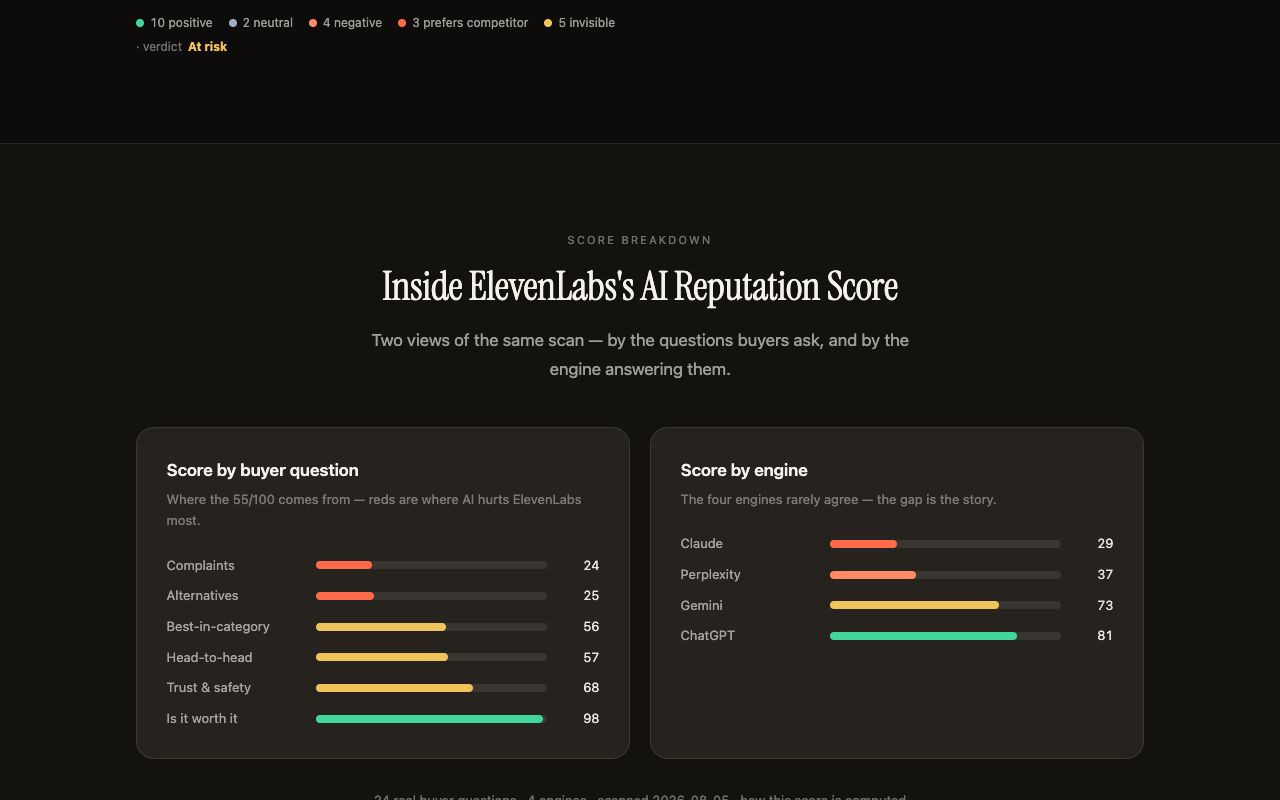
Because they are not reading the same web, and they are not told to weigh it the same way. Kairosy's scan of ElevenLabs (August 5, 2026) shows it cleanly: overall 55/100, verdict "At risk," but per engine ChatGPT 81, Gemini 73, Perplexity 37 and Claude 29. Of the 24 answers, 10 were positive, 2 neutral, 4 negative, 3 preferred a competitor and 5 left the brand out. Same brand, same week, same questions, a 52-point spread.
Retrieval is engine-specific. Perplexity's API is built around "web-grounded answers with built-in citations in one call", so each answer reflects the live web that day. Gemini's grounding is an opt-in tool that lets the model "cite verifiable sources beyond its knowledge cutoff". Anthropic's documentation says that with web search enabled, "Claude determines when to search based on the prompt", so two questions about one brand can draw on different evidence.
Source preferences differ. Profound's analysis of 680 million citations from August 2024 to June 2025 found Wikipedia at 7.8% of ChatGPT's citations versus Reddit at 6.6% of Perplexity's. An engine that leans on forum threads surfaces complaints an encyclopedia-first engine never sees.
Answer style differs. Some models volunteer downsides on an open question; others wait to be asked for the cons.
The spread is not an ElevenLabs quirk. Across Kairosy's 205 public brand reports (as of September 16, 2026), these are the widest per-engine gaps:
| Brand | Lowest engine | Highest engine | Gap |
|---|---|---|---|
| KKday | Perplexity — 19/100 | Claude — 73/100 | 54 pts |
| Crazy Egg | Gemini — 22/100 | Claude — 74/100 | 52 pts |
| ElevenLabs | Claude — 29/100 | ChatGPT — 81/100 | 52 pts |
| Loomly | Claude — 33/100 | Gemini — 81/100 | 48 pts |
| Fathom Analytics | Gemini — 27/100 | Perplexity — 74/100 | 47 pts |
| Luma AI | Perplexity — 26/100 | Gemini — 73/100 | 47 pts |
| BrightEdge | Claude — 35/100 | Gemini — 81/100 | 46 pts |
| Gelato | Gemini — 29/100 | Claude — 73/100 | 44 pts |
A single-engine number is one engine's opinion, not "your AI sentiment." Report per engine, and treat the lowest as the one your next buyer may be using.
What Causes Negative AI Brand Sentiment?
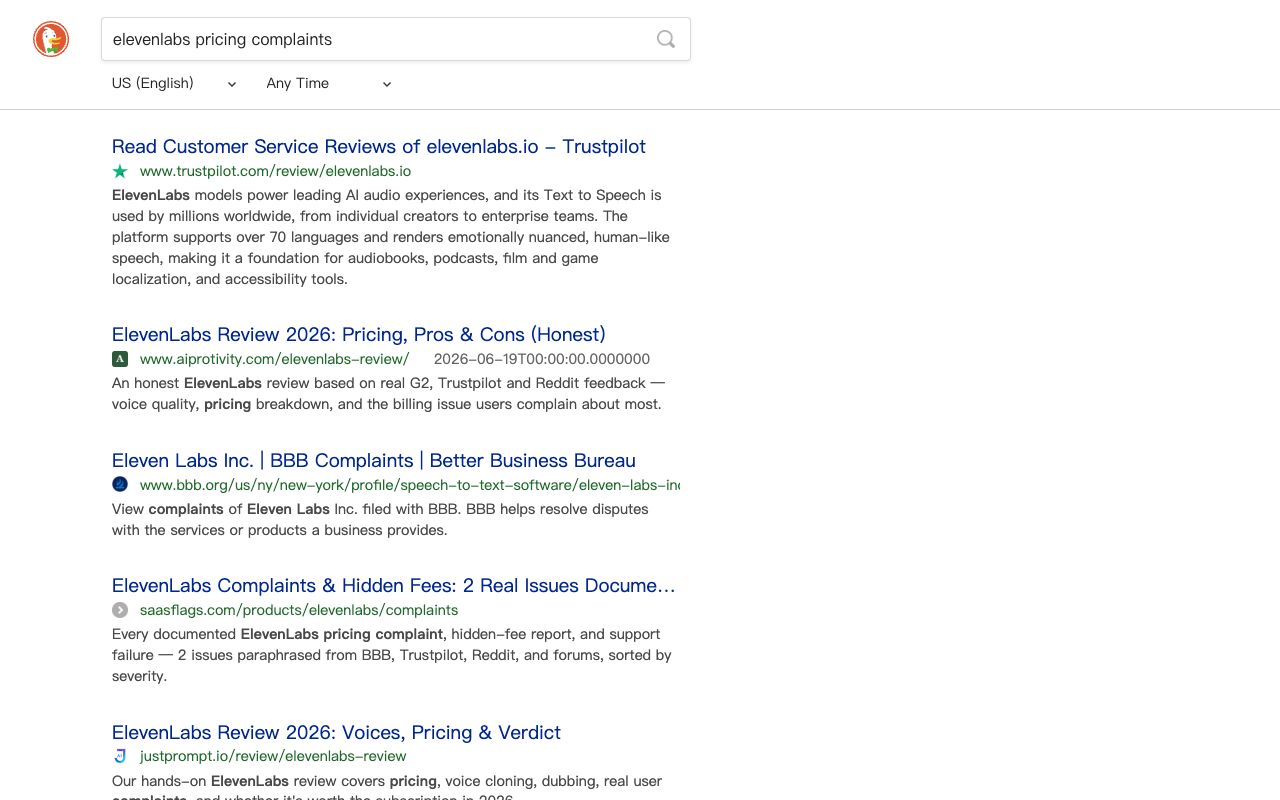
Negative verdicts are almost never invented. They are compressed from something the engine read. The recurring causes:
- A complaint on a high-authority page. A pricing thread on Reddit, a two-star cluster on a review site, or a "limitations" section in a comparison article. Once cited, it becomes the engine's opinion.
- Comparison content written by a rival or affiliate. "X vs Y" articles frame you as the compromise, and engines answering "which should I choose" reuse the frame.
- Pages the engine cannot read. If pricing, docs or trust pages block AI crawlers or render only in JavaScript, the engine fills the gap with third-party accounts. A crawl check is the cheapest fix on this list.
- Stale facts and entity confusion. A limit you removed a year ago still lives in cached articles, and a similarly named company's outage gets pinned on you, especially on engines answering from memory.
- Thin first-party evidence. No case studies, no named customers, no numbers. With nothing positive to cite, the engine borrows the negative it found.
How Do You Turn Negative Into Positive AI Sentiment?
Short version, because the full playbook is its own post: find the exact answer and the URL it cited, change or outrank that source, publish the first-party page the engine was missing, and re-scan on the same prompts until the label flips. The step-by-step procedures are in how to fix negative brand sentiment in AI, and the wider program sits under AI reputation management.
Two rules keep it honest. Fix what is true before contesting what is false; an engine that read a legitimate pricing complaint will keep reading it. And tie every fix to a re-scan target (which prompt, which engine, which label), so you can tell a fix that worked from sampling noise.
Which cited sources create your AI brand sentiment?
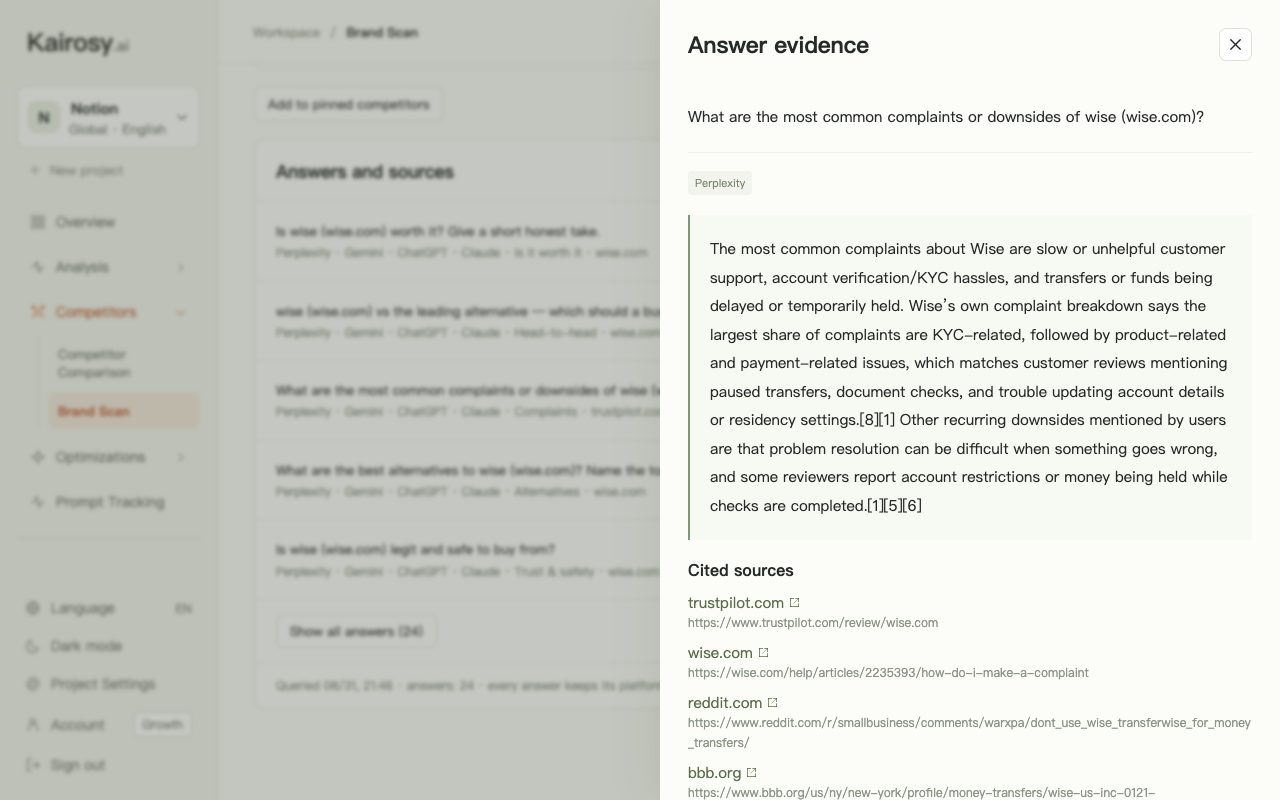
Source attribution turns a sentiment score into a to-do list. Grounded engines return the URLs behind each answer (Anthropic's docs note that for web search, "Citations are always enabled"), so you can group every negative answer by the domains it cited and see which handful of pages do the damage.
The distribution is lopsided and engine-dependent. 5WPR's May 2026 State of AI Citations report, synthesizing datasets from August 2024 to March 2026, puts Wikipedia at "47.9% of ChatGPT's top-10 source share," Reddit at "approximately 46.7% of Perplexity's top-10 source share," and finds that "approximately 43% of AI Overview citations link back to Google-owned properties." If your negatives cluster on Perplexity, expect a forum thread; if on ChatGPT, check your Wikipedia article and the comparison pages ranking for your name.
A working attribution table has four columns: cited domain, answers it appears in, share of those answers that were negative or competitor-preferred, and the engines citing it. Sort by the third column; two or three domains usually account for most negative labels, and one is typically a page you can edit, respond on, or outrank. Kairosy's Visibility module lists source domains per brand, and the most-cited AI sources post covers which domains dominate by category.
How stable is AI brand sentiment? Confidence and volatility explained
Less stable than a review average. Two sources of variance stack.
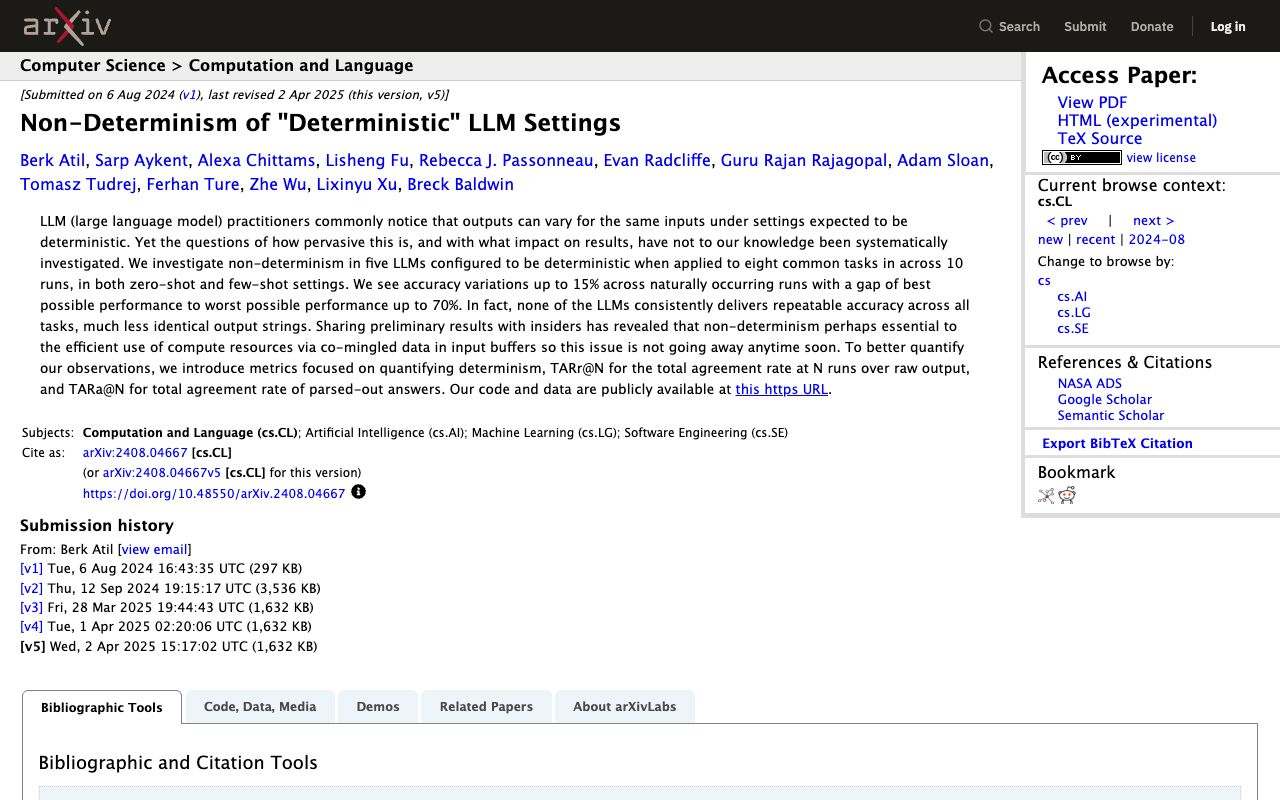
Sampling noise inside one engine. Language models are not deterministic even when configured to be. The 2024 study "Non-Determinism of 'Deterministic' LLM Settings" ran five models on eight tasks ten times each and reported "accuracy variations up to 15% across naturally occurring runs with a gap of best possible performance to worst possible performance up to 70%." OpenAI's cookbook on the seed parameter states that "Determinism is not guaranteed" and that there is "a small chance that responses differ even when request parameters and system_fingerprint match." Ask the same question twice and you can get a caution and then a recommendation.
Session and retrieval variance. Grounded engines re-search on every call. A new Reddit thread, a rival's fresh comparison post, or a shift in which page ranks third for your name changes the evidence set, and therefore the verdict, with nothing about your product changing.
- Treat one scan as one sample: a point estimate with an error bar you cannot see. Twenty-four answers from four engines are far steadier than three from one.
- Confirm before acting. A drop that repeats on the next weekly run, or an engine flipping from positive to negative on the same prompt, is signal. A single-run wobble usually is not.
- Prefer per-engine trends to the blended score. Blending hides an engine that has quietly turned.
This is why Kairosy's weekly re-scan alerts only on specific events: new negative keywords, a competitor becoming the preferred pick, a score drop, or an engine flipping sentiment. It is also why the first scan is free (7-day trial, no credit card, full report) and the second is where the information starts.
AI Brand Sentiment FAQs
What is AI brand sentiment in one sentence?
It is the classified tone (positive, neutral, negative, prefers a competitor, or invisible) that AI assistants take toward your brand across a fixed set of buyer questions, scored per engine and tracked over time. That is the whole of what is AI brand sentiment; everything else is measurement detail.
What is brand sentiment in AI, and is it the same as AI visibility?
No. Visibility is whether you appear in the answer at all; sentiment is what the answer says once you do. A brand can be highly visible and negatively described (ElevenLabs above: 79% visibility, 55/100 score), or barely visible and glowing.
What is brand sentiment analysis in AI search?
Prompting AI search engines with buyer questions, labeling each answer, capturing the cited URLs, and repeating on a schedule so the labels become a trend; the output is a per-engine score plus the answers and sources behind it.
What is Profound's AI tool for brand sentiment?
Profound is an enterprise AI visibility platform whose homepage lists monitoring across ChatGPT, Perplexity, Claude, Gemini, Grok, Microsoft Copilot, DeepSeek and Google AI Overviews, including sentiment in answer engines; it publishes no prices on its homepage (as of September 2026). Kairosy covers ChatGPT, Gemini, Claude and Perplexity with per-answer labels and citations from $29 per month.
Can AI brand sentiment be negative on one engine and positive on another?
Routinely. The widest gap in Kairosy's public reports is 54 points (KKday: Perplexity 19, Claude 73), with 52-point spreads for ElevenLabs and Crazy Egg. Read each engine's score before the blended one.
See what AI says about your brand
Run a free scan across ChatGPT, Gemini, Claude & Perplexity in about 30 seconds.
Run my free scan