AI Source Monitoring in 2026: Sources, Metrics, Churn and Ownership
AI source monitoring is the practice of recording which web pages ChatGPT, Gemini, Claude and Perplexity cite when they answer questions about your brand, what claim each page contributes, and who on your team owns that page or relationship. The engines do not describe you from memory: they read a short list of pages at answer time and repeat what those pages say, complaints included.
That list is unstable. A July 2026 study of 530,875 citations found that only 1.1% of the sources ChatGPT cited on day one were still cited on all seven days of the week. This post is the program, not the tactics: source types, prompt set, metrics, competitor sources, churn, ownership, cadence, and the Source Impact review. For the source-by-source playbook on earning a citation, read how to get cited by AI.
What Is AI Source Monitoring, and How Does It Differ From Citation Tracking?
Citation tracking answers one question: how often does my domain show up in AI answers? AI source monitoring turns it around: for every answer about your brand, which pages did the engine read, and what did each page put into the answer? A complaint in an answer is exactly as fixable as the page it was lifted from.
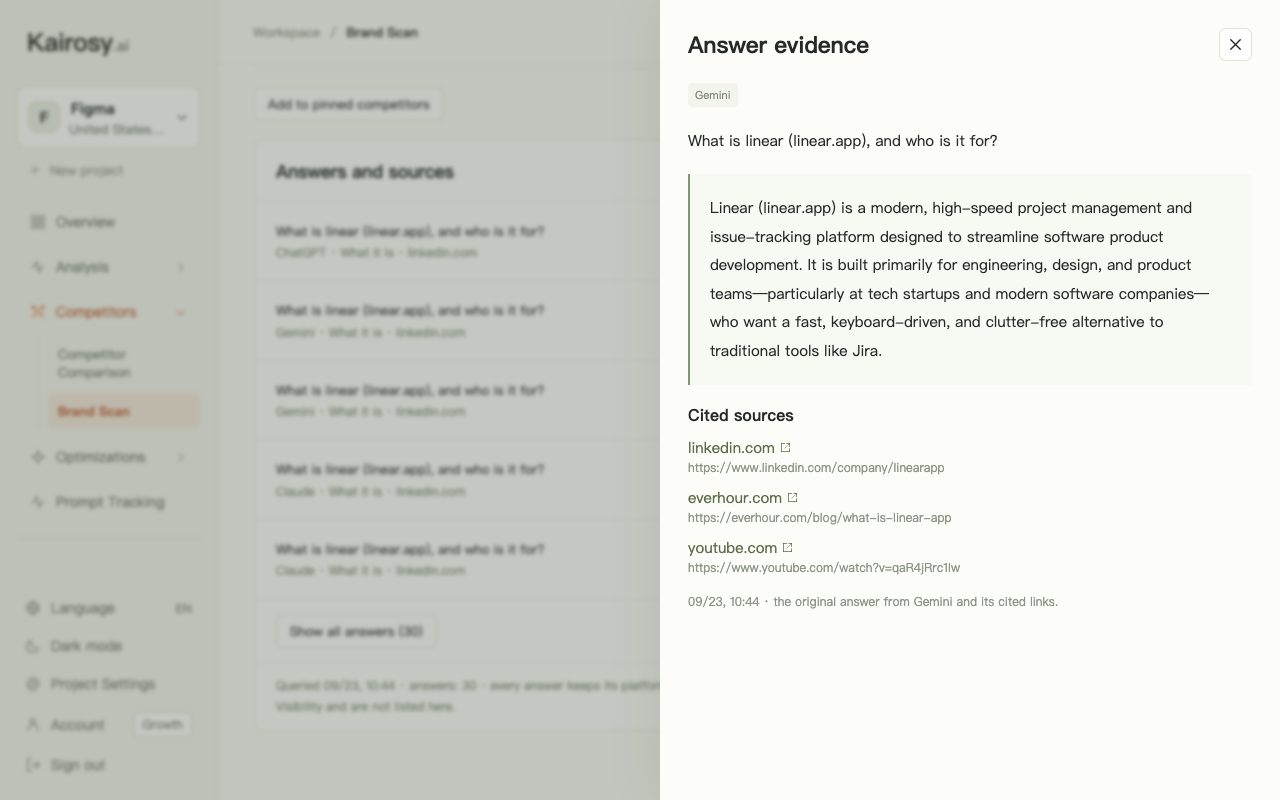
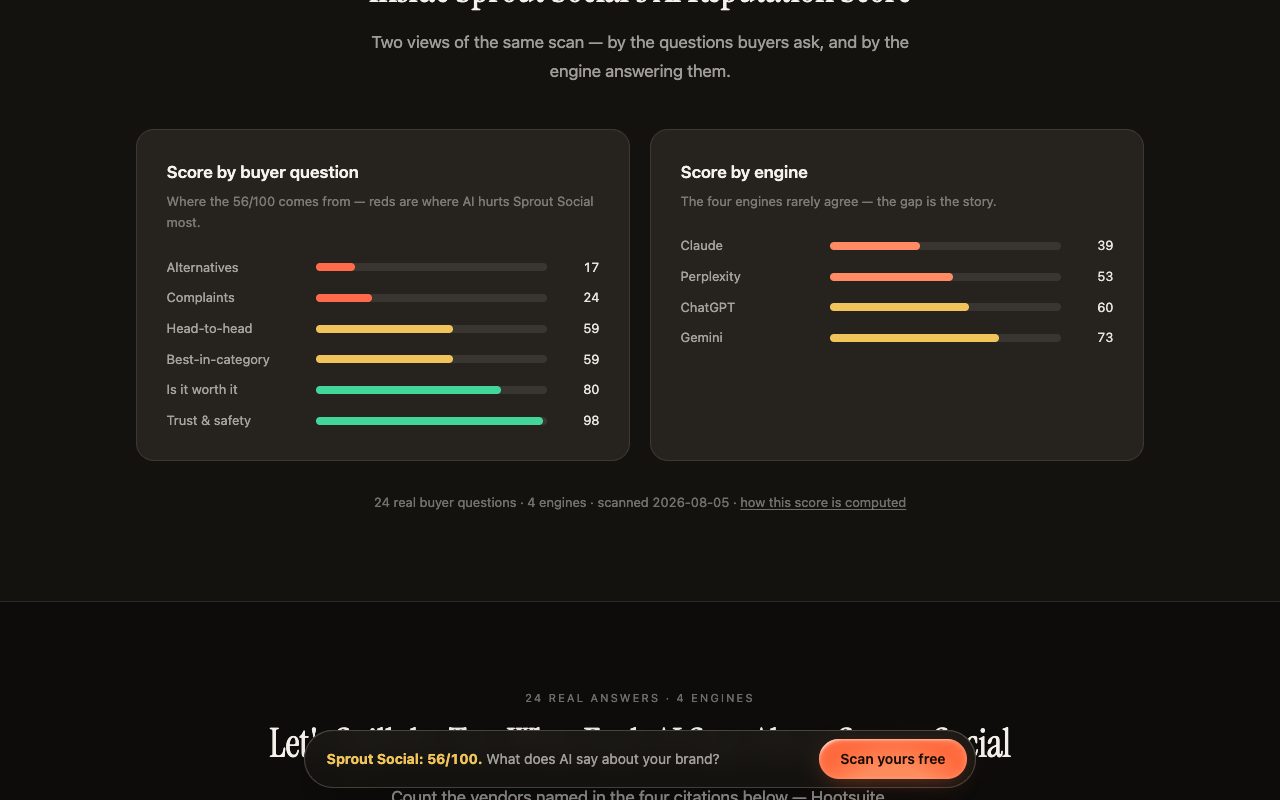
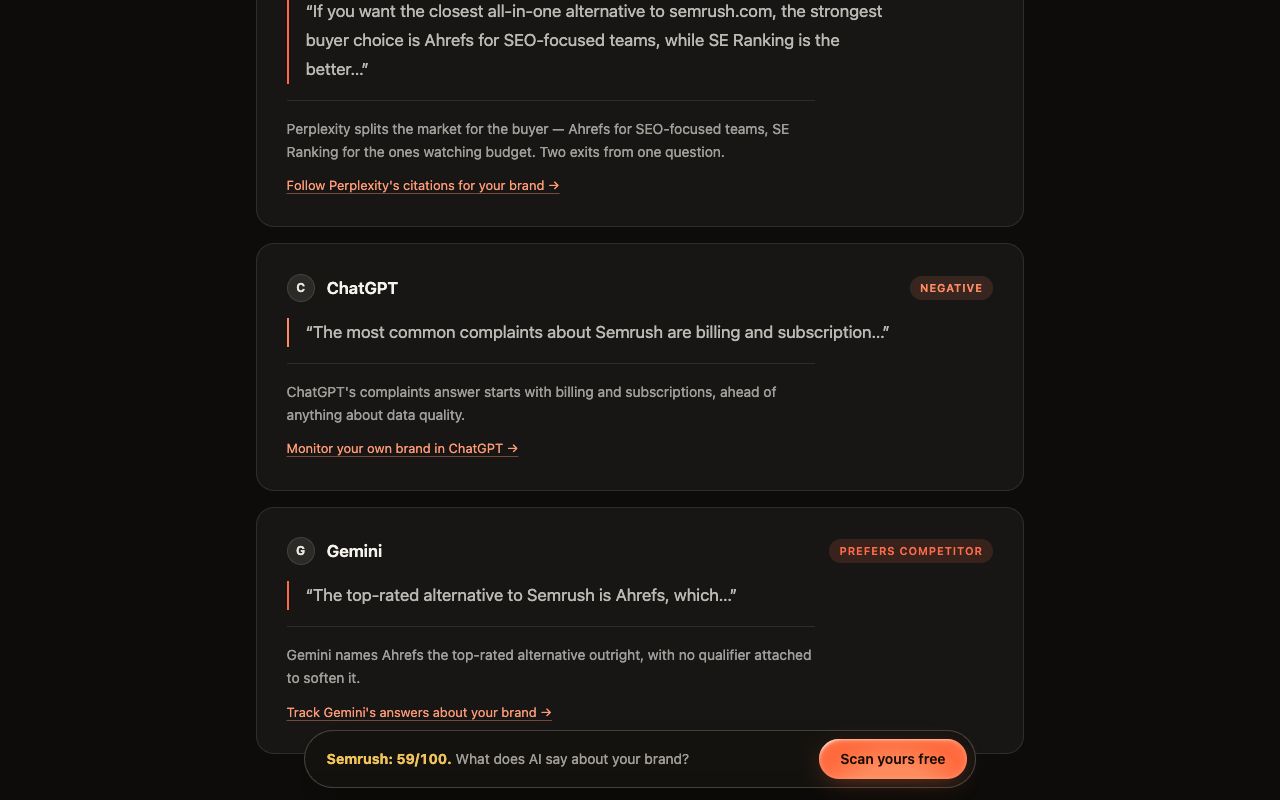
So the unit you track is a four-part record: prompt, engine, cited URL, and the claim that URL fed. The same domain can supply a positive claim on one prompt and a negative one on the next, which is why domain counts hide the problem. Kairosy's scan of Semrush (2026-08-05, score 59/100) describes the two fixable inputs as "a billing narrative sourced from review sites and a comparison page the market has already written on Semrush's behalf." Two sources, two claims, two owners.
Which Source Types Should AI Source Monitoring Cover?
Start from how the engines distribute citations. Analyze's August 4, 2026 study of 115,843 citation events across 460 B2B prompts sorts sources into five families: brand websites and product pages; lists, comparisons and reviews; editorial and educational content; community and social platforms; directories and marketplaces (Analyze source-family study). No two engines share the same split.
| Engine | Brand sites | Lists / comparisons / reviews | Editorial | Community | Directories |
|---|---|---|---|---|---|
| ChatGPT | 68.8% | 13.9% | 11.9% | 5.3% | 0.13% |
| Perplexity | 35.4% | 34.4% | 25.2% | 4.7% | 0.26% |
| Google AI Mode | 37.9% | 33.1% | 23.8% | 4.8% | 0.46% |
Share of citation events by source family. Analyze, August 4, 2026; 22,295 AI answers, 460 B2B prompts.
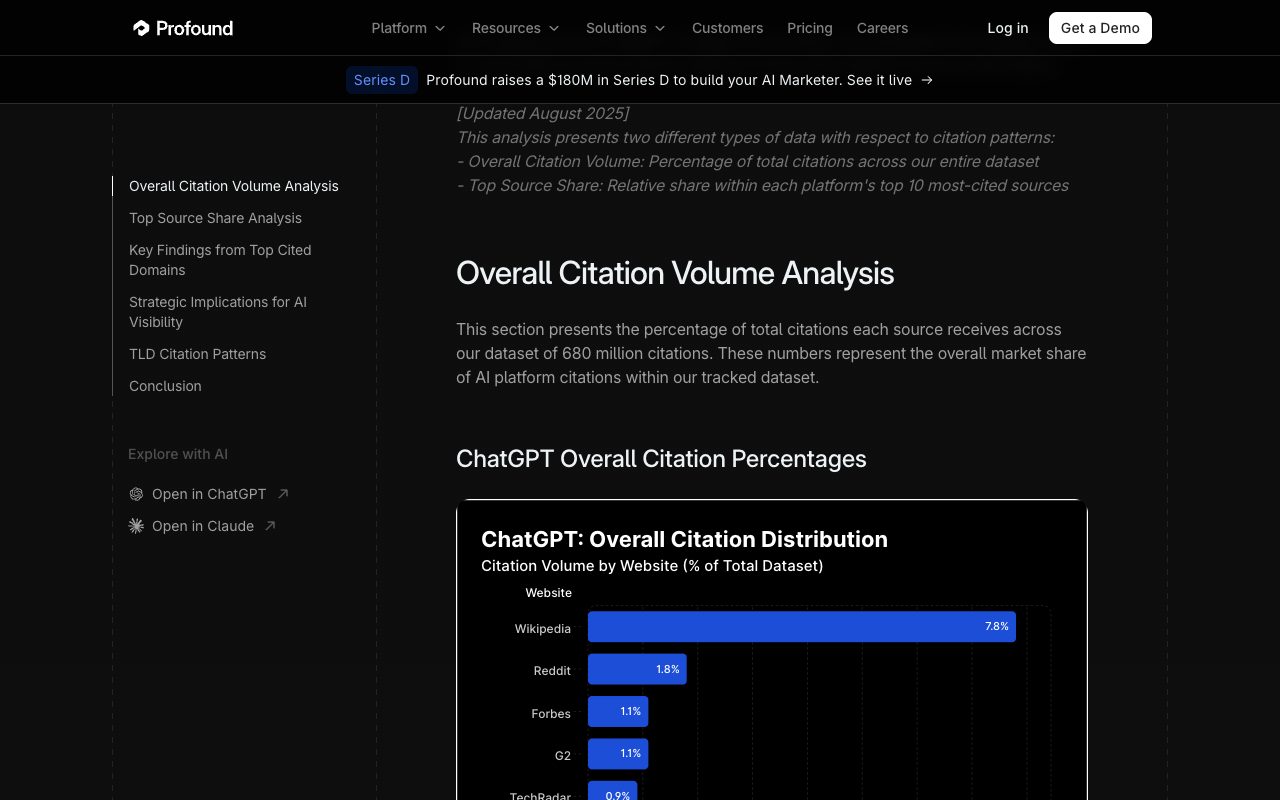
For monitoring I split those families into seven buckets, because each lands on a different desk: owned pages, review platforms, comparison and listicle pages, editorial media, community threads, reference profiles such as Wikipedia, and competitor-owned pages. Profound's 680-million-citation dataset (published June 5, 2025, covering August 2024 to June 2025) shows why reference and community get their own lines: Wikipedia was 7.8% of ChatGPT's citations and Reddit 6.6% of Perplexity's (Profound citation patterns). Per-engine domain tables are in the most cited AI sources.
Which Prompts Should AI Source Monitoring Run?
A source list means nothing without the prompt that produced it. The review platform that is invisible on "best running shoes" becomes the primary source on "common complaints about Allbirds." The prompt set is your sampling frame; build it before you look at a citation.
Twenty to forty prompts across five intents covers one brand in one market: category discovery ("best help desk for Shopify stores"), brand evaluation ("is Gorgias worth it"), complaints ("what do customers dislike about Gorgias"), comparison ("Gorgias vs Zendesk") and alternatives ("alternatives to Gorgias"). Complaint and alternatives prompts pull the most third-party sources, which is where negative claims are born. Kairosy checks 15, 28 or 70 tracked prompts daily on its Basic ($29), Pro ($99) and Growth ($399) monthly plans, as of September 2026. More on prompt design in search prompt monitoring.
Which Metrics Matter: Citation Rate, Mention Rate and Source Diversity?
Three numbers, computed per engine, carry the program.
- Citation rate: the share of prompt-and-engine pairs where at least one cited URL sits on a domain you own. The only metric your web team moves directly.
- Mention rate: the share of answers that name your brand at all. The gap between the two rates is how often the engine describes you from someone else's page.
- Source diversity: the count of distinct domains behind your answers and their concentration. If three domains supply 80% of your citations and one carries a complaint, your reputation in that engine is one page wide.
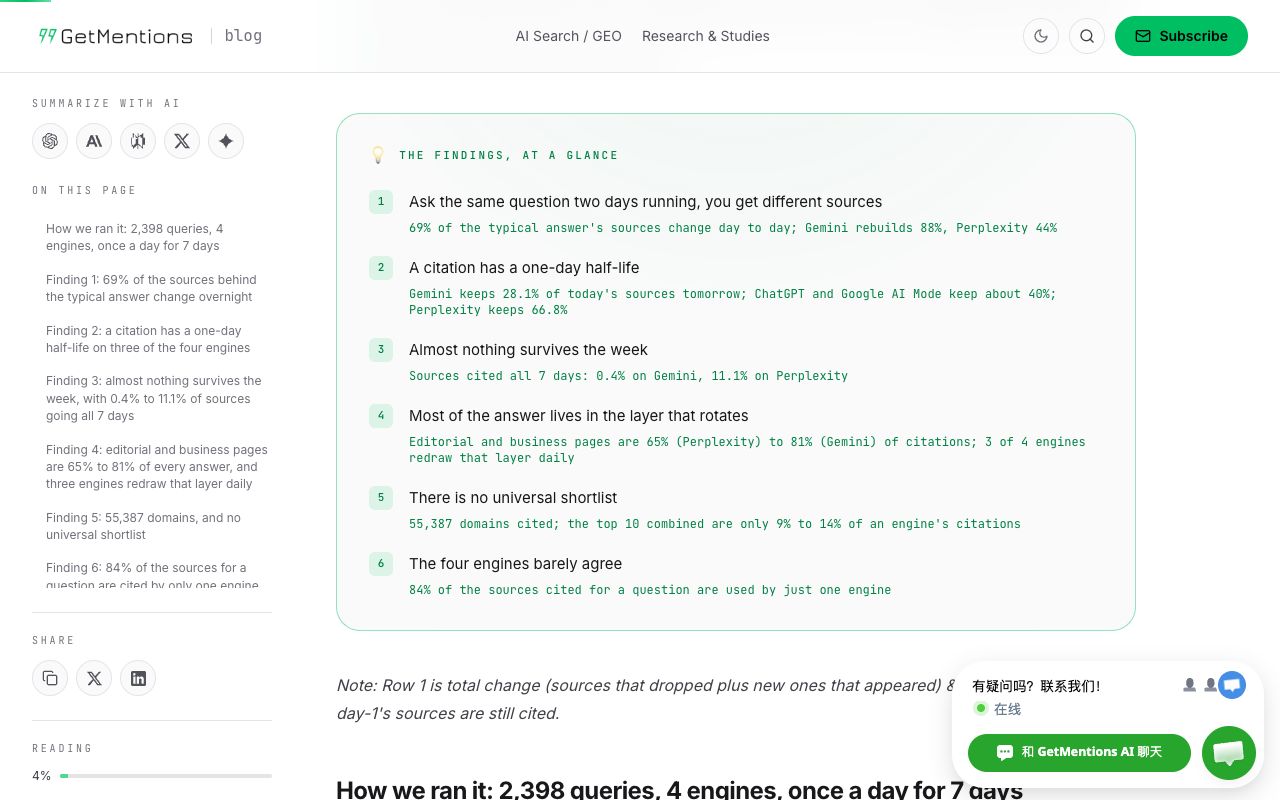
Compute them per engine: the July 2026 GetMentions study found that "84% of the sources for a question are cited by just one engine" (GetMentions volatility study), so a blended number describes no engine that exists. Then add negative-source share, the fraction of cited pages that fed a negative or competitor-preferred claim; it feeds the Source Impact table below. Share-of-voice math is in AI share of voice.
How Do You Monitor Competitor Sources Without Copying Them?
Run the identical prompt set with competitor names and keep the same four-part record. Every source that feeds a positive claim for a competitor and never appears for you is a gap with an address attached; the ones recurring on two or more engines go first. You are locating the pages the engines already trust, then deciding which your team can legitimately earn.
The comparison bucket hurts most. In the Semrush scan, Perplexity answered the alternatives question with "If you want the closest all-in-one alternative to semrush.com, the strongest buyer choice is Ahrefs for SEO-focused teams…" and 5 of 24 answers were tagged prefers competitor. Perplexity scored 45/100 against ChatGPT's 74/100: the two engines were reading different pages.
What Is Source Churn, and How Fast Do Cited Sources Rotate?
Source churn is the share of yesterday's cited sources that are absent today for the same prompt on the same engine. GetMentions measured it by asking 2,398 questions daily for seven days in June 2026 on four engines and logging all 530,875 citations (published July 9, 2026).
| Engine | Daily source churn | Sources surviving day 1 to day 2 | Sources cited all 7 days |
|---|---|---|---|
| Gemini | 88.3% | 28.1% | 0.4% |
| ChatGPT | 79.2% | 40.9% | 1.1% |
| Google AI Mode | 75.9% | 40.4% | 2.6% |
| Perplexity | 44.4% | 66.8% | 11.1% |
GetMentions AI citation volatility study, July 9, 2026.
Two rules follow. A single scan is a sample, not a state, so a source should appear in at least three of the last seven runs before anyone is assigned to it. And keep a "new sources" and a "dropped sources" list per engine each week. Churn also happens at platform level: Semrush's study of 230,000 prompts, published November 10, 2025, recorded ChatGPT citing Reddit in close to 60% of responses in early August 2025 and around 10% by mid-September (Semrush most-cited domains study). If your Reddit-sourced mentions vanished that month, nothing on your side caused it.
Who Owns Each Source When a Citation Needs Fixing?
Action routing is the step most setups skip: the dashboard flags a source and nobody's name is next to it. Assign an owner per bucket before the first alert, and write down each platform's rules so the fix does not create a worse source.
- Owned pages: web or content team. OAI-SearchBot (OpenAI bots docs) and PerplexityBot (Perplexity crawler docs) must be allowed. The free AI crawl checker tests crawler access; the AI-ready audit runs 33 checks across access, readability, structured data, citability and trust.
- Review platforms: support or CX. G2 states that "Employees working for the product's company and employees of a direct competitor may not leave reviews" (G2 guidelines); Trustpilot's business guidelines (version 7.2, June 2026) require you to "invite consistently and fairly," whatever the customer's experience (Trustpilot guidelines).
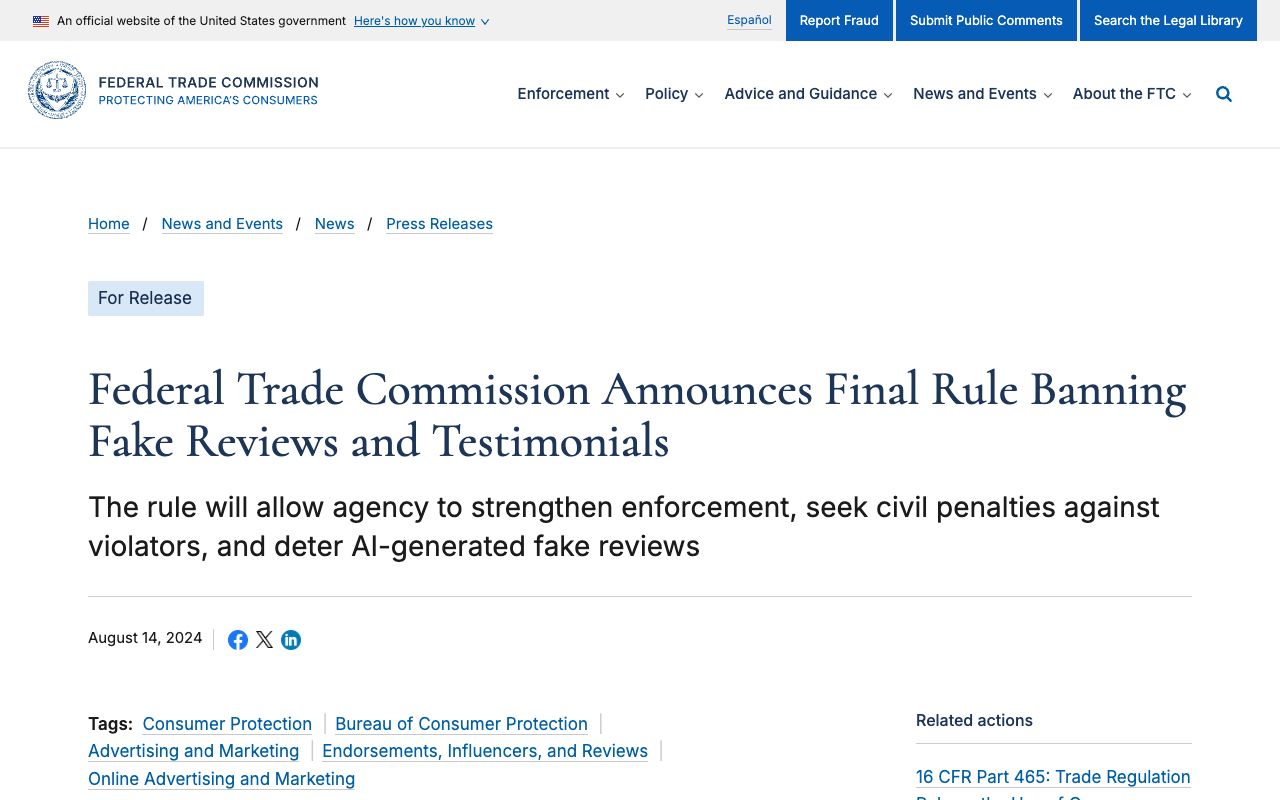
- Community threads: one named person with a disclosed affiliation. The FTC's consumer reviews rule (16 CFR Part 465, announced August 14, 2024) bans incentives "conditioned on the writing of consumer reviews expressing a particular sentiment" and lets the agency "seek civil penalties against knowing violators" (FTC press release).
- Reference profiles: communications. Wikipedia asks for "reliable, independent, published sources with a reputation for fact-checking and accuracy" (Wikipedia reliable sources); the lever is earning coverage, not editing the article.
- Comparison pages and editorial media: product marketing and PR. One publishes a verifiable comparison; the other pitches listicles with data.
How Often Should You Run AI Source Monitoring?
The churn table sets the floor. With 1.1% of ChatGPT sources surviving a week, a monthly check cannot separate trend from noise, while a daily read of forty prompts on four engines is more than a small team will act on. Layer it.
- Daily: run the tracked prompt set for mentions, citations and new domains. Detection, not decision.
- Weekly: a full scan with complete answers and sentiment per engine, diffed against last week. Kairosy re-scans every tracking slot (one brand in one market) on Mondays and emails alerts for new negative keywords, a competitor becoming the preferred pick, score drops and an engine flipping its sentiment.
- Monthly: the Source Impact review below, owners present.
- Quarterly: refresh the prompt set and re-baseline after any platform-level shift like the September 2025 Reddit change.
What Is Source Impact: Which Sources Create Positive, Neutral or Negative Claims?
Source Impact is the review that turns the feed into work. For each source that passed the three-of-seven rule, record the claim it fed, the sentiment of the answers that used it, the owner, and one action. The table draws on three public Kairosy scans; engine quotes are verbatim.
| Source (bucket) | Claim it feeds | Sentiment in answers | Owner | Action |
|---|---|---|---|---|
| Review sites behind Allbirds complaints answers (the report pictures Trustpilot) | "overpriced for how simple they are, and durability can be hit-or-miss" (Gemini) | Negative: 4 of 24 answers | CX lead | Reply publicly to the durability reviews; publish a durability page |
| Unanswered review pages for Gorgias | "ticket-based billing, overage charges, and reports that AI resolutions can be billed twice" (ChatGPT) | Negative: 4 of 24 answers | Support lead with pricing owner | Answer every open review; publish a billing explainer |
| Third-party Semrush-vs-Ahrefs comparison pages | "the strongest buyer choice is Ahrefs for SEO-focused teams" (Perplexity) | Prefers competitor: 5 of 24 answers | Product marketing | Publish a verifiable comparison; earn placement on the cited page |
| Wikipedia and reference profiles | Category, founding and ownership facts | Neutral by design | Communications | Earn independent coverage; raise errors on the talk page, not by direct edit |
| Owned pricing and docs pages | Plan names, limits, feature claims | Neutral to positive when current | Web team | Keep crawlable; update within a day of any change |
| Reddit and forum threads | "Is it worth it" verdicts from users | Mixed; the dominant thread decides | Community manager | Answer with disclosed affiliation; no incentives (FTC rule) |
Quotes and counts from Kairosy's public scans of Allbirds (2026-08-01, 71/100), Gorgias (2026-08-05, 69/100) and Semrush (2026-08-05); the last three rows apply the guidelines above.
The Gorgias report says in one line what the table is for: the downside claims are "sourced from review pages nobody at Gorgias has answered."
Does AI Sentiment Change After You Change the Source?
This is the test the program exists to run, and it needs a control for churn or you will credit yourself for noise. Baseline the prompt-by-engine sentiment over the seven runs before the change. Change one source at a time, wait one crawl cycle, then compare the next seven runs.
Read three things in order: is the changed source still cited for that prompt; did the quoted claim change, even if the label did not; did the sentiment label flip on at least two engines, or on three consecutive runs of one engine. Anything less sits inside the daily churn you measured. Kairosy's weekly alerts fire when an engine flips its sentiment, and its page audit shows a "since your last audit" diff for owned pages.
When sentiment does not move after the source did, the engine usually found the same claim on a second page you never listed, and the new citations tell you where; or the claim has moved into editorial pages, where PR owns the fix. Either way you are back at the routing table with a new row. Per-engine setups are on Perplexity brand monitoring and the broader AI brand monitoring page.
AI Source Monitoring FAQs
What is the difference between AI source monitoring and AI citation tracking?
Citation tracking counts appearances of your domain. AI source monitoring records every page an engine cited for a prompt about you, the claim it fed, its sentiment and its owner, including pages you do not control.
Which AI engines show the sources behind an answer?
ChatGPT search, Perplexity, Gemini with Google Search grounding and Google AI Mode return source links, and Claude cites pages when it uses web search. The URLs differ by engine, so log them separately.
Can you remove a negative source from AI answers?
Not directly. You can change what the source says with a public reply or a corrected page, add a better source, or ask a platform to remove content that breaks its rules. Suppressing or paying for reviews is banned under the FTC's 2024 rule.
Is AI source monitoring different for Perplexity and ChatGPT?
Yes. Perplexity's sources were the most stable in the July 2026 volatility data (44.4% daily churn); ChatGPT rotated 79.2% of its sources daily and drew 68.8% of citations from brand sites in the August 2026 Analyze data. Set thresholds per engine.
See what AI says about your brand
Run a free scan across ChatGPT, Gemini, Claude & Perplexity in about 30 seconds.
Run my free scan