Multi-LLM Brand Monitoring: Why 4 AI Engines Disagree About You (2026)
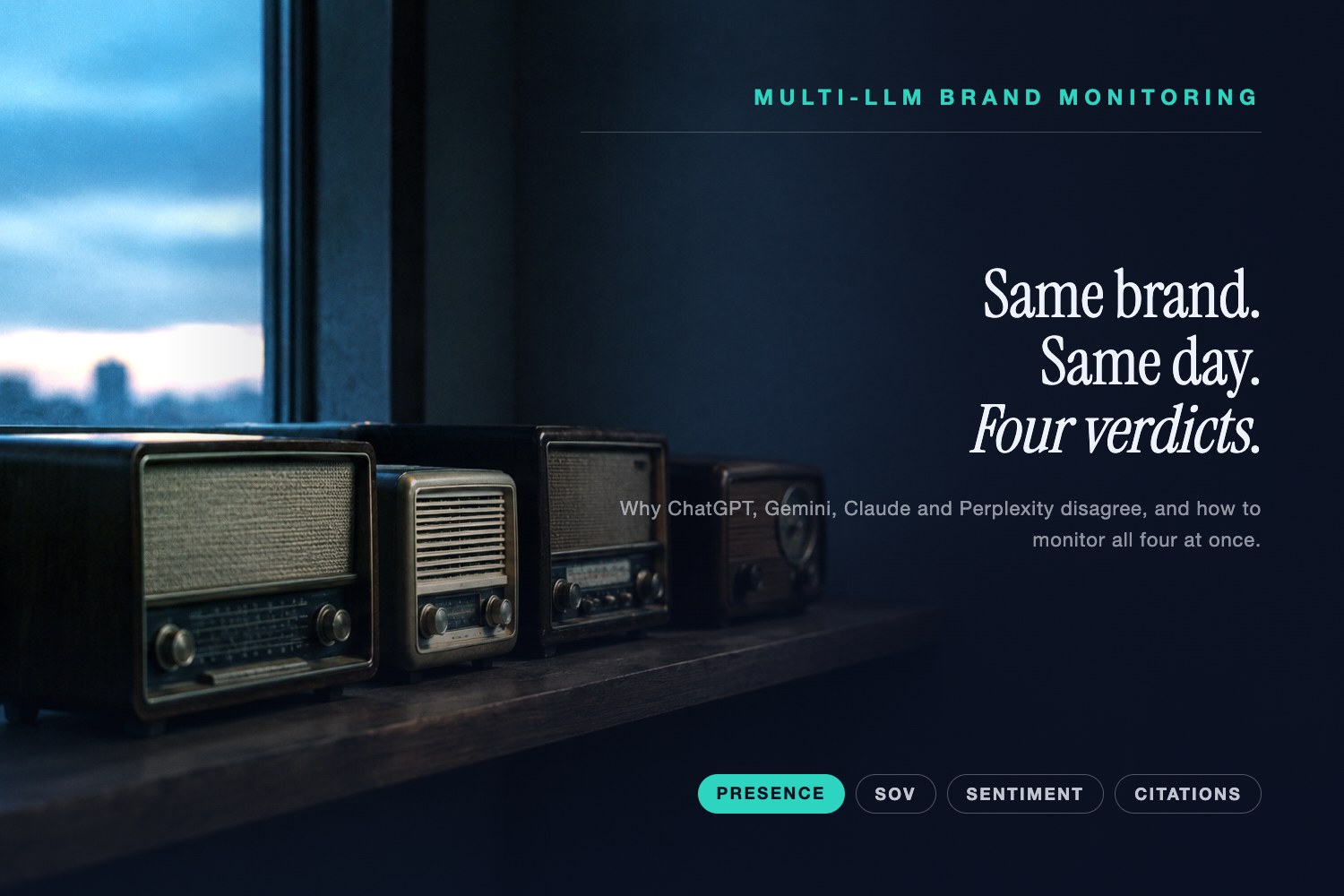
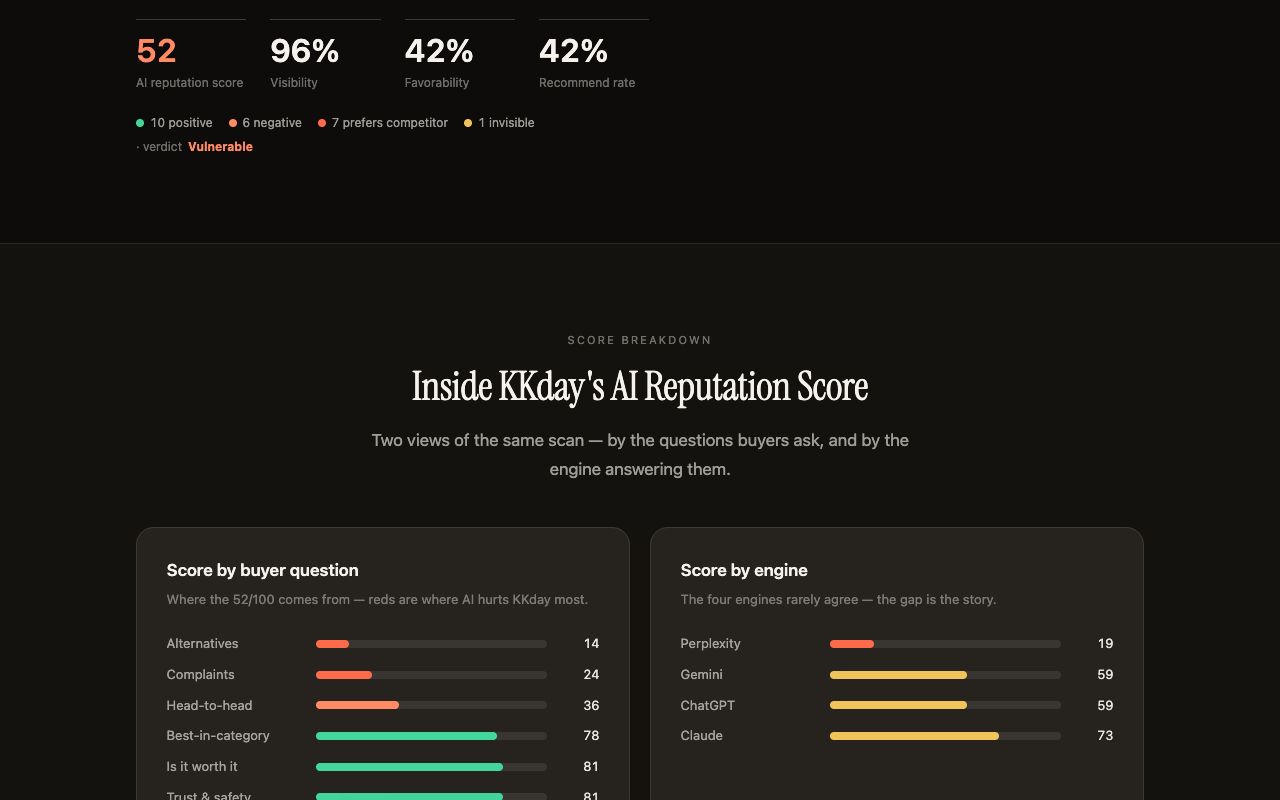
Multi-LLM brand monitoring exists because AI engines do not agree about brands. Kairosy's scan of KKday on August 1, 2026 scored the travel marketplace 73/100 on Claude and 19/100 on Perplexity in the same run, with ChatGPT and Gemini both at 59. One brand, one week, a 54-point spread.
That spread is not noise you can average away. It comes from three mechanisms: which pages each engine reads, how much weight it gives them, and what story it builds from them. This post walks the stack in order — disagreement, presence, share of voice, sentiment, citations, competitor benchmark — then settles whether you run it by hand or automate it.
Why Does ChatGPT Praise a Brand While Perplexity Pans It?
Across the 205 public brand reports on Kairosy as of September 16, 2026, the average distance between a brand's best and worst engine is 23 points. The six widest gaps, verbatim from those reports:
| Brand | Lowest engine | Highest engine | Gap |
|---|---|---|---|
| KKday | Perplexity — 19/100 | Claude — 73/100 | 54 pts |
| Crazy Egg | Gemini — 22/100 | Claude — 74/100 | 52 pts |
| ElevenLabs | Claude — 29/100 | ChatGPT — 81/100 | 52 pts |
| Loomly | Claude — 33/100 | Gemini — 81/100 | 48 pts |
| Fathom Analytics | Gemini — 27/100 | Perplexity — 74/100 | 47 pts |
| Luma AI | Perplexity — 26/100 | Gemini — 73/100 | 47 pts |
No engine is reliably the harsh one: Perplexity is the floor for KKday and the ceiling for Fathom Analytics. Three patterns explain most gaps once you read the answers behind the numbers.
First, the low engine is reacting to different pages. In the KKday report Perplexity wrote "For most buyers, Klook is the leading alternative to KKday", while Claude framed the same rival as a starting point: "For Asia-focused activities, start with Klook; for worldwide tours, compare GetYourGuide". Same competitor, opposite framing.
Second, a low score can be an engine failing to answer at all. Kairosy's scan of Crazy Egg on August 5, 2026 gave Gemini 22/100 against Claude's 74. Gemini's comparison response was, in full, "About crazyegg.com? Yes." That is not an opinion; it is an absence dressed as one, and it drags the headline down until someone opens it.
Third, engines weight the same complaint differently. In the ElevenLabs report both ChatGPT (81/100) and Claude (29/100) raised cost. ChatGPT tucked "pricing/usage limits that can feel restrictive for heavy users" inside a favorable answer; Claude led with "the free tier is quite limited, and the paid plans can feel expensive for high-volume". Same fact, 52 points of tone.
What Do Model Disagreement, Source Overlap and Narrative Consistency Measure?
Those patterns map to three metrics, all computable from the answers and citation lists a multi-LLM brand monitoring scan already collects.
Model disagreement score
The simplest version is the range: highest per-engine score minus lowest. KKday's is 54. A brand whose four engines land within 10 points has a headline number you can trust, and the range beats standard deviation in practice because it names the engine to open first.
Treat disagreement as a diagnostic, not a KPI to drive to zero. Conductor's July 17, 2026 study of 14,000 API calls across ChatGPT, Perplexity, Claude and Gemini concluded that "no single LLM leads across all intent types" and that "Gemini is the most inconsistent engine by a significant margin", returning 9.2 brands per response against ChatGPT's 5.
Source overlap
Source overlap asks how many URLs engine A cited also appear in engine B's list, expressed as a Jaccard ratio: shared URLs divided by the union. Writesonic's July 22, 2026 analysis of 161,286 prompts found that only 3.8% of cited sources were shared by ChatGPT, Gemini, Perplexity and Google AI Overviews together, and that 72 to 73% of cited domains appeared on exactly one engine. The pairwise figures from that study:
| Engine pair | Jaccard overlap | Shared sources |
|---|---|---|
| Perplexity and AI Overviews | 0.237 | 24% |
| Gemini and AI Overviews | 0.216 | 22% |
| Gemini and Perplexity | 0.174 | 17% |
| ChatGPT and Perplexity | 0.130 | 13% |
| ChatGPT and AI Overviews | 0.126 | 13% |
| ChatGPT and Gemini | 0.119 | 12% |
When your own numbers look like that table, disagreement is upstream of the model: the engines never read the same evidence. Peec AI's March 2026 study of 30 million sources saw the same split, with ChatGPT favoring Wikipedia, Reddit and Forbes while Perplexity leaned on Reddit, LinkedIn and G2 for B2B queries. A Perplexity problem may be a G2 listing, not your homepage.
Narrative consistency
Narrative consistency is qualitative but scoreable. For each engine, list the two or three claims it makes about you (best for X, weak on Y, pricier than Z), then count how many recur across engines. ElevenLabs' engines agree that cost is the complaint: high consistency, so the fix is a pricing page. KKday's engines disagree on whether Klook replaces it or complements it: low consistency, so the fix is comparison content that settles the question in your words.
How Do You Track Brand Mentions Across LLMs? Presence First, Then Share of Voice
The rest of the stack runs in order of prerequisite: no sentiment without a mention, no share of voice without knowing who else was mentioned.
Presence: were you in the answer at all?
Presence is binary per answer: your brand appears or it does not. Reported as a percentage of answers across engines and prompts, it has the least interpretive wiggle. KKday's is 96%; the problem is what the engines say next. To track brand mentions across LLMs at this level you need one fixed prompt set sent to every engine in the same batch, so a drop on Perplexity is a Perplexity event rather than a calendar artifact.
Share of voice: how much of the answer is yours?
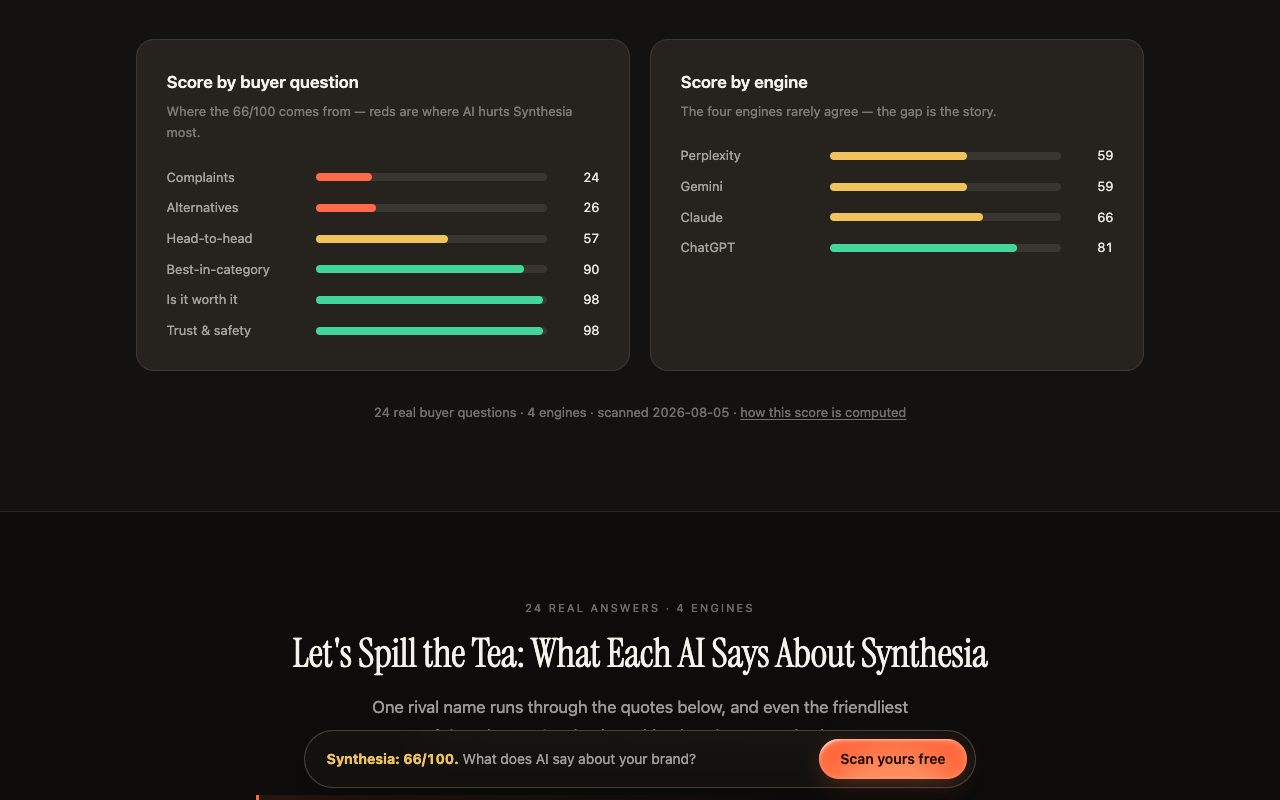
Share of voice divides your mentions by all brand mentions in the same answers. KKday holds 28% against Klook, GetYourGuide, Viator and Trip.com; ElevenLabs' report lists Murf AI at 14% and Play.ht at 8%. Per-engine share of voice is where disagreement becomes a business number: if Perplexity hands Klook the lead and Claude hands it to you, two engines are sending buyers to two checkouts. The math is in our AI share of voice guide; the multi-engine rule is never to report one blended figure.
How Should You Monitor Brand Visibility Across LLMs for Sentiment and Citations?
Sentiment: positive, neutral, negative, with the reason attached
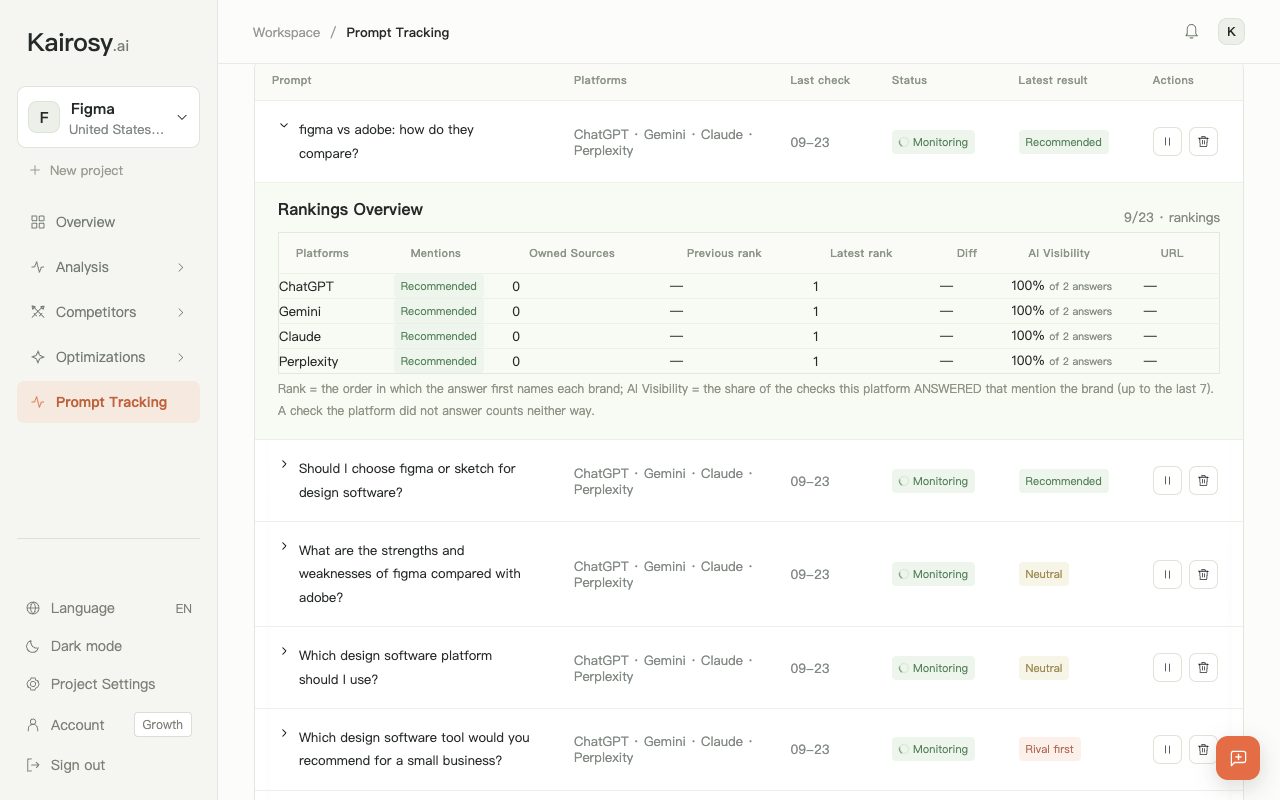
A sentiment label without its reason is a number you cannot act on. Every answer should carry the phrase that earned its label: "slow refunds" for KKday, "annual subscriptions by default" for Crazy Egg, "free tier is quite limited" for ElevenLabs. Kairosy classifies each answer as positive, neutral or negative with the reasons listed, and the headline score is the average of the per-engine scores of the engines that answered, so a missing engine shrinks your sample rather than your score.
When you monitor brand visibility across LLMs, negatives split three ways a single-engine view hides. A negative on all four engines is a product or pricing fact. A negative on one engine only is a source that engine alone trusts. A negative that comes and goes between runs is a low-confidence claim worth a re-scan before anyone reacts.
Citations: the URLs that produced the answer
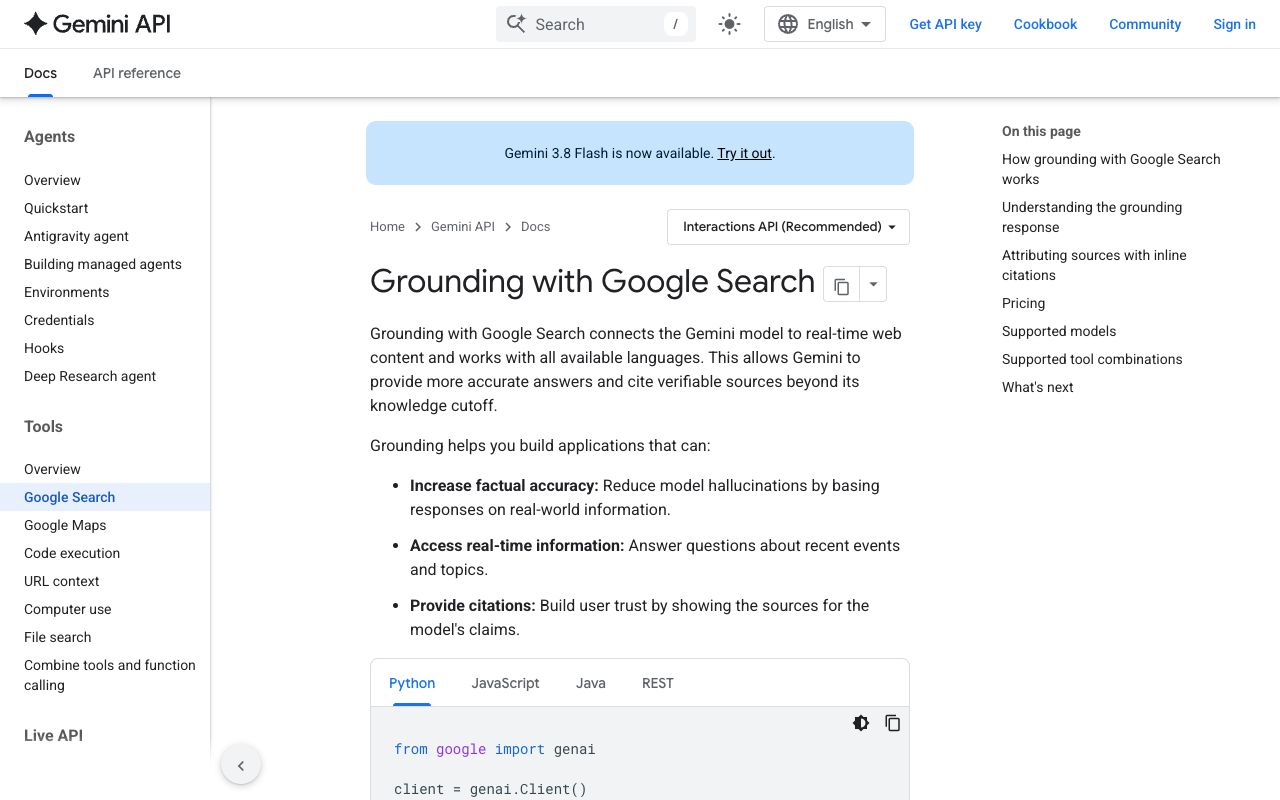
Citations are the only layer that explains the others, and every vendor now documents them. Anthropic's web search tool docs state that "the response includes citations for sources drawn from search results". OpenAI's web search guide says the tool lets models "provide answers with sourced citations". Google's Gemini API docs say Grounding with Google Search "connects the Gemini model to real-time web content" with inline annotations linking text to sources. Perplexity's crawler docs describe PerplexityBot as "designed to surface and link websites in search results on Perplexity".
Collecting those URLs per engine turns a disagreement score into a to-do list: if Perplexity's 19/100 on KKday traces to two review pages Claude never cited, the work is on those two pages. Before chasing any citation, confirm the engine can fetch your site: the free AI crawl checker tests whether OAI-SearchBot, PerplexityBot and Google-Extended are blocked by your robots.txt.
Which Competitor Benchmark Belongs in Multi-LLM Brand Monitoring?
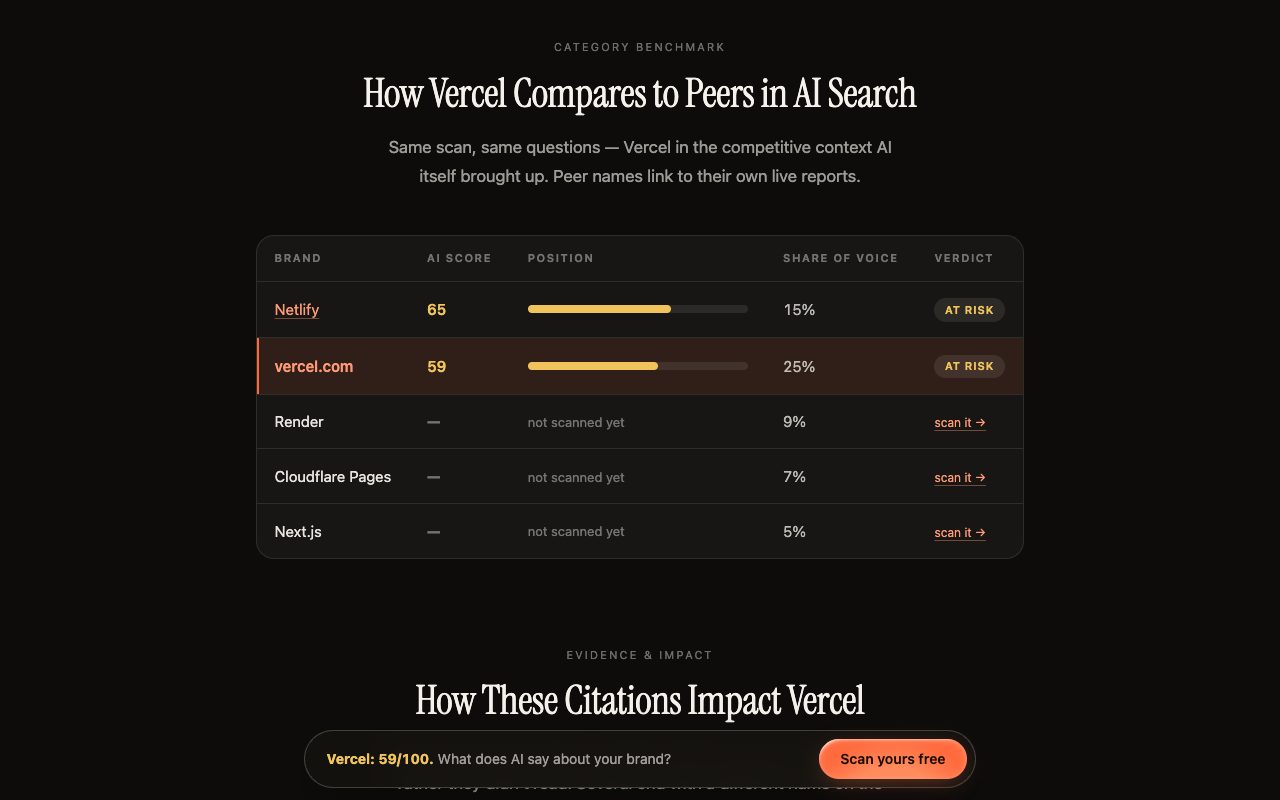
A 55/100 where every rival scores 40 is a lead; the same 55 beside a rival at 75 is a problem. The benchmark that matters in multi-LLM brand monitoring is per engine and per competitor: engines as rows, the brands in your answers as columns, score or share of voice in the cells.
Read the grid for two shapes. A column where one rival beats you on every engine points to a product or reputation fact. The June 2026 arXiv paper "Incumbent Advantage" by Xi Chu and Yupeng Hou found that across GPT-4o-mini, Claude Sonnet and Gemini 3 Flash the established brand was recommended 100% of the time when specs were identical, and that a challenger needed only about +0.1 stars to break that monopoly. A row where a single engine flips the winner points to a source problem on that engine alone. Crazy Egg shows the second shape: ChatGPT steers buyers to Hotjar "if they need a broader product-insight stack", while Claude and Perplexity score Crazy Egg in the 70s.
The public brand reports are a free sanity check: lay your per-engine row beside two rivals from the same category before you pay for anything.
Manual Checks vs Automated LLM Brand Monitoring: Which Should You Run?
Manual monitoring means four chat windows, the same pasted prompts, and a spreadsheet. It works for one brand, one market, one afternoon. It fails on the three metrics above: no source overlap without every citation list exported, no disagreement score without identical prompts on identical days, no narrative shift without last month's answers stored verbatim.
Automated LLM brand monitoring replaces the spreadsheet with a scheduler: the same prompt set, every engine, on a fixed cadence, with each answer and citation kept. Here is what the automated options cost as of September 2026, checked on each vendor's pricing page:
| Tool | Published plans (monthly billing) | Prompts tracked | Engines covered |
|---|---|---|---|
| Kairosy | Basic $29 / Pro $99 / Growth $399; Enterprise = talk to sales | 25 / 100 / 350, checked daily | ChatGPT, Gemini, Claude, Perplexity, with citations on all four |
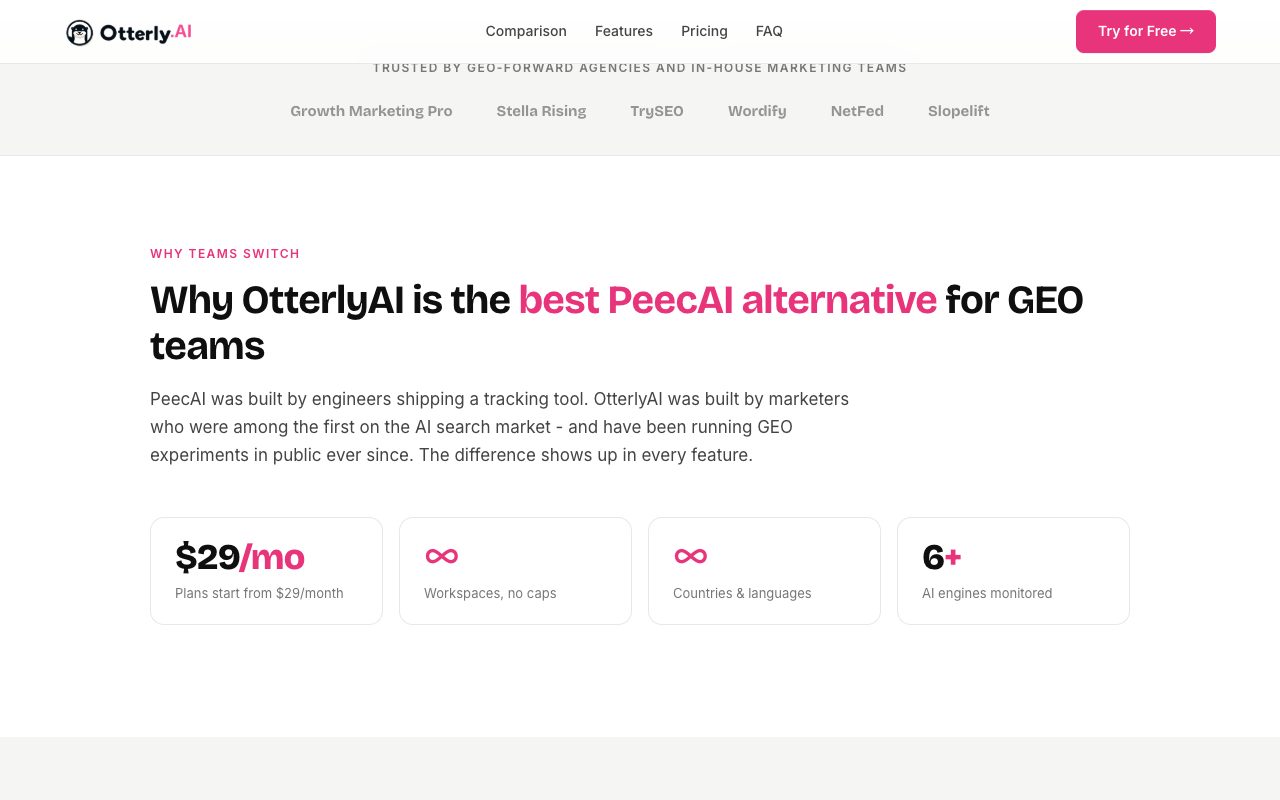
| Otterly.AI | Lite $29 / Standard $189 / Premium $489; Enterprise custom | 15 / 100 / 400 search prompts, daily | ChatGPT, Google AI Overviews, Perplexity, Microsoft Copilot |
| Peec AI | Starter / Pro / Advanced; prices not shown on the public page; Enterprise = talk to sales | Not published | Not published on the pricing page |
| Profound | Free trial; Enterprise custom | Trial: 50 prompts daily for 7 days | Trial: ChatGPT, Gemini, Google AI Overviews; Enterprise: up to 9 answer engines |
Two caveats. Otterly.AI covers Google AI Overviews and Microsoft Copilot but not Claude or Gemini, so it answers a different overlap question. Kairosy is a visibility and reputation scanner, not a rank tracker or keyword tool, and should be judged as one. For a broader shortlist see best LLM visibility tools.
How Do You Set Up Automated AI Brand Mention Tracking That Keeps Running?
Match cadence to how fast each layer moves: mentions daily, sentiment and citations weekly, the competitor benchmark monthly. A working setup for automated AI brand mention tracking:
- Freeze one prompt set per market, written the way buyers ask (alternatives, comparisons, "is it worth it", pricing), and keep it unchanged for a quarter.
- Run all four engines against that set daily and store every answer verbatim.
- Re-scan the full report weekly with citations and compute the disagreement score on every run.
- Alert on four events only: a new negative keyword, a competitor becoming the preferred pick, a score drop, and an engine flipping sentiment.
- Route each alert to a URL. An alert that cannot name the page to change is not finished.
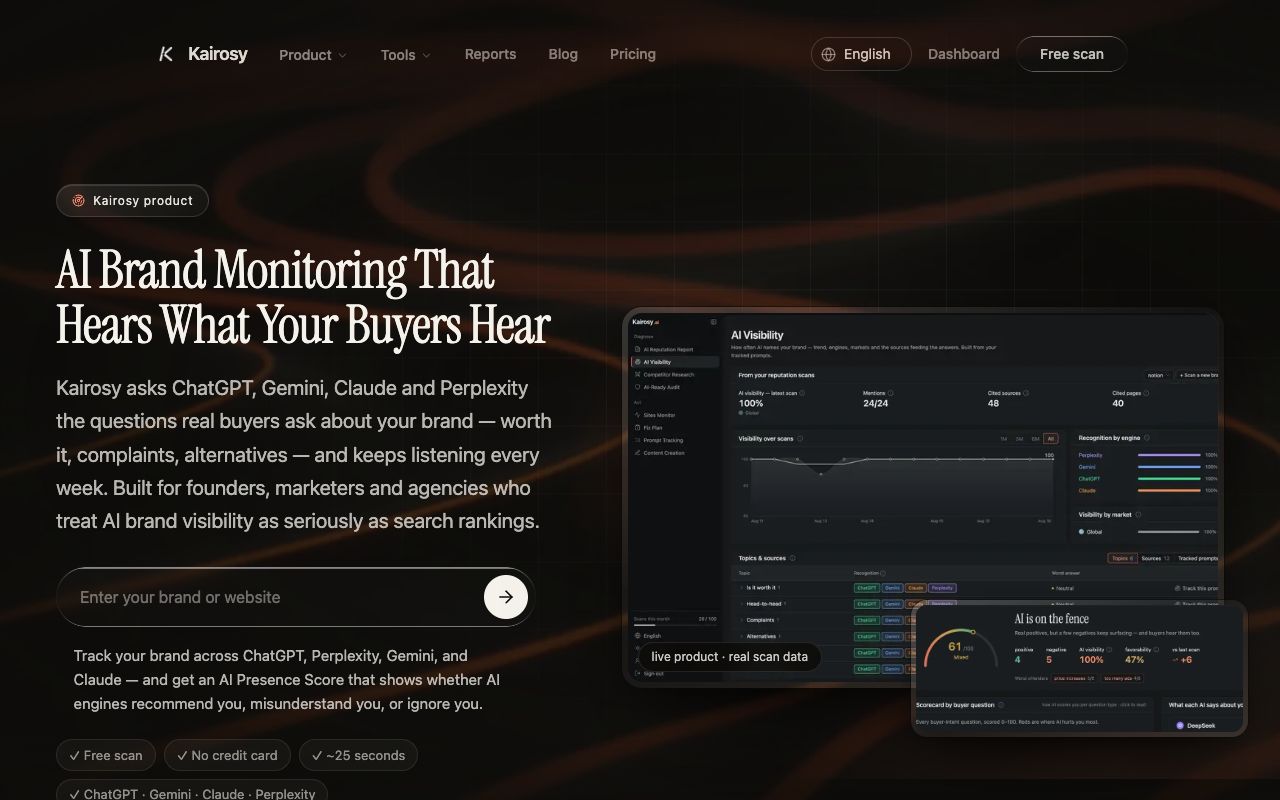
Kairosy's AI brand monitoring runs this schedule out of the box: tracked prompts are checked daily on every paid plan, each tracking slot (one brand in one market) is re-scanned every Monday with an email digest, alerts fire on the four events above, and the Fix Plan attaches a prioritized action to each finding (per-engine views: Perplexity brand monitoring and its siblings). The seven-day trial needs no credit card and produces full reports. For press and social coverage, the track brand mentions guide covers that side.
Multi-LLM Brand Monitoring FAQs
Why do AI engines give different answers about the same brand?
Because they read different pages: Writesonic's July 2026 study found only 3.8% of cited sources shared by all four major engines. Add different weighting of the same complaint and you get spreads like KKday's 54 points.
How many LLMs should multi-LLM brand monitoring cover?
Four is the practical floor: ChatGPT, Gemini, Claude and Perplexity. More engines help only if you keep the same prompt set and cadence on all of them; uneven coverage breaks the disagreement score.
How often should you track brand mentions across LLMs?
Daily for presence and mentions, weekly for a full sentiment and citation re-scan, monthly for the competitor benchmark. Faster than daily adds cost without signal, because answers re-ground on the same pages until those pages change.
Can you monitor brand visibility across LLMs for free?
Partly. Kairosy's public reports show per-engine scores for 205 brands at no cost, and the trial gives seven days of full reports without a card. Continuous tracking with stored answers and citations needs a paid plan.
What is a good model disagreement score?
Under 10 points means the engines broadly agree and the headline is trustworthy. Above 30 means one engine is working from evidence the others never saw; open its citations first. The average across Kairosy's 205 public reports is 23.
See what AI says about your brand
Run a free scan across ChatGPT, Gemini, Claude & Perplexity in about 30 seconds.
Run my free scan