Generative Engine Optimization (GEO) Service for Enterprises 2026
A generative engine optimization GEO service for enterprises is something you buy, not something you read about: a retainer, a platform contract, or both, aimed at making your brand the recommendation when a buyer asks ChatGPT, Gemini, Claude, or Perplexity what to purchase. This post is the purchasing side of that decision — scope, budget, contract language, and shortlist.
If your own team is doing the build, two other guides cover it. The engineering work lives in our GEO implementation guide for technical teams, and the question of which department owns which signal is answered in our GEO strategy breakdown. Everything below assumes you are writing a check instead.
What Is a Generative Engine Optimization (GEO) Service for Enterprises?
It is a paid engagement whose deliverable is answer-share, not rank. A classic SEO retainer is judged on positions and sessions. A GEO engagement is judged on whether an assistant names you, describes you accurately, and cites a source you influenced — across several engines, in several countries, repeatedly over months.
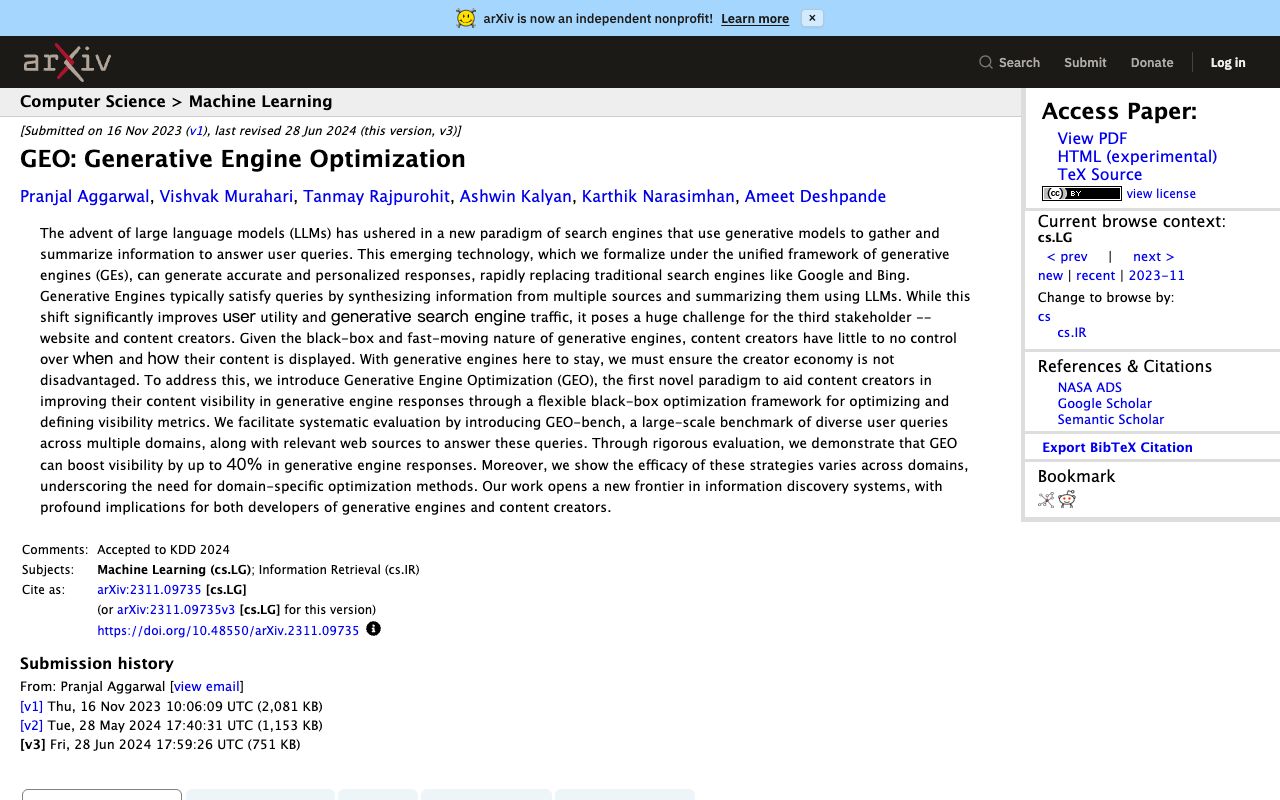
The term comes from an academic paper. "GEO: Generative Engine Optimization" by Pranjal Aggarwal, Vishvak Murahari and co-authors (arXiv, last revised June 2024) tested content-side changes against generative engines and reported visibility gains of up to 40%. Treat that as a research ceiling on a benchmark corpus, not a number any vendor should promise you in a pitch deck.
What makes the enterprise version different is rarely the tactics. It is the surface area: several product lines that get confused with each other, a dozen country markets where the assistant answers in a different language, a legal team that must approve any claim a model repeats, and a procurement process that will ask for SOC 2 and SSO before it asks about methodology.
Should You Buy an Agency Retainer, a Platform Seat, or Build In-House?
Three procurement routes exist, and most large companies eventually run two of them at once.
Agency retainer. You are buying hands. iPullRank, for example, publicly lists Generative Engine Optimization and "Relevance Engineering" alongside an AI Search Strategy program; like most agencies in this space, it publishes no rate card and routes buyers to a call. Pick this route when the bottleneck is production — comparison pages that do not exist, docs nobody has rewritten, third-party placements nobody has pitched.
Platform contract. You are buying instrumentation and workflow, and supplying the humans. This is where Profound, Peec AI, Conductor and Botify sit. Pick it when you already have an SEO team that will act on findings, and what you lack is a defensible measurement layer.
In-house. Cheapest per unit of work, slowest to first result, and the only option that survives a budget freeze. Realistically it needs one technical owner, one content owner, and a tool that tells them whether anything moved.
A useful test: if you cannot name the person who will read the vendor's dashboard every Monday, buy the agency. If you can, buy the platform.
What Do Enterprise AI Search Optimization Services Cost in 2026?
Almost all enterprise AI search optimization services are demo-and-quote. The vendors that publish numbers publish them for their small-team tiers and stop at the enterprise line. Below is what is actually verifiable today, plus third-party contract data from Vendr, which anonymizes real buyer transactions.
| Vendor | Published list price | Vendr median contract (last updated Feb 2026) | How enterprise pricing is set |
|---|---|---|---|
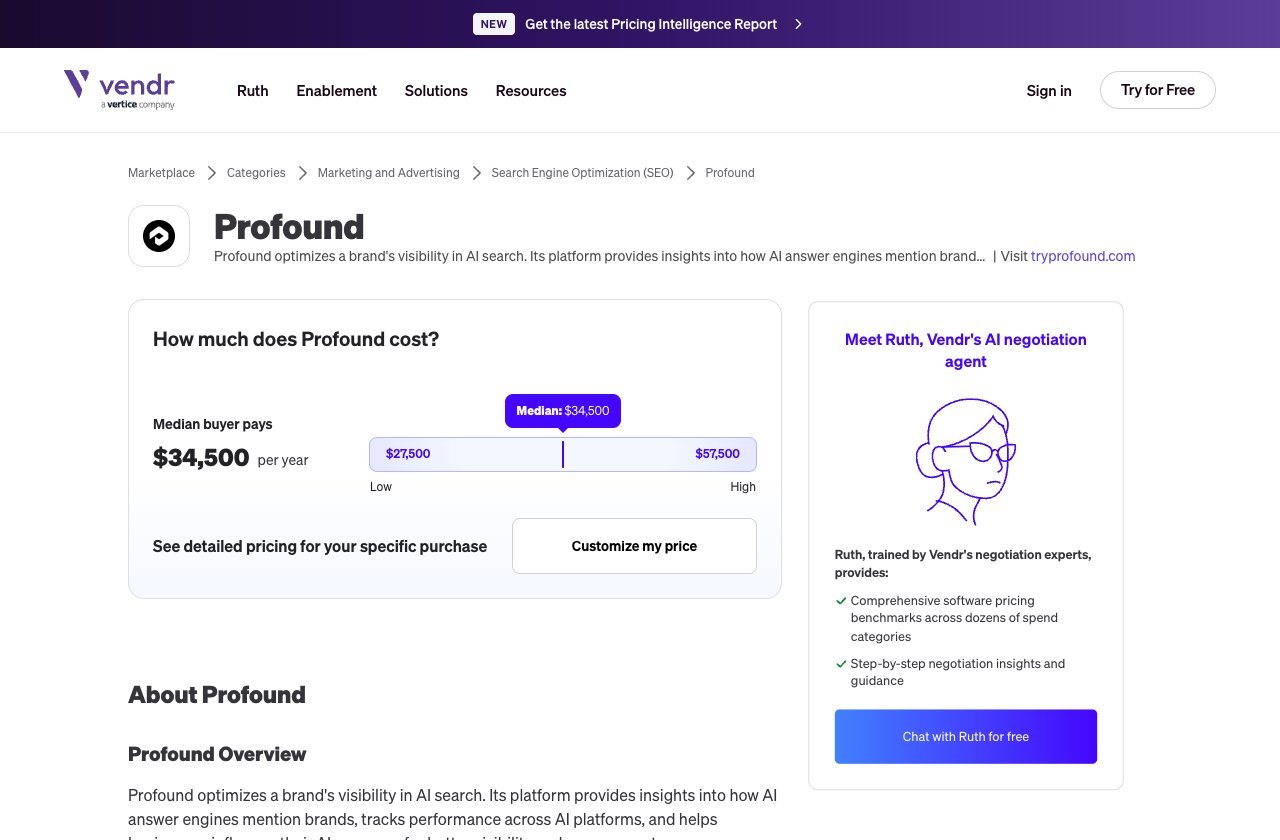
| Profound | None for brands (free 7-day trial only); agencies: $99/mo plus $399/mo per client workspace | $34,500 a year (checked September 2026) | Enterprise is custom; up to 9 answer engines, SSO/SAML and SOC 2 |
| Peec AI | Starter / Pro / Advanced tiers shown, no figures on the pricing page | Not listed | "Talk to Sales" for the Enterprise tier |
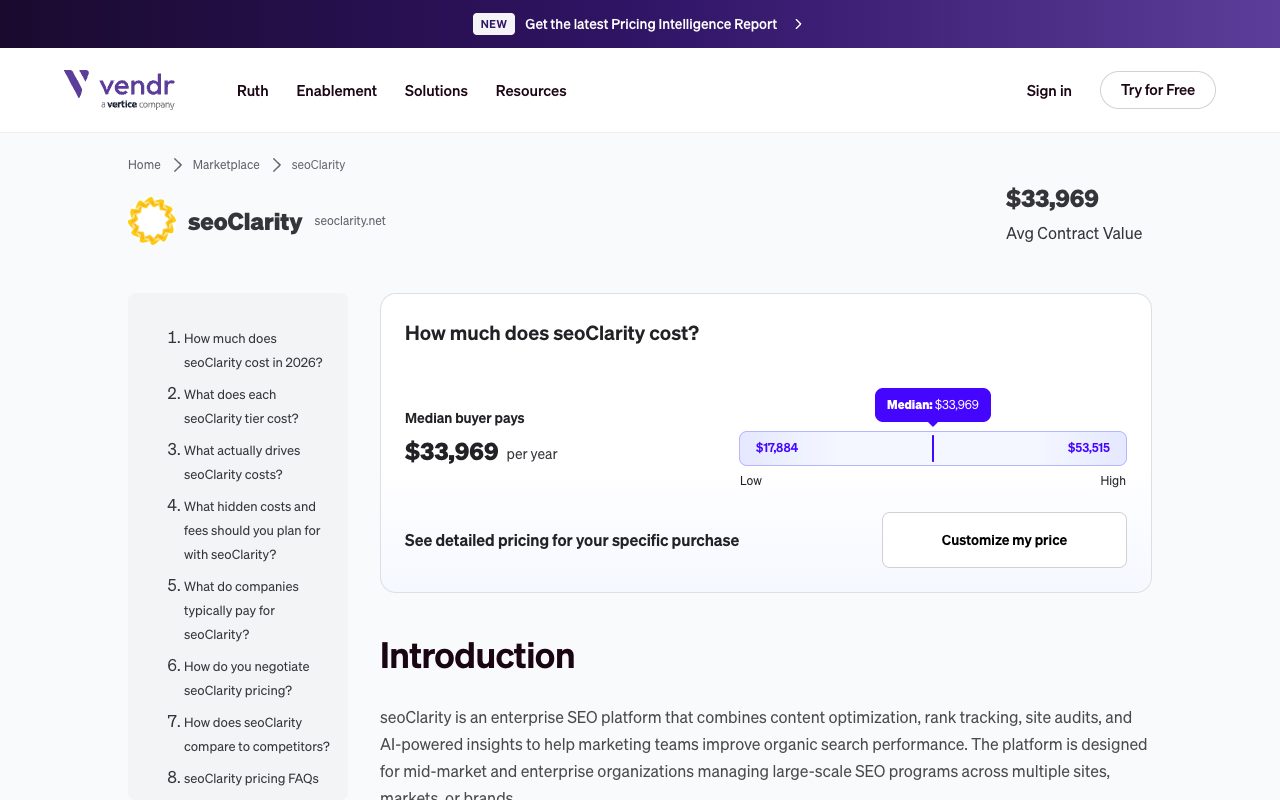
| seoClarity | Enterprise package from $4,500/mo (£3,600/mo) | $33,969 per year | Priced on domains and keywords tracked |
| Conductor | None published | $49,510 per year (range $40,446–$93,338) | Request a demo |
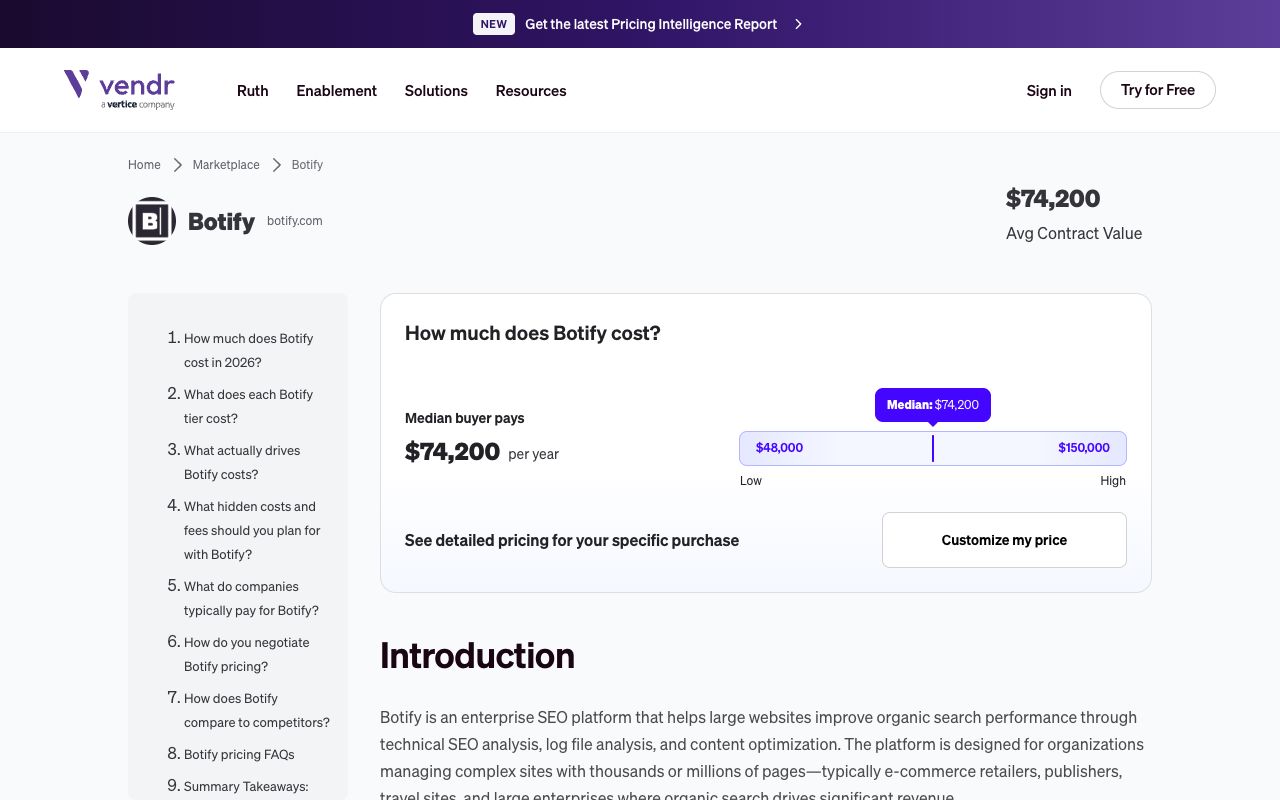
| Botify | None published | $74,200 per year (range $48,000–$150,000) | Contact sales |
| Kairosy | Basic $29, Pro $99, Growth $399 per month | Not listed | Self-serve, no sales call |
Two things fall out of that table. First, the visibility-only newcomers start an order of magnitude below the incumbent enterprise SEO platforms, because they are selling one module rather than a crawler, a rank tracker and a content suite. Second, the gap between a vendor's list price and what enterprises actually sign is large — seoClarity publishes a $4,500/mo Enterprise floor, while Vendr's buyer data puts the median contract at $33,969 a year — under eight months at that list rate. Quotes are negotiable.
For agency retainers, no honest public benchmark exists. Anyone publishing a GEO agency rate card is guessing. Ask three vendors for scoped quotes on an identical brief and let the spread tell you the market rate.
Which Services Belong in an Enterprise GEO Statement of Work?
Five workstreams cover almost every credible engagement. If a proposal is missing two of them, it is a content retainer wearing a new label.
1. A frozen baseline across engines and markets
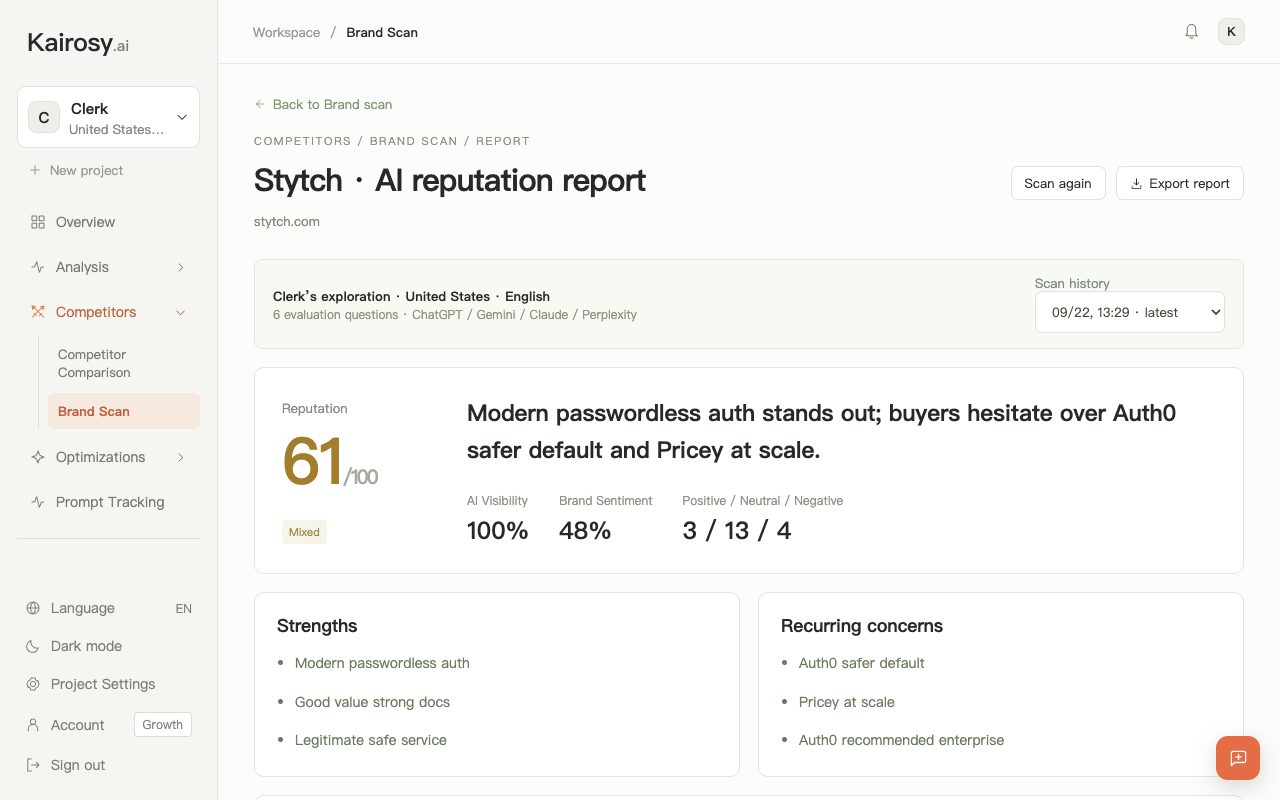
Before anyone writes a word, you need a measured starting point: which questions were asked, which engines answered, who got named. Engines disagree enough that a single-engine baseline is misleading. In Kairosy's scan of Smartsheet (24 answers, run 1 August 2026), the brand scored 73 on Gemini but 59 on Perplexity — the same company, the same questions, a 14-point spread.
2. Technical AI readiness
Crawler access, server-side rendering, structured data, and a machine-readable summary of your site. This is the least glamorous workstream and the one that most often explains a flat result. You can pre-check the cheap parts yourself with our free llms.txt validator and schema markup checker before a vendor bills you to find the same issues, or run the full AI-ready audit.
3. Answer-shaped content and entity clarity
Comparison pages, pricing pages, integration docs and objection handling written so a model can lift a clean sentence out of them. Enterprise wrinkle: this is where legal gets involved, because whatever claim you publish is the claim an assistant will repeat.
4. Earning third-party citations
Models quote review sites, roundups, forums and trade press far more often than they quote your own domain. This workstream is digital PR aimed at a citation list rather than a DR score, and it is usually the slowest to show results.
5. Reporting, alerting and re-measurement
A monthly PDF is not measurement. You want a cadence tight enough to catch a bad answer that appeared last week, and alerting when an engine flips from recommending you to recommending a rival.
That fifth item is where the scope of a generative engine optimization GEO service for enterprises most often collapses into an invoice with nothing behind it. Insist on it in writing.
What Should You Demand Before Signing: A Vendor Evaluation Checklist
Run every proposal against this list. Each line has cost you money at some company already.
- Named engines, in the contract, with the refresh frequency for each
- Country-level markets, not just languages — a US answer and a UK answer differ
- Raw answer text and citation URLs, exportable, not only a composite score
- Disclosed methodology: how many prompts, how sampled, how often re-run
- A baseline captured before any optimization work begins, and frozen
- Data portability on termination, so leaving does not reset your history
- Security paperwork your procurement team will actually ask for — SOC 2, SSO/SAML
- Named approval owner for AI-assisted content, agreed with legal up front
The scoring question deserves its own paragraph. Every vendor has a proprietary visibility index and none of them are comparable. What is comparable is the underlying evidence: the question asked, the verbatim answer, the sources cited. Buy the evidence layer and treat the index as decoration.
How Long Does an Enterprise GEO Implementation Plan Take to Pay Off?
Set expectations before the kickoff deck, not after the first flat report. A realistic enterprise GEO implementation plan runs roughly like this:
- Weeks 0–4: baseline measurement, prompt-set design with sales input, technical crawl.
- Weeks 4–12: technical remediation ships, first tranche of answer-shaped content goes live.
- Weeks 12–24: third-party citation work lands and starts appearing in cited-source lists.
- Ongoing: weekly or daily re-measurement, quarterly prompt-set refresh as buyer language shifts.
Two cautions. Generative engines are non-deterministic — the same question asked twice can produce different brands, so a single before/after screenshot proves nothing. And model releases reshuffle results independently of anything you shipped, which is exactly why your enterprise GEO implementation plan should fix the measurement cadence in writing before it lists a single deliverable.
Which Answer Engine Optimization Tools for Enterprise SEO Teams Should You Shortlist?
Five products that a large team can genuinely deploy. The right answer engine optimization tools for enterprise SEO teams depend on whether you need measurement, execution, or the crawler underneath both.
Kairosy — measurement layer, self-serve
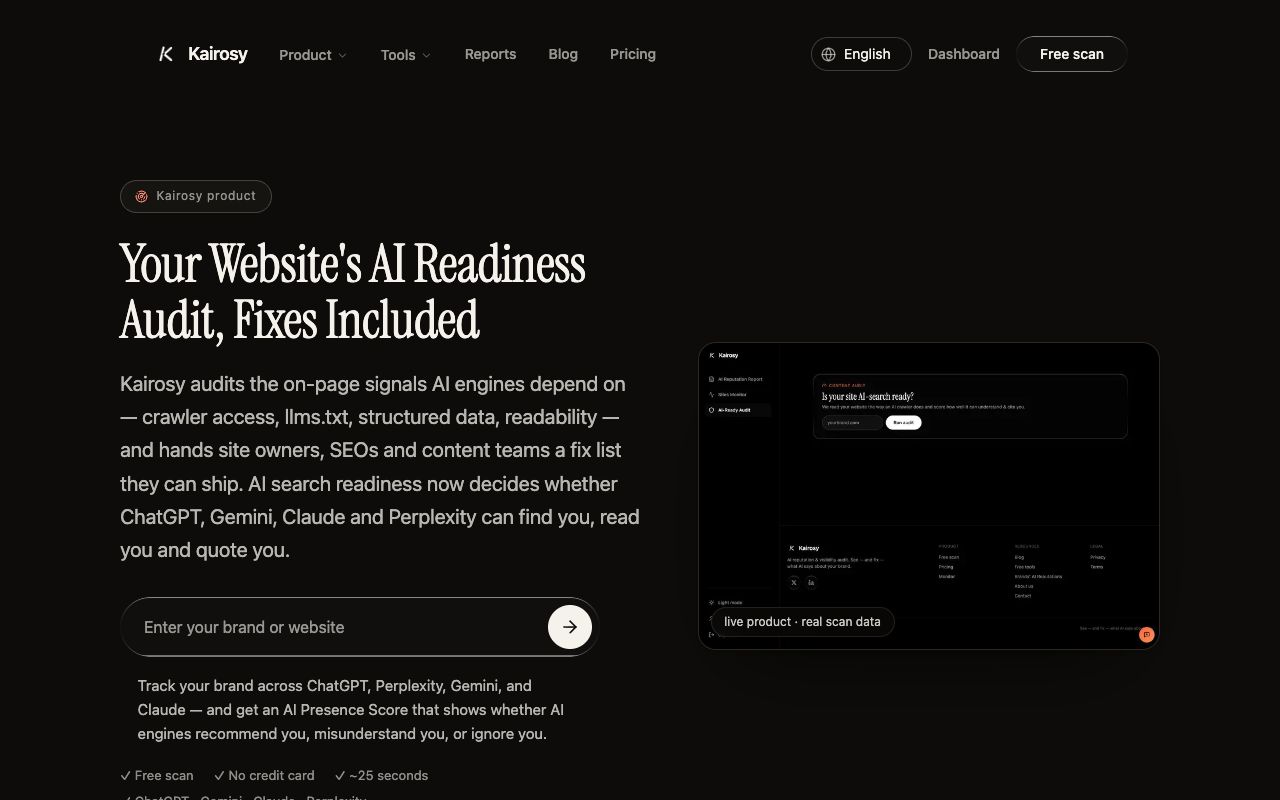
Kairosy scans ChatGPT, Gemini, Claude and Perplexity with the questions your buyers ask, classifies each answer's sentiment, records the sources cited, and returns a fix plan. Monitors re-run weekly per brand and market, prompt tracking runs daily, and paid plans cover 25 country markets. Plans are Basic $29, Pro $99 and Growth $399 per month, and the first 7 days are free.
Be clear about what it is not: Kairosy is a measurement and monitoring product, not an agency. It sells no services, no retainer, no digital PR. Enterprises use it as the neutral scoreboard alongside an agency engagement — or inside one, when you want a reading your vendor does not control. Continuous coverage is the AI brand monitoring side; the pre-engagement diagnostic is the AI-ready audit.
Profound — the enterprise-tier visibility platform
Profound's pricing page no longer publishes self-serve tiers for brands: they get a free 7-day Trial (50 prompts daily on ChatGPT, Gemini and Google AI Overviews), and everything beyond it is a quoted Enterprise tier with up to nine answer engines, multiple tracked companies, dedicated Slack support, and SSO/SAML with SOC 2 — the package most procurement teams are actually buying. Its only list prices are on the agency tab ($99/month Agency Growth, plus $399/month per client workspace). Vendr's anonymized buyer data (a third-party source) puts the median contract at $34,500 a year, in a $27,500 to $57,500 range.
Peec AI — prompt tracking priced by country coverage
Peec AI runs Starter, Pro, Advanced and Enterprise tiers built around projects, countries per project, and daily or weekly tracking. Its site advertises tracking across ChatGPT, Perplexity and Gemini and promises coverage "across all countries." No figures appear on the pricing page at the time of writing, so budget via their sales team.
Conductor — AI visibility bolted onto an enterprise SEO suite
Conductor markets Intelligence (brand visibility across ChatGPT, Gemini, Copilot, Claude and classic search), Creator, Monitoring and AgentStack. No public pricing; every path leads to a demo request. Vendr's February 2026 data puts the median contract at $49,510 a year.
Botify — crawler-first, for very large sites
Botify organizes its platform around AI Readiness, AI Visibility and AI Activation, including GEO analytics and AI bot analytics. It is the choice when the estate runs to millions of URLs and log-file-grade crawl data matters more than prompt tracking. There is no rate card at all — the pricing URL forwards straight to a demo request form. Vendr's median lands at $74,200 a year.
A shortlist rule that saves a quarter: buy one measurement tool and one execution partner. Buying two measurement tools produces two incompatible scores and an argument about which is right.
What Do Buyers Ask About a Generative Engine Optimization GEO Service for Enterprises? FAQs
Is a generative engine optimization GEO service for enterprises different from an AEO service?
In practice, no. GEO, AEO and "AI search optimization" describe the same work sold under different labels. Judge the scope document, not the acronym on the cover.
What should an enterprise GEO implementation plan cost in year one?
Software is the only part with public anchors: seoClarity's Enterprise package starts at $4,500 a month, and Vendr's February 2026 medians run from $33,969 (seoClarity) to $74,200 (Botify) a year. Agency retainers are quoted individually with no published benchmark, so collect three scoped bids rather than trusting a blog estimate.
Can we run enterprise AI search optimization services entirely in-house?
Yes, if you have a technical owner and a content owner with real capacity. Start with the GEO audit checklist to size the gap, then decide what to outsource. Most enterprises keep measurement in-house and buy execution.
Which answer engine optimization tools for enterprise SEO teams handle multiple markets?
Ask specifically about country-level rather than language-level coverage — a German answer and an Austrian answer can differ. Kairosy runs 25 country markets on paid plans; Peec AI structures tiers around countries per project; Profound's Enterprise tier covers multiple tracked companies and up to nine engines.
How do we prove the engagement worked?
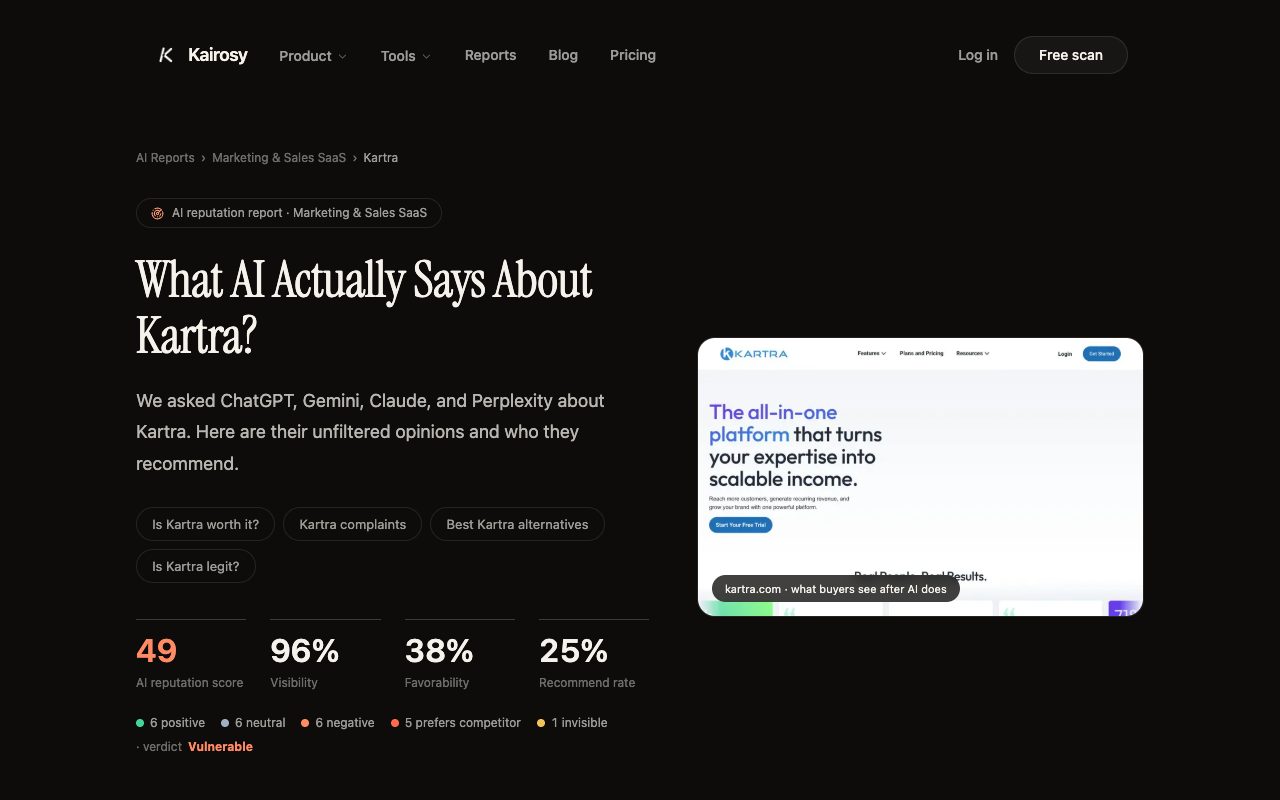
Freeze a baseline before work starts, keep the prompt set stable, and compare like for like on a fixed cadence. Public evidence helps too: our scan of Smartsheet's AI performance shows a brand mentioned in essentially every answer yet scoring 66 overall, because 21% of responses steered the buyer to monday.com, Asana or ClickUp. Presence is not preference, and only one of those is worth paying for.
Buy the evidence, contract the cadence, and keep the scoreboard outside the vendor's control. Do those three things and a generative engine optimization GEO service for enterprises stops being a leap of faith and starts being a line item you can defend in a QBR.
See what AI says about your brand
Run a free scan across ChatGPT, Gemini, Claude & Perplexity in about 30 seconds.
Run my free scan