How to Track Brand Performance in ChatGPT Response Over Time (2026)
To track brand performance in a ChatGPT response over time, freeze three things (the prompt set, the engines, the cadence), sample each prompt several times per check instead of once, and log six numbers per run: visibility, mention rate, citation rate, sentiment, share of voice, and which competitor was named first. Then, every time a number moves, attribute the move to a cause before you touch anything.
Most teams skip that last step: a citation appears, a score drops, and someone rewrites a page that afternoon. Often the "change" was sampling noise; otherwise it had a cause nobody checked. This guide to how to track brand performance in ChatGPT response over time ends with two tables to copy: cadence and change attribution.
How to Track Brand Performance in ChatGPT Response Over Time: What Do You Freeze in the Baseline?
A trend needs a fixed measuring stick. Record nine decisions before the first run; if one must change mid-series, start a new series and label the break.
| Decision | What you record per run | Freeze rule |
|---|---|---|
| AI engines | ChatGPT as primary; Gemini, Claude, Perplexity as controls | Same engines, same search mode, same account state |
| Prompt set | Exact prompt text, language, market | Version-numbered; edits create v2, never overwrite v1 |
| Cadence | Timestamp of every run | Fixed schedule, fixed runs per check |
| Visibility | Brand present anywhere (1/0) | Averaged across runs |
| Mention rate | Brand named in the answer body (1/0) | Kept separate from citation-only presence |
| Citation rate | Your domain cited (1/0) plus every third-party URL | Full URLs, not domains |
| Brand sentiment | Positive / neutral / negative plus the reason phrase | One rubric for every run |
| Share of voice | Your mentions ÷ all brand mentions | Denominator = fixed competitor panel + "other" |
| Competitors | Brand recommended first, and why | Panel fixed; new entrants tagged, not swapped in |
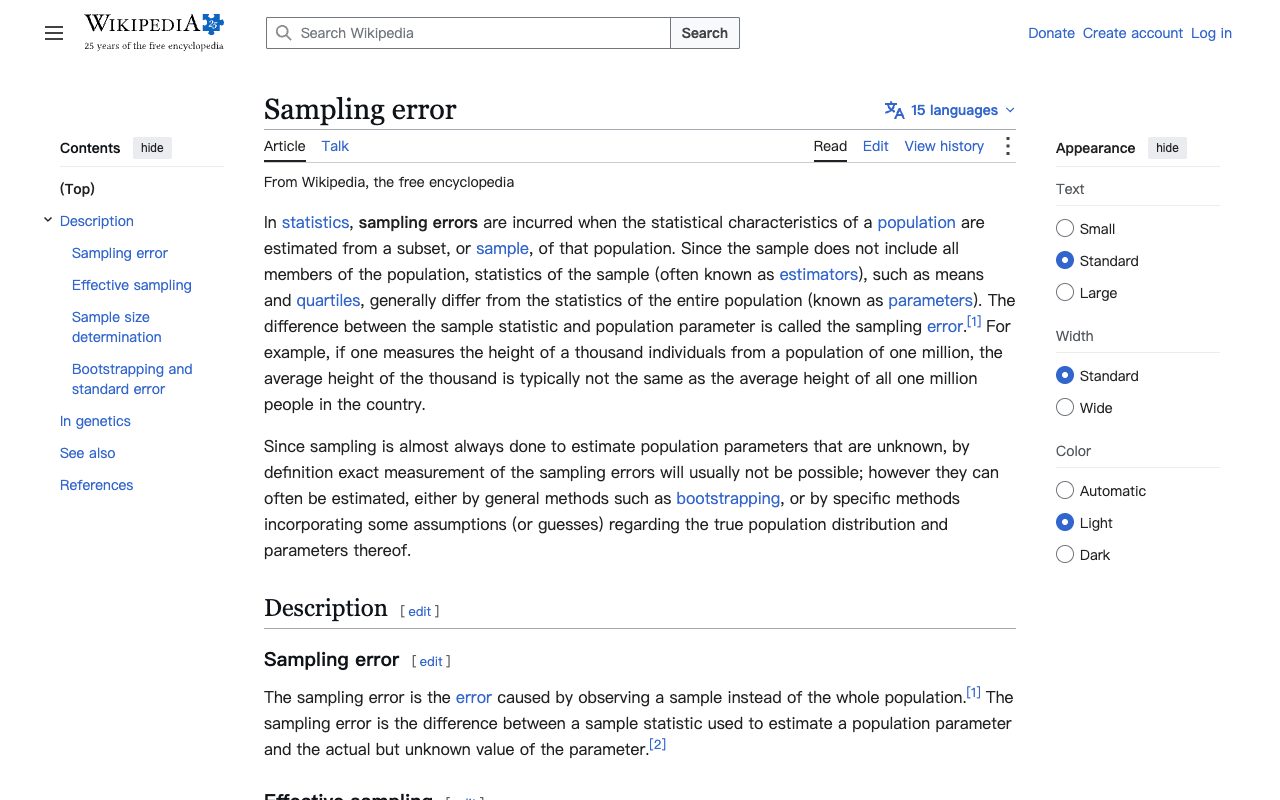
Share of voice comes from advertising, where it compares a company's media spending with its category's total (Wikipedia). Here the currency is mentions, but the rule holds: fix the denominator or the number means nothing.
Why Does a Single ChatGPT Response Tell You So Little?
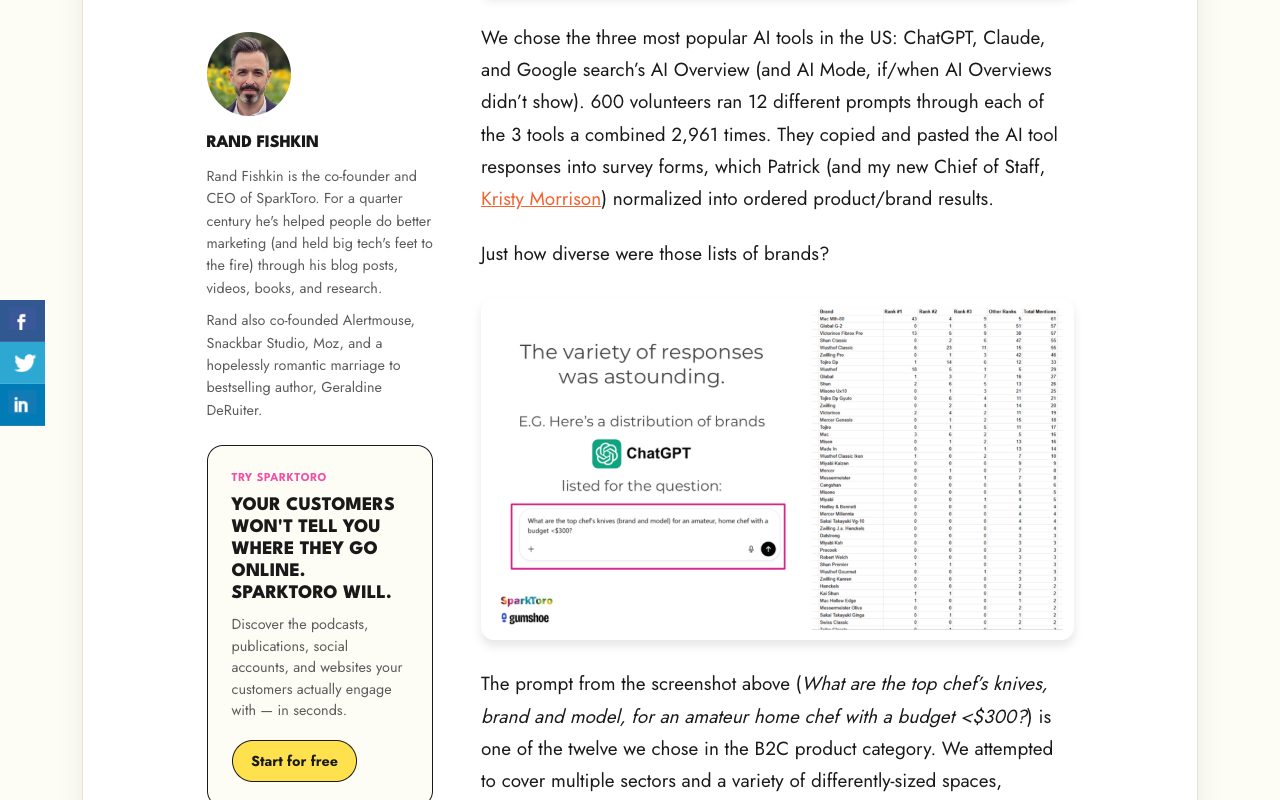
Because ChatGPT rarely gives the same answer twice. A study submitted to arXiv on April 8, 2026 entered eight prompts per campaign into ChatGPT, Gemini, Google AI Mode and Perplexity daily from January 24 to March 20, 2026, across four Swiss-German verticals. Its summary: "Source sets overlap by only 34–42% between consecutive days; brand sets somewhat more, at 45–59%, but with wide variance" (Schulte, Bleeker and Kaufmann, "Don't Measure Once").
The same paper sizes the sample. The standard error of a brand's detection rate "drops below 0.10 at n = 7 runs," and source coverage needs n = 8 for the same precision. On daily single runs, a 14-day window still leaves the error at 0.080, which the authors call "sufficient for directional monitoring," and they recommend rolling windows of two to four weeks. One run is a coin flip with a screenshot attached.
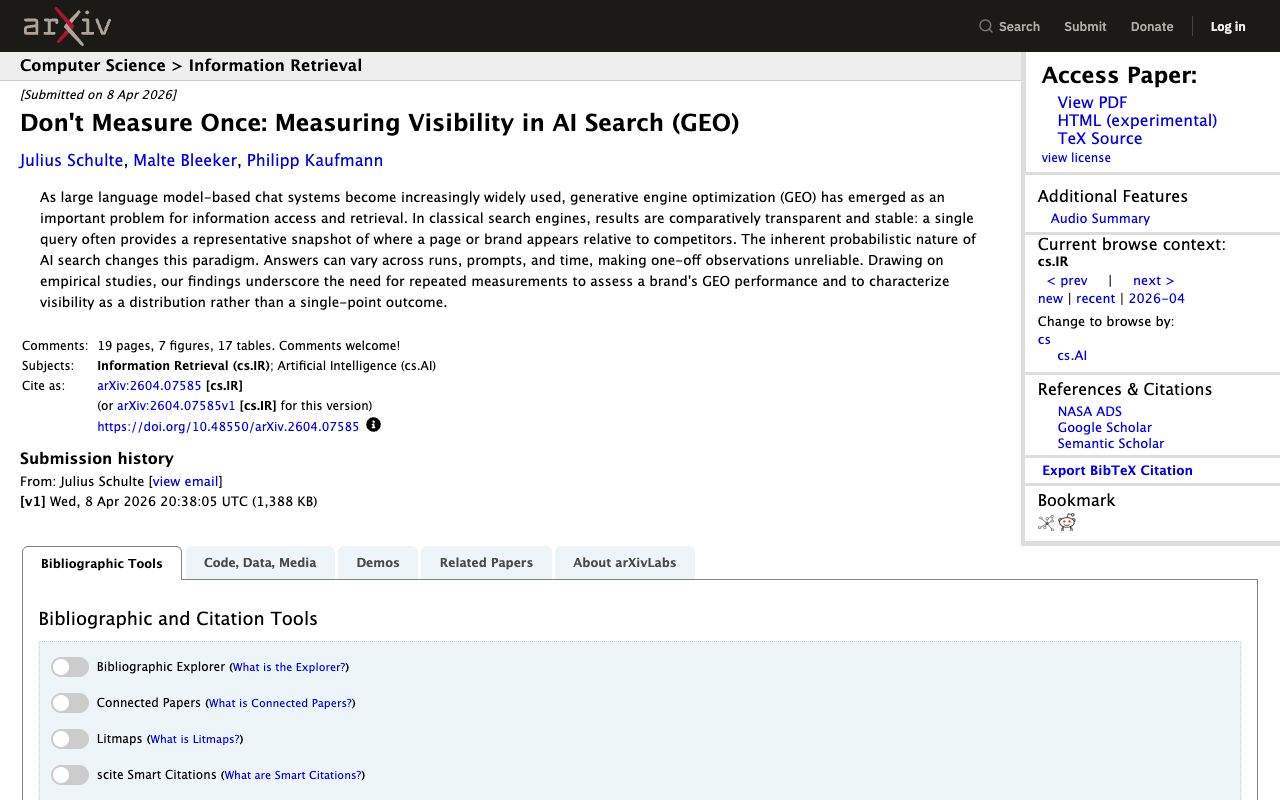
Ordered lists are worse. In SparkToro's January 2026 study, 600 volunteers ran 12 prompts through ChatGPT, Claude and Google's AI a combined 2,961 times; there was "a <1 in 100 chance" that ChatGPT or Google's AI would give the same list of brands in any two responses, and about 1 in 1,000 for the same order (SparkToro). Store detection rates and the first-recommended brand, never rank positions.
Longer horizons drift too. Trakkr's citation-decay study (March 30, 2026) found that "73.5% of citation URLs appear exactly once and don't return," that the median brand's citations drop to half their peak in 31 days, and that a typical brand's week-over-week citation count swings by 51.8% (Trakkr Research). Scrunch's analysis of 3.5 million citation events (September 2025 to March 2026) puts ChatGPT's source half-life at about 3.4 weeks versus about 5.8 on Perplexity (Scrunch). As a March 2026 arXiv paper puts it, "single-run visibility metrics provide a misleadingly precise picture."
How Do You Track Each Signal Without Fooling Yourself?
Engines: track ChatGPT, keep the other three as controls
Run the same prompts through Gemini, Claude and Perplexity in the same window, even if only ChatGPT matters to you. A move on all four usually traces to a source page or a real event; a ChatGPT-only move points at its retrieval layer or a model change. See how Kairosy runs that setup on the ChatGPT brand monitoring page.
Prompt set: version it like code
Ten to twenty-five real buyer prompts suffice for one brand: shortlists, evaluations ("is Brand legit"), comparisons and problem prompts ("Brand pricing complaints"). Add new questions as v2 and keep v1 running for a full cycle so the trend does not jump for a fake reason. Prompt design lives in how to monitor AI search visibility.
Visibility and mention rate: record them as rates
Do not log "mentioned: yes." Log "named in 5 of 7 runs" and store 0.71. Visibility (present anywhere, even as a bare link) and mention rate (named in the text) diverge, and the gap is a signal: high visibility with a low mention rate usually means ChatGPT reads your pages without endorsing you.
Citation rate: yours, and everyone else's
Keep two numbers: how often your own domain is cited, and the full list of third-party URLs, because those pages are where claims about you come from. Store exact URLs; a domain count hides a review page being swapped for a complaint thread. Source rotation is covered in AI source monitoring.
Sentiment: store the narrative, not only the label
"Negative" tells you nothing about what to fix. Store the reason phrase beside it ("pricing too high," "support slow") so a later run shows whether the narrative changed or only the label flipped. Kairosy classifies every answer positive, neutral or negative with reasons attached; diff the reasons week to week.
Share of voice and the competitor panel
Pick five to eight competitors once and count mentions against them, plus an "other" bucket for newcomers. Separately, record which brand ChatGPT recommends first: share of voice can rise while you lose the top slot, and the top slot is what costs deals.
Which Cadence Should Each Signal Get?
Runs per check follow the sample-size findings above; triggers justify an unscheduled run.
| Signal | Cadence | Runs per check | Off-cycle trigger | Why |
|---|---|---|---|---|
| Prompt-level mention / visibility | Daily | 1 run, read as a 14-day rolling rate | Launch, price change, PR event | SE 0.080 at a 14-day window (arXiv 2604.07585) |
| Full-panel score and sentiment | Weekly | 7 runs per prompt in one session | Any engine flips sentiment | SE below 0.10 at n = 7 (arXiv 2604.07585) |
| Your domain's citation rate | Weekly | 8 runs per prompt | Any robots.txt, redirect or CMS change | OpenAI: robots.txt updates take ~24 hours to apply |
| Third-party citation list | Weekly | Same 8 runs; log every URL | A new review, thread or article about you | 73.5% of citation URLs never return (Trakkr) |
| Competitor panel and share of voice | Weekly, reviewed monthly | Same runs | A competitor launches or reprices | Typical week-over-week swing: 51.8% (Trakkr) |
| Full-answer narrative read | Monthly | None; reread stored answers | Label flips without a reason change | Reason phrases, not labels, show the narrative |
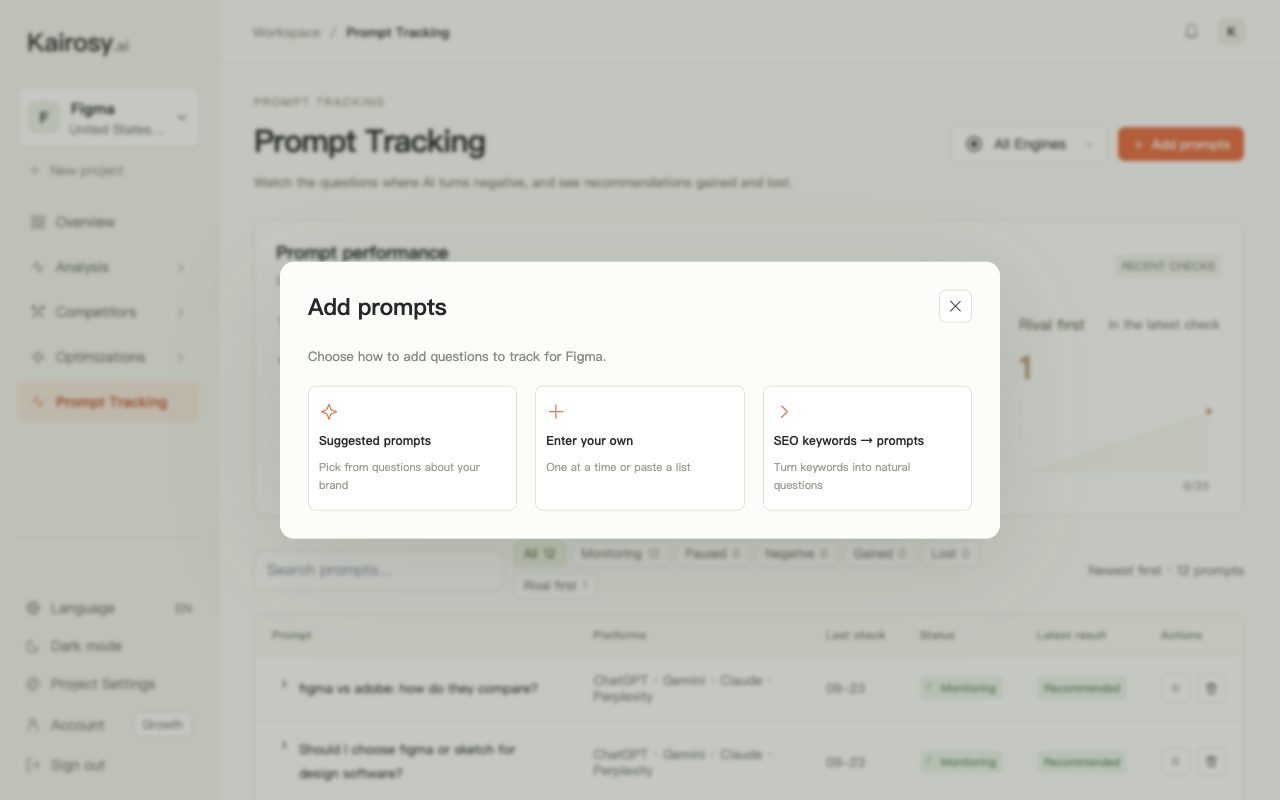
Budget the manual version honestly: 20 prompts × 7 runs × 4 engines is 560 answers a week to paste, classify and file, so automate collection and keep the judgment. In Kairosy, tracked prompts are checked daily on every paid plan (25, 100 or 350) and each tracking slot (one brand in one market; 5, 20 or 60 by plan) is re-scanned every Monday with an email digest and alerts. Manual and tool routes are compared in how to track brand mentions in ChatGPT.
How Do You Attribute a Change in ChatGPT Responses to Its Cause?
This is the table the whole log exists for: the observation, its usual cause, the check that confirms it, and the action that follows only after confirmation.
| Observed change | Likely cause | How to confirm | Action |
|---|---|---|---|
| New third-party citation appears | A fresh page about you was published or updated | Open the URL; compare its publish date with the run date; check whether the controls cite it too | Accurate: leave it. Inaccurate: contact the owner or publish a correction, then re-run |
| A long-cited source disappears | Normal decay, or the page changed or was removed | Fetch the page; confirm it resolves and is unchanged; compare the rolling rate, not one run | Decay: nothing. Your own page: fix access, re-check after 24 hours |
| Your domain stops being cited, mentions continue | Blocked crawl (robots.txt, firewall, redirect loop) or a migration broke the URL | Run the AI crawl checker for OAI-SearchBot, the redirect checker on old URLs, the index checker | Restore access; OpenAI's crawler docs say robots.txt changes take ~24 hours, so re-run after a day |
| A competitor's cited source changes | They published, or a publisher refreshed a roundup with them in it | Diff the URL list week over week; open the new page; note whether you are absent, present or criticized | Absent: pitch inclusion or publish your own comparison. Criticized: treat as a claim to correct |
| A competitor becomes the first recommendation | Their citations rose, or ChatGPT's stated reason changed (price, feature, reviews) | Read the stored answers for the reason; check whether that brand moved up on the controls | Real gap: route to product or pricing. Claim: correct the source |
| Sentiment flips negative with a new reason phrase | A new narrative entered the sources (billing, support, outage) | Search the reason phrase inside the cited URLs; confirm it lives in a source, not only in the answer | Fix or respond at the source; log the run date as the "before" |
| Score drops on ChatGPT only, controls flat | ChatGPT-side change: model update, search behavior, or a source only it cites | Check OpenAI's dated release notes; diff ChatGPT's citation list against last week | Platform: annotate and wait a cycle. Source: correct it |
| Score drops on all four engines | A real event or a widely read page (news, review surge) | Search the reason phrases; check review platforms and news for that week | Respond at the source; re-run weekly until it fades |
| Visibility high, recommendation rate low | ChatGPT knows you but does not endorse you, often over price or value | Read the reasons on neutral and negative answers; count how often a cheaper rival is named beside you | Answer the objection on your pricing page and in the comparison pages it cites |
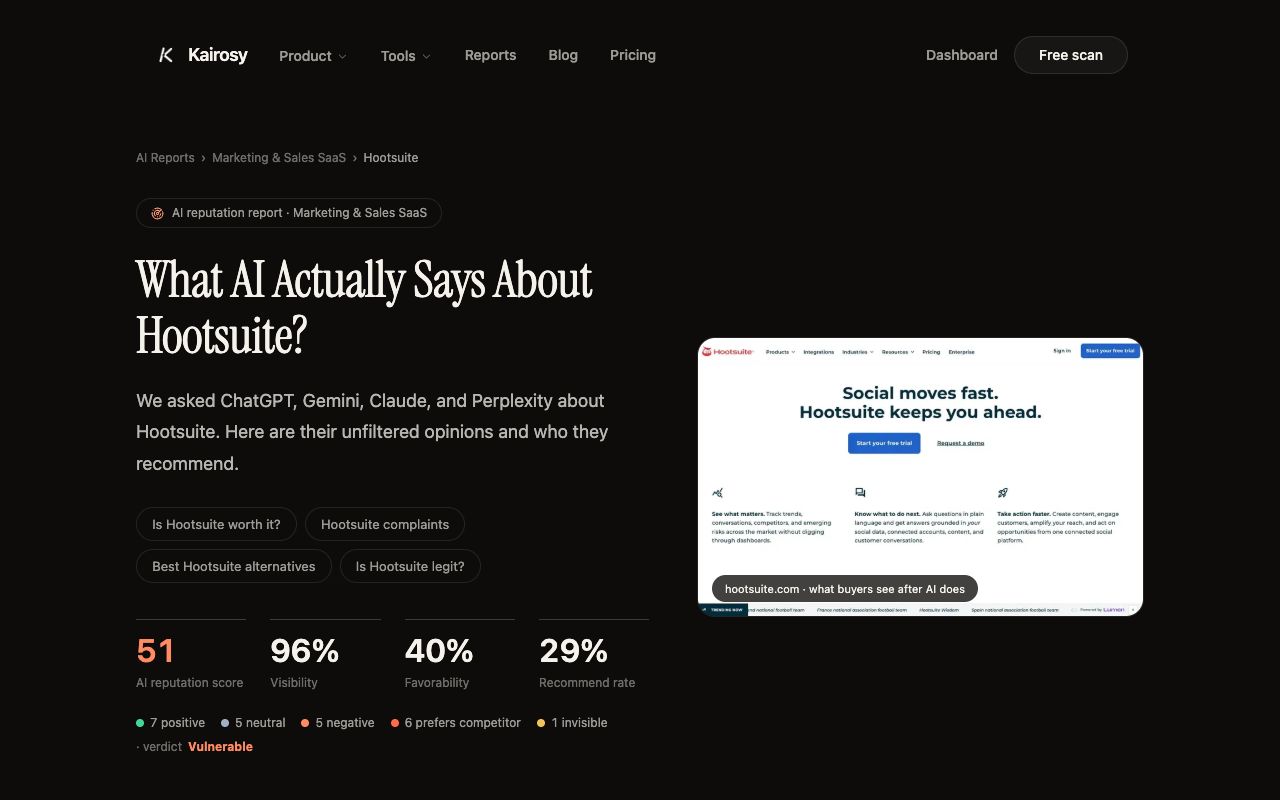
The last row is common in mature brands. Kairosy's scan of Hootsuite on 2026-08-05 scored it 51/100, verdict Vulnerable: "AI mentions Hootsuite in 96% of relevant answers, but only 29% actively recommend it." ChatGPT's answer names the objection: "it's hard to justify at $99/month with no free plan, and cheaper tools like Buffer or Later may be a better…" The fix target is a price narrative, not a visibility gap.
When Is a Movement Real, and When Should You Wait for the Next Run?
Use four gates, in order, and stop at the first one that fails.
- Sample gate. Before and after each rest on seven runs per prompt or a two-week rolling window. Anything thinner is "provisional."
- Control gate. Did Gemini, Claude and Perplexity move the same way? Then look outward, at sources or your market. A ChatGPT-only move points inward.
- Platform gate. Check OpenAI's ChatGPT release notes for a dated model or search change in the window. If there is one, annotate the series and wait a cycle.
- Source gate. Find the cited URL that carries the changed claim. No source, no cause: you are looking at noise.
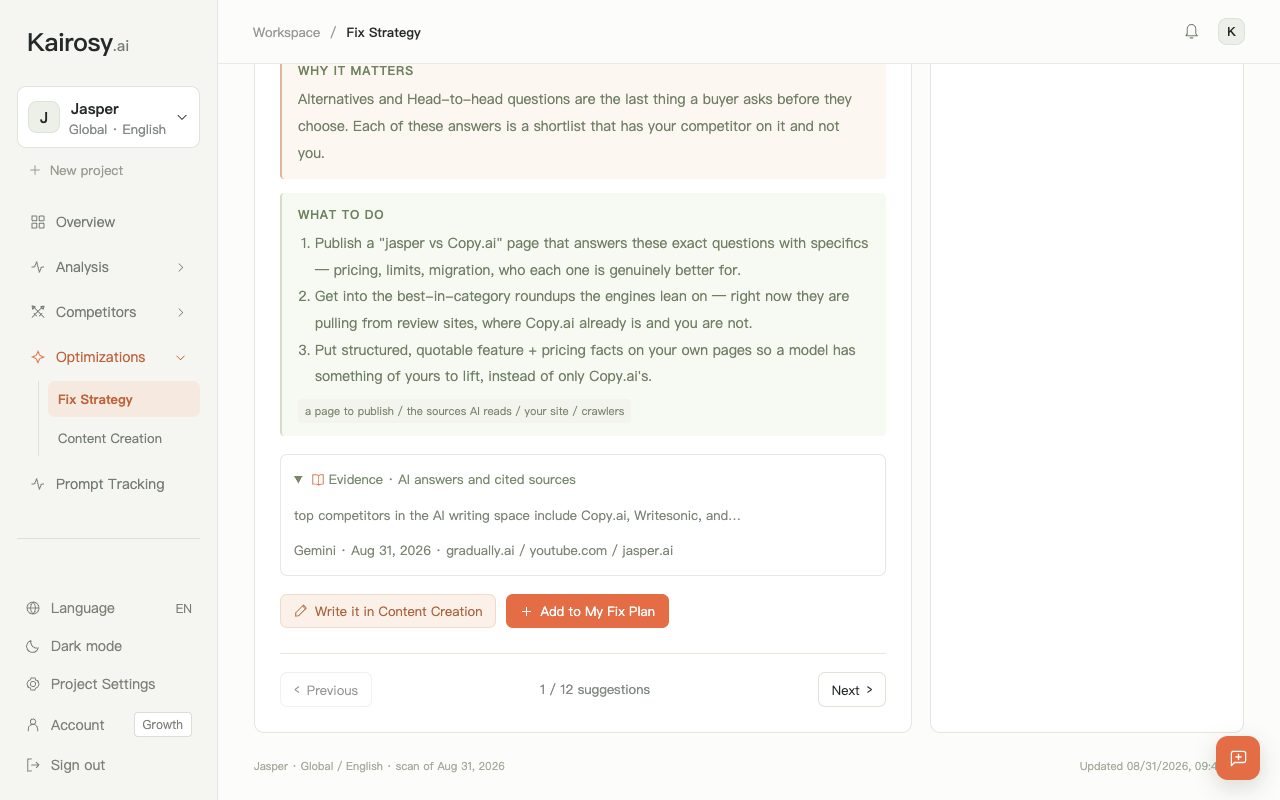
Only a change that clears all four gates earns an action, dated so the next run is a clean before/after (re-testing is covered in how to change what ChatGPT says about your brand). Kairosy's weekly alerts watch the same movements (new negative keywords, a competitor becoming the preferred pick, a score drop, an engine flipping sentiment), and the Fix Plan on each report lists prioritized actions.
How to Track Brand Performance in ChatGPT Response Over Time FAQs
How do you track brand performance in ChatGPT responses over time without a tool?
Use a spreadsheet with one row per run: date, prompt version, engine, present, mentioned, domain cited, third-party URLs, sentiment, reason phrase, first-recommended brand. Run each prompt seven times per weekly check and chart the rates. Past about ten prompts, collection swamps analysis.
How many times should you run the same prompt in ChatGPT before trusting the result?
Seven runs per check for brand detection and eight when source coverage matters, per the April 2026 arXiv study, which found a single run "essentially uninformative."
Why did ChatGPT stop citing my website?
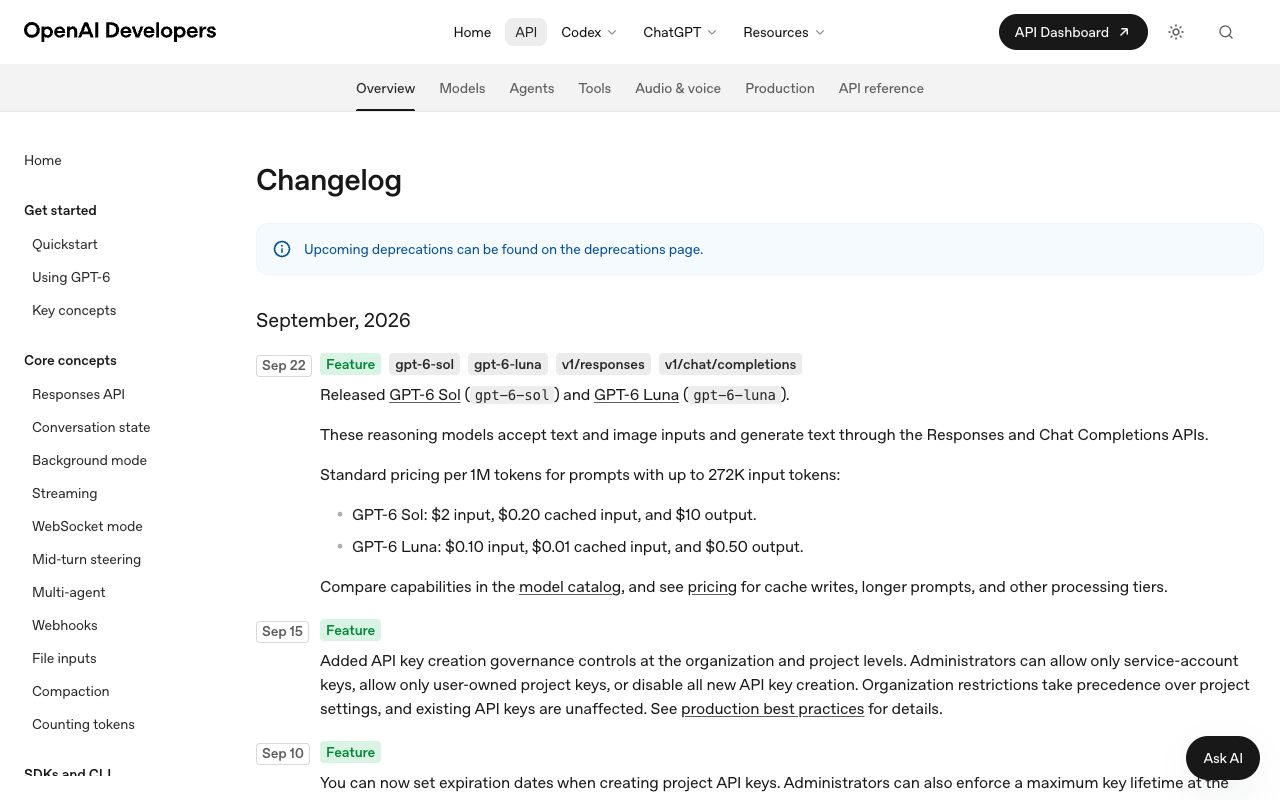
Usually one of three causes: ordinary decay (Trakkr found 73.5% of citation URLs appear once and never return), a page that changed or moved, or blocked access for OAI-SearchBot, which OpenAI uses to surface websites in ChatGPT search. Check access and redirects first, since you control those, then wait a cycle.
Does ChatGPT give different people different answers about the same brand?
Yes. SparkToro's 600 volunteers rarely got the same brand list twice, and the arXiv study measured only 45–59% brand overlap between consecutive days. That is why performance has to be a rate across runs, not a single answer.
What counts as a good mention rate in ChatGPT?
No cross-industry benchmark is worth targeting, because the number depends on your prompts. Compare against your own baseline and fixed competitor panel on identical prompts, and judge direction over three or more cycles.
See what AI says about your brand
Run a free scan across ChatGPT, Gemini, Claude & Perplexity in about 30 seconds.
Run my free scan