How to Monitor Citation Performance Across AI Models: 4 Tools (2026)
To monitor citation performance across AI models, you need three things none of the models hand you by default: one fixed prompt set asked to ChatGPT, Gemini, Claude and Perplexity on a schedule, the URL list behind every answer, and a rule for telling a real source change from run-to-run noise. Below: the four-step method, a source-adoption matrix built from a dated public citation study, a brand example where one model cannot place the company at all, and four tools matched to a job with prices checked in September 2026.
A single-model view fails for a measurable reason. A Loganix analysis released April 2, 2026 cites Averi's 680 million-citation study for this figure: only 11% of domains are cited by both ChatGPT and Perplexity. Track one engine and most of the domains the other relies on never enter your data.
How Do You Monitor Citation Performance Across AI Models in Four Steps?
The method is identical in a spreadsheet or a platform; only prompt volume and cadence change.
Step 1: Freeze a prompt set that mirrors a purchase
Pick 10 to 25 questions a buyer would type about your category: the "is it worth it" check, the complaints question, the head-to-head against your closest rival, the best-in-class shortlist and the trust question. Write them once and never edit them mid-series. A reworded prompt produces a different source list, and you will misread that as churn.
Step 2: Ask all four models with web access on, and keep the URLs
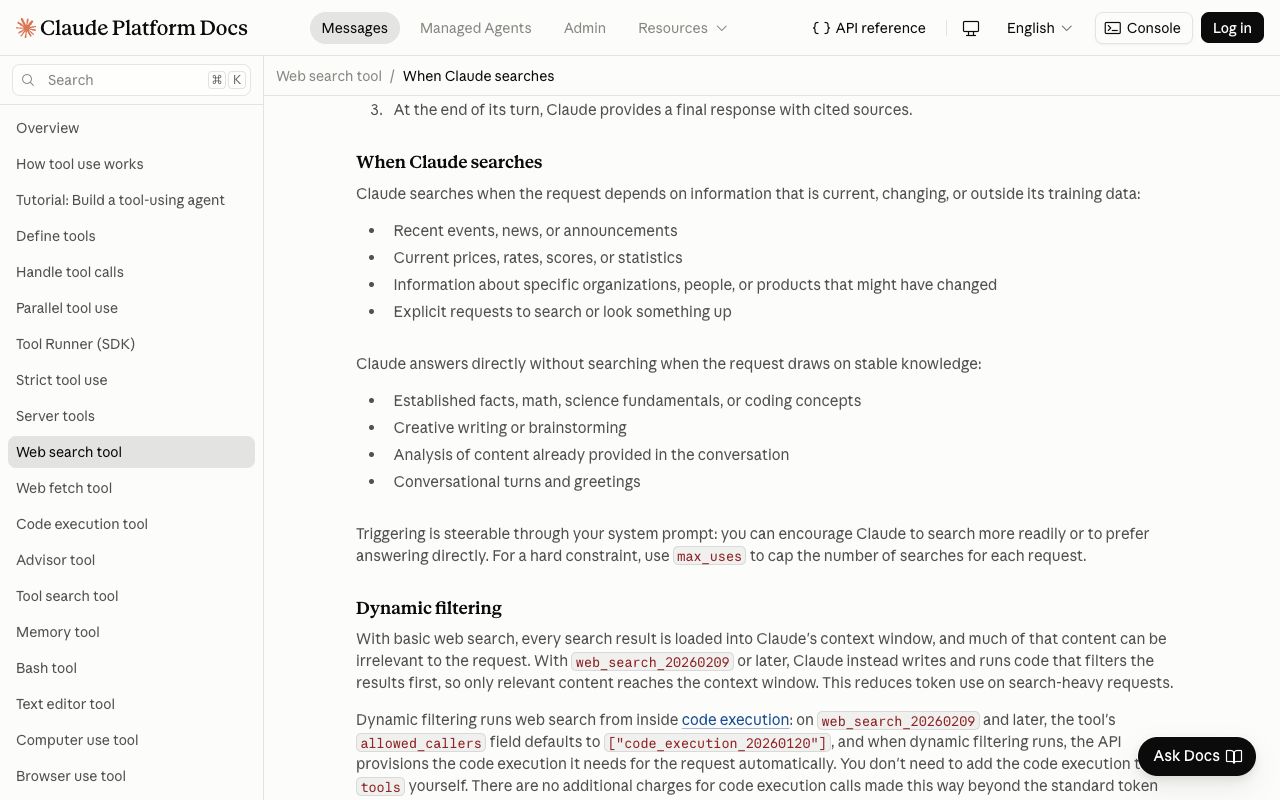
Each vendor exposes sources differently. OpenAI's web search returns url_citation annotations holding the URL, title and location of the cited source. Google's Gemini grounding docs state that "the model analyzes the prompt and determines if a Google Search can improve the answer", so a Gemini reply can arrive with no sources because it chose not to look. Anthropic's docs say "Citations are always enabled for web search", yet Claude answers directly when a request "draws on stable knowledge." Perplexity's Search API returns each result with a url, title and date.
Record four columns per answer: the model, the full text, every URL it cited, and whether the model searched at all. That last flag answers most "why is this source missing" questions.
Step 3: Turn the URLs into a source-by-model matrix
Collapse URLs to domains, list every domain any model cited as a row, and mark each model column as cited, mentioned without a link, or absent. The row you are hunting has one or two filled cells: a page one engine trusts and the others never load. That row is your citation gap, and the guide on how to analyze citation gaps in AI covers what to do with it.
Step 4: Re-run on a fixed cadence and alert on change, not volume
Weekly is the practical floor for a brand-level series. Compare each run to the last and flag three events: a domain vanishing from a model that cited it last week, a negative page entering any model's list, and a model switching from your site to a rival's comparison page. Raw citation counts move every run and do not deserve an alert on their own.
Why Does the Same Source Get Cited by One Model and Ignored by Another?
Three mechanisms explain almost every empty cell in a source matrix, and none is about your content quality.
The model may not have searched. Claude's documentation says it searches for information about products "that might have changed" but skips the search for established facts, and Gemini decides per prompt whether grounding is worth it. A brand question that lands on the "settled" side gets an answer with zero URLs, which looks like rejection but is abstention.
The models use different indexes. QuickSEO's May 19, 2026 roundup of citation studies reports 82% URL overlap between Perplexity's citations and Google's top ten, a Semrush figure, against roughly 6.5% for ChatGPT. A page that ranks in Google is far likelier to surface in Perplexity than in ChatGPT for that reason alone.
The models weight source types differently. Frase's June 9, 2026 roundup cites BrightEdge measuring pairwise overlap between engines' top cited sources at 16% to 59%, with Gemini and Google AI Mode sharing only 27% of sources. Even two Google surfaces disagree, which is why the Gemini column below is labeled a proxy.
Which Sources Do ChatGPT, Gemini, Claude and Perplexity Adopt? The Source Adoption Matrix
The table comes from Profound's AI Platform Citation Patterns study: 680 million citations collected August 2024 to June 2025, published June 5, 2025 and updated August 2025. Each cell is the domain's percentage of that platform's total citations. "Outside top 10" means the domain is missing from Profound's published top 10 for that platform, not that it is never cited. Profound did not measure Gemini, so that column uses Google AI Overviews. For Claude, Frase's roundup says "credible, large-scale data on Claude's source-type distribution is not yet published."
| Source | ChatGPT | Gemini (AI Overviews proxy) | Claude | Perplexity |
|---|---|---|---|---|
| 1.8% | 2.2% (#1) | No published share | 6.6% (#1) | |
| Wikipedia | 7.8% (#1) | 0.6% | No published share | Outside top 10 |
| YouTube | Outside top 10 | 1.9% | No published share | 2.0% |
| Forbes | 1.1% | 0.6% | No published share | 0.7% |
| G2 | 1.1% | Outside top 10 | No published share | 0.6% |
| Gartner | Outside top 10 | 0.7% | No published share | 1.0% |
| Outside top 10 | 1.3% | No published share | 0.8% | |
| NYT, The Atlantic, NPR | Outside top 10 | Outside top 10 | Named as Claude's top source cluster in QuickSEO's roundup | Outside top 10 |
Source: Profound, AI Platform Citation Patterns for the three measured platforms; the editorial row's Claude cell comes from the QuickSEO roundup above.
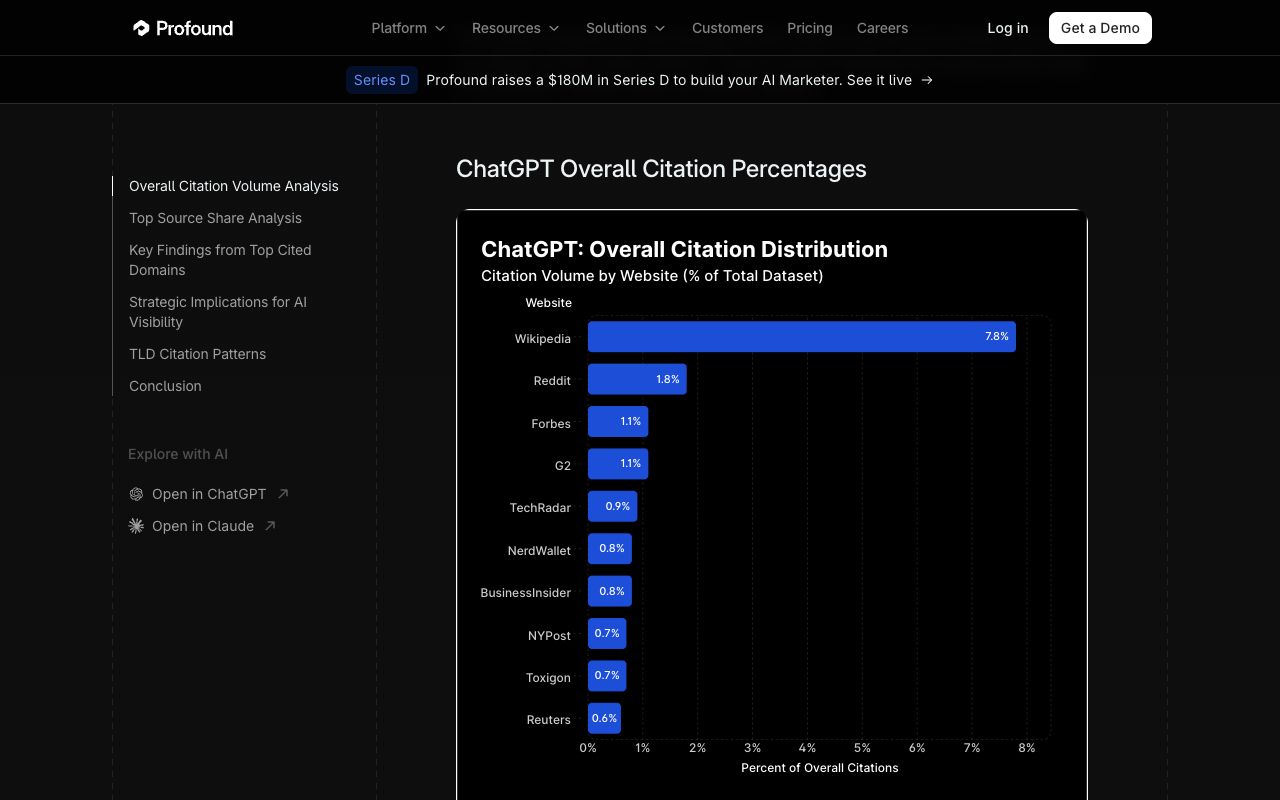
Read the rows, not the columns. Only Reddit, Forbes and NerdWallet (not shown) sit inside all three top-10 lists, and even Reddit carries very different weight: 6.6% of Perplexity's citations against 1.8% of ChatGPT's. Wikipedia anchors ChatGPT at 7.8% yet falls outside Perplexity's top 10. G2 counts for ChatGPT and Perplexity but misses the AI Overviews list, which matters for any software brand whose reviews live there.
Which Model Rejects a Brand Outright? A Real Example From Kairosy's Peec AI Scan
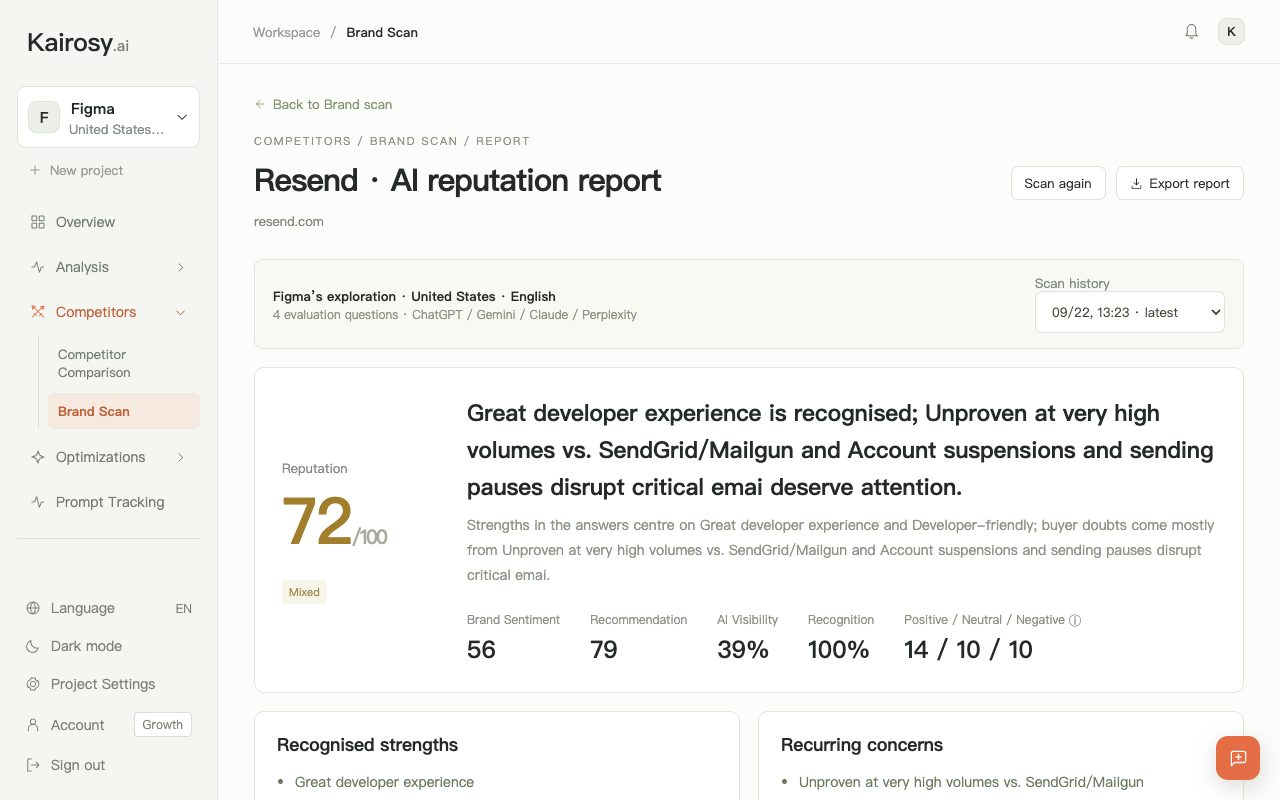
Aggregate studies show preference; one brand shows the cost. Kairosy's scan of Peec AI, run on 2026-08-05 across 24 buyer questions, scored the brand 52/100 with a Vulnerable verdict. Three engines converge on 60 and Gemini sits at 29. The public page is Kairosy's Peec AI report.
| Engine | Score | Answer quoted on the report | Report label |
|---|---|---|---|
| ChatGPT | 60 | "the strongest alternatives I found are Promptwatch, AthenaHQ, Otterly.AI, Profound, and Rankscale." | Prefers competitor |
| Claude | 60 | "Promptwatch – Best for full optimization; covers 10 AI engines with real-time crawler logs, content generation, and citation…" | Prefers competitor |
| Perplexity | 60 | "the leading alternative is Profound if you want the strongest enterprise-grade AI Overview tracking and entity-focused…" | Prefers competitor |
| Gemini | 29 | "I am not familiar with the specific brand peec.ai, so I cannot compare it to its leading…" | Head-to-head question, brand not recognized |
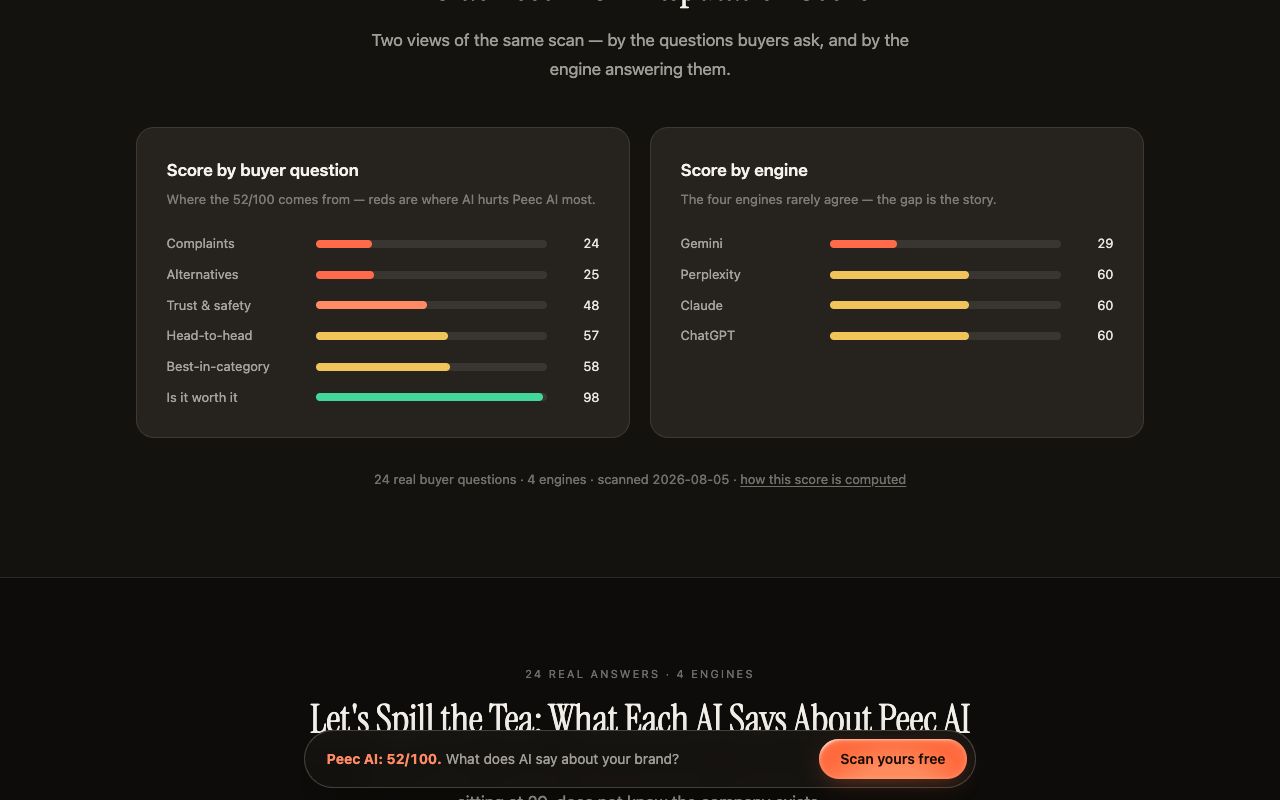
Three engines named a rival; one could not place the brand. The report's action plan explains the rivals' edge: "Promptwatch and Profound win the comparison and the substitute list across three engines, and the capability claims that decide it were collected from review sites." Its FAQ adds the general rule: "Engine gaps like this usually mean the brand's story lives in sources one model reads and another doesn't."
That fits the matrix, where G2 sits in the ChatGPT and Perplexity top 10 but outside the AI Overviews list. Treat it as a hypothesis to test in your own URL data, because the public page quotes answers without listing their sources. Kairosy's Otterly.AI report from the same date shows the same shape, Claude at 73 against Gemini at 44.
Which Tools Monitor Citation Performance Across AI Models, and for Which Use Case?
No tool covers every model with equal depth, so the useful question is which job each does best. Prices were read from each vendor's pricing page in September 2026.
Otterly.AI: scheduled prompt monitoring with engine add-ons
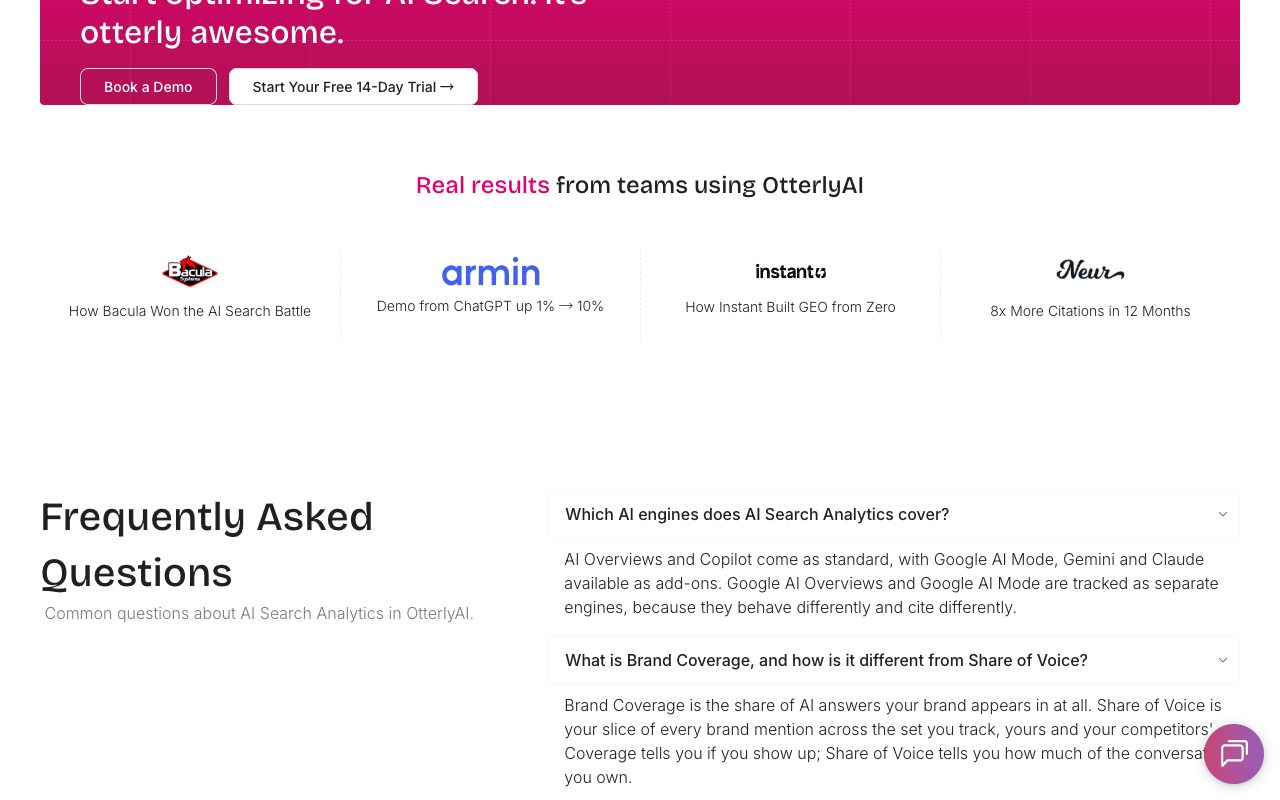
Otterly is built around a fixed prompt list checked daily, which is Step 1 and Step 4 above. As of September 2026 its pricing page lists Lite at $29 per month for 15 prompts, Standard at $189 for 100, Premium at $489 for 400, and Enterprise from $1,000, with 15% off annual billing and a free trial. Every plan tracks ChatGPT, Google AI Overviews, Perplexity and Microsoft Copilot. Claude, Gemini and Google AI Mode are paid add-ons, at $29, $9 and $9 per month on Lite, so a full four-column matrix costs more than the headline price.
Peec AI: AI visibility monitoring with source analytics
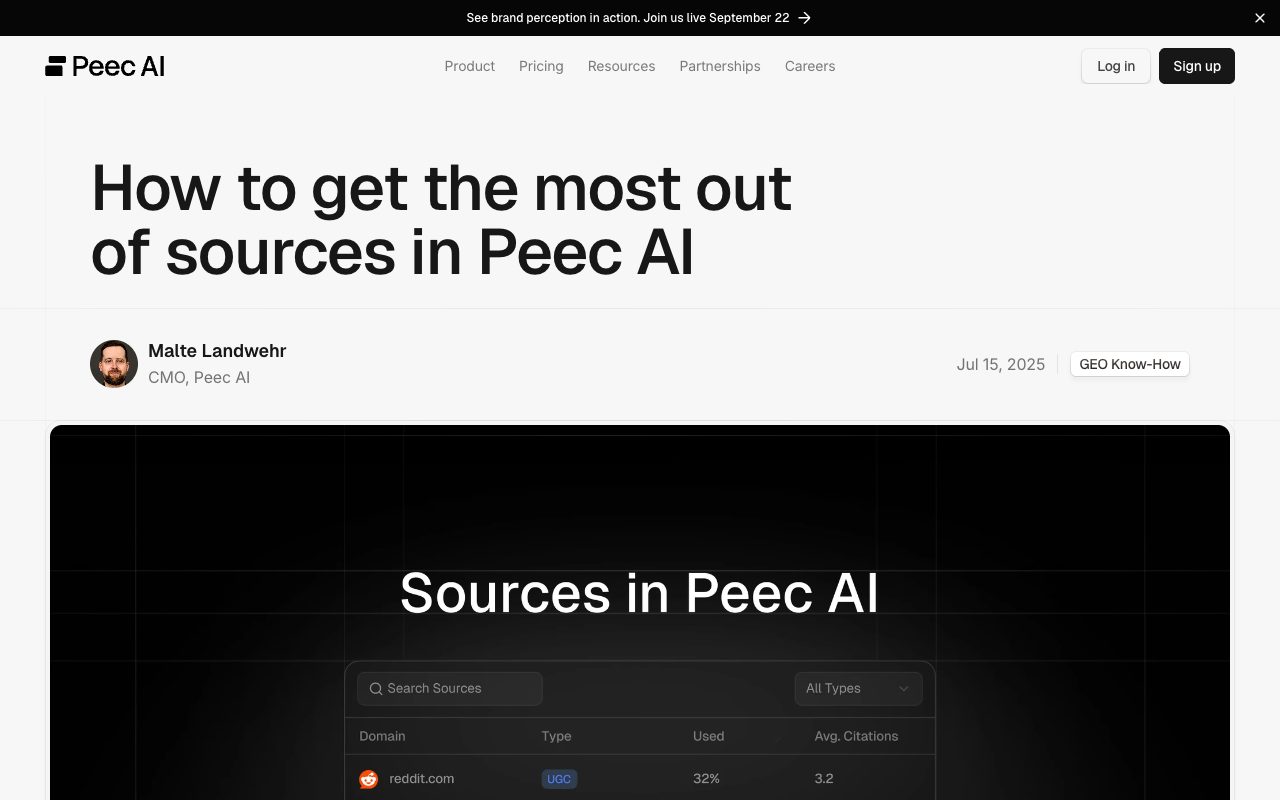
Peec's homepage pitches tracking of visibility, position and sentiment, and its pricing page lists source analytics with a domain and URL detail view. Starter, Pro and Advanced each let you choose 3 models from ChatGPT, AI Mode, AI Overviews, Copilot, Perplexity and Gemini, with 50, 150 and 350 prompts tracked daily. Claude appears only in the Enterprise model list. No numeric prices render as of September 2026; the homepage offers a free trial. Pick it when your question is "how visible are we, and which pages sit behind that."
Profound: enterprise citation analytics across nine answer engines
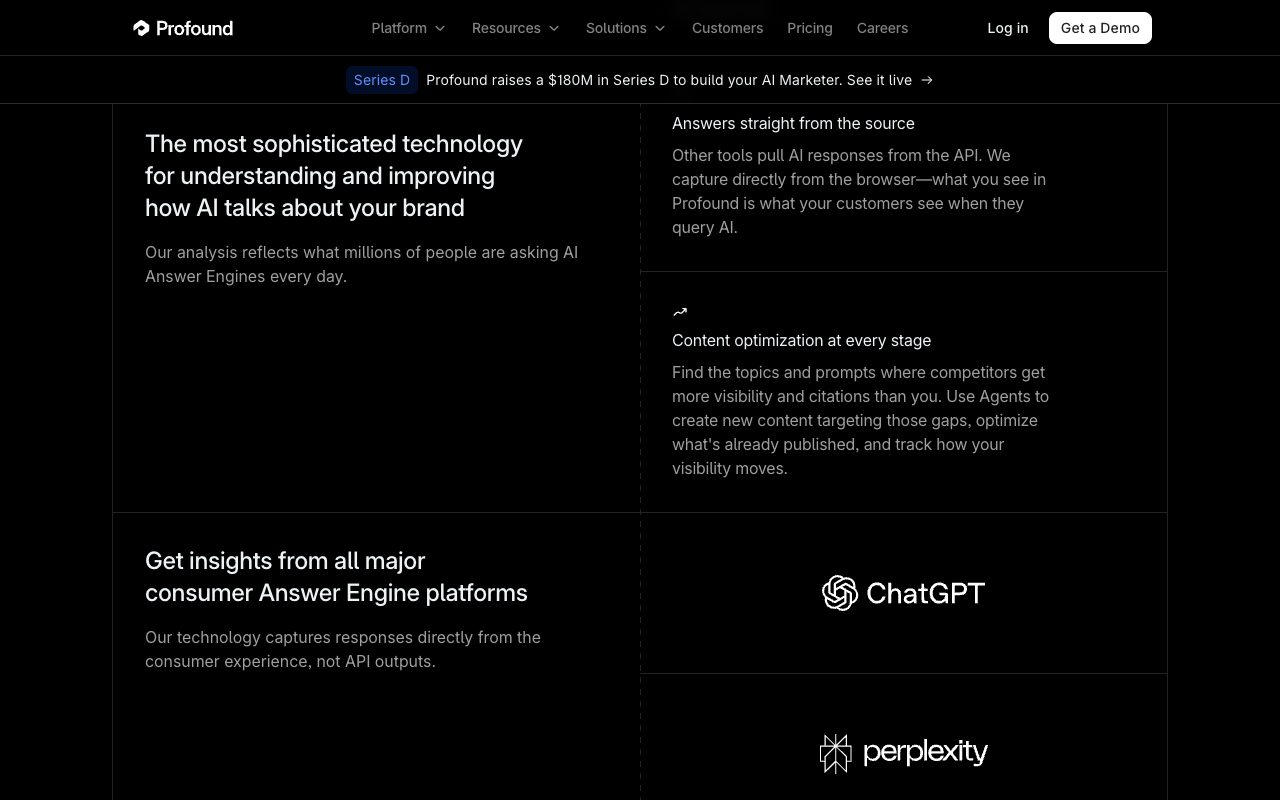
Profound has the widest engine list of the four. Its pricing page shows a free Trial with 50 prompts run daily for 7 days on ChatGPT, Gemini and Google AI Overviews, and an Enterprise plan at custom pricing that tracks ChatGPT, Perplexity, Google AI Mode, Google Gemini, Microsoft Copilot, DeepSeek, Anthropic Claude, Google AI Overviews and Exa Search daily. That breadth is the use case: a large brand that needs citation share on every surface.
Kairosy: negative-mention and sentiment monitoring across four engines
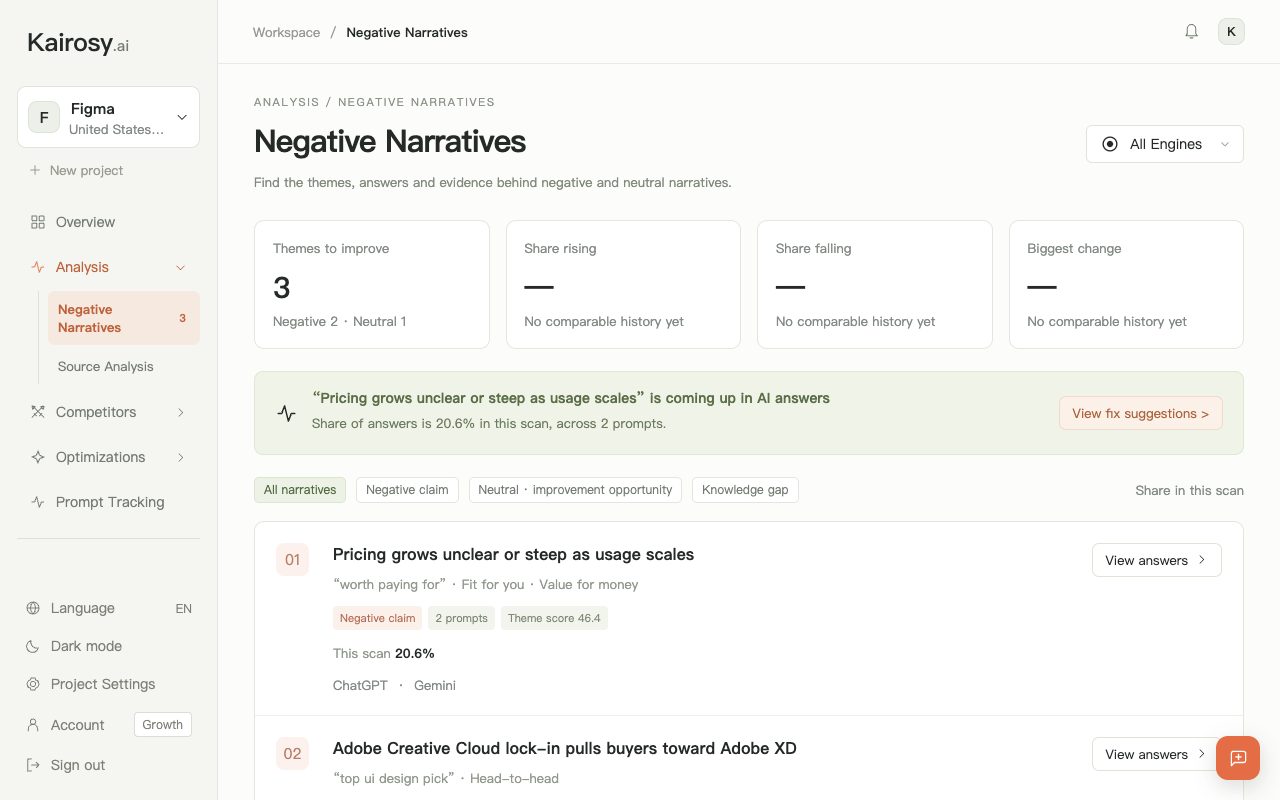
Kairosy is the pick when the question is what the answers say, not only whether you appear. It asks ChatGPT, Gemini, Claude and Perplexity the buyer questions from Step 1, classifies every answer as positive, neutral or negative with the reason, and lists the real citation URLs under each one, the raw material for the brand-level matrix in Step 3. Each Monday it re-scans every tracked brand-and-market pair and emails alerts for new negative keywords, a competitor becoming the preferred pick, a score drop, or an engine flipping sentiment. Plans are Basic $29, Pro $99 and Growth $399 per month, with 3, 6 and 20 tracking slots and 15, 28 and 70 prompts checked daily. Signup is a 7-day trial with full reports and no credit card. See AI brand monitoring and Perplexity brand monitoring for the per-engine setup.
How Often Should You Re-Check Citation Performance, and What Counts as a Real Change?
Sources rotate faster than sentiment. Retrieval is live and non-deterministic, so a domain appearing in one run and vanishing in the next is normal, and a program that alerts on every such move will be muted within a month.
Three rules keep the signal usable. Compare like with like: same prompt wording, same market, same week. Count answers before you compare scores, because a run where one model answered two prompts out of six is not comparable to one where it answered all six. Treat a source as adopted only after two consecutive appearances for the same model, and as dropped only after two consecutive absences.
Before you chase a missing citation, confirm the models can reach the page. A blocked crawler produces the same empty cell as a rejected source, and the free AI crawl checker rules that out. For the program that assigns each source an owner and a fix, see AI source monitoring. For why four engines score one brand so differently, see multi-LLM brand monitoring.
Monitor Citation Performance Across AI Models FAQs
What does citation performance mean when you compare AI models?
It is the share of a model's answers about your category that cite a page you control or a page that favors you, tracked per model over time. A brand can have strong citation performance in Perplexity and none in Gemini, which is why the metric only makes sense with a model column attached.
Can one tool monitor citation performance across AI models including Claude?
Yes, but check the engine list before the price list. As of September 2026, Otterly sells Claude as an add-on, Peec lists Claude only for Enterprise, Profound's Enterprise plan tracks nine engines including Claude, and Kairosy covers ChatGPT, Gemini, Claude and Perplexity on every plan.
Why does Gemini say it does not know a brand that ChatGPT describes in detail?
Usually because Gemini either decided not to ground the prompt or grounded on pages that never name the brand. Kairosy's Peec AI scan shows the result: Gemini answered "I am not familiar with the specific brand peec.ai" while ChatGPT, Claude and Perplexity each scored the brand 60.
Do AI models cite the same sources on every run?
No. The domain list shifts between runs even with identical prompts, which is why this guide asks for two consecutive runs before calling a source adopted or dropped, and for comparing answer counts before comparing scores.
How many prompts do you need to monitor citation performance across AI models?
Ten to 25 buyer-style prompts per brand is enough to see source patterns, and it maps to the entry tiers above: Otterly's Lite plan carries 15 and Kairosy's Basic plan 25 checked daily, while Profound's trial runs 50 for one week. More prompts add resolution, not new mechanisms.
See what AI says about your brand
Run a free scan across ChatGPT, Gemini, Claude & Perplexity in about 30 seconds.
Run my free scan