AI Brand Experience Optimization: The Five Layers Explained (2026)
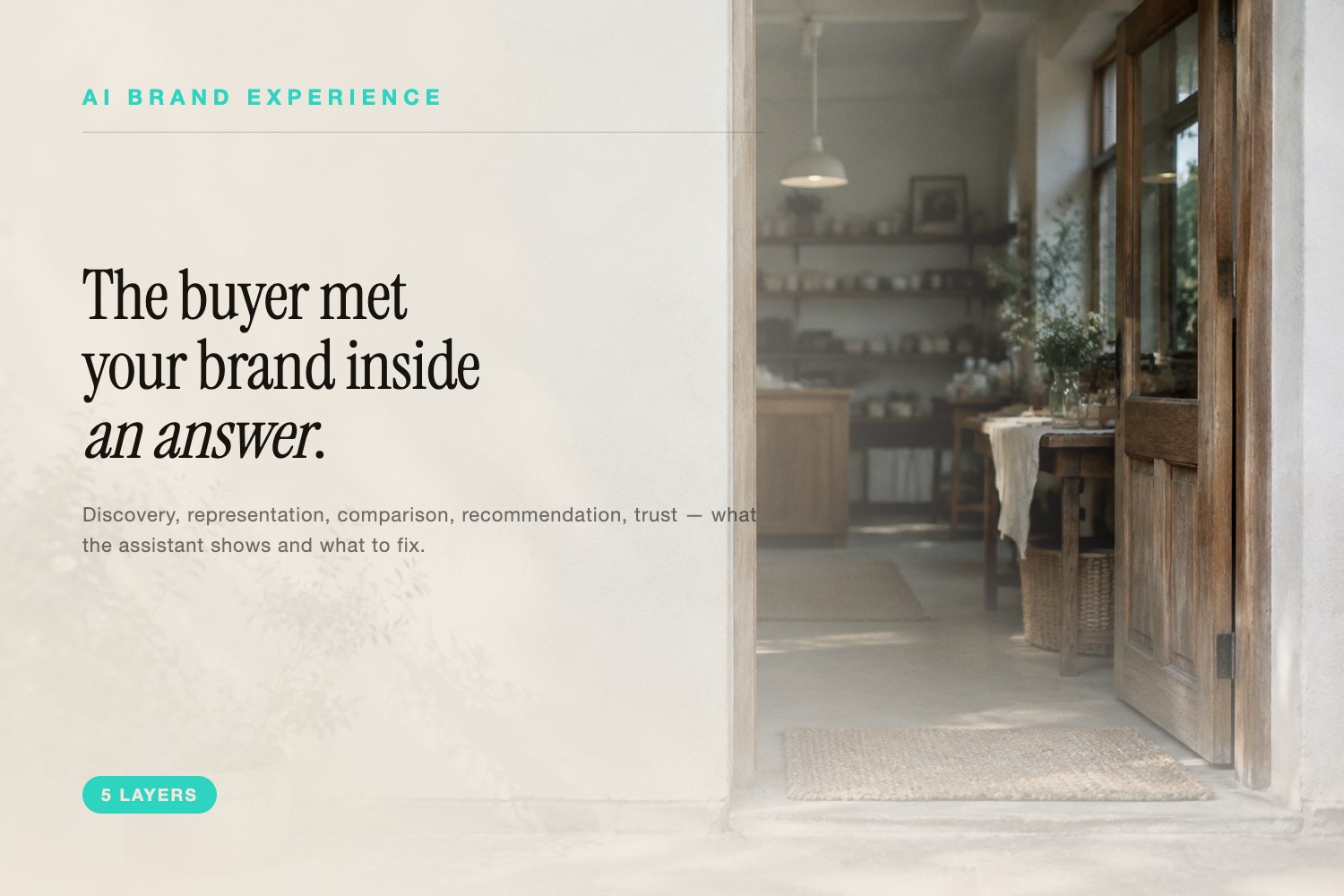
AI brand experience optimization is the work of improving what a person experiences when an AI assistant, not your website, introduces them to your brand. The buyer asks ChatGPT, Gemini, Claude or Perplexity a question, the model assembles an answer from what it knows and retrieves, and that answer is the brand experience. You did not design it, but you can change what feeds it.
This guide defines the term, separates it from "AI for customer experience", and walks its five layers: Discovery, Representation, Comparison, Recommendation and Trust, each with good and bad examples, a real AI answer excerpt, and its fix.
What is AI brand experience optimization?
An AI brand experience is every impression a buyer forms about your company inside a conversation with a language model: whether you come up, how you are described, who you are measured against, whether you get picked, and which sources the model trusted. AI brand experience optimization measures those impressions and moves the inputs (pages, listings, reviews, structured facts) so the next answer is more accurate and more favorable.
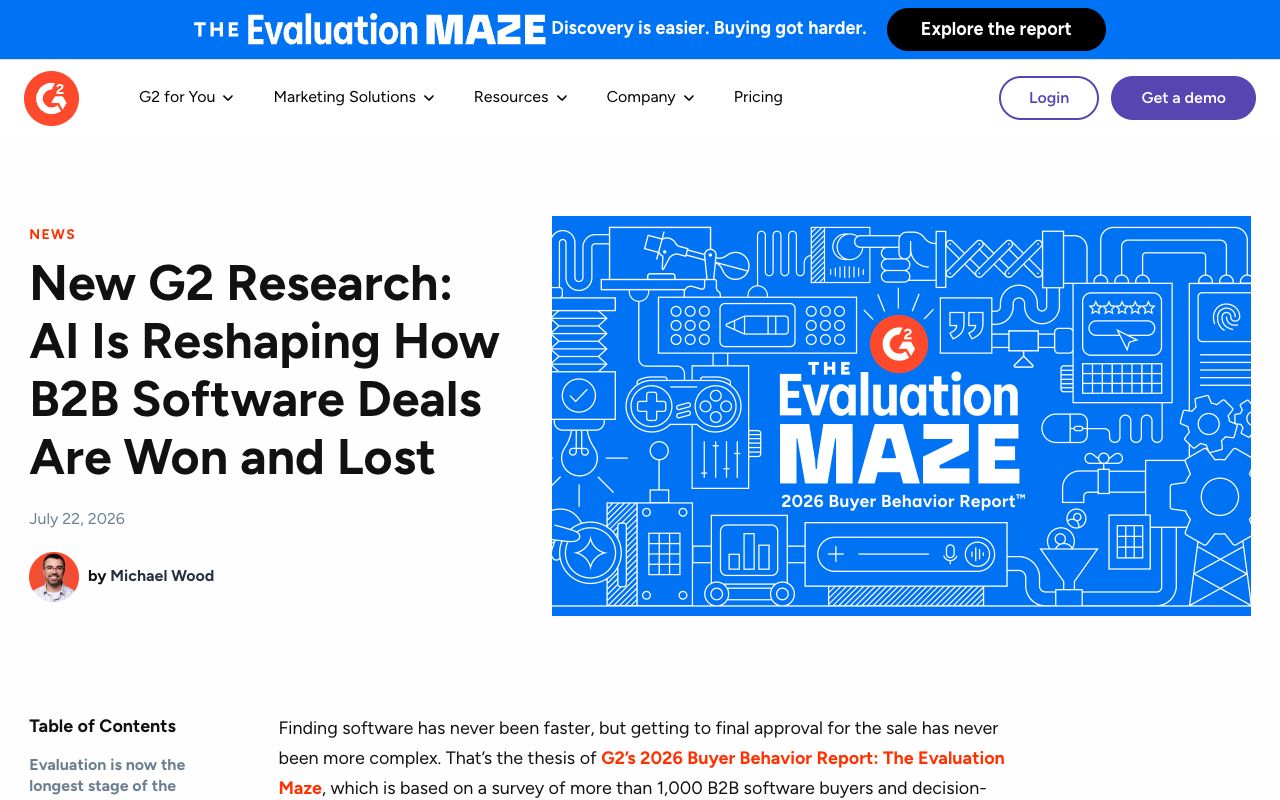
The audience is already large. G2's 2026 Buyer Behavior Report (July 22, 2026, 1,000-plus B2B software buyers surveyed) found that "eight out of 10 buyers have sourced software recommendations from tools like ChatGPT or Google AI Mode in the last two years." On the consumer side, Adobe Analytics data reported by Digital Commerce 360 on June 17, 2026 put AI-referred retail traffic up 138% year over year in May 2026, converting 54% better than non-AI traffic.
Is AI brand experience optimization the same as using AI to improve customer experience?
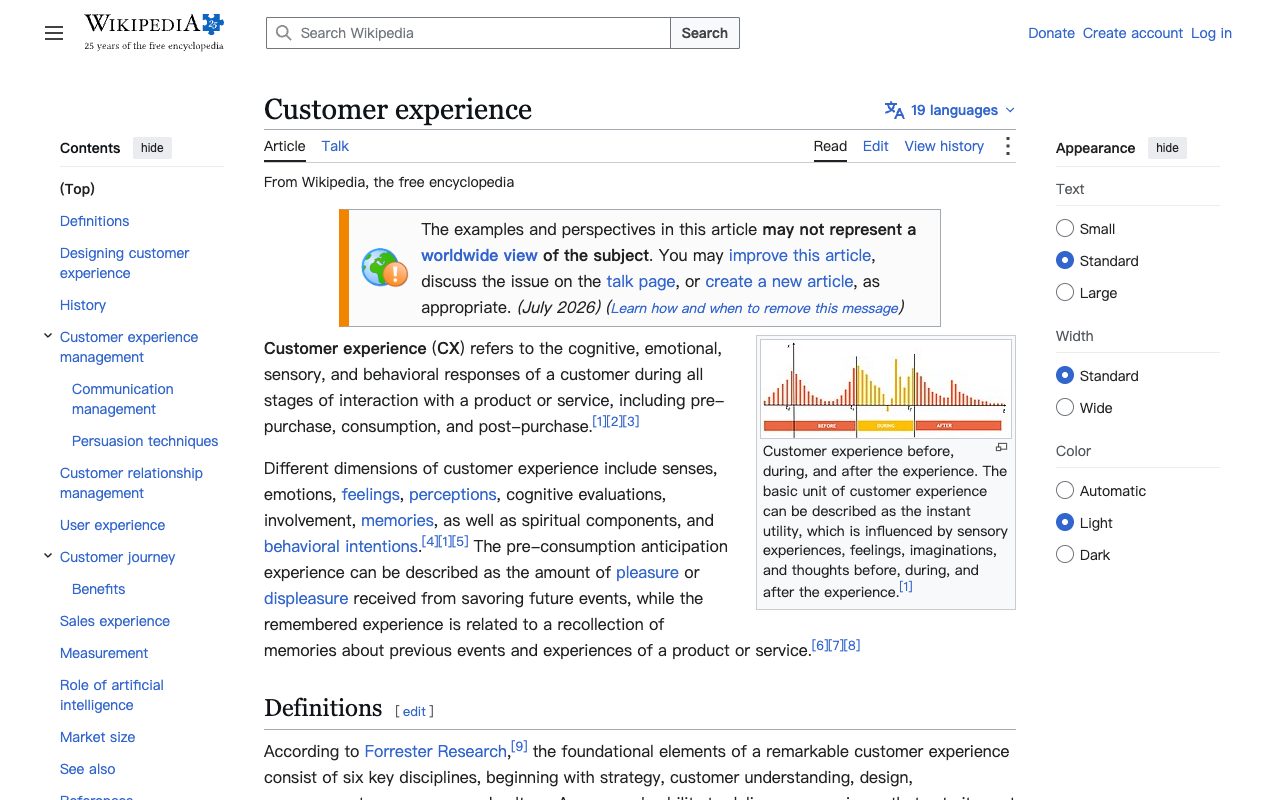
No. Customer experience, in Wikipedia's definition, covers a customer's "cognitive, emotional, sensory, and behavioral responses" across pre-purchase, consumption and post-purchase. "AI for CX" means using models to improve touchpoints you own: site chatbots, personalized email, support triage.
AI brand experience optimization points the other way. The touchpoint belongs to OpenAI, Google, Anthropic or Perplexity, the buyer may never reach your site, and the model builds its description from third-party material as much as from yours. You cannot redesign that interface; you can only change what the model finds and check what it says.
What are the five layers of AI brand experience optimization?
The layers follow the order in which a buyer meets you inside an answer, and each fails for different reasons and belongs to a different owner. A brand can pass Discovery with a near-perfect mention rate and still lose at Recommendation, the most common pattern in public scans.
| Layer | What the buyer experiences | Failure mode | Owner | Fix |
|---|---|---|---|---|
| 1. Discovery | Your name appears in an answer to a category question asked without naming you | Absent, or surfaced only when the buyer types your name | SEO / content lead | Organization schema, consistent naming, crawler access, presence on the pages engines retrieve |
| 2. Representation | The model describes what you do, who you serve and what you cost | Outdated pricing, wrong category, confusion with a same-name company, complaint-led summary | Product marketing | A dated, crawlable facts page (pricing, ICP, what you are not), corrected third-party listings |
| 3. Comparison | The model weighs you against named rivals on criteria it chose | Framed around a rival's strengths, your gaps listed as the reason to look elsewhere | Competitive / PMM | Your own comparison pages with honest criteria, presence on the comparison sources the model cites |
| 4. Recommendation | The model tells a specific buyer which option to choose | "Depends on your needs" with no pick, or a rival named as the safer choice | Growth / CMO | Segment-level "best for" claims the model can repeat, cases with numbers, the top complaint resolved |
| 5. Trust | The sources the model leaned on, shown as citations or implied in wording | Answer built from one review thread, an affiliate blog or a stale forum post | Comms / reputation | Audit citation URLs per answer, respond on review platforms, make trust pages machine-readable |
How do you optimize Discovery: does the AI bring up your brand at all?
Good Discovery means your brand is named when a buyer asks an unbranded question such as "best help desk for a Shopify store", on more than one engine and more than one day. Bad Discovery is silent: the model knows you when asked by name and never volunteers you otherwise.
Discovery is rarely binary. Kairosy's scan of Wise (August 10, 2026) recorded 96% Visibility, yet ChatGPT's answer to an alternatives question read: "The top alternatives often mentioned are Revolut, OFX, Payoneer, and WorldRemit, with BOSS Revolution also showing up as a pick." Discovery happens inside a set, and the buyer carries that set forward.
Two fixes belong here. Confirm retrieval crawlers can reach you: OpenAI's bot documentation states that "OAI-SearchBot is used to surface websites in search results in ChatGPT's search features", so a robots.txt block on it removes you from that path; the free AI crawl checker tests this. Then declare the entity with an Organization record whose sameAs links point to your Wikipedia, Wikidata and official pages.
How do you optimize Representation: does the AI describe your brand accurately?
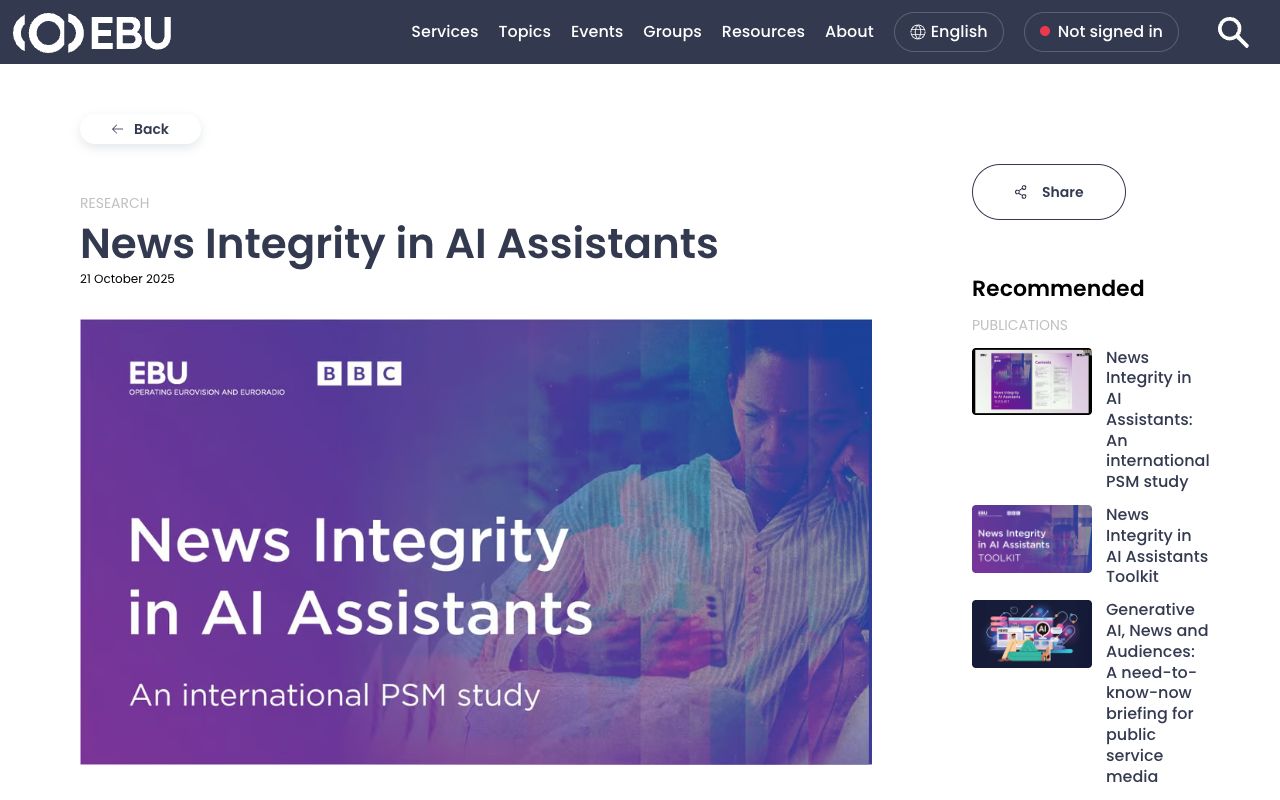
Good Representation is a description you would sign: right category, current pricing model, the customers you serve. Bad Representation runs from stale facts to a summary that opens with complaints, and assistants are not reliable narrators by default. The EBU and BBC study "News Integrity in AI Assistants", published October 21, 2025 after broadcasters in 18 countries reviewed more than 3,000 responses from ChatGPT, Copilot, Gemini and Perplexity, found that "almost half of all AI answers had at least one significant issue" and "a fifth contained major accuracy issues, such as hallucinated and/or outdated information."
Kairosy's scan of Descript (August 5, 2026) logged a ChatGPT answer describing "confusing or opaque billing/credit usage, with some users saying they were charged for extra seats or burned through AI credits faster than…". Whether or not that reflects the current plan, it is now the pricing story a buyer hears first.
The fix is a canonical facts surface the model can retrieve: a pricing page with a visible "last updated" date, a plain statement of who the product is for and what it is not, and consistent naming everywhere. Google's AI features documentation (updated December 10, 2025) says "there are no additional requirements to appear in AI Overviews or AI Mode"; the work is clarity, not new markup. If a same-name company exists, add one disambiguation line to the about page.
How do you optimize Comparison: how does the AI weigh you against rivals?
Comparison is where AI does its most consequential work: in the same G2 report, half of buyers said AI had its greatest impact when comparing and narrowing vendor options. Good Comparison means the model uses criteria you win on. Bad Comparison means the category is framed around a rival's feature set, and what you lack becomes the headline.
Kairosy's scan of Framer (August 5, 2026) shows the pattern at 100% Visibility: Claude summarized Webflow as "Best for design control and CMS power, especially if you need relational content collections and dynamic filtering that Framer lacks." One clause did the framing, and Framer's own strengths never got a sentence.
Two actions move this layer. Publish comparison pages with criteria you are willing to lose on as well as win on; a page that concedes a rival's advantage tends to be quoted for the rows it wins. Then track share of voice per topic, which competitor is named beside you on which prompts and engine, as Kairosy's Competitors module does, and write the topic gaps it lists. For the perception side, see how AI sees your brand.
How do you optimize Recommendation: does the AI actually pick you?
Passing Discovery does not mean passing Recommendation. The table lists six brands from Kairosy's public reports, scored 0–100 as the average of the per-engine scores of the engines that answered, with the share of answers naming the brand (Visibility) and the share recommending it (Recommend rate).
| Brand (scan date) | Visibility | Recommend rate | Score | Verdict |
|---|---|---|---|---|
| Klaviyo (2026-08-05) | 92% | 38% | 56 | At risk |
| Gorgias (2026-08-05) | 100% | 46% | 69 | At risk |
| Framer (2026-08-05) | 100% | 50% | 66 | At risk |
| Wise (2026-08-10) | 96% | 50% | 64 | At risk |
| Printful (2026-08-05) | 92% | 54% | 67 | At risk |
| Descript (2026-08-05) | 96% | 54% | 66 | At risk |
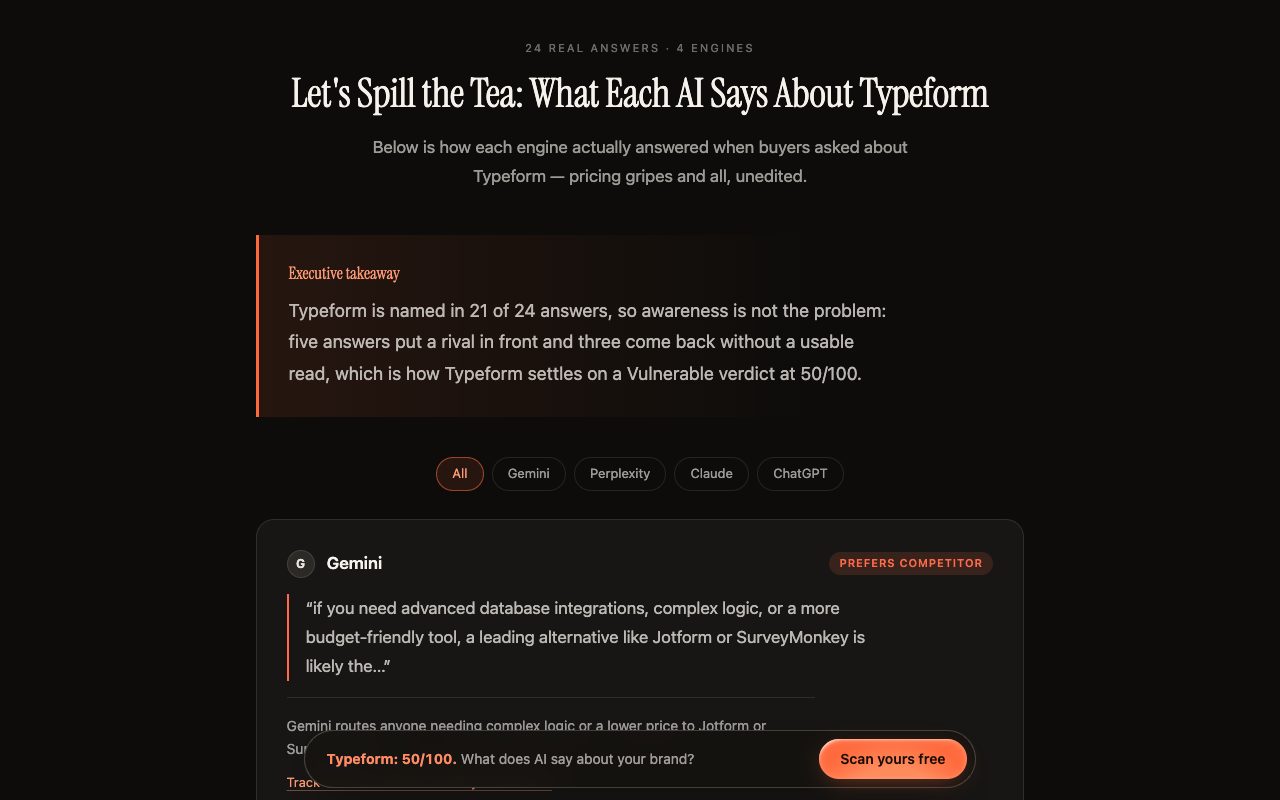
Every brand there is named in over nine answers out of ten and recommended in about half or fewer. The gap has two shapes. A rival picked for a segment: in Klaviyo's report, Gemini wrote, "If you have a service-based business or a tighter budget, Mailchimp is often better due to its lower cost and simpler setup." Or no pick at all: in Wise's report, Claude answered, "Your best choice depends on your needs—whether you prioritize speed, low fees, multi-currency features, or specific transfer methods."
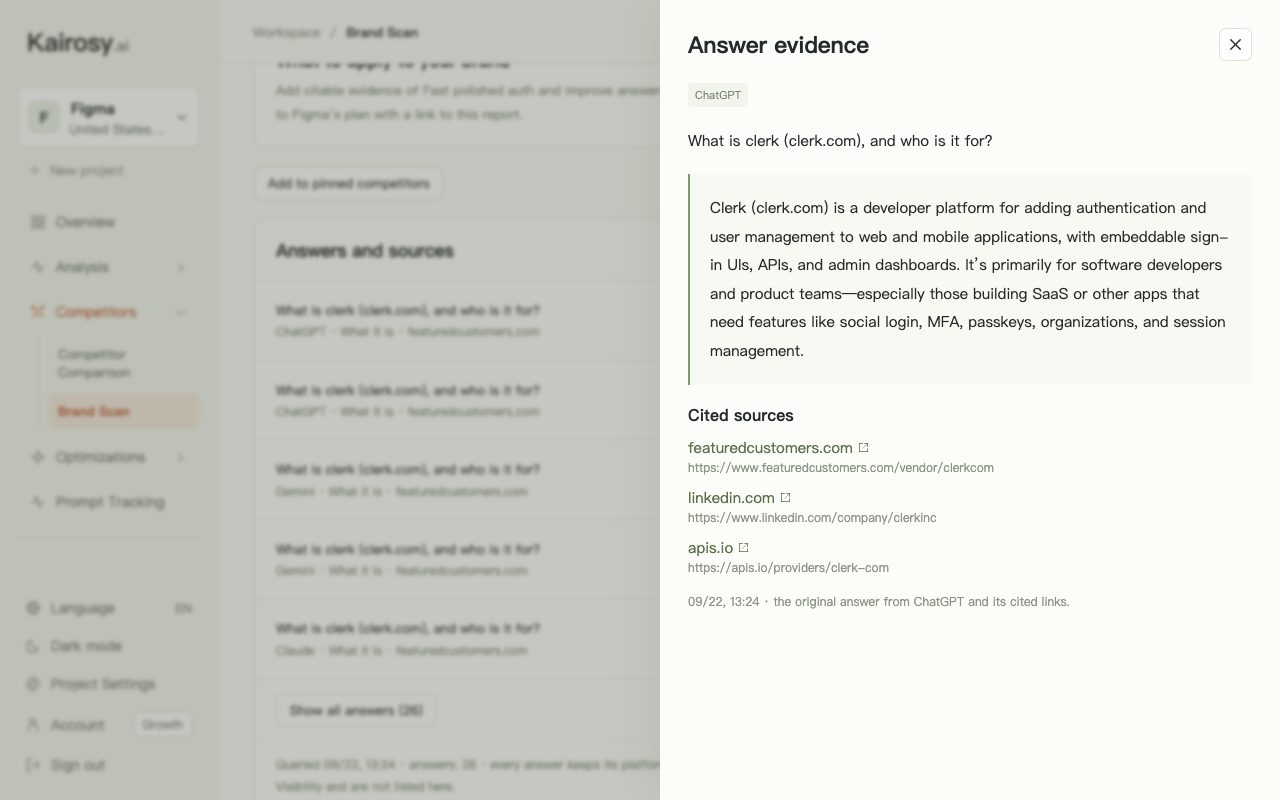
Good Recommendation is specific: the model names you for a defined buyer, with a reason it can repeat. To earn that, publish segment-level claims in plain sentences, back them with case studies that carry numbers, and resolve the one complaint that keeps producing the "but" clause; if that is pricing clarity, a pricing page rewrite outranks a new feature.
How do you optimize Trust: which sources does the AI lean on when it talks about you?
Trust underlies the other four layers: every description, comparison and recommendation is assembled from sources, and those sources are not the pages that rank. Ahrefs' study of 15,000 long-tail queries, published August 11, 2025, found that "only 12% of links cited by ChatGPT, Gemini, and Copilot appear in Google's top 10 results for the same prompt", with Perplexity the outlier at roughly 28.6%.
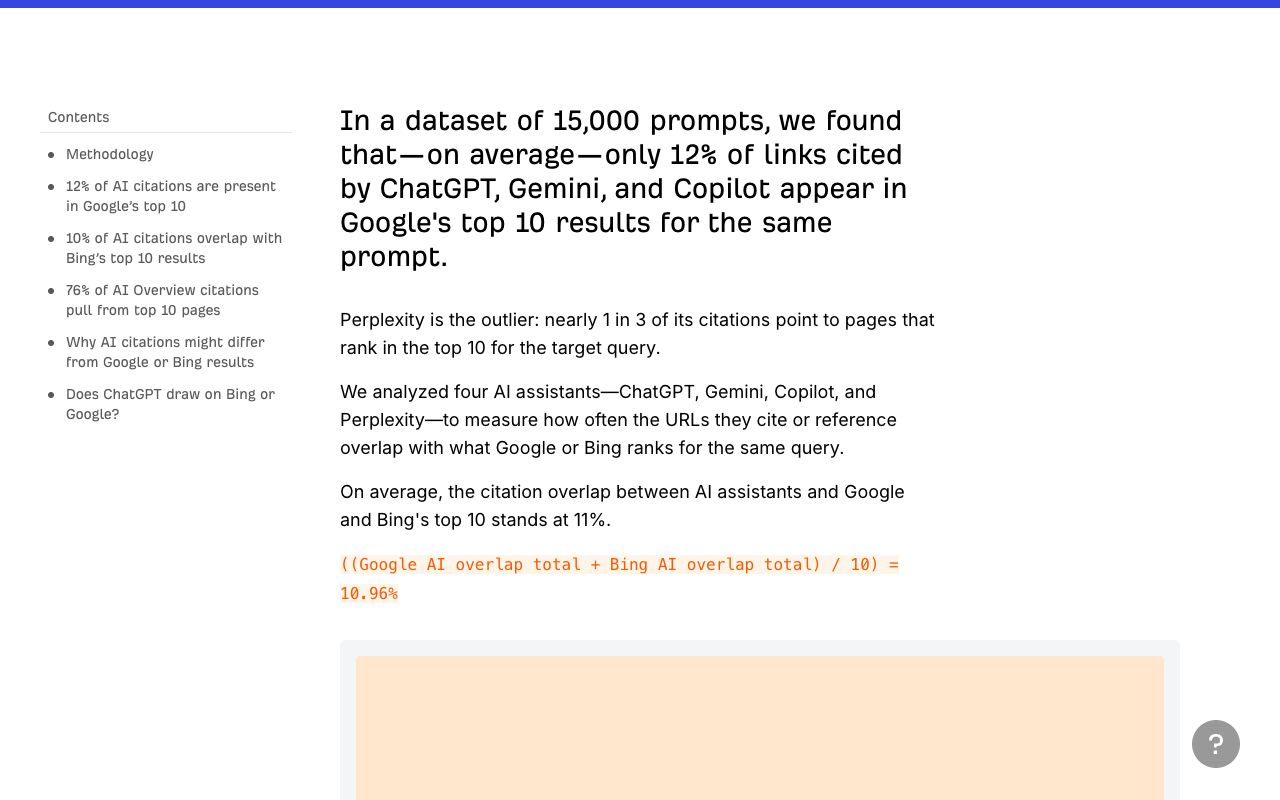
The mix differs by engine. Profound's analysis of 680 million citations from August 2024 to June 2025, published June 5, 2025, put Wikipedia at 7.8% of ChatGPT's citations while Reddit led Perplexity at 6.6%. And G2's 2026 report notes review sites edged past AI chatbots as the top source shaping shortlists, 38% to 37%; the chatbots read those same review sites.
Bad Trust is one unvetted source becoming your narrative. Kairosy's scan of Gorgias (August 5, 2026) recorded a ChatGPT answer citing "ticket-based billing, overage charges, and reports that AI resolutions can be billed twice"; "reports that" signals a relayed claim, and a Gemini answer in the same scan drew on evolveamz.com, a third-party site, rather than the vendor's pricing page.
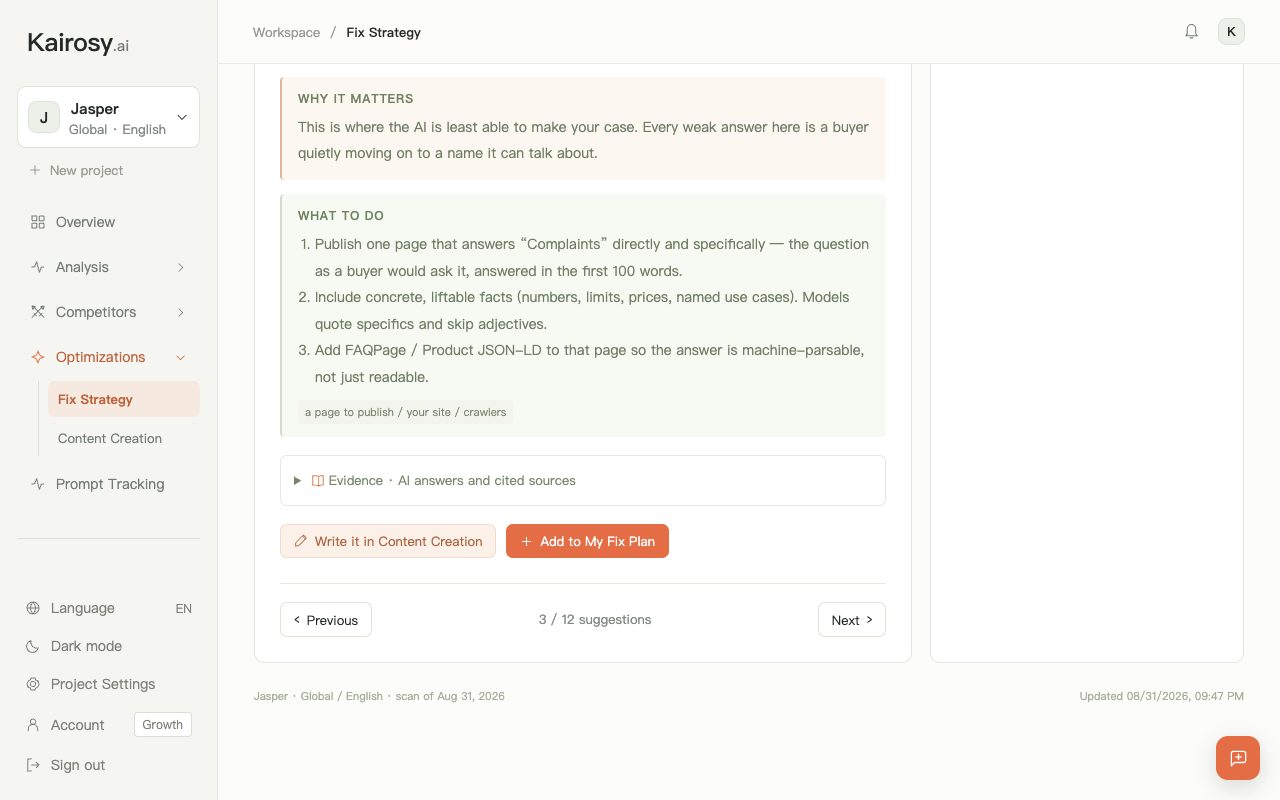
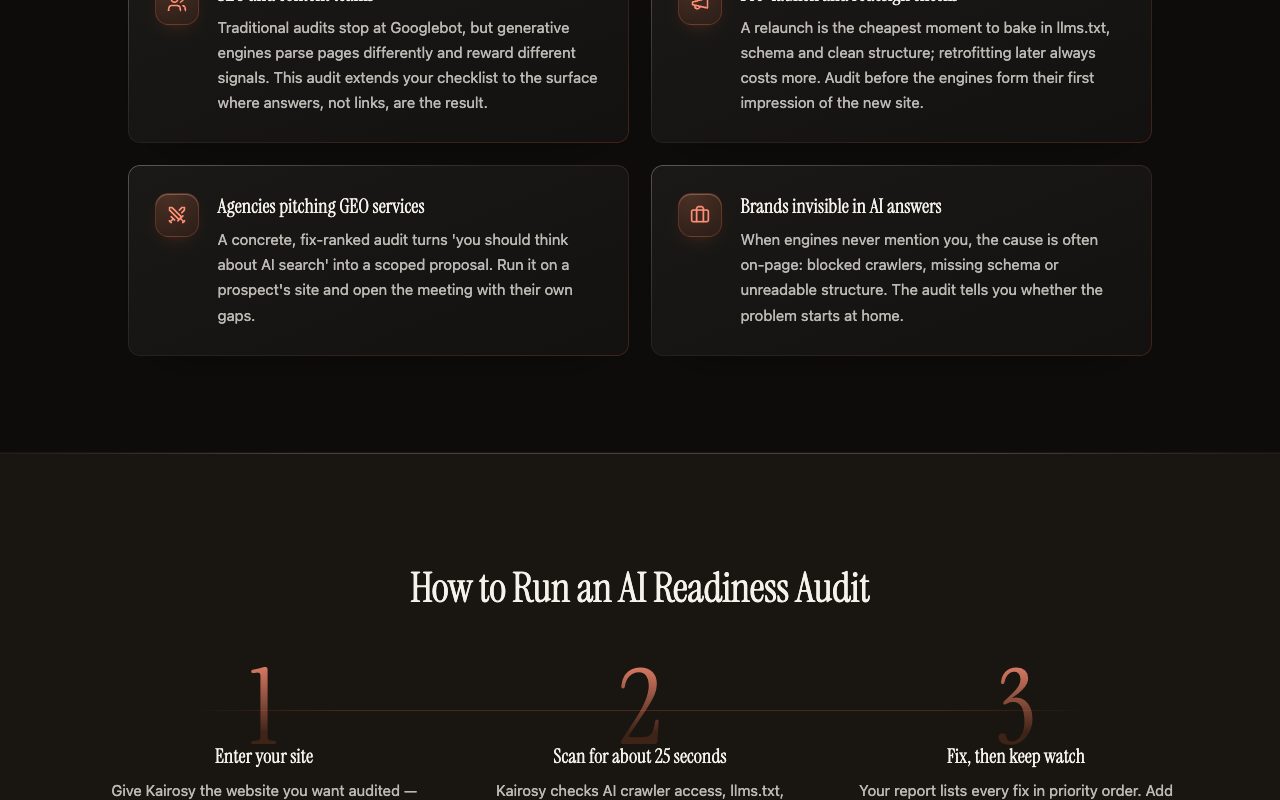
The fix starts with reading the citation list on every answer, then working the sources one by one: a review-platform reply, an updated forum thread, a corrected listing. On your own domain, make security, pricing, about and comparison pages fetchable and give them valid structured data, which the free schema markup checker verifies; the AI-Ready Page Audit runs 33 checks across access, readability, structured data, citability and trust for one URL, with a diff against your previous audit.
How do you run AI brand experience optimization week to week?
The five layers are a diagnosis. Running the work looks like this.
- Baseline scan. Ask the same buyer questions on ChatGPT, Gemini, Claude and Perplexity, classify each answer positive, neutral or negative with the reason, and keep the real citation URLs.
- Assign each finding to a layer. A missing mention is Discovery. A wrong price is Representation. A rival framed as the safer choice is Comparison. "Depends on your needs" is Recommendation. A cited affiliate blog is Trust.
- Track prompts daily, re-scan weekly. Tracked prompts run daily on paid plans, and each tracking slot (one brand in one market) is re-scanned every Monday, with alerts for new negative keywords, a competitor becoming the preferred pick, a score drop or an engine flipping sentiment.
- Work the Fix Plan, then re-check. Publish the prioritized fix, wait for the next Monday scan, and compare per engine, because engines move at different speeds.
As of September 2026, Kairosy's signup is a 7-day trial with full reports and no credit card; after it, new scans need a paid plan ($29, $99 or $399 per month for 3, 6 or 20 tracking slots), and past reports stay readable. For the vocabulary, see what AI brand sentiment means and how the awareness funnel is measured; the wider loop is covered in what AI reputation management is.
AI brand experience optimization FAQs
Is AI brand experience optimization the same as generative engine optimization (GEO)?
GEO is the technique set for getting content retrieved and cited by generative engines, which mainly serves Discovery and Trust. AI brand experience optimization is the outcome view: it also asks whether the description is accurate, how you are compared and whether you are recommended. You can win citations and still be the expensive option nobody picks.
Which layer should you fix first?
Whichever the scan shows failing earliest in the order. Absent from unbranded answers? Nothing downstream matters yet. Visible but described with stale facts? Fix Representation before spending on comparison content. Most highly visible brands find their first real problem at Recommendation or Trust.
How long does it take for AI answers to change after a fix?
No source promises a fixed interval. Answers built on live retrieval can reflect a changed page or a new review thread within days, while facts a model absorbed in training move more slowly. The honest method is a weekly re-scan of the same prompts, compared per engine.
Do ChatGPT, Gemini, Claude and Perplexity need different work?
Partly. The Profound and Ahrefs data above show different source mixes per engine, so Trust is engine-specific: a Wikipedia-grade reference helps more on ChatGPT, community threads more on Perplexity. Representation and Recommendation fixes on your own pages carry across all four.
See what AI says about your brand
Run a free scan across ChatGPT, Gemini, Claude & Perplexity in about 30 seconds.
Run my free scan