Answer Engine Optimization Tools That Execute the Fix (2026 Guide)

Answer engine optimization tools come in two kinds, and only one of them moves an AI answer: the kind that edits a page, pushes a listing, collects a review or lands an earned mention. This guide covers that execution kind — tools sorted by what they change (visibility, sentiment, reputation), every price checked on October 21, 2026 — then closes with a task sheet that takes one negative answer through to a shipped content change, and a column for how far each tool carries it.
For the taxonomy and the monitoring dashboards themselves, read the companion AEO tools guide; this post does not repeat them.
Why Do Answer Engine Optimization Tools Split Into Monitoring and Execution?
A monitoring tool re-asks your questions and reports what came back; it changes nothing. An AI answer is built from three inputs, and an execution tool has to touch one of them: the pages the engine can fetch, what those pages say, and what third-party pages say about you.
The fetch layer is documented by the engines. OpenAI's crawler documentation separates GPTBot (training) from OAI-SearchBot and states that "sites that are opted out of OAI-SearchBot will not be shown in ChatGPT search answers." Perplexity's bot guide draws the same line between PerplexityBot and the user-triggered Perplexity-User fetcher. Block the wrong agent and no content tool can help.
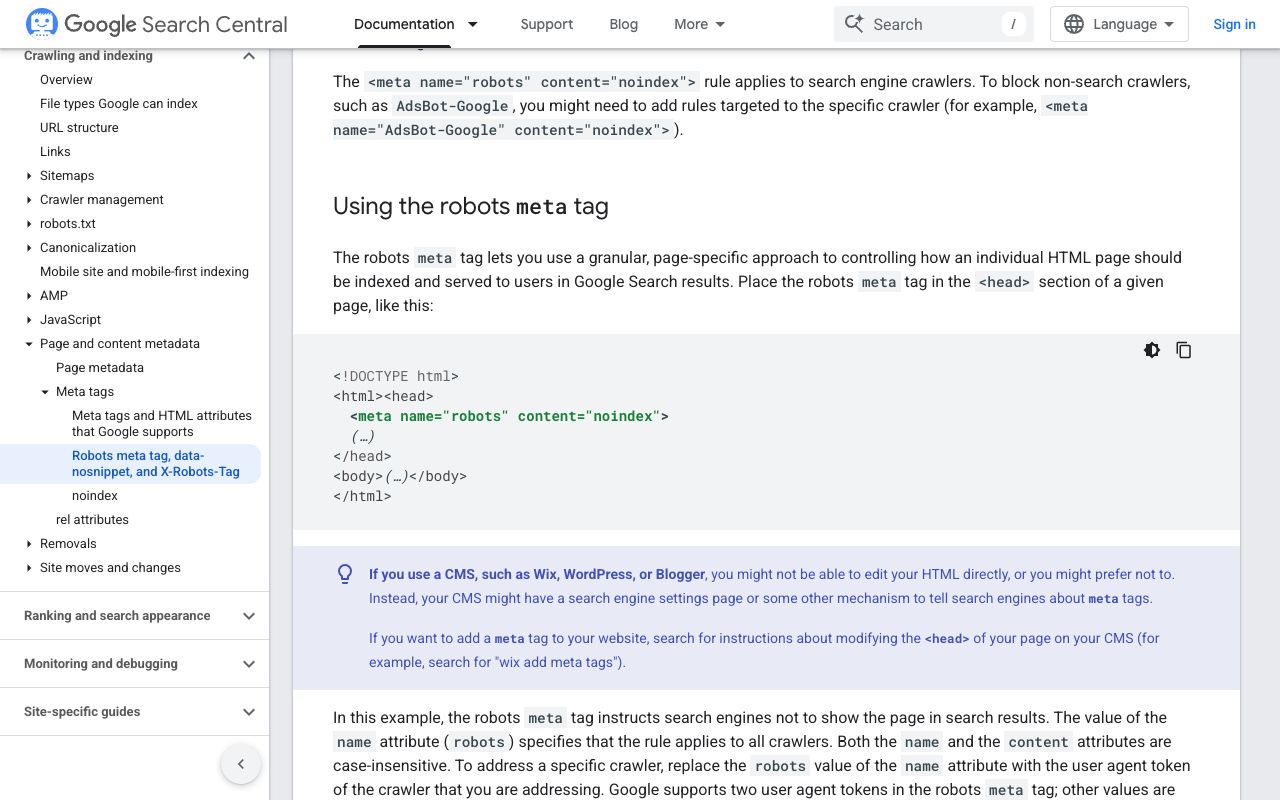
The content layer is where the budget goes. The GEO paper by Aggarwal et al. (Princeton, posted November 16, 2023, revised June 28, 2024) reports that generative engine optimization "can boost visibility by up to 40% in generative engine responses." Google's documentation says nothing extra is required for a page to appear in AI Overviews or AI Mode and names no special schema.org structured data — the lever is the page, not a file beside it.
So: a monitoring tool picks the gap and proves the change held; an execution tool makes the edit, on one of four surfaces:
- Your pages — articles, rewrites, structured data, crawl access.
- Your review profiles — invitations and replies where engines cite reviews.
- Your listings — one set of facts pushed to the directories engines read.
- Earned mentions — quotes and coverage on sites you do not own.
Which Answer Engine Visibility Optimization Tools Publish, Fix or Mark Up the Page?
Answer engine visibility optimization tools earn their price by changing a URL. Three paid tools below do that differently — new pages, rewritten pages, structured data — and a fourth group is free.
Writesonic — new AI articles, site audits and a trial-size Action Center
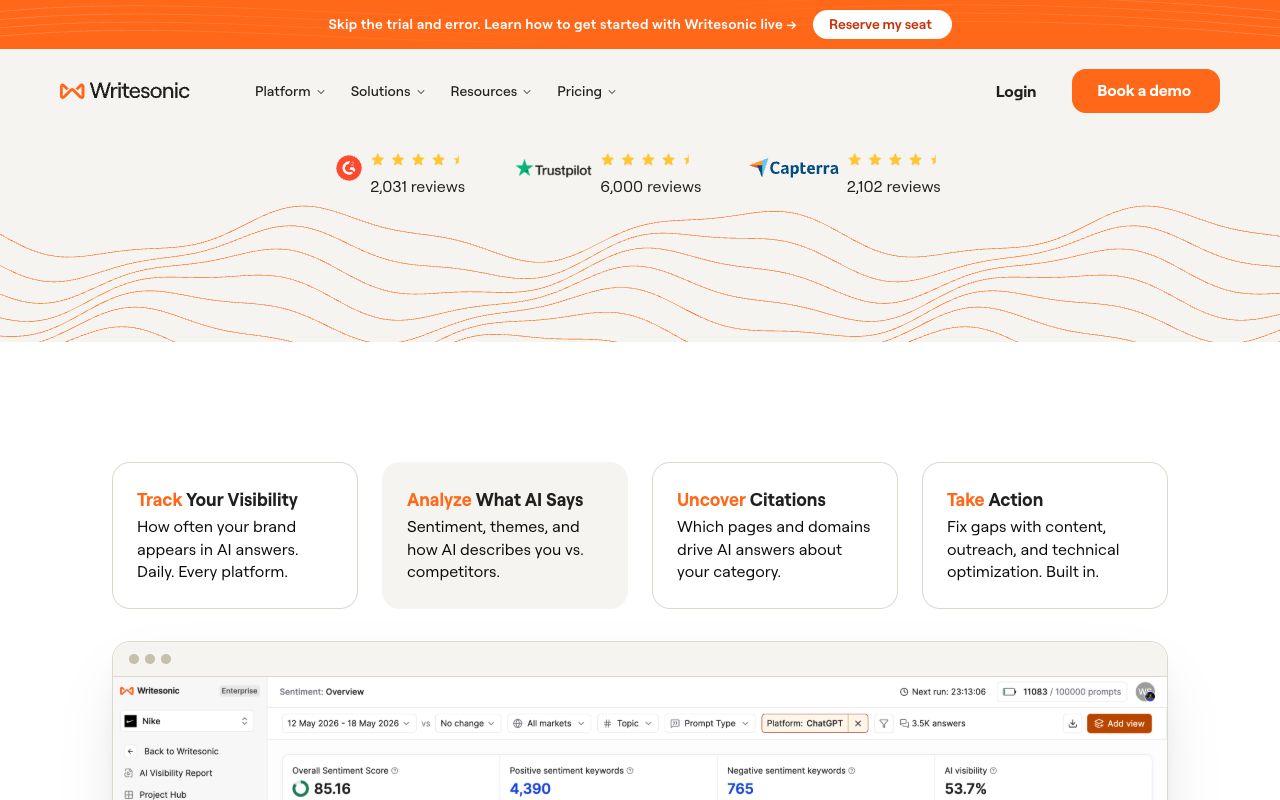
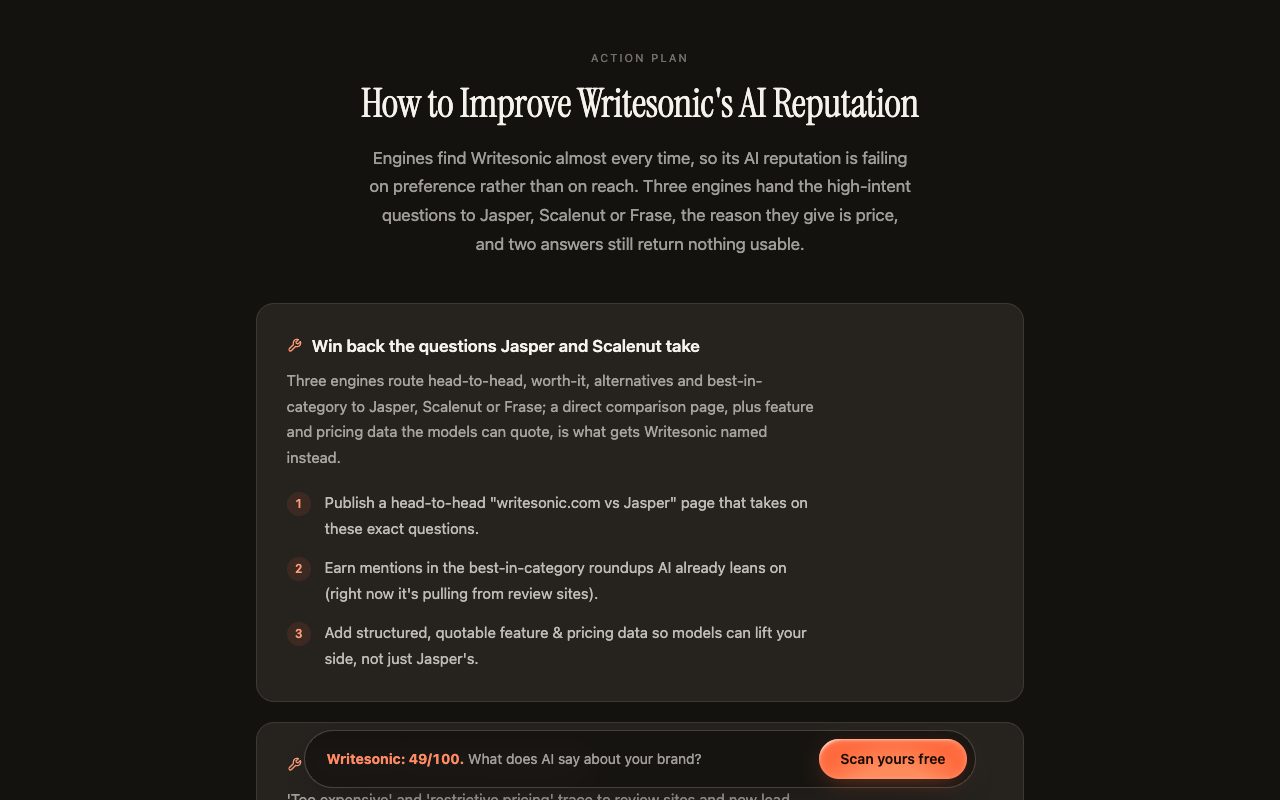
Writesonic sells execution by volume. On its pricing page, Starter is $79, Basic $199 and Growth $399, each shown "per month, billed annually". Those tiers include 15, 25 and 50 AI articles a month and 10, 20 and 50 site audits, beside 50, 100 and 200 tracked prompts across ChatGPT, Gemini and AI Overviews. Growth adds sentiment analysis and an "Action Center trial (5 off-page + 5 on-page)" — an allowance, not unlimited actions. No card for the trial.
It drafts the article and runs the audit; you still publish. One caution from Kairosy's public scan of Writesonic (49/100, 92% AI visibility): the engines know the brand well; the damage is a "credit-based pricing" narrative in cited reviews, which more articles would not fix.
Surfer — AI Tracker's Optimize button rewrites the cited page
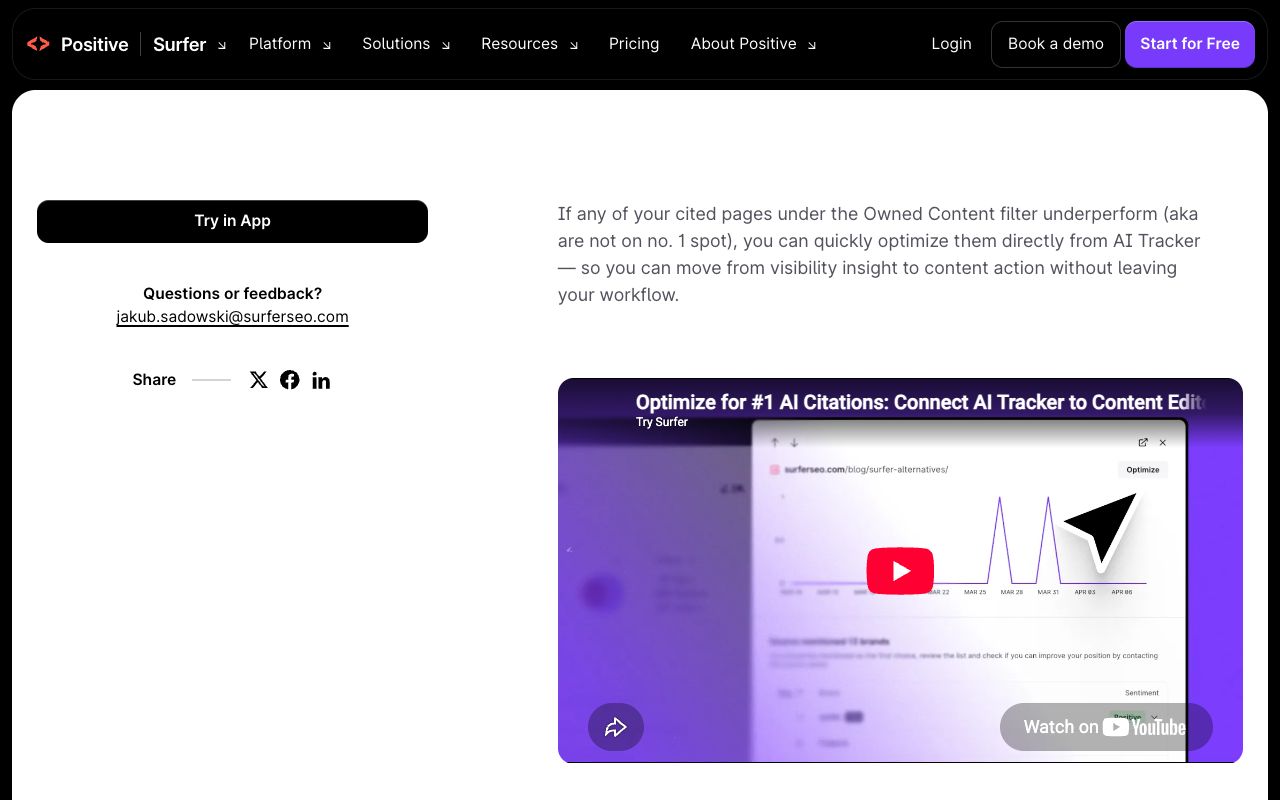
Surfer's March 10, 2026 update wired AI Tracker into Content Editor: the Sources tab lets you "filter by your domain" to see which of your pages are already cited, and an Optimize button opens the weak one in Content Editor, where Auto-Optimize rewrites it "for improved AI search citations and higher rankings in Google." That is the shortest path from "cited but outranked" to a rewritten page.
Pricing is shown billed yearly: Discovery $49 (120 documents, no AI tracking), Standard $99 (360 documents, 25 AI prompts across ChatGPT), Pro $182 (50 prompts refreshed daily), Peace of Mind $299 (100 prompts). It tracks AI Overviews, AI Mode, Gemini, Perplexity and ChatGPT; trial length is not stated.
WordLift — schema and knowledge-graph automation at enterprise pricing
WordLift writes the structured data for you. Business+ ($1,100 a month billed monthly, $879 billed yearly) covers 2,500 URLs and bundles schema markup, a knowledge graph, content creation, Q&A generation and internal linking; Enterprise is on quote. Its Resolve() API, in public beta, gives 1,000 free requests a month to link brands and products to Wikidata IDs.
Buy it for entity disambiguation, not as a lever for Google's answers. To see what a page already declares, the free schema markup checker takes seconds.
Free answer engine optimization tools worth running first
Free answer engine optimization tools check readiness rather than answers, which is the right first step. Kairosy's AI crawl checker tells you whether AI crawlers such as GPTBot and PerplexityBot are allowed on a URL; the llms.txt generator builds the file if you want one; the reading level checker flags pages written harder than a quick answer needs. WordPress sites get llms.txt from Yoast SEO ("built into Yoast, free for everyone"). None of these measure what an engine says.
One workflow platform gets a line but no price: AirOps lists Solo (35,000 tasks), Pro (100,000 tasks) and Enterprise tiers without dollar figures.
Which Brand Sentiment Optimization Tools Change What AI Engines Read About You?
Sentiment lives in two places: the third-party pages an engine cites (review sites, comparisons, forums) and whether your own pages answer the objection those pages raise. Brand sentiment optimization means fixing both; the two tools below split along that line.
Kairosy — negative narratives into task cards, drafts and a daily re-test
Kairosy starts from the answer, not the page. A scan asks real buyer questions on the engines you pick (Claude, ChatGPT, Gemini, Perplexity, DeepSeek and Doubao — any four per project), keeps every full answer with its cited sources, classifies sentiment per answer and groups the negatives into named narratives. Fix Strategy turns each narrative into a checklist card; the ones you accept go into a weekly fix plan.
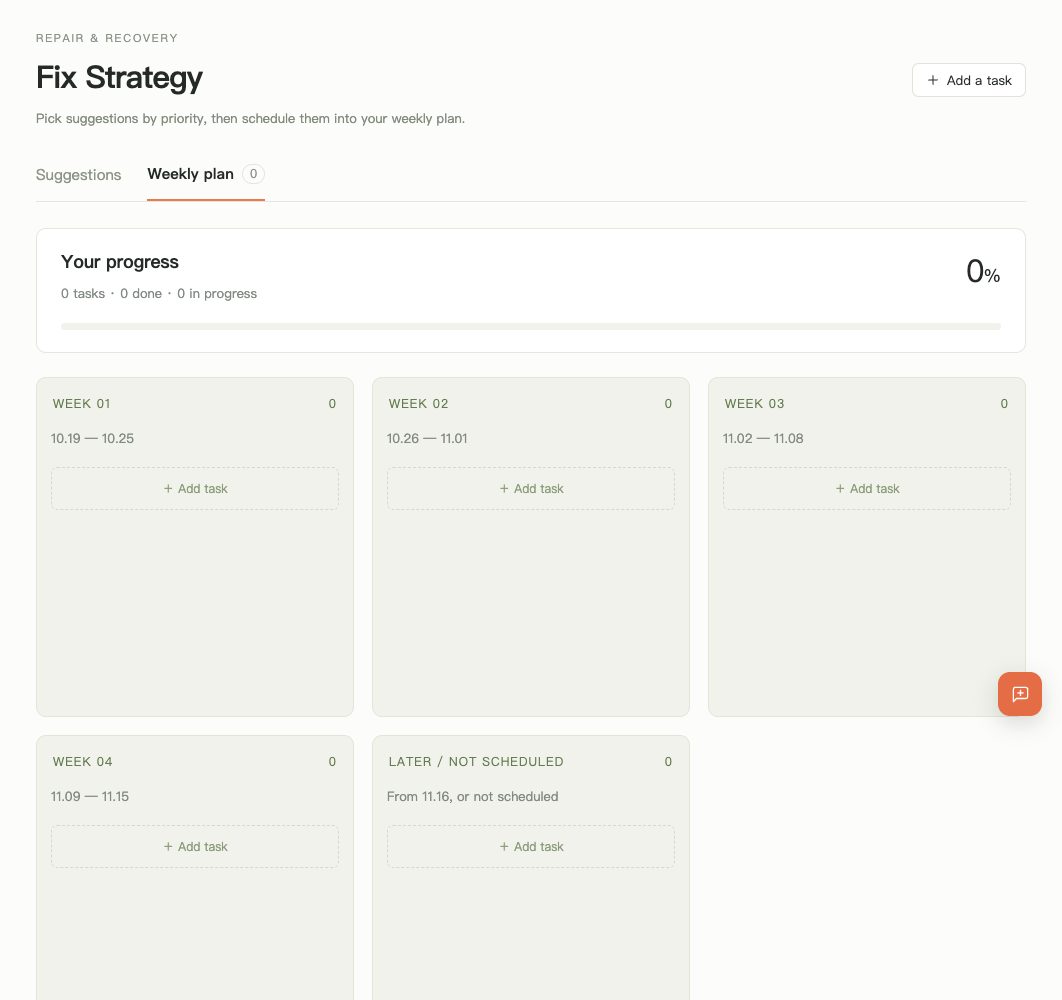
Execution is Content Creation: outlines, optimizations and articles drafted from the narrative and its evidence, metered in content points — 15 a month on Basic ($29), 60 on Pro ($99), 240 on Growth ($399); on annual billing those become $25, $79 and $299. The re-test is built in: tracked prompts re-run daily with a seven-run history per engine, every project is deep-rescanned on Mondays, and a weekly email calls out a score drop, a rival the engine now prefers, an engine that flipped or a new negative keyword. Alerts come weekly, not as they happen; there is no owner field. The seven-day trial asks for no card.
Trustpilot — invitations and replies on a domain the engines already cite
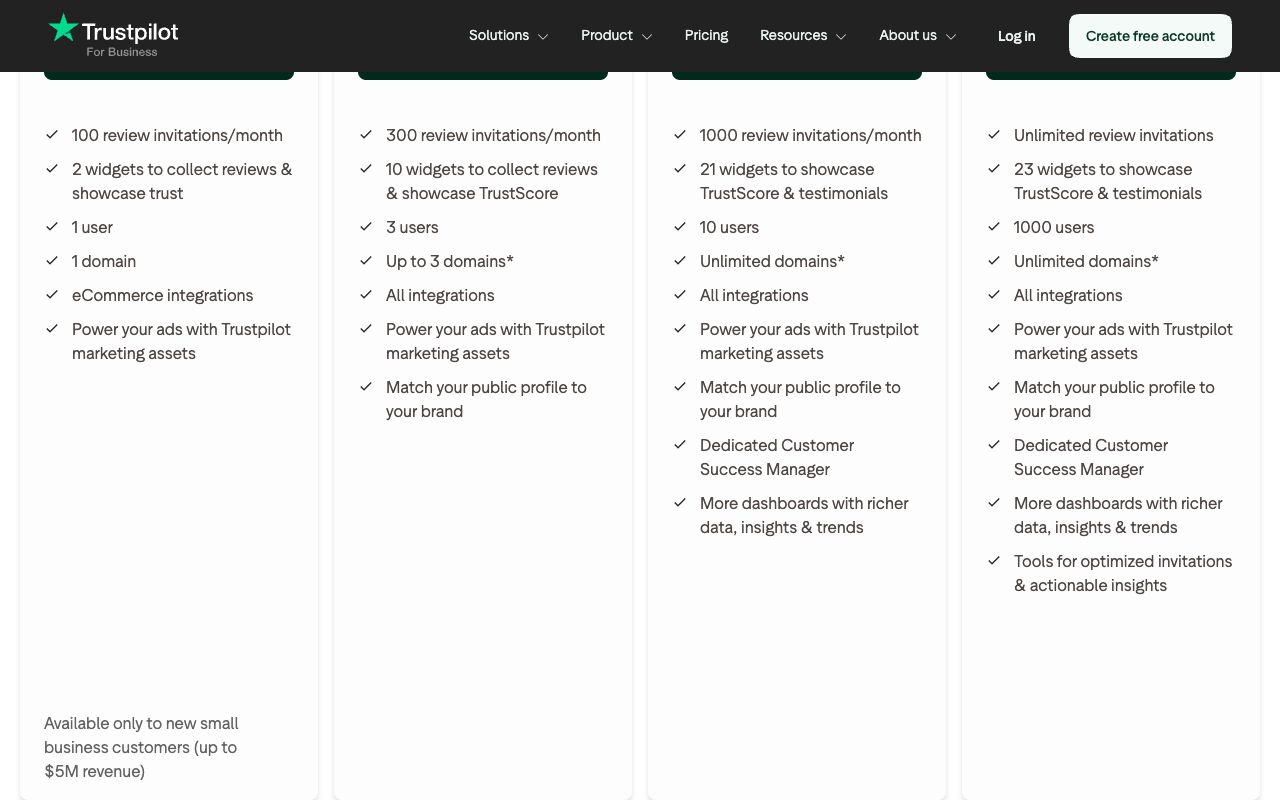
When review sites show up among cited sources, the fastest sentiment lever is the profile itself. Trustpilot's business plans execute two things: invitations and replies. Free gives 50 invitations a month plus reply and flag rights; Starter is "from $99 per month, per domain, billed annually" with 100 invitations, for new small-business customers up to $5M revenue only; Plus is from $319 (300 invitations, "AI Search Analytics"); Premium from $799 (1,000 invitations, "Topics report & sentiment analysis"). Enterprise is quote-based.
Birdeye (AI-drafted review responses plus listings) suits multi-location businesses, but its pricing page is a quote form with no figures.
Which AI Brand Reputation Optimization Tools Fix Listings, Reviews and Earned Mentions?
Reputation, as an engine sees it, is the facts and endorsements it finds on pages you do not control, so AI brand reputation optimization executes off-site: consistent facts in directories, earned mentions on authoritative sites.
Yext Listings — one set of facts synced to 70+ directories
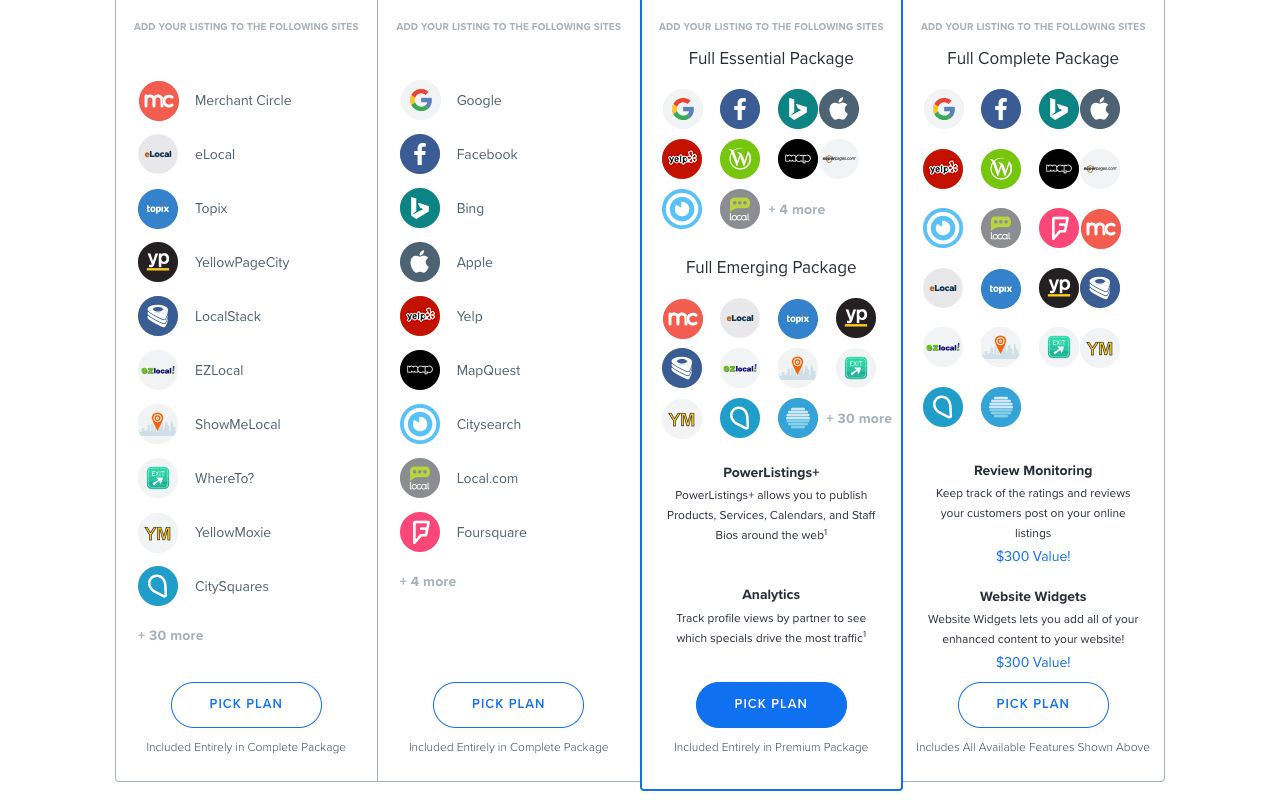
Engines that fetch Yelp, Apple or Bing read whatever is there; inconsistent hours become inconsistent answers. Yext's single-location plans are billed annually: Emerging $199 a year (shown as $4 a week, 40+ sites), Essential $449 (Google, Bing, Apple, Yelp and more), Complete $499 (70+ sites), Premium $999 (adds review monitoring and widgets); above 10 locations you book a demo. What it executes is the sync itself, one record to every directory.
Featured.com and Qwoted — earned quotes on sites you do not own
The roundups an engine cites were written by someone; expert-source platforms put you in front of that someone. Featured.com is $0 on Free with a daily pitching allowance, $29 a month on Lite billed annually ($39 monthly) and $79 on Pro ($99 monthly). Qwoted gives 2 pitches a month free with a two-hour delay, or 35 a month on Pro at $149.
These are slow levers (a quote takes weeks to publish and be re-fetched), so aim them. Kairosy's Source Analysis page lists the domains your answers cite today, which is the pitch list; the full prioritization method is in our AI brand reputation framework.
How Do You Take One Negative AI Answer Through the Task Sheet, and How Far Does Each Tool Carry It?
Five columns, one row per negative answer: the question that produced it, the evidence (engine, date, quoted claim, cited source), an owner, the change you will ship, and the re-test condition that counts as a pass. Northwind and Contoso are fictional brands; every cell is an example value, not a measured result.
| Question (example) | Evidence (example) | Owner | Change | Re-test condition |
|---|---|---|---|---|
| "Is Northwind CRM worth it for a 10-person sales team?" | Perplexity, Oct 14 run: "reviewers flag surprise renewal charges," citing a 2024 G2 review | Billing lead + content | Publish /pricing/renewals with the 30-day reminder policy; reply to the three G2 reviews about renewals | No "surprise renewal" phrasing in 5 of the next 7 daily runs; new page cited once |
| "Northwind vs Contoso CRM for startups" | ChatGPT recommends Contoso in 3 of 7 runs, citing a comparison blog with Northwind's 2023 pricing | Product marketing | Publish a dated head-to-head page with current pricing; pitch a correction to the blog's author | Northwind mentioned in 5 of 7 runs; 2023 figure gone from cited sources for two weeks |
| "Does Northwind integrate with QuickBooks?" | Gemini: "no native integration"; Northwind absent in 4 of 7 runs; cites an outdated help article | Support docs owner | Rewrite the help article with the integration in the H1 and first sentence; link it from /integrations | Gemini names Northwind and the integration in 4 of 7 runs; help article cited |
The re-test condition is the column people skip, and the one that stops arguments: engines vary run to run, so one good answer proves nothing and a count over seven daily runs on a fixed question does.
Now how far each tool carries that sheet. Legend: ✓ supported, ◐ partial, — not offered, n/s not stated on the vendor's page (October 21, 2026).
| Tool | Finds the negative answer | Keeps evidence (answer + cited source) | Assigns an owner | Drafts or executes the change | Re-tests the same question |
|---|---|---|---|---|---|
| Kairosy | ✓ Negative Narratives | ✓ answers + sources | — no owner field | ✓ checklist cards, drafts | ✓ daily, 7-run history |
| Writesonic | ✓ prompts; sentiment on Growth | n/s | — | ✓ articles, audits, Action Center trial | ✓ cadence n/s |
| Surfer | ✓ AI Tracker | ◐ cited pages only | — | ✓ Auto-Optimize | ✓ daily on Pro and up |
| WordLift | — | — | — | ✓ schema, entities, Q&A | ◐ rank tracking only |
| Trustpilot | ◐ Premium topics report | — | — | ✓ invitations, replies | — |
| Yext Listings | — | — | — | ✓ listings sync | — |
| Featured.com / Qwoted | — | — | — | ✓ earned quotes | — |
The owner column is empty for every tool. That is the finding: no answer engine optimization tool here manages who does the work, so the sheet lives in your project tracker. The practical stack is one tool that holds evidence and re-tests (Kairosy), one that edits the page (Surfer, Writesonic or your CMS) and the platform tools for listings, reviews and press. For the fixes behind each row, read how to fix negative brand sentiment in AI; for the service-level view, AI reputation management.
Answer Engine Optimization Tools FAQs
What is the difference between answer engine optimization tools and monitoring tools?
Monitoring tools re-ask the same questions on a cadence and report mentions, citations and sentiment. Answer engine optimization tools change an input to the answer: a page, a crawl rule, a schema block, a listing, a review profile or an earned mention. Most paid products do some of both, and no single one covers brand sentiment optimization and AI brand reputation optimization end to end.
Are there free answer engine optimization tools that change something, not just check it?
In small doses. Yoast SEO generates llms.txt free on WordPress; Kairosy's free tools check crawl access, schema and reading level; Trustpilot Free sends 50 review invitations a month; Featured.com Free and Qwoted's 2 free pitches earn quotes. What stays paid is the loop: keeping answers with sources and re-testing daily.
How to optimize for answer engines with one writer and no suite budget?
Run the crawl checker on your ten most important URLs and fix any blocked agents. Then pick one negative answer, fill in the task sheet, publish one page that answers the objection with dated facts, reply to the reviews that seeded it, and re-ask the question for seven days before touching anything else. On-page methods are in our answer engine optimization guide.
Does schema markup or llms.txt improve AI visibility?
Not for Google's answers, by Google's own documentation, which says no special markup or machine-readable files are required. Schema still helps engines disambiguate entities, and llms.txt costs nothing. Crawl access is the real gate, as OpenAI's note on OAI-SearchBot opt-outs shows.
How long before a re-test shows the change?
No vendor on this list publishes a figure, and we will not invent one. Engines must re-fetch the page and models update on their own schedules, so judge by counts over seven daily runs, not one good answer; an engine flip in the weekly email is the cue to re-read the sheet.
See what AI says about your brand
Run a free scan across ChatGPT, Gemini, Claude & Perplexity in about 30 seconds.
Run my free scan