Why Is My Brand Not Showing Up in ChatGPT? 5 Cases and 5 Fixes (2026)
Your brand is not showing up in ChatGPT for one of five reasons, and each one needs a different fix. Spend ten minutes on three prompts before you touch a page: "missing" covers everything from "the model has never heard of you" to "you appear in one run out of five", and a fix aimed at the wrong step wastes a quarter.
This post is the diagnosis. Two sibling posts cover the rest: why your brand is invisible to AI buyers explains the structural reasons, and how to check if ChatGPT recommends your brand is the measurement routine. This one is a five-row table with a confirming prompt and a fix per row.
Why Is My Brand Not Showing Up in ChatGPT? Missing vs Rejected
Missing and rejected are different problems. Rejected means ChatGPT knows you, puts you in the running, and steers the buyer elsewhere with a reason: a pricing complaint, a support story, a "better for larger teams" verdict on a rival. That is a sentiment problem, handled in how to fix negative AI mentions.
Missing means the answer never reaches you. When people ask "why is my brand not showing up in ChatGPT", they are almost always here, and there are five failure points on the path from "the model can resolve the entity" to "the model names it every time": recognition, category association, the recommendation set, attribution, stability. Collecting reviews while the model cannot resolve your company name is money spent on step three while you are stuck on step one.
One mechanical detail shapes the test. OpenAI's crawler documentation separates training (GPTBot) from search (OAI-SearchBot), so a brand can be unknown with search off yet appear with search on, or the reverse. Test both states every time.
Which of the 5 Missing-Brand Cases Are You In? (Diagnosis Table)
In a fresh ChatGPT session, run the prompt in the third column with web search on, then off. Repeat the category prompts five times and record the result before reading the fixes.
| Case | Symptom | Confirm with this prompt | Root cause | Fix |
|---|---|---|---|---|
| 1. Not recognized | "I don't have information about [Brand]", an invented description, or an answer about a namesake | "What is [Brand] ([domain])? What does it sell and who is it for?" | No consistent entity footprint, search crawler blocked, or pages unreadable without JavaScript | One canonical description everywhere, Organization schema, OAI-SearchBot allowed |
| 2. Known, not linked to the category | Describes you correctly, but never appears in "[category]" prompts and hedges when asked directly | "Is [Brand] a [category] product? Which category does it belong to?" | Positioning copy avoids the category noun; no third-party page places you in it | Category noun in title, H1 and first paragraph; directory categories; comparison pages |
| 3. In the category, never recommended | Confirms you are a valid option when named, but open recommendation prompts list 3 to 5 rivals | "Recommend three [category] tools for [use case] and explain why those." | Competitors dominate the consensus sources the answer is built from | Earn presence in the exact cited sources; use-case pages with specific numbers |
| 4. Cited, not named | Your URL sits in the sources list; the prose credits "guides", "experts" or a rival | The question your page answers, search on, then inspect the sources panel | Cited page reads as generic reference; the lifted passage carries no brand statement | Brand plus category sentence in the first 100 words; author and Organization markup |
| 5. Unstable | Named in one or two of five runs; present on one engine, absent on another | Same category prompt, five runs, search on and off | Marginal candidate inside a non-deterministic list; thin signal density | Measure mention rate, not single runs; deepen coverage in already-cited sources; track daily |
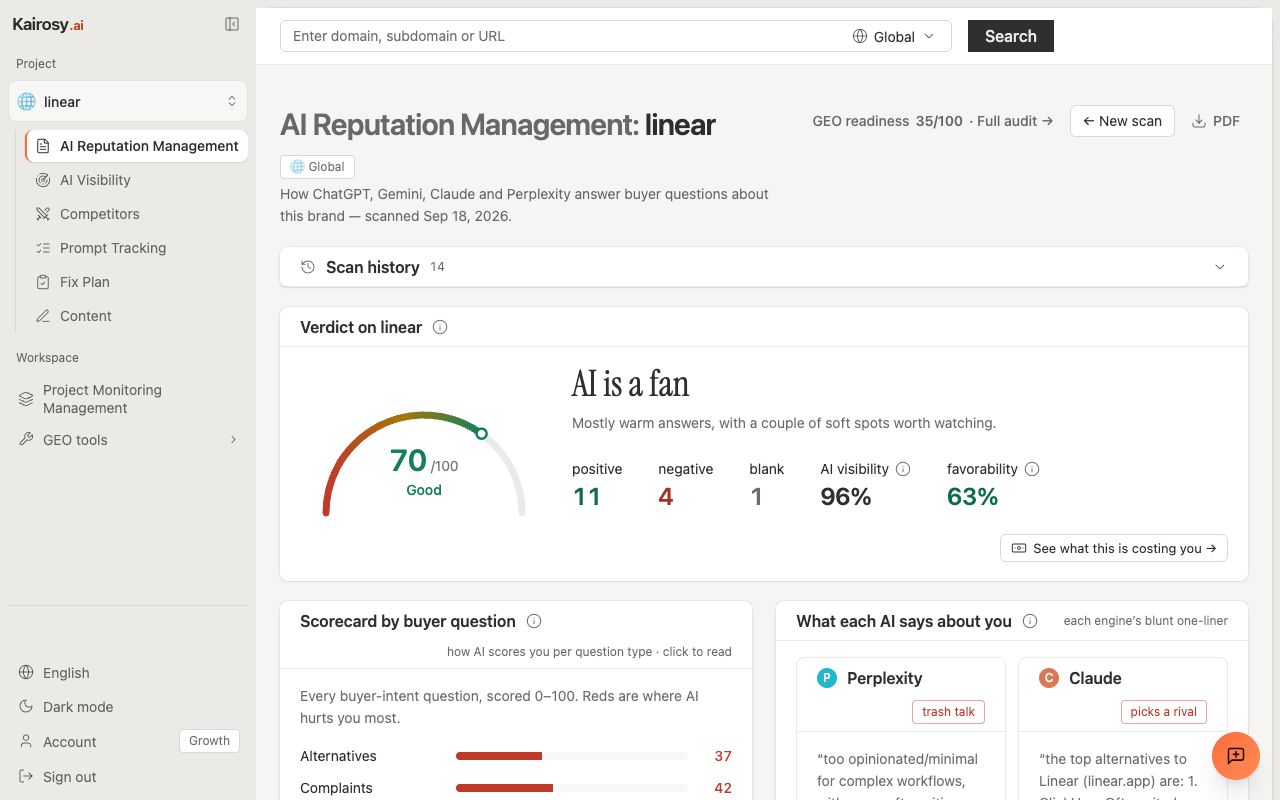
One report can hold several cases at once. Kairosy's scan of Siftly scored 54/100 with 6 invisible answers out of 24: Claude replied "I'm not familiar with a specific brand called 'siftly.ai,' so I can't speak to that directly" while Perplexity scored the same brand 72. Case 1 on one engine, Case 3 on another, which is why you test per engine (Siftly report).
Why Does ChatGPT Not Recognize My Brand at All? (Case 1)
Symptom: you ask what your company does and ChatGPT apologizes, invents a description, or answers about a namesake. If the domain is in the prompt and it still fails with search on, the crawler probably cannot read your site.
Root causes, in the order they usually show up:
- A blanket "block AI bots" rule written for GPTBot also blocks OAI-SearchBot, so the search side of ChatGPT never sees a page.
- Your pages render client-side only, so a fetch returns a loading shell with no product text.
- Your entity footprint contradicts itself: LinkedIn says "growth platform", Crunchbase says "analytics", the homepage says "the future of work". Three descriptions, no entity.
| OpenAI user agent | What OpenAI says it does | What blocking it changes |
|---|---|---|
| OAI-SearchBot | "used to surface websites in search results in ChatGPT's search features" | Your pages cannot appear as sources when ChatGPT searches the web |
| GPTBot | "used to crawl content that may be used in training our generative AI foundation models" | Your content stays out of future training runs; search results are unaffected |
| ChatGPT-User | "for certain user actions in ChatGPT and Custom GPTs" | User-initiated page visits, for which OpenAI notes robots.txt rules may not apply |
Source: OpenAI crawler overview, checked September 2026.
The fix is an entity foundation, built once:
- Allow OAI-SearchBot explicitly in robots.txt and confirm your CDN is not challenging it. The free AI crawl checker reads your robots.txt and reports which AI agents are allowed or blocked.
- Serve real HTML: fetch your homepage with curl and check that the product description is in the response body.
- Write one canonical sentence, "[Brand] is a [category] for [audience] that [outcome]", and use it verbatim on the homepage, About page, LinkedIn, Crunchbase and your G2 or Capterra profile.
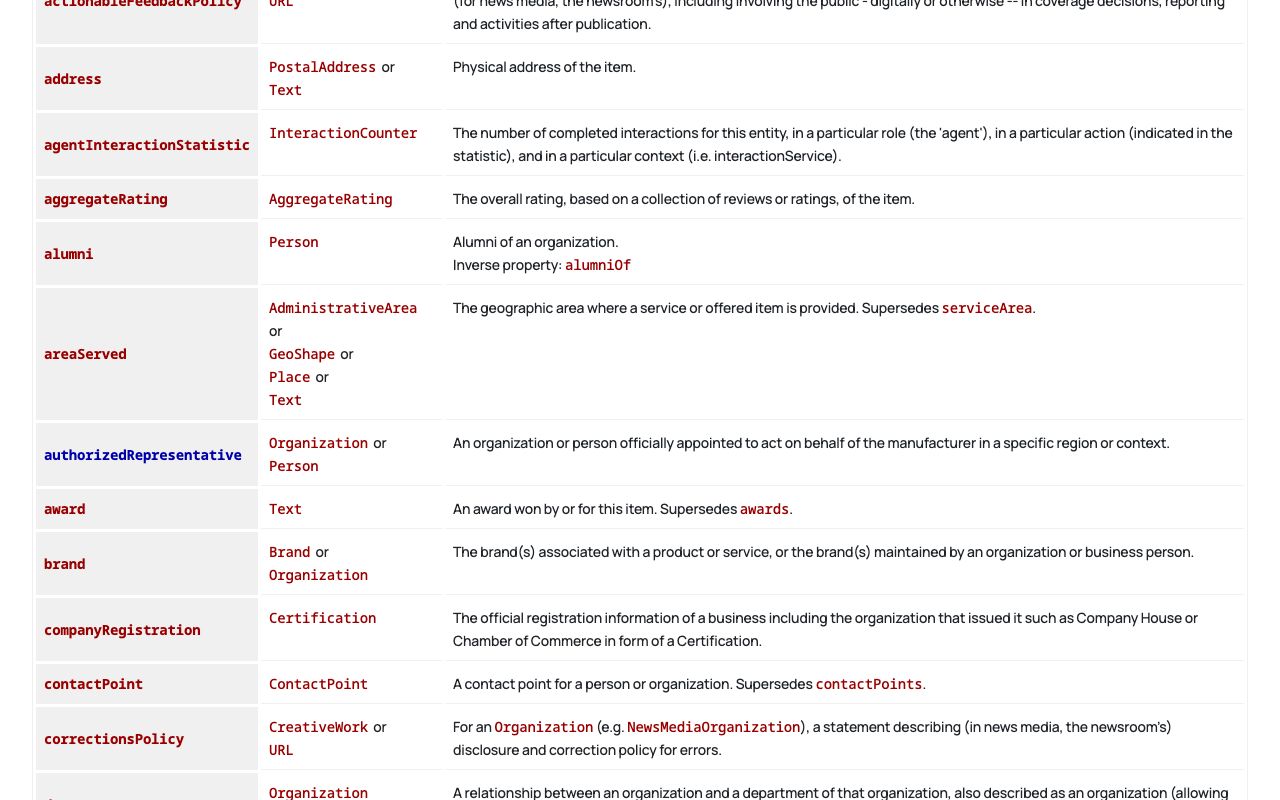
- Add Organization markup with name, url, logo, description and sameAs links to every profile from step three, following Google's Organization structured data guide, and validate it with the schema markup checker. Skip the Wikipedia article unless you clear Wikipedia's notability guideline for companies.
Why Does ChatGPT Know My Brand but Not My Category? (Case 2)
Symptom: "What is [Brand]?" comes back accurate, but "best [category] tools" never includes you, and "Is [Brand] a [category] tool?" gets a hedge such as "it appears to offer some features in that area".
Root cause: nobody, including you, has put the brand and the category noun in the same sentence often enough. Homepages written for differentiation ("the operating system for modern revenue teams") avoid the plain category word on purpose, and models learn categories from co-occurrence, so the avoidance works against you.
Fix, in order of leverage:
- Put the plain category noun in your title tag, H1 and first paragraph: "[Brand]: [category] software for [audience]". Keep the clever line as the subhead.
- Claim the right category on G2, Capterra and Product Hunt, and publish honest "[Brand] vs [Rival]" pages. Both force the association and give retrieval a page to quote.
- Get into two or three third-party "best [category]" round-ups. One paragraph naming you inside the category outweighs ten pages of your own copy.
Why Does ChatGPT Recommend Competitors but Not Your Brand? (Case 3)
This is the most common case and the one behind the question "why does ChatGPT recommend my competitors". Symptom: ChatGPT accepts you as an option when asked by name, but every open prompt like "recommend a [category] for a 20-person team" produces the same three or four rivals.
Root cause: recommendation answers are assembled from a small set of consensus sources, and your competitors own them. Ahrefs' analysis of ChatGPT citations (published September 2, 2026) puts reddit.com at 16.8% of citation share, en.wikipedia.org at 7.0% and consumerreports.org at 3.7%, with Forbes, Healthline and YouTube also in the top ten. Semrush's 13-week study of 230K prompts (published November 10, 2025) found that before September 2025 ChatGPT "cited Wikipedia and Reddit about five times as much as the next most-cited domains". If the threads, review-site category pages and listicles for your category all discuss the same four brands, the model has no material from which to recommend a fifth.
Kairosy's scan of Roomer shows the pattern in numbers: 88% visibility but a 13% recommend rate, with Booking.com at 10% share of voice and Expedia at 6%, and the report's summary calls the brand "invisible to AI buyers, not badmouthed" (Roomer report). Known, in the category, never the pick.
Fix: work the sources, not the model.
- Collect the citation URLs behind the recommendation prompts that matter to you. A ChatGPT brand monitoring scan lists them under every answer; manually, open the sources panel on five runs and copy them out.
- Rank those URLs by how often they recur. Usually five to ten pages carry the whole category, and those are your targets, not "the internet".
- For review sites, aim for 20 to 30 recent, specific reviews on the category page being cited. For forum threads, answer as the vendor, with disclosure, in threads already cited. For listicles, pitch the author with one genuine differentiator and a screenshot.
- On your own site, publish use-case pages with numbers in them. The Princeton GEO paper (arXiv, revised June 2024) reported that its content methods "can boost visibility by up to 40% in generative engine responses", with added statistics, quotations and source citations among the strongest.
The longer version of this workflow, including how to size each gap, is in how to analyze citation gaps in AI search.
Why Does ChatGPT Cite My Website Without Naming My Brand? (Case 4)
Symptom: your domain sits in the sources list under the answer, but the prose credits "industry guides", "experts" or a rival. You did the work and got footnoted, not recommended.
Root cause: the cited page is a generic reference. A glossary entry or how-to article is what retrieval loves and what never makes the model say your name, because the lifted passage contains no brand-and-category statement. Often the brand lives only in the logo image and the footer, which a text extractor never sees.
Fix:
- Put "[Brand] is a [category] that ..." inside the first 100 words of every page that earns citations, as plain text.
- Give informational pages a named author and an "About [Brand]" block near the section that gets quoted, marked up with Organization and Person schema.
- Add a short "how [Brand] handles this" section with a concrete number, so the extracted passage carries the name. Then run the AI-Ready Page Audit on the URL: its citability and trust dimensions flag missing entity statements and author signals, and the "since your last audit" diff shows whether the rewrite landed.
Why Does My Brand Show Up in ChatGPT Only Some of the Time? (Case 5)
Symptom: you appear in one run and vanish in the next, or show on Perplexity but not ChatGPT. Teams misread this as "we fixed it" on Monday and "it broke" on Thursday.
Root cause: recommendation lists are non-deterministic, and you are a marginal candidate. SparkToro and Gumshoe ran 2,961 prompt runs across ChatGPT, Claude and Google's AI (published January 28, 2026) and found "a <1 in 100 chance that ChatGPT or Google's AI, if asked 100X, will give you the same list of brands in any two responses". Established brands still surfaced reliably inside that noise: in headphone prompts, Bose, Sony, Sennheiser and Apple "showed up 55-77% of the time". The list is random; the strong candidates are not.
Conductor's study (published July 17, 2026; 14,000 API calls across ChatGPT, Perplexity, Claude and Gemini; 50 stateless runs per prompt) measured how much the set of named brands overlaps between two runs of the same prompt, by intent:
| Prompt intent | Brand overlap between two runs |
|---|---|
| Purchase | 40% |
| Support | 47% |
| Navigation | 47% |
| Recommendations | 49% |
| Pricing | 58% |
| Education | 60% |
| Comparison | 63% |
Source: Conductor, AI Brand Recommendation Study, July 17, 2026. The same study reports 91% lead-brand stability for comparison prompts and 72% for recommendation prompts.
Fix:
- Stop judging single runs. Use mention rate, the share of runs across a fixed prompt set that name you, with five runs per prompt as the floor, tracked per engine and per market.
- Raise signal density instead of adding new signal types: more reviews on the page already cited, more answers in the community already cited, fresh dates on the articles already cited. Density moves a marginal candidate into the reliable tier.
- Put the prompts on a schedule. Kairosy's Prompts module checks tracked prompts every day on paid plans and charts the mention rate, so instability shows up as a line instead of an argument. The mechanics are in how AI prompt tracking works.
How Do You Prove the Fix Worked and Keep It Working?
Every case ends the same way: rerun the confirming prompt on the same engine at least five times and compare with your baseline. Case 1 is fixed when "What is [Brand]?" returns your canonical description with search off and on; Case 2 when "Is [Brand] a [category]?" returns a plain yes; Case 3 when mention rate on open prompts rises, usually as a step change after a targeted source is updated; Case 4 when the cited passage carries your name; Case 5 when mention rate holds above your threshold for four consecutive weekly checks.
If you want the loop to run itself: Kairosy re-scans every tracked brand each Monday, emails the digest, and alerts on score drops, an engine flipping sentiment, new negative keywords, and a competitor becoming the preferred pick. Each report ends in a Fix Plan that orders the actions by impact. The 7-day trial needs no credit card and produces full reports; details are on the AI brand monitoring page.
Why Is My Brand Not Showing Up in ChatGPT FAQs
Why is my brand not showing up in ChatGPT answers even though I rank on Google?
Ranking first for your category keyword does not put you into the Reddit threads, review-site category pages or listicles from which recommendation answers are built. Start with Case 3.
Why is my brand not showing up in ChatGPT responses when web search is off?
With search off, ChatGPT can only draw on training data, so a brand launched after the data cutoff, or with a thin third-party footprint at the time, will not appear. Search on is the near-term route; a stronger entity footprint is the long-term one.
How long does it take for a brand to appear in ChatGPT after fixing the cause?
Search-driven cases (1, 3 and 4) can change within days of a cited page being updated or a crawl block being removed, because retrieval reads the live web. Training-driven recognition changes only when a new model version ships, so plan in quarters for that part.
Does blocking GPTBot stop my brand from showing up in ChatGPT?
Not by itself. In OpenAI's crawler documentation, GPTBot feeds training while OAI-SearchBot feeds ChatGPT search, so blocking only GPTBot leaves search unaffected. Blocking both, or blocking every unknown bot at the CDN, is what removes you from search results.
Why does ChatGPT recommend my competitors even when I include my brand in the prompt?
That is a rejected answer, not a missing one: the model resolved you, weighed you against the consensus sources and preferred a rival. Read the reasons it gives, trace each to its source, and repair the source.
See what AI says about your brand
Run a free scan across ChatGPT, Gemini, Claude & Perplexity in about 30 seconds.
Run my free scan